

A serial mediation model of social media addiction and college students' academic engagement: the role of sleep quality and fatigue
Open accessPublished version of a preprint
The DOI matches its Crossref record; 107 of the 107 references it cites were found in a registry or an index; 12 of the 51 sources its claims cite were checked for support.
Abstract
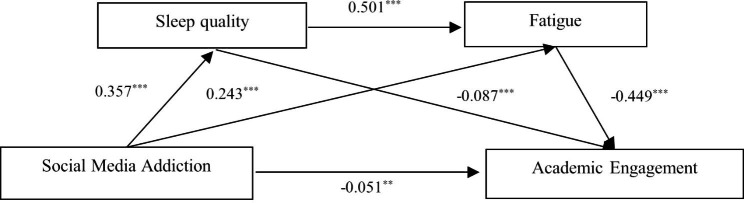
BACKGROUND: It has been documented that social media addiction (SMA) has a detrimental effect on college students' academic engagement. However, the mechanisms underlying this association are not well understood. This study aimed to determine the serial mediation effects of sleep quality and fatigue on the relationship between SMA and academic engagement among college students. METHODS: A cross-sectional survey was conducted with 2661 college students (43.3% males, mean age = 19.97 years). The participants completed the Bergen Social Media Addiction Scale, the Utrecht Student Work Engagement Scale for Students, the Pittsburgh Sleep Quality Index, and the Fatigue Assessment Scale. The serial mediation effects were examined using Model 6 in the Hayes' PROCESS macro for SPSS. RESULTS: The results showed that SMA among college students had a direct negative relationship with their academic engagement (Effect = - 0.051, 95% CI: -0.087 to - 0.015). In addition, sleep quality and fatigue mediated the relationship between SMA and academic engagement both independent and serially, with the independent mediation effect of sleep quality being - 0.031 (95% CI: -0.048 to - 0.016), the independent mediation effect of fatigue being - 0.109 (95% CI: -0.133 to - 0.088), and the serial mediation effect of sleep quality and fatigue being - 0.080 (95% CI: -0.095 to - 0.066). The total indirect effect of the three mediation paths was 80.9%. CONCLUSIONS: Decreased academic engagement caused by SMA can be aggravated by poor sleep quality and fatigue. Strengthening supervision and intervention in social media use among college students, supplemented by attention to psychosomatic health, including sleep quality and fatigue could promote their engagement in academic work.
Overview
CoChat Summary
TL;DR
This cross-sectional study tested whether sleep quality and fatigue serially mediate the relationship between social media addiction (SMA) and academic engagement among Chinese college students. It found that SMA was directly negatively associated with academic engagement, and that sleep quality and fatigue mediated this association both independently and sequentially.
Key findings
- SMA had a direct negative relationship with academic engagement (Effect = −0.051, 95% CI: −0.087 to −0.015).
- Sleep quality and fatigue mediated the SMA–academic engagement relationship independently and serially: sleep quality effect = −0.031 (95% CI: −0.048 to −0.016); fatigue effect = −0.109 (95% CI: −0.133 to −0.088); serial sleep quality–fatigue effect = −0.080 (95% CI: −0.095 to −0.066). The total indirect effect was −0.220, accounting for 80.9% of the total effect.
- SMA was positively correlated with poor sleep quality (r = 0.357, p < 0.001) and fatigue (r = 0.417, p < 0.001), and negatively correlated with academic engagement (r = −0.270, p < 0.001). Poor sleep quality was positively correlated with fatigue (r = 0.589, p < 0.001) and negatively correlated with academic engagement (r = −0.371, p < 0.001); fatigue was negatively correlated with academic engagement (r = −0.523, p < 0.001).
- According to the BSMAS, 4.1% of participants were classified as having SMA.
Methods
- Cross-sectional convenience sample from a university in Nantong, Jiangsu, China, conducted November 2020 to January 2021. Of 2,947 surveyed students, 2,661 were included after data cleaning (efficiency rate 90.3%); 43.3% were male, mean age = 19.97 ± 1.253 years.
- Measures included the Bergen Social Media Addiction Scale (BSMAS), Utrecht Work Engagement Scale-student (UWES-9 S), Pittsburgh Sleep Quality Index (PSQI), and Fatigue Assessment Scale (FAS), plus gender, age, academic major, and average daily social media use.
- Analyses used Pearson correlations and Model 6 in the Hayes PROCESS macro for SPSS to test serial mediation, with 5,000 bootstrap resamples and 95% confidence intervals; gender, age, and academic major were controlled. Harman single-factor test and VIF diagnostics were used for common method bias and multicollinearity.
Limitations
- The paper states that the cross-sectional design prevents establishing causality; that the single-university sample in Nantong limits generalizability; and that self-administered questionnaires may introduce subjective bias.
- Evident from the text: the convenience sampling and single-site design further constrain representativeness, and all key variables were self-reported, although the Harman single-factor test indicated no serious common method bias.
Model-written summary. Check it against the paper before relying on it.
Integrity signals
Registry
Cites
Statistics
Figures
Verification
Claims the paper makes
10 Valid · 0 Not valid · 30 Not checked · 40 Own results and interpretations
The cited sources support only part of this claim — read each source’s verdict below.
In the paper
“These findings support the notion that sleep quality are antecedents of fatigue.”
- Also stated in: § The serial mediating role of sleep quality and fatigue · plain
“Fatigue is due to sleep deprivation [43], and insomnia is associated with significantly higher levels of fatigue than in those who are not diagnosed with insomnia [44]. Prospective daily diary studies also found that subjective sleep quality plays a key role in predicting self-reported daytime fatigue [45, 46].”
§ A serial mediation model of social media addiction and college students’ academic engagement: the role of sleep quality and fatigue > Background > The serial mediating role of sleep quality and fatigue
What the sources say
- Partly supportedcites [43] Fortier-Brochu É Beaulieu-Bonneau S Ivers H Relations between sleep, fatigue, and health-related quality of life in individuals with insomnia J Psychosom Res 2010 69 5 475 83 10.1016/j.jpsychores.2010.05.005 20955867 PMC2958173 sourceExperimental — accuracy not yet measured
The Discussion (page unavailable) says subjective sleep quality predicted fatigue in individuals with insomnia, supporting an association. But the paper does not establish that sleep quality temporally precedes or causes fatigue; the Introduction notes that daytime tiredness may itself influence subjective sleep ratings. (LLM, conf=0.86)
- Partly supportedcites [44] Buysse DJ Thompson W Scott J Daytime symptoms in primary insomnia: a prospective analysis using ecological momentary assessment Sleep Med 2007 8 3 198 208 10.1016/j.sleep.2006.10.006 17368098 PMC1899354 sourceExperimental — accuracy not yet measured
The Results report that sleepiness/fatigue correlated with sleep-quality measures in patients with primary insomnia. But the Discussion says determining whether sleep predicts subsequent daytime symptoms, or the reverse, requires future analysis. The paper supports an association, not the claim that sleep quality is an antecedent of fatigue. (LLM, conf=0.88)
- Not checked — no full text of the sourcecites [45] Harris AL, Carmona NE, Moss TG, et al. Testing the contiguity of the sleep and fatigue relationship: a daily diary study. Sleep. 2021;44(5). 10.1093/sleep/zsaa252. 33245330 source
- Not checked — no full text of the sourcecites [46] Russell C Wearden AJ Fairclough G Subjective but not actigraphy-defined Sleep predicts next-day fatigue in chronic fatigue syndrome: a prospective Daily Diary Study Sleep 2016 39 4 937 44 10.5665/sleep.5658 26715232 PMC4791627 source
plainstates a cause- Asserted: passes — The authors put it forward as true.
- Checkable: passes — It can be checked against evidence.
- Load-bearing: passes — The paper’s conclusions depend on it.
- Based: passes — The paper gives a reason why it holds.
- Also stated in: § The serial mediating role of sleep quality and fatigue · plain
Every source the paper cites for this claim was checked and supports it.
In the paper
“A study conducted among Moroccan university students found higher levels of mental and physical fatigue in students with Internet addiction than in those without Internet addiction [37].”
§ A serial mediation model of social media addiction and college students’ academic engagement: the role of sleep quality and fatigue > Background > The mediating role of fatigue
What the sources say
- Supportedcites [37] Bachleda C Darhiri L Internet addiction and Mental and physical fatigue Int Technol Manage Rev 2018 7 1 25 10.2991/itmr.7.1.3 source
The Discussion reports that students with Internet addiction had significantly more physical and mental fatigue than students without it. The Method identifies the sample as Moroccan university students. (LLM, conf=0.95)
plainstates an association- Asserted: passes — The authors put it forward as true.
- Checkable: passes — It can be checked against evidence.
- Load-bearing: passes — The paper’s conclusions depend on it.
- Based: passes — The paper gives a reason why it holds.
- Supported
The cited sources support only part of this claim — read each source’s verdict below.
In the paper
“Numerous studies have reported a strong association between social network sites use and poorer sleep quality among young adults [20–22].”
§ A serial mediation model of social media addiction and college students’ academic engagement: the role of sleep quality and fatigue > Background > SMA and academic engagement
What the sources say
- Supportedcites [20] Levenson JC Shensa A Sidani JE The association between social media use and sleep disturbance among young adults Prev Med 2016 85 36 41 10.1016/j.ypmed.2016.01.001 26791323 PMC4857587 source
The Discussion reports consistent, substantial associations between social media use and sleep disturbance among U.S. young adults aged 19–32. This supports the citing sentence’s claim of a strong association with poorer sleep, though the study does not establish causation. (LLM, conf=0.93)
- Not checked — no full text of the sourcecites [21] Alonzo R Hussain J Stranges S Interplay between social media use, sleep quality, and mental health in youth: a systematic review Sleep Med Rev 2021 56 101414 10.1016/j.smrv.2020.101414 33385767 source
- Partly supportedcites [22] Woods HC Scott H #Sleepyteens Social media use in adolescence is associated with poor sleep quality, anxiety, depression and low self-esteem J Adolesc 2016 51 41 9 10.1016/j.adolescence.2016.05.008 27294324 sourceExperimental — accuracy not yet measured
The Discussion (p. 14) reports that greater social media use was associated with poorer sleep quality. The study examined adolescents, however, so it does not directly establish the association among young adults as the citing sentence states. (LLM, conf=0.86)
boostedstates an association- Asserted: passes — The authors put it forward as true.
- Checkable: passes — It can be checked against evidence.
- Load-bearing: passes — The paper’s conclusions depend on it.
- Based: passes — The paper gives a reason why it holds.
- Supported
The cited sources support only part of this claim — read each source’s verdict below.
In the paper
“SMA has been reported to have negative effects on students’ learning, such as distraction, severe procrastination, and decreased academic productivity [10, 11].”
§ A serial mediation model of social media addiction and college students’ academic engagement: the role of sleep quality and fatigue > Background
What the sources say
- Partly supportedcites [10] Walsh JL Fielder RL Carey KB Female College Students’ Media Use and Academic Outcomes: results from a Longitudinal Cohort Study Emerg Adulthood 2013 1 3 219 32 10.1177/2167696813479780 24505554 PMC3911790 sourceExperimental — accuracy not yet measured
The Discussion (page unavailable) says social networking may distract students from academics and reports an indirect association with GPA through academic behaviors and problems affecting schoolwork. The paper studies social-networking use, not social media addiction (SMA), and does not establish severe procrastination or decreased academic productivity as effects. Its findings are primarily associations, rather than proof of causation. (LLM, conf=0.86)
- Not checked — no full text of the sourcecites [11] Kirschner PA Karpinski AC Facebook® and academic performance Comput Hum Behav 2010 26 6 1237 45 10.1016/j.chb.2010.03.024 source
plainstates a cause- Asserted: passes — The authors put it forward as true.
- Checkable: passes — It can be checked against evidence.
- Load-bearing: passes — The paper’s conclusions depend on it.
- Based: passes — The paper gives a reason why it holds.
- Partly supported
Every source the paper cites for this claim was checked and supports it.
In the paper
“Therefore, excessive brain activity and stimulation can cause mental fatigue, akin to physical fatigue, making uncomplicated tasks increasingly difficult or even impossible [77].”
§ A serial mediation model of social media addiction and college students’ academic engagement: the role of sleep quality and fatigue > Discussion > SMA and academic engagement
What the sources say
- Supportedcites [77] Li G, Huang S, Xu W, et al. The impact of mental fatigue on brain activity: a comparative study both in resting state and task state using EEG. BMC Neurosci. 2020;21(1). 10.1186/s12868-020-00569-1. PMC7216620 32398004 source
The Background passage states that too much brain activity and stimulation can cause mental exhaustion akin to physical fatigue, and that mental fatigue can make uncomplicated tasks increasingly difficult or impossible. This directly supports the attributed paraphrase. (LLM, conf=0.95)
plainstates a cause- Asserted: passes — The authors put it forward as true.
- Checkable: passes — It can be checked against evidence.
- Load-bearing: passes — The paper’s conclusions depend on it.
- Based: passes — The paper gives a reason why it holds.
- Supported
40 more claims · 1 with their cited sources checked
Create a free account to see all 80 claims and to verify the 8 references still open.
- It may state two separate claims as one. 18
- Probably not a substantial claim. 20
- The quote only partly states this claim. 1
Claims other papers make about this one
Each is checked against this paper’s own text: does it say what the citing paper says it does?
The source backs part of the claim, not all of it — or backs it for a different population, condition or comparison.
In the citing paper
“Sleep quality plays a role in mediating SMA, anxiety and depression [78].”
From Correlations between social media addiction and anxiety, depression, FoMO, loneliness and self-esteem among students: A systematic review and meta-analysis (2025) · cites this paper as [78]
Experimental — accuracy not yet measuredThe source backs part of the claim, not all of it — or backs it for a different population, condition or comparison.
In the citing paper
“Social media addiction appears to weaken study discipline beyond its effect through procrastination.”
From Unraveling the Digital Distraction in the Context of Theory of Planned Behaviour: The Impact of Social Media Addiction on Academic Procrastination and Study Habits Among Undergraduate Students (2025) · cites this paper as Zhuang et al., 2023
Experimental — accuracy not yet measured
Citations
Cites
Podsakoff, P. M., MacKenzie, S. B., Lee, J.-Y., & Podsakoff, N. P. (2003) · Journal of Applied Psychology · doi:10.1037/0021-9010.88.5.879 · Cited by 82,194
Ryan, R. M., & Deci, E. L. (2000) · American Psychologist · doi:10.1037//0003-066x.55.1.68 · Cited by 54,599
(2013) · Cited by 44,563
The Pittsburgh Sleep Quality Index: a new instrument for psychiatric practice and research
Buysse, D. J., Reynolds, C. F., Monk, T. H., Berman, S. R., & Kupfer, D. J. (1989) · Psychiatry Research · doi:10.1016/0165-1781(89)90047-4 · Cited by 35,234
Diagnostic and Statistical Manual of Mental Disorders
(2012) · SpringerReference · doi:10.1007/springerreference_121117 · Cited by 20,570
Multivariate data analysis : a global perspective
Hair, J. F. (2010) · Cited by 20,126
Users of the world, unite! The challenges and opportunities of Social Media
Kaplan, A. M., & Haenlein, M. (2010) · Business Horizons · doi:10.1016/j.bushor.2009.09.003 · Cited by 17,875 · cited 1×
“0 for users to communicate and share information [2].”
Background(1998) · DigitalCommons - Kennesaw State University (Kennesaw State University) · Cited by 13,997
School Engagement: Potential of the Concept, State of the Evidence
Fredricks, J. A., Blumenfeld, P. C., & Paris, A. H. (2004) · Review of Educational Research · doi:10.3102/00346543074001059 · Cited by 12,581
The measurement of engagement and burnout: a two sample confirmatory factor analytic approach.
Schaufeli, W. B., Salanova, M., González-romá, V., & Bakker, A. B. (2002) · Journal of Happiness Studies · doi:10.1023/a:1015630930326 · Cited by 10,014 · cited 1×
“SMA and academic engagement Academic engagement is a positive and fulfilling mental state related to learning, that is embodied in the planning and practical actions of students in the learning process and is characterized by vitality, dedication and concentration [12].”
Background
Research works printed but not linked: 1
- Csikszentmihalyi M Flow The psychology of optimal experience 2008 New York HarperCollins
Cited by
Meng, S., Zhang, Y., Tang, L., Zhang, M., Tang, W., Onyebuchi, N., Han, Y., Han, S., Li, B., Tong, W., et al. (2024) · BMC Psychology · doi:10.1186/s40359-024-01899-z · Cited by 49
“The university stage is an essential transition period in life development, adequate or quality sleep is the foundation guarantee for life normality and study, but poor sleep behavior and habits will have many adverse effects on their sleep, body, and mind [13, 14].”
BackgroundJing, Z., Yang, W., Lei, Z., Junmei, W., Hui, L., & Tianmin, Z. (2025) · PLOS One · doi:10.1371/journal.pone.0329466 · Cited by 33
“Sleep quality plays a role in mediating SMA, anxiety and depression [78].”
Zhao, C., He, J., Xu, H., Zhang, J., Zhang, G., & Yu, G. (2023) · Addictive Behaviors · doi:10.1016/j.addbeh.2023.107906 · Cited by 21
Lu, H., Ren, Z., Zhen, P., Su, Z. W., & Wu, Y. (2025) · Addictive Behaviors · doi:10.1016/j.addbeh.2025.108337 · Cited by 18
Qi, X., Jiang, Y., & Lian, R. (2024) · BMC Psychology · doi:10.1186/s40359-024-01621-z · Cited by 28
Qin, X., Liu, L., Yan, Y., Guo, X., Yang, N., & Li, L. (2025) · Frontiers in Public Health · doi:10.3389/fpubh.2025.1512812 · Cited by 20
“(22).”
Che, X., Lu, Z., & Jin, Y. (2025) · Scientific Reports · doi:10.1038/s41598-025-11225-1 · Cited by 19
Rudnik, A. A., Sobczak, K., Sawicki, A. J., & Zdun‐Ryżewska, A. (2025) · PLoS ONE · doi:10.1371/journal.pone.0321946 · Cited by 11
“It is often reported as a common issue that affects concentration, motivation, and academic engagement [11,12].”
Kong, W., Li, Y., Luo, A., & Xie, W. (2024) · Journal of Medical Internet Research · doi:10.2196/48026 · Cited by 11
“In addition, SMA can make students less engaged in learning, affect their academic performance [18], distract workers and lead to lower work efficiency, and make them face difficulties in career [19].”
Ren, Z., Lu, H. J., Zheng, P., Lu, H., Su, Z., Huang, Z., & Wu, Y. (2025) · Addictive Behaviors · doi:10.1016/j.addbeh.2025.108515 · Cited by 13
Fuentes Chavez, S. E., Vera-Calmet, V. G., Aguilar-Armas, H. M., Yglesias Alva, L. A., Arbulú Ballesteros, M. A., & Alegria Silva, C. E. (2025) · Healthcare · doi:10.3390/healthcare13091072 · Cited by 8
“Social media addiction has a significant effect on irrational procrastination [4,7–10].”
Prolonged theoretical classes impact students’ perceptions: an observational study
Kotnik, P., Roelands, B., & Bogataj, Š. (2024) · Frontiers in Psychology · doi:10.3389/fpsyg.2024.1278396 · Cited by 22
Ji, W., Ding, L., Li, X., Wu, Y., & 李海燕 (2026) · Addictive Behaviors · doi:10.1016/j.addbeh.2026.108640 · Cited by 9
A Scoping Review of the Use and Determinants of Social Media Among College Students
Fatima, A., Akhter, M. S., Kanekar, A. S., Roy, S., Mitra, R., Imade, B., & Sharma, M. (2025) · Healthcare · doi:10.3390/healthcare13172234 · Cited by 29
Contrasting and Predicting Social Media’s Role in Addictive Use and Well-Being
Cemiloglu, D., Babiker, A., Alshakhsi, S. A. A., Naiseh, M., Al‐Thani, D., & Ali, R. (2025) · Journal of Technology in Behavioral Science · doi:10.1007/s41347-025-00527-w · Cited by 10
“Despite the growing emphasis on considering usage intentions and contextual factors (Brailovskaia et al., 2020; Zhuang et al., 2023), this study reaffirms that time spent online remains a key predictor of PSMU, consistent with findings linking high Instagram and TikTok usage to PSMU (Hendrikse &…”
Cai, Y., Wei, E., & Cai, X. (2024) · PLoS ONE · doi:10.1371/journal.pone.0307042 · Cited by 7
Khalaf, M. A., Omar, A. I., Abdulle, A. W., & Mohamud, M. A. (2025) · Frontiers in Education · doi:10.3389/feduc.2025.1614746 · Cited by 16
Wang, X., Wang, Y., Yang, S., Li, Z., & Fu, C. (2025) · Frontiers in Psychiatry · doi:10.3389/fpsyt.2025.1608527 · Cited by 17
“This scale has been extensively used among Chinese college students and exhibited excellent reliability and validity (25).”
Yang, K., Tu, R., Xu, L., Gu, Y., Fan, Q., Yin, S., Yuan, Y., Chang, A., Wang, Y., Yin, C., et al. (2025) · Frontiers in Bioengineering and Biotechnology · doi:10.3389/fbioe.2025.1595671 · Cited by 6
“The 95% CI value was provided for the size of each effect, which did not include 0, indicating a signi fi cant moderating effect (Zhuang et al., 2023; Kim and Cha, 2022).”
Liu, P. L. (2025) · Chinese Journal of Communication · doi:10.1080/17544750.2024.2444652 · Cited by 7
“Zhuang et al. (2023) showed that sleep disorders can impair cognitive function by depleting cognitive resources and diminishing academic motivation.”
Peng, B. (2023) · Iranian Journal of Public Health · doi:10.18502/ijph.v52i11.14033 · Cited by 11
Kaya, B. (2025) · The Journal of Genetic Psychology · doi:10.1080/00221325.2025.2584991 · Cited by 11
Problematic TikTok use severity, self-control, and school engagement: A one-year longitudinal study
Liu, Q., Zhang, C., Yang, Z., & Xu, X.-P. (2025) · Cyberpsychology Journal of Psychosocial Research on Cyberspace · doi:10.5817/cp2025-3-5 · Cited by 17
Wiedemann, H., Lüdecke, D., Thomasius, R., & Paschke, K. (2026) · Computers in Human Behavior Reports · doi:10.1016/j.chbr.2026.100958 · Cited by 9
Ma, L., & Li, G. (2026) · SAGE Open · doi:10.1177/21582440261416068 · Cited by 9
“It reflects students’ enthusiasm and level of participation in the learning process, characterized by vigor, dedication, and absorption—emphasizing energetic involvement, identification with tasks, and immersion in the academic experience (Y. J. Ma et al., 2023; Zhuang et al., 2023).”
Ranjbar, P., Khosrojavid, M., & Shal, R. S. (2025) · Journal of Human Behavior in the Social Environment · doi:10.1080/10911359.2025.2507147 · Cited by 6
Lin, T.-H., Yin, X., & Liu, C. (2024) · Educational Psychology · doi:10.1080/01443410.2024.2410974 · Cited by 7
“…use of social media (Alinejad et al., 2022; Bloemen & de Coninck, 2020; duan et al., 2020). next, other studies have also reported a negative relationship between social media engagement and student learning (Adams et al., 2017; Junco & Cotten, 2012; Wood et al., 2012; Zhuang et al., 2023).”
Ali, M. H., & Abdulrazzaq, D. M. (2024) · Language Testing in Asia · doi:10.1186/s40468-024-00308-x · Cited by 6
“The outcomes of Zhuang et al. (2023), which depicted that support from family, friends, and instructors is positively related to study involvement, make this clear.”
BackgroundZhou, M., Gao, G., Rong, B., Zhao, H., Huang, J., Tu, N., Bu, L., Ling, X., & Wang, G. (2024) · Frontiers in Psychiatry · doi:10.3389/fpsyt.2024.1379259 · Cited by 6
The Effect of Social Media Addiction on Premenstruel Syndrome and Sleep Quality
Özşahin, Z., Santur, S. G., & Derya, Y. A. (2023) · Genel Tıp Dergisi · doi:10.54005/geneltip.1320345 · Cited by 7
Ning, Y., Wang, L., Chen, X., Lu, X., Gamble, J. H., Chen, X., Jiang, X.-Y., Chen, I., & Lin, P. (2025) · International Journal of Mental Health Promotion · doi:10.32604/ijmhp.2024.057750 · Cited by 4
“Excessive social media use has been associated with increased fatigue [69,70], which may exacerbate the negative impact of PG on resilience through increased fatigue.”
Zhang, S., Liu, R., Rao, F., Zhou, Q., & 熊群 (2026) · Frontiers in Public Health · doi:10.3389/fpubh.2026.1845627 · Cited by 2
“Sleep problems may simultaneously impair emotion regulation and increase reliance on smartphones, thereby influencing SE and learning engagement through partly parallel routes rather than a single, ordered chain (86).”
Zerrouk, D., Kassab, K., Asri, A. E., & Zarrouq, B. (2026) · BMC Psychology · doi:10.1186/s40359-026-04354-3 · Cited by 9
“Findings from studies by Zhuang et al. (2023) and Khalaf et al. (2025) indicated that SMA is associated with poorer sleep quality, which in turn negatively affects students’ AP or engagement [94, 95].”
Balcı, Ş., & Özben, K. (2025) · Anadolu Üniversitesi Sosyal Bilimler Dergisi · doi:10.18037/ausbd.1661095 · Cited by 5
Işıkgöz, M. E., Sezan, T., Yüksel, A., & Öztunç, M. (2025) · SAGE Open · doi:10.1177/21582440251376854 · Cited by 6
“This pattern suggests that reliance on social media not only undermines individual academic outcomes, but also disrupts the broader processes of social and academic integration in the university environment (Mou et al., 2024; Zhuang et al., 2023).”
Rawlings, G. H., Stark, A., Armstrong, I. J., Costin, V., & Thompson, A. R. (2025) · Pulmonary Circulation · doi:10.1002/pul2.70101 · Cited by 4
“Fatigue ‐ related symptoms can be debilitating in their own right but can also have a negative impact on different aspects of daily life [22].”
Daud, K. (2024) · JOURNAL OF DIGITAL LEARNING AND DISTANCE EDUCATION · doi:10.56778/jdlde.v3i7.374 · Cited by 4
“This hypothesis aligns with the findings of (Sümen & Evgin, 2021); (Zhuang et al., 2023), who reported that excessive social media use disrupts academic routines and leads to poorer grades.”
The impact of social media use on college students’ mental health: a narrative review
Li, C. (2026) · Frontiers in Public Health · doi:10.3389/fpubh.2026.1811098 · Cited by 4
“…of 13.9% for depressive symptoms, with social appearance anxiety, body-checking behaviors, and social media addiction significantly positively correlated with depressive symptoms, indicating that social media addiction is an important risk factor for depressive symptoms among college students (26).”
InfluentialThe Cognitive Cost of Brain Rot: Indirect Effects on Depression via Burnout, Stress, and Anxiety
Batmaz, H., Özsağır, C. B., & Şekkeli, H. A. (2026) · Psychological Reports · doi:10.1177/00332941261450856 · Cited by 2
Kim, G.-H., & Lim, Y.-J. (2026) · Archives of Psychiatric Nursing · doi:10.1016/j.apnu.2026.152097 · Cited by 1
Influencing factors and mediating mechanisms of job crafting in clinical nursing practice
Jia, W., Li, Y., Sun, J., Cui, Y., Su, M., Tang, P., Wang, Y., Hu, Y., Chang, W., & Wang, Y. (2025) · Frontiers in Public Health · doi:10.3389/fpubh.2025.1711339 · Cited by 3
Pamuk, M., Göktaş, E., & Aslan, A. (2025) · The Educational and Developmental Psychologist · doi:10.1080/20590776.2025.2597756 · Cited by 3
“PSMU has been shown to have a negative impact on adolescents’ academic progress, school attendance, and academic engagement (Demirci et al., 2020; Zhuang et al., 2023).”
Ademoyegun, A. B., Ibitoye, A. G., Afolabi, J. O., Awotidebe, T. O., & Mbada, C. E. (2025) · Journal of Contemporary Studies in Epidemiology and Public Health · doi:10.29333/jconseph/17215 · Cited by 1
“Generally, sleep is important for general well-being and is influenced by many interacting factors, including bio-psychosocial and environmental factors [11].”
Erbas, M. E., Ziehfreund, S., Biedermann, T., & Zink, A. (2025) · BMC Public Health · doi:10.1186/s12889-025-24401-9 · Cited by 4
“Given that this type of addiction can lead to poor sleep quality and fatigue [37] subsequently leading to stress—a potential trigger for psoria-sis— [3], efforts should be made to break this detrimental cycle.”
Monisha, V., Arulappan, G., Rajini, S., Sheeba, R., & Iswarya, R. (2025) · International Journal of Community Medicine and Public Health · doi:10.18203/2394-6040.ijcmph20252857 · Cited by 2
Rodríguez‐de‐Dios, I. (2025) · Lecture notes in educational technology · doi:10.1007/978-981-96-5658-5_79 · Cited by 1
Miran, I., & Suhermin, S. (2023) · International Conference of Business and Social Sciences · doi:10.24034/icobuss.v3i1.347 · Cited by 3
Hubungan Fear of Missing out dengan Social Media Addiction pada Pengguna Instagram
Salim, A., Jatnika, R., & Yudiana, W. (2023) · Jurnal Ilmu Siber dan Teknologi Digital · doi:10.35912/jisted.v2i1.2372 · Cited by 18
“Penggunaan media sosial yang berlebihan seringkali melibatkan penghabisan waktu lebih banyak dalam beraktivitas di media sosial untuk hiburan ketimbang untuk belajar (Zhuang et al., 2023).”
BackgroundDewi, F. I. R., Hutapea, B., Ernawati, E., Mulyawan, B., & Firmansyah, Y. (2026) · International Journal of Adolescence and Youth · doi:10.1080/02673843.2026.2727980
Ghori, A., & Alivi, M. A. (2026) · SN Social Sciences · doi:10.1007/s43545-026-01712-1
“Furthermore, these find - ings align with broader evidence highlighting how unmonitored digital habits are associated with degraded time management and academic engagement (Chen et al. 2021; Zhang et al. 2023; Zhuang et al. 2023).”
Huang, J., Shi, Y., Li, F., He, P., Liu, J., & Zhang, H. (2026) · Frontiers in Psychology · doi:10.3389/fpsyg.2026.1927919 · Cited by 1
“Zhuang et al. (2023) further noted that learning engagement itself is a key psychological resource for academic success, so excessive smartphone addiction depletes such resources and reduces learning involvement.”
Sanz-Martín, D., González-Valero, G., Caracuel-Cáliz, R. F., & Zurita-Ortega, F. (2026) · Psychological Reports · doi:10.1177/00332941261480098
Development and validation of the Digital Detox Need Assessment Scale among young adults
Sneha, D., Govarthini, R., & Yogeswarie, S. (2026) · Frontiers in Education · doi:10.3389/feduc.2026.1883421
Wandira, R., Na’imah, T., Wahidah, F. R. N., & Nur’aeni, N. (2026) · Journal of Education and Learning Reviews · doi:10.60027/jelr.2026.e3366
Sh, C., Chen, S., Bao, J., Chen, J. M., & Chen, H. (2026) · Journal of Children and Media · doi:10.1080/17482798.2026.2706711
Obesity and Keratoconus: A Mediation Study Based on the Chinese Keratoconus Cohort
Yang, K., Chang, A., Tu, R., Xu, L., Gu, Y., Fan, Q., Yin, S., Yuan, Y., Wang, Y., Yin, C., et al. (2026) · Translational Vision Science & Technology · doi:10.1167/tvst.15.6.39
Bhasa, M. P. (2026) · London Review of Education · doi:10.14324/lre.24.1.12 · Cited by 2
Orhan, B. E. (2026) · Behavioral Sciences · doi:10.3390/bs16060864 · Cited by 1
“…excessive and difficult-to-regulate use patterns that resemble behavioral addiction and are associated with psychosocial costs when online activity displaces sleep, academic/work routines, and in-person relationships (Shannon et al., 2022; Weinstein, 2023; Kolhar et al., 2021; Zhuang et al., 2023).”
Unveiling muscle fatigue: identifying key gene biomarkers and therapeutic targets
Zhang, Y., Zhang, Z., Chen, X., Dai, M., Zheng, Y., Zhang, W., & Li, F. (2026) · Molecular and Cellular Biochemistry · doi:10.1007/s11010-026-05570-6
Zhang, J. (2026) · British Journal of Educational Psychology · doi:10.1111/bjep.70083
Vlachopanou, P. (2026) · Current Psychology · doi:10.1007/s12144-026-09329-6
“Prior research has supported the use of mediation to explore these indirect pathways (Vlachopanou, 2026 ; Vlachopanou& Karagian - nopoulou 2023 ), and the utility of PROCESS Model 6 is well established in psychological research (Zhuang et al., 2023 ; Lemardelet & Caron, 2022).”
Xiong, M., Chen, Y., & Zhou, Y. (2026) · Frontiers in Psychology · doi:10.3389/fpsyg.2026.1782027 · Cited by 2
“Prior research supports the usefulness of serial mediation in capturing layered communication effects (Zhuang et al., 2023), particularly in contexts where persuasion unfolds through multiple psychological stages.”
Smartphone Addiction and Nursing Students' Learning Engagement: Insomnia and Self-Control Mediation
Guo, C., Zhang, C., Zhou, C., Gou, W., Huang, J., Liu, Y., Li, Y., Zhang, Y., & Liang, T. (2026) · Journal of Nursing Education · doi:10.3928/01484834-20260120-02 · Cited by 2
Zhou, X., Zhu, T., & Rau, P. P. (2026) · Current Psychology · doi:10.1007/s12144-026-09251-x
Tresna, I. C., & Hartini, S. (2026) · Research Square · doi:10.21203/rs.3.rs-8396588/v1
Flores, E., & Quillip, H. J. (2025) · Psychology and Education A Multidisciplinary Journal · doi:10.70838/pemj.500701
Farooq, Z., & Akhtar, N. (2025) · Marriage & Family Review · doi:10.1080/01494929.2025.2579780
“…and communication patterns serially mediated the association between MLOC and marital instability and quality, the serial mediational analysis with Bootstrapping method of Confidence Intervals was used to test multiple mediation pathways simultaneously (Yang et al., 2024; Zhuang et al., 2023).”
The impact of social media addiction on presleep arousal among adults: A cross-sectional study
Tural, E., Incekara, F., & Dayan, A. (2025) · Medicine · doi:10.1097/md.0000000000044707
“In a large-scale study conducted with 2661 college students in China [21] similar to our study, the use of the BSMAS showed that decreased academic engagement due to SMA could lead to worse sleep and increased fatigue.”
Foo, C. Y. A., & Chew, P. K. H. (2025) · Journal of Humanistic Psychology · doi:10.1177/00221678251354999 · Cited by 3
Liu, Y., & Bai, K. (2025) · Psychological Reports · doi:10.1177/00332941251340337 · Cited by 1
Lu, R., Zhao, S., JIANG, Y., Zhou, J., Juan, W. E. N., & Lingmin, H. U. (2025) · PSYCHOLOGIA · doi:10.2117/psysoc.2023-a223
Erbas, M. E., Ziehfreund, S., Biedermann, T. M., et al. (2024) · Research Square · doi:10.21203/rs.3.rs-4509319/v1
Meng, S., Zhang, Y., Tong, W., et al. (2024) · Research Square · doi:10.21203/rs.3.rs-4143727/v1
Industrial Strike’s Impact on Student’s Social Media Addiction Level
Abdullahi, O. A., Bahari, M., Miskon, S., Olatinwo, I. S., Mohammed, F. D., Ayinde, I. M., & Saliu, O. N. (2024) · International Journal of Academic Research in Business and Social Sciences · doi:10.6007/ijarbss/v14-i2/20686
Ruengesri, S., & Isaranon, Y. (2022) · Chula Digiverse · doi:10.58837/chula.the.2022.314 · Cited by 1
ÇİFTÇİ, H., HARMANDAR DEMİREL, D., & AKÇAKESE, A. (2025) · Journal of Education and Recreation Patterns · doi:10.53016/jerp.v6i2.305
Metadata
- Authors
- Zhuang, J., Mou, Q., Zheng, T., Gao, F., Zhong, Y., Lu, Q., Gao, Y., & Zhao, M.
- Affiliations
- Nantong University (CN)
- Corresponding author
- Gao, Yuexia
- Zhao, Miaomiao
- Venue
- BMC Psychiatry
- Published
- 2023-05-12
- Volume
- 23
- Issue
- 1
- Pages
- 333-333
- ISSN
- 1471-244X (ISSN-L)
- PMC
- PMC10176952
- OpenAlex
- W4376279181
- Semantic Scholar
- 92e03c644f117d165631f17eabb7da8332927a65
- Cited by
- 104
- References
- 79
- Citations by year
- 2026: 40 · 2025: 42 · 2024: 16 · 2023: 5
- FWCI
- 30.66
- Type
- journal article
- Language
- en
- Open access
- gold
- doi.org
- Licence
- cc-by
- creativecommons.org/licenses/by/4.0 (tdm)
- creativecommons.org/licenses/by/4.0 (vor)
- Locations
- BMC Psychiatry (publishedVersion, cc-by)
- Research Square (submittedVersion, cc-by)
- PubMed Central (publishedVersion, cc-by)
- PubMed (publishedVersion)
- DOAJ (DOAJ: Directory of Open Access Journals) (submittedVersion, cc-by-sa)
- Funders
- the Innovation Training Program for College Students in Jiangsu province (202010304104Y)
- the 14th Five Year Plan of Jiangsu Education Science (B/2021/01/74)
- National Natural Science Foundation of China (72004104)
- Topics
- Social Sciences › Sociology and Political Science › Impact of Technology on Adolescents
- Social Sciences › Psychology › Experimental and Cognitive Psychology › Sleep and related disorders
- Social Sciences › Psychology › Social Psychology › Workaholism, burnout, and well-being
- Keywords
- social media addiction, academic engagement, sleep quality, fatigue, university students, serial mediation, work engagement, psychosomatic health
- MeSH terms
- Internet Addiction Disorder, Sleep Quality, Adult, Cross-Sectional Studies, Fatigue, Female, Humans, Male, Students, Young Adult
About these checks
Registry, retraction, Cites and statistics results are computed, not judged, with one exception: a printed reference that no index lists is read once by a model before it counts as a citation error. Claims are extracted by a model and kept only when their quote appears verbatim in the text; each cited source is then checked, with a model’s help, for whether it says what the claim relies on. Those verdicts can be wrong — read the claim’s quote and the cited source before relying on one.
The claim verdicts this report counts are experimental: their accuracy is not yet measured.
A language model drew the claims from the paper on 2026-10-10, under version 3 of the claim definition (model deepseek-v4.1-flash, prompt extract-v3).
A second model labelled each claim on 2026-10-10 (model jev-1.13-20260917, definition revision gold-guideline-v0.2).
Cited sources are checked with a language model’s help (gpt-6-sol).
Statistics and arithmetic are recomputed, not judged.
Confidence bands are shown only for fields calibrated on our annotated test set. None is calibrated yet, so no band is shown.
What counts as a claim ›How we measure confidence ›How we check this ›
Are you an author, or do you see a problem with this page? Request a review
Data sources
Bibliographic data: Semantic Scholar, OpenAlex, Crossref.
Contains information from the Semantic Scholar Academic Graph Datasets, made available under the ODC Attribution License (ODC-BY 1.0).
Semantic Scholar’s data is described in: Kinney, R., et al. (2023). The Semantic Scholar Open Data Platform. arXiv:2301.10140.
