

A serial mediation model of social media addiction and college students' academic engagement: the role of sleep quality and fatigue
Open accessPublished version of a preprint
The DOI matches its Crossref record; 107 of the 107 references it cites were found in a registry or an index; 12 of the 51 sources its claims cite were checked for support.
Abstract
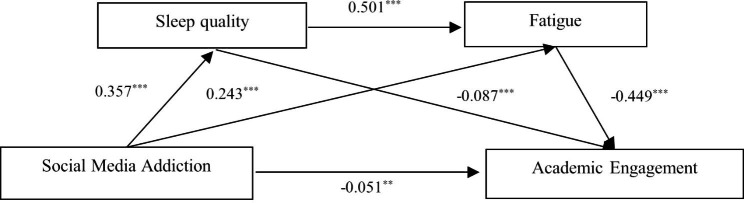
BACKGROUND: It has been documented that social media addiction (SMA) has a detrimental effect on college students' academic engagement. However, the mechanisms underlying this association are not well understood. This study aimed to determine the serial mediation effects of sleep quality and fatigue on the relationship between SMA and academic engagement among college students. METHODS: A cross-sectional survey was conducted with 2661 college students (43.3% males, mean age = 19.97 years). The participants completed the Bergen Social Media Addiction Scale, the Utrecht Student Work Engagement Scale for Students, the Pittsburgh Sleep Quality Index, and the Fatigue Assessment Scale. The serial mediation effects were examined using Model 6 in the Hayes' PROCESS macro for SPSS. RESULTS: The results showed that SMA among college students had a direct negative relationship with their academic engagement (Effect = - 0.051, 95% CI: -0.087 to - 0.015). In addition, sleep quality and fatigue mediated the relationship between SMA and academic engagement both independent and serially, with the independent mediation effect of sleep quality being - 0.031 (95% CI: -0.048 to - 0.016), the independent mediation effect of fatigue being - 0.109 (95% CI: -0.133 to - 0.088), and the serial mediation effect of sleep quality and fatigue being - 0.080 (95% CI: -0.095 to - 0.066). The total indirect effect of the three mediation paths was 80.9%. CONCLUSIONS: Decreased academic engagement caused by SMA can be aggravated by poor sleep quality and fatigue. Strengthening supervision and intervention in social media use among college students, supplemented by attention to psychosomatic health, including sleep quality and fatigue could promote their engagement in academic work.
Overview
CoChat Summary
TL;DR
This cross-sectional study tested whether sleep quality and fatigue serially mediate the relationship between social media addiction (SMA) and academic engagement among Chinese college students. It found that SMA was directly negatively associated with academic engagement, and that sleep quality and fatigue mediated this association both independently and sequentially.
Key findings
- SMA had a direct negative relationship with academic engagement (Effect = −0.051, 95% CI: −0.087 to −0.015).
- Sleep quality and fatigue mediated the SMA–academic engagement relationship independently and serially: sleep quality effect = −0.031 (95% CI: −0.048 to −0.016); fatigue effect = −0.109 (95% CI: −0.133 to −0.088); serial sleep quality–fatigue effect = −0.080 (95% CI: −0.095 to −0.066). The total indirect effect was −0.220, accounting for 80.9% of the total effect.
- SMA was positively correlated with poor sleep quality (r = 0.357, p < 0.001) and fatigue (r = 0.417, p < 0.001), and negatively correlated with academic engagement (r = −0.270, p < 0.001). Poor sleep quality was positively correlated with fatigue (r = 0.589, p < 0.001) and negatively correlated with academic engagement (r = −0.371, p < 0.001); fatigue was negatively correlated with academic engagement (r = −0.523, p < 0.001).
- According to the BSMAS, 4.1% of participants were classified as having SMA.
Methods
- Cross-sectional convenience sample from a university in Nantong, Jiangsu, China, conducted November 2020 to January 2021. Of 2,947 surveyed students, 2,661 were included after data cleaning (efficiency rate 90.3%); 43.3% were male, mean age = 19.97 ± 1.253 years.
- Measures included the Bergen Social Media Addiction Scale (BSMAS), Utrecht Work Engagement Scale-student (UWES-9 S), Pittsburgh Sleep Quality Index (PSQI), and Fatigue Assessment Scale (FAS), plus gender, age, academic major, and average daily social media use.
- Analyses used Pearson correlations and Model 6 in the Hayes PROCESS macro for SPSS to test serial mediation, with 5,000 bootstrap resamples and 95% confidence intervals; gender, age, and academic major were controlled. Harman single-factor test and VIF diagnostics were used for common method bias and multicollinearity.
Limitations
- The paper states that the cross-sectional design prevents establishing causality; that the single-university sample in Nantong limits generalizability; and that self-administered questionnaires may introduce subjective bias.
- Evident from the text: the convenience sampling and single-site design further constrain representativeness, and all key variables were self-reported, although the Harman single-factor test indicated no serious common method bias.
Model-written summary. Check it against the paper before relying on it.
Integrity signals
Registry
Cites
Statistics
Figures
Verification
Claims the paper makes
10 Valid · 0 Not valid · 30 Not checked · 40 Own results and interpretations
The cited sources support only part of this claim — read each source’s verdict below.
In the paper
“These findings support the notion that sleep quality are antecedents of fatigue.”
- Also stated in: § The serial mediating role of sleep quality and fatigue · plain
“Fatigue is due to sleep deprivation [43], and insomnia is associated with significantly higher levels of fatigue than in those who are not diagnosed with insomnia [44]. Prospective daily diary studies also found that subjective sleep quality plays a key role in predicting self-reported daytime fatigue [45, 46].”
§ A serial mediation model of social media addiction and college students’ academic engagement: the role of sleep quality and fatigue > Background > The serial mediating role of sleep quality and fatigue
What the sources say
- Partly supportedcites [43] Fortier-Brochu É Beaulieu-Bonneau S Ivers H Relations between sleep, fatigue, and health-related quality of life in individuals with insomnia J Psychosom Res 2010 69 5 475 83 10.1016/j.jpsychores.2010.05.005 20955867 PMC2958173 sourceExperimental — accuracy not yet measured
The Discussion (page unavailable) says subjective sleep quality predicted fatigue in individuals with insomnia, supporting an association. But the paper does not establish that sleep quality temporally precedes or causes fatigue; the Introduction notes that daytime tiredness may itself influence subjective sleep ratings. (LLM, conf=0.86)
- Partly supportedcites [44] Buysse DJ Thompson W Scott J Daytime symptoms in primary insomnia: a prospective analysis using ecological momentary assessment Sleep Med 2007 8 3 198 208 10.1016/j.sleep.2006.10.006 17368098 PMC1899354 sourceExperimental — accuracy not yet measured
The Results report that sleepiness/fatigue correlated with sleep-quality measures in patients with primary insomnia. But the Discussion says determining whether sleep predicts subsequent daytime symptoms, or the reverse, requires future analysis. The paper supports an association, not the claim that sleep quality is an antecedent of fatigue. (LLM, conf=0.88)
- Not checked — no full text of the sourcecites [45] Harris AL, Carmona NE, Moss TG, et al. Testing the contiguity of the sleep and fatigue relationship: a daily diary study. Sleep. 2021;44(5). 10.1093/sleep/zsaa252. 33245330 source
- Not checked — no full text of the sourcecites [46] Russell C Wearden AJ Fairclough G Subjective but not actigraphy-defined Sleep predicts next-day fatigue in chronic fatigue syndrome: a prospective Daily Diary Study Sleep 2016 39 4 937 44 10.5665/sleep.5658 26715232 PMC4791627 source
plainstates a cause- Asserted: passes — The authors put it forward as true.
- Checkable: passes — It can be checked against evidence.
- Load-bearing: passes — The paper’s conclusions depend on it.
- Based: passes — The paper gives a reason why it holds.
- Also stated in: § The serial mediating role of sleep quality and fatigue · plain
Every source the paper cites for this claim was checked and supports it.
In the paper
“A study conducted among Moroccan university students found higher levels of mental and physical fatigue in students with Internet addiction than in those without Internet addiction [37].”
§ A serial mediation model of social media addiction and college students’ academic engagement: the role of sleep quality and fatigue > Background > The mediating role of fatigue
What the sources say
- Supportedcites [37] Bachleda C Darhiri L Internet addiction and Mental and physical fatigue Int Technol Manage Rev 2018 7 1 25 10.2991/itmr.7.1.3 source
The Discussion reports that students with Internet addiction had significantly more physical and mental fatigue than students without it. The Method identifies the sample as Moroccan university students. (LLM, conf=0.95)
plainstates an association- Asserted: passes — The authors put it forward as true.
- Checkable: passes — It can be checked against evidence.
- Load-bearing: passes — The paper’s conclusions depend on it.
- Based: passes — The paper gives a reason why it holds.
- Supported
The cited sources support only part of this claim — read each source’s verdict below.
In the paper
“Numerous studies have reported a strong association between social network sites use and poorer sleep quality among young adults [20–22].”
§ A serial mediation model of social media addiction and college students’ academic engagement: the role of sleep quality and fatigue > Background > SMA and academic engagement
What the sources say
- Supportedcites [20] Levenson JC Shensa A Sidani JE The association between social media use and sleep disturbance among young adults Prev Med 2016 85 36 41 10.1016/j.ypmed.2016.01.001 26791323 PMC4857587 source
The Discussion reports consistent, substantial associations between social media use and sleep disturbance among U.S. young adults aged 19–32. This supports the citing sentence’s claim of a strong association with poorer sleep, though the study does not establish causation. (LLM, conf=0.93)
- Not checked — no full text of the sourcecites [21] Alonzo R Hussain J Stranges S Interplay between social media use, sleep quality, and mental health in youth: a systematic review Sleep Med Rev 2021 56 101414 10.1016/j.smrv.2020.101414 33385767 source
- Partly supportedcites [22] Woods HC Scott H #Sleepyteens Social media use in adolescence is associated with poor sleep quality, anxiety, depression and low self-esteem J Adolesc 2016 51 41 9 10.1016/j.adolescence.2016.05.008 27294324 sourceExperimental — accuracy not yet measured
The Discussion (p. 14) reports that greater social media use was associated with poorer sleep quality. The study examined adolescents, however, so it does not directly establish the association among young adults as the citing sentence states. (LLM, conf=0.86)
boostedstates an association- Asserted: passes — The authors put it forward as true.
- Checkable: passes — It can be checked against evidence.
- Load-bearing: passes — The paper’s conclusions depend on it.
- Based: passes — The paper gives a reason why it holds.
- Supported
The cited sources support only part of this claim — read each source’s verdict below.
In the paper
“SMA has been reported to have negative effects on students’ learning, such as distraction, severe procrastination, and decreased academic productivity [10, 11].”
§ A serial mediation model of social media addiction and college students’ academic engagement: the role of sleep quality and fatigue > Background
What the sources say
- Partly supportedcites [10] Walsh JL Fielder RL Carey KB Female College Students’ Media Use and Academic Outcomes: results from a Longitudinal Cohort Study Emerg Adulthood 2013 1 3 219 32 10.1177/2167696813479780 24505554 PMC3911790 sourceExperimental — accuracy not yet measured
The Discussion (page unavailable) says social networking may distract students from academics and reports an indirect association with GPA through academic behaviors and problems affecting schoolwork. The paper studies social-networking use, not social media addiction (SMA), and does not establish severe procrastination or decreased academic productivity as effects. Its findings are primarily associations, rather than proof of causation. (LLM, conf=0.86)
- Not checked — no full text of the sourcecites [11] Kirschner PA Karpinski AC Facebook® and academic performance Comput Hum Behav 2010 26 6 1237 45 10.1016/j.chb.2010.03.024 source
plainstates a cause- Asserted: passes — The authors put it forward as true.
- Checkable: passes — It can be checked against evidence.
- Load-bearing: passes — The paper’s conclusions depend on it.
- Based: passes — The paper gives a reason why it holds.
- Partly supported
Every source the paper cites for this claim was checked and supports it.
In the paper
“Therefore, excessive brain activity and stimulation can cause mental fatigue, akin to physical fatigue, making uncomplicated tasks increasingly difficult or even impossible [77].”
§ A serial mediation model of social media addiction and college students’ academic engagement: the role of sleep quality and fatigue > Discussion > SMA and academic engagement
What the sources say
- Supportedcites [77] Li G, Huang S, Xu W, et al. The impact of mental fatigue on brain activity: a comparative study both in resting state and task state using EEG. BMC Neurosci. 2020;21(1). 10.1186/s12868-020-00569-1. PMC7216620 32398004 source
The Background passage states that too much brain activity and stimulation can cause mental exhaustion akin to physical fatigue, and that mental fatigue can make uncomplicated tasks increasingly difficult or impossible. This directly supports the attributed paraphrase. (LLM, conf=0.95)
plainstates a cause- Asserted: passes — The authors put it forward as true.
- Checkable: passes — It can be checked against evidence.
- Load-bearing: passes — The paper’s conclusions depend on it.
- Based: passes — The paper gives a reason why it holds.
- Supported
40 more claims · 1 with their cited sources checked
Create a free account to see all 80 claims and to verify the 8 references still open.
- It may state two separate claims as one. 18
- Probably not a substantial claim. 20
- The quote only partly states this claim. 1
Claims other papers make about this one
Each is checked against this paper’s own text: does it say what the citing paper says it does?
The source backs part of the claim, not all of it — or backs it for a different population, condition or comparison.
In the citing paper
“Sleep quality plays a role in mediating SMA, anxiety and depression [78].”
From Correlations between social media addiction and anxiety, depression, FoMO, loneliness and self-esteem among students: A systematic review and meta-analysis (2025) · cites this paper as [78]
Experimental — accuracy not yet measuredThe source backs part of the claim, not all of it — or backs it for a different population, condition or comparison.
In the citing paper
“Social media addiction appears to weaken study discipline beyond its effect through procrastination.”
From Unraveling the Digital Distraction in the Context of Theory of Planned Behaviour: The Impact of Social Media Addiction on Academic Procrastination and Study Habits Among Undergraduate Students (2025) · cites this paper as Zhuang et al., 2023
Experimental — accuracy not yet measured
Citations
Cites
Podsakoff, P. M., MacKenzie, S. B., Lee, J.-Y., & Podsakoff, N. P. (2003) · Journal of Applied Psychology · doi:10.1037/0021-9010.88.5.879 · Cited by 82,194
Ryan, R. M., & Deci, E. L. (2000) · American Psychologist · doi:10.1037//0003-066x.55.1.68 · Cited by 54,599
(2013) · Cited by 44,563
The Pittsburgh Sleep Quality Index: a new instrument for psychiatric practice and research
Buysse, D. J., Reynolds, C. F., Monk, T. H., Berman, S. R., & Kupfer, D. J. (1989) · Psychiatry Research · doi:10.1016/0165-1781(89)90047-4 · Cited by 35,234
Diagnostic and Statistical Manual of Mental Disorders
(2012) · SpringerReference · doi:10.1007/springerreference_121117 · Cited by 20,570
Multivariate data analysis : a global perspective
Hair, J. F. (2010) · Cited by 20,126
Users of the world, unite! The challenges and opportunities of Social Media
Kaplan, A. M., & Haenlein, M. (2010) · Business Horizons · doi:10.1016/j.bushor.2009.09.003 · Cited by 17,875 · cited 1×
“0 for users to communicate and share information [2].”
Background(1998) · DigitalCommons - Kennesaw State University (Kennesaw State University) · Cited by 13,997
School Engagement: Potential of the Concept, State of the Evidence
Fredricks, J. A., Blumenfeld, P. C., & Paris, A. H. (2004) · Review of Educational Research · doi:10.3102/00346543074001059 · Cited by 12,581
The measurement of engagement and burnout: a two sample confirmatory factor analytic approach.
Schaufeli, W. B., Salanova, M., González-romá, V., & Bakker, A. B. (2002) · Journal of Happiness Studies · doi:10.1023/a:1015630930326 · Cited by 10,014 · cited 1×
“SMA and academic engagement Academic engagement is a positive and fulfilling mental state related to learning, that is embodied in the planning and practical actions of students in the learning process and is characterized by vitality, dedication and concentration [12].”
BackgroundDiagnostic and Statistical Manual of Mental Disorders
Siegel, L. J., & Fletcher‐Janzem, E. (2008) · Encyclopedia of Special Education · doi:10.1002/9780470373699.speced0655 · Cited by 8,477
The Measurement of Work Engagement With a Short Questionnaire: A Cross-National Study
Schaufeli, W. B., Bakker, A. B., & Salanova, M. (2006) · Educational and Psychological Measurement · doi:10.1177/0013164405282471 · Cited by 7,403 · cited 1×
“The utrecht work engagement scale-student The Utrecht Work Engagement Scale-student (UWES-9 S) was used to measure academic engagement [52].”
MethodMoral Identity and Developmental Theory
Lapsley, D. (2015) · Human Development · doi:10.1159/000435926 · Cited by 3,819
The Strength Model of Self-Control
Baumeister, R. F., Vohs, K. D., & Tice, D. M. (2007) · Current Directions in Psychological Science · doi:10.1111/j.1467-8721.2007.00534.x · Cited by 3,567
(2018) · Wiley Series in Probability and Statistics · doi:10.1002/9781119409137.ch4 · Cited by 3,515
A “components” model of addiction within a biopsychosocial framework
Griffiths, M. (2005) · Journal of Substance Use · doi:10.1080/14659890500114359 · Cited by 3,088 · cited 1×
“This uncontrollable overuse of social media can be explained by the general model of addiction and is considered a component of Internet addiction [8, 9].”
BackgroundKardefelt-Winther, D. (2014) · Computers in Human Behavior · doi:10.1016/j.chb.2013.10.059 · Cited by 2,519 · cited 1×
“Compensatory Internet use theory proposes that an individual’s overuse of social media is a mechanism to compensate for negative feelings or psychopathy [67].”
BackgroundNeurocognitive consequences of sleep deprivation
Goel, N., Rao, H., Durmer, J., & Dinges, D. (2009) · Seminars in Neurology · doi:10.1055/s-0029-1237117 · Cited by 2,154 · cited 1×
“Poor sleep quality impairs attention and affects cognitive functions governed by the brain, including language learning and abstract logical thinking, which are extremely important for learning inputs [69].”
BackgroundFraming student engagement in higher education
Kahu, E. R. (2013) · Studies in Higher Education · doi:10.1080/03075079.2011.598505 · Cited by 2,103 · cited 1×
“Discussion Academic engagement, recognized as an important influence on achievement and learning, has garnered significant research [62, 63].”
BackgroundAndreassen, C. S., Billieux, J., Griffiths, M. D., Kuss, D. J., Demetrovics, Z., Mazzoni, E., & Pallesen, S. (2016) · Psychology of Addictive Behaviors · doi:10.1037/adb0000160 · Cited by 2,095 · cited 1×
“The bergen social media addiction scale The Bergen Social Media Addiction Scale (BSMAS) was used to evaluate SMA [50].”
MethodFacebook and academic performance
Kirschner, P. A., & Karpinski, A. C. (2010) · Computers in Human Behavior · doi:10.1016/j.chb.2010.03.024 · Cited by 1,578 · cited 1×
“SMA has been reported to have negative effects on students’ learning, such as distraction, severe procrastination, and decreased academic productivity [10, 11].”
BackgroundDewald, J. F., Meijer, A. M., Oort, F. J., Kerkhof, G. A., & Bögels, S. M. (2010) · Sleep Medicine Reviews · doi:10.1016/j.smrv.2009.10.004 · Cited by 1,526
Belenky, G., Wesensten, N. J., Thorne, D. R., Thomas, M. L., Sing, H. C., Redmond, D. P., Russo, M. B., & Balkin, T. J. (2003) · Journal of Sleep Research · doi:10.1046/j.1365-2869.2003.00337.x · Cited by 1,436 · cited 1×
“and logical thinking skills [27, 28], which are associated with students’ academic engagement.”
BackgroundChang, A.-M., Aeschbach, D., Duffy, J. F., & Czeisler, C. A. (2015) · Proceedings of the National Academy of Sciences · doi:10.1073/pnas.1418490112 · Cited by 1,430 · cited 1×
“Second, improper timing of exposure to the bright light of electronic devices can disrupt circadian rhythms, resulting in insomnia [24].”
BackgroundSleep loss, learning capacity and academic performance
CURCIO, G., FERRARA, M., & DEGENNARO, L. (2006) · Sleep Medicine Reviews · doi:10.1016/j.smrv.2005.11.001 · Cited by 1,310 · cited 1×
“In addition, sleep deprivation causes impairs memory performance and reduced academic effort [30], and some students may experience subjective slacking due to poor sleep quality, leading to reduced academic motivation [31].”
BackgroundWoods, H. C., & Scott, H. (2016) · Journal of Adolescence · doi:10.1016/j.adolescence.2016.05.008 · Cited by 1,302
What Student Affairs Professionals Need to Know About Student Engagement
Kuh, G. D. (2009) · Journal of College Student Development · doi:10.1353/csd.0.0099 · Cited by 1,298
Assessing What Really Matters to Student Learning Inside The National Survey of Student Engagement
Kuh, G. D. (2001) · Change: The Magazine of Higher Learning · doi:10.1080/00091380109601795 · Cited by 1,193
Neuropsychiatric Disease and Treatment
(2020) · Neuropsychiatric Disease and Treatment · doi:10.2147/ndt · Cited by 1,179
Student engagement in the educational interface: Understanding the mechanisms of student success
Kahu, E. R., & Nelson, K. (2018) · Higher Education Research & Development · doi:10.1080/07294360.2017.1344197 · Cited by 1,108 · cited 1×
“It can serve as a proxy for students’ learning quality [14] and is closely connected with academic achievement and personal success [15, 16].”
BackgroundEffects of mental fatigue on attention: An ERP study
Boksem, M. A. S., Meijman, T. F., & Lorist, M. M. (2005) · Cognitive Brain Research · doi:10.1016/j.cogbrainres.2005.04.011 · Cited by 1,088 · cited 1×
“In addition, persistent mental fatigue has been shown to lead to increased distractibility, and poor information processing [74, 75], which are related with reduced academic attainment in college students [76].”
BackgroundInternet Addiction: A New Clinical Phenomenon and Its Consequences
Young, K. S. (2004) · American Behavioral Scientist · doi:10.1177/0002764204270278 · Cited by 1,088
Problematic social media use: Results from a large-scale nationally representative adolescent sample
Bányai, F., Zsila, Á., Király, O., Maraz, A., Elekes, Z., Griffiths, M. D., Andreassen, C. S., & Demetrovics, Z. (2017) · PLOS ONE · doi:10.1371/journal.pone.0169839 · Cited by 984 · cited 1×
“Individuals with a total score equal to or greater than 19 were considered to have SMA [51].”
BackgroundFacebook and texting made me do it: Media-induced task-switching while studying
Rosen, L. D., Mark Carrier, L., & Cheever, N. A. (2013) · Computers in Human Behavior · doi:10.1016/j.chb.2012.12.001 · Cited by 875 · cited 3×
“Studies have shown that SMA negatively affects students’ academic engagement [17].”
BackgroundInfluentialSleep deprivation: Impact on cognitive performance
Alhola, P., & Polo-Kantola, P. (2007) · Neuropsychiatric Disease and Treatment · doi:10.2147/ndt.a930 · Cited by 869
Psychometric qualities of a brief self-rated fatigue measure
Michielsen, H. J., De Vries, J., & Van Heck, G. L. (2003) · Journal of Psychosomatic Research · doi:10.1016/s0022-3999(02)00392-6 · Cited by 860
Social network site addiction - An overview
Andreassen, C., & Pallesen, S. (2014) · Current Pharmaceutical Design · doi:10.2174/13816128113199990616 · Cited by 840 · cited 1×
“Social media addiction (SMA) is defined as an excessive concern about social networking, a burning drive to consume it, and a commitment of so much time and attention to social media that it impairs other crucial aspects of life such as social activities, interpersonal relationships, studies/work, and health and well-…”
BackgroundAstill, R. G., Van der Heijden, K. B., Van IJzendoorn, M. H., & Van Someren, E. J. W. (2012) · Psychological Bulletin · doi:10.1037/a0028204 · Cited by 707 · cited 1×
“Nocturnal sleep disturbances affect daytime functioning, which is crucial for students’ performance during waking hours, and sleep plays a key role in cognitive function [79].”
BackgroundMental fatigue and the control of cognitive processes: effects on perseveration and planning
van der Linden, D., Frese, M., & Meijman, T. F. (2003) · Acta Psychologica · doi:10.1016/s0001-6918(02)00150-6 · Cited by 646 · cited 1×
“In addition, persistent mental fatigue has been shown to lead to increased distractibility, and poor information processing [74, 75], which are related with reduced academic attainment in college students [76].”
BackgroundA deficit in the ability to form new human memories without sleep
Yoo, S.-S., Hu, P. T., Gujar, N., Jolesz, F. A., & Walker, M. P. (2007) · Nature Neuroscience · doi:10.1038/nn1851 · Cited by 597 · cited 1×
“Similarly, sleep deprivation has been shown to reduce memory encoding, suggesting that the hippocampus is affected, leading to reduced knowledge retention [70].”
BackgroundShiau, W.-L., & Luo, M. M. (2012) · Computers in Human Behavior · doi:10.1016/j.chb.2012.07.030 · Cited by 471
Lau, W. W. F. (2017) · Computers in Human Behavior · doi:10.1016/j.chb.2016.11.043 · Cited by 462
Interplay between social media use, sleep quality, and mental health in youth: a systematic review
Alonzo, R., Hussain, J., Stranges, S., & Anderson, K. K. (2021) · Sleep Medicine Reviews · doi:10.1016/j.smrv.2020.101414 · Cited by 456
The association between social media use and sleep disturbance among young adults
Levenson, J. C., Shensa, A., Sidani, J. E., Colditz, J. B., & Primack, B. A. (2016) · Preventive Medicine · doi:10.1016/j.ypmed.2016.01.001 · Cited by 447
Empirical investigation of Facebook discontinues usage intentions based on SOR paradigm
Luqman, A., Cao, X., Ali, A., Masood, A., & Yu, L. (2017) · Computers in Human Behavior · doi:10.1016/j.chb.2017.01.020 · Cited by 425
Lai, J.-S., Cella, D., Choi, S., Junghaenel, D. U., Christodoulou, C., Gershon, R., & Stone, A. (2011) · Archives of Physical Medicine and Rehabilitation · doi:10.1016/j.apmr.2010.08.033 · Cited by 362
The relationship between fatigue and sleep in cancer patients: a review
ANCOLI-ISRAEL, S., MOORE, P. J., & JONES, V. (2001) · European Journal of Cancer Care · doi:10.1046/j.1365-2354.2001.00263.x · Cited by 319
The Neuroendocrinology of Chronic Fatigue Syndrome
Cleare, A. J. (2003) · Endocrine Reviews · doi:10.1210/er.2002-0014 · Cited by 315 · cited 1×
“As a neuroendocrine factor, cortisol, which is elevated under the influence of sleep disorders, can lead to abnormal activity in the hypothalamic-pituitary-adrenal cortex, negatively affecting mental fatigue and daytime excitability [78].”
BackgroundAzizi, S. M., Soroush, A., & Khatony, A. (2019) · BMC Psychology · doi:10.1186/s40359-019-0305-0 · Cited by 306
Daytime symptoms in primary insomnia: A prospective analysis using ecological momentary assessment
Buysse, D. J., Thompson, W., Scott, J., Franzen, P. L., Germain, A., Hall, M., Moul, D. E., Nofzinger, E. A., & Kupfer, D. J. (2007) · Sleep Medicine · doi:10.1016/j.sleep.2006.10.006 · Cited by 289
Assessment of fatigue among working people: a comparison of six questionnaires
De Vries, J., Michielsen, H. J., & Van Heck, G. L. (2003) · Occupational and Environmental Medicine · doi:10.1136/oem.60.suppl_1.i10 · Cited by 277
Scott, H., & Woods, H. C. (2018) · Journal of Adolescence · doi:10.1016/j.adolescence.2018.07.009 · Cited by 248
Frison, E., & Eggermont, S. (2015) · Computers in Human Behavior · doi:10.1016/j.chb.2014.11.070 · Cited by 244
Brailovskaia, J., Schillack, H., & Margraf, J. (2020) · Computers in Human Behavior · doi:10.1016/j.chb.2020.106511 · Cited by 244
Oginska, H., & Pokorski, J. (2006) · Chronobiology International · doi:10.1080/07420520601089349 · Cited by 234 · cited 1×
“Thus, students who are addicted to social media experience daytime sleepiness, poor concentration, reduced cognitive performance, and a tendency to devote less effort to their tasks [80], making problems with academic engagement unavoidable.”
BackgroundAlapin, I., Fichten, C. S., Libman, E., Creti, L., Bailes, S., & Wright, J. (2000) · Journal of Psychosomatic Research · doi:10.1016/s0022-3999(00)00194-x · Cited by 232 · cited 1×
“The serial mediating role of sleep quality and fatigue The relationship between sleep and fatigue has been explored previously [42].”
BackgroundDijk, D.-J., & Cajochen, C. (1997) · Journal of Biological Rhythms · doi:10.1177/074873049701200618 · Cited by 229
Academic Engagement: An Overview of Its Definitions, Dimensions, and Major Conceptualisations
Alrashidi, O., Phan, H. P., & Ngu, B. H. (2016) · International Education Studies · doi:10.5539/ies.v9n12p41 · Cited by 228 · cited 1×
“Discussion Academic engagement, recognized as an important influence on achievement and learning, has garnered significant research [62, 63].”
BackgroundA vacation from your mind: Problematic online gaming is a stress response
Snodgrass, J. G., Lacy, M. G., Dengah, H. J. F., Eisenhauer, S., Batchelder, G., & Cookson, R. J. (2014) · Computers in Human Behavior · doi:10.1016/j.chb.2014.06.004 · Cited by 224
Carmona-Halty, M. A., Schaufeli, W. B., & Salanova, M. (2019) · Frontiers in Psychology · doi:10.3389/fpsyg.2019.01017 · Cited by 215
Effects of sleep manipulation on cognitive functioning of adolescents: A systematic review
de Bruin, E. J., van Run, C., Staaks, J., & Meijer, A. M. (2017) · Sleep Medicine Reviews · doi:10.1016/j.smrv.2016.02.006 · Cited by 210 · cited 1×
“Decreased sleep quality impairs cognitive function [26], leading to decreases in memory capacity”
BackgroundThe effects of Internet addiction on the lifestyle and dietary behavior of Korean adolescents
Kim, Y., Park, J. Y., Kim, S. B., Jung, I.-K., Lim, Y. S., & Kim, J.-H. (2010) · Nutrition Research and Practice · doi:10.4162/nrp.2010.4.1.51 · Cited by 202
Brown, R. F., & Schutte, N. S. (2006) · Journal of Psychosomatic Research · doi:10.1016/j.jpsychores.2006.05.001 · Cited by 179
From attachment to addiction: The mediating role of need satisfaction on social networking sites
Chen, A. (2019) · Computers in Human Behavior · doi:10.1016/j.chb.2019.03.034 · Cited by 169
Brailovskaia, J., & Margraf, J. (2021) · Computers in Human Behavior · doi:10.1016/j.chb.2021.106720 · Cited by 167
Light, Sleep, and Circadian Rhythms: Together Again
Dijk, D.-J., & Archer, S. N. (2009) · PLoS Biology · doi:10.1371/journal.pbio.1000145 · Cited by 163
Li, G., Huang, S., Xu, W., Jiao, W., Jiang, Y., Gao, Z., & Zhang, J. (2020) · BMC Neuroscience · doi:10.1186/s12868-020-00569-1 · Cited by 151
Relations between sleep, fatigue, and health-related quality of life in individuals with insomnia
Fortier-Brochu, É., Beaulieu-Bonneau, S., Ivers, H., & Morin, C. M. (2010) · Journal of Psychosomatic Research · doi:10.1016/j.jpsychores.2010.05.005 · Cited by 144 · cited 1×
“Fatigue is due to sleep deprivation [43], and insomnia is associated with significantly higher levels of fatigue than in those who are not diagnosed with insomnia [44].”
BackgroundLess Facebook use – More well-being and a healthier lifestyle? An experimental intervention study
Brailovskaia, J., Ströse, F., Schillack, H., & Margraf, J. (2020) · Computers in Human Behavior · doi:10.1016/j.chb.2020.106332 · Cited by 138
Shochat, T., Flint‐Bretler, O., & Tzischinsky, O. (2010) · Acta Paediatrica · doi:10.1111/j.1651-2227.2010.01821.x · Cited by 137
Evers, K., Chen, S., Rothmann, S., Dhir, A., & Pallesen, S. (2020) · Journal of Adolescence · doi:10.1016/j.adolescence.2020.08.011 · Cited by 135
Circadian Regulation of Arousal: Role of the Noradrenergic Locus Coeruleus System and Light Exposure
González, M. M. C., & Aston-Jones, G. (2006) · Sleep · doi:10.1093/sleep/29.10.1327 · Cited by 134
To study or to sleep? The academic costs of extra studying at the expense of sleep
Gillen-O’Neel, C., Huynh, V. W., & Fuligni, A. J. (2013) · Child Development · doi:10.1111/j.1467-8624.2012.01834.x · Cited by 128 · cited 1×
“Therefore, students with poor sleep quality may have more difficulty grasping classroom materials, ultimately reducing their academic engagement [71].”
BackgroundMiranda, S., Trigo, I., Rodrigues, R., & Duarte, M. (2023) · Technological Forecasting and Social Change · doi:10.1016/j.techfore.2022.122280 · Cited by 128 · cited 1×
“The flow state can be achieved in a social media environment when a person is fully immersed in an activity [66].”
BackgroundBedtime, shuteye time and electronic media: sleep displacement is a two-step process.
Exelmans, L., & Van den Bulck, J. (2017) · Journal of Sleep Research · doi:10.1111/jsr.12510 · Cited by 106 · cited 1×
“First, the time spent on social media may replace that spent sleeping, leading to delayed bedtimes and shortened sleep duration [23].”
BackgroundHow sleep is related to fatigue
Lavidor, M., Weller, A., & Babkoff, H. (2003) · British Journal of Health Psychology · doi:10.1348/135910703762879237 · Cited by 105
Self-Report Instruments for Fatigue Assessment: A Systematic Review
Mota, D. D. C. F., & Pimenta, C. A. M. (2006) · Research and Theory for Nursing Practice · doi:10.1891/rtnp.20.1.49 · Cited by 103
Impact of social media on the academic performance of undergraduate medical students
Bhandarkar, A. M., Pandey, A. K., Nayak, R., Pujary, K., & Kumar, A. (2021) · Medical Journal Armed Forces India · doi:10.1016/j.mjafi.2020.10.021 · Cited by 87
Female College Students’ Media Use and Academic Outcomes: Results From a Longitudinal Cohort Study
Walsh, J. L., Fielder, R. L., Carey, K. B., & Carey, M. P. (2013) · Emerging Adulthood · doi:10.1177/2167696813479780 · Cited by 74
Psychometric investigation of Liebowitz Social Anxiety Scale
Ming-yua, Z. (2004) · Journal of Diagnostics · Cited by 71
Russell, C., Wearden, A. J., Fairclough, G., Emsley, R. A., & Kyle, S. D. (2016) · Sleep · doi:10.5665/sleep.5658 · Cited by 57 · cited 1×
“Prospective daily diary studies also found that subjective sleep quality plays a key role in predicting self-reported daytime fatigue [45, 46].”
BackgroundEffect of social media on academic engagement and performance: Perspective of graduate students
Mahdiuon, R., Salimi, G., & Raeisy, L. (2019) · Education and Information Technologies · doi:10.1007/s10639-019-10032-2 · Cited by 56
Huang, L., Zhang, J., Duan, W., & He, L. (2023) · Current Psychology · doi:10.1007/s12144-021-01997-w · Cited by 55 · cited 1×
“This uncontrollable overuse of social media can be explained by the general model of addiction and is considered a component of Internet addiction [8, 9].”
BackgroundThe Relationship between Stress, Fatigue, and Cognitive Functioning.
Palmer, L. K. (2013) · College student journal · Cited by 54
Cognitive Fatigue and the Wellbeing and Academic Attainment of University Students
Smith, A. (2018) · Journal of Education, Society and Behavioural Science · doi:10.9734/jesbs/2018/39529 · Cited by 50 · cited 1×
“In addition, persistent mental fatigue has been shown to lead to increased distractibility, and poor information processing [74, 75], which are related with reduced academic attainment in college students [76].”
BackgroundMou, Q., Zhuang, J., Gao, Y., Zhong, Y., Lu, Q., Gao, F., & Zhao, M. (2022) · Journal of Affective Disorders · doi:10.1016/j.jad.2022.04.158 · Cited by 48
Self-citationAntecedents of academic engagement and the implications for college grades
Schlenker, B. R., Schlenker, P. A., & Schlenker, K. A. (2013) · Learning and Individual Differences · doi:10.1016/j.lindif.2013.06.014 · Cited by 46
Testing the contiguity of the sleep and fatigue relationship: a daily diary study
Harris, A. L., Carmona, N. E., Moss, T. G., & Carney, C. E. (2021) · Sleep · doi:10.1093/sleep/zsaa252 · Cited by 42
Clinical Practice: Chronic fatigue syndrome
Werker, C. L., Nijhof, S. L., & van de Putte, E. M. (2013) · European Journal of Pediatrics · doi:10.1007/s00431-013-2058-8 · Cited by 39 · cited 1×
“A decrease in enjoyment and motivation for attending school can lead to significant absenteeism or an impertinent attitude toward learning that compromises academic engagement [41].”
BackgroundTurhan Gürbüz, P., Çoban, Ö. G., Erdoğan, A., Kopuz, H. Y., Adanir, A. S., & Önder, A. (2021) · Substance Use & Misuse · doi:10.1080/10826084.2021.1958856 · Cited by 38 · cited 1×
“Although the wide variety of social media applications and the extremely high popularity of social media among the younger generations afford conveniences and fresh user experiences to those active in online social networking, addiction to social media is a public health concerns that must be faced squarely [5].”
BackgroundRelationship of Subjective Chronic Fatigue to Academic Performance
Nagane, M. (2004) · Psychological Reports · doi:10.2466/pr0.95.1.48-52 · Cited by 38
Effects of anxiety and sleep on academic engagement among university students
Ng, H. T. H., Zhang, C.-Q., Phipps, D., Zhang, R., & Hamilton, K. (2022) · Australian Psychologist · doi:10.1080/00050067.2021.1965854 · Cited by 36 · cited 1×
“In addition, sleep deprivation causes impairs memory performance and reduced academic effort [30], and some students may experience subjective slacking due to poor sleep quality, leading to reduced academic motivation [31].”
BackgroundWang, T., Wong, J. Y. H., Wang, M. P., Li, A. C. Y., Kim, S. S., & Lee, J. J. (2021) · Journal of Medical Internet Research · doi:10.2196/26733 · Cited by 35
Measuring fatigue following stroke: the Chinese version of the Fatigue Assessment Scale
Ho, L. Y. W., Lai, C. K. Y., & Ng, S. S. M. (2020) · Disability and Rehabilitation · doi:10.1080/09638288.2020.1730455 · Cited by 34
Fatigue Assessment Scales: A comprehensive literature review
Aghdam, S. R., Alizadeh, S. S., Rasoulzadeh, Y., & Safaiyan, A. (2019) · Archives of Hygiene Sciences · doi:10.29252/archhygsci.8.3.145 · Cited by 28
Internet Addiction and Mental and Physical Fatigue
Bachleda, C., & Darhiri, L. (2018) · The International Technology Management Review · doi:10.2991/itmr.7.1.3 · Cited by 26 · cited 1×
“A study conducted among Moroccan university students found higher levels of mental and physical fatigue in students with Internet addiction than in those without Internet addiction [37].”
BackgroundMaksniemi, E., Hietajärvi, L., Ketonen, E. E., Lonka, K., Puukko, K., & Salmela‐Aro, K. (2022) · Journal of Adolescence · doi:10.1002/jad.12033 · Cited by 25 · cited 1×
“Based on this theory, poor sleep quality due to excessive use of social media will cause psychological demands and resources consumptions, further forming an imbalance between demands and resources, leading to increased demands and feelings of exhaustion the following day, and in turn resulting in a decrease in fatigu…”
BackgroundDigital Engagement and Academic Functioning: A Developmental-Contextual Approach
Hietajärvi, L., Maksniemi, E., & Salmela-Aro, K. (2022) · European Psychologist · doi:10.1027/1016-9040/a000480 · Cited by 23
Information Overload: Causes, Symptoms, Consequences and Solutions
Efe Stanley, O. (2021) · Asian Journal of Information Science and Technology · doi:10.51983/ajist-2021.11.2.2887 · Cited by 18 · cited 1×
“As Stanley noted, addicts tend to constantly check social media and change from one task to another on social media; such information overload leads to fatigue and exhaustion [38].”
BackgroundGuan, Y., & Duan, W. (2020) · JMIR Mental Health · doi:10.2196/11609 · Cited by 14
Psychometric Properties of the Academic Encouragement Scale in Chinese University Students
Tang, H., Huo, Z., Liu, C., Liu, Z., & Wong, Y. J. (2021) · Journal of Psychoeducational Assessment · doi:10.1177/0734282920966821 · Cited by 13 · cited 1×
“The Chinese version of the UWES-9 S has demonstrated good reliability and validity [53].”
BackgroundBakker, R. J., van de Putte, E. M., Kuis, W., & Sinnema, G. (2011) · Archives of Disease in Childhood · doi:10.1136/adc.2009.172072 · Cited by 12 · cited 1×
“Students who felt fatigued tended to show worse learning motivation [40], that is, subjective exhaustion greatly affected their enthusiasm for devoting their energy to academic activities.”
BackgroundLifestyle factors and internet addiction among school children
Bener, A. (2017) · European Psychiatry · doi:10.1016/j.eurpsy.2017.01.414 · Cited by 10
Nagane, M. (1990) · Perceptual and Motor Skills · doi:10.2466/pms.1990.70.2.611 · Cited by 7
Lifestyle Factors and Internet Addiction Among School Children
Bener, A. (2017) · doi:10.26226/morressier.5885d712d462b8028d8921cf · Cited by 3
Prevalence Rates of Chronic Fatigue Complaints in a Probability Sample of Arab College Students
Abdel-Khalek, A. M. (2019) · Heart and Mind · doi:10.4103/hm.hm_49_19 · Cited by 2 · cited 1×
“Fatigue is common among college students [35] among whom it is associated with behavioral, cognitive, and affective factors [36].”
Background(2017) · Journal of the Association for Information Systems
Research works printed but not linked: 1
- Csikszentmihalyi M Flow The psychology of optimal experience 2008 New York HarperCollins
Cited by
Meng, S., Zhang, Y., Tang, L., Zhang, M., Tang, W., Onyebuchi, N., Han, Y., Han, S., Li, B., Tong, W., et al. (2024) · BMC Psychology · doi:10.1186/s40359-024-01899-z · Cited by 49
“The university stage is an essential transition period in life development, adequate or quality sleep is the foundation guarantee for life normality and study, but poor sleep behavior and habits will have many adverse effects on their sleep, body, and mind [13, 14].”
BackgroundJing, Z., Yang, W., Lei, Z., Junmei, W., Hui, L., & Tianmin, Z. (2025) · PLOS One · doi:10.1371/journal.pone.0329466 · Cited by 33
“Sleep quality plays a role in mediating SMA, anxiety and depression [78].”
Zhao, C., He, J., Xu, H., Zhang, J., Zhang, G., & Yu, G. (2023) · Addictive Behaviors · doi:10.1016/j.addbeh.2023.107906 · Cited by 21
Lu, H., Ren, Z., Zhen, P., Su, Z. W., & Wu, Y. (2025) · Addictive Behaviors · doi:10.1016/j.addbeh.2025.108337 · Cited by 18
Qi, X., Jiang, Y., & Lian, R. (2024) · BMC Psychology · doi:10.1186/s40359-024-01621-z · Cited by 28
Metadata
- Authors
- Zhuang, J., Mou, Q., Zheng, T., Gao, F., Zhong, Y., Lu, Q., Gao, Y., & Zhao, M.
- Affiliations
- Nantong University (CN)
- Corresponding author
- Gao, Yuexia
- Zhao, Miaomiao
- Venue
- BMC Psychiatry
- Published
- 2023-05-12
- Volume
- 23
- Issue
- 1
- Pages
- 333-333
- ISSN
- 1471-244X (ISSN-L)
- PMC
- PMC10176952
- OpenAlex
- W4376279181
- Cited by
- 104
- References
- 79
- Citations by year
- 2026: 40 · 2025: 42 · 2024: 16 · 2023: 5
- FWCI
- 30.66
- Type
- journal article
- Language
- en
- Open access
- gold
- doi.org
- Licence
- cc-by
- creativecommons.org/licenses/by/4.0 (tdm)
- creativecommons.org/licenses/by/4.0 (vor)
- Locations
- BMC Psychiatry (publishedVersion, cc-by)
- Research Square (submittedVersion, cc-by)
- PubMed Central (publishedVersion, cc-by)
- PubMed (publishedVersion)
- DOAJ (DOAJ: Directory of Open Access Journals) (submittedVersion, cc-by-sa)
- Funders
- the Innovation Training Program for College Students in Jiangsu province (202010304104Y)
- the 14th Five Year Plan of Jiangsu Education Science (B/2021/01/74)
- National Natural Science Foundation of China (72004104)
- Topics
- Social Sciences › Sociology and Political Science › Impact of Technology on Adolescents
- Social Sciences › Psychology › Experimental and Cognitive Psychology › Sleep and related disorders
- Social Sciences › Psychology › Social Psychology › Workaholism, burnout, and well-being
- Keywords
- social media addiction, academic engagement, sleep quality, fatigue, university students, serial mediation, work engagement, psychosomatic health
- MeSH terms
- Internet Addiction Disorder, Sleep Quality, Adult, Cross-Sectional Studies, Fatigue, Female, Humans, Male, Students, Young Adult
About these checks
Registry, retraction, Cites and statistics results are computed, not judged, with one exception: a printed reference that no index lists is read once by a model before it counts as a citation error. Claims are extracted by a model and kept only when their quote appears verbatim in the text; each cited source is then checked, with a model’s help, for whether it says what the claim relies on. Those verdicts can be wrong — read the claim’s quote and the cited source before relying on one.
The claim verdicts this report counts are experimental: their accuracy is not yet measured.
A language model drew the claims from the paper on 2026-10-10, under version 3 of the claim definition (model deepseek-v4.1-flash, prompt extract-v3).
A second model labelled each claim on 2026-10-10 (model jev-1.13-20260917, definition revision gold-guideline-v0.2).
Cited sources are checked with a language model’s help (gpt-6-sol).
Statistics and arithmetic are recomputed, not judged.
Confidence bands are shown only for fields calibrated on our annotated test set. None is calibrated yet, so no band is shown.
What counts as a claim ›How we measure confidence ›How we check this ›
Are you an author, or do you see a problem with this page? Request a review
Data sources
Bibliographic data: Semantic Scholar, OpenAlex, Crossref.
Contains information from the Semantic Scholar Academic Graph Datasets, made available under the ODC Attribution License (ODC-BY 1.0).
Semantic Scholar’s data is described in: Kinney, R., et al. (2023). The Semantic Scholar Open Data Platform. arXiv:2301.10140.
