

The DOI matches its Crossref record; 53 of the 53 references it cites were found in a registry or an index.
Six addiction components of problematic social media use in relation to depression, anxiety, and stress symptoms: a latent profile analysis and network analysis
Open accessAbstract
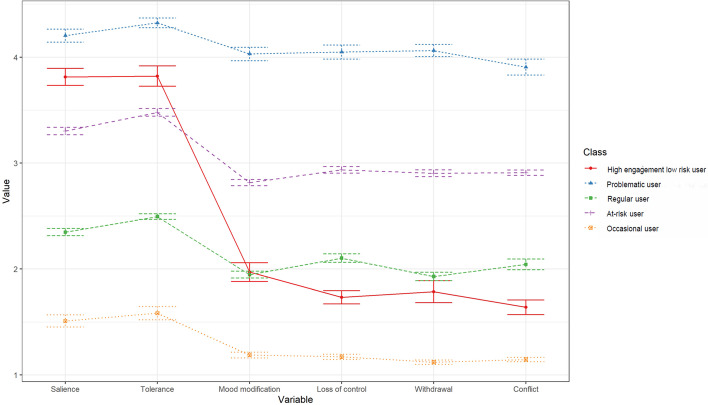
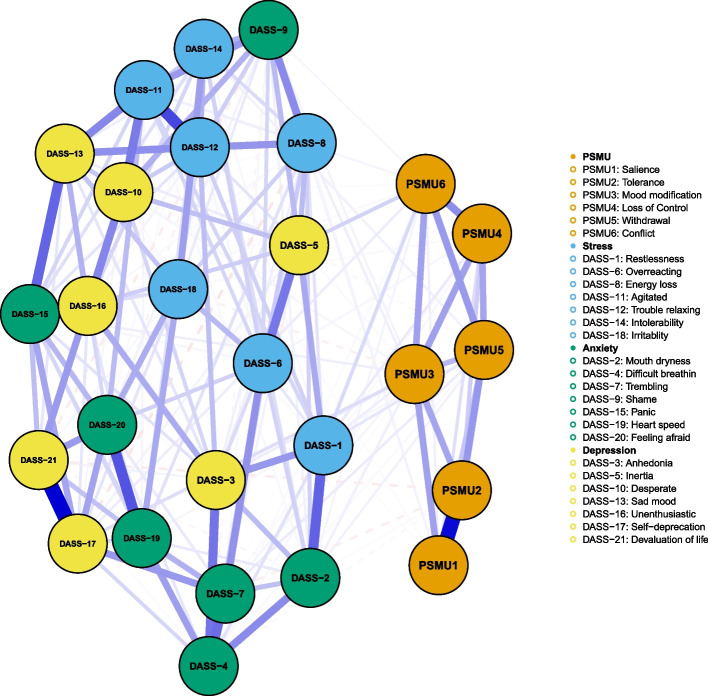
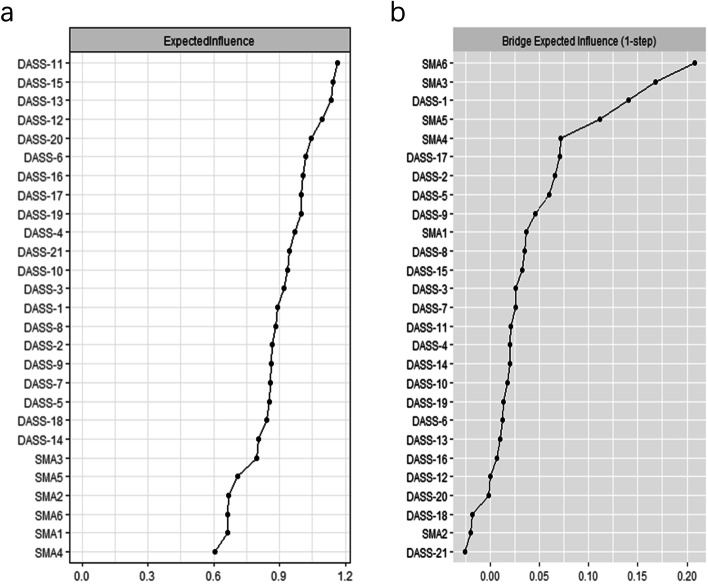
BACKGROUNDS: Components of addiction (salience, tolerance, mood modification, relapse, withdrawal, and conflict) is the most cited theoretical framework for problematic social media use (PSMU). However, studies criticized its ability to distinguish problematic users from engaged users. We aimed to assess the association of the six criteria with depression, anxiety, and stress at a symptom level. METHODS: Ten thousand six hundred sixty-eight participants were recruited. Bergen Social Media Addiction Scale (BSMAS) was used to detect six addiction components in PSMU. We applied the depression-anxiety-stress scale to assess mental distress. Latent profile analysis (LPA) was conducted based on BSMAS items. Network analysis (NA) was performed to determine the symptom-symptom interaction of PSMU and mental distress. RESULTS: (1) Social media users were divided into five subgroups including occasional users (10.6%, n = 1127), regular users (31.0%, n = 3309), high engagement low risk users (10.4%, n = 1115), at-risk users (38.1%, n = 4070), and problematic users (9.8%, n = 1047); (2) PSMU and mental distress varied markedly across subgroups. Problematic users had the most severe PSMU, depression, anxiety, and stress symptoms. High engagement users scored high on tolerance and salience criteria of PSMU but displayed little mental distress; (3) NA showed conflict and mood modification was the bridge symptoms across the network, while salience and tolerance exhibited weak association with mental distress. CONCLUSIONS: Salience and tolerance might not distinguish engaged users from problematic users. New frameworks and assessment tools focusing on the negative consequences of social media usage are needed.
Overview
The claims and statistics of this paper haven’t been checked yet.
Run the check — free, no account needed. It reads the open-access text and checks the sources it cites.
Integrity signals
Registry
Cites
Statistics
Figures
Verification
Claims the paper makes
The claims and statistics of this paper haven’t been checked yet.
Run the check — free, no account needed. It reads the open-access text and checks the sources it cites.
Claims other papers make about this one
Each is checked against this paper’s own text: does it say what the citing paper says it does?
The source backs part of the claim, not all of it — or backs it for a different population, condition or comparison.
In the citing paper
“Some of the negative impacts of excessive usage of social media on a user’s life (internet addiction) are salience, excessive thinking or planning to use social media, excessive time spent on social media, mood modification, social media as a tool for overcoming emotional problem, relapse or failure in decreasing social media usage, withdrawn or feeling troubled when unable to use social media and”
From Investigating social media addiction and impact of social media addiction, loneliness, depression, life satisfaction and problem-solving skills on academic self-efficacy and academic success among university students (2024) · cites this paper as [20]
Experimental — accuracy not yet measuredThe cited source says what the claim attributes to it.
In the citing paper
“Occasional users who spend less time on social media have lower levels of depression, anxiety and stress.”
The cited source says what the claim attributes to it.
In the citing paper
“Low risk users are high on tolerance and salience criteria.”
The cited source says what the claim attributes to it.
In the citing paper
“At-risk users are more prone to depression, anxiety, and stress”
The cited source says what the claim attributes to it.
In the citing paper
“while problematic users have the highest level of problematic social media use, depression, anxiety, and stress (20).”
The cited source says what the claim attributes to it.
In the citing paper
“Importantly, there is a lack of conceptual clarity and ongoing debate regarding the definition of ‘problematic’ social media use (Peng and Liao, 2023).”
From Will restricting the age of access to social media reduce mental illness in Australian youth? (2025) · cites this paper as Peng and Liao, 2023
In the citing paper
“Moreover, problematic social media use (PSMU) has been associated with severe depression, anxiety, and stress symptoms [128,129,130].”
From Comprehensive review of chronic stress pathways and the efficacy of behavioral stress reduction programs (BSRPs) in managing diseases. (2024) · cites this paper as [128]
In the citing paper
“Excessive media consumption has been linked to heightened stress and negative emotional states, with individuals who consume media for over four hours daily reporting higher Perceived Stress Scale scores and lower Positive Emotion Scale scores compared to those with less media exposure.”
From Comprehensive review of chronic stress pathways and the efficacy of behavioral stress reduction programs (BSRPs) in managing diseases. (2024) · cites this paper as [128]
Self-check
Percentages, sums and reported differences re-computed from the paper’s own numbers.
The self-check needs the paper’s full text.
Citations
Cites
Estimating psychological networks and their accuracy: A tutorial paper
Epskamp, S., Borsboom, D., & Fried, E. I. (2018) · Behavior Research Methods · doi:10.3758/s13428-017-0862-1 · Cited by 5,715
A “components” model of addiction within a biopsychosocial framework
Griffiths, M. (2005) · Journal of Substance Use · doi:10.1080/14659890500114359 · Cited by 3,088
A cognitive-behavioral model of pathological Internet use
Davis, R. A. (2001) · Computers in Human Behavior · doi:10.1016/s0747-5632(00)00041-8 · Cited by 3,010
Spurk, D., Hirschi, A., Wang, M., Valero, D., & Kauffeld, S. (2020) · Journal of Vocational Behavior · doi:10.1016/j.jvb.2020.103445 · Cited by 2,119
Andreassen, C. S., Billieux, J., Griffiths, M. D., Kuss, D. J., Demetrovics, Z., Mazzoni, E., & Pallesen, S. (2016) · Psychology of Addictive Behaviors · doi:10.1037/adb0000160 · Cited by 2,095
Bridge Centrality: A Network Approach to Understanding Comorbidity
Jones, P. J., Ma, R., & McNally, R. J. (2019) · Multivariate Behavioral Research · doi:10.1080/00273171.2019.1614898 · Cited by 1,895
Online Social Network Site Addiction: A Comprehensive Review
Andreassen, C. S. (2015) · Current Addiction Reports · doi:10.1007/s40429-015-0056-9 · Cited by 1,212
Network analysis: a brief overview and tutorial
Hevey, D. (2018) · Health Psychology and Behavioral Medicine · doi:10.1080/21642850.2018.1521283 · Cited by 1,188
Variable-Centered, Person-Centered, and Person-Specific Approaches: Where Theory Meets the Method
Howard, M. C., & Hoffman, M. E. (2018) · Organizational Research Methods · doi:10.1177/1094428117744021 · Cited by 1,121
Depression sum-scores don’t add up: why analyzing specific depression symptoms is essential
Fried, E. I., & Nesse, R. M. (2015) · BMC Medicine · doi:10.1186/s12916-015-0325-4 · Cited by 981
Cited by
Sorted by citations
Qu, D., Liu, B., Jia, L., Zhang, X., Chen, D., Zhang, Q., Feng, Y., & Chen, R. (2023) · Computers in Human Behavior · doi:10.1016/j.chb.2023.108059 · Cited by 144
Shchaslyvyi, A. Y., Antonenko, S. V., & Telegeev, G. D. (2024) · International Journal of Environmental Research and Public Health · doi:10.3390/ijerph21081077 · Cited by 73
Aslan, I., & Polat, H. (2024) · Frontiers in Public Health · doi:10.3389/fpubh.2024.1359691 · Cited by 51
Youths’ sensitivity to social media feedback: A computational account
Pinho, A. D. S., Izquierdo, V. C., Lindström, B., & van den Bos, W. (2024) · Science Advances · doi:10.1126/sciadv.adp8775 · Cited by 58
Peng, P., Chen, Z., Ren, S., Liu, Y., He, R., Liang, Y., Tan, Y., Tang, J., Chen, X., & Liao, Y. (2023) · BMC Psychiatry · doi:10.1186/s12888-023-05170-4 · Cited by 44
Self-citation
Metadata
- Authors
- Peng, P., & Liao, Y.
- Affiliations
- Sir Run Run Shaw Hospital (CN)
- Corresponding author
- Liao, Yanhui
- ORCID
- Venue
- BMC Psychiatry
- Published
- 2023-05-08
- Volume
- 23
- Issue
- 1
- Pages
- 321-321
- ISSN
- 1471-244X (ISSN-L)
- PMC
- PMC10166459
- OpenAlex
- W4375955897
- Cited by
- 114
- References
- 53
- Citations by year
- 2026: 51 · 2025: 37 · 2024: 17 · 2023: 9
- FWCI
- 48.97
- Type
- journal article
- Language
- en
- Open access
- gold
- doi.org
- Locations
- BMC Psychiatry (publishedVersion, cc-by)
- PubMed Central (publishedVersion, cc-by)
- PubMed (publishedVersion)
- DOAJ (DOAJ: Directory of Open Access Journals) (submittedVersion, cc-by-sa)
- Funders
- STI 2030—Major Projects - "Brain Science and Brain-like Research" Project (2022ZD0211200)
- Topics
- Social Sciences › Sociology and Political Science › Impact of Technology on Adolescents
- Social Sciences › Psychology › Clinical Psychology › Sexuality, Behavior, and Technology
- Social Sciences › Psychology › Experimental and Cognitive Psychology › Mental Health Research Topics
- Keywords
- social media addiction, salience, tolerance, mood modification, relapse, withdrawal, conflict, depression, anxiety, stress, Bergen Social Media Addiction Scale, symptom networks
- MeSH terms
- Anxiety, Anxiety Disorders, Depression, Humans, Mood Disorders, Social Media
About these checks
Registry, retraction, Cites and statistics results are computed, not judged, with one exception: a printed reference that no index lists is read once by a model before it counts as a citation error. Claims are extracted by a model and kept only when their quote appears verbatim in the text; each cited source is then checked, with a model’s help, for whether it says what the claim relies on. Those verdicts can be wrong — read the claim’s quote and the cited source before relying on one.
Statistics and arithmetic are recomputed, not judged.
Confidence bands are shown only for fields calibrated on our annotated test set. None is calibrated yet, so no band is shown.
What counts as a claim ›How we measure confidence ›How we check this ›
Are you an author, or do you see a problem with this page? Request a review
