

It's ok that I feel like this": a qualitative study of adolescents' and parents' experiences of facilitators, mechanisms of change and outcomes in a joint emotion regulation group skills training
Open accessThe DOI matches its Crossref record; 61 of the 62 references it cites were found in a registry or an index.
Abstract
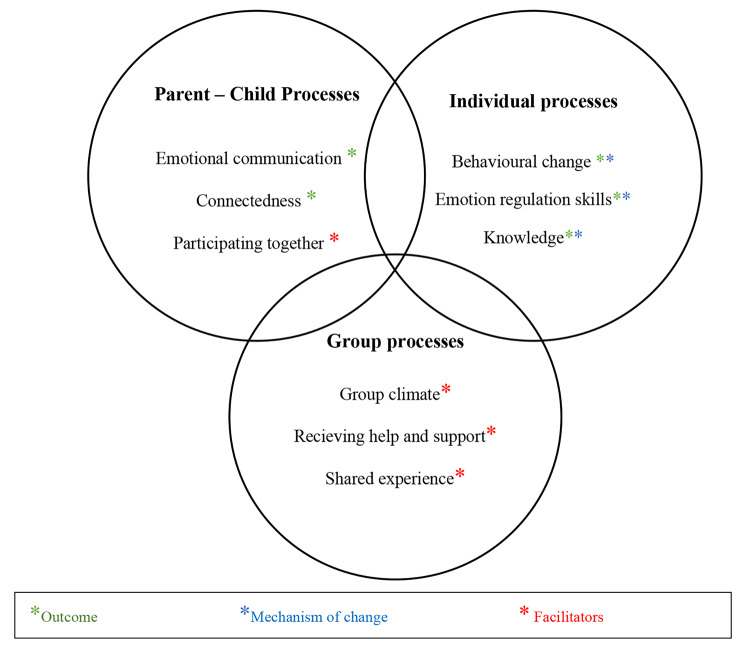
BACKGROUND: Emotion regulation difficulties underlie several psychiatric conditions, and treatments that focus on improving emotion regulation can have an effect on a broad range of symptoms. However, participants' in-depth experiences of participating in emotion regulation treatments have not been much studied. In this qualitative study, we investigated participants' experiences of a joint emotion regulation group skills training in a child and adolescent psychiatric outpatient setting. METHODS: Twenty-one participants (10 adolescents and 11 parents) were interviewed about their experiences after they had participated in a seven-session transdiagnostic emotion regulation skills training for adolescents and parents. The aim of the skills training was to decrease emotion regulation difficulties, increase emotional awareness, reduce psychiatric symptoms, and enhance quality of life. The skills training consisted of psychoeducation about emotions and skills for regulating emotions. The interviews were transcribed and analysed using reflexive thematic analysis. RESULTS: The analysis resulted in three overarching themes: Parent - Child processes, Individual processes, and Group processes. The result showed that participants considered an improved parent-child relationship to be the main outcome. Increased knowledge, emotion regulation skills and behavioural change were conceptualised as both mechanisms of change and outcomes. The group format, and the fact that parents and adolescents participated together, were seen as facilitators. Furthermore, the participants experienced targeting emotions in skills training as meaningful and helpful. CONCLUSION: The results highlight the potential benefits of providing emotion regulation skills training for adolescents and parents together in a group format to improve the parent-child relationship and enable the opportunity to learn skills.
Overview
The claims and statistics of this paper haven’t been checked yet.
Free: it reads the open-access text and checks the first 5 claims that cite a source we can check. Create a free account to check every claim.
Integrity signals
Registry
Cites
Statistics
Figures
Verification
Claims the paper makes
The claims and statistics of this paper haven’t been checked yet.
Free: it reads the open-access text and checks the first 5 claims that cite a source we can check. Create a free account to check every claim.
Claims other papers make about this one
Each is checked against this paper’s own text: does it say what the citing paper says it does?
The cited source says what the claim attributes to it.
In the citing paper
“ER skills, behavioral change and knowledge were interpreted as both mechanisms of change and outcomes (28).”
From An emotion regulation skills training for adolescents and parents: perceptions and acceptability of methodological aspects (2024) · cites this paper as [28]
The cited source says what the claim attributes to it.
In the citing paper
“The group format and the fact that the adolescents and parents participated together were interpreted as facilitators for change.”
From An emotion regulation skills training for adolescents and parents: perceptions and acceptability of methodological aspects (2024) · cites this paper as [28]
The cited source says what the claim attributes to it.
In the citing paper
“Results showed that the participants considered the improved parent-child relationship as the main outcome.”
From An emotion regulation skills training for adolescents and parents: perceptions and acceptability of methodological aspects (2024) · cites this paper as [28]
The cited source says what the claim attributes to it.
In the citing paper
“A qualitative analysis of 21 interviews with participants who had taken part in the extended seven-session ER group skills training described here focused on process-related variables.”
From An emotion regulation skills training for adolescents and parents: perceptions and acceptability of methodological aspects (2024) · cites this paper as [28]
Self-check
Percentages, sums and reported differences re-computed from the paper’s own numbers.
The self-check needs the paper’s full text.
Citations
Cites
Using thematic analysis in psychology
Braun, V., & Clarke, V. (2006) · Qualitative Research in Psychology · doi:10.1191/1478088706qp063oa · Cited by 194,414
Tong, A., Sainsbury, P., & Craig, J. (2007) · International Journal for Quality in Health Care · doi:10.1093/intqhc/mzm042 · Cited by 42,509
Kessler, R. C., Berglund, P., Demler, O., Jin, R., Merikangas, K. R., & Walters, E. E. (2005) · Archives of General Psychiatry · doi:10.1001/archpsyc.62.6.593 · Cited by 20,391
Emotion-regulation strategies across psychopathology: A meta-analytic review
Aldao, A., Nolen-Hoeksema, S., & Schweizer, S. (2010) · Clinical Psychology Review · doi:10.1016/j.cpr.2009.11.004 · Cited by 6,686 · cited 2×
“Findings from an earlier meta-analysis in the role of emotion regulation in psychopathology indicate that heightened levels of maladaptive emotion regulation strategies predict greater psychopathology, even when adaptive strategies are present [7].”
BackgroundResultThematic Analysis: A Practical Guide
Braun, V., & Clarke, V. (2022) · QMiP Bulletin · doi:10.53841/bpsqmip.2022.1.33.46 · Cited by 5,438
Cognitive and affective development in adolescence
Steinberg, L. (2005) · Trends in Cognitive Sciences · doi:10.1016/j.tics.2004.12.005 · Cited by 2,978 · cited 1×
“A maladaptive shift in emotion regulation has been seen in adolescents aged 12–15 years, compared to both younger and older adolescents [17–19].”
ResultCompas, B. E., Jaser, S. S., Bettis, A. H., Watson, K. H., Gruhn, M. A., Dunbar, J. P., Williams, E., & Thigpen, J. C. (2017) · Psychological Bulletin · doi:10.1037/bul0000110 · Cited by 1,555
Acceptance and commitment therapy.
Hayes, S. C., & Lillis, J. (2012) · American Psychological Association eBooks · doi:10.1037/17335-000 · Cited by 1,543
(2014) · Cited by 1,541
Social Psychiatry and Psychiatric Epidemiology
(2013) · Social Psychiatry and Psychiatric Epidemiology · doi:10.1007/127.1433-9285 · Cited by 1,307
Research works printed but not linked: 3
- LeBlanc S Essau CA Ollendick TH Essau CA LeBlanc S Ollendick TH Emotion regulation: an introduction 2017 1 New York, NY Oxford University Press 3 17
- Neacsiu AD Bohus M Linehan MM Gross JJ Dialectical Behavior Therapy: an intevention for emotion dysregulation 2014 2 New York Guilford Press 491 507
- Ehrenreich-May J Queen AH Bilek EL Remmes CS Marciel KK Ehrenreich-May J Chu BC Ehrenreich-May J Chu BC The unified protocols for the treatment of emotional disorders in children and adolescents 2014 New York Guilford Press 267 92
Cited by
Holmqvist Larsson, K., & Zetterqvist, M. (2024) · Frontiers in Psychiatry · doi:10.3389/fpsyt.2024.1448529 · Cited by 7
Pokowitz, E. L., Prakash, N., Planaj, D., Oprandi, S., & Deldin, P. J. (2024) · Behavioral Sciences · doi:10.3390/bs14030252 · Cited by 5
“Qualitative data provides a unique lens into the lived experiences of clients in a treatment program, allowing researchers to explore the salient processes, experiences, and changes experienced in therapy from the perspective of the individual engaging in the therapeutic process (e.g., [13,14]).”
BackgroundOrsolini, L., Longo, G., & Volpe, U. (2025) · International Review of Psychiatry · doi:10.1080/09540261.2025.2570445 · Cited by 5
“…could include a tailored psychoeducational programs for adolescents and young adults specifically addressing emotions and emotion regulation (Holmqvist Larsson et al., 2023; Sökmen & Karaca, 2023), cognitive behaviour therapy (CBT) approaches, including dialectical behaviour therapy (DBT)…”
Larsson, K. H., Falkenström, F., Andersson, G., Stern, H., Bolmgren, L., Engström, T., Källström, V., Nilsson, M., Pettersson, E., Seesing, F., et al. (2026) · Child and Adolescent Psychiatry and Mental Health · doi:10.1186/s13034-026-01098-1 · Cited by 1
“The participants reported that the skill of identifying and labelling emotions was a prerequisite for improved emotional communication between family members [54].”
Factors contributing to learning losses among primary school children: a scoping review
Pek, L. S., Nadarajan, N.-T. M., Khusni, H. K., Mee, R. W. M., Ismail, M. R., Adha, N. S. Q. S., & Arma, A. E. S. A. J. (2024) · Journal of Education and Learning (EduLearn) · doi:10.11591/edulearn.v18i3.21305 · Cited by 5
“Parents and other guardians are crucial in helping children regulate emotional arousal, develop coping mechanisms, and effectively manage their behavior [44], [45].”
Background
Metadata
- Authors
- Holmqvist Larsson, K., Thunberg, M., Münger, A.-C., Andersson, G., Falkenström, F., & Zetterqvist, M.
- Affiliations
- Region Östergötland (SE)
- Linköping University (SE)
- Venue
- BMC Psychiatry
- Published
- 2023-08-15
- Volume
- 23
- Issue
- 1
- Pages
- 591-591
- ISSN
- 1471-244X (ISSN-L)
- PMC
- PMC10428531
- OpenAlex
- W4385828615
- Cited by
- 9
- References
- 62
- Citations by year
- 2026: 4 · 2025: 2 · 2024: 3
- FWCI
- 2.61
- Type
- journal article
- Language
- en
- Open access
- gold
- doi.org
- Licence
- cc-by
- creativecommons.org/licenses/by/4.0 (tdm)
- creativecommons.org/licenses/by/4.0 (vor)
- Locations
- BMC Psychiatry (publishedVersion, cc-by)
- PubMed Central (publishedVersion, cc-by)
- PubMed (publishedVersion)
- Diva portal (Dalarna University Library) (submittedVersion, other-oa)
- KTH Publication Database DiVA (KTH Royal Institute of Technology) (submittedVersion, other-oa)
- DOAJ (DOAJ: Directory of Open Access Journals) (submittedVersion, cc-by-sa)
- Funders
- Linköping University
- Topics
- Social Sciences › Psychology › Clinical Psychology › Child and Adolescent Psychosocial and Emotional Development
- Social Sciences › Psychology › Clinical Psychology › Personality Disorders and Psychopathology
- Social Sciences › Psychology › Clinical Psychology › Psychotherapy Techniques and Applications
- Keywords
- emotion regulation, group skills training, adolescents, parents, parent-adolescent relationships, mechanisms of change, facilitators, transdiagnostic treatment, child and adolescent psychiatry, psychoeducation, emotional awareness, quality of life, psychiatric symptoms
- MeSH terms
- Emotional Regulation, Adolescent, Emotions, Humans, Parent-Child Relations, Parents, Quality of Life
About these checks
Registry, retraction, Cites and statistics results are computed, not judged, with one exception: a printed reference that no index lists is read once by a model before it counts as a citation error. Claims are extracted by a model and kept only when their quote appears verbatim in the text; each cited source is then checked, with a model’s help, for whether it says what the claim relies on. Those verdicts can be wrong — read the claim’s quote and the cited source before relying on one.
Statistics and arithmetic are recomputed, not judged.
Confidence bands are shown only for fields calibrated on our annotated test set. None is calibrated yet, so no band is shown.
What counts as a claim ›How we measure confidence ›How we check this ›
Are you an author, or do you see a problem with this page? Request a review
How to cite
Cite CoChat for the checks on this page, and the paper for its own findings.
- This page
- CoChat. (2026). Citation check: It's ok that I feel like this": a qualitative study of adolescents' and parents' experiences of facilitators, mechanisms of change and outcomes in a joint emotion regulation group skills training. https://app.cochat.ai/papers/10.1186/s12888-023-05080-5
- The paper
- Holmqvist Larsson, K., Thunberg, M., Münger, A.-C., Andersson, G., Falkenström, F., & Zetterqvist, M. (2023). It's ok that I feel like this": a qualitative study of adolescents' and parents' experiences of facilitators, mechanisms of change and outcomes in a joint emotion regulation group skills training. BMC Psychiatry. https://doi.org/10.1186/s12888-023-05080-5
Data sources
Bibliographic data: Semantic Scholar, OpenAlex, Crossref.
Contains information from the Semantic Scholar Academic Graph Datasets, made available under the ODC Attribution License (ODC-BY 1.0).
Semantic Scholar’s data is described in: Kinney, R., et al. (2023). The Semantic Scholar Open Data Platform. arXiv:2301.10140.
