

Evaluation of dialectical behavior therapy for adolescents in routine clinical practice: a pre-post study
Open accessThe DOI matches its Crossref record; 40 of the 41 references it cites were found in a registry or an index; 11 of the 19 sources its claims cite were checked for support.
Abstract
Background: Self-harm and suicidal ideation are prevalent among adolescents, cause physical and psychosocial disability, and have potentially life-threatening consequences. Dialectical behavioral therapy for Adolescents (DBT-A) is an evidence-based intervention for reducing self-harm. However, few studies have investigated the effectiveness of DBT-A when delivered in routine clinical practice. Methods: A follow-up cohort study, based on data from a quality assessment register of DBT-A in child and adolescent mental health services including seven outpatient clinics. Inclusion criteria were ongoing or a history of self-harming behavior the last 6 months; current suicidal behavior; at least 3 criteria of DSM-IV Borderline personality disorder (BPD), or at least the self-destruction criterion of DSM-IV BPD, in addition to minimum 2 subthreshold criteria; and fluency in Norwegian. Participants received 20 weeks of DBT-A consisting of multifamily skills training groups and individual therapy sessions. Outcomes from 41 participants included frequency of self-harm, suicide attempts and hospitalizations caused by self-harm or suicide attempts, assessed pre-, during, and post-treatment by self-report and reviews of the patient’s medical records. Suicidal ideation, urge to self-harm and perceived feelings of happiness and sadness were assessed by the patients’ diary cards at week 1, 5, 10, 15 and 20 of the treatment program. Results: Participants attended an average of 17.9 (SD = 4.7) individual sessions, 14.7 (SD = 3.4) group-based skills training sessions and 4.6 (SD = 4.1) brief intersession telephone consultations. Moderate to large within-group effect sizes (ES) were found in self-harm from pre-treatment to 1–5 weeks (d = 0.64), 6–10 weeks (d = 0.84), 11–15 weeks (d = 0.99), 16–20 weeks (d = 1.26) and post-treatment (d = 1.68). Nine participants were admitted to hospitalization during DBT-A, whereas five had attempted suicide, but no suicides were completed. No statistically significant changes were found in suicidal ideation, urge to self-harm or perceived feelings of happiness or sadness from pre to post treatment. Conclusion: The findings of the current study are promising as the participants reported considerably reduced self-harm behavior after DBT-A treatment in a child and adolescent mental health outpatient setting. © The Author(s) 2024.
Overview
CoChat Summary
TL;DR
In this routine-clinical-practice pre-post cohort study of DBT-A in Norwegian outpatient CAMHS, self-harm decreased markedly over treatment, with a large within-group effect by post-treatment (d = 1.68). Secondary outcomes did not change significantly, and the study cannot separate treatment effects from natural change because it had no control group.
Key findings
- Among 41 consenting adolescents (mean age 15.8 years, 85.4% female), self-harm effect sizes increased over time: d = 0.64 at 1–5 weeks, 0.84 at 6–10 weeks, 0.99 at 11–15 weeks, 1.26 at 16–20 weeks, and 1.68 post-treatment.
- Participants attended an average of 17.9 individual sessions, 14.7 group skills sessions, and 4.6 brief telephone consultations over the treatment course.
- Nine participants were admitted to hospital during DBT-A, five had suicide attempts during treatment, and no suicides were completed.
- Suicidal ideation, urge to self-harm, and self-reported happiness/sadness showed no statistically significant pre-to-post change.
Methods
- Follow-up cohort pre-post study using a quality-assessment register from seven outpatient child and adolescent mental health clinics in Norway; DBT-A was delivered as routine public care.
- Sample: 41 adolescents who consented from 103 who received DBT-A; inclusion required self-harm and/or suicidal behavior plus DSM-IV BPD-related criteria and fluency in Norwegian.
- Outcomes were analyzed with linear mixed models for repeated measures; self-harm was assessed pre-, during, and post-treatment, and secondary outcomes came from weekly DBT-A diary cards.
Limitations
- The paper states there was no control or alternative treatment group, limiting causal conclusions.
- The paper states there was no follow-up, so long-term durability of effects is unknown.
- The paper states outcomes were largely self-reported and not based on validated outcome measures; also, no standardized adherence measures were included.
- Evident from the text: only 41 of 103 treated adolescents consented, which may introduce selection bias; the paper explicitly notes this concern.
Model-written summary. Check it against the paper before relying on it.
Integrity signals
Registry
Cites
Statistics
Figures
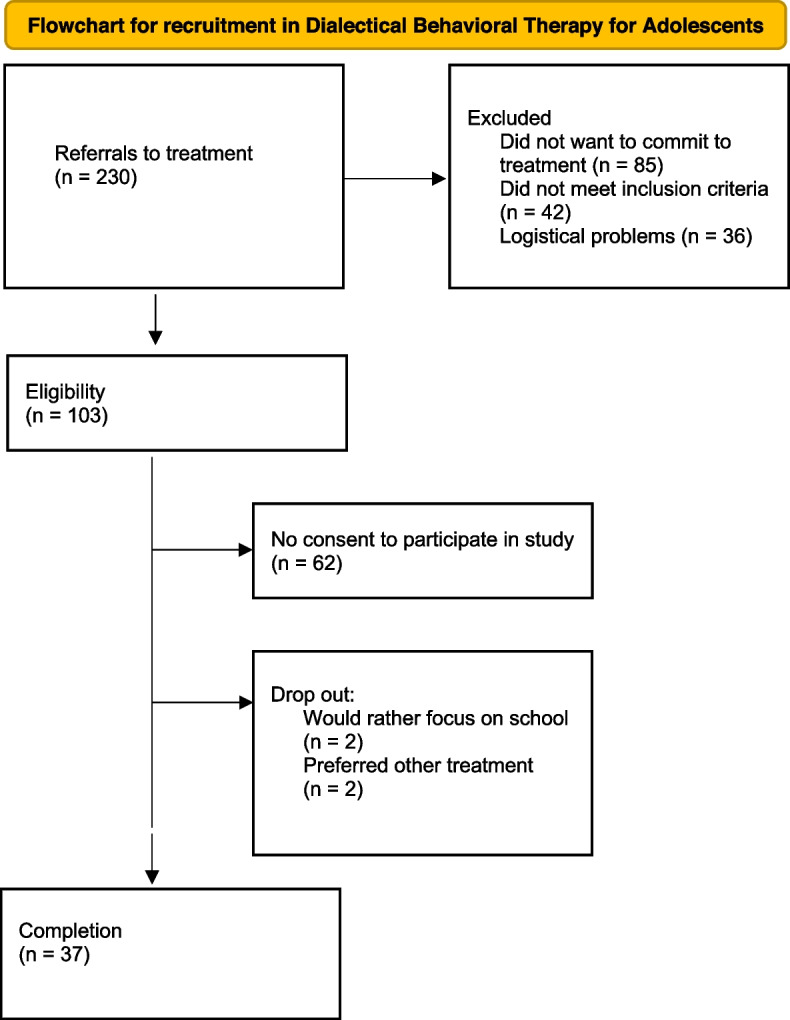
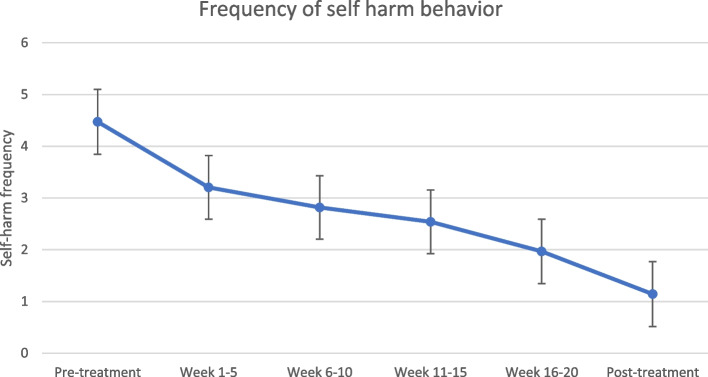
Verification
Claims the paper makes
9 Valid · 0 Not valid · 5 Not checked · 30 Own results and interpretations
The cited sources support only part of this claim — read each source’s verdict below.
In the paper
“However, few studies have investigated the effectiveness of DBT-A when delivered in routine clinical practice.”
§ Evaluation of dialectical behavior therapy for adolescents in routine clinical practice: a pre-post study > Abstract > Background
What the sources say
- Partly supportedcites [12] Kothgassner OD Goreis A Robinson K Huscsava MM Schmahl C Plener PL Efficacy of dialectical behavior therapy for adolescent self-harm and suicidal ideation: a systematic review and meta-analysis Psychol Med 2021 51 7 1057 1067 10.1017/S0033291721001355 33875025 PMC8188531 sourceExperimental — accuracy not yet measured
The Discussion (page not given) describes a scarcity of studies investigating DBT-A efficacy, supporting the general point that the evidence base is limited. The Results (page not given) identify 21 studies across several designs and settings, but the paper does not say that few specifically investigated effectiveness when DBT-A was delivered in routine clinical practice. (LLM, conf=0.80)
- Partly supportedcites [13] Witt, K. G., Hetrick, S. E., Rajaram, G., Hazell, P., Taylor Salisbury, T. L., Townsend, E., & Hawton, K. (2021). Interventions for self‐harm in children and adolescents. Cochrane Database System Rev. (3). 10.1002/14651858.CD013667.pub2. PMC8094399 33677832 sourceExperimental — accuracy not yet measured
The review’s DBT-A comparison section identifies only two trials evaluating its effectiveness, supporting the claim that the evidence base is small. It does not establish that those trials studied DBT-A as delivered in routine clinical practice; routine care is described as a comparator, not necessarily the setting or mode of DBT-A delivery. The indexed passages provide no page number. (LLM, conf=0.82)
plain- Asserted: passes — The authors put it forward as true.
- Checkable: passes — It can be checked against evidence.
- Load-bearing: passes — The paper’s conclusions depend on it.
- Based: passes — The paper gives a reason why it holds.
- Partly supported
The cited sources support only part of this claim — read each source’s verdict below.
In the paper
“Dialectical behavioral therapy for Adolescents (DBT-A) is an evidence-based intervention for reducing self-harm.”
§ Evaluation of dialectical behavior therapy for adolescents in routine clinical practice: a pre-post study > Abstract > Background
What the sources say
- Supportedcites [12] Kothgassner OD Goreis A Robinson K Huscsava MM Schmahl C Plener PL Efficacy of dialectical behavior therapy for adolescent self-harm and suicidal ideation: a systematic review and meta-analysis Psychol Med 2021 51 7 1057 1067 10.1017/S0033291721001355 33875025 PMC8188531 source
The Results report that DBT-A significantly reduced adolescent self-harm compared with control interventions (g = −0.44, p = 0.021). The Discussion concludes that current evidence indicates DBT-A is superior to control interventions for reducing self-harm among adolescents. (LLM, conf=0.94)
- Partly supportedcites [13] Witt, K. G., Hetrick, S. E., Rajaram, G., Hazell, P., Taylor Salisbury, T. L., Townsend, E., & Hawton, K. (2021). Interventions for self‐harm in children and adolescents. Cochrane Database System Rev. (3). 10.1002/14651858.CD013667.pub2. PMC8094399 33677832 sourceExperimental — accuracy not yet measured
The review’s ‘2.1 Repetition of SH’ section reports a significant reduction in self-harm frequency over time in one DBT-A trial, which lends some support to the claim. But the pooled post-intervention analyses found no significant effect on repetition or frequency of self-harm, and the discussion calls the evidence on repetition ‘equivocal.’ Calling DBT-A an evidence-based intervention for reducing self-harm overstates this mixed evidence. Page numbers are not available in our copy. (LLM, conf=0.85)
plainstates a cause- Asserted: passes — The authors put it forward as true.
- Checkable: passes — It can be checked against evidence.
- Load-bearing: passes — The paper’s conclusions depend on it.
- Based: passes — The paper gives a reason why it holds.
- Supported
The cited sources support only part of this claim — read each source’s verdict below.
In the paper
“The sample of patients in the current study is comparable to the inclusion criteria, age and gender in 10 of the 13 pre-post studies included in their systematic review and meta-analysis, supporting the feasibility of DBT-A on this population [12].”
§ Evaluation of dialectical behavior therapy for adolescents in routine clinical practice: a pre-post study > Discussion
What the sources say
- Partly supportedcites [12] Kothgassner OD Goreis A Robinson K Huscsava MM Schmahl C Plener PL Efficacy of dialectical behavior therapy for adolescent self-harm and suicidal ideation: a systematic review and meta-analysis Psychol Med 2021 51 7 1057 1067 10.1017/S0033291721001355 33875025 PMC8188531 sourceExperimental — accuracy not yet measured
The Results report 13 pre-post studies, and Table 1 lists their eligibility criteria, ages, and gender composition. The source does not describe the citing study’s patients, so it cannot establish that its sample is comparable to 10 of those 13 studies; that comparison is the citing authors’ own assessment. (LLM, conf=0.85)
plainstates an association- Asserted: passes — The authors put it forward as true.
- Checkable: passes — It can be checked against evidence.
- Load-bearing: passes — The paper’s conclusions depend on it.
- Based: passes — The paper gives a reason why it holds.
- Partly supported
Every source the paper cites for this claim was checked and supports it.
In the paper
“The present findings are in accordance with Kothgassner and colleagues’ systematic review and meta-analysis who found large within-group effects on self-harm in their DBT-A pre-post evaluations.”
§ Evaluation of dialectical behavior therapy for adolescents in routine clinical practice: a pre-post study > Discussion
What the sources say
- Supportedcites [12] Kothgassner OD Goreis A Robinson K Huscsava MM Schmahl C Plener PL Efficacy of dialectical behavior therapy for adolescent self-harm and suicidal ideation: a systematic review and meta-analysis Psychol Med 2021 51 7 1057 1067 10.1017/S0033291721001355 33875025 PMC8188531 source
The Results report large within-group, pre-post reductions in self-harm among adolescents receiving DBT-A (Hedges’ g = −0.98; 95% CI −1.15 to −0.81). This directly supports the finding attributed to the systematic review and meta-analysis. (LLM, conf=0.95)
plainstates an association- Asserted: passes — The authors put it forward as true.
- Checkable: passes — It can be checked against evidence.
- Load-bearing: unclear — It is unclear whether the paper’s conclusions depend on it.
- Based: passes — The paper gives a reason why it holds.
- Supported
The cited sources support only part of this claim — read each source’s verdict below.
In the paper
“A more recent meta-analysis found no effect on suicide attempts in treatments of BPD for adolescents from pre to post treatment, including DBT-A [42].”
§ Evaluation of dialectical behavior therapy for adolescents in routine clinical practice: a pre-post study > Discussion
What the sources say
- Partly supportedcites [42] Wong J Bahji A Khalid-Khan S Psychotherapies for adolescents with subclinical and borderline personality disorder: a systematic review and meta-analysis The Canadian Journal of Psychiatry 2020 65 1 5 15 10.1177/0706743719878975 31558033 PMC6966252 sourceExperimental — accuracy not yet measured
The ‘Suicide Attempts and Nonsuicidal Self-Injury’ section reports no significant difference in suicide-attempt frequency between psychotherapy and control arms at treatment completion (OR 1.03, 95% CI 0.46–2.30); the reviewed trials included DBT-A. This supports the between-group finding, but not the claim that suicide attempts showed no change from pre- to posttreatment within the treatment groups. (LLM, conf=0.87)
plain- Asserted: passes — The authors put it forward as true.
- Checkable: passes — It can be checked against evidence.
- Load-bearing: unclear — It is unclear whether the paper’s conclusions depend on it.
- Based: passes — The paper gives a reason why it holds.
- Partly supported
21 more claims
Create a free account to see all 44 claims and to verify the 1 reference still open.
- It may state two separate claims as one. 14
- Probably not a substantial claim. 8
Citations
Cites
(1998) · PubMed · Cited by 10,216
Applied Multiple Regression/Correlation Analysis for the Behavioral Sciences
Cohen (2013) · doi:10.4324/9780203774441 · Cited by 3,228
(1997) · American Psychiatric Press eBooks · Cited by 3,056
Goodman, R., Ford, T., Richards, H., Gatward, R., & Meltzer, H. (2000) · Journal of Child Psychology and Psychiatry · doi:10.1111/j.1469-7610.2000.tb02345.x · Cited by 1,755 · cited 1×
“The DSM-IV Axis 1 diagnoses were assessed by semi-structured clinical interviews, such as Kiddie SADS [28], MiniPlus [29] and DAWBA [30] at the outpatient clinics prior to referral to DBT-A treatment.”
MethodGueorguieva, R., & Krystal, J. H. (2004) · Archives of General Psychiatry · doi:10.1001/archpsyc.61.3.310 · Cited by 1,529 · cited 1×
“Data from all participants collected at pre-treatment were included in the linear mixed model analysis, adhering to the intention-to-treat principle [35].”
MethodLobbestael, J., Leurgans, M., & Arntz, A. (2011) · Clinical Psychology & Psychotherapy · doi:10.1002/cpp.693 · Cited by 1,124 · cited 1×
“The Structured Clinical Interview for DSM-IV (SCID-II) [31] was conducted by the DBT-A therapist prior to starting DBT-A to measure traits of BPD. SCID-II has shown excellent inter-rater reliability for Axis II disorders in several studies [32, 33].”
MethodAMBROSINI, P. J. (2000) · Journal of the American Academy of Child & Adolescent Psychiatry · doi:10.1097/00004583-200001000-00016 · Cited by 725 · cited 1×
“The DSM-IV Axis 1 diagnoses were assessed by semi-structured clinical interviews, such as Kiddie SADS [28], MiniPlus [29] and DAWBA [30] at the outpatient clinics prior to referral to DBT-A treatment.”
MethodDialectical behavior therapy adapted for suicidal adolescents
Rathus, J. H., & Miller, A. L. (2002) · Suicide and Life-Threatening Behavior · doi:10.1521/suli.32.2.146.24399 · Cited by 635
Mehlum, L., Tørmoen, A. J., Ramberg, M., Haga, E., Diep, L. M., Laberg, S., Larsson, B. S., Stanley, B. H., Miller, A. L., Sund, A. M., et al. (2014) · Journal of the American Academy of Child & Adolescent Psychiatry · doi:10.1016/j.jaac.2014.07.003 · Cited by 616 · cited 2×
“A large reduction in self-harm from pre-to post-treatment was found in a RCT in a CAMHS setting in Norway comparing DBT-A to treatment as usual, a clinical setting similar to the current study [38].”
ResultWeisz, J. R., Jensen-Doss, A., & Hawley, K. M. (2006) · American Psychologist · doi:10.1037/0003-066x.61.7.671 · Cited by 560 · cited 2×
“As such, treatment programs developed and evaluated under highly controlled conditions in specialized research settings may not produce similar results when delivered in routine clinical care [21].”
BackgroundGillies, D., Christou, M. A., Dixon, A. C., Featherston, O. J., Rapti, I., Garcia-Anguita, A., Villasis-Keever, M., Reebye, P., Christou, E., Al Kabir, N., et al. (2018) · Journal of the American Academy of Child & Adolescent Psychiatry · doi:10.1016/j.jaac.2018.06.018 · Cited by 557 · cited 1×
“A meta-analysis including 144 population-based studies from 41 countries reported a lifetime prevalence of 16.9% for self-harm in adolescents aged 12 to 18 years old [6].”
BackgroundInfluentialMaffei, C., Fossati, A., Agostoni, I., Barraco, A., Bagnato, M., Deborah, D., Namia, C., Novella, L., & Petrachi, M. (1997) · Journal of Personality Disorders · doi:10.1521/pedi.1997.11.3.279 · Cited by 516 · cited 2×
“The Structured Clinical Interview for DSM-IV (SCID-II) [31] was conducted by the DBT-A therapist prior to starting DBT-A to measure traits of BPD. SCID-II has shown excellent inter-rater reliability for Axis II disorders in several studies [32, 33].”
BackgroundMethodOugrin, D., Tranah, T., Stahl, D., Moran, P., & Asarnow, J. R. (2015) · Journal of the American Academy of Child & Adolescent Psychiatry · doi:10.1016/j.jaac.2014.10.009 · Cited by 508 · cited 1×
“However, a systematic review and meta-analysis by Ougrin and colleagues [41] consisting of 19 RCTs on treatments of BPD in adolescents, found that when the effects of suicide attempts and self-harm without suicidal intent were examined separately, the effect on suicide attempts was weaker than the…”
Background(2007) · Cited by 485
Clinical and social outcomes of adolescent self harm: population based birth cohort study
Mars, B., Heron, J., Crane, C., Hawton, K., Lewis, G., Macleod, J., Tilling, K., & Gunnell, D. (2014) · BMJ · doi:10.1136/bmj.g5954 · Cited by 311 · cited 1×
“Self-harming behavior (i.e., nonfatal self-injury with or without suicidal intent) in adolescence is associated with mental health problems, such as depression, anxiety, substance abuse, and antisocial behavior in addition to an increased risk of poorer educational and occupational outcomes [2, 3].”
BackgroundReynolds, W. M., & Mazza, J. J. (1999) · School Psychology Review · doi:10.1080/02796015.1999.12085945 · Cited by 300 · cited 1×
“This measure may not accurately capture changes in suicidal ideations as it is not a validated instrument such as the Suicidal Ideation Questionnaire used in the RCT [39].”
MethodChakraborty, H. (2009) · doi:10.3768/rtipress.2009.mr.0009.0903 · Cited by 298 · cited 1×
“Missing data were estimated from the observed data based on the assumption of data missing at random, using a restricted maximum likelihood as recommended by Chakraborty and Gu [36].”
MethodKothgassner, O. D., Goreis, A., Robinson, K., Huscsava, M. M., Schmahl, C., & Plener, P. L. (2021) · Psychological Medicine · doi:10.1017/s0033291721001355 · Cited by 288 · cited 5×
“…settings, and university research clinics and routine clinical care with in total 1673 adolescents receiving DBT-A, found small to moderate between group effects for reducing self-harm frequency compared to control conditions, and large within-group effects of DBT-A in pre-post evaluations [12].”
BackgroundMethodResultInfluentialCarr, M. J., Steeg, S., Webb, R. T., Kapur, N., Chew-Graham, C. A., Abel, K. M., Hope, H., Pierce, M., & Ashcroft, D. M. (2021) · The Lancet Public Health · doi:10.1016/s2468-2667(20)30288-7 · Cited by 265 · cited 1×
“Additionally, several studies have demonstrated an increase in various mental health symptoms in general, and in self-harm among adolescents in particular during the COVID-19 pandemic [43, 44].”
BackgroundInterventions for self-harm in children and adolescents
Hawton, K., Witt, K. G., Taylor Salisbury, T. L., Arensman, E., Gunnell, D., Townsend, E., van Heeringen, K., & Hazell, P. (2015) · Cochrane Database of Systematic Reviews · doi:10.1002/14651858.cd012013 · Cited by 261
Evidence-Based Youth Psychotherapy in the Mental Health Ecosystem
Weisz, J. R., Ugueto, A. M., Cheron, D. M., & Herren, J. (2013) · Journal of Clinical Child & Adolescent Psychology · doi:10.1080/15374416.2013.764824 · Cited by 228 · cited 1×
“A well-established treatment such as DBT-A may perform differently in routine clinical care compared to delivery in research clinics for a variety of reasons [21, 22].”
BackgroundMoving beyond efficacy and effectiveness in child and adolescent intervention research.
La Greca, A. M., Silverman, W. K., & Lochman, J. E. (2009) · Journal of Consulting and Clinical Psychology · doi:10.1037/a0015954 · Cited by 184 · cited 1×
“Studies evaluating DBT-A with treatment implemented as part of the routine clinical services delivered could complement findings from efficacy studies regarding the effectiveness of the treatment [25, 26].”
MethodRoutinely collected data and comparative effectiveness evidence: promises and limitations
Hemkens, L. G., Contopoulos-Ioannidis, D. G., & Ioannidis, J. P. A. (2016) · Canadian Medical Association Journal · doi:10.1503/cmaj.150653 · Cited by 181 · cited 1×
“Studies evaluating DBT-A with treatment implemented as part of the routine clinical services delivered could complement findings from efficacy studies regarding the effectiveness of the treatment [25, 26].”
MethodSelf-harm in the context of borderline personality disorder
Reichl, C., & Kaess, M. (2021) · Current Opinion in Psychology · doi:10.1016/j.copsyc.2020.12.007 · Cited by 175 · cited 1×
“Repeated self-harm is further associated with Borderline personality disorder (BPD) [4], as emotional instability has shown to maintain self-harming behavior and an increased risk of suicidal behavior in individuals with BPD [5].”
BackgroundCarter, G., Page, A., Large, M., Hetrick, S., Milner, A. J., Bendit, N., Walton, C., Draper, B., Hazell, P., Fortune, S., et al. (2016) · Australian & New Zealand Journal of Psychiatry · doi:10.1177/0004867416661039 · Cited by 167
Wergeland, G. J., Riise, E. N., & Öst, L. (2020) · Clinical Psychology Review · doi:10.1016/j.cpr.2020.101918 · Cited by 150 · cited 1×
“…procedure to ensure high internal validity, e.g., by using rigorous inclusion and exclusion criteria, randomizing participants into different conditions, and having therapists with access to extensive training, supervision, and treatment monitoring with an emphasis on treatment integrity [23, 24].”
MethodSelf-citationInterventions for self-harm in children and adolescents
Witt, K. G., Hetrick, S. E., Rajaram, G., Hazell, P., Taylor Salisbury, T. L., Townsend, E., & Hawton, K. (2021) · Cochrane Database of Systematic Reviews · doi:10.1002/14651858.cd013667.pub2 · Cited by 149
20-year outcomes in adolescents who self-harm: a population-based cohort study
Borschmann, R., Becker, D., Coffey, C., Spry, E., Moreno-Betancur, M., Moran, P., & Patton, G. C. (2017) · The Lancet Child & Adolescent Health · doi:10.1016/s2352-4642(17)30007-x · Cited by 135 · cited 1×
“Self-harming behavior (i.e., nonfatal self-injury with or without suicidal intent) in adolescence is associated with mental health problems, such as depression, anxiety, substance abuse, and antisocial behavior in addition to an increased risk of poorer educational and occupational outcomes [2, 3].”
BackgroundChange in prevalence of self-harm from 2002 to 2018 among Norwegian adolescents
Tørmoen, A. J., Myhre, M. Ø., Walby, F. A., Grøholt, B., & Rossow, I. M. (2020) · European Journal of Public Health · doi:10.1093/eurpub/ckaa042 · Cited by 115 · cited 1×
“A recent study reported an increase in self-harm among Norwegian adolescents from 4.1% to 16.2% from 2002 to 2018 [7].”
BackgroundInfluentialAmerican Psychiatric Association Practice Guidelines
Alarcón, R. D. (1997) · The Journal of Clinical Psychiatry · doi:10.4088/jcp.v58n0107 · Cited by 112
Recent advances in understanding and managing self-harm in adolescents
Clarke, S., Allerhand, L. A., & Berk, M. S. (2019) · F1000Research · doi:10.12688/f1000research.19868.1 · Cited by 87 · cited 1×
“Dialectical Behavior Therapy for Adolescents (DBT-A) is the treatment that has shown the most encouraging results [12, 13], and is a well-established [14] and recommended treatment for reducing self-harming behavior and BPD according to several guidelines [15–17].”
BackgroundWong, J., Bahji, A., & Khalid-Khan, S. (2020) · The Canadian Journal of Psychiatry · doi:10.1177/0706743719878975 · Cited by 76 · cited 1×
“A more recent meta-analysis found no effect on suicide attempts in treatments of BPD for adolescents from pre to post treatment, including DBT-A [42].”
MethodDoes the Delivery of CBT for Youth Anxiety Differ Across Research and Practice Settings?
Smith, M. M., McLeod, B. D., Southam-Gerow, M. A., Jensen-Doss, A., Kendall, P. C., & Weisz, J. R. (2017) · Behavior Therapy · doi:10.1016/j.beth.2016.07.004 · Cited by 49 · cited 1×
“…procedure to ensure high internal validity, e.g., by using rigorous inclusion and exclusion criteria, randomizing participants into different conditions, and having therapists with access to extensive training, supervision, and treatment monitoring with an emphasis on treatment integrity [23, 24].”
MethodBuerger, A., Fischer-Waldschmidt, G., Hammerle, F., Auer, K. V., Parzer, P., & Kaess, M. (2019) · Journal of Personality Disorders · doi:10.1521/pedi_2018_32_334 · Cited by 46 · cited 3×
“The results from the current study align with findings from a similar pre-post study in an outpatient setting in Germany [40].”
BackgroundResultInfluentialGrzejszczak, J., Strzelecki, D., Gabryelska, A., & Kotlicka‐Antczak, M. (2024) · Journal of Clinical Medicine · doi:10.3390/jcm13030744 · Cited by 43 · cited 1×
“Additionally, several studies have demonstrated an increase in various mental health symptoms in general, and in self-harm among adolescents in particular during the COVID-19 pandemic [43, 44].”
BackgroundJohnstone, O. K., Marshall, J. J., & McIntosh, L. G. (2021) · Adolescent Research Review · doi:10.1007/s40894-020-00147-w · Cited by 39 · cited 2×
“A systematic review from 2022 that included 21 studies on DBT for adolescents and 4 studies on MBT found significant improvements in suicidal ideation, suicidal attempts, and self-harm in both treatments [10].”
BackgroundGeneralizability: Linking Evidence to Practice
Kamper, S. J. (2020) · Journal of Orthopaedic & Sports Physical Therapy · doi:10.2519/jospt.2020.0701 · Cited by 35
Efficacy of mentalization‐based therapy in treating self‐harm: A systematic review and meta‐analysis
Hajek Gross, C., Oehlke, S., Prillinger, K., Goreis, A., Plener, P. L., & Kothgassner, O. D. (2024) · Suicide and Life-Threatening Behavior · doi:10.1111/sltb.13044 · Cited by 31 · cited 1×
“However, a recent systematic review and meta-analysis on the efficacy of MBT in treating self-harm showed no superiority of MBT to control conditions (e.g., treatment as usual, structured clinical management) [11].”
BackgroundReasons for Dropout of Clients from Therapy
Behl, K., & Rajagopal, M. (2018) · International Journal of Indian Psychology · doi:10.25215/0602.014 · Cited by 5
(2001) · PubMed
Research works printed but not linked: 4
- Rossouw T, Wiwe M, Vrouva I. Mentalization-Based Treatment for Adolescents: A Practical Treatment Guide. Routledge: Routledge/Taylor & Francis Group; 2021.
- National Institute for Clinical Excellence guideline number NG225 (2022). Self-harm: assessment, management and preventing recurrence. Methods. 36595613
- Linehan MM. Skills training manual for treating borderline personality disorder. New York: Guilford press; 1993.
- Koerner K. Doing dialectical behavior therapy: A practical guide. New York: Guilford Press; 2011.
Cited by
Saghafi, A., Rodrigues, S. M., Aldridge, J., Myint, M., Balsam, D., Inzunza, N., Hernandez, J., Clancy, S., Monreal-Duarte, L., & Bounds, D. T. (2025) · Trauma Violence & Abuse · doi:10.1177/15248380251326902 · Cited by 3
“The predominance of behavioral frameworks, particularly DBT and CBT, found among included programs reflects the established efficacy of these frameworks in addressing youth MH challenges within the literature (Jeppesen et al., 2021; Krause et al., 2024; Syversen et al., 2024).”
Li, X., Xiao, Q., Xiao, Y., Huang, L., Hou, D., & Huang, X. (2026) · BMC Psychiatry · doi:10.1186/s12888-026-08057-2 · Cited by 2
“First, many adolescents may have received psychiatric treatment or psychosocial support during follow-up, which may be associated with changes in self-harm behavior over time [38].”
de Weerd, A., Krabbendam, A. A., Koudstaal, A., et al. (2025) · medRxiv · doi:10.64898/2025.12.18.25342603
Evaluation of DBT Skills: Construction and Validation of the DBT-H Scale
Quintero, P. S. J., Quant, D. M., Yepes, T. G., Etchezahar, E. D., & Arenas-Landgrave, P. (2026) · Behavioral Psychology/Psicología Conductual · doi:10.31083/bp52649
Spilková, E., & Livanou, M. (2026) · Child & Family Behavior Therapy · doi:10.1080/07317107.2026.2662968
Metadata
- Authors
- Syversen, A. M., Schønning, V., Fjellheim, G. S., Elgen, I., & Wergeland, G. J.
- Affiliations
- Haukeland University Hospital (NO)
- NORCE Research AS (NO)
- Corresponding author
- Syversen, Anne Mari
- Venue
- BMC Psychiatry
- Published
- 2024-06-14
- Volume
- 24
- Issue
- 1
- Pages
- 447-447
- ISSN
- 1471-244X (ISSN-L)
- PMC
- PMC11177375
- OpenAlex
- W4399679642
- Cited by
- 6
- References
- 41
- Citations by year
- 2026: 5 · 2025: 1
- FWCI
- 2.99
- Type
- journal article
- Language
- en
- Open access
- gold
- doi.org
- Licence
- cc-by
- creativecommons.org/licenses/by/4.0 (tdm)
- creativecommons.org/licenses/by/4.0 (vor)
- Locations
- BMC Psychiatry (publishedVersion, cc-by)
- PubMed Central (publishedVersion, cc-by-nc-sa)
- PubMed (publishedVersion)
- NORA - Norwegian Open Research Archives (submittedVersion, other-oa)
- DOAJ (DOAJ: Directory of Open Access Journals) (submittedVersion, cc-by-sa)
- Funders
- Department of Biotechnology, Ministry of Science and Technology, India
- Topics
- Social Sciences › Psychology › Clinical Psychology › Personality Disorders and Psychopathology
- Social Sciences › Psychology › Clinical Psychology › Suicide and Self-Harm Studies
- Health Sciences › Medicine › Psychiatry and Mental health › Bipolar Disorder and Treatment
- Keywords
- dialectical behavior therapy for adolescents, DBT-A, self-harm, suicidal ideation, suicide attempts, borderline personality disorder, routine clinical practice, outpatient care, child and adolescent mental health services, hospitalization, treatment effectiveness, Norwegian adolescents, mood diary, telephone consultation
- MeSH terms
- Dialectical Behavior Therapy, Adolescent, Borderline Personality Disorder, Child, Female, Follow-Up Studies, Humans, Male, Suicide, Attempted, Self-Injurious Behavior, Treatment Outcome, Suicidal Ideation
About these checks
Registry, retraction, Cites and statistics results are computed, not judged, with one exception: a printed reference that no index lists is read once by a model before it counts as a citation error. Claims are extracted by a model and kept only when their quote appears verbatim in the text; each cited source is then checked, with a model’s help, for whether it says what the claim relies on. Those verdicts can be wrong — read the claim’s quote and the cited source before relying on one.
The claim verdicts this report counts are experimental: their accuracy is not yet measured.
A language model drew the claims from the paper on 2026-10-11, under version 3 of the claim definition (model deepseek-v4.1-flash, prompt extract-v3).
A second model labelled each claim on 2026-10-11 (model jev-1.13-20260917, definition revision gold-guideline-v0.2).
Cited sources are checked with a language model’s help (gpt-6-sol).
Statistics and arithmetic are recomputed, not judged.
Confidence bands are shown only for fields calibrated on our annotated test set. None is calibrated yet, so no band is shown.
What counts as a claim ›How we measure confidence ›How we check this ›
Are you an author, or do you see a problem with this page? Request a review
Data sources
Bibliographic data: Semantic Scholar, OpenAlex, Crossref.
Contains information from the Semantic Scholar Academic Graph Datasets, made available under the ODC Attribution License (ODC-BY 1.0).
Semantic Scholar’s data is described in: Kinney, R., et al. (2023). The Semantic Scholar Open Data Platform. arXiv:2301.10140.
