

The DOI matches its Crossref record; 83 of the 83 references it cites were found in a registry or an index.
Are interventions to promote healthy eating equally effective for all? Systematic review of socioeconomic inequalities in impact
Open accessAbstract
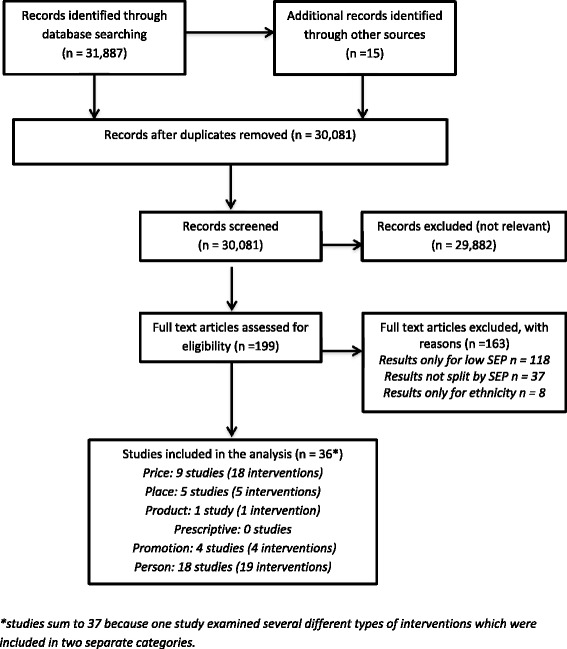
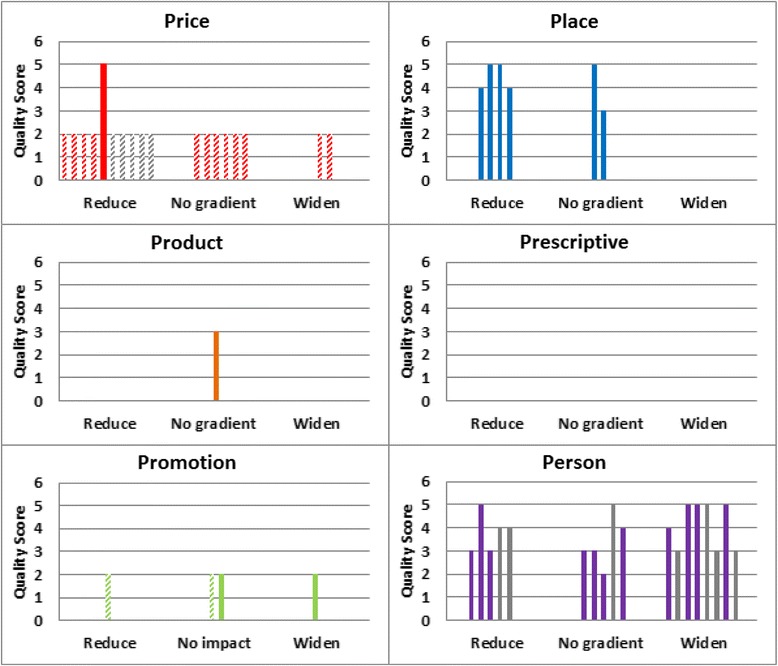
BACKGROUND: Interventions to promote healthy eating make a potentially powerful contribution to the primary prevention of non communicable diseases. It is not known whether healthy eating interventions are equally effective among all sections of the population, nor whether they narrow or widen the health gap between rich and poor. We undertook a systematic review of interventions to promote healthy eating to identify whether impacts differ by socioeconomic position (SEP). METHODS: We searched five bibliographic databases using a pre-piloted search strategy. Retrieved articles were screened independently by two reviewers. Healthier diets were defined as the reduced intake of salt, sugar, trans-fats, saturated fat, total fat, or total calories, or increased consumption of fruit, vegetables and wholegrain. Studies were only included if quantitative results were presented by a measure of SEP. Extracted data were categorised with a modified version of the "4Ps" marketing mix, expanded to 6 "Ps": "Price, Place, Product, Prescriptive, Promotion, and Person". RESULTS: Our search identified 31,887 articles. Following screening, 36 studies were included: 18 "Price" interventions, 6 "Place" interventions, 1 "Product" intervention, zero "Prescriptive" interventions, 4 "Promotion" interventions, and 18 "Person" interventions. "Price" interventions were most effective in groups with lower SEP, and may therefore appear likely to reduce inequalities. All interventions that combined taxes and subsidies consistently decreased inequalities. Conversely, interventions categorised as "Person" had a greater impact with increasing SEP, and may therefore appear likely to reduce inequalities. All four dietary counselling interventions appear likely to widen inequalities. We did not find any "Prescriptive" interventions and only one "Product" intervention that presented differential results and had no impact by SEP. More "Place" interventions were identified and none of these interventions were judged as likely to widen inequalities. CONCLUSIONS: Interventions categorised by a "6 Ps" framework show differential effects on healthy eating outcomes by SEP. "Upstream" interventions categorised as "Price" appeared to decrease inequalities, and "downstream" "Person" interventions, especially dietary counselling seemed to increase inequalities. However the vast majority of studies identified did not explore differential effects by SEP. Interventions aimed at improving population health should be routinely evaluated for differential socioeconomic impact.
Overview
The claims and statistics of this paper haven’t been checked yet.
Run the check — free, no account needed. It reads the open-access text and checks the sources it cites.
Integrity signals
Registry
Cites
Statistics
Figures
Verification
Claims the paper makes
The claims and statistics of this paper haven’t been checked yet.
Run the check — free, no account needed. It reads the open-access text and checks the sources it cites.
Claims other papers make about this one
Each is checked against this paper’s own text: does it say what the citing paper says it does?
In the citing paper
“In addition, population strategies to address diet, such as economic incentives, can reduce socioeconomic-related disparities in health, whereas individual-based approaches may exacerbate inequities.98, 99”
From Dietary and Policy Priorities for Cardiovascular Disease, Diabetes, and Obesity: A Comprehensive Review (2016) · cites this paper as [98]
Self-check
Percentages, sums and reported differences re-computed from the paper’s own numbers.
The self-check needs the paper’s full text.
Citations
Cites
Lim, S. S., Vos, T., Flaxman, A. D., Danaei, G., Shibuya, K., Adair-Rohani, H., AlMazroa, M. A., Amann, M., Anderson, H. R., Andrews, K. G., et al. (2012) · The Lancet · doi:10.1016/s0140-6736(12)61766-8 · Cited by 11,805
Indicators of socioeconomic position (part 1): Figure 1
Galobardes, B., Shaw, M., Lawlor, D. A., Lynch, J. W., & Smith, G. D. (2005) · Journal of Epidemiology & Community Health · doi:10.1136/jech.2004.023531 · Cited by 2,979 · cited 2×
“For each of the included interventions, if the outcome was split by more than one socioeconomic proxy measure, we took the quantitative effect on inequalities from the stratified results that best represented SEP [24,25].”
Socioeconomic factors and cardiovascular disease: a review of the literature.
Kaplan, G. A., & Keil, J. E. (1993) · Circulation · doi:10.1161/01.cir.88.4.1973 · Cited by 1,845
A Framework for Public Health Action: The Health Impact Pyramid
Frieden, T. R. (2010) · American Journal of Public Health · doi:10.2105/ajph.2009.185652 · Cited by 1,535 · cited 2×
“Frieden depicts this difference as a “Health Impact Pyramid” [79].”
(2012) · Choice Reviews Online · doi:10.5860/choice.49-6620 · Cited by 1,284
Evaluating primary care behavioral counseling interventions An evidence-based approach
Whitlock, E. (2002) · American Journal of Preventive Medicine · doi:10.1016/s0749-3797(02)00415-4 · Cited by 1,057 · cited 1×
“Whitlock and colleagues reviewed the effectiveness of counselling interventions on public health [81].”
What types of interventions generate inequalities? Evidence from systematic reviews
Lorenc, T., Petticrew, M., Welch, V., & Tugwell, P. (2013) · Journal of Epidemiology and Community Health · doi:10.1136/jech-2012-201257 · Cited by 927 · cited 1×
“explicitly concluded that “downstream” interventions actually worsen health inequalities [82].”
Self-citationSOCIAL MARKETING IN PUBLIC HEALTH
Grier, S. A., & Bryant, C. A. (2004) · Annual Review of Public Health · doi:10.1146/annurev.publhealth.26.021304.144610 · Cited by 925 · cited 1×
“The “4 Ps” framework is a well-established framework used within the marketing field and translates well to a policy context [31].”
Tackling of unhealthy diets, physical inactivity, and obesity: health effects and cost-effectiveness
Cecchini, M., Sassi, F., Lauer, J. A., Lee, Y. Y., Guajardo-Barron, V., & Chisholm, D. (2010) · The Lancet · doi:10.1016/s0140-6736(10)61514-0 · Cited by 889 · cited 1×
“Preventative interventions are more cost effective when compared to treatment [86].”
Welch, V. A., Petticrew, M. P., Tugwell, P., Moher, D., Petkovic, J., Waters, E., White, H., & the PRISMA-Equity Bellagio group (2012) · PLoS Medicine · doi:10.1371/journal.pmed.1001333 · Cited by 732 · cited 2×
“Upon fulfilling these criteria, studies were assessed utilising a PICOS (Participants, Interventions, Comparators, Outcomes and Study design) [23].”
Self-citation
Research works printed but not linked: 1
- Thomas H. Quality Assessment Tool for Quantitative Studies. Toronto: Effective Public Health Practice Project McMaster University; 2003.
Cited by
Sorted by citations
Mozaffarian, D. (2016) · Circulation · doi:10.1161/circulationaha.115.018585 · Cited by 2,216
“In addition, population strategies to address diet, such as economic incentives, can reduce socioeconomic-related disparities in health, whereas individual-based approaches may exacerbate inequities.(98,99) Evidence-based personalized approaches, especially related to underlying nongenetic characteristics, should be c…”
Bridel, C., van Wieringen, W. N., Zetterberg, H., Tijms, B. M., Teunissen, C. E., and the NFL Group, Alvarez-Cermeño, J. C., Andreasson, U., Axelsson, M., Bäckström, D. C., et al. (2019) · JAMA Neurology · doi:10.1001/jamaneurol.2019.1534 · Cited by 764
Good intentions are not enough: how informatics interventions can worsen inequality
Veinot, T. C., Mitchell, H., & Ancker, J. S. (2018) · Journal of the American Medical Informatics Association · doi:10.1093/jamia/ocy052 · Cited by 704
Brown, K., Rumgay, H., Dunlop, C., Ryan, M., Quartly, F., Cox, A., Deas, A., Elliss‐Brookes, L., Gavin, A., Hounsome, L. S., et al. (2018) · British Journal of Cancer · doi:10.1038/s41416-018-0029-6 · Cited by 558
“Further, many lifestyle ‘choices’ are driven by environmental/societal factors such as food pricing and availability, and susceptibility to these factors varies with socioeconomic position.(33) Differences in risk factor exposure prevalence between countries are generally not large, with the exception of H.”
BackgroundLister, N. B., Baur, L. A., Felix, J. F., Hill, A. J., Marcus, C., Reinehr, T., Summerbell, C., & Wabitsch, M. (2023) · Nature Reviews Disease Primers · doi:10.1038/s41572-023-00435-4 · Cited by 596
Metadata
- Authors
- McGill, R., Anwar, E., Orton, L., Bromley, H., Lloyd-Williams, F., O’Flaherty, M., Taylor-Robinson, D., Guzman-Castillo, M., Gillespie, D., Moreira, P., Allen, K., Hyseni, L., Calder, N., Petticrew, M., White, M., Whitehead, M., & Capewell, S.
- Affiliations
- University of Liverpool (GB)
- London School of Hygiene & Tropical Medicine (GB)
- University of Cambridge (GB)
- Corresponding author
- McGill, Rory
- ORCID
- Venue
- BMC Public Health
- Published
- 2015-05-02
- Volume
- 15
- Issue
- 1
- Pages
- 457-457
- ISSN
- 1471-2458 (ISSN-L)
- PMC
- PMC4423493
- OpenAlex
- W4239413439
- Cited by
- 407
- References
- 83
- Citations by year
- 2026: 18 · 2025: 30 · 2024: 48 · 2023: 33 · 2022: 40 · 2021: 63 · 2020: 42 · 2019: 38 · 2018: 37 · 2017: 32 · 2016: 21 · 2015: 5
- FWCI
- 4.07
- Type
- journal article
- Language
- en
- Update notices
- correction (2015-09-15)
- Open access
- gold
- doi.org
- Locations
- BMC Public Health (publishedVersion, cc-by)
- PubMed Central (publishedVersion, cc-by)
- PubMed (publishedVersion)
- LSHTM Research Online (London School of Hygiene and Tropical Medicine) (acceptedVersion)
- Apollo (University of Cambridge) (submittedVersion, cc-by)
- Apollo
- Funders
- London School of Hygiene and Tropical Medicine
- Wellcome Trust (087636/Z/08/Z)
- National Institute for Health and Care Research
- University of Exeter
- University of Sheffield
- National Institutes of Health
- Medical Research Council (MR/K023187/1)
- Economic and Social Research Council (ES/G007462/1, ES/G007470/1)
- School for Public Health Research
- Topics
- Health Sciences › Nursing › Nutrition and Dietetics › Nutrition, Health and Food Behavior
- Health Sciences › Medicine › Public Health, Environmental and Occupational Health › Nutritional Studies and Diet
- Health Sciences › Medicine › Public Health, Environmental and Occupational Health › Obesity, Physical Activity, Diet
- Keywords
- healthy eating interventions, socioeconomic disparities, socioeconomic position, nutrition counseling, non-communicable disease prevention, dietary intake, fruit and vegetable intake, health disparities
- MeSH terms
- Commerce, Diet, Feeding Behavior, Health Education, Health Promotion, Humans, Socioeconomic Factors, Vegetables, Marketing
About these checks
Registry, retraction, Cites and statistics results are computed, not judged, with one exception: a printed reference that no index lists is read once by a model before it counts as a citation error. Claims are extracted by a model and kept only when their quote appears verbatim in the text; each cited source is then checked, with a model’s help, for whether it says what the claim relies on. Those verdicts can be wrong — read the claim’s quote and the cited source before relying on one.
Statistics and arithmetic are recomputed, not judged.
Confidence bands are shown only for fields calibrated on our annotated test set. None is calibrated yet, so no band is shown.
What counts as a claim ›How we measure confidence ›How we check this ›
Are you an author, or do you see a problem with this page? Request a review
