

Changes in mean serum lipids among adults in Germany: results from National Health Surveys 1997-99 and 2008-11
Open accessThe DOI matches its Crossref record; 60 of the 61 references it cites were found in a registry or an index.
Abstract
BACKGROUND: Monitoring of serum lipid concentrations at the population level is an important public health tool to describe progress in cardiovascular disease risk control and prevention. Using data from two nationally representative health surveys of adults 18-79 years, this study identified changes in mean serum total cholesterol (TC), high-density lipoprotein cholesterol (HDL-C), and triglycerides (TG) in relation to changes in potential determinants of serum lipids between 1997-99 and 2008-11 in Germany. METHODS: Sex-specific multivariable linear regression analyses were performed with serum lipids as dependent variables and survey wave as independent variable and adjusted for the following covariables: age, fasting duration, educational status, lifestyle, and use of medication. RESULTS: Mean TC declined between the two survey periods by 13 % (5.97 mmol/l vs. 5.19 mmol/l) among men and by 12 % (6.03 mmol/l vs. 5.30 mmol/l) among women. Geometric mean TG decreased by 14 % (1.66 mmol/l vs. 1.42 mmol/l) among men and by 8 % (1.20 mmol/l vs. 1.10 mmol/l) among women. Mean HDL-C remained unchanged among men (1.29 mmol/l vs. 1.27 mmol/l), but decreased by 5 % among women (1.66 mmol/l vs. 1.58 mmol/l). Sports activity and coffee consumption increased, while smoking and high alcohol consumption decreased only in men. Processed food consumption increased and wholegrain bread consumption decreased in both sexes, and obesity increased among men. The use of lipid-lowering medication, in particular statins nearly doubled over time in both sexes. Among women, hormonal contraceptive use increased and postmenopausal hormone therapy halved over time. The changes in lipid levels between surveys remained significant after adjusting for covariables. CONCLUSION: Serum TC and TG considerably declined over one decade in Germany, which can be partly explained by increased use of lipid-lowering medication and improved lifestyle among men. The decline in serum lipids among women, however, remains unexplained.
Overview
The claims and statistics of this paper haven’t been checked yet.
Free: it reads the open-access text and checks the first 5 claims that cite a source we can check. Create a free account to check every claim.
Integrity signals
Registry
Cites
Statistics
Figures
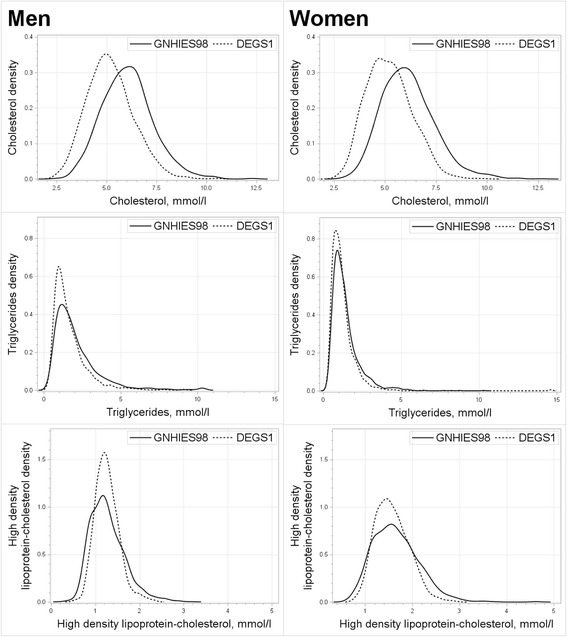
Verification
Claims the paper makes
The claims and statistics of this paper haven’t been checked yet.
Free: it reads the open-access text and checks the first 5 claims that cite a source we can check. Create a free account to check every claim.
Claims other papers make about this one
Each is checked against this paper’s own text: does it say what the citing paper says it does?
The check wasn’t confident either way, so it gives no verdict — never disputed.
In the citing paper
“Its prevalence is ∼10% in the adult population with considerable interregional variation.1–5”
From Clinical review on triglycerides (2020) · cites this paper as [5]
Experimental — accuracy not yet measuredIn the citing paper
“The prevalence of mild-to-moderate HTG parallels that of obesity and Type 2 diabetes; its increase is, therefore, unsurprising over the last few decades.5”
From Clinical review on triglycerides (2020) · cites this paper as [5]
Self-check
Percentages, sums and reported differences re-computed from the paper’s own numbers.
The self-check needs the paper’s full text.
Citations
Cites
Toprak, O., Kurt, H., Sarı, Y., Şarkış, C., Us, H., & Kırık, A. (2017) · Kidney and Blood Pressure Research · doi:10.1159/000468530 · Cited by 29,627
Expert Panel on Detection, E. (2001) · JAMA: The Journal of the American Medical Association · doi:10.1001/jama.285.19.2486 · Cited by 26,011
(2000) · PubMed · Cited by 13,173
Obesity : Preventing and managing the global epidemic
Akram, D. S., Astrup, A. V., Atinmo, T., Boissin, J.-L., Bray, G. A., Carroll, K. N., Chitson, P., Chen, C., Dietz, W. H., Hill, J. O., et al. (2000) · Research at the University of Copenhagen (University of Copenhagen) · Cited by 12,945
Bundesgesundheitsblatt - Gesundheitsforschung - Gesundheitsschutz
(2013) · Bundesgesundheitsblatt - Gesundheitsforschung - Gesundheitsschutz · doi:10.1007/103.1437-1588 · Cited by 11,796
European Guidelines on cardiovascular disease prevention in clinical practice (version 2012)
Authors/Task Force Members:, Perk, J., De Backer, G., Gohlke, H., Graham, I., Reiner, Ž., Verschuren, M., Albus, C., Benlian, P., Boysen, G., et al. (2012) · European Heart Journal · doi:10.1093/eurheartj/ehs092 · Cited by 8,490
Diet, nutrition and the prevention of chronic diseases
Joint, W. (2002) · Medical Entomology and Zoology · Cited by 4,916
ESC/EAS Guidelines for the management of dyslipidaemias
Reiner, Ž., Catapano, A. L., De Backer, G., Graham, I., Taskinen, M.-R., Wiklund, O., Agewall, S., Alegria, E., Chapman, M. J., Durrington, P., et al. (2011) · European Heart Journal · doi:10.1093/eurheartj/ehr158 · Cited by 3,549
Biological, clinical and population relevance of 95 loci for blood lipids
Teslovich, T. M., Musunuru, K., Smith, A. V., Edmondson, A. C., Stylianou, I. M., Koseki, M., Pirruccello, J. P., Ripatti, S., Chasman, D. I., Willer, C. J., et al. (2010) · Nature · doi:10.1038/nature09270 · Cited by 3,487 · cited 1×
“Serum lipid levels are determined by genetic [5] as well as acquired factors, such as lifestyle [6], in particular diet, physical activity, and smoking, use of lipid-lowering medications, use of other medications e.g. hormonal contraceptives [7] and postmenopausal hormone therapy [8], and diseases…”
Swinburn, B., Baba, N. H., Belhadj, M., Deurenberg‐Yap, M., Djazayery, A., Forrester, T., Galuska, D. A., Herman, S. T., James, W. P. T., Kabangu, J. R. M., et al. (2003) · World Health Organization eBooks · Cited by 3,453
Cholesterol-lowering effects of dietary fiber: a meta-analysis
Brown, L., Rosner, B., Willett, W. W., & Sacks, F. M. (1999) · The American Journal of Clinical Nutrition · doi:10.1093/ajcn/69.1.30 · Cited by 1,857
Triglycerides and cardiovascular disease
Nordestgaard, B. G., & Varbo, A. (2014) · The Lancet · doi:10.1016/s0140-6736(14)61177-6 · Cited by 1,419 · cited 1×
“Other dyslipidaemias, including low high density lipoprotein cholesterol (HDL-C) and elevated triglyceride (TG) levels are markers of increased CVD risk; however, the evidence for a causal relationship and practical implications for treatment are less clear [2, 3].”
HDL and cardiovascular disease
Rader, D. J., & Hovingh, G. K. (2014) · The Lancet · doi:10.1016/s0140-6736(14)61217-4 · Cited by 870 · cited 1×
“Other dyslipidaemias, including low high density lipoprotein cholesterol (HDL-C) and elevated triglyceride (TG) levels are markers of increased CVD risk; however, the evidence for a causal relationship and practical implications for treatment are less clear [2, 3].”
Brien, S. E., Ronksley, P. E., Turner, B. J., Mukamal, K. J., & Ghali, W. A. (2011) · BMJ · doi:10.1136/bmj.d636 · Cited by 791
Health effects of trans-fatty acids: experimental and observational evidence
Mozaffarian, D., Aro, A., & Willett, W. C. (2009) · European Journal of Clinical Nutrition · doi:10.1038/sj.ejcn.1602973 · Cited by 662 · cited 1×
“TFA seem to increase CVD risk and, among others, increase serum TC levels and decrease HDL-C levels [41].”
Saturated fat, carbohydrate, and cardiovascular disease
Siri-Tarino, P. W., Sun, Q., Hu, F. B., & Krauss, R. M. (2010) · The American Journal of Clinical Nutrition · doi:10.3945/ajcn.2008.26285 · Cited by 636 · cited 1×
“For instance, increased TG levels are associated with changes in dietary habits when saturated fats are replaced by carbohydrates [32].”
Blood Lipid and Lipoprotein Adaptations to Exercise: A Quantitative Analysis
Durstine, J. L., Grandjean, P. W., Davis, P. G., Ferguson, M. A., Alderson, N. L., & DuBose, K. D. (2001) · Sports Medicine · doi:10.2165/00007256-200131150-00002 · Cited by 588
Farzadfar, F., Finucane, M. M., Danaei, G., Pelizzari, P. M., Cowan, M. J., Paciorek, C. J., Singh, G. M., Lin, J. K., Stevens, G. A., Riley, L. M., et al. (2011) · The Lancet · doi:10.1016/s0140-6736(10)62038-7 · Cited by 513
Rauber, F., Campagnolo, P. D. B., Hoffman, D. J., & Vitolo, M. R. (2015) · Nutrition, Metabolism and Cardiovascular Diseases · doi:10.1016/j.numecd.2014.08.001 · Cited by 488
Mozaffarian, D., & Clarke, R. (2009) · European Journal of Clinical Nutrition · doi:10.1038/sj.ejcn.1602976 · Cited by 410 · cited 1×
“Other studies suggested, that the changes explain about 0.04 mmol/l [45] to 0.08 mmol/l [13] of the TC decline.”
InfluentialScheidt-Nave, C., Kamtsiuris, P., Gößwald, A., Hölling, H., Lange, M., Busch, M. A., Dahm, S., Dölle, R., Ellert, U., Fuchs, J., et al. (2012) · BMC Public Health · doi:10.1186/1471-2458-12-730 · Cited by 403
Self-citationAuthors/Task Force Members:, Perk, J., De Backer, G., Gohlke, H., Graham, I., Reiner, Z., Verschuren, W. M. M., Albus, C., Benlian, P., Boysen, G., et al. (2012) · European Heart Journal · doi:10.1093/eurheartj/ehs254 · Cited by 390
Brauns, H., & Steinmann, S. (1999) · Social Science Open Access Repository (GESIS – Leibniz Institute for the Social Sciences) · Cited by 286
Trends in Lipids and Lipoproteins in US Adults, 1988-2010
Carroll, M. D., Kit, B. K., Lacher, D. A., Shero, S. T., & Mussolino, M. E. (2012) · JAMA · doi:10.1001/jama.2012.13260 · Cited by 282
Kamtsiuris, P., Lange, M., Hoffmann, R., Schaffrath Rosario, A., Dahm, S., Kuhnert, R., & Kurth, B. M. (2013) · Bundesgesundheitsblatt - Gesundheitsforschung - Gesundheitsschutz · doi:10.1007/s00103-012-1650-9 · Cited by 235
The effect of coffee consumption on serum lipids: a meta-analysis of randomized controlled trials
Cai, L., Ma, D., Zhang, Y., Liu, Z., & Wang, P. (2012) · European Journal of Clinical Nutrition · doi:10.1038/ejcn.2012.68 · Cited by 204
Secondary causes of hyperlipidemia.
Stone, N. J. (1994) · Medical Clinics of North America · doi:10.1016/s0025-7125(16)30179-1 · Cited by 199 · cited 1×
“postmenopausal hormone therapy [8], and diseases [9].”
Lampert, T., von der Lippe, E., & Müters, S. (2013) · Bundesgesundheitsblatt - Gesundheitsforschung - Gesundheitsschutz · doi:10.1007/s00103-013-1698-1 · Cited by 189
Walley, T., Folino‐Gallo, P., Stephens, P., Van Ganse, E., & EuroMedStat group (2005) · British Journal of Clinical Pharmacology · doi:10.1111/j.1365-2125.2005.02478.x · Cited by 187
[The German Health Survey. 1997/98].
Bellach, B.-M., Knopf, H. C., & Thefeld, W. (1998) · PubMed · Cited by 184
Self-citationEllison, R. C., Zhang, Y., Qureshi, M. M., Knox, S., Arnett, D. K., & Province, M. A. (2004) · American Heart Journal · doi:10.1016/j.ahj.2003.10.033 · Cited by 168
World-wide consumption of trans fatty acids
Craig-Schmidt, M. C. (2006) · Atherosclerosis Supplements · doi:10.1016/j.atherosclerosissup.2006.04.001 · Cited by 165
The first wave of the German Health Interview and Examination Survey for Adults (DEGS1)
Kamtsiuris, P., Lange, M., Hoffmann, R. G., Rosario, A. S., Dahm, S., Kuhnert, R., & Kurth, B. (2013) · doi:10.25646/1444 · Cited by 154
Knopf, H., & Grams, D. (2013) · Bundesgesundheitsblatt - Gesundheitsforschung - Gesundheitsschutz · doi:10.1007/s00103-013-1667-8 · Cited by 140
Self-citationLipid lowering efficacy of atorvastatin
Adams, S. P., Tsang, M., & Wright, J. M. (2012) · Cochrane Database of Systematic Reviews · doi:10.1002/14651858.cd008226.pub2 · Cited by 126
Atorvastatin for lowering lipids
Adams, S. P., Tsang, M., & Wright, J. M. (2015) · Cochrane Database of Systematic Reviews · doi:10.1002/14651858.cd008226.pub3 · Cited by 124
(2008) · Ernährung - Wissenschaft und Praxis · doi:10.1007/s12082-008-0148-1 · Cited by 119
Prevalence of smoking in the adult population of Germany
Lampert, T., von der Lippe, E., & Müters, S. (2013) · Publication server of the Robert Koch Institute (Robert Kock Institute) · doi:10.25646/1469 · Cited by 113
The new joint EAS/ESC guidelines for the management of dyslipidaemias
Catapano, A. L., Chapman, J., Wiklund, O., & Taskinen, M. (2011) · Atherosclerosis · doi:10.1016/j.atherosclerosis.2011.06.011 · Cited by 111
An ecological study of serum cholesterol and ischaemic heart disease between 1950 and 1990.
Law, M. R., & Wald, N. J. (1994) · PubMed · Cited by 92
ELIASSON, M., JANLERT, U., JANSSON, J. ‐., & STEGMAYR, B. (2006) · Journal of Internal Medicine · doi:10.1111/j.1365-2796.2006.01730.x · Cited by 90
Trends in plasma lipids, lipoproteins and dyslipidaemias in French adults, 1996–2007
Ferrières, J., Bongard, V., Dallongeville, J., Arveiler, D., Cottel, D., Haas, B., Wagner, A., Amouyel, P., & Ruidavets, J. (2009) · Archives of cardiovascular diseases · doi:10.1016/j.acvd.2009.02.002 · Cited by 87
Stender, S., Astrup, A. V., & Dyerberg, J. (2012) · BMJ Open · doi:10.1136/bmjopen-2012-000859 · Cited by 86
Mensink, G., & Beitz, R. (2004) · European Journal of Clinical Nutrition · doi:10.1038/sj.ejcn.1601923 · Cited by 85
Self-citationBrauns, H., & Steinmann, S. (1997) · RePEc: Research Papers in Economics · Cited by 83
Obst- und Gemüsekonsum in Deutschland
Mensink, G., Truthmann, J., Rabenberg, M., Heidemann, C., Haftenberger, M., Schienkiewitz, A., & Richter, A. (2013) · Bundesgesundheitsblatt - Gesundheitsforschung - Gesundheitsschutz · doi:10.1007/s00103-012-1651-8 · Cited by 77
Self-citationMedication of adults in Germany
Knopf, H. C., & Grams, D. (2013) · Publication server of the Robert Koch Institute (Robert Kock Institute) · doi:10.25646/1451 · Cited by 77
Self-citationPfau, C., Oltersdorf, U., & Brombach, C. (2008) · Cited by 62
Valsta, L. M., Tapanainen, H., Sundvall, J., Laatikainen, T., Männistö, S., Pietinen, P., & Vartiainen, E. (2010) · Public Health Nutrition · doi:10.1017/s1368980010001126 · Cited by 55
Ford, E. S., & Capewell, S. (2013) · PLoS ONE · doi:10.1371/journal.pone.0065228 · Cited by 52
Fruit and vegetable intake in Germany
Mensink, G., Truthmann, J., Rabenberg, M., Heidemann, C., Haftenberger, M., Schienkiewitz, A., & Richter, A. (2013) · Publication server of the Robert Koch Institute (Robert Kock Institute) · doi:10.25646/1439 · Cited by 37
Self-citationLipid Profile of Women Using Oral Contraceptive Pills
Naz, F., Jyoti, S., Akhtar, N., Afzal, M., & Siddique, Y. H. (2012) · Pakistan Journal of Biological Sciences · doi:10.3923/pjbs.2012.947.950 · Cited by 35
Sai, A. J., Gallagher, J. C., & Fang, X. (2011) · Menopause The Journal of The North American Menopause Society · doi:10.1097/gme.0b013e318217d41d · Cited by 33
Differences in Menopausal Hormone Therapy Use among Women in Germany between 1998 and 2003
Du, Y., Dören, M., Melchert, H.-U., Scheidt‐Nave, C., & Knopf, H. C. (2007) · BMC Women s Health · doi:10.1186/1472-6874-7-19 · Cited by 33
Self-citationKrachler, B., Eliasson, M., Johansson, I., Hallmans, G., & Lindahl, B. (2005) · Public Health Nutrition · doi:10.1079/phn2004710 · Cited by 32
Trends in risk factor control in Germany 1984–1998: high blood pressure and total cholesterol
Laaser, U., & Breckenkamp, J. (2005) · European Journal of Public Health · doi:10.1093/eurpub/cki062 · Cited by 24
Libuda, L., Alexy, U., & Kersting, M. (2013) · British Journal Of Nutrition · doi:10.1017/s0007114513002031 · Cited by 23
Jansson, J., Boman, K., & Messner, T. (2003) · Scandinavian Journal of Public Health · doi:10.1080/14034950310001397 · Cited by 22
Burger, M., & Mensink, G. (2004) · Public Health Nutrition · doi:10.1079/phn2004631 · Cited by 20
Self-citationRehm, J. T., Sempos, C. T., Kohlmeier, L., Myers, G. L., Thefeld, W., Gunter, E. W., Thamm, M., Dortschy, R., Murphy, R., Feinleib, M., et al. (2000) · European Journal of Epidemiology · doi:10.1023/a:1007693009604 · Cited by 5
Research works printed but not linked: 1
- Klose G Schwabe U Schwabe U Paffrath D Lipidsenkende Mittel Arzneimittelverordnungsreport 2014. Aktuelle Daten, Kosten, Trends und Kommentare 2014 Heidelberg Springer Medizin Verlag
Cited by
Clinical review on triglycerides
Laufs, U., Parhofer, K. G., Ginsberg, H. N., & Hegele, R. A. (2020) · European Heart Journal · doi:10.1093/eurheartj/ehz785 · Cited by 544
“The prevalence of mild-to-moderate HTG parallels that of obesity and Type 2 diabetes; its increase is, therefore, unsurprising over the last few decades.(5) Severe HTG, defined as plasma TG concentration >10 mmol/L (>885 mg/dL) is less common, with prevalence ranging from 0.”
BackgroundRepositioning of the global epicentre of non-optimal cholesterol
NCD Risk Factor Collaboration (NCD-RisC), Taddei, C., Zhou, B., Bixby, H., Carrillo-Larco, R. M., Danaei, G., Jackson, R. T., Farzadfar, F., Sophiea, M. K., Di Cesare, M., et al. (2020) · Nature · doi:10.1038/s41586-020-2338-1 · Cited by 298
NCD Risk Factor Collaboration (NCD-RisC), Taddei, C., Jackson, R., Zhou, B., Bixby, H., Danaei, G., Di Cesare, M., Kuulasmaa, K., Hajifathalian, K., Bentham, J., et al. (2020) · International Journal of Epidemiology · doi:10.1093/ije/dyz099 · Cited by 65
Self-citationOlesen, S. S., Harakow, A., Krogh, K., Drewes, A. M., Handberg, A., & Christensen, P. A. (2021) · Pancreatology · doi:10.1016/j.pan.2021.02.005 · Cited by 67
Time Trends in Cardiometabolic Risk Factors in Adults
Finger, J. D., Busch, M. A., Du, Y., Heidemann, C., Knopf, H. C., Kuhnert, R., Lampert, T., Mensink, G., Neuhauser, H. K., Rosario, A. S., et al. (2016) · Deutsches Ärzteblatt international · doi:10.3238/arztebl.2016.0712 · Cited by 70
Self-citation
Metadata
- Authors
- Truthmann, J., Schienkiewitz, A., Busch, M. A., Mensink, G. B. M., Du, Y., Bosy-Westphal, A., Knopf, H., & Scheidt-Nave, C.
- Affiliations
- Robert Koch Institute (DE)
- Corresponding author
- Truthmann, Julia
- Venue
- BMC Public Health
- Published
- 2016-03-08
- Volume
- 16
- Issue
- 1
- Pages
- 240-240
- ISSN
- 1471-2458 (ISSN-L)
- PMC
- PMC4784325
- OpenAlex
- W2296705127
- Cited by
- 27
- References
- 61
- Citations by year
- 2025: 3 · 2023: 3 · 2021: 6 · 2020: 6 · 2019: 3 · 2018: 2 · 2017: 2 · 2016: 2
- FWCI
- 3.32
- Type
- journal article
- Language
- en
- Open access
- gold
- doi.org
- Licence
- cc-by
- Locations
- BMC Public Health (publishedVersion, cc-by)
- PubMed Central (publishedVersion, cc-by)
- PubMed (publishedVersion)
- Publication server of the Robert Koch Institute (Robert Kock Institute) (submittedVersion)
- DOAJ (DOAJ: Directory of Open Access Journals) (submittedVersion)
- Funders
- Koch Institute for Integrative Cancer Research, Massachusetts Institute of Technology
- Robert Koch Institut
- Topics
- Health Sciences › Medicine › Cardiology and Cardiovascular Medicine › Lipoproteins and Cardiovascular Health
- Health Sciences › Medicine › Endocrinology, Diabetes and Metabolism › Diabetes, Cardiovascular Risks, and Lipoproteins
- Health Sciences › Medicine › Cardiology and Cardiovascular Medicine › Cardiovascular Health and Risk Factors
- Keywords
- serum lipids, total cholesterol, HDL cholesterol, triglycerides, secular trends, lipid-lowering drugs, statins, hormonal contraception, hormone replacement therapy, lifestyle factors, sports activities, coffee consumption, smoking, alcohol consumption, processed food consumption, whole grain bread, obesity, cardiovascular risk, Germany
- MeSH terms
- Adolescent, Adult, Aged, Cardiovascular Diseases, Cholesterol, Female, Germany, Health Surveys, Humans, Life Style, Lipids, Cholesterol, HDL, Male, Middle Aged, Sex Factors, Triglycerides, Young Adult
About these checks
Registry, retraction, Cites and statistics results are computed, not judged, with one exception: a printed reference that no index lists is read once by a model before it counts as a citation error. Claims are extracted by a model and kept only when their quote appears verbatim in the text; each cited source is then checked, with a model’s help, for whether it says what the claim relies on. Those verdicts can be wrong — read the claim’s quote and the cited source before relying on one.
Statistics and arithmetic are recomputed, not judged.
Confidence bands are shown only for fields calibrated on our annotated test set. None is calibrated yet, so no band is shown.
What counts as a claim ›How we measure confidence ›How we check this ›
Are you an author, or do you see a problem with this page? Request a review
Data sources
Bibliographic data: Semantic Scholar, OpenAlex, Crossref.
Contains information from the Semantic Scholar Academic Graph Datasets, made available under the ODC Attribution License (ODC-BY 1.0).
Semantic Scholar’s data is described in: Kinney, R., et al. (2023). The Semantic Scholar Open Data Platform. arXiv:2301.10140.
