

The Healthy Primary School of the Future: study protocol of a quasi-experimental study
Open accessThe DOI matches its Crossref record; 63 of the 64 references it cites were found in a registry or an index.
Abstract
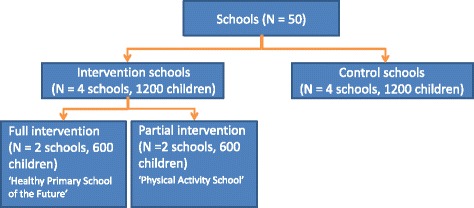
BACKGROUND: Unhealthy lifestyles in early childhood are a major global health challenge. These lifestyles often persist from generation to generation and contribute to a vicious cycle of health-related and social problems. This design article presents a study evaluating the effects of two novel healthy school interventions. The main outcome measure will be changes in children's body mass index (BMI). In addition, lifestyle behaviours, academic achievement, child well-being, socio-economic differences, and societal costs will be examined. METHODS: In close collaboration with various stakeholders, a quasi-experimental study was developed, for which children of four intervention schools (n = 1200) in the southern part of the Netherlands are compared with children of four control schools (n = 1200) in the same region. The interventions started in November 2015. In two of the four intervention schools, a whole-school approach named 'The Healthy Primary School of the Future', is implemented with the aim of improving physical activity and dietary behaviour. For this intervention, pupils are offered an extended curriculum, including a healthy lunch, more physical exercises, and social and educational activities, next to the regular school curriculum. In the two other intervention schools, a physical-activity school approach called 'The Physical Activity School', is implemented, which is essentially similar to the other intervention, except that no lunch is provided. The interventions proceed during a period of 4 years. Apart from the effectiveness of both interventions, the process, the cost-effectiveness, and the expected legal implications are studied. Data collection is conducted within the school system. The baseline measurements started in September 2015 and yearly follow-up measurements are taking place until 2019. DISCUSSION: A whole-school approach is a new concept in the Netherlands. Due to its innovative, multifaceted nature and sound scientific foundation, these integrated programmes have the potential to form a template for primary schools worldwide. The effects of this approach may extend further than the outcomes associated with well-being and academic achievement, potentially impacting legal and cultural aspects in our society. TRIAL REGISTRATION: The study protocol was registered in the database ClinicalTrials.gov on 14-06-2016 with the reference number NCT02800616 .
Overview
The claims and statistics of this paper haven’t been checked yet.
Free: it reads the open-access text and checks the first 5 claims that cite a source we can check. Create a free account to check every claim.
Integrity signals
Registry
Cites
Statistics
Figures
Verification
Claims the paper makes
The claims and statistics of this paper haven’t been checked yet.
Free: it reads the open-access text and checks the first 5 claims that cite a source we can check. Create a free account to check every claim.
Claims other papers make about this one
Each is checked against this paper’s own text: does it say what the citing paper says it does?
The cited source says what the claim attributes to it.
In the citing paper
“This region is characterized by a low SES, compared to the mean for the Netherlands [16,17,18].”
From The Healthy Primary School of the Future: A Contextual Action-Oriented Research Approach (2018) · cites this paper as [18]
In the citing paper
“Health and educational issues, such as a high prevalence of overweight/obesity and high school dropout rates compared to the national average, are a persistent problem in this region, and continue to exist from generation to generation [18,19,20,21].”
From The Healthy Primary School of the Future: A Contextual Action-Oriented Research Approach (2018) · cites this paper as [18]
Self-check
Percentages, sums and reported differences re-computed from the paper’s own numbers.
The self-check needs the paper’s full text.
Citations
Cites
Measuring emotion: The self-assessment manikin and the semantic differential
Bradley, M. M., & Lang, P. J. (1994) · Journal of Behavior Therapy and Experimental Psychiatry · doi:10.1016/0005-7916(94)90063-9 · Cited by 9,538 · cited 1×
“Social, emotional, and academic self-efficacy is assessed in younger children using three questions from the SelfEfficacy Questionnaire for Children (SEQ-C), which is rated using a Manikin scale [41, 42].”
MethodGlobal status report on noncommunicable diseases 2010.
Alwan, A. (2011) · Cited by 8,494
EQ-SD: a measure of health status from the EuroQol Group
Rabin, R., & Charro, F. D. (2001) · Annals of Medicine · doi:10.3109/07853890109002087 · Cited by 5,613 · cited 1×
“Parental well-being and HR-QOL are measured by the Satisfaction With Life Survey (SWLS) questionnaire and the EuroQol – 5-Dimensions Questionnaire (EQ-5D), respectively [49, 50].”
MethodVarni, J. W., Seid, M., & Kurtin, P. S. (2001) · Medical Care · doi:10.1097/00005650-200108000-00006 · Cited by 5,131 · cited 1×
“Childspecific HR-QoL is measured by the validated Paediatric Quality of Life Inventory (PedsQL) and parents complete the proxy version of this questionnaire [37, 38].”
MethodInterventions for preventing obesity in children
Brown, T., Moore, T. H., Hooper, L., Gao, Y., Zayegh, A., Ijaz, S., Elwenspoek, M., Foxen, S. C., Magee, L., O'Malley, C., et al. (2019) · Cochrane Database of Systematic Reviews · doi:10.1002/14651858.cd001871.pub4 · Cited by 2,982
Planning health promotion programs an intervention mapping approach
Bartholomew, L. K., Parcel, G. S., Kok, G., & Gottlieb, N. (2006) · Research Publications (Maastricht University) · Cited by 2,317
Pavot, W., Diener, E., Colvin, C. R., & Sandvik, E. (1991) · Journal of Personality Assessment · doi:10.1207/s15327752jpa5701_17 · Cited by 1,866 · cited 1×
“Parental well-being and HR-QOL are measured by the Satisfaction With Life Survey (SWLS) questionnaire and the EuroQol – 5-Dimensions Questionnaire (EQ-5D), respectively [49, 50].”
Method(1999) · Cited by 1,648
Interventions for preventing obesity in children
Waters, E., de Silva-Sanigorski, A., Burford, B. J., Brown, T., Campbell, K. J., Gao, Y., Armstrong, R., Prosser, L., & Summerbell, C. D. (2011) · Cochrane Database of Systematic Reviews · doi:10.1002/14651858.cd001871.pub3 · Cited by 1,455
Tracking of obesity-related behaviours from childhood to adulthood: A systematic review
Craigie, A. M., Lake, A. A., Kelly, S. A., Adamson, A. J., & Mathers, J. C. (2011) · Maturitas · doi:10.1016/j.maturitas.2011.08.005 · Cited by 1,088
Global status report on noncommunicable diseases
Chan, M. (2010) · Cited by 1,065
Mendis, S., Davis, S., & Norrving, B. (2015) · Stroke · doi:10.1161/strokeaha.115.008097 · Cited by 1,019
Green, L. W., & Glasgow, R. E. (2006) · Evaluation & the Health Professions · doi:10.1177/0163278705284445 · Cited by 922 · cited 1×
“This will facilitate implementation and continuation of the interventions in the long term [58].”
BackgroundThe Strengths and Difficulties Questionnaire (SDQ)
Muris, P., Meesters, C., & van den Berg, F. (2003) · European Child & Adolescent Psychiatry · doi:10.1007/s00787-003-0298-2 · Cited by 920
Self-citationPate (2006) · doi:10.1161/circulationaha.106.177052 · Cited by 755
[Measuring the quality of life in economic evaluations: the Dutch EQ-5D tariff].
Lamers, L. M., Stalmeier, P. F. M., McDonnell, J., Krabbe, P. F. M., & Busschbach, J. J. V. (2005) · PubMed · Cited by 697
A Brief Questionnaire for Measuring Self-Efficacy in Youths
Muris, P. (2001) · Journal of Psychopathology and Behavioral Assessment · doi:10.1023/a:1010961119608 · Cited by 665 · cited 5×
“Abbreviations : CITO centrale eindtoets basisonderwijs, CSPQ comprehensive snack parenting questionnaire, EQ-5D-Y EuroQol 5-Dimensions Youth version, EQ-5D EuroQol 5-Dimensions, GGD regional public health services, PedsQL paediatric quality of life inventory, SDQ strength and difficulties questionnaire, SEQ-C self-eff…”
BackgroundMethodInfluentialSelf-citationInterventions for preventing obesity in children
Waters, E., Silva-Sanigorski, A. D., Burford, B. J., Brown, T., Campbell, K. J., Gao, Y., Armstrong, R., Prosser, L., & Summerbell, C. D. (2014) · Sao Paulo Medical Journal · doi:10.1590/1516-3180.20141322t2 · Cited by 584
Feasibility, reliability, and validity of the EQ-5D-Y: results from a multinational study
Ravens-Sieberer, U., Wille, N., Badia, X., Bonsel, G., Burström, K., Cavrini, G., Devlin, N., Egmar, A.-C., Gusi, N., Herdman, M., et al. (2010) · Quality of Life Research · doi:10.1007/s11136-010-9649-x · Cited by 464 · cited 8×
“Our tertiary research questions are: (1) What is the effect of the full intervention in comparison with the partial intervention and the regular school approach (control schools) on: (a) children ’ s levels of physical activity and sedentary behaviour, nutritional knowledge, healthy food preferences and behaviour, cog…”
MethodInfluentialSchram, M. T., Sep, S. J. S., van der Kallen, C. J., Dagnelie, P. C., Koster, A., Schaper, N., Henry, R. M. A., & Stehouwer, C. D. A. (2014) · European Journal of Epidemiology · doi:10.1007/s10654-014-9889-0 · Cited by 457 · cited 1×
“All questions about SES have been derived from previous, large-scale Dutch studies, including those specifically addressing socio-economic inequalities in health [51–53].”
MethodAge-Related Consequences of Childhood Obesity
Kelsey, M. M., Zaepfel, A., Bjornstad, P., & Nadeau, K. J. (2014) · Gerontology · doi:10.1159/000356023 · Cited by 442 · cited 1×
“Even in early childhood, unhealthy behaviours contribute to major issues such as a reduced health-related quality of life (HR-QoL), psychosocial problems, and chronic diseases including obesity [3–5].”
BackgroundGreen, L. W., Kreuter, M. W., & Lefebvre, R. C. (2000) · Social Marketing Quarterly · doi:10.1080/15245004.2000.9961104 · Cited by 427
Systematic review of physical activity and cognitive development in early childhood
Carson, V., Hunter, S., Kuzik, N., Wiebe, S. A., Spence, J. C., Friedman, A., Tremblay, M. S., Slater, L., & Hinkley, T. (2016) · Journal of Science and Medicine in Sport · doi:10.1016/j.jsams.2015.07.011 · Cited by 355 · cited 1×
“In addition, there is some prelimin-ary evidence that lifestyle interventions improve academic achievements, thereby helping schools to achieve their primary academic goals [11 – 13].”
BackgroundSchönbeck, Y., Talma, H., van Dommelen, P., Bakker, B., Buitendijk, S. E., HiraSing, R. A., & van Buuren, S. (2011) · PLoS ONE · doi:10.1371/journal.pone.0027608 · Cited by 352 · cited 1×
“BMI Z-scores are calculated using Dutch reference values [32].”
MethodPsychological correlates of childhood obesity
Puder, J. J., & Munsch, S. (2010) · International Journal of Obesity · doi:10.1038/ijo.2010.238 · Cited by 306 · cited 1×
“Even in early childhood, unhealthy behaviours contribute to major issues such as a reduced health-related quality of life (HR-QoL), psychosocial problems, and chronic diseases including obesity [3 – 5].”
BackgroundKhambalia, A. Z., Dickinson, S., Hardy, L. L., Gill, T., & Baur, L. A. (2012) · Obesity Reviews · doi:10.1111/j.1467-789x.2011.00947.x · Cited by 304 · cited 2×
“Admittedly, the potential of school-based interventions to normalize BMI is found to be modest [14, 15, 18].”
BackgroundSchool‐based obesity prevention programs: A meta‐analysis of randomized controlled trials
Sobol‐Goldberg, S., Rabinowitz, J., & Gross, R. (2013) · Obesity · doi:10.1002/oby.20515 · Cited by 231 · cited 1×
“Admittedly, the potential of school-based interventions to normalize BMI is found to be modest [14, 15, 18].”
BackgroundSystematic review and meta-analysis of school-based interventions to reduce body mass index
Lavelle, H. V., Mackay, D. F., & Pell, J. P. (2012) · Journal of Public Health · doi:10.1093/pubmed/fdr116 · Cited by 212 · cited 1×
“Physical education seems to be one of the most viable components to effectively decrease obesity rates in schools [20, 22].”
BackgroundMackenbach, J. P., van de Mheen, H., & Stronks, K. (1994) · Social Science & Medicine · doi:10.1016/0277-9536(94)90399-9 · Cited by 195 · cited 1×
“All questions about SES have been derived from previous, large-scale Dutch studies, including those specifically addressing socio-economic inequalities in health [51 – 53].”
MethodVan Assema, P., Brug, J., Ronda, G., Steenhuis, I., & Oenema, A. (2002) · Nutrition and Health · doi:10.1177/026010600201600203 · Cited by 193
Taylor, R. W., McAuley, K. A., Barbezat, W., Strong, A., Williams, S. M., & Mann, J. I. (2007) · The American Journal of Clinical Nutrition · doi:10.1093/ajcn/86.3.735 · Cited by 186 · cited 1×
“Detecting this difference is feasible in this population, as a school-based longitudinal study with comparable intervention components found a mean difference between the intervention and control groups of − 0.26 (CI 95 %: − 0.32, − 0.21) BMI Z -score [55].”
BackgroundInfluentialEngelen, V., Haentjens, M. M., Detmar, S. B., Koopman, H. M., & Grootenhuis, M. A. (2009) · BMC Pediatrics · doi:10.1186/1471-2431-9-68 · Cited by 185
Estimation of Aerobic Fitness from 20-m Multistage Shuttle Run Test Performance
Mahar, M. T., Guerieri, A. M., Hanna, M. S., & Kemble, C. D. (2011) · American Journal of Preventive Medicine · doi:10.1016/j.amepre.2011.07.008 · Cited by 176 · cited 1×
“During PE lessons, children perform a 20-m shuttle run test, better known as the Progressive Aerobic Cardiovascular Endurance Run (PACER) as a measure of their cardiorespiratory fitness [44].”
Methodvan Lier, P. A. C., Muthén, B. O., van der Sar, R. M., & Crijnen, A. A. M. (2004) · Journal of Consulting and Clinical Psychology · doi:10.1037/0022-006x.72.3.467 · Cited by 172
Katz, D. L. (2009) · Annual Review of Public Health · doi:10.1146/annurev.publhealth.031308.100307 · Cited by 169 · cited 1×
“For instance, the school setting offers the advantages of facilitating compliance with an intervention and also enables preventive measures to reach children from a variety of socio-economic and ethnic backgrounds [8, 9].”
BackgroundVan Assema, P., Brug, J., Ronda, G., & Steenhuis, I. (2001) · Journal of Human Nutrition and Dietetics · doi:10.1046/j.1365-277x.2001.00310.x · Cited by 167
van Stralen, M. M., Yıldırım, M., Wulp, A., te Velde, S. J., Verloigne, M., Doessegger, A., Androutsos, O., Kovács, É., Brug, J., & Chinapaw, M. J. M. (2014) · Journal of Science and Medicine in Sport · doi:10.1016/j.jsams.2013.04.019 · Cited by 144
Direct and indirect effects of body weight on adult wages
Han, E., Norton, E. C., & Powell, L. M. (2011) · Economics & Human Biology · doi:10.1016/j.ehb.2011.07.002 · Cited by 122 · cited 7×
“Privacy-sensitive questions, such as parental BMI, SES and disease status will not be mandatory to complete.”
BackgroundInfluentialHollar, D., Lombardo, M., Lopez-Mitnik, G., Hollar, T. L., Almon, M., Agatston, A. S., & Messiah, S. E. (2010) · Journal of Health Care for the Poor and Underserved · doi:10.1353/hpu.0.0304 · Cited by 114 · cited 1×
“In addition, there is some prelimin-ary evidence that lifestyle interventions improve academic achievements, thereby helping schools to achieve their primary academic goals [11 – 13].”
BackgroundAge-Specific Reliability of Two Grip-Strength Dynamometers When Used by Children
Molenaar, H. M., Zuidam, J. M., Selles, R. W., Stam, H. J., & Hovius, S. E. R. (2008) · Journal of Bone and Joint Surgery · doi:10.2106/jbjs.g.00469 · Cited by 98 · cited 1×
“Handgrip strength is measured with a calibrated Jamar hydraulic hand dynamometer (model 5030 J1, Jamar, Huthwaite, United Kingdom) to the nearest 0.5 kg [34].”
MethodInfluentialEffectiveness of a primary school-based intervention to reduce overweight
Jansen, W., Borsboom, G., Meima, A., Zwanenburg, E. J.-V., Mackenbach, J. P., Raat, H., & Brug, J. (2011) · International Journal of Pediatric Obesity · doi:10.3109/17477166.2011.575151 · Cited by 93 · cited 1×
“➢ ‘Lekker Fit’ program: healthy lifestyle education with physical activity and nutrition lessons as part of the curriculum [60].”
BackgroundGevers, D. W. M., Kremers, S., de Vries, N. K., & van Assema, P. (2014) · Appetite · doi:10.1016/j.appet.2014.04.002 · Cited by 84 · cited 3×
“Parental practices regarding physical activity are assessed by a questionnaire developed in the same style as the CSPQ. Parental well-being and HR-QOL are measured by the Satisfaction With Life Survey (SWLS) questionnaire and the EuroQol – 5-Dimensions Questionnaire (EQ-5D), respectively [49, 50].”
BackgroundSelf-citationValidity and responsiveness of four measures of occupational sitting and standing
van Nassau, F., Chau, J. Y., Lakerveld, J., Bauman, A. E., & van der Ploeg, H. P. (2015) · International Journal of Behavioral Nutrition and Physical Activity · doi:10.1186/s12966-015-0306-1 · Cited by 83
Meng, L., Xu, H., Liu, A., van Raaij, J., Bemelmans, W., Hu, X., Zhang, Q., Du, S., Fang, H., Ma, J., et al. (2013) · PLoS ONE · doi:10.1371/journal.pone.0077971 · Cited by 71 · cited 1×
“Despite the relatively high costs of school-based interventions, existing programmes have been found to be cost-effective in terms of body mass index (BMI) improvements and HR-QoL gains [16, 17].”
BackgroundKwaliteit van leven meten in economische evaluaties: het Nederlands EQ-5D-tarief
Lamers, L. M., Stalmeier, P. F. M., McDonnell, J., Krabbe, P. F. M., & Busschbach, J. J. V. (2005) · University of Groningen research database (University of Groningen / Centre for Information Technology) · Cited by 69
SDQ: discriminative validity and diagnostic potential
Silva, T. B. F., Osório, F. L., & Loureiro, S. R. (2015) · Frontiers in Psychology · doi:10.3389/fpsyg.2015.00811 · Cited by 65 · cited 1×
“Psychological attributes (emotional symptoms, conduct problems, hyperactivity/inattention, peer relationship problems and prosocial behaviour) are measured by means of the Strength and Difficulties Questionnaire, a well-validated index of psychosocial functioning in children [39, 40].”
MethodClustering of food and activity preferences in primary school children
Rodenburg, G., Oenema, A., Pasma, M., Kremers, S., & van de Mheen, D. (2012) · Appetite · doi:10.1016/j.appet.2012.10.007 · Cited by 64 · cited 1×
“These questions were developed based on an existing instrument previously used in the INPACT study [47].”
MethodSelf-citationLifetime cost effectiveness of a through-school nutrition and physical programme: Project Energize
Rush, E. C., Obolonkin, V., McLennan, S., Graham, D., Harris, J., Mernagh, P., & Weston, A. R. (2013) · Obesity Research & Clinical Practice · doi:10.1016/j.orcp.2013.03.005 · Cited by 60 · cited 1×
“Despite the relatively high costs of school-based interventions, existing programmes have been found to be cost-effective in terms of body mass index (BMI) improvements and HR-QoL gains [16, 17].”
BackgroundGender gaps in primary school achievement
Golsteyn, B., & Schils, T. (2014) · Economics of Education Review · doi:10.1016/j.econedurev.2014.04.001 · Cited by 60 · cited 7×
“All participating schools are primary schools situated in the Parkstad region in the Province of Limburg, in the southern part of the Netherlands.”
BackgroundInfluentialSelf-citationSaraf, D. S., Nongkynrih, B., Pandav, C. S., Gupta, S. K., Shah, B., Kapoor, S. K., & Krishnan, A. (2012) · Asia Pacific Journal of Public Health · doi:10.1177/1010539512445053 · Cited by 50 · cited 2×
“Admittedly, the potential of school-based interventions to normalize BMI is found to be modest [14, 15, 18].”
BackgroundPsychosocial Perspectives and the Issue of Prevention in Childhood Obesity
Stein, D. J., Weinberger-Litman, S. L., & Latzer, Y. (2014) · Frontiers in Public Health · doi:10.3389/fpubh.2014.00104 · Cited by 46 · cited 7×
“Privacy-sensitive questions, such as parental BMI, SES and disease status will not be mandatory to complete.”
BackgroundInfluentialParental Preferences for Primary School Characteristics
Borghans, L., Golsteyn, B., & Zölitz, U. (2014) · The B E Journal of Economic Analysis & Policy · doi:10.1515/bejeap-2014-0032 · Cited by 41 · cited 9×
“All participating schools are primary schools situated in the Parkstad region in the Province of Limburg, in the southern part of the Netherlands.”
BackgroundInfluentialSelf-citationvan den Akker, M., Spigt, M., Raeve, L. D., van Steenkiste, B., Metsemakers, J. F. M., van Voorst, E. J., & de Vries, H. (2008) · BMC Public Health · doi:10.1186/1471-2458-8-19 · Cited by 30
van Breukelen, G., Candel, M. J. J. M., & Berger, M. P. F. (2007) · Statistical Methods in Medical Research · doi:10.1177/0962280206079018 · Cited by 27
Vermaire, J. H., van Loveren, C., Poorterman, J. H. G., & Hoogstraten, J. (2011) · Caries Research · doi:10.1159/000325742 · Cited by 19 · cited 1×
“For example, it is known that participants with a low SES are usually underrepresented in scientific studies [59].”
BackgroundTheunissen, M., van, I. G., Verdonk, P., FERON, F. J. M., & Bosma, H. (2012) · BMC Public Health · doi:10.1186/1471-2458-12-1033 · Cited by 19
Self-citationIntraclass Correlations Among Physiologic Measures in Children and Adolescents
Amorim, L. D. A. F., Bangdiwala, S. I., McMurray, R. G., Creighton, D., & Harrell, J. (2007) · Nursing Research · doi:10.1097/01.nnr.0000289497.91918.94 · Cited by 18 · cited 1×
“…80 % Independent-samples t -test on difference in absolute BMI Z -scores An intraclass correlation coefficient of 0.01, as based on Amorim et al. [64] Unequal cluster sizes with a relative efficiency of 90 % [65] A dropout rate of 20 % (including both study drop-out and natural drop-out such as…”
MethodInfluentialNansel, T. R., Huang, T. T., Rovner, A. J., & Sanders-Butler, Y. (2010) · Public Health Nutrition · doi:10.1017/s1368980009005898 · Cited by 17 · cited 1×
“In addition, there is some preliminary evidence that lifestyle interventions improve academic achievements, thereby helping schools to achieve their primary academic goals [11–13].”
BackgroundA collaborative approach to tailored whole-school health promotion : the schoolBeat study
Leurs, M. T. W. (2008) · Research Publications (Maastricht University) · doi:10.26481/dis.20080516ml · Cited by 17
A Mixed-Methods Evaluation of School-Based Active Living Programs
McCreary, L. L., Park, C. G., Gomez-Feliciano, L., Peterson, S., Pino, D. S., & McElmurry, B. J. (2012) · American Journal of Preventive Medicine · doi:10.1016/j.amepre.2012.06.030 · Cited by 15 · cited 1×
“Physical education seems to be one of the most viable components to effectively decrease obesity rates in schools [20, 22].”
BackgroundA Collaborative approach to tailored whole-school health promotion
Schaalma, H. P., de Vries, N. K., Mur-Veeman, I. M., Jansen, M. W. J., & Leurs, M. T. W. (2002) · Cited by 11
Self-citationSystematic promotion of physical activity
Kremers, S., Meertens, R. M., & Ruiter, R. A. C. (2017) · Oxford University Press eBooks · doi:10.1093/med/9780198757672.003.0022 · Cited by 5 · cited 1×
“To support and encourage the schools, we searched for relevant and evidence-based additional activities, using a systematic health promotion approach, based on the PRECEDEPROCEED model [7, 29] and the Intervention Mapping protocol [30].”
MethodSelf-citationSystematic promotion of physical activity
Kremers, S., Schaalma, H. P., Meertens, R. M., van Mechelen, W., & Kok, G. (2008) · Oxford University Press eBooks · doi:10.1093/med/9780199232482.003.0030 · Cited by 3
Self-citation
Research works printed but not linked: 6
- Jansen M Kuppens E Op zoek naar de Limburg-factor [seeking the Limburg-factor] 2015 Geleen GGD Zuid Limburg
- Vermeer AJM Boot NMWM Hesdahl MH Janssen-Goffin MJH Linssen ECAJ Rutten N Hajema KJ Lokale rapporten Volksgezondheid Toekomst Verkenning: Een nieuwe kijk op gezondheid in Heerlen, Kerkrade, Landgraaf en Brunssum; [Local reports on Public Health Development: A new perspective on health in Heerlen, Kerkrade, Landgraaf and Brunssum] 2014 Geleen GGD Zuid Limburg
- Driessen G Claassen A Smit F Variatie in schooltijden; Een internationale literatuurstudie naar de effecten van verschillende invullingen van de schooldag, de schoolweek en het schooljaar 2010 Nijmegen Radboud Universiteit Nijmegen 108
- WHO. Waist Circumference and Waist-Hip Ratio: Report of a WHO Expert Consultation. Geneva: World Health Organisation Press; 2008. p.47.
- Slingerland M Bij modern bewegingsonderwijs wordt…… bewogen!: een praktijkartikel over het intensiveren van de les LO [In modern physical education lessons pupils……move!: a practice-based article about intensivating the physical education lessons] Lichamelijke opvoeding. 2011 5 28 30
- Battjes-Fries MCE van Dongen EJI Haveman-Nies A Evaluatie van smaaklessen: heeft smaaklessen effect op determinanten van gezond en bewust eetgedrag? [Evaluation of taste lessons: do taste lessons influence determinants of healthy and conscious eating behaviour?] 2013 Wageningen Wageningen University
Cited by
Bartelink, N. H. M., van Assema, P., Kremers, S. P. J., Savelberg, H. H. C. M., Oosterhoff, M., Willeboordse, M., van Schayck, O. C. P., Winkens, B., & Jansen, M. W. J. (2019) · Nutrients · doi:10.3390/nu11030689 · Cited by 165
“Children’s ethnicity was determined by the country of birth of both parents and divided into (1) Western background (including the Netherlands) and (2) non-Western background [47].”
BackgroundMethodInfluentialSelf-citationThe Moderating Role of the School Context on the Effects of the Healthy Primary School of the Future
Bartelink, N. H. M., van Assema, P., Jansen, M. W. J., Savelberg, H. H. C. M., & Kremers, S. (2019) · International Journal of Environmental Research and Public Health · doi:10.3390/ijerph16132432 · Cited by 108
“The study protocol was peer-reviewed by the Limburg provincial authorities and Maastricht University.”
BackgroundResultSelf-citationProcess evaluation of the Healthy Primary School of the Future: the key learning points
Bartelink, N. H. M., van Assema, P., Jansen, M. W. J., Savelberg, H. H. C. M., Moore, G. F., Hawkins, J. L., & Kremers, S. (2019) · BMC Public Health · doi:10.1186/s12889-019-6947-2 · Cited by 83
“Together they developed the idea for the HPSF initiative [19].”
BackgroundMethodInfluentialSelf-citationvan Rinsum, C. E., Gerards, S. M. P. L., Rutten, G. M., Philippens, N., Janssen, E., Winkens, B., van de Goor, I., & Kremers, S. (2018) · International Journal of Environmental Research and Public Health · doi:10.3390/ijerph15040680 · Cited by 54
“The recruitment of children mostly took place via referral by Youth Health Care (YHC) professionals, schools (such as those taking part in the “Healthy Elementary School of the Future” programme [31]), pedagogical workers and paediatricians in two regions (‘s-Hertogenbosch and Breda) in one of the same two provinces.”
BackgroundSelf-citationBartelink, N. H. M., van Assema, P., Kremers, S. P. J., Savelberg, H. H. C. M., Oosterhoff, M., Willeboordse, M., van Schayck, O. C. P., Winkens, B., & Jansen, M. W. J. (2019) · BMJ Open · doi:10.1136/bmjopen-2019-030676 · Cited by 40
Self-citation
Metadata
- Authors
- Willeboordse, M., Jansen, M. W., van den Heijkant, S. N., Simons, A., Winkens, B., de Groot, R. H. M., Bartelink, N., Kremers, S. P., van Assema, P., Savelberg, H. H., de Neubourg, E., Borghans, L., Schils, T., Coppens, K. M., Dietvorst, R., ten Hoopen, R., Coomans, F., Klosse, S., Conjaerts, M. H. J., Oosterhoff, M., Joore, M. A., Ferreira, I., Muris, P., Bosma, H., Toppenberg, H. L., & van Schayck, C. P.
- Affiliations
- Maastricht University (NL)
- Maastricht University Medical Centre (NL)
- The University of Queensland (AU)
- Corresponding author
- Jansen, M. W.
- ORCID
- Venue
- BMC Public Health
- Published
- 2016-07-26
- Volume
- 16
- Issue
- 1
- Pages
- 639-639
- ISSN
- 1471-2458 (ISSN-L)
- PMC
- PMC4960894
- OpenAlex
- W2494937978
- Cited by
- 54
- References
- 64
- Citations by year
- 2026: 4 · 2025: 2 · 2024: 3 · 2023: 6 · 2022: 3 · 2021: 4 · 2020: 11 · 2019: 9 · 2018: 9 · 2017: 3
- FWCI
- 14.57
- Type
- journal article
- Language
- en
- Update notices
- correction (2017-04-11)
- Open access
- gold
- doi.org
- Licence
- Locations
- BMC Public Health (publishedVersion, cc-by)
- PubMed Central (publishedVersion, cc-by)
- PubMed (publishedVersion)
- DSpace (Open University in the Netherlands) (publishedVersion, cc-by)
- Research Publications (Maastricht University) (acceptedVersion, cc-by)
- Research Online (University of Wollongong) (submittedVersion)
- DOAJ (DOAJ: Directory of Open Access Journals) (submittedVersion, cc-by-sa)
- DSpace (Open University in the Netherlands) (submittedVersion, cc-by)
- Figshare (submittedVersion)
- SUNScholar (Stellenbosch University) (submittedVersion)
- DSpace (Open University in the Netherlands) (submittedVersion)
- Research Publications (Maastricht University) (submittedVersion, other-oa)
- Funders
- Limburg provincial authorities (200130003)
- Friesland Campina (LLMV00)
- Universiteit Maastricht
- Topics
- Health Sciences › Medicine › Public Health, Environmental and Occupational Health › School Health and Nursing Education
- Health Sciences › Medicine › Public Health, Environmental and Occupational Health › Obesity, Physical Activity, Diet
- Health Sciences › Medicine › Public Health, Environmental and Occupational Health › Physical Activity and Health
- Keywords
- whole-school approach, elementary school students, childhood obesity, body mass index, physical activity, dietary behaviour, academic performance, child well-being, socioeconomic disparities, cost-effectiveness, unhealthy lifestyle
- MeSH terms
- Child, Child Welfare, Child, Preschool, Clinical Protocols, Cost-Benefit Analysis, Curriculum, Female, Health Promotion, Humans, Life Style, Male, Netherlands, School Health Services, Schools, Program Evaluation, Exercise, Non-Randomized Controlled Trials as Topic
About these checks
Registry, retraction, Cites and statistics results are computed, not judged, with one exception: a printed reference that no index lists is read once by a model before it counts as a citation error. Claims are extracted by a model and kept only when their quote appears verbatim in the text; each cited source is then checked, with a model’s help, for whether it says what the claim relies on. Those verdicts can be wrong — read the claim’s quote and the cited source before relying on one.
Statistics and arithmetic are recomputed, not judged.
Confidence bands are shown only for fields calibrated on our annotated test set. None is calibrated yet, so no band is shown.
What counts as a claim ›How we measure confidence ›How we check this ›
Are you an author, or do you see a problem with this page? Request a review
Data sources
Bibliographic data: Semantic Scholar, OpenAlex, Crossref.
Contains information from the Semantic Scholar Academic Graph Datasets, made available under the ODC Attribution License (ODC-BY 1.0).
Semantic Scholar’s data is described in: Kinney, R., et al. (2023). The Semantic Scholar Open Data Platform. arXiv:2301.10140.
