

‘Fit for school’ – a school-based water, sanitation and hygiene programme to improve child health: Results from a longitudinal study in Cambodia, Indonesia and Lao PDR
Open accessThe DOI matches its Crossref record; 43 of the 43 references it cites were found in a registry or an index.
Abstract
The Fit for School (FIT) programme integrates school health and Water, Sanitation and Hygiene interventions, which are implemented by the Ministries of Education in four Southeast Asian countries. This paper describes the findings of a Health Outcome Study, which aimed to assess the two-year effect of the FIT programme on the parasitological, weight, and oral health status of children attending schools implementing the programme in Cambodia, Indonesia and Lao PDR. The study was a non-randomized clustered controlled trial with a follow-up period of two years. The intervention group consisted of children attending public elementary schools implementing the FIT programme, including daily group handwashing with soap and toothbrushing with fluoride toothpaste, biannual school-based deworming; as well as construction of group handwashing facilities. Control schools implemented the regular government health education curriculum and biannual deworming. Per school, a random selection of six to seven-year-old grade-one students was drawn. Data on parasitological infections, anthropometric measurements, dental caries, odontogenic infections and sociodemographic characteristics were collected at baseline and at follow-up (24 months later). Data were analysed using the χ 2 -test, Mann Whitney U-test and multilevel logistic and linear regression. A total of 1847 children (mean age = 6.7 years, range 6.0–8.0 years) participated in the baseline survey. Of these, 1499 children were available for follow-up examination – 478, 486 and 535 children in Cambodia, Indonesia and Lao PDR, respectively. In all three countries, children in intervention schools had a lower increment in the number of decayed, missing and filled permanent teeth between baseline and follow-up, in comparison to children in controls schools. The preventive fraction was 24% at average. The prevalence of soil-transmitted helminth infection (which was unexpectedly low at baseline), the prevalence of thinness and the prevalence of odontogenic infections did not significantly differ between baseline and follow-up, nor between intervention and control schools. The study found that the FIT programme significantly contributed to the prevention of dental caries in children. This study describes the challenges, learnings and, moreover, the importance of conducting real-life implementation research to evaluate health programmes to transform school settings into healthy learning environments for children. The study is retrospectively registered with the German Clinical Trials Register, University of Freiburg (Trial registration number: DRKS00004485, date of registration: 26th of February, 2013).
Overview
The claims and statistics of this paper haven’t been checked yet.
Free: it reads the open-access text and checks the first 5 claims that cite a source we can check. Create a free account to check every claim.
Integrity signals
Registry
Cites
Statistics
Figures
Verification
Claims the paper makes
The claims and statistics of this paper haven’t been checked yet.
Free: it reads the open-access text and checks the first 5 claims that cite a source we can check. Create a free account to check every claim.
Claims other papers make about this one
Each is checked against this paper’s own text: does it say what the citing paper says it does?
The cited source says what the claim attributes to it.
In the citing paper
“Four of the 18 publications reported no evidence of reduced risk for the primary disease-related outcome measures, including soil-transmitted helminths and E. coli on pupils’ hands [17,20,25,26].”
From Water, Sanitation and Hygiene (WASH) in Schools in Low-Income Countries: A Review of Evidence of Impact (2019) · cites this paper as [20]
The check wasn’t confident either way, so it gives no verdict — never disputed.
In the citing paper
“There is evidence, however, that latrine construction, without other supporting water and hygiene-related interventions, is not effective at reducing diarrhoeal disease [11, 20).”
From Water, Sanitation and Hygiene (WASH) in Schools in Low-Income Countries: A Review of Evidence of Impact (2019) · cites this paper as [20]
Experimental — accuracy not yet measured
Self-check
Percentages, sums and reported differences re-computed from the paper’s own numbers.
The self-check needs the paper’s full text.
Citations
Cites
1 retracted
Community-based population-level interventions for promoting child oral health
de Silva, A. M., Hegde, S., Nwagbara, B. A., Calache, H., Gussy, M. G., Nasser, M., Morrice, H. R., Riggs, E., Leong, P., Meyenn, L. K., et al. (2016) · Cochrane Database of Systematic Reviews · doi:10.1002/14651858.cd009837.pub2 · Cited by 148
RetractedDevelopment of a WHO growth reference for school-aged children and adolescents
de Onis, M. (2007) · Bulletin of the World Health Organization · doi:10.2471/blt.07.043497 · Cited by 8,826 · cited 1×
“Body mass index (BMI) was computed as weigh/height(2) (kg/m(2)) and converted to BMI for age z-scores using the 2007 WHO Growth reference for school-aged children and adolescents [21].”
MethodOral Health Surveys: Basic Methods
Organization, W. H. (1971) · Biometrics · doi:10.2307/2528861 · Cited by 3,698
Soil-transmitted helminth infections: ascariasis, trichuriasis, and hookworm
Bethony, J., Brooker, S., Albonico, M., Geiger, S. M., Loukas, A., Diemert, D., & Hotez, P. J. (2006) · The Lancet · doi:10.1016/s0140-6736(06)68653-4 · Cited by 2,478
Global burden of childhood pneumonia and diarrhoea
Walker, C. L. F., Rudan, I., Liu, L., Nair, H., Theodoratou, E., Bhutta, Z. A., O'Brien, K. L., Campbell, H., & Black, R. E. (2013) · The Lancet · doi:10.1016/s0140-6736(13)60222-6 · Cited by 2,356
Worms: Identifying Impacts on Education and Health in the Presence of Treatment Externalities
Miguel, E., & Kremer, M. (2004) · Econometrica · doi:10.1111/j.1468-0262.2004.00481.x · Cited by 2,268
Prevention and control of schistosomiasis and soil-transmitted helminthiasis.
(2002) · PubMed · Cited by 1,527
The emerging epidemic of obesity in developing countries
Prentice, A. M. (2006) · International Journal of Epidemiology · doi:10.1093/ije/dyi272 · Cited by 1,204 · cited 1×
“The emergence of obesity as a major public health problem in developing countries has been frequently reported [41, 42].”
BackgroundChild undernutrition, tropical enteropathy, toilets, and handwashing
Humphrey, J. H. (2009) · The Lancet · doi:10.1016/s0140-6736(09)60950-8 · Cited by 862 · cited 1×
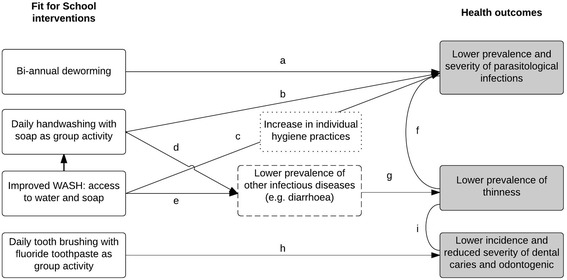
“f, g Lower prevalence of worm infection and diarrhoea have been associated with weight gain [35, 46].”
BackgroundFluoride toothpastes for preventing dental caries in children and adolescents
Marinho, V. C., Higgins, J., Logan, S., & Sheiham deceased, A. (2003) · Cochrane Database of Systematic Reviews · doi:10.1002/14651858.cd002278 · Cited by 845 · cited 2×
“fluoride toothpaste prevents dental caries and odontogenic infections [31].”
Result
Research works printed but not linked: 6
- Benzian H Williams D The challenge of oral disease – a call for global action. The oral health atlas. 2nd ed 2015 Geneva FDI World Dental Federation
- UNDP Support to the implementation of the sustainable development goals Goal 6. Sustainable management of water and sanitation. United Nations development Programme 2016
- Cogill B 2003 revised edition anthropometric indicators measurement guide 2003 Washington DC Academy for Educational Development
- UNICEF WASH in schools monitoring package 2011
- Monse B Panesar A Roach E Wendland C Wienpahl I Schlenk J Toetzke J Case 15: Philippines, Cambodia, Indonesia, Lao PDR. Strengthening the evidence of group handwashing in schools Sustainable sanitation alliance. Making WASH in schools more sustainable: case stories from SuSaNa partners (Vol. 2) 2015
- van Palenstein Helderman W, Holmgren C, Monse B, Benzian H. Caries prevention and control in low- and middle-income countries. In: Fejerskov O, Nyvad B, Kidd (Eds). Dental Caries: the disease and its clinical management. Wiley-Blackwell; 405: 2015.
Cited by
McMichael, C. (2019) · International Journal of Environmental Research and Public Health · doi:10.3390/ijerph16030359 · Cited by 220
Hand-washing promotion for preventing diarrhoea
Ejemot-Nwadiaro, R. I., Ehiri, J. E., Arikpo, D., Meremikwu, M. M., & Critchley, J. (2021) · Cochrane Database of Systematic Reviews · doi:10.1002/14651858.cd004265.pub4 · Cited by 188
Dimaisip-Nabuab, J., Duijster, D., Benzian, H., Heinrich‐Weltzien, R., Homsavath, A., Monse, B., Hak, S., Stauf, N., Susilawati, S., & Kromeyer-Hauschild, K. (2018) · BMC Pediatrics · doi:10.1186/s12887-018-1277-6 · Cited by 153
“Full details of the study procedures, the selection of schools and the power calculation are described in a previous publication [21].”
MethodSelf-citationChirgwin, H., Cairncross, S., Zehra, D., & Waddington, H. S. (2021) · Campbell Systematic Reviews · doi:10.1002/cl2.1194 · Cited by 130
Akera, P., Kennedy, S., Lingam, R., Obwolo, M. J., Schutte, A. E., & RICHMOND, R. L. (2022) · BMC Oral Health · doi:10.1186/s12903-022-02291-2 · Cited by 130
“For example, the SMD of net increment in DMFT scores for interventions invoking children 5–8 years old [9, 23, 27, 32, 34] was − 0.”
BackgroundMethodInfluentialEffective Strategies to Integrate Oral Health into Primary Care: A Systematic Review
Christian, B., George, A., Veginadu, P., Villarosa, A. R., Makino, Y., Kim, W. J., Masood, M., Martin, R. E., Harada, Y., & Mijares-Majini, M. C. (2022) · BMJ Open · doi:10.1136/bmjopen-2022-070622 · Cited by 97
Self-citationGrover, E., Hossain, M. K., Uddin, S., Venkatesh, M., Ram, P. K., & Dreibelbis, R. (2018) · Tropical Medicine & International Health · doi:10.1111/tmi.12999 · Cited by 83
“As has been noted in other studies, sustained management and monitoring of intervention activities are typically important factors in achieving positive hygiene behaviour change [26, 61].”
ResultChard, A. N., Garn, J. V., Chang, H. H., Clasen, T., & Freeman, M. C. (2019) · Journal of Global Health · doi:10.7189/jogh.09.020402 · Cited by 81
Gurav, K. M., Shetty, V., Vinay, V., Bhor, K. B., Jain, C., & Divekar, P. (2022) · International Journal of Clinical Pediatric Dentistry · doi:10.5005/jp-journals-10005-2395 · Cited by 82
The effects of school-based hygiene intervention programme: Systematic review and meta-analysis
Ismail, S. R., Radzi, R., Kamaruddin, P. S. N. M., Lokman, E. F., Lim, H. Y., Rahim, N. A., Yow, H.-Y., Arumugam, D., Ngu, A., Low, A. C. Y., et al. (2024) · PLoS ONE · doi:10.1371/journal.pone.0308390 · Cited by 75
“…the trials were conducted include Cambodia (n = 1 study) [40], Indonesia (n = 3 studies) [40, 50, 51], India (n = 3) [37, 52, 53], Palestine (n = 1) [54], Lao PDR (n = 1 study) [40], Nigeria (n = 1 study) [51], Philippines (n = 1 study) [55], Iran (n = 1 study) [56], and China (n = 2) [30, 57].”
BackgroundSangalang, S. O., Lemence, A. L. G., Ottong, Z. J., Valencia, J. C., Olaguera, M., Canja, R. J. F., Mariano, S. M. F., Prado, N. O., Ocaña, R. M. Z., Singson, P. A. A., et al. (2022) · BMC Public Health · doi:10.1186/s12889-022-14398-w · Cited by 67
“…Indonesia and Lao People’s Democratic Republic that involved six and seven year-old children (baseline N = 1,847; endline N = 1,499) showed that group tooth brushing and handwashing, combined with deworming and the construction of handwashing units, did not reduce thinness prevalence [28].”
BackgroundGarn, J. V., Wilkers, J. L., Meehan, A. A., Pfadenhauer, L. M., Burns, J., Imtiaz, R., & Freeman, M. C. (2022) · Cochrane Database of Systematic Reviews · doi:10.1002/14651858.cd012199.pub2 · Cited by 57
Munteanu, C., TEOIBAS-SERBAN, D., IORDACHE, L., BALAUREA, M., & Blendea, C.-D. (2021) · Balneo and PRM Research Journal · doi:10.12680/balneo.2021.439 · Cited by 50
“Improvements in Water, Sanitation, and Hygiene are fundamental to promote child health in low and middle-income countries (32).”
BackgroundPhanthavong, S., Nonaka, D., Phonaphone, T., Kanda, K., Sombouaphan, P., Wake, N., Sayavong, S., Nakasone, T., Phongsavath, K., & Arasaki, A. (2019) · PLoS ONE · doi:10.1371/journal.pone.0211257 · Cited by 48
“In Lao PDR, the Fit for School program promoted a daily tooth brushing and hand hygiene at selected primary schools and demonstrated the effectiveness of daily tooth brushing with fluoride toothpaste at school in reducing increment of dental caries [5].”
BackgroundTomazoni, F., Vettore, M. V., Baker, S. R., & Ardenghi, T. M. (2019) · JDR Clinical & Translational Research · doi:10.1177/2380084418816984 · Cited by 42
Bick, S., Davies, K., Mwenge, M., MacLeod, C., Braun, L., Chipungu, J., Chidziwisano, K., & Dreibelbis, R. (2025) · BMJ Global Health · doi:10.1136/bmjgh-2024-018059 · Cited by 43
“These include parallel trials of comprehensive WASH and school garden interventions in Burkina Faso 61 and Nepal 9 ; regional expansion of a programme promoting daily group handwashing and toothbrushing (‘FIT for School’) developed in the Philippines 66 to Cambodia, Indonesia and Laos, 29 and further development of th…”
Oral health promotion through health‐promoting schools in developing countries: A scoping review
Elsadek, Y. E., & Baker, S. R. (2023) · Community Dentistry And Oral Epidemiology · doi:10.1111/cdoe.12864 · Cited by 39
Duijster, D., Buxton, H., Benzian, H., Dimaisip-Nabuab, J., Monse, B., Volgenant, C. M. C., & Dreibelbis, R. (2020) · International Journal of Public Health · doi:10.1007/s00038-020-01514-z · Cited by 37
“HWWS and TBFT are recognised globally as highly effective hygiene activities preventing infectious diseases and tooth decay; both activities are able to deliver positive health benefits when practiced in schools (Monse et al. 2010; Duijster et al. 2017; McGuinness et al. 2018).”
BackgroundSelf-citationBick, S., Ezezew, A., Opondo, C., Leurent, B., Argaw, W., Hunter, E. C., Cumming, O., Allen, E., & Dreibelbis, R. (2024) · BMC Medicine · doi:10.1186/s12916-024-03558-x · Cited by 39
“To achieve access to safe WASH, interventions must ensure sustained management of water and sanitation services over time [11], including consistent availability of soap and water for practising handwashing [19].”
BackgroundResultIs oral hygiene as important as hand hygiene during COVID-19 pandemic?
Bains, V. K., & Bains, R. (2020) · Asian Journal of Oral Health and Allied Sciences · doi:10.25259/ajohas_8_2020 · Cited by 33
Social outcomes of a community-based water, sanitation and hygiene intervention
Malolo, R., Kumwenda, S., Chidziwisano, K., Kambala, C., & Morse, T. (2021) · Journal of Water Sanitation and Hygiene for Development · doi:10.2166/washdev.2021.264 · Cited by 26
Huang, G., Cao, G., Liu, J., & Liu, M. (2024) · The Journal of the American Dental Association · doi:10.1016/j.adaj.2024.05.006 · Cited by 25
Ruff, R. R., Monse, B., Duijster, D., Itchon, G. S., Naliponguit, E. C., & Benzian, H. (2022) · Community Dentistry And Oral Epidemiology · doi:10.1111/cdoe.12729 · Cited by 24
Self-citationDuijster, D., Monse, B., Marquez, M., Pakes, U., Stauf, N., & Benzian, H. (2022) · International Journal of Environmental Research and Public Health · doi:10.3390/ijerph191610059 · Cited by 26
“Previous studies on the FIT programme [17,18] have shown that a sample of 20 schools provides sufficient power to show statistically significant differences in toilet conditions between intervention and control schools.”
BackgroundSelf-citationJane, A., & Pienaah, C. K. A. (2023) · ISABB Journal of Health and Environmental Sciences · doi:10.5897/isaab-jhe2021.0073 · Cited by 32
Buxton, H., Dimaisip-Nabuab, J., Duijster, D., Monse, B., Benzian, H., & Dreibelbis, R. (2019) · BMC Public Health · doi:10.1186/s12889-019-7833-7 · Cited by 27
Self-citationBenzian, H., & Listl, S. (2021) · Bundesgesundheitsblatt - Gesundheitsforschung - Gesundheitsschutz · doi:10.1007/s00103-021-03353-6 · Cited by 23
Self-citationA Structured Review of Emotional Barriers to WASH Provision for Schoolgirls Post-Disaster
Royo, M. G., Parrott, E., Pacheco, E.-M., Ahmed, I., Meilianda, E., Kumala, I. D., Oktari, R. S., Joffé, H., & Parikh, P. (2022) · Sustainability · doi:10.3390/su14042471 · Cited by 19
“Poor school sanitation facilities may have an adverse impact on the health of students and teachers, which in turn has psychological implications and can interfere with comfort in learning activities [102], especially in schools that implement full-day schooling.”
Establishing and implementing a health promoting school in rural Cambodia
Heesch, K. C., Hepple, E., Dingle, K. D., & Freeman, N. S. (2018) · Health Promotion International · doi:10.1093/heapro/day114 · Cited by 17
Sharma, M. K., Khanal, S. P., & Adhikari, R. (2022) · Scholars Journal · doi:10.3126/scholars.v5i1.55744 · Cited by 24
“Scholars' Journal, Volume 5, December 2022, 11 (Duijster et al., 2017) Cambodia, Indonesia, and Lao PDR Longitudinal study 1847 children School-based WASH programme to improve child health Child health The odds of having Soil-transmitted Helminthes infection were more than two times higher for children in schools with…”
BackgroundVijayalakshmi, P., Reddy, M. K., Devi, K. V. S., & Padmaja, I. J. (2023) · Journal of Water Sanitation and Hygiene for Development · doi:10.2166/washdev.2023.229 · Cited by 16
Status of school health programs in Asia: National policy and implementation
Ogasawara, R., Yamanaka, H., Kobayashi, J., Tomokawa, S., Sugita, E. W., Hirano, T., Kigawa, M., Nishio, A., Akiyama, T., Nam, E. W., et al. (2022) · Pediatrics International · doi:10.1111/ped.15146 · Cited by 17
Redman-MacLaren, M. L., Barrington, D., Harrington, H., Cram, D., Selep, J., & MacLaren, D. J. (2018) · Journal of Water Sanitation and Hygiene for Development · doi:10.2166/washdev.2018.274 · Cited by 16
Crystal, Y. O., Luo, Y. L., Duangthip, D., Tantawi, M. E., Benzian, H., Schroth, R. J., Feldens, C. A., Virtanen, J. I., Al-Batayneh, O. B., Díaz, A. C. M., et al. (2024) · BMC Oral Health · doi:10.1186/s12903-024-04535-9 · Cited by 15
Self-citationSchool sanitation and student health status: a literature review
Moelyaningrum, A. D., Keman, S., Notobroto, H. B., Melaniani, S., Sulistyorini, L., & Efendi, F. (2023) · Journal of Public Health in Africa · doi:10.4081/jphia.2023.2540 · Cited by 18
Shapu, R. C., Ismail, S., Lim, P. Y., Ahmad, N., & Njodi, I. A. (2021) · Water · doi:10.3390/w13070987 · Cited by 21
“Interventions involving WASH have a potential contribution in making the general health and welfare of children and adolescents better [28].”
BackgroundResultESSENTIAL HEALTHY SCHOOL ENVIRONMENT STANDARDS TO MAINTAIN CONDUCIVE LEARNING ATMOSPHERE
Maba, W. (2022) · International Journal of Social Science · doi:10.53625/ijss.v2i1.2788 · Cited by 12
“Basically, all schools should have a clean and healthy school program with the objective to create schools that have a clean, beautiful, comfortable, orderly, safe, and tidy school environment (Duijster et al., 2017).”
BackgroundTurton, B. J., Patel, J., Hill, R. C., Sieng, C., & Durward, C. S. (2019) · Community Dentistry And Oral Epidemiology · doi:10.1111/cdoe.12503 · Cited by 11
Seni, A.-G., Todor, L., Kiș, A. M., Cincu, M.-G., Popovici, R. A., Porumb, A., Olariu, I., & Tarcea, M. (2025) · Children · doi:10.3390/children12101288 · Cited by 9
“Instead, holistic programs that integrate oral hygiene awareness into broader public health promotion can significantly reduce the burden of oral disease among these populations [37–40].”
Sapriana, S., Maryam, M., & Arianty, R. (2020) · Poltekita Jurnal Ilmu Kesehatan · doi:10.33860/jik.v14i1.58 · Cited by 21
A Sustainable Water Management Framework for Schools in Sub-Saharan Africa
Achi, C. G., Ariyo, O. F., Coker, A. O., Abbey, S. J., Agyekum, K., Booth, C. A., & Horry, R. E. (2025) · Green Health · doi:10.3390/greenhealth1020008 · Cited by 8
Effect of hand hygiene program among school children in Bangladesh
Akhter, F., Khatun, S., & Biswas, H. B. (2025) · BMC Public Health · doi:10.1186/s12889-025-25592-x · Cited by 8
“These conditions negatively affect school attendance, academic performance, and overall well-being, perpetuating a cycle of poor health and poverty [14].”
Kontaminasi Telur Dan Larva Cacing Usus Pada Tanah Di Desa Juku Eja Kabupaten Tanah Bumbu
Juhairiyah, J., Indriyati, L., Hairani, B., & Fakhrizal, D. (2020) · JURNAL KESEHATAN LINGKUNGAN INDONESIA · doi:10.14710/jkli.19.2.127-132 · Cited by 8
Total observed caries experience: assessing the effectiveness of community‐based caries prevention
Ruff, R. R. (2018) · Journal of Public Health Dentistry · doi:10.1111/jphd.12284 · Cited by 8
“Models adjusted for the presence of any untreated decay at baseline (for the untreated decay outcome) or baseline TOCE scores (for count outcomes) and further adjusted for school, the number of siblings each participant had, gender, and family ownership of a television, which was included as a proxy measure for socioe…”
Turton, B. J., Patel, J., Sieng, C., Tak, R., & Durward, C. S. (2021) · Frontiers in Oral Health · doi:10.3389/froh.2021.667867 · Cited by 8
“However, this approach did not significantly reduce the incidence of pulpally-involved teeth and did not address the high prevalence and severity of existing disease [6].”
BackgroundOral Hygiene and Dietary Behaviors Among Romanian Schoolchildren: A Cross-Sectional Study
Lile, I. E., Cojocariu, C., Marian, D., Hosszu, T., Stana, A. H., & Stana, O. L. (2025) · Children · doi:10.3390/children12121712 · Cited by 7
“School-based oral health promotion programs, such as supervised toothbrushing, fluoride varnish application, and nutritional education, have demonstrated significant improvements in oral hygiene indicators when properly implemented [12,13].”
Arnaiz, P., Bergman, M. M., Seelig, H., Adams, L., Dolley, D., Gerber, M., Joubert, N., Nqweniso, S., Steinmann, P., Utzinger, J., et al. (2024) · BMC Public Health · doi:10.1186/s12889-024-18456-3 · Cited by 7
“The importance of assessing the implementation quality of school-based health interventions has been previously reported [22].”
BackgroundSharma, M. K., Adhikari, R., van Tejlingen, E., Devkota, B., & Khanal, S. P. (2024) · International Journal of Health Promotion and Education · doi:10.1080/14635240.2024.2314459 · Cited by 9
“Absenteeism information from middle and higher-income countries showed poor academic performance, lower social development, higher dropout rates, and poor learning performance (Duijster et al. 2017).”
Shmarina, E., Ericson, D., Franzén, C., & Götrick, B. (2021) · Acta Odontologica Scandinavica · doi:10.1080/00016357.2021.2014068 · Cited by 7
“The informants talked about the availability of reticulated water and sanitation which they perceived contributed to establishment of favourable oral hygiene practice and subsequently led to their good oral health, which was in accordance with previous research [38].”
ResultCaries Incidence Is Associated with Wasting among Cambodian Children
Turton, B. J., Sullivan, S. G., Chher, T., Hak, S., Sokal‐Gutierrez, K., Wieringa, F. T., & Singh, A. (2022) · Journal of Dental Research · doi:10.1177/00220345221126713 · Cited by 8
“Most of the linear growth faltering due to other causes is expected to have taken place before 24 mo of age; in contrast, previous studies from other LMICs suggested that caries is associated with a poorer linear growth and development at the older “childhood” age group (Duijster et al. 2017; Tanner et al. 2022).”
ResultInfluentialLiterature review: Water quality and public health problems in developing countries
Muryani, E. (2021) · AIP conference proceedings · doi:10.1063/5.0061561 · Cited by 8
THE EFFECT OF USING THE TRAINING MODULE ON THE KNOWLEDGE LEVEL OF SMALL DENTIST CADRES
Fatikhah, N., Supriyanto, I., & Restuning, S. (2023) · JDHT Journal of Dental Hygiene and Therapy · doi:10.36082/jdht.v4i1.989 · Cited by 5
Hubungan Pelaksanaan Usaha Kesehatan Gigi Sekolah terhadap Status Karies Gigi : Literature Review
Failasufa, H., Fahrie, T. O., & Arimbi, A. (2021) · Indonesian Journal of Dentistry · doi:10.26714/ijd.v1i2.7977 · Cited by 5
Schools as opportunity for oral health promotion: Existing status in India
Chahar, P., Jain, M., Sharma, A. D., Yadav, N., Mutneja, P., & Jain, V. (2018) · Indian Journal of Child Health · doi:10.32677/ijch.2018.v05.i08.001 · Cited by 4
“had a lower prevalence of dental caries at follow-up and a lower increment in decay experience between baseline and follow-up in comparison to children in controls schools [28].”
ResultApplying the Brocher Declaration to short-term experiences in global health in dental education
Rosenbaum, E., Lasker, J. N., Prasad, S., & Shick, E. A. (2023) · Frontiers in Education · doi:10.3389/feduc.2023.1214124 · Cited by 4
Ngatemi, N., Purnama, T., & Suwarsono, S. (2022) · Journal of Drug Delivery and Therapeutics · doi:10.22270/jddt.v12i6.5818 · Cited by 3
The number of toilets, toilet types, and school enrollment rates: Evidence from Cambodia
Yamada, H., & Vu, T. M. (2024) · International Journal of Educational Development · doi:10.1016/j.ijedudev.2024.103194 · Cited by 3
Fatikhah, N., Yubiliana, G., & Rinawan, F. R. (2020) · Dental Journal (Majalah Kedokteran Gigi) · doi:10.20473/j.djmkg.v53.i4.p206-211 · Cited by 3
Oral Health Status and Practice among Buddhist Monk and Nun Students: Monastery Based Study in Nepal
Prajapati, D., Lama, S. R., Mahanta, S. K., Subedi, S., & Mahat, S. (2021) · Journal of Nepalese Association of Pediatric Dentistry · doi:10.3126/jnapd.v2i2.43906 · Cited by 4
School – based oral health promotion strategies: A global scoping review
Shrivastava, R., Mehta, N., Patyal, N., Ahsan, I., & Gupta, A. (2026) · Community Dental Health · doi:10.1177/0265539x261463937 · Cited by 2
Astoeti, D. D., Gumiri, S., Neneng, L., & Ardianoor (2021) · IOP Conference Series Earth and Environmental Science · doi:10.1088/1755-1315/886/1/012067 · Cited by 2
“2 Environmental health problems that are common in Indonesia and other developing countries can generally be identified by poor water quality, low public understanding of sanitation, and poor hygiene conditions [10,11].”
BackgroundAoyama, H., Nakamura, K., & Zhang, M. (2025) · Journal of Current Research in Oral Surgery · doi:10.51847/egkgnemal8 · Cited by 2
Seroney, G. C., Mchunu, G. G., Kgarosi, K., & Magak, N. A. G. (2023) · medRxiv · doi:10.1101/2023.08.09.23293884 · Cited by 2
“Water scarcity, limited access to improved sanitation and lack of personal hygiene at home and in school significantly contribute to the immense burden of preventable childhood diseases, such as diarrhoea, acute respiratory infections, intestinal worms and dental caries (1).”
BackgroundWang, M., Wu, J., & Shih, W.-Y. (2021) · European Journal Of Oral Sciences · doi:10.1111/eos.12841 · Cited by 1
Research and Discussions in Critical Discourses and Remedies in Global Health Education
(2024) · Frontiers research topics · doi:10.3389/978-2-8325-5215-5 · Cited by 1
Zaheer, K., Zerin, T., Coughlan, J., Saha, S., DELGADO-ANGULO, E. K., & Kateeb, E. T. (2025) · International Dental Journal · doi:10.1016/j.identj.2025.100929 · Cited by 1
“14 Turton et al 15 proposed and tested the Healthy Kids Cambodia (HKC), which aims to prevent the initiation and progression of caries with a graduated delivery of care from simplex to complex dental treatment.”
Kusbaryanto, K., & Dwitasari, E. N. (2025) · Indonesian Journal of Global Health Research · doi:10.37287/ijghr.v7i6.142 · Cited by 1
“School-based programs, including the Fit for School (FIT) initiative featuring daily group handwashing, have demonstrated positive outcomes but require consistent implementation resources for sustainable impact (Duijster et al., 2017).”
Chray, M., Khorn, S., Da, S., Turton, B. J., & Durward, C. S. (2018) · International Dentistry Scientific Meeting (IDSM) · doi:10.2991/idsm-17.2018.17 · Cited by 3
“This strategy involves cooperation between Non-Governmental Organisations lead by One-2-One Cambodia, and the University of Puthisastra, in partnership with the School Health Department at the Ministry of Youth Education and Sport (Cambodia).”
BackgroundMethodDelivering school health programmes
Tull, K. (2017) · OpenDocs (Institute of Development Studies)
Caries Prevention for All Age Groups
Ramos‐Gomez, F., van Loveren, C., & Foláyan, M. O. (2025) · Springer eBooks · doi:10.1007/978-3-031-79152-9_9
Collectieve preventie en public health
Duijster, D., & Vanobbergen, J. (2025) · doi:10.1007/978-90-368-2984-7_12
Self-citationEVALUATION OF ORAL HYGIENE AND DENTAL STATUS AMONG 7–10-YEAR-OLD SCHOOL CHILDREN
Seni, A. G., Todor, L., Păcurar, M., Dinu, Ş., Porumb, A., Dumitresc, S. I., & Tarcea, M. (2025) · Romanian Journal of Oral Rehabilitation · doi:10.62610/rjor.2025.2.17.19
Long-term Implementation and Clinical Outcomes: Nutrition Literacy Program for Oral Health Promotion
Sorasak, C., Nak‐Ai, W., Yuennan, C., & Wongsapai, M. (2025) · The Asia Pacific Scholar · doi:10.29060/taps.2025-10-4/oa3777
Chimimba, P., McMahon, A. D., Chipanda, M., Taylor, L., Milne, V., Milne, N., Conway, D. I., Bagg, J., & Macpherson, L. M. D. (2025) · Community Dental Health · doi:10.1177/0265539x251400603 · Cited by 1
Sangalang, S. O., Lemence, A. L. G., Ottong, Z. J., Valencia, J. C., Olaguera, M., Canja, R. J. F., Mariano, S. M. F., Prado, N. O., Ocaña, R. M. Z., Singson, P. A. A., et al. (2022) · Figshare · doi:10.6084/m9.figshare.21515061
Bick, S., Ezezew, A., Opondo, C., Leurent, B., Argaw, W., Hunter, E. C., Cumming, O., Allen, E., & Dreibelbis, R. (2024) · Figshare · doi:10.6084/m9.figshare.26944707
Akera, P., Kennedy, S. E., Lingam, R., Obwolo, M. J., Schutte, A. E., & RICHMOND, R. L. (2022) · Figshare · doi:10.6084/m9.figshare.20194089
Bick, S., Ezezew, A., Opondo, C., Leurent, B., Argaw, W., Hunter, E. C., Cumming, O., Allen, E., & Dreibelbis, R. (2024) · Figshare · doi:10.6084/m9.figshare.26944704
Arnaiz, P., Bergman, M. M., Seelig, H., Adams, L., Dolley, D., Gerber, M., Joubert, N., Nqweniso, S., Steinmann, P., Utzinger, J., et al. (2024) · Figshare · doi:10.6084/m9.figshare.25522667
Akera, P., Kennedy, S. E., Lingam, R., Obwolo, M. J., Schutte, A. E., & RICHMOND, R. L. (2022) · Figshare · doi:10.6084/m9.figshare.20194110
Crystal, Y. O., Luo, Y. L., Duangthip, D., Tantawi, M. E., Benzian, H., Schroth, R. J., Feldens, C. A., Virtanen, J. I., Al-Batayneh, O. B., Diaz, A. C. M., et al. (2024) · Figshare · doi:10.6084/m9.figshare.26747207
Self-citationArnaiz, P., Bergman, M. M., Seelig, H., Adams, L., Dolley, D., Gerber, M., Joubert, N., Nqweniso, S., Steinmann, P., Utzinger, J., et al. (2024) · Figshare · doi:10.6084/m9.figshare.25522775
Akera, P., Kennedy, S. E., Lingam, R., Obwolo, M. J., Schutte, A. E., & RICHMOND, R. L. (2022) · Figshare · doi:10.6084/m9.figshare.20194113
Akera, P., Kennedy, S. E., Lingam, R., Obwolo, M. J., Schutte, A. E., & RICHMOND, R. L. (2022) · Figshare · doi:10.6084/m9.figshare.20194083
Aghayani, E., Farboud, M., Alinejad, N., Hayati, R., Ghasemi, A., Mohammadi, H., Ansari, F., Keshtkar, M., & Abazari, M. (2026) · PubMed Central · doi:10.30476/intjsh.2025.107315.1527
“Environmental hygiene encompasses all measures aimed at maintaining student health, preventing disease transmission, and enhancing overall health standards within schools (10, 11).”
Ezenwaka, U., Ikeako, K. L., & Onwujekwe, O. E. (2026) · BMC Public Health · doi:10.1186/s12889-026-26644-6
Fatikhah, N., Fatimah, S., & Restuning, S. (2026) · GEMAKES Jurnal Pengabdian Kepada Masyarakat · doi:10.36082/gemakes.v6i1.2796
Nitawati, E. Y., Iman, N., & Noviandari, I. (2026) · Jurnal Pengabdian Masyarakat dan Riset Pendidikan · doi:10.31004/jerkin.v4i3.5196 · Cited by 2
Abdilah, Y. W., & Rosyidah, E. (2026) · Jurnal Bhakti Pendidikan Blambangan · doi:10.62734/jbpb.v1i1.934
Development of a school sanitation index to prevent disease transmission in Surabaya, Indonesia
Moelyaningrum, A. D., Melaniani, S., Keman, S., Sulistyorini, L., Notobroto, H. B., Paskarini, I., Salim, L. A., Yudhastuti, R., & Hashemi, F. (2026) · Discover Sustainability · doi:10.1007/s43621-026-03773-x
School Hygiene and Student Health Outcomes: A Review of Global Interventions
Gholamrezaee-Sarvelat, Z., Khoshsourat, J., & Taheri‐Kharameh, Z. (2025) · Archives of Hygiene Sciences · doi:10.66224/ahs.14.4.157
Nadia, F., Rahmita, H., Yunika, Y., Suhada, N. A., Lestari, M., Sundari, Y., Nurrahmi, S., Sari, A. W., Vitaloka, S., Aifa, W. E., et al. (2026) · Prima Abdika Jurnal Pengabdian Masyarakat · doi:10.37478/abdika.v6i3.7978
Hirani, J. D., & Mahesar, G. A. (2022) · Annals of Human and Social Sciences
Integration of oral health promotion in primary school health programs: A scoping review
Surani, N., Fagundes, N. C. F., Kaur, H., Gokiert, R., Perez, A. J., & Amin, M. S. (2026) · PLOS Global Public Health · doi:10.1371/journal.pgph.0007390
“Two were multi-country studies spanning more than one income region [62,77].”
InfluentialAgustian, M. I., & Rahmawaty, S. (2026) · INSOLOGI Jurnal Sains dan Teknologi · doi:10.55123/insologi.v5i4.8901
Pheng, S., Tep, V., Asakura, T., Chan, S., Ueno, M., Ahissou, N. C. A., & Kobayashi, J. (2026) · Tropical Medicine and Health · doi:10.1186/s41182-026-01103-5
“To date, school health programs in Cambodia have focused primarily on primary education, particularly the water, sanitation, and hygiene (WASH) program [35], rather than on the multi-level, multi-sectoral implementation of national policy.”
Techniques for mapping Taenia solium in the Lao People’s Democratic Republic
Larkins, A. (n.d.) · Murdoch University Research Portal · Cited by 2
Metadata
- Authors
- Duijster, D., Monse, B., Dimaisip-Nabuab, J., Djuharnoko, P., Heinrich-Weltzien, R., Hobdell, M., Kromeyer-Hauschild, K., Kunthearith, Y., Mijares-Majini, M. C., Siegmund, N., Soukhanouvong, P., & Benzian, H.
- Affiliations
- Academic Center for Dentistry Amsterdam (NL)
- Deutsche Gesellschaft für Internationale Zusammenarbeit (PH)
- University College London (GB)
- Jena University Hospital (DE)
- New York University (US)
- Corresponding author
- Duijster, Denise
- Venue
- BMC Public Health
- Published
- 2017-04-05
- Volume
- 17
- Issue
- 1
- Pages
- 302-302
- ISSN
- 1471-2458 (ISSN-L)
- PMC
- PMC5382467
- OpenAlex
- W2604566428
- Semantic Scholar
- 3e461116c157eacd6642fd0525b7997829aa29b7
- Cited by
- 86
- References
- 43
- Citations by year
- 2026: 4 · 2025: 13 · 2024: 13 · 2023: 8 · 2022: 17 · 2021: 13 · 2020: 5 · 2019: 6 · 2018: 6 · 2017: 1
- FWCI
- 4.09
- Type
- journal article
- Language
- en
- Open access
- gold
- doi.org
- Licence
- cc-by
- Locations
- BMC Public Health (publishedVersion, cc-by)
- PubMed Central (publishedVersion, cc-by)
- PubMed (publishedVersion)
- VU Research Portal (publishedVersion, other-oa)
- UvA-DARE (University of Amsterdam) (submittedVersion, cc-by)
- DOAJ (DOAJ: Directory of Open Access Journals) (submittedVersion, cc-by-sa)
- Data Archiving and Networked Services (DANS) (submittedVersion, other-oa)
- Funders
- Gesellschaft fur Internationale Zusammenarbeit
- Topics
- Health Sciences › Nursing › Nutrition and Dietetics › Child Nutrition and Water Access
- Health Sciences › Medicine › Public Health, Environmental and Occupational Health › School Health and Nursing Education
- Life Sciences › Immunology and Microbiology › Parasitology › Parasites and Host Interactions
- Keywords
- school health, dental caries prevention, handwashing with soap, fluoride toothpaste, school-based deworming, soil-transmitted helminths, odontogenic infection, child malnutrition, school-based health interventions, healthy learning environment, children's oral health, Southeast Asia, Cambodia, Indonesia, Laos, implementation research, health program evaluation
- MeSH terms
- Cambodia, Child, Child Health Services, Dental Caries, Female, Helminthiasis, Humans, Indonesia, Interviews as Topic, Laos, Longitudinal Studies, Male, Oral Hygiene, Surveys and Questionnaires, Sanitation, School Health Services, Water Supply, Cohort Studies
About these checks
Registry, retraction, Cites and statistics results are computed, not judged, with one exception: a printed reference that no index lists is read once by a model before it counts as a citation error. Claims are extracted by a model and kept only when their quote appears verbatim in the text; each cited source is then checked, with a model’s help, for whether it says what the claim relies on. Those verdicts can be wrong — read the claim’s quote and the cited source before relying on one.
Statistics and arithmetic are recomputed, not judged.
Confidence bands are shown only for fields calibrated on our annotated test set. None is calibrated yet, so no band is shown.
What counts as a claim ›How we measure confidence ›How we check this ›
Are you an author, or do you see a problem with this page? Request a review
Data sources
Bibliographic data: Semantic Scholar, OpenAlex, Crossref.
Contains information from the Semantic Scholar Academic Graph Datasets, made available under the ODC Attribution License (ODC-BY 1.0).
Semantic Scholar’s data is described in: Kinney, R., et al. (2023). The Semantic Scholar Open Data Platform. arXiv:2301.10140.
