

‘Fit for school’ – a school-based water, sanitation and hygiene programme to improve child health: Results from a longitudinal study in Cambodia, Indonesia and Lao PDR
Open accessThe DOI matches its Crossref record; 43 of the 43 references it cites were found in a registry or an index.
Abstract
The Fit for School (FIT) programme integrates school health and Water, Sanitation and Hygiene interventions, which are implemented by the Ministries of Education in four Southeast Asian countries. This paper describes the findings of a Health Outcome Study, which aimed to assess the two-year effect of the FIT programme on the parasitological, weight, and oral health status of children attending schools implementing the programme in Cambodia, Indonesia and Lao PDR. The study was a non-randomized clustered controlled trial with a follow-up period of two years. The intervention group consisted of children attending public elementary schools implementing the FIT programme, including daily group handwashing with soap and toothbrushing with fluoride toothpaste, biannual school-based deworming; as well as construction of group handwashing facilities. Control schools implemented the regular government health education curriculum and biannual deworming. Per school, a random selection of six to seven-year-old grade-one students was drawn. Data on parasitological infections, anthropometric measurements, dental caries, odontogenic infections and sociodemographic characteristics were collected at baseline and at follow-up (24 months later). Data were analysed using the χ 2 -test, Mann Whitney U-test and multilevel logistic and linear regression. A total of 1847 children (mean age = 6.7 years, range 6.0–8.0 years) participated in the baseline survey. Of these, 1499 children were available for follow-up examination – 478, 486 and 535 children in Cambodia, Indonesia and Lao PDR, respectively. In all three countries, children in intervention schools had a lower increment in the number of decayed, missing and filled permanent teeth between baseline and follow-up, in comparison to children in controls schools. The preventive fraction was 24% at average. The prevalence of soil-transmitted helminth infection (which was unexpectedly low at baseline), the prevalence of thinness and the prevalence of odontogenic infections did not significantly differ between baseline and follow-up, nor between intervention and control schools. The study found that the FIT programme significantly contributed to the prevention of dental caries in children. This study describes the challenges, learnings and, moreover, the importance of conducting real-life implementation research to evaluate health programmes to transform school settings into healthy learning environments for children. The study is retrospectively registered with the German Clinical Trials Register, University of Freiburg (Trial registration number: DRKS00004485, date of registration: 26th of February, 2013).
Overview
The claims and statistics of this paper haven’t been checked yet.
Free: it reads the open-access text and checks the first 5 claims that cite a source we can check. Create a free account to check every claim.
Integrity signals
Registry
Cites
Statistics
Figures
Verification
Claims the paper makes
The claims and statistics of this paper haven’t been checked yet.
Free: it reads the open-access text and checks the first 5 claims that cite a source we can check. Create a free account to check every claim.
Claims other papers make about this one
Each is checked against this paper’s own text: does it say what the citing paper says it does?
The cited source says what the claim attributes to it.
In the citing paper
“Four of the 18 publications reported no evidence of reduced risk for the primary disease-related outcome measures, including soil-transmitted helminths and E. coli on pupils’ hands [17,20,25,26].”
From Water, Sanitation and Hygiene (WASH) in Schools in Low-Income Countries: A Review of Evidence of Impact (2019) · cites this paper as [20]
The check wasn’t confident either way, so it gives no verdict — never disputed.
In the citing paper
“There is evidence, however, that latrine construction, without other supporting water and hygiene-related interventions, is not effective at reducing diarrhoeal disease [11, 20).”
From Water, Sanitation and Hygiene (WASH) in Schools in Low-Income Countries: A Review of Evidence of Impact (2019) · cites this paper as [20]
Experimental — accuracy not yet measured
Self-check
Percentages, sums and reported differences re-computed from the paper’s own numbers.
The self-check needs the paper’s full text.
Citations
Cites
1 retracted
Community-based population-level interventions for promoting child oral health
de Silva, A. M., Hegde, S., Nwagbara, B. A., Calache, H., Gussy, M. G., Nasser, M., Morrice, H. R., Riggs, E., Leong, P., Meyenn, L. K., et al. (2016) · Cochrane Database of Systematic Reviews · doi:10.1002/14651858.cd009837.pub2 · Cited by 148
RetractedDevelopment of a WHO growth reference for school-aged children and adolescents
de Onis, M. (2007) · Bulletin of the World Health Organization · doi:10.2471/blt.07.043497 · Cited by 8,826 · cited 1×
“Body mass index (BMI) was computed as weigh/height(2) (kg/m(2)) and converted to BMI for age z-scores using the 2007 WHO Growth reference for school-aged children and adolescents [21].”
MethodOral Health Surveys: Basic Methods
Organization, W. H. (1971) · Biometrics · doi:10.2307/2528861 · Cited by 3,698
Soil-transmitted helminth infections: ascariasis, trichuriasis, and hookworm
Bethony, J., Brooker, S., Albonico, M., Geiger, S. M., Loukas, A., Diemert, D., & Hotez, P. J. (2006) · The Lancet · doi:10.1016/s0140-6736(06)68653-4 · Cited by 2,478
Global burden of childhood pneumonia and diarrhoea
Walker, C. L. F., Rudan, I., Liu, L., Nair, H., Theodoratou, E., Bhutta, Z. A., O'Brien, K. L., Campbell, H., & Black, R. E. (2013) · The Lancet · doi:10.1016/s0140-6736(13)60222-6 · Cited by 2,356
Worms: Identifying Impacts on Education and Health in the Presence of Treatment Externalities
Miguel, E., & Kremer, M. (2004) · Econometrica · doi:10.1111/j.1468-0262.2004.00481.x · Cited by 2,268
Prevention and control of schistosomiasis and soil-transmitted helminthiasis.
(2002) · PubMed · Cited by 1,527
The emerging epidemic of obesity in developing countries
Prentice, A. M. (2006) · International Journal of Epidemiology · doi:10.1093/ije/dyi272 · Cited by 1,204 · cited 1×
“The emergence of obesity as a major public health problem in developing countries has been frequently reported [41, 42].”
BackgroundChild undernutrition, tropical enteropathy, toilets, and handwashing
Humphrey, J. H. (2009) · The Lancet · doi:10.1016/s0140-6736(09)60950-8 · Cited by 862 · cited 1×
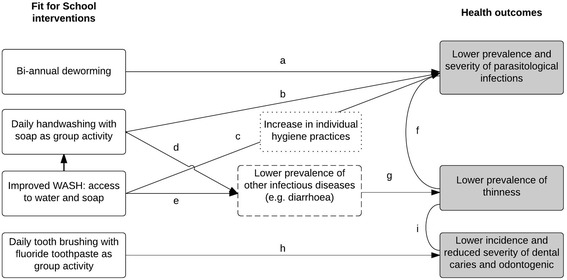
“f, g Lower prevalence of worm infection and diarrhoea have been associated with weight gain [35, 46].”
BackgroundFluoride toothpastes for preventing dental caries in children and adolescents
Marinho, V. C., Higgins, J., Logan, S., & Sheiham deceased, A. (2003) · Cochrane Database of Systematic Reviews · doi:10.1002/14651858.cd002278 · Cited by 845 · cited 2×
“fluoride toothpaste prevents dental caries and odontogenic infections [31].”
ResultKeiser, J., & Utzinger, J. (2008) · JAMA · doi:10.1001/jama.299.16.1937 · Cited by 798
Strunz, E. C., Addiss, D. G., Stocks, M. E., Ogden, S., Utzinger, J., & Freeman, M. C. (2014) · PLoS Medicine · doi:10.1371/journal.pmed.1001620 · Cited by 795 · cited 3×
“The FIT programme was expected to improve children’s parasitological health via three mechanisms: biannual administration of albendazole or mebendazole is an efficacious method to treat existing worm infection [28], handwashing with soap interrupts transmission of helminthiases from contaminated soil or infected faece…”
BackgroundHelminthiasis, S.-T. (2002) · World Health Organization eBooks · Cited by 781
Dental caries affects body weight, growth and quality of life in pre-school children
Sheiham, A. (2006) · British Dental Journal · doi:10.1038/sj.bdj.4814259 · Cited by 742
Esrey, S. A., Feachem, R. G., & Jm, H. (1985) · Europe PMC (PubMed Central) · Cited by 587
Worms: Education and health externalities in kenyaPreprint
Kremer, M. R., & Miguel, E. A. (n.d.) · RePEc: Research Papers in Economics · Cited by 581
The dual burden household and the nutrition transition paradox
Doak, C. M., Adair, L. S., Bentley, M., Monteiro, C., & Popkin, B. M. (2005) · International Journal of Obesity · doi:10.1038/sj.ijo.0802824 · Cited by 575 · cited 1×
“The emergence of obesity as a major public health problem in developing countries has been frequently reported [41, 42].”
BackgroundEffect of Sanitation on Soil-Transmitted Helminth Infection: Systematic Review and Meta-Analysis
Ziegelbauer, K., Speich, B., Mäusezahl, D., Bos, R., Keiser, J., & Utzinger, J. (2012) · PLoS Medicine · doi:10.1371/journal.pmed.1001162 · Cited by 570 · cited 1×
“The FIT programme was expected to improve children’s parasitological health via three mechanisms: biannual administration of albendazole or mebendazole is an efficacious method to treat existing worm infection [28], handwashing with soap interrupts transmission of helminthiases from contaminated soil or infected faece…”
BackgroundImpact of poor oral health on children's school attendance and performance
Jackson, S. L., Vann, W. F., Kotch, J. B., Pahel, B. T., & Lee, J. Y. (2011) · American Journal of Public Health · doi:10.2105/ajph.2010.200915 · Cited by 537
Delivering better oral health: an evidence-based toolkit for prevention
Munday, P. (2008) · Vital · doi:10.1038/vital731 · Cited by 456
PUFA – An index of clinical consequences of untreated dental caries
Monse, B., Heinrich‐Weltzien, R., Benzian, H., Holmgren, C., & Van Palenstein Helderman, W. (2010) · Community Dentistry and Oral Epidemiology · doi:10.1111/j.1600-0528.2009.00514.x · Cited by 452 · cited 1×
“Odontogenic infections were scored according to the criteria of the pufa/PUFA-index [24], which records the presence of open pulp (p/P), ulceration (u/U), fistula (f/F) and abscesses (a/A).”
MethodSelf-citationSoil-Transmitted Helminth Reinfection after Drug Treatment: A Systematic Review and Meta-Analysis
Jia, T.-W., Melville, S., Utzinger, J., King, C. H., & Zhou, X.-N. (2012) · PLoS Neglected Tropical Diseases · doi:10.1371/journal.pntd.0001621 · Cited by 422 · cited 1×
“This corresponds with previous studies reporting that anthelmintic drugs only provide a temporal reduction in morbidity, but do not prevent rapid reinfection [34].”
ResultTaylor-Robinson, D. C., Maayan, N., Soares-Weiser, K., Donegan, S., & Garner, P. (2015) · Cochrane Database of Systematic Reviews · doi:10.1002/14651858.cd000371.pub6 · Cited by 392 · cited 2×
“f, g Lower prevalence of worm infection and diarrhoea have been associated with weight gain [35, 46].”
BackgroundMethodDangour, A. D., Watson, L., Cumming, O., Boisson, S., Che, Y., Velleman, Y., Cavill, S., Allen, E., & Uauy, R. (2013) · Cochrane Database of Systematic Reviews · doi:10.1002/14651858.cd009382.pub2 · Cited by 374 · cited 1×
“Handwashing with soap and safe sanitation are obvious measures to prevent infectious diseases, although the evidence of their effect on weight status and child growth is weak due to a lack of high quality randomised trials [36].”
Hand washing promotion for preventing diarrhoea
Ejemot-Nwadiaro, R. I., Ehiri, J. E., Arikpo, D., Meremikwu, M. M., & Critchley, J. A. (2015) · Cochrane Database of Systematic Reviews · doi:10.1002/14651858.cd004265.pub3 · Cited by 332 · cited 1×
“The benefit of schoolbased handwashing with soap is now well established; this intervention alone has been shown to prevent around one-third of diarrhoea episodes in children [9].”
Niehaus, M. D., Moore, S. R., Patrick, P. D., Derr, L. L., Lorntz, B., Lima, A. A., & Guerrant, R. L. (2002) · The American journal of tropical medicine and hygiene · doi:10.4269/ajtmh.2002.66.590 · Cited by 322
Freeman, M. C., Greene, L. E., Dreibelbis, R., Saboori, S., Muga, R., Brumback, B., & Rheingans, R. (2012) · Tropical Medicine & International Health · doi:10.1111/j.1365-3156.2011.02927.x · Cited by 228
BOWEN, A., MA, H., OU, J., BILLHIMER, W., LONG, T., MINTZ, E., HOEKSTRA, R. M., & LUBY, S. (2007) · The American Journal of Tropical Medicine and Hygiene · doi:10.4269/ajtmh.2007.76.1166 · Cited by 208
Freeman, M. C., Ogden, S., Jacobson, J., Abbott, D., Addiss, D. G., Amnie, A. G., Beckwith, C., Cairncross, S., Callejas, R., Colford, J. M., et al. (2013) · PLoS Neglected Tropical Diseases · doi:10.1371/journal.pntd.0002439 · Cited by 198 · cited 2×
“However, there are not many studies evaluating the benefits of WinS programmes on children’s health outcomes [7], which are generally challenging to measure.”
BackgroundBenzian, H., Monse, B., Heinrich‐Weltzien, R., HOBDELL, M. H., Mulder, J., & Helderman, W. H. V. P. (2011) · BMC Public Health · doi:10.1186/1471-2458-11-558 · Cited by 177
Self-citationLangford, R., Bonell, C., Jones, H., & Campbell, R. (2015) · International Journal of Behavioral Nutrition and Physical Activity · doi:10.1186/s12966-015-0167-7 · Cited by 166 · cited 1×
“A healthy nutrition environment at school (with nutrition choices low in sugar and fat), combined with regular physical activity, could be effective strategies to address obesity in school health programmes [43].”
BackgroundMahmud, M. A., Spigt, M., Bezabih, A. M., Pavon, I. L., Dinant, G.-J., & Velasco, R. B. (2015) · PLOS Medicine · doi:10.1371/journal.pmed.1001837 · Cited by 122 · cited 2×
“The FIT programme was expected to improve children’s parasitological health via three mechanisms: biannual administration of albendazole or mebendazole is an efficacious method to treat existing worm infection [28], handwashing with soap interrupts transmission of helminthiases from contaminated soil or infected faece…”
BackgroundBlanton, E., Ombeki, S., Oluoch, G. O., Mwaki, A., Wannemuehler, K., & Quick, R. (2010) · The American Society of Tropical Medicine and Hygiene · doi:10.4269/ajtmh.2010.09-0422 · Cited by 114
Marinho, V., Higgins, J., Sheiham, A., & Logan, S. (2000) · Cochrane Database of Systematic Reviews · doi:10.1002/14651858.cd002780 · Cited by 100
Langford, R., Lunn, P., & Brick, C. P. (2011) · American Journal of Human Biology · doi:10.1002/ajhb.21189 · Cited by 86 · cited 2×
“More than 70% of children had severe dental infection, which can lead to eating and sleeping impacts, poor quality of life, school absenteeism and growth retardation [3, 37].”
BackgroundMonse, B., Benzian, H., Naliponguit, E., Belizario, V., Schratz, A., & van Palenstein Helderman, W. (2013) · BMC Public Health · doi:10.1186/1471-2458-13-256 · Cited by 85 · cited 13×
“This was based on the Philippine HOS and other studies, where children’s BMI significantly increased after 1 year of regular deworming, possibly as a result of the substantial reduction in moderate to heavy worm infestation [17], although the actual evidence for this mechanism is not strongly supported by literature […”
MethodResultInfluentialSelf-citationTaylor-Robinson, D. C., Maayan, N., Soares-Weiser, K., Donegan, S., & Garner, P. (2012) · Cochrane Database of Systematic Reviews · doi:10.1002/14651858.cd000371.pub4 · Cited by 81
Taylor-Robinson, D. C., Maayan, N., Soares-Weiser, K., Donegan, S., & Garner, P. (2012) · Cochrane Database of Systematic Reviews · doi:10.1002/14651858.cd000371.pub5 · Cited by 80
Soil-Transmitted Helminths of Humans in Southeast Asia—Towards Integrated Control
Jex, A. R., Lim, Y. A. L., Bethony, J. M., Hotez, P. J., Young, N. D., & Gasser, R. B. (2011) · Advances in Parasitology/Advances in parasitology · doi:10.1016/b978-0-12-385897-9.00004-5 · Cited by 78 · cited 2×
“Yet, it should be noted that the prevalence rates in this study are clearly not a representative reflection of national prevalence estimates, which revealed prevalences up to 86%, 90% and 66% in Cambodia, Indonesia and Lao PDR, respectively (with a mean prevalence of approximately 30%) [33], and that other geographica…”
ResultGarn, J. V., Greene, L. E., Dreibelbis, R., Saboori, S., Rheingans, R. D., & Freeman, M. C. (2013) · Journal of Water, Sanitation and Hygiene for Development · doi:10.2166/washdev.2013.217 · Cited by 71
Monse, B., Duijster, D., Sheiham, A., Grijalva-Eternod, C. S., Helderman, W. H. V. P., & HOBDELL, M. H. (2012) · BMC Public Health · doi:10.1186/1471-2458-12-725 · Cited by 58
Self-citationEssential health care package for children - the ‘Fit for School’ program in the Philippines
Monse, B., Naliponguit, E. C., Belizario, V., Benzian, H., & Helderman, W. H. V. P. (2010) · International Dental Journal · doi:10.1016/s0020-6539(20)34067-3 · Cited by 48
Self-citationPublic health in action: effective school health needs renewed international attention
Benzian, H., Monse, B., Belizario, V. Y., Schratz, A., Şahin, M., & Helderman, W. H. V. P. (2012) · Global Health Action · doi:10.3402/gha.v5i0.14870 · Cited by 23 · cited 1×
“The implementation of the FIT approach is conceptually based on the principles of ‘simplicity’, ‘scalability’, ‘sustainability’ and ‘systemthinking’ [15], which address the concepts of intersectoral collaboration, sustainable financing mechanisms, active community involvement and the strengthening of school-based mana…”
MethodSelf-citation
Research works printed but not linked: 6
- Benzian H Williams D The challenge of oral disease – a call for global action. The oral health atlas. 2nd ed 2015 Geneva FDI World Dental Federation
- UNDP Support to the implementation of the sustainable development goals Goal 6. Sustainable management of water and sanitation. United Nations development Programme 2016
- Cogill B 2003 revised edition anthropometric indicators measurement guide 2003 Washington DC Academy for Educational Development
- UNICEF WASH in schools monitoring package 2011
- Monse B Panesar A Roach E Wendland C Wienpahl I Schlenk J Toetzke J Case 15: Philippines, Cambodia, Indonesia, Lao PDR. Strengthening the evidence of group handwashing in schools Sustainable sanitation alliance. Making WASH in schools more sustainable: case stories from SuSaNa partners (Vol. 2) 2015
- van Palenstein Helderman W, Holmgren C, Monse B, Benzian H. Caries prevention and control in low- and middle-income countries. In: Fejerskov O, Nyvad B, Kidd (Eds). Dental Caries: the disease and its clinical management. Wiley-Blackwell; 405: 2015.
Cited by
McMichael, C. (2019) · International Journal of Environmental Research and Public Health · doi:10.3390/ijerph16030359 · Cited by 220
Hand-washing promotion for preventing diarrhoea
Ejemot-Nwadiaro, R. I., Ehiri, J. E., Arikpo, D., Meremikwu, M. M., & Critchley, J. (2021) · Cochrane Database of Systematic Reviews · doi:10.1002/14651858.cd004265.pub4 · Cited by 188
Dimaisip-Nabuab, J., Duijster, D., Benzian, H., Heinrich‐Weltzien, R., Homsavath, A., Monse, B., Hak, S., Stauf, N., Susilawati, S., & Kromeyer-Hauschild, K. (2018) · BMC Pediatrics · doi:10.1186/s12887-018-1277-6 · Cited by 153
“Full details of the study procedures, the selection of schools and the power calculation are described in a previous publication [21].”
MethodSelf-citationChirgwin, H., Cairncross, S., Zehra, D., & Waddington, H. S. (2021) · Campbell Systematic Reviews · doi:10.1002/cl2.1194 · Cited by 130
Akera, P., Kennedy, S., Lingam, R., Obwolo, M. J., Schutte, A. E., & RICHMOND, R. L. (2022) · BMC Oral Health · doi:10.1186/s12903-022-02291-2 · Cited by 130
“For example, the SMD of net increment in DMFT scores for interventions invoking children 5–8 years old [9, 23, 27, 32, 34] was − 0.”
BackgroundMethodInfluential
Metadata
- Authors
- Duijster, D., Monse, B., Dimaisip-Nabuab, J., Djuharnoko, P., Heinrich-Weltzien, R., Hobdell, M., Kromeyer-Hauschild, K., Kunthearith, Y., Mijares-Majini, M. C., Siegmund, N., Soukhanouvong, P., & Benzian, H.
- Affiliations
- Academic Center for Dentistry Amsterdam (NL)
- Deutsche Gesellschaft für Internationale Zusammenarbeit (PH)
- University College London (GB)
- Jena University Hospital (DE)
- New York University (US)
- Corresponding author
- Duijster, Denise
- Venue
- BMC Public Health
- Published
- 2017-04-05
- Volume
- 17
- Issue
- 1
- Pages
- 302-302
- ISSN
- 1471-2458 (ISSN-L)
- PMC
- PMC5382467
- OpenAlex
- W2604566428
- Cited by
- 86
- References
- 43
- Citations by year
- 2026: 4 · 2025: 13 · 2024: 13 · 2023: 8 · 2022: 17 · 2021: 13 · 2020: 5 · 2019: 6 · 2018: 6 · 2017: 1
- FWCI
- 4.09
- Type
- journal article
- Language
- en
- Open access
- gold
- doi.org
- Licence
- cc-by
- Locations
- BMC Public Health (publishedVersion, cc-by)
- PubMed Central (publishedVersion, cc-by)
- PubMed (publishedVersion)
- VU Research Portal (publishedVersion, other-oa)
- UvA-DARE (University of Amsterdam) (submittedVersion, cc-by)
- DOAJ (DOAJ: Directory of Open Access Journals) (submittedVersion, cc-by-sa)
- Data Archiving and Networked Services (DANS) (submittedVersion, other-oa)
- Funders
- Gesellschaft fur Internationale Zusammenarbeit
- Topics
- Health Sciences › Nursing › Nutrition and Dietetics › Child Nutrition and Water Access
- Health Sciences › Medicine › Public Health, Environmental and Occupational Health › School Health and Nursing Education
- Life Sciences › Immunology and Microbiology › Parasitology › Parasites and Host Interactions
- Keywords
- school health, dental caries prevention, handwashing with soap, fluoride toothpaste, school-based deworming, soil-transmitted helminths, odontogenic infection, child malnutrition, school-based health interventions, healthy learning environment, children's oral health, Southeast Asia, Cambodia, Indonesia, Laos, implementation research, health program evaluation
- MeSH terms
- Cambodia, Child, Child Health Services, Dental Caries, Female, Helminthiasis, Humans, Indonesia, Interviews as Topic, Laos, Longitudinal Studies, Male, Oral Hygiene, Surveys and Questionnaires, Sanitation, School Health Services, Water Supply, Cohort Studies
About these checks
Registry, retraction, Cites and statistics results are computed, not judged, with one exception: a printed reference that no index lists is read once by a model before it counts as a citation error. Claims are extracted by a model and kept only when their quote appears verbatim in the text; each cited source is then checked, with a model’s help, for whether it says what the claim relies on. Those verdicts can be wrong — read the claim’s quote and the cited source before relying on one.
Statistics and arithmetic are recomputed, not judged.
Confidence bands are shown only for fields calibrated on our annotated test set. None is calibrated yet, so no band is shown.
What counts as a claim ›How we measure confidence ›How we check this ›
Are you an author, or do you see a problem with this page? Request a review
Data sources
Bibliographic data: Semantic Scholar, OpenAlex, Crossref.
Contains information from the Semantic Scholar Academic Graph Datasets, made available under the ODC Attribution License (ODC-BY 1.0).
Semantic Scholar’s data is described in: Kinney, R., et al. (2023). The Semantic Scholar Open Data Platform. arXiv:2301.10140.
