

The centrality of social ties to climate migration and mental health
Open accessThe DOI matches its Crossref record; 68 of the 69 references it cites were found in a registry or an index.
Abstract
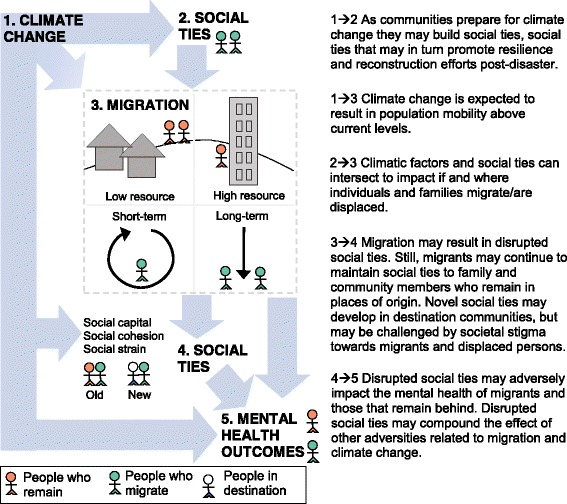
Climate change-related hazards and disasters, known to adversely impact physical and mental health outcomes, are also expected to result in human migration above current levels. Environmentally-motivated migration and displacement may lead to the disruption of existing social ties, with potentially adverse consequences for mobile populations as well as their family members who remain in places of origin. We propose that the disruption of social ties is a key mechanism by which climate-related migration may negatively impact mental health, in particular. Existing social ties may provide social and material resources that buffer mental health stressors related to both prolonged and acute climate events. Preparation for such events may also strengthen these same ties and protect mental health. Communities may leverage social ties, first to mitigate climate change, and second, to adapt and rebuild post-disaster in communities of origin. Additionally, social ties can inform migration decisions and destinations. For example, scholars have found that the drought-motivated adaptive migration of West African Fulbe herders only occurred because of the long-term development of social networks between migrants and non-migrants through trade and seasonal grazing. On the other hand, social ties do not always benefit mental health. Some migrants, including those from poor regions or communities with no formal safety net, may face considerable burden to provide financial and emotional resources to family members who remain in countries of origin. In destination communities, migrants often face significant social marginalization. Therefore, policies and programs that aim to maintain ongoing social ties among migrants and their family and community members may be critically important in efforts to enhance population resilience and adaptation to climate change and to improve mental health outcomes. Several online platforms, like Refugee Start Force, serve to integrate refugees by connecting migrants directly to people and services in destination communities. These efforts may increasingly draw upon novel technologies to support and maintain social networks in the context of population mobility due to climatic and other factors.
Overview
The claims and statistics of this paper haven’t been checked yet.
Free: it reads the open-access text and checks the first 5 claims that cite a source we can check. Create a free account to check every claim.
Integrity signals
Registry
Cites
Statistics
Figures
Verification
Claims the paper makes
The claims and statistics of this paper haven’t been checked yet.
Free: it reads the open-access text and checks the first 5 claims that cite a source we can check. Create a free account to check every claim.
Claims other papers make about this one
Each is checked against this paper’s own text: does it say what the citing paper says it does?
The source backs part of the claim, not all of it — or backs it for a different population, condition or comparison.
In the citing paper
“These groups of people, forced to migrate, already have their own psychological vulnerabilities (162).”
From The Impact of Climate Change on Mental Health: A Systematic Descriptive Review (2020) · cites this paper as [162]
Experimental — accuracy not yet measuredThe cited source says what the claim attributes to it.
In the citing paper
“Extreme weather events seem to have the power to also destroy social ties (162).”
From The Impact of Climate Change on Mental Health: A Systematic Descriptive Review (2020) · cites this paper as [162]
The check wasn’t confident either way, so it gives no verdict — never disputed.
In the citing paper
“Literature analyzes single types of climatic events, since certain consequent disorders are specific while others generally occur in different extreme events (162).”
From The Impact of Climate Change on Mental Health: A Systematic Descriptive Review (2020) · cites this paper as [162]
Experimental — accuracy not yet measured
Self-check
Percentages, sums and reported differences re-computed from the paper’s own numbers.
The self-check needs the paper’s full text.
Citations
Cites
Theories of International Migration: A Review and Appraisal
Massey, D. S., Arango, J., Hugo, G., Kouaouci, A., Pellegrino, A., & Taylor, J. E. (1993) · Population and Development Review · doi:10.2307/2938462 · Cited by 5,583
Mechanisms Linking Social Ties and Support to Physical and Mental Health
Thoits, P. A. (2011) · Journal of Health and Social Behavior · doi:10.1177/0022146510395592 · Cited by 4,076
Kawachi, I. (2001) · Journal of Urban Health: Bulletin of the New York Academy of Medicine · doi:10.1093/jurban/78.3.458 · Cited by 3,538
Ferrari, A. J., Charlson, F. J., Norman, R. E., Patten, S. B., Freedman, G., Murray, C. J. L., Vos, T., & Whiteford, H. A. (2013) · PLoS Medicine · doi:10.1371/journal.pmed.1001547 · Cited by 3,115
Social-Ecological Resilience to Coastal Disasters
Adger, W. N., Hughes, T. P., Folke, C., Carpenter, S. R., & Rockström, J. (2005) · Science · doi:10.1126/science.1112122 · Cited by 2,685
Quantifying the influence of climate on human conflict
Hsiang, S. M., Burke, M., & Miguel, E. (2013) · Science · doi:10.1126/science.1235367 · Cited by 1,827 · cited 1×
“the health consequences of climate migration has been more limited, but has included altered distribution of infectious diseases [12], increased violence [13], and reduced access to healthcare [5].”
BackgroundThe Effects of Climate Change on Cardiac Health
De Blois, J., Kjellstrom, T., Agewall, S., Ezekowitz, J. A., Armstrong, P. W., & Atar, D. (2015) · Cardiology · doi:10.1159/000398787 · Cited by 1,697
Cultural dimensions of climate change impacts and adaptation
Adger, W. N., Barnett, J., Brown, K., Marshall, N., & O'Brien, K. (2013) · Nature Climate Change · doi:10.1038/nclimate1666 · Cited by 1,456
Climate change in the Fertile Crescent and implications of the recent Syrian drought
Kelley, C. P., Mohtadi, S., Cane, M. A., Seager, R., & Kushnir, Y. (2015) · Proceedings of the National Academy of Sciences · doi:10.1073/pnas.1421533112 · Cited by 1,379 · cited 2×
“authors [23] describe that the collapse of much of the country’s agricultural production.”
BackgroundSolastalgia: The Distress Caused by Environmental Change
Albrecht, G., Sartore, G.-M., Connor, L., Higginbotham, N., Freeman, S., Kelly, B., Stain, H., Tonna, A., & Pollard, G. (2007) · Australasian Psychiatry · doi:10.1080/10398560701701288 · Cited by 1,369
Research works printed but not linked: 5
- Clayton S Manning C M., Krygsman, K., & Speiser, M. Mental health and our changing climate: impacts, implications, and guidance 2017 American Psychological Association and ecoAmerica Washington, D.C
- Bhattacharyya A Werz M Climate change, migration and conflict in South Asia 2012 Washington, DC Centre for American Progress
- Kiama L Mikkelsen C Njeri C Hansen M The role of technology in family tracing in Kenya Forced Migr Rev 2011 38 35 36
- Louisiana Office of Community Development Disaster Recovery Unit Louisiana's strategic adaptations for future environments 2015 Baton Rouge, LA State of Louisiana
- Ryan K Unaccompanied and separated minors: a call for a multidisciplinary response to a humanitarian crisis Migration Policy Practice 2014 4 3 4 10
Cited by
The Impact of Climate Change on Mental Health: A Systematic Descriptive Review
Cianconi, P., Betrò, S., & Janiri, L. (2020) · Frontiers in Psychiatry · doi:10.3389/fpsyt.2020.00074 · Cited by 1,320
Lawrance, E. L., Thompson, R., Newberry Le Vay, J., Page, L., & Jennings, N. (2022) · International Review of Psychiatry · doi:10.1080/09540261.2022.2128725 · Cited by 500
“The mental health effects of climate migration in particular are currently understudied, though there is evidence for negative effects (208,279).”
BackgroundNature-based approaches to managing climate change impacts in cities
Hobbie, S. E., & Grimm, N. B. (2020) · Philosophical Transactions of the Royal Society B: Biological Sciences · doi:10.1098/rstb.2019.0124 · Cited by 312
“Disruptions to livelihoods and health caused by climate-change-related damage of infrastructure and forced migration will disrupt social systems and social ties, reducing adaptive capacity of climate change migrants [48,49].”
BackgroundThe health impacts of climate-related migration
Schwerdtle, P., Bowen, K., & McMichael, C. (2018) · BMC Medicine · doi:10.1186/s12916-017-0981-7 · Cited by 260
“However, other studies of indigenous populations elsewhere indicate complex climate–migration mental health impacts on both the host and migrant communities due to the disruption of social ties, with deleterious implications for those left behind as well as those on the move [28].”
BackgroundIndigenous mental health in a changing climate: A systematic scoping review of the global literature
Middleton, J., Cunsolo, A., Jones-Bitton, A., Wright, C. J., & Harper, S. L. (2020) · Environmental Research Letters · doi:10.1088/1748-9326/ab68a9 · Cited by 212
Climate change, environment pollution, COVID-19 pandemic and mental health
Marazziti, D., Cianconi, P., Mucci, F., Foresi Crowther, L., Chiarantini, I., & Della Vecchia, A. (2021) · Science of The Total Environment · doi:10.1016/j.scitotenv.2021.145182 · Cited by 192
“However, it is difficult to establish the specific cause-effect relationships of these phenomena onmental health, as they result from the interactions of two complex systems: the environment, with everything (biotic and abiotic elements) populating it, and human beings (Torres and Casey, 2017; Gaddi et al., 2018).”
Dannenberg, A. L., Frumkin, H., Hess, J. J., & Ebi, K. L. (2019) · Climatic Change · doi:10.1007/s10584-019-02382-0 · Cited by 169
“Displacement may trigger mental health problems, including anxiety, depression, substance abuse, and suicide, and undermine social capital (Uscher-Pines 2009; Asugeni et al. 2015; Torres and Casey 2017), especially among residents with a strong sense of place attachment (Agyeman et al.”
BackgroundUddin, K., & Matin, M. A. (2021) · Progress in Disaster Science · doi:10.1016/j.pdisas.2021.100185 · Cited by 187
Mental Health Impacts of Climate Change Among Vulnerable Populations Globally: An Integrative Review
White, B. P., Breakey, S., Brown, M. J., Smith, J. R., Tarbet, A., Nicholas, P. K., & Ros, A. M. V. (2023) · Annals of Global Health · doi:10.5334/aogh.4105 · Cited by 141
Intangible cultural heritage: a benefit to climate-displaced and host communities
Aktürk, G., & Lerski, M. (2021) · Journal of Environmental Studies and Sciences · doi:10.1007/s13412-021-00697-y · Cited by 109
“2017), psychological impact of loss and grief (Torres and Casey 2017), and identity (Farbotko et al.”
BackgroundBrain diseases in changing climate
Ruszkiewicz, J. A., Tinkov, A. A., Skalny, A. V., Siokas, V., Dardiotis, E., Tsatsakis, A. M., Bowman, A. B., da Rocha, J. B. T., & Aschner, M. (2019) · Environmental Research · doi:10.1016/j.envres.2019.108637 · Cited by 92
Ziersch, A. M., Miller, E., Baak, M., & Mwanri, L. (2020) · BMC Public Health · doi:10.1186/s12889-020-09724-z · Cited by 99
Rajper, S. A., Ullah, S., & Li, Z. (2018) · PLoS ONE · doi:10.1371/journal.pone.0194364 · Cited by 80
Hayward, G., & Ayeb‐Karlsson, S. (2021) · Climatic Change · doi:10.1007/s10584-021-03053-9 · Cited by 87
“The resultant disruption to social ties is a key mechanism by which mental health can be damaged (Torres and Casey 2017).”
BackgroundMigration and climate change – The role of social protection
Silchenko, D., & Murray, Ú. (2022) · Climate Risk Management · doi:10.1016/j.crm.2022.100472 · Cited by 80
Syndemics: A Cross-Disciplinary Approach to Complex Epidemic Events Like COVID-19
Singer, M., Bulled, N., Ostrach, B., & Lerman Ginzburg, S. (2021) · Annual Review of Anthropology · doi:10.1146/annurev-anthro-100919-121009 · Cited by 59
Vos, S. R., Clark‐Ginsberg, A., Puente-Durán, S., Salas‐Wright, C. P., Duque, M., Herrera, I. C., Maldonado‐Molina, M. M., Castillo, M. N., Lee, T. K., García, M. F., et al. (2021) · New Directions for Child and Adolescent Development · doi:10.1002/cad.20397 · Cited by 81
Schwerdtle, P. N., Bärnighausen, K., Karim, S., Raihan, S. T., Selim, S. A., Bärnighausen, T., & Danquah, I. (2021) · International Journal of Environmental Research and Public Health · doi:10.3390/ijerph18052629 · Cited by 65
Climate change and coastal megacities: Adapting through mobility
Ekoh, S. S., Teron, L., & Ajibade, I. M. (2023) · Global Environmental Change · doi:10.1016/j.gloenvcha.2023.102666 · Cited by 54
Haque, M. R., Parr, N., & Muhidin, S. (2019) · Social Science & Medicine · doi:10.1016/j.socscimed.2019.02.032 · Cited by 45
Research priorities for climate mobility
Simpson, N. P., Mach, K. J., Tebboth, M. G. L., Gilmore, E., Siders, A. R., Holden, P. B., Anderson, B., Singh, C., Sabour, S., Stringer, L. C., et al. (2024) · One Earth · doi:10.1016/j.oneear.2024.02.002 · Cited by 45
Climate change, migration and health systems resilience: Need for interdisciplinary research
Ridde, V., Benmarhnia, T., Bonnet, E., Bottger, C., Cloos, P., Dagenais, C., Allegri, M. D., Giralt, A. N., Queuille, L., & Sarker, M. (2019) · F1000Research · doi:10.12688/f1000research.17559.2 · Cited by 41
Hossain, I., Rana, M. S., Haque, A. K. M. M., & Masud, A. A. (2024) · Discover Sustainability · doi:10.1007/s43621-024-00697-2 · Cited by 38
“According to Torres & Casey [63], expanding green spaces and tree shade coverage would naturally cool the air, particularly in places that are heavily inhabited and economically challenged.”
Freeman, K. R., Baek, K., Ngo, M., Kelley, V., Miller-Karas, E., Citron, S., & Montgomery, S. (2021) · Community Mental Health Journal · doi:10.1007/s10597-021-00872-z · Cited by 38
SOLECKI, W. D., & Friedman, E. (2021) · Annual Review of Public Health · doi:10.1146/annurev-publhealth-090419-102302 · Cited by 39
Girginov, V., Moore, P., Olsen, N., Godfrey, T., & Cooke, F. (2020) · Cogent Social Sciences · doi:10.1080/23311886.2020.1742517 · Cited by 40
Yusoff, S., & Yusoff, N. H. (2022) · Sustainability · doi:10.3390/su14127405 · Cited by 35
Yates, O. E. T., Manuela, S., Neef, A., & Groot, S. (2021) · Climate and Development · doi:10.1080/17565529.2021.1911775 · Cited by 34
Environmental change and floods: the long-ignored effects of displacement on mental health
Akram, S., & Mushtaq, S. (2024) · Frontiers in Public Health · doi:10.3389/fpubh.2024.1434123 · Cited by 40
“The literature examines various climatic events and their associated diseases, which can be specific to certain conditions or occur in different extreme situations (84).”
Baxter, H. (2019) · International Journal of Disaster Risk Science · doi:10.1007/s13753-019-0216-y · Cited by 23
“Community adaptation and transformation have been framed by some authors as climate justice issues (McNamara and Buggy 2017; Schlosberg et al. 2017; Torres and Casey 2017).”
BackgroundHow do migration decisions and drivers differ against extreme environmental events?
Mallick, B., Best, K. B., Carrico, A. R., Ghosh, T., Priodarshini, R., Sultana, Z., & Samanta, G. (2023) · Environmental Hazards · doi:10.1080/17477891.2023.2195152 · Cited by 29
“While social networks are key to facilitating migration, strong social ties can also ameliorate the stresses of environmental change, discouraging migration by boosting the coping mechanisms of people at risk (Torres & Casey, 2017).”
BackgroundMental Health Impacts of Climate Change: Considerations for Nurse Practitioners
Brown, M. J., White, B. P., & Nicholas, P. K. (2021) · The Journal for Nurse Practitioners · doi:10.1016/j.nurpra.2021.07.013 · Cited by 24
Climate Change and Mental Health: Implications for Nurses
Kameg, B. N. (2020) · Journal of Psychosocial Nursing and Mental Health Services · doi:10.3928/02793695-20200624-05 · Cited by 18
Yates, O. E. T., Groot, S., Manuela, S., & Neef, A. (2022) · Journal of Community Psychology · doi:10.1002/jcop.22928 · Cited by 18
Chen, D.-D., Tu, J.-H., Ling, K.-N., Jin, X., & Huang, H. (2025) · Frontiers in Public Health · doi:10.3389/fpubh.2024.1463676 · Cited by 23
Cloos, P., Belloiseau, M., Pherson, N. M., Harris-Glenville, F., Joseph, D. D., & Zinszer, K. (2023) · The Journal of Climate Change and Health · doi:10.1016/j.joclim.2023.100237 · Cited by 17
Paulhus, L., Bernard, K., Bourque, C., Guilmette, S., Laquerre, M.-Ê., Laramée, E. L.-È., & Levasseur, M. (2025) · BMC Public Health · doi:10.1186/s12889-025-25849-5 · Cited by 17
“Certain populations have also been forced to migrate to new unknown countries with safer climate, which can have a major influence on mobility and social participation, such as breaking of existing social ties [41].”
Environmental Displacement and Mental Well-Being in Banjarnegara, Indonesia
Burrows, K., Pelupessy, D. C., Khoshnood, K., & Bell, M. L. (2021) · Environmental Health Perspectives · doi:10.1289/ehp9391 · Cited by 18
“Landslide-displacement may disrupt social networks, separate families and friends, and fragment communities (Torres and Casey 2017), all of which are important sources of stability and coping after disasters (McMichael et al. 2012).”
Lifestyle Medicine Interventions for Personal and Planetary Health: The Urgent Need for Action
Pathak, N., Pollard, K. J., & McKinney, A. E. (2022) · American Journal of Lifestyle Medicine · doi:10.1177/15598276221090887 · Cited by 21
No man is an island: trust, trustworthiness, and social networks among refugees in Germany
El‐Bialy, N., Aranda, E. F., Nicklisch, A., Saleh, L., & Voigt, S. (2023) · Journal of Population Economics · doi:10.1007/s00148-023-00969-7 · Cited by 21
“For example, moving to a new country often entails a disruption of past social connections (Torres and Casey 2017; Boyle et al. 2008), and establishing a new set of connections can be extremely helpful, even crucial, to immigrants and refugees facing the difficult task of starting a new life in a…”
BackgroundPost-migration well-being of Sub-Saharan Africans in China: a nationwide cross-sectional survey
Zou, X., Hall, B. J., Xiong, M., & Wang, C. (2020) · Quality of Life Research · doi:10.1007/s11136-020-02663-7 · Cited by 15
Khalid, A., Babry, J. A., Vearey, J., & Zenner, D. (2023) · Journal of Migration and Health · doi:10.1016/j.jmh.2023.100172 · Cited by 17
Mental health in the Pacific: Urgency and opportunity
Ali, S., Williams, O. D., Chang, O., Shidhaye, R. R., Hunter, E. M., & Charlson, F. (2020) · Asia Pacific Viewpoint · doi:10.1111/apv.12286 · Cited by 15
Dawson, W. D., Booi, L., Pintado‐Caipa, M., de Oliveira, M. O., Kornhuber, A., Spoden, N., Golonka, O., Shallcross, L., Davidziuk, A., Cominetti, M. R., et al. (2023) · The Lancet Regional Health - Americas · doi:10.1016/j.lana.2023.100627 · Cited by 15
“,48 – 51 Again, this is not an exhaustive list of threats to global brain health.”
BackgroundClimate change and mental health and wellbeing: Reflections from a health geography lens
Martin, G. (2024) · Geography Compass · doi:10.1111/gec3.12734 · Cited by 15
Shibesh, B. F., & Nagabhatla, N. (2025) · Climate · doi:10.3390/cli13070139 · Cited by 16
“Additionally, people with mental health conditions may face stigma, discrimination, and denial of their human rights, and are more likely to experience physical and sexual abuse [35].”
Anchored in pacific protocols – climate change, mental health and wellbeing
Newport, C., Tiatia‐Seath, J., Ma'ia'i, K. A., Underhill‐Sem, Y., & Woodward, A. J. (2023) · Climate and Development · doi:10.1080/17565529.2023.2255563 · Cited by 12
“Indeed, and as Torres and Casey (2017) note, there is an increased vulnerability to adverse mental health outcomes because of climate migration and disrupted social networks (p. 3) .”
BackgroundCosentino, M., Gal-Oz, R., & Safer, D. L. (2024) · Springer eBooks · doi:10.1007/978-3-031-54790-4_15 · Cited by 12
Lifestyle medicine prescriptions for personal and planetary health
Pathak, N., & Pollard, K. J. (2021) · The Journal of Climate Change and Health · doi:10.1016/j.joclim.2021.100077 · Cited by 12
Xiang, X., Xiao, Y., Feng, Q., Wang, R., & Huang, H. (2024) · International Journal of Disaster Risk Reduction · doi:10.1016/j.ijdrr.2024.104741 · Cited by 15
Parnes, M. F., Amort, B., Calderon-Smith, C., Chambers, E. C., & Musicaro, R. M. (2024) · Current Pediatrics Reports · doi:10.1007/s40124-024-00331-9 · Cited by 13
“These consequences may contribute to loss of social support, disrupted education, and related mental health challenges (e.g., increased worry, stress) [3, 5–7].”
Robison, R., van Bommel, M., & Rohse, M. (2022) · Frontiers in Climate · doi:10.3389/fclim.2022.794669 · Cited by 11
Pinho, P. F., Canova, M. A., de Toledo, P. M., González‐Chaves, A., Lapola, D. M., Ometto, J. P., & Stafford‐Smith, M. (2022) · Regional Environmental Change · doi:10.1007/s10113-022-01938-8 · Cited by 14
“This stands out particularly among Caiçaras, whose cultural norms and livelihood practices are associated with coastal zone use and protection and who rely more closely and meaningfully on social (and family) ties (Adams 2003; Torres and Casey 2017).”
BackgroundFleeing Drought: The Great Migration to Europe
Palinkas, L. A. (2020) · Springer eBooks · doi:10.1007/978-3-030-41890-8_5 · Cited by 11
Assessing the capability approach as a justice basis of climate resilience strategies
Cañizares, J. C., Copeland, S. M., & Doorn, N. (2024) · Journal of Global Ethics · doi:10.1080/17449626.2024.2338349 · Cited by 10
“While such achievements can contribute much to personal and community resilience, deficits here make people very vulnerable (Cutter, Boruff, and Lynn Shirley 2003; Torres and Casey 2017).”
Climate change and cardiovascular risk
Ang, S. P., & Chia, J. E. (2025) · Current Opinion in Cardiology · doi:10.1097/hco.0000000000001207 · Cited by 8
León, D. C. R. (2020) · Gerencia y Políticas de Salud · doi:10.11144/javeriana.rgps19.dasm · Cited by 23
Establishing and Maintaining Social Relationships During Significant Life Events: The Role of Age
Radjenovic, S., Rupprecht, F. S., & Nikitin, J. (2024) · The Journals of Gerontology Series B · doi:10.1093/geronb/gbae144 · Cited by 8
“For example, in countries with less welfare, where support is more dependent on informal relationships, the importance of maintaining existing social relationships during significant life events may be greater than in more developed countries (Torres & Casey, 2017).”
BackgroundSharma, S., & Anikeeva, O. (2025) · Journal of Racial and Ethnic Health Disparities · doi:10.1007/s40615-025-02527-1 · Cited by 9
Chasing the ghosts: stories of people left behind on the frontline of climate and ecological crisis
Rai, A. (2022) · South African Journal of Psychology · doi:10.1177/00812463221130902 · Cited by 7
“Importantly, climate-induced migration negatively impacts mental health by disrupting social ties, community affiliations, and interpersonal ties (Shultz et al., 2019; Torres & Casey, 2017).”
BackgroundCommunity resilience to wildfires: A network analysis approach by utilizing human mobility data
Chen, Q., Wang, B., & Crooks, A. T. (2024) · Computers Environment and Urban Systems · doi:10.1016/j.compenvurbsys.2024.102110 · Cited by 6
Crisis care: tackling the climate and ecological emergency
Bailey, C., Poole, N. A., & James, A. (2021) · BJPsych Bulletin · doi:10.1192/bjb.2021.33 · Cited by 7
The 2023 Maui Wildfires and the Mental Health Effects of Climate-Induced Relocation
Suresh, A., Tu, L., & Stanford, F. C. (2024) · American Journal of Public Health · doi:10.2105/ajph.2024.307815 · Cited by 6
Mapping climate change interaction with human health through DPSIR framework: Qatar perspective
Eldos, H. I., Tahir, F., Athira, U. N., Mohamed, H. O., Samuel, B. G., Skariah, S., Al‐Ghamdi, S. G., Al‐Ansari, T. A., & Sultan, A. A. (2025) · Heliyon · doi:10.1016/j.heliyon.2025.e42455 · Cited by 6
“This displacement disrupts social networks and can lead to conflicts, exacerbating mental health issues such as depression and anxiety [145].”
Gomez-Cunya, L.-A., Babbar‐Sebens, M., Tullos, D., & Tilt, J. H. (2024) · International Journal of Disaster Risk Reduction · doi:10.1016/j.ijdrr.2024.104432 · Cited by 5
Kanamori, M., Castaneda, D., Self, K. J., Sanchez, L., Rosas, Y., Rodriguez, E., Shrader, C., Arroyo-Flores, J. G., Johnson, A., Skvoretz, J. V., et al. (2021) · International Journal of Environmental Research and Public Health · doi:10.3390/ijerph182312709 · Cited by 6
Analysis of environmental migrants and their mental health in strengthening health systems
Herrán, K., & Biehler, D. D. (2020) · F1000Research · doi:10.12688/f1000research.27272.1 · Cited by 4
“No fish – no fishermen”: staying as a voluntary choice despite environmental risks
Sun, Y., Mallick, B., & Bayrak, M. M. (2024) · Local Environment · doi:10.1080/13549839.2024.2394667 · Cited by 7
“Some scholars also argue that social networks and ties significantly prevent vulnerable people and communities from migrating (Farbotko and McMichael 2019; Torres and Casey 2017).”
How Latinos’ perceptions of environmental health threats impact policy preferences
Vargas, E. D., Gómez-Aguiñaga, B., Sánchez, G. R., & Barreto, M. A. (2024) · Social Science Quarterly · doi:10.1111/ssqu.13372 · Cited by 4
Climate change-related mass migration requires health system resilience
Clark‐Ginsberg, A., & Chandra, A. (2023) · Environmental Research Health · doi:10.1088/2752-5309/ace5ca · Cited by 7
Walker, R., Lakika, D. M., Makandwa, T., & Boeyink, C. (2023) · Frontiers in Human Dynamics · doi:10.3389/fhumd.2023.1260042 · Cited by 5
Addressing the Health Effects of Climate Change: an Approach Based on Evidence and Ethics
Kirch, D. G., & Petelle, K. (2018) · Academic Psychiatry · doi:10.1007/s40596-018-0907-5 · Cited by 4
“In BMC Public Health, Torres and Casey link climate-related migration with disrupted community ties and negative mental health effects [7].”
BackgroundSiddik, M. A. B., Ali, A., Shakil, M. R., Syfullah, M. K., Hoque, M. S., Islam, M. A., Guo, H., & Ali, S. (2025) · Climatic Change · doi:10.1007/s10584-025-03916-5 · Cited by 6
“…hazards like floods, cyclones, riverbank erosion, or other natural disas - ters not only displace individuals from their homeland but also may lead to psychological distress for those affected and even displaced by natural disasters (Torres and Casey 2017 ; Palinkas and Wong 2020).”
A Decision Framework for Equitable Use of Federal Funds for Voluntary Buyout Programs
Motlagh, F., & Hamideh, S. (2025) · Sustainability · doi:10.3390/su17030966 · Cited by 5
A systematized review exploring the map of publications on the health impacts of drought
Mehdipour, S., Nakhaee, N., Zolala, F., Okhovati, M., Afsar, F., & Haghdoost, A. A. (2022) · Natural Hazards · doi:10.1007/s11069-022-05311-0 · Cited by 6
“2015; Torres and Casey 2017; Tortajada et al.”
BackgroundBehbahani, H. S., & Green, M. (2023) · ACS in focus · doi:10.1021/acsinfocus.7e7016 · Cited by 8
Bakalova, D., & Panchelieva, T. (2023) · European Journal of Psychology Open · doi:10.1024/2673-8627/a000037 · Cited by 4
Badawy, W., Mdawi, A. M. M. A., Melweth, H. M. A., & Shaban, M. (2025) · Geriatric Nursing · doi:10.1016/j.gerinurse.2025.05.006 · Cited by 5
Hodgson, L., Fernando, G., & Lansbury, N. (2022) · Weather Climate and Society · doi:10.1175/wcas-d-21-0169.1 · Cited by 4
Walker, S. E., Bailey, K. M., & Smith, E. A. (2022) · Journal of Environmental Media · doi:10.1386/jem_00078_1 · Cited by 1
Utjecaj klimatskih promjena na mentalno zdravlje
Klinika za psihijatriju, K. B. D., & Marinić, L. M. (2023) · Socijalna psihijatrija · doi:10.24869/spsih.2023.161 · Cited by 3
Tellez, J., & Balcells, L. (2022) · World Bank policy research working paper · doi:10.1596/1813-9450-10019 · Cited by 5
Ciborowski, H. M., Brouwer, K. C., Hurst, S., Pérez, R. L., Swanson, K., & Baker, H. (2025) · International Journal of Environmental Research and Public Health · doi:10.3390/ijerph22091328 · Cited by 2
Mental health in the time of polycrisis: geopolitical determinants and modern psychiatry
Bhugra, D., Liebrenz, M., & Smith, A. J. (2026) · Frontiers in Psychiatry · doi:10.3389/fpsyt.2026.1813883 · Cited by 3
Practice Responses to Climigration
Palinkas, L. A. (2020) · Springer eBooks · doi:10.1007/978-3-030-41890-8_9 · Cited by 3
Bowen, E. A. (2023) · Addiction Research & Theory · doi:10.1080/16066359.2023.2292593 · Cited by 2
“Climate-driven displacement and migration disrupt social ties, both for those who migrate and those who remain in communities with high rates of displacement (Torres & Casey, 2017).”
Watkins, L., Blanco, E., Barraza, J., de León, A. D., Pérez, M., & Rocha‐Jiménez, T. (2025) · Cities & Health · doi:10.1080/23748834.2025.2536890 · Cited by 3
“…can facilitate the exchange of resources (e.g., food, shelter) and information (e.g., early warnings regarding environmental risks), increasing resilience and buffering some of the adverse physical and mental health impacts of both short-term and prolonged climate events (Torres and Casey 2017).”
InfluentialXiang, X., Xiao, Y., Wang, R., & Huang, H. (2023) · SSRN Electronic Journal · doi:10.2139/ssrn.4583426 · Cited by 2
Taking the Weather with You: Remittances, Translocality, and the Climate Migrant Within
Parsons, L. (2020) · Springer eBooks · doi:10.1007/978-3-030-47178-1_15 · Cited by 1
Tellez, J., & Balcells, L. (2024) · Journal of Conflict Resolution · doi:10.1177/00220027241253532 · Cited by 4
“Second, forced relocation also means that long-standing networks of cooperation, reciprocity, and exchange within communities are often severed (Dorff 2017; Torres and Casey 2017).”
Climate Change and Mental Health from a Developmental and Life Course Perspective
Ha, S. (2024) · Springer eBooks · doi:10.1007/978-3-031-56736-0_2 · Cited by 1
Social connection and loneliness in the era of extreme weather and climate change
Akhter‐Khan, S. C., Holt‐Lunstad, J., & Liu, S. (2026) · Nature Health · doi:10.1038/s44360-025-00041-6 · Cited by 2
“Several frameworks have mapped links between climate-induced migration and disruption of social connections, which lead to isolation and mental illness 58,59 .”
Brik, A. B., Al‐Romaihi, H. E., Al-Shamali, M. H. M. A., Mohammed, H. T., Shaikhan, F. M., Kasem, H. A., & Bansal, D. (2026) · Public Health in Practice · doi:10.1016/j.puhip.2026.100754 · Cited by 4
“Despite these theoretical advances, significant gaps remain in empirical understanding of risk factors and intervention effectiveness [36,37].”
Pakravan-Charvadeh, M. R., & Maleknia, R. (2026) · Environmental Development · doi:10.1016/j.envdev.2026.101485 · Cited by 1
Rakib, M. A., Rakin, M. G. R., Jibon, M. J. N., Akter, A., & Valenzuela, V. P. B. (2026) · Geopsychiatry · doi:10.1016/j.geopsy.2026.100090 · Cited by 1
Climate change and social health
Bower, M., Filia, K., Lawrance, E. L., Card, K. G., Teesson, L., Smout, S., Gao, C., Naderpajouh, N., Donohoe‐Bales, A., Lagi, R., et al. (2026) · Nature Human Behaviour · doi:10.1038/s41562-026-02455-y · Cited by 2
“Remaining residents may feel abandoned or strained by resource gaps 42,43 , and displaced individuals face isolation, loneliness, stigma and loss of identity 44,45 .”
The UCL–Lancet Commission on Migration and Health: review of the state of progress
Abubakar, I. I., Tellez, D., Aldridge, R. W., Altare, C., Barreto, M. L., Boukari, Y., Burns, R., Cabieses, B., Devakumar, D., Fouad, F. M., et al. (2026) · The Lancet · doi:10.1016/s0140-6736(26)00494-0 · Cited by 3
Climate Change-Induced Migration and Mental Health or Displacement
Jashari, K., & Rao, K. R. (2024) · Advances in psychology, mental health, and behavioral studies (APMHBS) book series · doi:10.4018/979-8-3693-2177-5.ch013 · Cited by 1
Gargano, M. C., DiBiase, C. E., & Miller‐Graff, L. E. (2024) · Transcultural Psychiatry · doi:10.1177/13634615231213837 · Cited by 2
“Research on international migration has shown that both maintaining social ties in the community of origin and forging social relationships in the current community are important for improving mental health outcomes (Torres & Casey, 2017).”
Rhythm and Glue: An Entertainment-Education Prototype for Climate Communication
Coren, E. (2024) · Springer eBooks · doi:10.1007/978-3-031-54790-4_7 · Cited by 1
Metadata
- Authors
- Torres, J. M., & Casey, J. A.
- Affiliations
- University of California, San Francisco (US)
- University of California, Berkeley (US)
- Corresponding author
- Torres, Jacqueline M.
- Venue
- BMC Public Health
- Published
- 2017-07-06
- Volume
- 17
- Issue
- 1
- Pages
- 600-600
- ISSN
- 1471-2458 (ISSN-L)
- PMC
- PMC5498922
- OpenAlex
- W2724989404
- Semantic Scholar
- 16b454a1599bbcabf046322ac469260f5599a3ee
- Cited by
- 139
- References
- 69
- Citations by year
- 2026: 20 · 2025: 22 · 2024: 22 · 2023: 18 · 2022: 17 · 2021: 15 · 2020: 15 · 2019: 7 · 2018: 3
- FWCI
- 17.51
- Type
- journal article
- Language
- en
- Open access
- gold
- doi.org
- Licence
- cc-by
- Locations
- BMC Public Health (publishedVersion, cc-by)
- Europe PMC (PubMed Central) (publishedVersion, cc-by)
- PubMed Central (publishedVersion, cc-by)
- PubMed (publishedVersion)
- DOAJ (DOAJ: Directory of Open Access Journals) (submittedVersion, cc-by-sa)
- eScholarship (California Digital Library) (submittedVersion)
- Topics
- Social Sciences › Sociology and Political Science › Climate Change, Adaptation, Migration
- Social Sciences › Psychology › Clinical Psychology › Migration, Health and Trauma
- Physical Sciences › Environmental Science › Health, Toxicology and Mutagenesis › Climate Change and Health Impacts
- Keywords
- climate-induced migration, social ties, mental health, climate-induced displacement, social networks, social capital, climate change adaptation, disaster recovery, migration decisions, social marginalization, population resilience, refugee integration, social networking sites, drought
- MeSH terms
- Acculturation, Climate, Disasters, Emigration and Immigration, Family, Humans, Mental Health, Refugees, Social Support, Stress, Psychological, Transients and Migrants, Emigrants and Immigrants, Resilience, Psychological, Climate Change, Social Discrimination
About these checks
Registry, retraction, Cites and statistics results are computed, not judged, with one exception: a printed reference that no index lists is read once by a model before it counts as a citation error. Claims are extracted by a model and kept only when their quote appears verbatim in the text; each cited source is then checked, with a model’s help, for whether it says what the claim relies on. Those verdicts can be wrong — read the claim’s quote and the cited source before relying on one.
Statistics and arithmetic are recomputed, not judged.
Confidence bands are shown only for fields calibrated on our annotated test set. None is calibrated yet, so no band is shown.
What counts as a claim ›How we measure confidence ›How we check this ›
Are you an author, or do you see a problem with this page? Request a review
Data sources
Bibliographic data: Semantic Scholar, OpenAlex, Crossref.
Contains information from the Semantic Scholar Academic Graph Datasets, made available under the ODC Attribution License (ODC-BY 1.0).
Semantic Scholar’s data is described in: Kinney, R., et al. (2023). The Semantic Scholar Open Data Platform. arXiv:2301.10140.
