

The centrality of social ties to climate migration and mental health
Open accessThe DOI matches its Crossref record; 68 of the 69 references it cites were found in a registry or an index.
Abstract
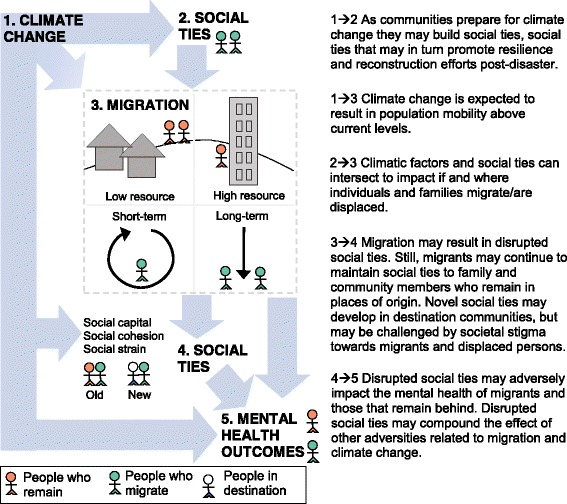
Climate change-related hazards and disasters, known to adversely impact physical and mental health outcomes, are also expected to result in human migration above current levels. Environmentally-motivated migration and displacement may lead to the disruption of existing social ties, with potentially adverse consequences for mobile populations as well as their family members who remain in places of origin. We propose that the disruption of social ties is a key mechanism by which climate-related migration may negatively impact mental health, in particular. Existing social ties may provide social and material resources that buffer mental health stressors related to both prolonged and acute climate events. Preparation for such events may also strengthen these same ties and protect mental health. Communities may leverage social ties, first to mitigate climate change, and second, to adapt and rebuild post-disaster in communities of origin. Additionally, social ties can inform migration decisions and destinations. For example, scholars have found that the drought-motivated adaptive migration of West African Fulbe herders only occurred because of the long-term development of social networks between migrants and non-migrants through trade and seasonal grazing. On the other hand, social ties do not always benefit mental health. Some migrants, including those from poor regions or communities with no formal safety net, may face considerable burden to provide financial and emotional resources to family members who remain in countries of origin. In destination communities, migrants often face significant social marginalization. Therefore, policies and programs that aim to maintain ongoing social ties among migrants and their family and community members may be critically important in efforts to enhance population resilience and adaptation to climate change and to improve mental health outcomes. Several online platforms, like Refugee Start Force, serve to integrate refugees by connecting migrants directly to people and services in destination communities. These efforts may increasingly draw upon novel technologies to support and maintain social networks in the context of population mobility due to climatic and other factors.
Overview
The claims and statistics of this paper haven’t been checked yet.
Free: it reads the open-access text and checks the first 5 claims that cite a source we can check. Create a free account to check every claim.
Integrity signals
Registry
Cites
Statistics
Figures
Verification
Claims the paper makes
The claims and statistics of this paper haven’t been checked yet.
Free: it reads the open-access text and checks the first 5 claims that cite a source we can check. Create a free account to check every claim.
Claims other papers make about this one
Each is checked against this paper’s own text: does it say what the citing paper says it does?
The source backs part of the claim, not all of it — or backs it for a different population, condition or comparison.
In the citing paper
“These groups of people, forced to migrate, already have their own psychological vulnerabilities (162).”
From The Impact of Climate Change on Mental Health: A Systematic Descriptive Review (2020) · cites this paper as [162]
Experimental — accuracy not yet measuredThe cited source says what the claim attributes to it.
In the citing paper
“Extreme weather events seem to have the power to also destroy social ties (162).”
From The Impact of Climate Change on Mental Health: A Systematic Descriptive Review (2020) · cites this paper as [162]
The check wasn’t confident either way, so it gives no verdict — never disputed.
In the citing paper
“Literature analyzes single types of climatic events, since certain consequent disorders are specific while others generally occur in different extreme events (162).”
From The Impact of Climate Change on Mental Health: A Systematic Descriptive Review (2020) · cites this paper as [162]
Experimental — accuracy not yet measured
Self-check
Percentages, sums and reported differences re-computed from the paper’s own numbers.
The self-check needs the paper’s full text.
Citations
Cites
Theories of International Migration: A Review and Appraisal
Massey, D. S., Arango, J., Hugo, G., Kouaouci, A., Pellegrino, A., & Taylor, J. E. (1993) · Population and Development Review · doi:10.2307/2938462 · Cited by 5,583
Mechanisms Linking Social Ties and Support to Physical and Mental Health
Thoits, P. A. (2011) · Journal of Health and Social Behavior · doi:10.1177/0022146510395592 · Cited by 4,076
Kawachi, I. (2001) · Journal of Urban Health: Bulletin of the New York Academy of Medicine · doi:10.1093/jurban/78.3.458 · Cited by 3,538
Ferrari, A. J., Charlson, F. J., Norman, R. E., Patten, S. B., Freedman, G., Murray, C. J. L., Vos, T., & Whiteford, H. A. (2013) · PLoS Medicine · doi:10.1371/journal.pmed.1001547 · Cited by 3,115
Social-Ecological Resilience to Coastal Disasters
Adger, W. N., Hughes, T. P., Folke, C., Carpenter, S. R., & Rockström, J. (2005) · Science · doi:10.1126/science.1112122 · Cited by 2,685
Quantifying the influence of climate on human conflict
Hsiang, S. M., Burke, M., & Miguel, E. (2013) · Science · doi:10.1126/science.1235367 · Cited by 1,827 · cited 1×
“the health consequences of climate migration has been more limited, but has included altered distribution of infectious diseases [12], increased violence [13], and reduced access to healthcare [5].”
BackgroundThe Effects of Climate Change on Cardiac Health
De Blois, J., Kjellstrom, T., Agewall, S., Ezekowitz, J. A., Armstrong, P. W., & Atar, D. (2015) · Cardiology · doi:10.1159/000398787 · Cited by 1,697
Cultural dimensions of climate change impacts and adaptation
Adger, W. N., Barnett, J., Brown, K., Marshall, N., & O'Brien, K. (2013) · Nature Climate Change · doi:10.1038/nclimate1666 · Cited by 1,456
Climate change in the Fertile Crescent and implications of the recent Syrian drought
Kelley, C. P., Mohtadi, S., Cane, M. A., Seager, R., & Kushnir, Y. (2015) · Proceedings of the National Academy of Sciences · doi:10.1073/pnas.1421533112 · Cited by 1,379 · cited 2×
“authors [23] describe that the collapse of much of the country’s agricultural production.”
BackgroundSolastalgia: The Distress Caused by Environmental Change
Albrecht, G., Sartore, G.-M., Connor, L., Higginbotham, N., Freeman, S., Kelly, B., Stain, H., Tonna, A., & Pollard, G. (2007) · Australasian Psychiatry · doi:10.1080/10398560701701288 · Cited by 1,369
Research works printed but not linked: 5
- Clayton S Manning C M., Krygsman, K., & Speiser, M. Mental health and our changing climate: impacts, implications, and guidance 2017 American Psychological Association and ecoAmerica Washington, D.C
- Bhattacharyya A Werz M Climate change, migration and conflict in South Asia 2012 Washington, DC Centre for American Progress
- Kiama L Mikkelsen C Njeri C Hansen M The role of technology in family tracing in Kenya Forced Migr Rev 2011 38 35 36
- Louisiana Office of Community Development Disaster Recovery Unit Louisiana's strategic adaptations for future environments 2015 Baton Rouge, LA State of Louisiana
- Ryan K Unaccompanied and separated minors: a call for a multidisciplinary response to a humanitarian crisis Migration Policy Practice 2014 4 3 4 10
Cited by
Items 101–139 of 139
Vélez, G. F. P., Wiegel, H., Sapiains, R., & Azócar, G. (2025) · Springer eBooks · doi:10.1007/978-3-031-84433-1_24 · Cited by 2
Bondarenko, Y. D., Zelenska, K., Zhuravel, Y. V., & Serdyuk, O. I. (2025) · INTERNATIONAL NEUROLOGICAL JOURNAL · doi:10.22141/2224-0713.21.5.2025.1203 · Cited by 5
Climate change adaptation in Bangladesh: Sen's capability approach and the role of freedom of choice
Assaduzzaman, M. (2023) · doi:10.3990/1.9789036557153 · Cited by 4
Later Begİnnİngs: A Research on the February 6 Earthquake in Türkİye and the Mİgratİon ProcessPreprint
Aydın, M., Yarar, A. E., Batu, M., & Onat, F. (2025) · Research Square · doi:10.21203/rs.3.rs-7164721/v1 · Cited by 1
Bergeret, P., Stuiver, M., & de Rooij, B. (2019) · Presses de Sciences Po eBooks · doi:10.3917/scpo.chea.2018.01.00219
Bergeret, P., Stuiver, M., & de Rooij, B. (2019) · Presses de Sciences Po eBooks · doi:10.3917/scpo.chea.2018.02.0211
The New International Relations of Migration: A Planetary Health Agenda?
Lederle, M. J. (2020) · SUNScholar (Stellenbosch University) · Cited by 2
Wozniak-Brown, J. (2022) · Shore & Beach · doi:10.34237/1009044 · Cited by 1
“Residents experiencing displacement, especially for those with strong place attachment, are at risk of several mental health challenges including anxiety and depression (Agyeman et al. 2009; Uscher-Pines 2009; Asugeni et al. 2015; Torres and Casey 2017; Dannenberg et al. 2019).”
BackgroundAnalytical Grid: Territory and Human Rights
Gouritin, A. (2022) · Springer eBooks · doi:10.1007/978-3-031-10335-3_2
Mega Risks and Urban Health System: Investment in Life
Khan, M. A. (2022) · Springer eBooks · doi:10.1007/978-3-031-14088-4_7
Examining the Phenomenon: The Link Between Migration and Climate Change
Gouritin, A. (2022) · Springer eBooks · doi:10.1007/978-3-031-10335-3_1
Rahman, G. M. E., Ashar, K., & Satria, D. (2023) · Journal of International Conference Proceedings · doi:10.32535/jicp.v6i3.2454
“Additionally, social networks and cultural ties can play a crucial role in determining migration patterns, as individuals often follow the footsteps of family and friends who have successfully migrated (Torres & Casey, 2017).”
BackgroundSubjective Well-Being and Mental Health of Puerto Rican Post-Disaster Migrants
Escue, M., Aranda, E. M., & Rosa, A. (2023) · Hispanic Journal of Behavioral Sciences · doi:10.1177/07399863231205337
“Torres and Casey (2017) find that the disruption of social networks and loss of social ties represent the loss of social and material resources from countries of origin, concluding that the loss is “a key mechanism by which climate-related migration may negatively impact mental health” (p. 600).”
BackgroundGhose, A., & Ali, S. M. (2024) · Advances in psychology, mental health, and behavioral studies (APMHBS) book series · doi:10.4018/979-8-3693-2177-5.ch004
Analysing the Indicators and the Associated Recommendations of Household Emission Calculators
Alexopoulos, C., Karelis, C., Keramidis, P., Orfanou, A., Lekkas, D., & Charalabidis, Y. K. (2024) · Circular Economy and Sustainability · doi:10.1007/s43615-024-00401-6
“…also in aspects like the global economy [3, 34, 44], the political discourse and governance [10, 20, 54], the tourism [17], the migration [6, 28, 57] and even the psychology and behaviour of the citizens [11, 13], the scientific community must propose solutions that assist individuals,…”
Bridge Builders: Bridging Resettlement Gaps Through a Relationship-Based Volunteer Program
Suk, A. N., Ko, M., & Paw, H. E. (2024) · Journal of Immigrant & Refugee Studies · doi:10.1080/15562948.2024.2407161
Vojnovic, J., Magnini, G., Vassalli, R., & Repčák, D. (2025) · SSRN Electronic Journal · doi:10.2139/ssrn.5175974 · Cited by 1
Development and Validation of Multidimensional Climate Change Distress Scale (MCCDS)
Asim, J., Ilyas, U., & Ilyas, S. (2025) · Journal of Professional & Applied Psychology · doi:10.52053/jpap.v6i1.356
MNEs, Climate Change, and Heart Diseases: AI for Global Health Equity
Lane, H., Oakley, C. J., Hossain, T., Goswami, A., Sah, R. K., & Mishra, M. (2025) · CSR, sustainability, ethics & governance · doi:10.1007/978-3-031-80797-8_4
Thomas, N. R., Mathew, L. M., Thomas, R., & Thampi, K. (2025) · Social Work in Mental Health · doi:10.1080/15332985.2025.2505521
“This can be due to the lack of access to emotional and social support (Torres & Casey, 2017) in new urban areas that were once abundant in Kuttanad.”
Thampi, K., Thomas, N. R., Mathew, L. M., & Thomas, R. (2025) · Regional Environmental Change · doi:10.1007/s10113-025-02447-0 · Cited by 1
“Similar studies also evidenced this (Blackwell et al. 2023; White et al. 2023; Torres and Casey 2017; Akef et al. 2024).”
Talukder, B., Sarkar, M., Mondal, K. P., Salim, R., & Islam, S. T. (2025) · Elsevier eBooks · doi:10.1016/b978-0-443-31568-8.00055-6
Wang, M., Zhai, S., Li, S., & Liu, X. (2025) · BMC Public Health · doi:10.1186/s12889-025-25987-w
“This adaptation pressure not only affects their independence in daily life, but also increases their psychological burden [4, 5].”
Ziersch, A., Miller, E., Baak, M., & Mwanri, L. (2020) · Figshare · doi:10.6084/m9.figshare.13237663
Channappaji, S. N., Shivappa, B. B., & Prakash, A. (2025) · IGI Global eBooks · doi:10.4018/979-8-3373-5811-6.ch007
Hossain, I., Haque, A. K. M. M., Rana, M. S., & Lawal, S. A. (2026) · Springer eBooks · doi:10.1007/978-3-032-08828-4_9 · Cited by 2
Field to flight: Migration dynamics amidst climate driven crop yield fluctuations in Burkina Faso
Belesova, K., Zabré, P., Opata, M. R., Sie, A. B., Sauerborn, R., Schwerdtle, P. N., & Rocklöv, J. (2026) · PLOS Climate · doi:10.1371/journal.pclm.0000832
“Such increases may create socio-economic challenges for both sending and receiving communities [4,5], although migration can also function as an adaptive strategy that helps reduce climate-related risks, including adverse health outcomes.”
Spousal migration and well-being of married women in Southwestern Bangladesh
Islam, S., Donato, K. M., Bailey, K. M., & Carrico, A. R. (2026) · Climate and Development · doi:10.1080/17565529.2026.2653120
Joseph, T. D., & Thapa, V. (2026) · Social Science & Medicine · doi:10.1016/j.socscimed.2026.119382 · Cited by 1
Neef, A., Brenner, T., Christiansen, H., Farbotko, C., Heinrichs, D. H., Lewis, M., Link, A.-C., Nalau, J., Pernice-Warnke, S., Pietsch, J., et al. (2026) · Climate and Development · doi:10.1080/17565529.2026.2667495
Exploring the Nexus Between Climate Change and Well-Being: Subjective and Objective Dimensions
Datta, P., Mishra, P., & Behera, B. (2026) · Advances in global change research · doi:10.1007/978-3-032-25479-5_1 · Cited by 1
Mental health as both outcome and determinant in climate adaptation
Long, Y., Zhou, Z., Kajikawa, Y., Asatani, K., Sakata, I., & Yoshida, Y. (2026) · Nature Climate Change · doi:10.1038/s41558-026-02673-2
Han, C., & Guhathakurta, S. (2026) · SSRN Electronic Journal · doi:10.2139/ssrn.7037104
Lorubbio, V. (2026) · Revista de Derecho Privado · doi:10.18601/01234366.51.03
Rahmayati, Y., & Alaidaros, S. (2026) · Lecture notes in civil engineering · doi:10.1007/978-981-92-1595-9_12
Cheng, L., & Yan, Z. (2026) · Habitat International · doi:10.1016/j.habitatint.2026.103989
Push and pull factors of relocation in the coastal zone: what matters most?
Bukvic, A., & Kim, M. (2026) · Population and Environment · doi:10.1007/s11111-026-00541-x · Cited by 1
“Social ties may provide psychosocial support in dealing with climate-related events and resulting migration, facilitate adaptation, and inform migration decisions and destination selection (Torres & Casey, 2017).”
Edward, M. M. (2026) · Health & Social Care in the Community · doi:10.1155/hsc/7184225
Metadata
- Authors
- Torres, J. M., & Casey, J. A.
- Affiliations
- University of California, San Francisco (US)
- University of California, Berkeley (US)
- Corresponding author
- Torres, Jacqueline M.
- Venue
- BMC Public Health
- Published
- 2017-07-06
- Volume
- 17
- Issue
- 1
- Pages
- 600-600
- ISSN
- 1471-2458 (ISSN-L)
- PMC
- PMC5498922
- OpenAlex
- W2724989404
- Semantic Scholar
- 16b454a1599bbcabf046322ac469260f5599a3ee
- Cited by
- 139
- References
- 69
- Citations by year
- 2026: 20 · 2025: 22 · 2024: 22 · 2023: 18 · 2022: 17 · 2021: 15 · 2020: 15 · 2019: 7 · 2018: 3
- FWCI
- 17.51
- Type
- journal article
- Language
- en
- Open access
- gold
- doi.org
- Licence
- cc-by
- Locations
- BMC Public Health (publishedVersion, cc-by)
- Europe PMC (PubMed Central) (publishedVersion, cc-by)
- PubMed Central (publishedVersion, cc-by)
- PubMed (publishedVersion)
- DOAJ (DOAJ: Directory of Open Access Journals) (submittedVersion, cc-by-sa)
- eScholarship (California Digital Library) (submittedVersion)
- Topics
- Social Sciences › Sociology and Political Science › Climate Change, Adaptation, Migration
- Social Sciences › Psychology › Clinical Psychology › Migration, Health and Trauma
- Physical Sciences › Environmental Science › Health, Toxicology and Mutagenesis › Climate Change and Health Impacts
- Keywords
- climate-induced migration, social ties, mental health, climate-induced displacement, social networks, social capital, climate change adaptation, disaster recovery, migration decisions, social marginalization, population resilience, refugee integration, social networking sites, drought
- MeSH terms
- Acculturation, Climate, Disasters, Emigration and Immigration, Family, Humans, Mental Health, Refugees, Social Support, Stress, Psychological, Transients and Migrants, Emigrants and Immigrants, Resilience, Psychological, Climate Change, Social Discrimination
About these checks
Registry, retraction, Cites and statistics results are computed, not judged, with one exception: a printed reference that no index lists is read once by a model before it counts as a citation error. Claims are extracted by a model and kept only when their quote appears verbatim in the text; each cited source is then checked, with a model’s help, for whether it says what the claim relies on. Those verdicts can be wrong — read the claim’s quote and the cited source before relying on one.
Statistics and arithmetic are recomputed, not judged.
Confidence bands are shown only for fields calibrated on our annotated test set. None is calibrated yet, so no band is shown.
What counts as a claim ›How we measure confidence ›How we check this ›
Are you an author, or do you see a problem with this page? Request a review
Data sources
Bibliographic data: Semantic Scholar, OpenAlex, Crossref.
Contains information from the Semantic Scholar Academic Graph Datasets, made available under the ODC Attribution License (ODC-BY 1.0).
Semantic Scholar’s data is described in: Kinney, R., et al. (2023). The Semantic Scholar Open Data Platform. arXiv:2301.10140.
