

The centrality of social ties to climate migration and mental health
Open accessThe DOI matches its Crossref record; 68 of the 69 references it cites were found in a registry or an index.
Abstract
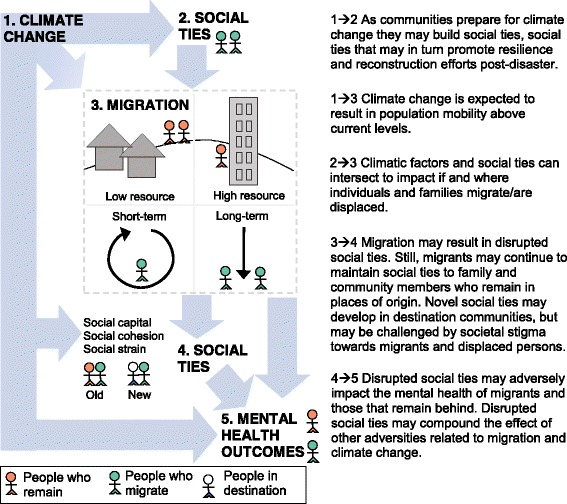
Climate change-related hazards and disasters, known to adversely impact physical and mental health outcomes, are also expected to result in human migration above current levels. Environmentally-motivated migration and displacement may lead to the disruption of existing social ties, with potentially adverse consequences for mobile populations as well as their family members who remain in places of origin. We propose that the disruption of social ties is a key mechanism by which climate-related migration may negatively impact mental health, in particular. Existing social ties may provide social and material resources that buffer mental health stressors related to both prolonged and acute climate events. Preparation for such events may also strengthen these same ties and protect mental health. Communities may leverage social ties, first to mitigate climate change, and second, to adapt and rebuild post-disaster in communities of origin. Additionally, social ties can inform migration decisions and destinations. For example, scholars have found that the drought-motivated adaptive migration of West African Fulbe herders only occurred because of the long-term development of social networks between migrants and non-migrants through trade and seasonal grazing. On the other hand, social ties do not always benefit mental health. Some migrants, including those from poor regions or communities with no formal safety net, may face considerable burden to provide financial and emotional resources to family members who remain in countries of origin. In destination communities, migrants often face significant social marginalization. Therefore, policies and programs that aim to maintain ongoing social ties among migrants and their family and community members may be critically important in efforts to enhance population resilience and adaptation to climate change and to improve mental health outcomes. Several online platforms, like Refugee Start Force, serve to integrate refugees by connecting migrants directly to people and services in destination communities. These efforts may increasingly draw upon novel technologies to support and maintain social networks in the context of population mobility due to climatic and other factors.
Overview
The claims and statistics of this paper haven’t been checked yet.
Free: it reads the open-access text and checks the first 5 claims that cite a source we can check. Create a free account to check every claim.
Integrity signals
Registry
Cites
Statistics
Figures
Verification
Claims the paper makes
The claims and statistics of this paper haven’t been checked yet.
Free: it reads the open-access text and checks the first 5 claims that cite a source we can check. Create a free account to check every claim.
Claims other papers make about this one
Each is checked against this paper’s own text: does it say what the citing paper says it does?
The source backs part of the claim, not all of it — or backs it for a different population, condition or comparison.
In the citing paper
“These groups of people, forced to migrate, already have their own psychological vulnerabilities (162).”
From The Impact of Climate Change on Mental Health: A Systematic Descriptive Review (2020) · cites this paper as [162]
Experimental — accuracy not yet measuredThe cited source says what the claim attributes to it.
In the citing paper
“Extreme weather events seem to have the power to also destroy social ties (162).”
From The Impact of Climate Change on Mental Health: A Systematic Descriptive Review (2020) · cites this paper as [162]
The check wasn’t confident either way, so it gives no verdict — never disputed.
In the citing paper
“Literature analyzes single types of climatic events, since certain consequent disorders are specific while others generally occur in different extreme events (162).”
From The Impact of Climate Change on Mental Health: A Systematic Descriptive Review (2020) · cites this paper as [162]
Experimental — accuracy not yet measured
Self-check
Percentages, sums and reported differences re-computed from the paper’s own numbers.
The self-check needs the paper’s full text.
Citations
Cites
Theories of International Migration: A Review and Appraisal
Massey, D. S., Arango, J., Hugo, G., Kouaouci, A., Pellegrino, A., & Taylor, J. E. (1993) · Population and Development Review · doi:10.2307/2938462 · Cited by 5,583
Mechanisms Linking Social Ties and Support to Physical and Mental Health
Thoits, P. A. (2011) · Journal of Health and Social Behavior · doi:10.1177/0022146510395592 · Cited by 4,076
Kawachi, I. (2001) · Journal of Urban Health: Bulletin of the New York Academy of Medicine · doi:10.1093/jurban/78.3.458 · Cited by 3,538
Ferrari, A. J., Charlson, F. J., Norman, R. E., Patten, S. B., Freedman, G., Murray, C. J. L., Vos, T., & Whiteford, H. A. (2013) · PLoS Medicine · doi:10.1371/journal.pmed.1001547 · Cited by 3,115
Social-Ecological Resilience to Coastal Disasters
Adger, W. N., Hughes, T. P., Folke, C., Carpenter, S. R., & Rockström, J. (2005) · Science · doi:10.1126/science.1112122 · Cited by 2,685
Quantifying the influence of climate on human conflict
Hsiang, S. M., Burke, M., & Miguel, E. (2013) · Science · doi:10.1126/science.1235367 · Cited by 1,827 · cited 1×
“the health consequences of climate migration has been more limited, but has included altered distribution of infectious diseases [12], increased violence [13], and reduced access to healthcare [5].”
BackgroundThe Effects of Climate Change on Cardiac Health
De Blois, J., Kjellstrom, T., Agewall, S., Ezekowitz, J. A., Armstrong, P. W., & Atar, D. (2015) · Cardiology · doi:10.1159/000398787 · Cited by 1,697
Cultural dimensions of climate change impacts and adaptation
Adger, W. N., Barnett, J., Brown, K., Marshall, N., & O'Brien, K. (2013) · Nature Climate Change · doi:10.1038/nclimate1666 · Cited by 1,456
Climate change in the Fertile Crescent and implications of the recent Syrian drought
Kelley, C. P., Mohtadi, S., Cane, M. A., Seager, R., & Kushnir, Y. (2015) · Proceedings of the National Academy of Sciences · doi:10.1073/pnas.1421533112 · Cited by 1,379 · cited 2×
“authors [23] describe that the collapse of much of the country’s agricultural production.”
BackgroundSolastalgia: The Distress Caused by Environmental Change
Albrecht, G., Sartore, G.-M., Connor, L., Higginbotham, N., Freeman, S., Kelly, B., Stain, H., Tonna, A., & Pollard, G. (2007) · Australasian Psychiatry · doi:10.1080/10398560701701288 · Cited by 1,369
Black, R., Bennett, S. R. G., Thomas, S. M., & Beddington, J. R. (2011) · Nature · doi:10.1038/478477a · Cited by 1,043
Climate change and mental health: a causal pathways framework
Berry, H. L., Bowen, K., & Kjellstrom, T. (2010) · International Journal of Public Health · doi:10.1007/s00038-009-0112-0 · Cited by 1,035
Migration as an Adaptation to Climate Change
McLeman, R., & Smit, B. (2006) · Climatic Change · doi:10.1007/s10584-005-9000-7 · Cited by 811 · cited 1×
“In an example of environmentally-motivated migration, by the early 1930s, over 60,000 people from Oklahoma had resettled in California as part of the Dust Bowl migration [33].”
BackgroundClimate Change: The Public Health Response
Frumkin, H., Hess, J., Luber, G., Malilay, J., & McGeehin, M. (2008) · American Journal of Public Health · doi:10.2105/ajph.2007.119362 · Cited by 623
Temperature-driven global sea-level variability in the Common Era
Kopp, R. E., Kemp, A. C., Bittermann, K., Horton, B. P., Donnelly, J. P., Gehrels, W. R., Hay, C. C., Mitrovica, J. X., Morrow, E. D., & Rahmstorf, S. (2016) · Proceedings of the National Academy of Sciences · doi:10.1073/pnas.1517056113 · Cited by 531
Livelihood resilience in the face of climate change
Tanner, T., Lewis, D., Wrathall, D., Bronen, R., Cradock-Henry, N., Huq, S., Lawless, C., Nawrotzki, R., Prasad, V., Rahman, M. A., et al. (2015) · Nature Climate Change · doi:10.1038/nclimate2431 · Cited by 518
Disaster Planning and Risk Communication With Vulnerable Communities: Lessons From Hurricane Katrina
Eisenman, D. P., Cordasco, K. M., Asch, S., Golden, J. F., & Glik, D. (2007) · American Journal of Public Health · doi:10.2105/ajph.2005.084335 · Cited by 463
Environmental dimensions of migration
Hunter, L. M., Luna, J. K., & Norton, R. M. (2015) · Annual Review of Sociology · doi:10.1146/annurev-soc-073014-112223 · Cited by 449 · cited 1×
“Acute weather events, along with related protracted environmental and economic changes may contribute directly and indirectly to the dislocation of populations [4].”
BackgroundNonlinear permanent migration response to climatic variations but minimal response to disasters
Bohra-Mishra, P., Oppenheimer, M., & Hsiang, S. M. (2014) · Proceedings of the National Academy of Sciences · doi:10.1073/pnas.1317166111 · Cited by 434
Flachsland, C. (2015) · OPUS 4 (Zuse Institute Berlin) · Cited by 410
Global mismatch between greenhouse gas emissions and the burden of climate change
Althor, G., Watson, J. E. M., & Fuller, R. A. (2016) · Scientific Reports · doi:10.1038/srep20281 · Cited by 353
Scheffran, J., Marmer, E., & Sow, P. (2012) · Applied Geography · doi:10.1016/j.apgeog.2011.10.002 · Cited by 315
Mathbor, G. M. (2007) · International Social Work · doi:10.1177/0020872807076049 · Cited by 300
Climate change and health: on the latest IPCC report
Woodward, A., Smith, K. R., Campbell-Lendrum, D., Chadee, D. D., Honda, Y., Liu, Q., Olwoch, J., Revich, B., Sauerborn, R., Chafe, Z., et al. (2014) · The Lancet · doi:10.1016/s0140-6736(14)60576-6 · Cited by 299
The Cross-Border Connection: Immigrants, Emigrants, and Their Homelands
Waldinger, R. (2015) · Harvard University Press eBooks · doi:10.4159/harvard.9780674736283 · Cited by 290
Preparing for Resettlement Associated with Climate Change
de Sherbinin, A., Castro, M., Gemenne, F., Cernea, M. M., Adamo, S., Fearnside, P. M., Krieger, G., Lahmani, S., Oliver-Smith, A., Pankhurst, A., et al. (2011) · Science · doi:10.1126/science.1208821 · Cited by 273
Suárez-Orozco, C., Bang, H. J., & Kim, H. Y. (2011) · Journal of Adolescent Research · doi:10.1177/0743558410376830 · Cited by 270
Piguet, E. (2013) · Annals of the Association of American Geographers · doi:10.1080/00045608.2012.696233 · Cited by 259
McIver, L., Kim, R., Woodward, A., Hales, S., Spickett, J., Katscherian, D., Hashizume, M., Honda, Y., Kim, H., Iddings, S., et al. (2016) · Environmental Health Perspectives · doi:10.1289/ehp.1509756 · Cited by 238 · cited 2×
“In the most extreme form, planned permanent resettlement may lead to the relocation of entire communities, as with low-lying coastal or island populations [26].”
BackgroundExploring the climate change, migration and conflict nexus
Burrows, K., & Kinney, P. (2016) · International Journal of Environmental Research and Public Health · doi:10.3390/ijerph13040443 · Cited by 223
Extreme events as sources of health vulnerability: Drought as an example
Ebi, K. L., & Bowen, K. (2016) · Weather and Climate Extremes · doi:10.1016/j.wace.2015.10.001 · Cited by 214
Catalyst or Crown: Does Naturalization Promote the Long-Term Social Integration of Immigrants?
HAINMUELLER, J., HANGARTNER, D., & PIETRANTUONO, G. (2017) · American Political Science Review · doi:10.1017/s0003055416000745 · Cited by 214
Unmanned aerial vehicle-aided communications system for disaster recovery
Tuna, G., Nefzi, B., & Conte, G. (2014) · Journal of Network and Computer Applications · doi:10.1016/j.jnca.2013.10.002 · Cited by 208
Migration and Remittances Factbook 2011
Ratha, D. (2023) · doi:10.57966/bzgn-xj50 · Cited by 185
Embodied experiences of environmental and climatic changes in landscapes of everyday life in Ghana
Tschakert, P., Tutu, R. A., & Alcaro, A. (2011) · Emotion, space and society · doi:10.1016/j.emospa.2011.11.001 · Cited by 180
Turning the Tide: Recognizing Climate Change Refugees in International Law
WILLIAMS, A. (2008) · Law & Policy · doi:10.1111/j.1467-9930.2008.00290.x · Cited by 179
The cross-border connection: immigrants, emigrants, and their homelands
(2015) · Choice Reviews Online · doi:10.5860/choice.189984 · Cited by 176
Migrant destinations in an era of environmental change
Findlay, A. M. (2011) · Global Environmental Change · doi:10.1016/j.gloenvcha.2011.09.004 · Cited by 175
Cantor-Graae, E., & Pedersen, C. B. (2013) · JAMA Psychiatry · doi:10.1001/jamapsychiatry.2013.441 · Cited by 172
Rainfall Patterns and U.S. Migration from Rural Mexico
Hunter, L. M., Murray, S., & Riosmena, F. (2013) · International Migration Review · doi:10.1111/imre.12051 · Cited by 170
Hikichi, H., Aida, J., Tsuboya, T., Kondo, K., & Kawachi, I. (2016) · American Journal of Epidemiology · doi:10.1093/aje/kwv335 · Cited by 161
Sudden Shift or Migratory Drift? FulBe Herd Movements to the Sudano-Guinean Region of West Africa
Bassett, T. J., & Turner, M. D. (2006) · Human Ecology · doi:10.1007/s10745-006-9067-4 · Cited by 149
Migration and mental health: Evidence from a natural experiment
Stillman, S., McKenzie, D. J., & Gibson, J. K. (2009) · Journal of Health Economics · doi:10.1016/j.jhealeco.2009.02.007 · Cited by 148
Global Estimates 2014: People displaced by disasters
(2016) · Human Rights Documents online · doi:10.1163/2210-7975_hrd-9806-2014019 · Cited by 129
Improving Latino Disaster Preparedness Using Social Networks
Eisenman, D. P., Glik, D. C., Gonzalez, L. R., Maranon, R., Zhou, Q., Tseng, C., & Asch, S. M. (2009) · American Journal of Preventive Medicine · doi:10.1016/j.amepre.2009.07.022 · Cited by 113
Carbon choices determine US cities committed to futures below sea level
Strauss, B., Kulp, S., & Levermann, A. (2015) · Proceedings of the National Academy of Sciences · doi:10.1073/pnas.1511186112 · Cited by 108
Breslau, J., Borges, G., Tancredi, D., Saito, N., Kravitz, R., Hinton, L., Vega, W., Medina-Mora, M. E., & Aguilar-Gaxiola, S. (2011) · Archives of General Psychiatry · doi:10.1001/archgenpsychiatry.2011.21 · Cited by 105
The Location of Displaced New Orleans Residents in the Year After Hurricane Katrina
Sastry, N., & Gregory, J. (2014) · Demography · doi:10.1007/s13524-014-0284-y · Cited by 102
Anticipation of migration and psychological stress and the Three Gorges Dam project, China
Hwang, S., Xi, J., Cao, Y., Feng, X., & Qiao, X. (2007) · Social Science & Medicine · doi:10.1016/j.socscimed.2007.05.003 · Cited by 98
The meanings of migration, remittances and gifts: views of Honduran women who stay
McKenzie, S., & Menjívar, C. (2010) · Global Networks · doi:10.1111/j.1471-0374.2011.00307.x · Cited by 95
The implications of global climatic changes for international security
Gleick, P. H. (1989) · Climatic Change · doi:10.1007/bf00138857 · Cited by 93
Goldman, N., Pebley, A. R., Creighton, M. J., Teruel, G., Rubalcava, L., & Chung, C. (2014) · Demography · doi:10.1007/s13524-014-0304-y · Cited by 89
Borges, G., Medina-Mora, M. E., Breslau, J., & Aguilar-Gaxiola, S. (2007) · American Journal of Public Health · doi:10.2105/ajph.2006.097915 · Cited by 87
Climate Change and Poverty—An Analytical Framework
Bangalore, M., Hallegatte, S., Bonzanigo, L., Fay, M., Narloch, U., Rozenberg, J., & Vogt‐Schilb, A. (2014) · The World Bank Open Knowledge Repository (World Bank) · doi:10.1596/1813-9450-7126 · Cited by 87
Joarder, M. A. M., & Miller, P. W. (2013) · Global Environmental Change · doi:10.1016/j.gloenvcha.2013.07.026 · Cited by 78
Social connectedness and mobile phone use among refugee women in Australia
Walker, R., Koh, L., Wollersheim, D., & Liamputtong, P. (2015) · Health & Social Care in the Community · doi:10.1111/hsc.12155 · Cited by 72
Indigenous culture and adaptation to climate change: sockeye salmon and the St’át’imc people
Jacob, C., McDaniels, T. L., & Hinch, S. G. (2010) · Mitigation and Adaptation Strategies for Global Change · doi:10.1007/s11027-010-9244-z · Cited by 67
Displacement, county social cohesion, and depression after a large-scale traumatic event
Lê, F., Tracy, M., Norris, F. H., & Galea, S. (2013) · Social Psychiatry and Psychiatric Epidemiology · doi:10.1007/s00127-013-0698-7 · Cited by 63
Transnational ties and past-year major depressive episodes among Latino immigrants.
Alcántara, C., Chen, C.-N., & Alegría, M. (2015) · Cultural Diversity & Ethnic Minority Psychology · doi:10.1037/a0037540 · Cited by 48 · cited 1×
“While there is some evidence linking remittance sending to improved mental health among remittancesenders [74], others have reported the opposite effect [75].”
BackgroundAmoyaw, J. A., & Abada, T. S. J. (2016) · Social Science & Medicine · doi:10.1016/j.socscimed.2016.02.007 · Cited by 41
Migration of Children and Impact on Depression in Older Parents in Rural Thailand, Southeast Asia
Abas, M., Tangchonlatip, K., Punpuing, S., Jirapramukpitak, T., Darawuttimaprakorn, N., Prince, M. J., & Flach, C. (2012) · JAMA Psychiatry · doi:10.1001/jamapsychiatry.2013.271 · Cited by 40
Relocation and Social Support Among Older Adults in Rural China
Wu, Z., Penning, M. J., Zeng, W., Li, S., & Chappell, N. L. (2016) · The Journals of Gerontology Series B: Psychological Sciences and Social Sciences · doi:10.1093/geronb/gbu187 · Cited by 38
A longitudinal analysis of cross-border ties and depression for Latino adults
Torres, J. M., Lee, A., González, H. M., García, L., & Haan, M. N. (2016) · Social Science & Medicine · doi:10.1016/j.socscimed.2016.04.018 · Cited by 34
Self-citationSnodgrass, J. G., Upadhyay, C., Debnath, D., & Lacy, M. G. (2016) · World Development Perspectives · doi:10.1016/j.wdp.2016.09.001 · Cited by 33
Wickrama, K. A. S., & Wickrama, T. (2010) · International Journal of Social Psychiatry · doi:10.1177/0020764010374426 · Cited by 32
Project-induced migration and depression: A panel analysis
Hwang, S., Cao, Y., & Xi, J. (2010) · Social Science & Medicine · doi:10.1016/j.socscimed.2010.02.005 · Cited by 32
New technologies and new policies: the ICRC's evolving approach to working with separated families
Dubois, O., Marshall, K., & McNamara, S. S. (2012) · International Review of the Red Cross · doi:10.1017/s181638311300057x · Cited by 11
Bank, W. (2015) · World Bank, Washington, DC eBooks · doi:10.1596/22772 · Cited by 1
Research works printed but not linked: 5
- Clayton S Manning C M., Krygsman, K., & Speiser, M. Mental health and our changing climate: impacts, implications, and guidance 2017 American Psychological Association and ecoAmerica Washington, D.C
- Bhattacharyya A Werz M Climate change, migration and conflict in South Asia 2012 Washington, DC Centre for American Progress
- Kiama L Mikkelsen C Njeri C Hansen M The role of technology in family tracing in Kenya Forced Migr Rev 2011 38 35 36
- Louisiana Office of Community Development Disaster Recovery Unit Louisiana's strategic adaptations for future environments 2015 Baton Rouge, LA State of Louisiana
- Ryan K Unaccompanied and separated minors: a call for a multidisciplinary response to a humanitarian crisis Migration Policy Practice 2014 4 3 4 10
Cited by
The Impact of Climate Change on Mental Health: A Systematic Descriptive Review
Cianconi, P., Betrò, S., & Janiri, L. (2020) · Frontiers in Psychiatry · doi:10.3389/fpsyt.2020.00074 · Cited by 1,320
Lawrance, E. L., Thompson, R., Newberry Le Vay, J., Page, L., & Jennings, N. (2022) · International Review of Psychiatry · doi:10.1080/09540261.2022.2128725 · Cited by 500
“The mental health effects of climate migration in particular are currently understudied, though there is evidence for negative effects (208,279).”
BackgroundNature-based approaches to managing climate change impacts in cities
Hobbie, S. E., & Grimm, N. B. (2020) · Philosophical Transactions of the Royal Society B: Biological Sciences · doi:10.1098/rstb.2019.0124 · Cited by 312
“Disruptions to livelihoods and health caused by climate-change-related damage of infrastructure and forced migration will disrupt social systems and social ties, reducing adaptive capacity of climate change migrants [48,49].”
BackgroundThe health impacts of climate-related migration
Schwerdtle, P., Bowen, K., & McMichael, C. (2018) · BMC Medicine · doi:10.1186/s12916-017-0981-7 · Cited by 260
“However, other studies of indigenous populations elsewhere indicate complex climate–migration mental health impacts on both the host and migrant communities due to the disruption of social ties, with deleterious implications for those left behind as well as those on the move [28].”
BackgroundIndigenous mental health in a changing climate: A systematic scoping review of the global literature
Middleton, J., Cunsolo, A., Jones-Bitton, A., Wright, C. J., & Harper, S. L. (2020) · Environmental Research Letters · doi:10.1088/1748-9326/ab68a9 · Cited by 212
Metadata
- Authors
- Torres, J. M., & Casey, J. A.
- Affiliations
- University of California, San Francisco (US)
- University of California, Berkeley (US)
- Corresponding author
- Torres, Jacqueline M.
- Venue
- BMC Public Health
- Published
- 2017-07-06
- Volume
- 17
- Issue
- 1
- Pages
- 600-600
- ISSN
- 1471-2458 (ISSN-L)
- PMC
- PMC5498922
- OpenAlex
- W2724989404
- Cited by
- 139
- References
- 69
- Citations by year
- 2026: 20 · 2025: 22 · 2024: 22 · 2023: 18 · 2022: 17 · 2021: 15 · 2020: 15 · 2019: 7 · 2018: 3
- FWCI
- 17.51
- Type
- journal article
- Language
- en
- Open access
- gold
- doi.org
- Licence
- cc-by
- Locations
- BMC Public Health (publishedVersion, cc-by)
- Europe PMC (PubMed Central) (publishedVersion, cc-by)
- PubMed Central (publishedVersion, cc-by)
- PubMed (publishedVersion)
- DOAJ (DOAJ: Directory of Open Access Journals) (submittedVersion, cc-by-sa)
- eScholarship (California Digital Library) (submittedVersion)
- Topics
- Social Sciences › Sociology and Political Science › Climate Change, Adaptation, Migration
- Social Sciences › Psychology › Clinical Psychology › Migration, Health and Trauma
- Physical Sciences › Environmental Science › Health, Toxicology and Mutagenesis › Climate Change and Health Impacts
- Keywords
- climate-induced migration, social ties, mental health, climate-induced displacement, social networks, social capital, climate change adaptation, disaster recovery, migration decisions, social marginalization, population resilience, refugee integration, social networking sites, drought
- MeSH terms
- Acculturation, Climate, Disasters, Emigration and Immigration, Family, Humans, Mental Health, Refugees, Social Support, Stress, Psychological, Transients and Migrants, Emigrants and Immigrants, Resilience, Psychological, Climate Change, Social Discrimination
About these checks
Registry, retraction, Cites and statistics results are computed, not judged, with one exception: a printed reference that no index lists is read once by a model before it counts as a citation error. Claims are extracted by a model and kept only when their quote appears verbatim in the text; each cited source is then checked, with a model’s help, for whether it says what the claim relies on. Those verdicts can be wrong — read the claim’s quote and the cited source before relying on one.
Statistics and arithmetic are recomputed, not judged.
Confidence bands are shown only for fields calibrated on our annotated test set. None is calibrated yet, so no band is shown.
What counts as a claim ›How we measure confidence ›How we check this ›
Are you an author, or do you see a problem with this page? Request a review
Data sources
Bibliographic data: Semantic Scholar, OpenAlex, Crossref.
Contains information from the Semantic Scholar Academic Graph Datasets, made available under the ODC Attribution License (ODC-BY 1.0).
Semantic Scholar’s data is described in: Kinney, R., et al. (2023). The Semantic Scholar Open Data Platform. arXiv:2301.10140.
