

Identifying factors influencing contraceptive use in Bangladesh: evidence from BDHS 2014 data
Open accessThe DOI matches its Crossref record; 41 of the 42 references it cites were found in a registry or an index.
Abstract
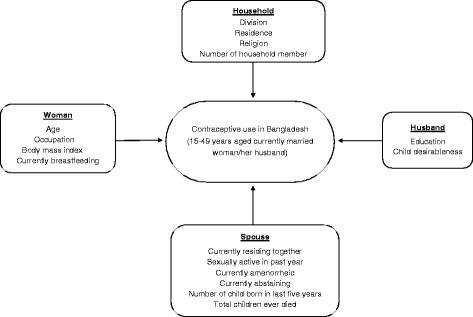
BACKGROUND: Birth control is the conscious control of the birth rate by methods which temporarily prevent conception by interfering with the normal process of ovulation, fertilization, and implantation. High contraceptive prevalence rate is always expected for controlling births for those countries that are experiencing high population growth rate. The factors that influence contraceptive prevalence are also important to know for policy implication purposes in Bangladesh. This study aims to explore the socio-economic, demographic and others key factors that influence the use of contraception in Bangladesh. METHODS: The contraception data are extracted from the 2014 Bangladesh Demographic and Health Survey (BDHS) data which were collected by using a two stage stratified random sampling technique that is a source of nested variability. The nested sources of variability must be incorporated in the model using random effects in order to model the actual parameter effects on contraceptive prevalence. A mixed effect logistic regression model has been implemented for the binary contraceptive data, where parameters are estimated through generalized estimating equation by assuming exchangeable correlation structure to explore and identify the factors that truly affect the use of contraception in Bangladesh. RESULTS: The prevalence of contraception use by currently married 15-49 years aged women or their husbands is 62.4%. Our study finds that administrative division, place of residence, religion, number of household members, woman's age, occupation, body mass index, breastfeeding practice, husband's education, wish for children, living status with wife, sexual activity in past year, women amenorrheic status, abstaining status, number of children born in last five years and total children ever died were significantly associated with contraception use in Bangladesh. CONCLUSIONS: The odds of women experiencing the outcome of interest are not independent due to the nested structure of the data. As a result, a mixed effect model is implemented for the binary variable 'contraceptive use' to produce true estimates for the significant determinants of contraceptive use in Bangladesh. Knowing such true estimates is important for attaining future goals including increasing contraception use from 62 to 75% by 2020 by the Bangladesh government's Health, Population & Nutrition Sector Development Program (HPNSDP).
Overview
The claims and statistics of this paper haven’t been checked yet.
Free: it reads the open-access text and checks the first 5 claims that cite a source we can check. Create a free account to check every claim.
Integrity signals
Registry
Cites
Statistics
Figures
Verification
Claims the paper makes
The claims and statistics of this paper haven’t been checked yet.
Free: it reads the open-access text and checks the first 5 claims that cite a source we can check. Create a free account to check every claim.
Claims other papers make about this one
Each is checked against this paper’s own text: does it say what the citing paper says it does?
The source backs part of the claim, not all of it — or backs it for a different population, condition or comparison.
In the citing paper
“Other factors, such as education and religiosity, also influence contraceptive use (e.g. [44, 45]).”
From Human fertility in relation to education, economy, religion, contraception, and family planning programs (2020) · cites this paper as [44]
Experimental — accuracy not yet measured
Self-check
Percentages, sums and reported differences re-computed from the paper’s own numbers.
The self-check needs the paper’s full text.
Citations
Cites
Longitudinal data analysis using generalized linear models
LIANG, K.-Y., & ZEGER, S. L. (1986) · Biometrika · doi:10.1093/biomet/73.1.13 · Cited by 18,550
Nepal Demographic And Health Survey 2006
Mohp, P., & Nepal (2007) · Cited by 1,312
The variability of female reproductive ageing
te Velde, E. R. (2002) · Human Reproduction Update · doi:10.1093/humupd/8.2.141 · Cited by 1,214 · cited 1×
“It is also evident that to avoid unwanted pregnancies, to choose the size of family and improve the spacing between the births of children, to reduce abortion and to allow spontaneous sex, contraceptives are inevitable and convenient for both men and women [6].”
BackgroundA Hierarchical Model for Studying School Effects
Raudenbush, S., & Bryk, A. S. (1986) · Sociology of Education · doi:10.2307/2112482 · Cited by 818
Pakistan Demographic and Health Survey 1990/1991.
Sathar], [. A. (1992) · Population and Development Review · doi:10.2307/1973773 · Cited by 639
Categorical Data Analysis, Second Edition
Chimka, J. R. (2003) · IIE Transactions · doi:10.1080/07408170304423 · Cited by 605
So, R., & Rojas, G. V. E. (2003) · Cited by 470
Factors Associated with Contraceptive Choice and Inconsistent Method Use, United States, 2004
Frost, J. J., & Darroch, J. E. (2008) · Perspectives on Sexual and Reproductive Health · doi:10.1363/4009408 · Cited by 381
Mixed Models: Theory and Applications with R
Demidenko, E. (2013) · Cited by 339
Medical History of Contraception
HIMES, N. E. (1934) · New England Journal of Medicine · doi:10.1056/nejm193403152101103 · Cited by 273
Religious and Cultural Influences on Contraception
Srikanthan, A., & Reid, R. L. (2008) · Journal of Obstetrics and Gynaecology Canada · doi:10.1016/s1701-2163(16)32736-0 · Cited by 236
Lakew, Y., Reda, A. A., Tamene, H., Benedict, S., & Deribe, K. (2013) · Reproductive Health · doi:10.1186/1742-4755-10-52 · Cited by 189
Prevalence and Determinants of Contraceptive use among Employed and Unemployed Women in Bangladesh
Islam, A. Z., Mondal, M. N. I., Khatun, M. L., Rahman, M. M., Islam, M. R., Mostofa, M. G., & Hoque, M. N. (2016) · International Journal of Maternal and Child Health and AIDS · doi:10.21106/ijma.83 · Cited by 153
Improving Birth Outcomes: Meeting the Challenge in the Developing World
(2003) · National Academies Press eBooks · doi:10.17226/10841 · Cited by 131
Spatial variation in contraceptive use in Bangladesh: Looking Beyond the borders
Amin, S., Basu, A. M., & Stephenson, R. (2002) · Demography · doi:10.1353/dem.2002.0014 · Cited by 113
Reproductive Health in Developing Countries: Expanding Dimensions, Building Solutions
Iskandar, M. B., Tsui, A. O., Wasserheit, J. N., & Haaga, J. G. (1998) · Studies in Family Planning · doi:10.2307/172188 · Cited by 113
Multilevel Logistic Regression Analysis Applied to Binary Contraceptive Prevalence Data
Khan, M. H. R., & Shaw, E. (2021) · Journal of Data Science · doi:10.6339/jds.201101_09(1).0008 · Cited by 109
Self-citationContraceptive Use among Women of Reproductive Age in Kenya’s City Slums
Okech, T. C., Wawire, N. W., & Mburu, T. K. (2011) · Cited by 109
Contraceptive use by diabetic and obese women
Chuang, C. H., Chase, G. A., Bensyl, D. M., & Weisman, C. S. (2005) · Women s Health Issues · doi:10.1016/j.whi.2005.04.002 · Cited by 108
Afghanistan Demographic and Health Survey 2015
Afghanistan (2017) · Cited by 108
Jayaraman, A., Mishra, V., & Arnold, F. (2009) · International Perspectives on Sexual and Reproductive Health · doi:10.1363/3502909 · Cited by 101
Ogunjuyigbe, P. O., Ojofeitimi, E. O., & Liasu, A. (2009) · Indian Journal of Community Medicine · doi:10.4103/0970-0218.51232 · Cited by 98
Jayaraman, A., Mishra, V., & Arnold, F. (2009) · PubMed · doi:10.1363/ifpp.35.029.09 · Cited by 90
Building and Applying Logistic Regression Models
(2007) · Wiley Series in Probability and Statistics · doi:10.1002/9780470114759.ch5 · Cited by 77
Age Difference between Spouses and Contraceptive Practice in Sub-Saharan Africa
Barbiéri, M., & Hertrich, V. (2005) · Population (English Edition) · doi:10.3917/pope.505.0617 · Cited by 70
Medical History of Contraception
Florence, L. S. (1937) · The Economic Journal · doi:10.1093/ej/47.supplement_1.503 · Cited by 62
Trends in Family Size Preferences and Contraceptive Use in Matlab, Bangladesh
Koenig, M., Phillips, J. F., Simmons, R. S., & Khan, M. A. (1987) · Studies in Family Planning · doi:10.2307/1966807 · Cited by 60
Self-citationContraceptive Use in India: A Data Mining Approach
Chaurasia, A. R. (2014) · International Journal of Population Research · doi:10.1155/2014/821436 · Cited by 59
Gubhaju, B. (2009) · International Perspectives on Sexual and Reproductive Health · doi:10.1363/3517609 · Cited by 57
A hierarchical model of contraceptive use in urban and rural Bangladesh
Khan, H. T. A. (1997) · Contraception · doi:10.1016/s0010-7824(96)00278-8 · Cited by 37
Side effects and oral contraceptive discontinuation in rural Bangladesh
Khan, A. (2001) · Contraception · doi:10.1016/s0010-7824(01)00238-4 · Cited by 31
Ecarts d'age entre conjoints et pratique contraceptive en Afrique sub-saharienne
Barbiéri, M., & Hertrich, V. (2005) · Population · doi:10.3917/popu.505.0725 · Cited by 30
Determinants of contraceptive method choice in Bangladesh: Male perspectives
Islam, M. S. (2014) · South East Asia Journal of Public Health · doi:10.3329/seajph.v3i1.17711 · Cited by 19
CONTRACEPTIVE USE AND METHOD CHOICE IN URBAN SLUM OF BANGLADESH
Kamal, S. M. M. (2009) · Cited by 12
Modelling contraceptive prevalence in Bangladesh: a hierarchical approach
Kalam, E. M. N., & Khan, H. T. A. (2002) · UWL Repository (University of West London) · Cited by 10
Helzner, J. F., & Guedes, A. C. (1999) · Development in Practice · doi:10.1080/09614529952819 · Cited by 8
Determinants of Contraceptive Use in Bangladesh: A Hierarchical Modeling Approach
Shaw, J. E. H., & Khan, M. H. R. (2009) · The International Journal of Interdisciplinary Social Sciences Annual Review · doi:10.18848/1833-1882/cgp/v04i04/52877 · Cited by 8
Self-citationEffect of Son Mortality on Contraceptive Practice in Bangladesh
Johnson, N. E., & Sufian, A. J. M. (1992) · Journal of Biosocial Science · doi:10.1017/s0021932000006751 · Cited by 7
Islam, M. S. (2014) · Research on humanities and social sciences · Cited by 6
Pennachio, D. L. (2005) · PubMed · Cited by 5
Contraceptive Counseling in Obese Women
McNicholas, C. P., Zigler, R. E., & Madden, T. E. (2015) · Springer eBooks · doi:10.1007/978-1-4939-2611-4_9 · Cited by 3
Research works printed but not linked: 6
- Kumar N “met and unmet needs for family planning: a global issue EC Gynaecol 2016 3 281 9
- National Institute of Population Studies (NIPS) [Pakistan] and ICF International. Pakistan Demographic and Health Survey 2012-13. Islamabad, Pakistan, and Calverton, Maryland, USA; 2013. Available at www.DHSprogram.com.
- Cleland J Phillips JF Amin S Kamal GM The determinants of reproductive change in Bangladesh. World Bank Regional and Sectoral Studies 1994 Washington The World Bank
- Kamal N Lim C Omar R Determinants of contraceptive use in the urban slums of Bangladesh: A multilevel model 2005 UK Department of Statistical Science, UCL
- Verbeke G Models for Discrete Longitudinal Data. Springer Series in Statistics 2005 New York Springer
- Das K Gautam V Das K Tripathy P Influence of age gap between couples on contraception and fertility J Fam Welf 2011 57 2 30 8
Cited by
Götmark, F., & Andersson, M. (2020) · BMC Public Health · doi:10.1186/s12889-020-8331-7 · Cited by 230
Nigatu, M., & Edosa, Z. K. (2020) · BMC Women s Health · doi:10.1186/s12905-020-00923-9 · Cited by 69
Ghosh, R., Mozumdar, A., Chattopadhyay, A., & Acharya, R. (2021) · PLoS ONE · doi:10.1371/journal.pone.0254400 · Cited by 54
Islam, M. K., Haque, M. R., & Hema, P. S. (2020) · PLoS ONE · doi:10.1371/journal.pone.0230143 · Cited by 52
Ahmed, Z., Shew, A. M., Mondal, M. K., Yadav, S., Jagadish, S. V. K., Prasad, P. V. V., Buisson, M.-C., Das, M., & Bakuluzzaman, M. (2022) · Journal of Rural Studies · doi:10.1016/j.jrurstud.2022.06.008 · Cited by 59
Metadata
- Authors
- Hossain, M., Khan, M., Ababneh, F., & Shaw, J.
- Affiliations
- BRAC (BD)
- Al-Hussein Bin Talal University (JO)
- University of Warwick (GB)
- ORCID
- Venue
- BMC Public Health
- Published
- 2018-01-30
- Volume
- 18
- Issue
- 1
- Pages
- 192-192
- ISSN
- 1471-2458 (ISSN-L)
- PMC
- PMC5789662
- OpenAlex
- W2786456849
- Cited by
- 125
- References
- 42
- Citations by year
- 2026: 10 · 2025: 23 · 2024: 21 · 2023: 19 · 2022: 17 · 2021: 13 · 2020: 15 · 2019: 5 · 2018: 1
- FWCI
- 8.10
- Type
- journal article
- Language
- en
- Open access
- gold
- doi.org
- Licence
- cc-by
- Locations
- BMC Public Health (publishedVersion, cc-by)
- PubMed Central (publishedVersion, cc-by)
- PubMed (publishedVersion)
- Warwick Research Archive Portal (University of Warwick) (acceptedVersion)
- DOAJ (DOAJ: Directory of Open Access Journals) (submittedVersion)
- Funders
- University of Dhaka
- Topics
- Health Sciences › Medicine › Public Health, Environmental and Occupational Health › Reproductive Health and Contraception
- Social Sciences › Gender Studies › Demographic Trends and Gender Preferences
- Health Sciences › Medicine › Urology › Male Reproductive Health Studies
- Keywords
- contraceptive use, contraceptive prevalence, determinants of contraceptive use, married women of reproductive age, Bangladesh, socioeconomic factors, demographic factors, breastfeeding, amenorrhea, family planning policy, mixed-effects logistic regression
- MeSH terms
- Adolescent, Adult, Bangladesh, Contraception, Demography, Female, Humans, Male, Middle Aged, Socioeconomic Factors, Young Adult
About these checks
Registry, retraction, Cites and statistics results are computed, not judged, with one exception: a printed reference that no index lists is read once by a model before it counts as a citation error. Claims are extracted by a model and kept only when their quote appears verbatim in the text; each cited source is then checked, with a model’s help, for whether it says what the claim relies on. Those verdicts can be wrong — read the claim’s quote and the cited source before relying on one.
Statistics and arithmetic are recomputed, not judged.
Confidence bands are shown only for fields calibrated on our annotated test set. None is calibrated yet, so no band is shown.
What counts as a claim ›How we measure confidence ›How we check this ›
Are you an author, or do you see a problem with this page? Request a review
Data sources
Bibliographic data: Semantic Scholar, OpenAlex, Crossref.
Contains information from the Semantic Scholar Academic Graph Datasets, made available under the ODC Attribution License (ODC-BY 1.0).
Semantic Scholar’s data is described in: Kinney, R., et al. (2023). The Semantic Scholar Open Data Platform. arXiv:2301.10140.
