

Identifying factors influencing contraceptive use in Bangladesh: evidence from BDHS 2014 data
Open accessThe DOI matches its Crossref record; 41 of the 42 references it cites were found in a registry or an index.
Abstract
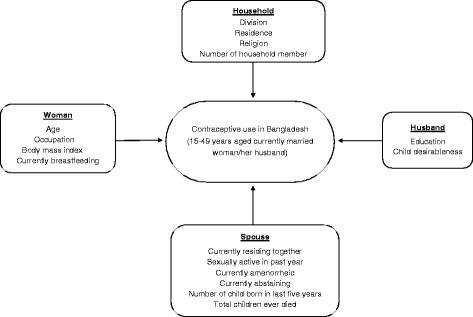
BACKGROUND: Birth control is the conscious control of the birth rate by methods which temporarily prevent conception by interfering with the normal process of ovulation, fertilization, and implantation. High contraceptive prevalence rate is always expected for controlling births for those countries that are experiencing high population growth rate. The factors that influence contraceptive prevalence are also important to know for policy implication purposes in Bangladesh. This study aims to explore the socio-economic, demographic and others key factors that influence the use of contraception in Bangladesh. METHODS: The contraception data are extracted from the 2014 Bangladesh Demographic and Health Survey (BDHS) data which were collected by using a two stage stratified random sampling technique that is a source of nested variability. The nested sources of variability must be incorporated in the model using random effects in order to model the actual parameter effects on contraceptive prevalence. A mixed effect logistic regression model has been implemented for the binary contraceptive data, where parameters are estimated through generalized estimating equation by assuming exchangeable correlation structure to explore and identify the factors that truly affect the use of contraception in Bangladesh. RESULTS: The prevalence of contraception use by currently married 15-49 years aged women or their husbands is 62.4%. Our study finds that administrative division, place of residence, religion, number of household members, woman's age, occupation, body mass index, breastfeeding practice, husband's education, wish for children, living status with wife, sexual activity in past year, women amenorrheic status, abstaining status, number of children born in last five years and total children ever died were significantly associated with contraception use in Bangladesh. CONCLUSIONS: The odds of women experiencing the outcome of interest are not independent due to the nested structure of the data. As a result, a mixed effect model is implemented for the binary variable 'contraceptive use' to produce true estimates for the significant determinants of contraceptive use in Bangladesh. Knowing such true estimates is important for attaining future goals including increasing contraception use from 62 to 75% by 2020 by the Bangladesh government's Health, Population & Nutrition Sector Development Program (HPNSDP).
Overview
The claims and statistics of this paper haven’t been checked yet.
Free: it reads the open-access text and checks the first 5 claims that cite a source we can check. Create a free account to check every claim.
Integrity signals
Registry
Cites
Statistics
Figures
Verification
Claims the paper makes
The claims and statistics of this paper haven’t been checked yet.
Free: it reads the open-access text and checks the first 5 claims that cite a source we can check. Create a free account to check every claim.
Claims other papers make about this one
Each is checked against this paper’s own text: does it say what the citing paper says it does?
The source backs part of the claim, not all of it — or backs it for a different population, condition or comparison.
In the citing paper
“Other factors, such as education and religiosity, also influence contraceptive use (e.g. [44, 45]).”
From Human fertility in relation to education, economy, religion, contraception, and family planning programs (2020) · cites this paper as [44]
Experimental — accuracy not yet measured
Self-check
Percentages, sums and reported differences re-computed from the paper’s own numbers.
The self-check needs the paper’s full text.
Citations
Cites
Longitudinal data analysis using generalized linear models
LIANG, K.-Y., & ZEGER, S. L. (1986) · Biometrika · doi:10.1093/biomet/73.1.13 · Cited by 18,550
Nepal Demographic And Health Survey 2006
Mohp, P., & Nepal (2007) · Cited by 1,312
The variability of female reproductive ageing
te Velde, E. R. (2002) · Human Reproduction Update · doi:10.1093/humupd/8.2.141 · Cited by 1,214 · cited 1×
“It is also evident that to avoid unwanted pregnancies, to choose the size of family and improve the spacing between the births of children, to reduce abortion and to allow spontaneous sex, contraceptives are inevitable and convenient for both men and women [6].”
BackgroundA Hierarchical Model for Studying School Effects
Raudenbush, S., & Bryk, A. S. (1986) · Sociology of Education · doi:10.2307/2112482 · Cited by 818
Pakistan Demographic and Health Survey 1990/1991.
Sathar], [. A. (1992) · Population and Development Review · doi:10.2307/1973773 · Cited by 639
Categorical Data Analysis, Second Edition
Chimka, J. R. (2003) · IIE Transactions · doi:10.1080/07408170304423 · Cited by 605
So, R., & Rojas, G. V. E. (2003) · Cited by 470
Factors Associated with Contraceptive Choice and Inconsistent Method Use, United States, 2004
Frost, J. J., & Darroch, J. E. (2008) · Perspectives on Sexual and Reproductive Health · doi:10.1363/4009408 · Cited by 381
Mixed Models: Theory and Applications with R
Demidenko, E. (2013) · Cited by 339
Medical History of Contraception
HIMES, N. E. (1934) · New England Journal of Medicine · doi:10.1056/nejm193403152101103 · Cited by 273
Research works printed but not linked: 6
- Kumar N “met and unmet needs for family planning: a global issue EC Gynaecol 2016 3 281 9
- National Institute of Population Studies (NIPS) [Pakistan] and ICF International. Pakistan Demographic and Health Survey 2012-13. Islamabad, Pakistan, and Calverton, Maryland, USA; 2013. Available at www.DHSprogram.com.
- Cleland J Phillips JF Amin S Kamal GM The determinants of reproductive change in Bangladesh. World Bank Regional and Sectoral Studies 1994 Washington The World Bank
- Kamal N Lim C Omar R Determinants of contraceptive use in the urban slums of Bangladesh: A multilevel model 2005 UK Department of Statistical Science, UCL
- Verbeke G Models for Discrete Longitudinal Data. Springer Series in Statistics 2005 New York Springer
- Das K Gautam V Das K Tripathy P Influence of age gap between couples on contraception and fertility J Fam Welf 2011 57 2 30 8
Cited by
Götmark, F., & Andersson, M. (2020) · BMC Public Health · doi:10.1186/s12889-020-8331-7 · Cited by 230
Nigatu, M., & Edosa, Z. K. (2020) · BMC Women s Health · doi:10.1186/s12905-020-00923-9 · Cited by 69
Ghosh, R., Mozumdar, A., Chattopadhyay, A., & Acharya, R. (2021) · PLoS ONE · doi:10.1371/journal.pone.0254400 · Cited by 54
Islam, M. K., Haque, M. R., & Hema, P. S. (2020) · PLoS ONE · doi:10.1371/journal.pone.0230143 · Cited by 52
Ahmed, Z., Shew, A. M., Mondal, M. K., Yadav, S., Jagadish, S. V. K., Prasad, P. V. V., Buisson, M.-C., Das, M., & Bakuluzzaman, M. (2022) · Journal of Rural Studies · doi:10.1016/j.jrurstud.2022.06.008 · Cited by 59
Kundu, S., Kundu, S., Rahman, M. A., Kabir, H., Banna, M. H. A., Basu, S., Reza, H. M., & Hossain, A. (2022) · BMC Public Health · doi:10.1186/s12889-022-14857-4 · Cited by 48
“Several previous Bangladeshi studies identified different sociodemographic factors like women’s age, women’s educational level, household wealth status, women working status, administrative division, place of residence, religion, number of household members, breastfeeding practice, husband’s education are significantl…”
BackgroundMethodResultInfluentialRoy, N., Amin, M. B., Maliha, M. J., Sarker, B., Aktarujjaman, M., Hossain, E., & Talukdar, G. (2021) · PLoS ONE · doi:10.1371/journal.pone.0257634 · Cited by 40
Khan, M. N., Islam, M. M., & Akter, S. (2022) · BMC Health Services Research · doi:10.1186/s12913-022-08565-3 · Cited by 35
“However, previous studies on this topic in Bangladesh considered only the population-level factors [2, 23, 24].”
Self-citationAkram, R., Sarker, A. R., Sheikh, N., Ali, N., Mozumder, M. G. N., & Sultana, M. (2020) · PLoS ONE · doi:10.1371/journal.pone.0233634 · Cited by 33
“Despite the extensive coverage of family planning interventions including the use of contraceptives, fertility desires among women and TFR vary widely across different geographic and socio-economic strata in Bangladesh [2,4,5].”
BackgroundTsegaw, M., Mulat, B., & Shitu, K. (2022) · Open Access Journal of Contraception · doi:10.2147/oajc.s350117 · Cited by 31
“Background Contraception is defined as the intentional prevention of conception or pregnancy during sexual activity.(1) Modern contraceptive utilization is a human right issued under the international human rights law.”
BackgroundContraceptive use among women with no fertility intention in Ethiopia
Asresie, M. B., Fekadu, G. A., & Dagnew, G. W. (2020) · PLoS ONE · doi:10.1371/journal.pone.0234474 · Cited by 29
The Association of Female Reproductive Factors with Glaucoma and Related Traits
Madjedi, K. M., Stuart, K. V., Chua, S. Y. L., Foster, P. J., Strouthidis, N. G., Luben, R., Warwick, A., Kang, J. H., Wiggs, J. L., Pasquale, L. R., et al. (2022) · Ophthalmology Glaucoma · doi:10.1016/j.ogla.2022.06.003 · Cited by 33
“43 Decisions made by women around contraception use are influenced by numerous demographic, socioeconomic, and geographic factors, 44,45 which may potentially explain or modify any potential associations between OC use and IOP or OAG.”
Pradhan, M. R., & Mondal, S. (2023) · BMC Women s Health · doi:10.1186/s12905-023-02587-7 · Cited by 29
“Recent literature suggests that women’s age, education, place of residence, and region are the significant determinants of contraceptive use in Bangladesh, India, Nepal, and Paki-stan [5–8].”
BackgroundImpact of multiple food environments on body mass index
Dornelles, A. C. (2019) · PLoS ONE · doi:10.1371/journal.pone.0219365 · Cited by 26
Islam, M. Z., Islam, M. M., Rahman, M. M., & Khan, M. N. (2022) · Scientific Reports · doi:10.1038/s41598-022-13193-2 · Cited by 22
Self-citationSharma, H., & Singh, S. K. (2022) · BMC Women s Health · doi:10.1186/s12905-022-01736-8 · Cited by 21
“Similar findings were provided by a study on Bangladeshi women in which women from rural setting had less chance of contraceptive use than a woman from urban setting [17].”
ResultDeterminants of Modern Contraceptive Use and Unmet Need for Family Planning among the Urban Poor
Singh, L. M., Prinja, S., Rai, P., Siddhanta, A., Singh, A. K., Sharma, A., Sharma, V., Rana, S. K., Muneeza, K. F., & Srivastava, A. (2020) · Open Journal of Social Sciences · doi:10.4236/jss.2020.85031 · Cited by 17
Abeid, R. A., Sumari, E. I., Qin, C., Lyimo, A. A., & Luttaay, G. A. (2023) · Contraception and Reproductive Medicine · doi:10.1186/s40834-023-00234-y · Cited by 18
“More studies reported similar information where about 90% of the participants experienced opposition from their husbands, community stigma 55% [41, 42], need for more children by husband [43], and influence of religion [23, 32].”
BackgroundMare, K. U., Aychiluhm, S. B., Tadesse, A. W., & Mohammed, O. A. (2022) · Emerging Themes in Epidemiology · doi:10.1186/s12982-022-00112-z · Cited by 15
“6%) [39], Zambia (40%) [40], India (46.”
Ahmed, M. S., & Yunus, F. M. (2020) · The European Journal of Contraception & Reproductive Health Care · doi:10.1080/13625187.2020.1850675 · Cited by 16
Kaombe, T. M. (2024) · BMC Women s Health · doi:10.1186/s12905-024-02891-w · Cited by 15
“Whereas contraceptive usage and professional occupation are the by-products of knowledge acquisition, which is why these factors are associated with a higher number of schooling years in females [34].”
BackgroundBelachew, T. B., Negash, W. D., Bitew, D. A., & Asmamaw, D. B. (2023) · BMJ Open · doi:10.1136/bmjopen-2022-066432 · Cited by 18
Determinants of Fertility in Bangladesh: Evidence From the 2014 Demographic and Health Survey
Nahar, M. Z., & Zahangir, M. S. (2019) · International Quarterly of Community Health Education · doi:10.1177/0272684x19857426 · Cited by 15
Kayi, E. A., Biney, A. A. E., Dodoo, N. D., Ofori, C. A. E., & Dodoo, F. N. (2021) · PLoS ONE · doi:10.1371/journal.pone.0261005 · Cited by 15
“Similar findings have been reported in other contexts among women in their reproductive ages [41,42].”
ResultContraceptive uses among married women in Bangladesh: a systematic review and meta-analyses
Hossain, S., Akter, T., Mohsin, M., Islam, M. M., Chowdhury, P. B., & Khudri, M. M. (2024) · Journal of Health Population and Nutrition · doi:10.1186/s41043-024-00502-w · Cited by 12
“Contraception indicates to prevent pregnancy as a consequence of sexual intercourse [6, 8].”
BackgroundMethodZegeye, B., Idriss-Wheeler, D., Ahinkorah, B. O., Ameyaw, E. K., Seidu, A., Keetile, M., & Yaya, S. (2022) · International Health · doi:10.1093/inthealth/ihab092 · Cited by 15
Pickard, A., Islam, M. I., Ahmed, M. S., & Martiniuk, A. L. C. (2024) · PLOS Global Public Health · doi:10.1371/journal.pgph.0002518 · Cited by 17
“Contraceptive use also increases with the number of existing children a woman has [33,44,49–51].”
BackgroundRana, M. S., Alam, M. B., Hassen, M. T., Kabir, M. I., Khanam, S. J., & Khan, M. N. (2024) · PLoS ONE · doi:10.1371/journal.pone.0291100 · Cited by 11
“Existing studies have primarily focused on either young women or the entire reproductive-aged female population and examine socio-demographic factors associated with contraception use [4, 5, 23–25].”
Self-citationKapasia, N., Paul, P., Roy, A., & Chouhan, P. (2022) · Women s Reproductive Health · doi:10.1080/23293691.2021.2016188 · Cited by 8
Alam, N., Mollah, M. M. H., & Naomi, S. S. (2023) · Frontiers in Public Health · doi:10.3389/fpubh.2023.1088465 · Cited by 16
Abdi, B., Okal, J., Serour, G. I., Were, V. O., Temmerman, M., & Gichangi, P. (2024) · BMC Women s Health · doi:10.1186/s12905-024-02892-9 · Cited by 9
“This is consistent with other studies conducted that focused on the determinants and prevalence of contraception use among employed and unemployed women [8, 37].”
ResultAlam, M. B., Khanam, S. J., Kabir, M. A., Abate, K. H., & Khan, M. N. (2025) · Contraception and Reproductive Medicine · doi:10.1186/s40834-025-00383-2 · Cited by 13
“This finding aligns with previous studies in Bangladesh [10, 35, 55, 56, 58] but contradicts research from other countries, where higher socioeconomic status typically correlates with greater contraceptive use [59–61].”
Self-citationSujarwoto, S., Ekoriano, M., Purwoko, E., Titisari, A. S., Rahmadhony, A., & Sari, D. P. (2023) · SAGE Open · doi:10.1177/21582440231160665 · Cited by 7
“Nevertheless, our findings corroborate studies in Benin, Zimbabwe, and Bangladesh (Emina et al., 2014; Hossain et al., 2018).”
BackgroundResultShort birth interval in the Asia-Pacific region: A systematic review and meta-analysis
Abate, K. H., Chojenta, C., Khan, M. N., Shifti, D. M., & Harris, M. L. (2024) · Journal of Global Health · doi:10.7189/jogh.14.04072 · Cited by 11
“Cultural norms, beliefs, and traditions regarding family planning and fertility may affect the timing between births [37,80,81].”
BackgroundSelf-citationThe Impact of Education and Residence on Current Use of Contraception in Ethiopian Women
Ahmed, A., & Zahangir, M. S. (2019) · Global Journal of Health Science · doi:10.5539/gjhs.v11n9p182 · Cited by 7
Social networks and their effects on the choice of contraceptive use and method in Bangladesh
Islam, M. S. (2019) · International Journal of Human Rights in Healthcare · doi:10.1108/ijhrh-07-2018-0045 · Cited by 7
Ahmed, M. S., Khan, S., & Yunus, F. M. (2021) · Midwifery · doi:10.1016/j.midw.2021.103139 · Cited by 7
Kundu, S. (2022) · Journal of Biosocial Science · doi:10.1017/s002193202200030x · Cited by 6
Asah‐Opoku, K., Mumuni, K., Ameme, D. K., Mohammed, A. G., Samba, A., & Nkyekyer, K. (2023) · International Journal of Gynecology & Obstetrics · doi:10.1002/ijgo.14654 · Cited by 7
Akter, S., Khan, M. M. H., Hossain, A. H. M. K., Uddin, M., & Haque, M. A. (2025) · Contraception and Reproductive Medicine · doi:10.1186/s40834-024-00331-6 · Cited by 6
“It includes primarily, among other things, contra-ception, a method of birth control, which refers to the deliberate prevention of pregnancy during sexual activity by using devices, agents, medications, sexual behavior, or surgery [3].”
Self-citationWondie, K. Y., Badi, M. B., & Tamiru, A. T. (2020) · Open Access Journal of Contraception · doi:10.2147/oajc.s255551 · Cited by 6
Fertility behaviour in linguistic zones: revisiting the diffusion hypothesis in greater Bengal
Das, P., Husain, Z., & Ghosh, S. (2020) · Asian Population Studies · doi:10.1080/17441730.2019.1706300 · Cited by 6
DETERMINANTS OF CONTRACEPTIVE USE IN RURAL POOR AREAS: EVIDENCE FROM INDONESIA
Gayatri, M. (2023) · The Indonesian Journal of Public Health · doi:10.20473/ijph.v18i1.2023.34-46 · Cited by 9
Kabir, S., Tareq, M., & Hossain, M. I. (2024) · PLoS ONE · doi:10.1371/journal.pone.0304122 · Cited by 5
“…are several studies which have found significant factors associated with the use of modern contra-ceptives, such as respondent’s age [1,3,9,10], education [7,3,11,12], region [5,13,14], fertility preferences [15], women’s decisions on own health care [16,17], and the number of surviving [9,18–20].”
BackgroundSelf-citationMoon, M. P. (2025) · Frontiers in Global Women s Health · doi:10.3389/fgwh.2025.1492105 · Cited by 7
Endale, H. T., Negash, H. K., Tesfaye, W., Hasen, F. S., Asefa, T., Gelaw, D. T., Ayenew, Y. T., Baykemagn, N. D., Yehuala, T. Z., & Getnet, M. (2025) · PLoS ONE · doi:10.1371/journal.pone.0323899 · Cited by 6
“The finding that employed women have better utilization of modern contraceptives compared to non-employed women is consistent with studies conducted in Ethiopia [55], Malawi [56], Zambia [57], Cameroon [31], Indonesia [58], Bangladesh [59] and India [60].”
Usage of contraception among the married women in India, 2019–21: a cross-sectional study
Shekhar, C., Sahoo, H., & Das, L. (2025) · Contraception and Reproductive Medicine · doi:10.1186/s40834-025-00375-2 · Cited by 4
“Contracep-tive practices are heavily influenced by gender norms and religious beliefs, with Muslim women using contraceptives less frequently than non-Muslims [3].”
Lakhani, S., Meerza, S. S. A., Khakwani, S., Naqvi, S. K., Khan, M. H., & Asim, M. (2024) · PLOS Global Public Health · doi:10.1371/journal.pgph.0003424 · Cited by 4
“We found similar findings present in China and Bangladesh where the number of living children increases contraceptive use [43,44].”
ResultSelf-citationData Mining Classification Approach to Predict The Duration of Contraceptive Use
Maulana, Y. D. F., Ruldeviyani, Y., & Sensuse, D. I. (2020) · International Conference on Informatics and Computing (ICIC) · doi:10.1109/icic50835.2020.9288568 · Cited by 4
“While target variables in this research are the duration of contraceptive used (1-3 months; 4-12 months; and more than 1 year) [16][17].”
BackgroundElamin, H. A. M., Gadir, I. K. A., Alhazmi, M. H. A., & Owisi, N. H. (2022) · Saudi Journal for Health Sciences · doi:10.4103/sjhs.sjhs_135_21 · Cited by 4
Jahan, I., Vučković, M., Kabir, S. S., Rashid, S. F., & Bouey, J. Z. H. (2024) · Culture Health & Sexuality · doi:10.1080/13691058.2024.2302052 · Cited by 6
“This description supports findings from the 2014 Bangladesh Demographic and Health Survey showing that the prevalence of any contraceptive use in Bangladesh is higher than in other South Asian countries (Hossain et al. 2018).”
Haider, M. M., Rahman, M. M., Khan, S., Efa, T. K., & Rahman, M. (2024) · Journal of Global Health · doi:10.7189/jogh.14.04246 · Cited by 3
Das, N. C., Ghosh, P. K., Hossain, M. A., Shuvo, U. A., Talukder, N. R., Khatun, F., & Chowdhury, M. Z. I. (2025) · PLoS ONE · doi:10.1371/journal.pone.0335442 · Cited by 6
Self-citationAmadou, S., Lee, M., Lee, J., Kim, S., & Kang, S. (2025) · Scientific Reports · doi:10.1038/s41598-025-85998-w · Cited by 3
“Maternal mortality remains a pressing global issue, particularly in sub-Saharan Africa, as emphasized by its inclusion in Sustainable Development Goal 3.1 by the United Nations 1 .”
InfluentialMim, F. N., Ali, M. H., Rahman, S., Koasha, F. A., Islam, M. R., & Yasmin, S. (2025) · Health Science Reports · doi:10.1002/hsr2.71033 · Cited by 4
“Previous studies have examined various determinants of modern contraceptive use [9, 10], yet limited research has comprehensively analyzed the combined impact of age at first marriage, education level, and employment status on modern contraceptive adoption in Bangladesh [11].”
Faktor-Faktor yang Berhubungan dengan Penggunaan Metode Kontrasepsi Tradisional
Wijayanti, U. T. (2021) · JURNAL PROMOSI KESEHATAN INDONESIA · doi:10.14710/jpki.16.1.14-22 · Cited by 3
Peran Pemberdayaan Wanita sebagai Upaya Peningkatan Kesehatan Ibu di Indonesia
Astuti, B. W. (2021) · Jurnal Ilmiah Kesehatan · doi:10.33221/jikes.v20i1.847 · Cited by 9
Nurcahyani, L., Widiyastuti, D., Iman, A. T., Cahyati, Y., & Fitrianingsih, Y. (2023) · Kesmas National Public Health Journal · doi:10.21109/kesmas.v18i2.6860 · Cited by 3
Eva, I. J., & Habib, M. A. (2024) · International Journal of Science and Business · doi:10.58970/ijsb.2389 · Cited by 3
Khan, M. M. A., Karim, M., Islam, M. R., Hoque, M. N., Islam, M. N., Abedin, S., & Hossain, M. M. (2020) · Applied demography series · doi:10.1007/978-3-030-57069-9_2 · Cited by 5
Self-citationAdem, J. B., Nebi, T. D., Walle, A. D., Mamo, D. N., Wado, S. J., Enyew, E. B., & Kebede, S. D. (2024) · Research Square · doi:10.21203/rs.3.rs-3848375/v1 · Cited by 3
Khan, M. N., Khan, M. M. A., Billah, M. A., Khanam, S. J., Haider, M. M., Sarker, B. K., & Harris, M. L. (2025) · PLoS ONE · doi:10.1371/journal.pone.0318363 · Cited by 4
Self-citationAdem, J. B., Nebi, T. D., Walle, A. D., Mamo, D. N., Wado, S. J., Enyew, E. B., & Kebede, S. D. (2025) · BMJ Public Health · doi:10.1136/bmjph-2024-000962 · Cited by 9
“Therefore, FP providers and stakeholders should focus on reducing barriers to intention to use FP, such as the side effects and discomfort with the FP methods, targeting the unmet needs for FP and encouraging husband/partner involvement in FP use.”
Sarvestani, K. A., & Hulsbergen, M. (2024) · BMC Public Health · doi:10.1186/s12889-023-17414-9 · Cited by 3
“Meanwhile, in the case of Bangladesh, other studies have noted that even before the COVID-19 pandemic, rural women had a lower chance of receiving contraception and MR services than urban women [24, 36, 46].”
ResultOmona, K., Ssekyeru, E., Kirya, P., Mutebi, J., Tenywa, I., Mugabi, A., & Ochieng, B. O. (2021) · Cognizance Journal of Multidisciplinary Studies · doi:10.47760/cognizance.2021.v01i03.005 · Cited by 2
“This finding is in line with the results of a studies done in south Sudan (22), Nigeria (23), Bangladesh (24), Ghana (25).”
ResultChoe, C. G., Rittirong, J., & Chamchan, C. (2022) · Journal of Public Health and Development · doi:10.55131/jphd/2022/200103 · Cited by 2
Factors Affecting Contraceptive Choice and Discontinuation Among Married Women in Iraqi Kurdistan
Alsanity, M. A., & Hasan, C. Y. (2023) · Journal of Obstetrics Gynecology and Cancer Research · doi:10.30699/jogcr.8.3.240 · Cited by 4
“Using contraceptives properly can reduce family size, give spacing between pregnancies, and prevent unwanted pregnancies (7, 8) .”
BackgroundSardasht, F. G., Keramat, A., & Motaghi, Z. (2021) · Iranian Journal of Nursing and Midwifery Research · doi:10.4103/ijnmr.ijnmr_13_20 · Cited by 2
“Our findings are consistent with the findings of Hossain et al.[22] Table 3: Logistic regression analysis for contraceptive use and contraceptive failure”
BackgroundResultDuru, C. B., Andibanbang, F. A., Duru, C. A., & Ogelle, O. M. (2022) · Journal of Drug Delivery and Therapeutics · doi:10.22270/jddt.v12i4-s.5511 · Cited by 1
Khan, M. N., Khanam, S. J., Billah, M. A., Khan, M. M. A., & Islam, M. M. (2025) · BMC Public Health · doi:10.1186/s12889-025-22527-4 · Cited by 2
“While previous studies in Bangladesh have shown these effects exist [8, 45, 46], an interesting area for investigation would be whether the presence of diabetes and hypertension amplifies them.”
Self-citationLaker, F., Okot, J., Ojara, F. W., Akello, F., Amone, D., Pebolo, P. F., Awor, S., Atim, P., & Bongomin, F. (2025) · Women s Health · doi:10.1177/17455057251374498 · Cited by 1
“36,37 Similarly, being in school and receiving monthly allow-ances was associated with EC utilization as supported by other studies.”
Hossain, M. A., Arafat, M. Y., Saha, B. R., Mothashin, M., Mamun, A. S. M. A., & Hossain, G. (2026) · Contraception and Reproductive Medicine · doi:10.1186/s40834-026-00446-y · Cited by 2
“Previous studies in Bangladesh have been correlated with enhanced usage of MC, including women’s age, occupation, breastfeeding practices, abstaining status of sexual activity in the past year, and women’s amenorrhea [13].”
Self-citationKhan, J., & Mumtaz, S. (2026) · Discover Public Health · doi:10.1186/s12982-026-01878-2 · Cited by 1
Naqvi, S. K., Hussain, L., Kumari, S., Madni, V., Malik, H., Ali, I. F. M., Kumar, P. A., Malik, A., Farooqui, K., Das, J. K., et al. (2026) · The Lancet Regional Health - Southeast Asia · doi:10.1016/j.lansea.2026.100828 · Cited by 4
Khatun, M. S., Nabeen, A. H. M. M. R., Husain, M. M., & Akanda, M. A. S. (2020) · Dhaka University Journal of Science · doi:10.3329/dujs.v68i2.54609 · Cited by 1
Knowledge, Attitude and Perception of Married Women Toward Family Planning in Shekhan City
Hasan, J. N. (2022) · Annals of the College of Medicine Mosul/Annals of the College of Medecine · doi:10.33899/mmed.2021.131885.1119 · Cited by 1
Factors Associated with Contraceptive Use in Malaysia and Pakistan
Hoo, K. Y., & Lai, S. L. (2023) · Pertanika journal of social science & humanities · doi:10.47836/pjssh.31.1.14 · Cited by 1
Abejo, J. R. A., Gulle, J. S., & Montajes, R. S. (2024) · American Journal of Agricultural Science Engineering and Technology · doi:10.54536/ajaset.v8i1.2303 · Cited by 1
Yunita, R., Ramani, A., & Baroya, N. (2023) · BIOGRAPH-I Journal of Biostatistics and Demographic Dynamic · doi:10.19184/biograph-i.v3i2.29828 · Cited by 1
Ds, N. K. A. D. U., Wirawan, D. N., & Ani, L. S. (2019) · Public Health and Preventive Medicine Archive · doi:10.15562/phpma.v7i2.211 · Cited by 1
Mbilinyi, L. B., & Moshiro, C. S. (2020) · doi:10.21203/rs.3.rs-25841/v1 · Cited by 1
Masters Program in Public Health, U. S. M., Frafitasari, D. Y., Budihastuti, U. R., Murti, B., & Masters Program in Public Health, U. S. M. (2021) · Journal of Maternal and Child Health · doi:10.26911/thejmch.2020.05.01.07
“Hossain et al. (2018) said that complications and death in pregnancy can be prevented by the use of appropriate contraceptive methods because of the many benefits”
BackgroundIlesanmi, A., Okamgba, O. C., Oyeleke, K. O., Anyiam, A. F., & Ayegoro, B. (2020) · Frontiers in Women’s Health · doi:10.15761/fwh.1000180
Noormal, A. S., Winkler, V. F., Eshraqi, A. M., Deckert, A., Noormal, S., Sadaat, I., & Dambach, P. (2021) · Research Square · doi:10.21203/rs.3.rs-722358/v1
Use of Modern Contraceptive Methods in Family Planning Among Married Women in Guinea
Camara, M. K., Magassouba, M., Kouyate, S., Loua, C., Sidibé, S., Sandouno, M. R., & Magassouba, A. S. (2021) · Journal of Gynecology and Obstetrics · doi:10.11648/j.jgo.20210906.11
“4% [15] reported to Nigeria, identical among all women of childbearing age but below 24% among married women in Burkina Faso [16].”
BackgroundLiver cell adenoma with malignant transformation: A case report
MasahiroIto, MakotoSasaki, Chun-YangWen, MasahiroNakashima, ToshihitoUeki, HiromiIshibashi, MichitamiYano, MasayoshiKage, & MasamichiKojiro (2003)
Maulana, Y. D. F., Handayani, P. W., & Shihab, M. R. (2021) · International Conference on Advanced Computer Science and Information Systems · doi:10.1109/icacsis53237.2021.9631317
Shrestha, S. R., Silvanus, V., & Shakya, B. (2022) · Nepal Medical College Journal · doi:10.3126/nmcj.v24i2.46038
“-Multiple response were present Table 2: Mean values of SBP, DBP and BMI according to different hormonal contraceptive methods Variables Hormonal contraceptives Min Max Mean SD Lower 95% CI Upper 95% CI p-value SBP OCP 100 150 119.9 9.6 117.3 122.5 0.524Depo-Provera 90 150 119.5 10.2 117.8 121.2 Implant 90 150 121.4 1…”
BackgroundInfluentialEsther, O. A. (2022) · Texila international journal of public health · doi:10.21522/tijph.2013.10.03.art004
Sumon, M. K., Khan, M. M. A., Billah, M. A., Khanam, S. J., Haider, M. M., Sarker, B. K., & Harris, M. L. (2023) · SSRN Electronic Journal · doi:10.2139/ssrn.4463501
Self-citationUchenna, N. G., & Farotimi, A. A. (2023) · nternational Journal of Public Health Pharmacy and Pharmacology · doi:10.37745/ijphpp.15/vol8n31126
Rana, M. S., Alam, M. B., Abate, K. H., Kabir, M. I., Khanam, S. J., & Khan, M. N. (2023) · medRxiv · doi:10.1101/2023.08.23.23294471
Self-citationDeterminants of Use of Contraceptive Methods Among Sexually Active Married Men in Nigeria
Kupoluyi, J. A., Solanke, B. L., Chukwu, E. O., & Adejugbe, B. O. (2023) · Journal of Population and Social Studies · doi:10.25133/jpssv312023.047
TRENDS OF SOCIOECONOMIC INEQUALITY IN CHILD AND MOTHER’S HEALTH INDICATORS IN BANGLADESH
Biswas, B., Biswas, S., Husain, M. M., Kumar, N., & Khatun, K. (2023) · Journal of Science and Technology · doi:10.59125/jst.21111
Singh, S. K., Sharma, H., Legare, C. H., & Mondal, S. (2023) · SSRN Electronic Journal · doi:10.2139/ssrn.4578189
Sultana, I. (2023) · Corvinus Journal of Sociology and Social Policy · doi:10.14267/cjssp.2023.1.4 · Cited by 1
Uddin, M. S. (2023) · Research Square · doi:10.21203/rs.3.rs-3492661/v1
THE SYSTEMATIC REVIEW OF GLAUCOMA AND ITS ASSOCIATIONS WITH FEMALE REPRODUCTIVE FACTORS
Paranoan, A., & Male, H. D. C. (2024) · Journal of Advance Research in Medical & Health Science · doi:10.61841/8227z085
“10,11 The epidemiology research does not consistently support an overall link between age at menopause and POAG; nevertheless, some subgroup analyses indicate that people with an earlier age at natural menopause are more likely to develop POAG.”
ResultMaqsood, S., Sunil, S., Fatima, M., & Johnson, P. D. (2024) · doi:10.53555/jptcp.v31i3.5116 · Cited by 1
Metadata
- Authors
- Hossain, M., Khan, M., Ababneh, F., & Shaw, J.
- Affiliations
- BRAC (BD)
- Al-Hussein Bin Talal University (JO)
- University of Warwick (GB)
- ORCID
- Venue
- BMC Public Health
- Published
- 2018-01-30
- Volume
- 18
- Issue
- 1
- Pages
- 192-192
- ISSN
- 1471-2458 (ISSN-L)
- PMC
- PMC5789662
- OpenAlex
- W2786456849
- Cited by
- 125
- References
- 42
- Citations by year
- 2026: 10 · 2025: 23 · 2024: 21 · 2023: 19 · 2022: 17 · 2021: 13 · 2020: 15 · 2019: 5 · 2018: 1
- FWCI
- 8.10
- Type
- journal article
- Language
- en
- Open access
- gold
- doi.org
- Licence
- cc-by
- Locations
- BMC Public Health (publishedVersion, cc-by)
- PubMed Central (publishedVersion, cc-by)
- PubMed (publishedVersion)
- Warwick Research Archive Portal (University of Warwick) (acceptedVersion)
- DOAJ (DOAJ: Directory of Open Access Journals) (submittedVersion)
- Funders
- University of Dhaka
- Topics
- Health Sciences › Medicine › Public Health, Environmental and Occupational Health › Reproductive Health and Contraception
- Social Sciences › Gender Studies › Demographic Trends and Gender Preferences
- Health Sciences › Medicine › Urology › Male Reproductive Health Studies
- Keywords
- contraceptive use, contraceptive prevalence, determinants of contraceptive use, married women of reproductive age, Bangladesh, socioeconomic factors, demographic factors, breastfeeding, amenorrhea, family planning policy, mixed-effects logistic regression
- MeSH terms
- Adolescent, Adult, Bangladesh, Contraception, Demography, Female, Humans, Male, Middle Aged, Socioeconomic Factors, Young Adult
About these checks
Registry, retraction, Cites and statistics results are computed, not judged, with one exception: a printed reference that no index lists is read once by a model before it counts as a citation error. Claims are extracted by a model and kept only when their quote appears verbatim in the text; each cited source is then checked, with a model’s help, for whether it says what the claim relies on. Those verdicts can be wrong — read the claim’s quote and the cited source before relying on one.
Statistics and arithmetic are recomputed, not judged.
Confidence bands are shown only for fields calibrated on our annotated test set. None is calibrated yet, so no band is shown.
What counts as a claim ›How we measure confidence ›How we check this ›
Are you an author, or do you see a problem with this page? Request a review
Data sources
Bibliographic data: Semantic Scholar, OpenAlex, Crossref.
Contains information from the Semantic Scholar Academic Graph Datasets, made available under the ODC Attribution License (ODC-BY 1.0).
Semantic Scholar’s data is described in: Kinney, R., et al. (2023). The Semantic Scholar Open Data Platform. arXiv:2301.10140.
