

Evaluating the impact of screening plus eave tubes on malaria transmission compared to current best practice in central Côte d’Ivoire: a two armed cluster randomized controlled trial
Open accessThe DOI matches its Crossref record; 41 of the 42 references it cites were found in a registry or an index.
Abstract
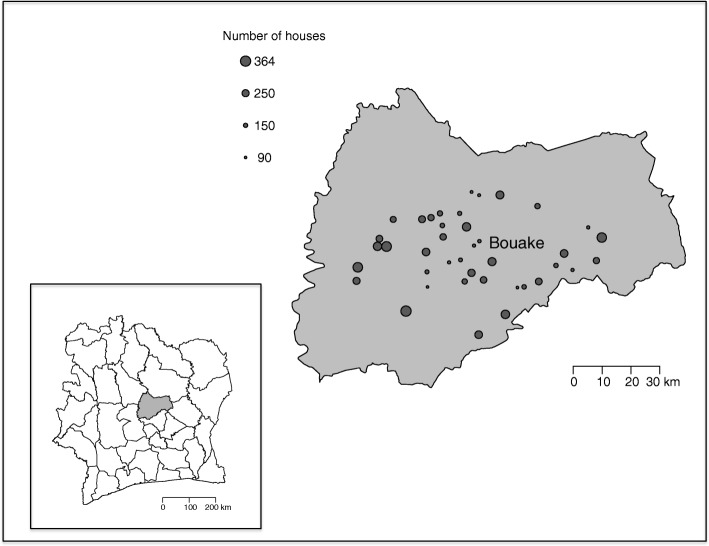
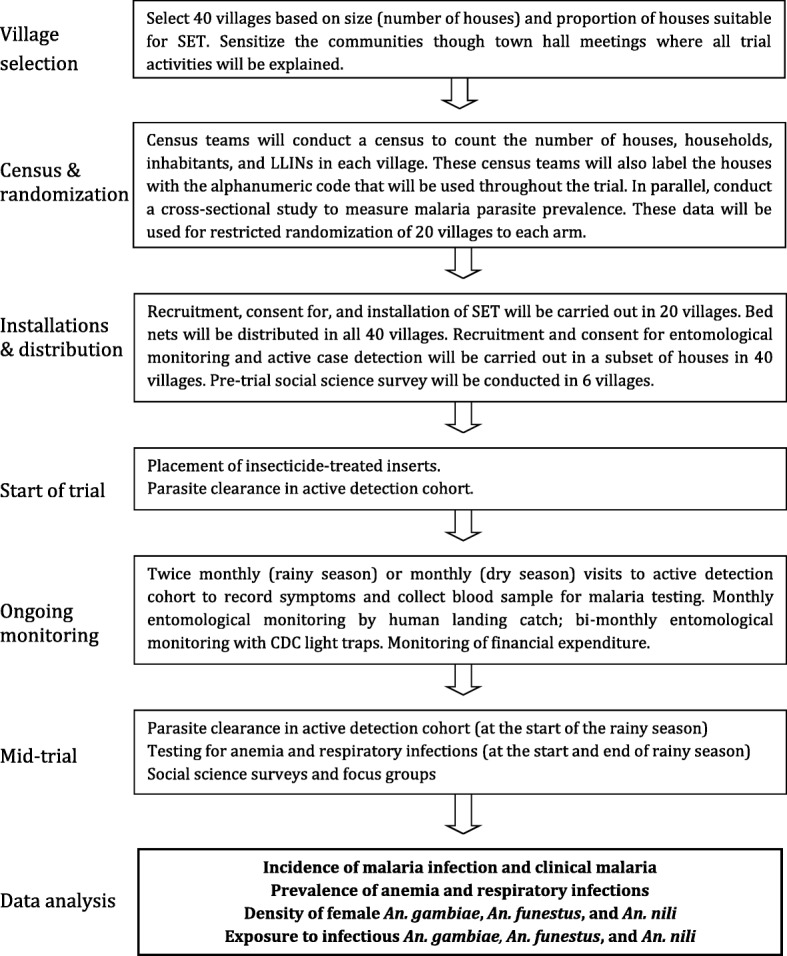
BACKGROUND: Access to long-lasting insecticidal nets (LLINs) has increased and malaria has decreased globally, but malaria transmission remains high in parts of sub-Saharan Africa and insecticide resistance threatens current progress. Eave tubes are a new tool for the targeted delivery of insecticides against mosquitoes attempting to enter houses. The primary objective of this trial is to test whether screening plus eave tubes (SET) provides protection against malaria, on top of universal coverage with LLINs in an area of intense pyrethroid resistance. The trial will also assess acceptability and cost-effectiveness of the intervention. METHODS/DESIGN: A two-armed, cluster randomized controlled trial will be conducted to evaluate the effect of SET on clinical malaria incidence in children living in central Côte d'Ivoire. Forty villages will be selected based on population size and the proportion of houses suitable for modification with SET. Using restricted randomization, half the villages will be assigned to the treatment arm (SET + LLINs) and the remainder will be assigned to the control arm (LLINs only). In both arms, LLINs will be distributed and in the treatment arm, householders will be offered SET. Fifty children aged six months to eight years old will be enrolled from randomly selected households in each of the 40 villages. Cohorts will be cleared of malaria parasites at the start of the study and one year after recruitment, and will be monitored for clinical malaria case incidence by active case detection over two years. Mosquito densities will be assessed using CDC light traps and human landing catches and a subset of Anopheles mosquitoes will be examined for parity status and tested for sporozoite infection. Acceptability of SET will be monitored using surveys and focus groups. Cost-effectiveness analysis will measure the incremental cost per case averted and per disability-adjusted life year (DALY) averted of adding SET to LLINs. Economic and financial costs will be estimated from societal and provider perspective using standard economic evaluation methods. DISCUSSION: This study will be the first evaluation of the epidemiological impact of SET. Trial findings will show whether SET is a viable, cost-effective technology for malaria control in Côte d'Ivoire and possibly elsewhere. TRIAL REGISTRATION: ISRCTN18145556 , registered on 01 February 2017 - retrospectively registered.
Overview
The claims and statistics of this paper haven’t been checked yet.
Free: it reads the open-access text and checks the first 5 claims that cite a source we can check. Create a free account to check every claim.
Integrity signals
Registry
Cites
Statistics
Figures
Verification
Claims the paper makes
The claims and statistics of this paper haven’t been checked yet.
Free: it reads the open-access text and checks the first 5 claims that cite a source we can check. Create a free account to check every claim.
Claims other papers make about this one
Each is checked against this paper’s own text: does it say what the citing paper says it does?
The source backs part of the claim, not all of it — or backs it for a different population, condition or comparison.
In the citing paper
“but the addition of insecticide-treated tubes increased mortality to around 25% per day.”
From Semi-field evaluation of the cumulative effects of a "Lethal House Lure" on malaria mosquito mortality (2019) · cites this paper as [13]
Experimental — accuracy not yet measuredThe cited source says what the claim attributes to it.
In the citing paper
“The epidemiological impact of screening plus eave tubes is currently being evaluated in a large-scale cluster randomized trial (CRT) in 40 villages in central Côte d’Ivoire [8].”
From Semi-field studies to better understand the impact of eave tubes on mosquito mortality and behaviour (2018) · cites this paper as [8]
The cited source says what the claim attributes to it.
In the citing paper
“Briefly, we designed the study to detect a 40% difference in malaria case incidence, assuming a control group incidence of 0·5 malaria cases per child-year and a coefficient of variation of 0·5 between clusters. This design required 20 clusters per group and 50 children per cluster followed for 2 years.”
From Impact and cost-effectiveness of a lethal house lure against malaria transmission in central Côte d'Ivoire: a two-arm, cluster-randomised controlled trial (2021) · cites this paper as [27]
The cited source says what the claim attributes to it.
In the citing paper
“Numerous laboratory, semi-field, and modelling studies have been suggestive of the potential of SET,20, 21, 24, 27”
From Impact and cost-effectiveness of a lethal house lure against malaria transmission in central Côte d'Ivoire: a two-arm, cluster-randomised controlled trial (2021) · cites this paper as [27]
Self-check
Percentages, sums and reported differences re-computed from the paper’s own numbers.
The self-check needs the paper’s full text.
Citations
Cites
The effect of malaria control on Plasmodium falciparum in Africa between 2000 and 2015
Bhatt, S., Weiss, D. J., Cameron, E., Bisanzio, D., Mappin, B., Dalrymple, U., Battle, K. E., Moyes, C. L., Henry, A., Eckhoff, P. A., et al. (2015) · Nature · doi:10.1038/nature15535 · Cited by 3,225 · cited 2×
“Background The incidence of malaria worldwide declined by 41% between 2000 and 2015 [1, 2].”
BackgroundRanson, H., N’Guessan, R., Lines, J., Moiroux, N., Nkuni, Z., & Corbel, V. (2011) · Trends in Parasitology · doi:10.1016/j.pt.2010.08.004 · Cited by 1,142 · cited 1×
“While LLIN coverage has increased over time, there are still concerns over operational limits on increasing coverage and use [36, 37] and insecticide resistance in vector populations [38, 39].”
BackgroundSelf-citationRanson, H., & Lissenden, N. (2016) · Trends in Parasitology · doi:10.1016/j.pt.2015.11.010 · Cited by 1,008 · cited 1×
“While LLIN coverage has increased over time, there are still concerns over operational limits on increasing coverage and use [36, 37] and insecticide resistance in vector populations [38, 39].”
BackgroundCalculating and presenting disability adjusted life years (DALYs) in cost-effectiveness analysis
Rushby, J. F. (2001) · Health Policy and Planning · doi:10.1093/heapol/16.3.326 · Cited by 383 · cited 2×
“The numbers of malaria cases averted in the SET + LLIN arm compared to the LLIN only arm will be used to calculate disability adjusted life years (DALYs) averted using standard methods [34].”
MethodThe evidence for improving housing to reduce malaria: a systematic review and meta-analysis
Tusting, L. S., Ippolito, M. M., Willey, B. A., Kleinschmidt, I., Dorsey, G., Gosling, R. D., & Lindsay, S. W. (2015) · Malaria Journal · doi:10.1186/s12936-015-0724-1 · Cited by 355 · cited 2×
“Based on previous house improvement trials [11, 13, 14], “mosquito proofing” of houses (screening windows, sealing cracks and open eaves) is expected to reduce the number of infective bites received indoors”
BackgroundSelf-citationKirby, M. J., Ameh, D., Bottomley, C., Green, C., Jawara, M., Milligan, P. J., Snell, P. C., Conway, D. J., & Lindsay, S. W. (2009) · The Lancet · doi:10.1016/s0140-6736(09)60871-0 · Cited by 293
Housing Improvements and Malaria Risk in Sub-Saharan Africa: A Multi-Country Analysis of Survey Data
Tusting, L. S., Bottomley, C., Gibson, H., Kleinschmidt, I., Tatem, A. J., Lindsay, S. W., & Gething, P. W. (2017) · PLOS Medicine · doi:10.1371/journal.pmed.1002234 · Cited by 282 · cited 2×
“Based on previous house improvement trials [11, 13, 14], “mosquito proofing” of houses (screening windows, sealing cracks and open eaves) is expected to reduce the number of infective bites received indoors”
BackgroundSelf-citationReducing malaria by mosquito-proofing houses
Lindsay, S. W., Emerson, P. M., & Charlwood, J. D. (2002) · Trends in Parasitology · doi:10.1016/s1471-4922(02)02382-6 · Cited by 242
Killeen, G. F., Govella, N. J., Lwetoijera, D. W., & Okumu, F. O. (2016) · Malaria Journal · doi:10.1186/s12936-016-1280-z · Cited by 166 · cited 1×
“reduced even in unmodified houses [19, 41].”
Developing an expanded vector control toolbox for malaria elimination
Killeen, G. F., Tatarsky, A., Diabate, A., Chaccour, C. J., Marshall, J. M., Okumu, F. O., Brunner, S., Newby, G., Williams, Y. A., Malone, D., et al. (2017) · BMJ Global Health · doi:10.1136/bmjgh-2016-000211 · Cited by 149 · cited 1×
“Thus, there is a strong argument to be made that meeting the GTS milestones will require a greater diversity of vector control tools than currently exist [4, 5].”
Background
Research works printed but not linked: 1
- Adja AM, N’Goran KE, Kengne P, Koudou GB, Toure M, Koffi AA, et al. Transmission vectorielle du paludisme en savane arborée à Gansé en Côte d'Ivoire. Médecine Trop. 2006;66:449–55. 17201288
Cited by
The importance of vector control for the control and elimination of vector-borne diseases
Wilson, A. L., Courtenay, O., Kelly-Hope, L. A., Scott, T. W., Takken, W., Torr, S. J., & Lindsay, S. W. (2020) · PLOS Neglected Tropical Diseases · doi:10.1371/journal.pntd.0007831 · Cited by 874
“Eave tubes are being tested in a large randomised-controlled trial in Côte d’Ivoire, which includes other house improvements, including eave closure and window screening [20].”
BackgroundNovel control strategies for mosquito-borne diseases
Jones, R. G., Ant, T. H., Cameron, M., & Logan, J. G. (2020) · Philosophical Transactions of the Royal Society B Biological Sciences · doi:10.1098/rstb.2019.0802 · Cited by 157
“The results of a large scale clusterrandomized trial investigating the epidemiological impact of the window screens and eaves tubes [35] are keenly awaited.”
BackgroundAbbasi, E., Vahedi, M., Bagheri, M., Gholizadeh, S., Alipour, H., & Moemenbellah‐Fard, M. D. (2022) · Heliyon · doi:10.1016/j.heliyon.2022.e08830 · Cited by 72
Sternberg, E. D., Cook, J., Alou, L. P. A., Assi, S. B., Koffi, A. A., Doudou, D. T., Aoura, C. J., Wolie, R. Z., Oumbouke, W. A., Worrall, E., et al. (2021) · The Lancet · doi:10.1016/s0140-6736(21)00250-6 · Cited by 57
Self-citationOumbouke, W. A., Pignatelli, P., Barreaux, A. M. G., Tia, I. Z., Koffi, A. A., Ahoua Alou, L. P., Sternberg, E. D., Thomas, M. B., Weetman, D., & N’Guessan, R. (2020) · Scientific Reports · doi:10.1038/s41598-020-71933-8 · Cited by 49
Self-citationHouse modifications for preventing malaria
Furnival-Adams, J., Olanga, E. A., Napier, M., & Garner, P. (2021) · Cochrane Database of Systematic Reviews · doi:10.1002/14651858.cd013398.pub3 · Cited by 46
“Sternberg 2018 (protocol) used thematic analysis to evaluate ethnographic and focus group information related to user acceptability.”
InfluentialKoffi, A. A., Camara, S., Alou, L. P. A., Oumbouke, W. A., Wolie, R. Z., Tia, I. Z., Sternberg, E. D., Yapo, F. H. A., Koffi, F. M., Assi, S.-B., et al. (2023) · Malaria Journal · doi:10.1186/s12936-023-04623-1 · Cited by 50
“The project, which was conducted in 40 villages, was designed to test whether modification of houses through the addition of window screening and eave tubes, provides additional protection against malaria in areas with intense pyrethroid-resistance above and beyond universal coverage of pyrethroid-only LLINs [29].”
MethodInfluentialSelf-citationHouse modifications for preventing malaria
Furnival-Adams, J., Olanga, E. A., Napier, M., & Garner, P. (2020) · Cochrane Database of Systematic Reviews · doi:10.1002/14651858.cd013398.pub2 · Cited by 45
Wolie, R. Z., Koffi, A. A., Ahoua Alou, L. P., Sternberg, E. D., N’Nan-Alla, O., Dahounto, A., Yapo, F. H. A., Kanh, K. M. H., Camara, S., Oumbouke, W. A., et al. (2021) · Parasites & Vectors · doi:10.1186/s13071-021-05079-5 · Cited by 24
Self-citationGenome engineering in insects for the control of vector borne diseases
Hillary, V. E., & Ceasar, S. A. (2021) · Progress in molecular biology and translational science · doi:10.1016/bs.pmbts.2020.12.017 · Cited by 28
Semi-field studies to better understand the impact of eave tubes on mosquito mortality and behaviour
Barreaux, A. M. G., Brou, N., Koffi, A. A., N’Guessan, R., Oumbouke, W. A., Tia, I. Z., & Thomas, M. B. (2018) · Malaria Journal · doi:10.1186/s12936-018-2457-4 · Cited by 19
“The epidemiological impact of screening plus eave tubes is currently being evaluated in a large-scale cluster randomized trial (CRT) in 40 villages in central Côte d’Ivoire [8].”
BackgroundSelf-citationOumbouke, W. A., Tia, I. Z., Barreaux, A. M. G., Koffi, A. A., Sternberg, E. D., Thomas, M. B., & N’Guessan, R. (2018) · Malaria Journal · doi:10.1186/s12936-018-2517-9 · Cited by 17
Self-citationAsale, A., Abro, Z., Enchalew, B., Teshager, A., Belay, A. K., Kassie, M. B., & Mutero, C. M. (2021) · Malaria Journal · doi:10.1186/s12936-021-03996-5 · Cited by 18
The role of human and mosquito behaviour in the efficacy of a house-based intervention
Barreaux, A. M. G., Oumbouke, W. A., Brou, N., Tia, I. Z., Alou, L. P. A., Doudou, D. T., Koffi, A. A., N’Guessan, R., Sternberg, E. D., & Thomas, M. B. (2020) · Philosophical Transactions of the Royal Society B Biological Sciences · doi:10.1098/rstb.2019.0815 · Cited by 16
“It is given regarding the CRT treatment arm, control or EaveTubes+ screening and it was assessed between December 2017 and June 2018. royalsocietypublishing.org/journal/rstb Phil.”
BackgroundMethodSelf-citationDemissie, D. B., Fetensa, G., Desta, T., & Tiyare, F. T. (2025) · International Journal of Environmental Research and Public Health · doi:10.3390/ijerph22071045 · Cited by 17
Barreaux, A. M. G., Oumbouke, W. A., Tia, I. Z., Brou, N., Koffi, A. A., N’guessan, R., & Thomas, M. B. (2019) · Malaria Journal · doi:10.1186/s12936-019-2936-2 · Cited by 10
Self-citationFrancisco, M. E., & Watanabe, K. (2024) · Frontiers in Public Health · doi:10.3389/fpubh.2024.1404493 · Cited by 14
Communal Innovations: Inspiring Neighborhoods of Hope and Advocacy
Smith, R. A., Kim, Y., Matthews, S. A., Sternberg, E. D., Doudou, D. T., & Thomas, M. B. (2020) · Journal of Health Communication · doi:10.1080/10810730.2020.1785059 · Cited by 9
“The field trial for the SET innovation engaged the community in a few ways (see Sternberg et al., 2018 for details).”
BackgroundSelf-citationUsing electric fields to control insects: current applications and future directions
Jobe, N. B., Chourasia, A., Smith, B. H., Molins, E., Rose, A., Pavlic, T. P., & Paaijmans, K. P. (2024) · Journal of Insect Science · doi:10.1093/jisesa/ieae007 · Cited by 13
Kleinschmidt, I., & Rowland, M. (2021) · Ecology and control of vector-borne diseases · doi:10.3920/978-90-8686-895-7_2 · Cited by 8
Self-citationDurable wall lining for malaria control in Liberia: results of a cluster randomized trial
Giesbrecht, D., Belleh, T. G., Pontarollo, J., Hinneh, V. S., Pratt, O., Kamal, S., & Allan, R. J. (2023) · Malaria Journal · doi:10.1186/s12936-022-04429-7 · Cited by 8
“Other house improvement approaches currently being tested include eave barrier tubes [15] and screening [24], with the latter showing a measurable effect on anaemia, even with non-insecticidal screening.”
BackgroundMethodGlobal malaria predictors at a localized scale
Skinner, E. B., Childs, M. L., Thomas, M. B., Cook, J. A., Sternberg, E. D., Koffi, A. A., N’Guessan, R., Wolie, R. Z., Oumbouke, W. A., Alou, L. P. A., et al. (2024) · Frontiers in Malaria · doi:10.3389/fmala.2024.1338648 · Cited by 6
Self-citationCanelas, T., Thomsen, E. K., McDermott, D. P., Sternberg, E. D., Thomas, M. B., & Worrall, E. (2021) · PLOS Global Public Health · doi:10.1371/journal.pgph.0000030 · Cited by 5
“For each 5 km(2) grid square, the primary model outputs were 1) a point estimate for the proportion of houses that are suitable, and 2) an exceedance probability of attaining a threshold of 80% suitable households, based on the inclusion criteria of the Côte d’Ivoire SET CRT [13] in which�80% of the houses in the stud…”
BackgroundMethodInfluentialSelf-citationOumbouke, W. A., Barreaux, A. M. G., Tia, I. Z., Koffi, A. A., N'Guessan, Y. T., Alou, L. P. A., Wolie, R. Z., Cook, J. A., Sternberg, E. D., Thomas, M. B., et al. (2023) · Scientific Reports · doi:10.1038/s41598-023-31116-7 · Cited by 3
Self-citationCook, J. A., Sternberg, E. D., Aoura, C. J., N’Guessan, R., Kleinschmidt, I., Koffi, A. A., Thomas, M. B., & Assi, S.-B. (2023) · BMC Medicine · doi:10.1186/s12916-023-02871-1 · Cited by 3
“Trial overview The protocol and primary results for the trial have been previously published [11, 14].”
BackgroundSelf-citationAverting malaria transmission with lethal house lure intervention
Chanda, E. (2021) · The Lancet · doi:10.1016/s0140-6736(21)00355-x
Tropical and Vectors-Borne Diseases: Insights into Biology, Transmission, and Control Measures
Bakri, R. A., & Jadkarim, R. J. (2025) · Infectious diseases · doi:10.5772/intechopen.1007959
Wolie, R. Z., Koffi, A. A., Alou, L. P. A., Sternberg, E. D., N’Nan-Alla, O., Dahounto, A., Yapo, F. H. A., Kanh, K. H. M., Camara, S., Oumbouke, W. A., et al. (2021) · Research Square · doi:10.21203/rs.3.rs-637056/v1
Self-citationGiesbrecht, D., Belleh, T. G., Pontarollo, J., Hinneh, V. S., Pratt, O., Kamal, S., & Allan, R. J. (2023) · Figshare · doi:10.6084/m9.figshare.22598540
Giesbrecht, D., Belleh, T. G., Pontarollo, J., Hinneh, V. S., Pratt, O. J., Kamal, S., & Allan, R. J. (2023) · Figshare · doi:10.6084/m9.figshare.22598537
Zoh, M. G., Barreaux, A. M. G., Dangbénon, E., Koffi, A. A., Alou, L. P. A., Camara, S., Brou, N., Koffi, S. Y., Thomas, M. B., & N’Guessan, R. (2025) · Parasites & Vectors · doi:10.1186/s13071-025-07194-z
“Field trials in Africa demonstrated that eave tubes in combination with screening of windows reduced mosquito densities and malaria transmission when implemented on a large scale [6, 7].”
Self-citation
Metadata
- Authors
- Sternberg, E. D., Cook, J., Ahoua Alou, L. P., Aoura, C. J., Assi, S. B., Doudou, D. T., Koffi, A. A., N’Guessan, R., Oumbouke, W. A., Smith, R. A., Worrall, E., Kleinschmidt, I., & Thomas, M. B.
- Affiliations
- Pennsylvania State University (US)
- London School of Hygiene & Tropical Medicine (GB)
- Institut National de Santé Publique (CI)
- Université Alassane Ouattara (CI)
- Liverpool School of Tropical Medicine (GB)
- University of the Witwatersrand (ZA)
- Corresponding author
- Sternberg, Eleanore D.
- ORCID
- Venue
- BMC Public Health
- Published
- 2018-07-18
- Volume
- 18
- Issue
- 1
- Pages
- 894-894
- ISSN
- 1471-2458 (ISSN-L)
- PMC
- PMC6052618
- OpenAlex
- W2884996442
- Cited by
- 31
- References
- 42
- Citations by year
- 2025: 3 · 2024: 3 · 2023: 6 · 2022: 1 · 2021: 9 · 2020: 6 · 2019: 1 · 2018: 2
- FWCI
- 4.28
- Type
- journal article
- Language
- en
- Open access
- gold
- doi.org
- Licence
- cc-by
- creativecommons.org/licenses/by/4.0/ (tdm)
- creativecommons.org/licenses/by/4.0/ (vor)
- Locations
- BMC Public Health (publishedVersion, cc-by)
- Europe PMC (PubMed Central) (publishedVersion, other-oa)
- PubMed Central (publishedVersion, cc-by)
- PubMed (publishedVersion)
- LSTM Online Archive (Liverpool School of Tropical Medicine) (acceptedVersion)
- White Rose Research Online (University of Leeds, The University of Sheffield, University of York) (acceptedVersion)
- LSHTM Research Online (London School of Hygiene and Tropical Medicine) (acceptedVersion)
- DOAJ (DOAJ: Directory of Open Access Journals) (submittedVersion, cc-by-sa)
- Funders
- Bill and Melinda Gates Foundation (OPP1131603)
- Topics
- Health Sciences › Medicine › Public Health, Environmental and Occupational Health › Malaria Research and Control
- Health Sciences › Medicine › Public Health, Environmental and Occupational Health › Mosquito-borne diseases and control
- Life Sciences › Agricultural and Biological Sciences › Plant Science › Insect Pest Control Strategies
- Keywords
- malaria transmission, long-lasting insecticidal nets, pyrethroid resistance, insecticide resistance, malaria vector control, Anopheles, sporozoite infection, cost-effectiveness, acceptability, Côte d'Ivoire
- MeSH terms
- Anemia, Animals, Anopheles, Child, Child, Preschool, Cost-Benefit Analysis, Female, Humans, Infant, Insecticides, Cote d'Ivoire, Malaria, Male, Mosquito Control, Surveys and Questionnaires, Research Design, Seasons, Incidence, Randomized Controlled Trials as Topic, Disease Transmission, Infectious, Endemic Diseases, Insecticide-Treated Bednets
About these checks
Registry, retraction, Cites and statistics results are computed, not judged, with one exception: a printed reference that no index lists is read once by a model before it counts as a citation error. Claims are extracted by a model and kept only when their quote appears verbatim in the text; each cited source is then checked, with a model’s help, for whether it says what the claim relies on. Those verdicts can be wrong — read the claim’s quote and the cited source before relying on one.
Statistics and arithmetic are recomputed, not judged.
Confidence bands are shown only for fields calibrated on our annotated test set. None is calibrated yet, so no band is shown.
What counts as a claim ›How we measure confidence ›How we check this ›
Are you an author, or do you see a problem with this page? Request a review
Data sources
Bibliographic data: Semantic Scholar, OpenAlex, Crossref.
Contains information from the Semantic Scholar Academic Graph Datasets, made available under the ODC Attribution License (ODC-BY 1.0).
Semantic Scholar’s data is described in: Kinney, R., et al. (2023). The Semantic Scholar Open Data Platform. arXiv:2301.10140.
