

Geographic and socio-demographic predictors of household food insecurity in Canada, 2011–12
Open accessThe DOI matches its Crossref record; 71 of the 71 references it cites were found in a registry or an index.
Abstract
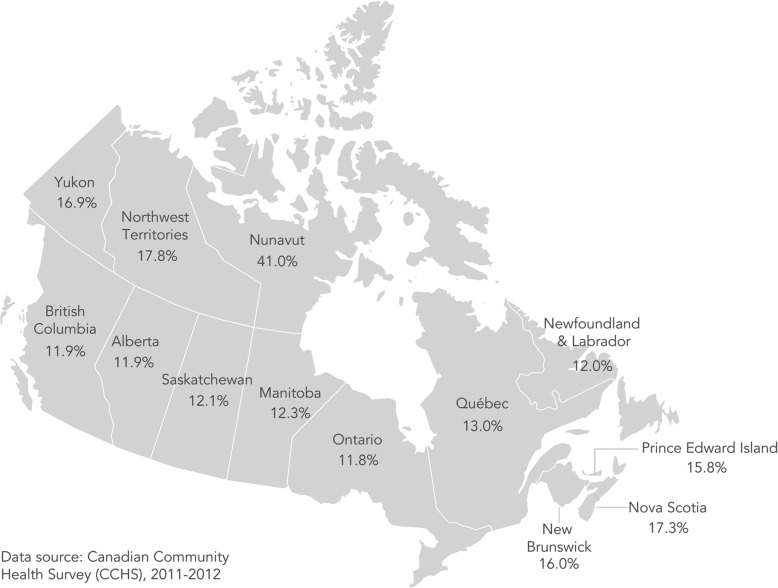
BACKGROUND: Household food insecurity is a potent social determinant of health and health care costs in Canada, but understanding of the social and economic conditions that underlie households' vulnerability to food insecurity is limited. METHODS: Data from the 2011-12 Canadian Community Health Survey were used to determine predictors of household food insecurity among a nationally-representative sample of 120,909 households. Household food insecurity over the past 12 months was assessed using the 18-item Household Food Security Survey Module. Households were classified as food secure or marginally, moderately, or severely food insecure based on the number of affirmative responses. Multivariable binary and multinomial logistic regression analyses were used to determine geographic and socio-demographic predictors of presence and severity of household food insecurity. RESULTS: The prevalence of household food insecurity ranged from 11.8% in Ontario to 41.0% in Nunavut. After adjusting for socio-demographic factors, households' odds of food insecurity were lower in Quebec and higher in the Maritimes, territories, and Alberta, compared to Ontario. The adjusted odds of food insecurity were also higher among households reliant on social assistance, Employment Insurance or workers' compensation, those without a university degree, those with children under 18, unattached individuals, renters, and those with an Aboriginal respondent. Higher income, immigration, and reliance on seniors' income sources were protective against food insecurity. Living in Nunavut and relying on social assistance were the strongest predictors of severe food insecurity, but severity was also associated with income, education, household composition, Aboriginal status, immigration status, and place of residence. The relation between income and food insecurity status was graded, with every $1000 increase in income associated with 2% lower odds of marginal food insecurity, 4% lower odds of moderate food insecurity, and 5% lower odds of severe food insecurity. CONCLUSIONS: The probability of household food insecurity in Canada and the severity of the experience depends on a household's province or territory of residence, income, main source of income, housing tenure, education, Aboriginal status, and household structure. Our findings highlight the intersection of household food insecurity with public policy decisions in Canada and the disproportionate burden of food insecurity among Indigenous peoples.
Overview
The claims and statistics of this paper haven’t been checked yet.
Free: it reads the open-access text and checks the first 5 claims that cite a source we can check. Create a free account to check every claim.
Integrity signals
Registry
Cites
Statistics
Figures
Verification
Claims the paper makes
The claims and statistics of this paper haven’t been checked yet.
Free: it reads the open-access text and checks the first 5 claims that cite a source we can check. Create a free account to check every claim.
Claims other papers make about this one
Each is checked against this paper’s own text: does it say what the citing paper says it does?
The source backs part of the claim, not all of it — or backs it for a different population, condition or comparison.
In the citing paper
“with risk greatest among lone-parent families, social assistance recipients, individuals who identify as Indigenous or Black, and people who live in Nunavut [2, 7].”
From Prevalence and sociodemographic correlates of food insecurity among post-secondary students and non-students of similar age in Canada (2023) · cites this paper as [2]
Experimental — accuracy not yet measuredThe cited source says what the claim attributes to it.
In the citing paper
“Food insecurity is most prevalent among households with inadequate and insecure incomes and few assets [2–6]”
From Prevalence and sociodemographic correlates of food insecurity among post-secondary students and non-students of similar age in Canada (2023) · cites this paper as [2]
Self-check
Percentages, sums and reported differences re-computed from the paper’s own numbers.
The self-check needs the paper’s full text.
Citations
Cites
Whitaker, R. C., Phillips, S. M., & Orzol, S. M. (2006) · Pediatrics · doi:10.1542/peds.2006-0239 · Cited by 817
Seligman, H. K., Bindman, A. B., Vittinghoff, E., Kanaya, A. M., & Kushel, M. B. (2007) · Journal of General Internal Medicine · doi:10.1007/s11606-007-0192-6 · Cited by 789
Household Food Insufficiency Is Associated with Poorer Health
Vozoris, N. T., & Tarasuk, V. S. (2003) · The Journal of Nutrition · doi:10.1093/jn/133.1.120 · Cited by 737
Self-citationThe Economics of Food Insecurity in the United States
Gundersen, C., Kreider, B., & Pepper, J. (2011) · Applied Economic Perspectives and Policy · doi:10.1093/aepp/ppr022 · Cited by 475
Household Food Security in the United States in 2018
Coleman‐Jensen, A., Rabbitt, M. P., Gregory, C., Singh, A. P., Coleman‐Jensen, A., Rabbitt, M. P., Gregory, C., & Singh, A. P. (2019) · AgEcon Search (University of Minnesota, USA) · doi:10.22004/ag.econ.301167 · Cited by 463
Food insufficiency and women's mental health: Findings from a 3-year panel of welfare recipients
Heflin, C. M., Siefert, K., & Williams, D. R. (2005) · Social Science & Medicine · doi:10.1016/j.socscimed.2005.04.014 · Cited by 396
Laraia, B. A., Siega-Riz, A. M., Gundersen, C., & Dole, N. (2006) · The Journal of Nutrition · doi:10.1093/jn/136.1.177 · Cited by 385
Cook, J. T., Black, M., Chilton, M., Cutts, D., Ettinger de Cuba, S., Heeren, T. C., Rose-Jacobs, R., Sandel, M., Casey, P. H., Coleman, S., et al. (2013) · Advances in Nutrition · doi:10.3945/an.112.003228 · Cited by 335 · cited 2×
“These results, taken in tandem with findings that marginal food insecurity is associated with poorer health [16, 22, 52, 53] and higher health care utilization [16, 25], argue for an end to the practice of treating marginally food insecure households as if they are food secure.”
BackgroundResultChild Hunger and Long-term Adverse Consequences for Health
Kirkpatrick, S. I., McIntyre, L., & Potestio, M. L. (2010) · Archives of Pediatrics & Adolescent Medicine · doi:10.1001/archpediatrics.2010.117 · Cited by 329
Food insecurity in Canadian households.
Che, J., & Chen, J. (2001) · PubMed · Cited by 311
Research works printed but not linked: 4
- 3. Riches G. Food banks and the welfare crisis. Ottawa: Canadian Council on Social Development; 1986.
- 12. Health Canada. Canadian community health survey, cycle 2.2, nutrition (2004) - income-related household food security in Canada. Ottawa: Office of Nutrition Policy and Promotion, Health Products and Food Branch, Health Canada; 2007.
- 55. Fréchet G, Lanctôt P, Morin A, Savard F. Equivalence scales: an empirical validation. 2010.
- 60. Gundersen C, Gruber J. The dynamic determinants of food insufficiency. In: Andrews M, Prell M, editors. Second Food Security Measurement and Research Conference, Volume II: Papers. Washington DC: U.S. Department of Agriculture, Economic Research Service; 2001. pp. 91–109.
Cited by
Dent, E., Wright, O. R. L., Woo, J., & Hoogendijk, E. O. (2023) · The Lancet · doi:10.1016/s0140-6736(22)02612-5 · Cited by 521
Farooq, M. S., Uzair, M., Raza, A., Habib, M., Xu, Y., Yousuf, M., Yang, S. H., & Ramzan Khan, M. (2022) · Frontiers in Plant Science · doi:10.3389/fpls.2022.927535 · Cited by 267
Food security and Canada's agricultural system challenged by COVID‐19
Deaton, B. J., & Deaton, B. J. (2020) · Canadian Journal of Agricultural Economics/Revue canadienne d'agroeconomie · doi:10.1111/cjag.12227 · Cited by 245
The relationship between diet quality and the severity of household food insecurity in Canada
Hutchinson, J., & Tarasuk, V. (2021) · Public Health Nutrition · doi:10.1017/s1368980021004031 · Cited by 154
Self-citationClimate change and food security in selected Sub-Saharan African Countries
Adesete, A. A., Olanubi, O. E., & Dauda, R. O. S. (2022) · Environment Development and Sustainability · doi:10.1007/s10668-022-02681-0 · Cited by 133
“This is in line with theoretical expectation and conforms with the conclusion of Tarasuk et al. (2019) which found out that higher income helps protect against food insecurity.”
BackgroundResultA Food Insecurity Systematic Review: Experience from Malaysia
Sulaiman, N., Yeatman, H. R., Russell, J. C., & Law, L. S. (2021) · Nutrients · doi:10.3390/nu13030945 · Cited by 129
Food Insecurity amid the COVID-19 Pandemic: Food Charity, Government Assistance, and Employment
Men, F. K., & Tarasuk, V. S. (2021) · Canadian Public Policy · doi:10.3138/cpp.2021-001 · Cited by 114
“…of household food insecurity to incomebased policy interventions that improve the financial circumstances of low-resource households (Brown and Tarasuk 2019; Ionescu-Ittu, Glymour, and Kaufman 2015; Li, Dachner, and Tarasuk 2016; Loopstra, Dachner, and Tarasuk 2015; McIntyre, Dutton, et al.…”
BackgroundSelf-citationFood insecurity is associated with mental health problems among Canadian youth
Men, F., Elgar, F. J., & Tarasuk, V. S. (2021) · Journal of Epidemiology & Community Health · doi:10.1136/jech-2020-216149 · Cited by 100
Self-citationBatal, M., Chan, H. M., Fediuk, K., Ing, A., Berti, P. R., Mercille, G., Sadik, T., & Johnson‐Down, L. (2021) · Canadian Journal of Public Health · doi:10.17269/s41997-021-00491-x · Cited by 103
Dondi, A., Candela, E., Morigi, F., Lenzi, J., Pierantoni, L., & Lanari, M. (2020) · Nutrients · doi:10.3390/nu13010121 · Cited by 87
Pakravan-Charvadeh, M. R., Savari, M., Khan, H. A., Gholamrezai, S., & Flora, C. B. (2021) · Public Health Nutrition · doi:10.1017/s1368980021000318 · Cited by 85
Money speaks: Reductions in severe food insecurity follow the Canada Child Benefit
Brown, E. M., & Tarasuk, V. (2019) · Preventive Medicine · doi:10.1016/j.ypmed.2019.105876 · Cited by 71
Self-citationMen, F., Gundersen, C., Urquia, M. L., & Tarasuk, V. (2020) · Health Affairs · doi:10.1377/hlthaff.2019.01637 · Cited by 66
Self-citationYau, A., White, M., Hammond, D. G., White, C. M., & Adams, J. (2020) · Public Health Nutrition · doi:10.1017/s1368980020000087 · Cited by 66
“relied on social assistance, or had children(17).”
Men, F. K., Urquia, M. L., & Tarasuk, V. S. (2021) · Preventive Medicine · doi:10.1016/j.ypmed.2021.106558 · Cited by 66
Self-citationFood insecurity, chronic pain, and use of prescription opioids
Men, F., Fischer, B., Urquia, M. L., & Tarasuk, V. S. (2021) · SSM - Population Health · doi:10.1016/j.ssmph.2021.100768 · Cited by 63
Self-citationFafard St-Germain, A.-A., & Tarasuk, V. (2020) · International Journal for Equity in Health · doi:10.1186/s12939-019-1114-z · Cited by 58
“Health Canada conventionally defines food insecurity as two or more affirmative answers to the 10 items [42], but recent evidence suggests that any affirmative item is indicative of marginal food insecurity associated with unique socioeconomic profiles [14, 20] and poorer health outcomes [6, 7, 9].”
BackgroundSelf-citationMen, F., Gundersen, C., Urquia, M. L., & Tarasuk, V. (2019) · CMAJ Open · doi:10.9778/cmajo.20190075 · Cited by 48
Self-citationDlamini, S. N., Craig, A., Mtintsilana, A., Mapanga, W., Toit, J. D., Ware, L. J., & Norris, S. A. (2023) · Public Health Nutrition · doi:10.1017/s1368980023000186 · Cited by 60
“To compute the household asset score, households were given a score of one for having each of the following 21 assets: (1) tap water in the house or on plot, (2) hot running water from a geyser, (3) built-in kitchen sink, (4) flush toilet in or outside the house, (5) deep freezer-free standing, (6) dishwashing machine…”
Black–white racial disparities in household food insecurity from 2005 to 2014, Canada
Dhunna, S., & Tarasuk, V. (2021) · Canadian Journal of Public Health · doi:10.17269/s41997-021-00539-y · Cited by 50
Self-citationBlanchet, R., Batal, M., Johnson‐Down, L., Johnson, S., Initiatives, O. N. S. R., Louie, C., Terbasket, E., Terbasket, P., Wright, H., & Willows, N. D. (2021) · BMC Public Health · doi:10.1186/s12889-021-11229-2 · Cited by 50
Lung, S. C., Tsou, M. M., Hu, S., Hsieh, Y., Wang, W. V., Shui, C., & Tan, C. (2020) · Indoor Air · doi:10.1111/ina.12763 · Cited by 46
Reeves, A., Loopstra, R., & Tarasuk, V. (2021) · American Journal of Public Health · doi:10.2105/ajph.2020.306096 · Cited by 42
Self-citationTarasuk, V. S., Gundersen, C., Wang, X., Roth, D. E., & Urquia, M. L. (2020) · Journal of Nutrition · doi:10.1093/jn/nxaa240 · Cited by 48
Self-citationAssociation of Family Income and Risk of Food Insecurity With Iron Status in Young Children
Bayoumi, I., Parkin, P. C., Birken, C. S., Maguire, J. L., & Borkhoff, C. M. (2020) · JAMA Network Open · doi:10.1001/jamanetworkopen.2020.8603 · Cited by 51
Gajda, R., & Jeżewska-Zychowicz, M. (2020) · Nutrients · doi:10.3390/nu12103191 · Cited by 43
Gender Disparities in Food Security, Dietary Intake, and Nutritional Health in the United States
Ma, C., Ho, S. K. M., Singh, S., & Choi, M. Y. (2021) · The American Journal of Gastroenterology · doi:10.14309/ajg.0000000000001118 · Cited by 47
Rajasooriar, D., & Soma, T. (2022) · BMC Public Health · doi:10.1186/s12889-021-12434-9 · Cited by 43
Yousefi-Rizi, L., Baek, J., Blumenfeld, N., & Stoskopf, C. H. (2021) · Journal of Community Health · doi:10.1007/s10900-021-00999-w · Cited by 38
Zaçe, D., Pietro, M. L. D., Caprini, F., de Waure, C., & Ricciardi, W. (2020) · Annali dell Istituto Superiore di Sanità · doi:10.4415/ann_20_01_13 · Cited by 37
“This implies that the duration of exposure is not specified, nor multiple dimensions of food insecurity captured, such as hunger or insecure access to sufficient quantities of food, as are measured by the HFSM [2].”
BackgroundInfluentialSantos, L. A., Pérez‐Escamilla, R., Cherol, C. C. D. S., Ferreira, A. A., & Salles‐Costa, R. (2023) · PLOS Global Public Health · doi:10.1371/journal.pgph.0002324 · Cited by 35
Economic change and population health: lessons learnt from an umbrella review on the Great Recession
Backhaus, I., Hoven, H., Tecco, C. D., Iavicoli, S., Conte, A., & Dragano, N. (2022) · BMJ Open · doi:10.1136/bmjopen-2021-060710 · Cited by 35
Living Standards in One-Person Households of the Elderly Population
Piekut, M. J. (2020) · Sustainability · doi:10.3390/su12030992 · Cited by 35
“The lower risk of pauperization among seniors households is consistent with research suggestion saying that the public pensions provided to people 65+ are protective for them and offer them financial security [6,59].”
BackgroundResultFactors determining household-level food insecurity during COVID-19 epidemic: a case of Wuhan, China
Zhang, Y., Yang, K., Hou, S., Zhong, T., & Crush, J. (2021) · Food & Nutrition Research · doi:10.29219/fnr.v65.5501 · Cited by 31
“Housing property: The property status of the house has been linked to food insecurity in previous research (10, 31).”
BackgroundHiggins, C. D., Páez, A., Kim, G., & Wang, J. (2021) · Social Science & Medicine · doi:10.1016/j.socscimed.2021.114442 · Cited by 34
Wang, X., Anders, S., Jiang, Z., Bruce, M., Gidrewicz, D., MARCON, M. A., Turner, J. M., & Mager, D. R. (2024) · Journal of Pediatric Gastroenterology and Nutrition · doi:10.1002/jpn3.12398 · Cited by 33
“37 This fi nding was also supported by the analysis of adolescents who completed the 2017 – 2018 Canadian Community Health Survey reporting that the high rate of FI occurred more frequently among adolescents who were not living with two parents.”
EVALUATION OF DEMOGRAPHIC COMPONENT OF COUNTRIES’ ECONOMIC SECURITY
Hrybinenko, O., Bulatova, О., & Zakharova, O. (2020) · Business Management and Education · doi:10.3846/jbem.2020.12309 · Cited by 32
“…migration of population together with other economic determinants describing a level and nature of income distribution, a level of welfare of the population) are considered as the indicators of influence on food insecurity (Tarasuk et al., 2019) and the national economy on the whole (Lori, 2019).”
BackgroundFood insecurity among Canadian youth and young adults: insights from the Canada Food Study
Bhawra, J., Kirkpatrick, S. I., & Hammond, D. G. (2021) · Canadian Journal of Public Health · doi:10.17269/s41997-020-00469-1 · Cited by 32
The importance of social financial support in reducing food insecurity among elderly people
Gajda, R., & Jeżewska-Zychowicz, M. (2021) · Food Security · doi:10.1007/s12571-021-01151-1 · Cited by 29
Men, F., & Tarasuk, V. S. (2021) · Journal of Nutrition · doi:10.1093/jn/nxab447 · Cited by 31
Self-citationEffect of Canada Child Benefit on Food Insecurity: A Propensity Score−Matched Analysis
Men, F., St-Germain, A.-A. F., Ross, K., Remtulla, R., & Tarasuk, V. S. (2023) · American Journal of Preventive Medicine · doi:10.1016/j.amepre.2023.01.027 · Cited by 31
Self-citationHeasley, C., Clayton, B., Muileboom, J., Schwanke, A. J., Rathnayake, S., Richter, A., & Little, M. (2021) · Archives of Public Health · doi:10.1186/s13690-021-00657-6 · Cited by 30
Child and adolescent food insecurity in South Africa: A household-level analysis of hunger
Mkhize, S. A., Libhaber, E. N., Sewpaul, R., Reddy, P. S., & Baldwin-Ragaven, L. (2022) · PLoS ONE · doi:10.1371/journal.pone.0278191 · Cited by 32
“[ 54] have shown that in Canada, household before-tax income adjusted for family size was protective against food insecurity; however, households receiving social assistance were three times more likely to be food insecure.”
Exploring the nexus between poor governance and household food security
Khan, Y., Bojnec, Š., Daraz, U., & Zulpiqar, F. (2024) · Economic Change and Restructuring · doi:10.1007/s10644-024-09679-w · Cited by 28
“Such insecurity escalates healthcare usage (Men et al. 2021) and compromises mental and physical health, particularly in vulnerable groups (Tarasuk et al. 2019).”
Food worry and mental health outcomes during the COVID-19 pandemic
Han, B. B., Purkey, E., Davison, C., Watson, A., Nolan, D., Mitchell, D., Traviss, S., Kehoe, J., & Bayoumi, I. (2022) · BMC Public Health · doi:10.1186/s12889-022-13410-7 · Cited by 27
Sustainable food consumption pattern with emphasis on socioeconomic factors to reduce food waste
Pakravan-Charvadeh, M. R., & Flora, C. B. (2022) · International Journal of Environmental Science and Technology · doi:10.1007/s13762-022-04186-9 · Cited by 29
Sabião, T. D. S., Mendonça, R. D. D., Meireles, A. L., Machado-Coelho, G. L. L., & Carraro, J. C. C. (2022) · SSM - Population Health · doi:10.1016/j.ssmph.2022.101156 · Cited by 27
Mobility impairments and geographic variation in vulnerability to household food insecurity
Schwartz, N. S., Tarasuk, V. S., Buliung, R. N., & Wilson, K. (2019) · Social Science & Medicine · doi:10.1016/j.socscimed.2019.112636 · Cited by 25
Self-citationHousehold Food Security and Infant Adiposity
Benjamin‐Neelon, S. E., Allen, C., & Neelon, B. (2020) · PEDIATRICS · doi:10.1542/peds.2019-3725 · Cited by 30
Men, F. K., Urquia, M. L., & Tarasuk, V. S. (2021) · BMC Public Health · doi:10.1186/s12889-021-11610-1 · Cited by 23
Self-citationMen, F., & Tarasuk, V. S. (2020) · BMC Public Health · doi:10.1186/s12889-020-09547-y · Cited by 26
Self-citationRelationship Between Food Insecurity and Neighborhood Child Opportunity Index
Ho, B. J., Rucker, A. C., Boyle, M. D., Badolato, G. M., & Goyal, M. K. (2022) · The Journal of Pediatrics · doi:10.1016/j.jpeds.2022.02.042 · Cited by 22
A Citizen Science and Photovoice Approach to Food Asset Mapping and Food System Planning
Soma, T., Li, B., & Shulman, T. (2022) · Journal of Planning Education and Research · doi:10.1177/0739456x221088985 · Cited by 22
The spatial modification effect of predictors on household level food insecurity in Ethiopia
Dessie, Z. G., Zewotir, T. T., & North, D. (2022) · Scientific Reports · doi:10.1038/s41598-022-23918-y · Cited by 24
Zaçe, D., Pietro, M. L. D., Reali, L., de Waure, C., & Ricciardi, W. (2020) · Food Security · doi:10.1007/s12571-020-01111-1 · Cited by 25
Baker, S., Gallegos, D., Rebuli, M. A., Taylor, A. J., & Mahoney, R. (2024) · Nutrients · doi:10.3390/nu16111684 · Cited by 22
Food insecurity among Finnish private service sector workers: validity, prevalence and determinants
Walsh, H. M., Nevalainen, J., Saari, T., Uusitalo, L., Näppilä, T., Rahkonen, O., & Erkkola, M. (2022) · Public Health Nutrition · doi:10.1017/s1368980022000209 · Cited by 24
“of the HFIAS tool was investigated by looking at whether it distinguished between different socio-demographic groups with established differences in food insecurity such as sex, age, family structure, housing, income, education, living area, marital status and occupation(7,14,44).”
BackgroundMethodThe prevalence and predictors of household food insecurity among adolescents in Canada
Liu, R., Urquia, M. L., & Tarasuk, V. S. (2023) · Canadian Journal of Public Health · doi:10.17269/s41997-022-00737-2 · Cited by 22
“In contrast to prior Canadian research (Tarasuk et al., 2019a), we did not observe a significantly lower odds of household food insecurity among adolescents living in households reliant on senior’s incomes and/or dividends and interest.”
BackgroundMethodResultInfluentialSelf-citationPakravan-Charvadeh, M. R., Flora, C. B., & Khan, H. A. (2022) · Frontiers in Public Health · doi:10.3389/fpubh.2022.923705 · Cited by 19
The Impact of Social Determinants of Health on Transition From Pediatric to Adult Cardiology Care
Fernandez, D. C., Lopez, K. N., Bravo‐Jaimes, K., & Mackie, A. S. (2024) · Canadian Journal of Cardiology · doi:10.1016/j.cjca.2024.03.023 · Cited by 24
Kansanga, M. M., Sano, Y., Bayor, I., Braimah, J. A., Nunbogu, A. M., & Luginaah, I. (2021) · Ageing and Society · doi:10.1017/s0144686x20002081 · Cited by 21
Food security, food insecurity, and Canada’s national food policy: Meaning, measures, and assessment
Deaton, B. J., & Scholz, A. (2022) · Outlook on Agriculture · doi:10.1177/00307270221113601 · Cited by 20
Al-Kharabsheh, L., Al-Bazz, S., Koç, M., Garcia, J., Lane, G. L., Engler‐Stringer, R., White, J., & Vatanparast, H. (2020) · BORDER CROSSING · doi:10.33182/bc.v10i2.1161 · Cited by 20
“Notably, socioeconomically disadvantaged segments of the population are most vulnerable to food insecurity (Tarasuk et al., 2019).”
BackgroundMethodPrevalence and determinants of food insecurity during the 2022 COVID-19 related lockdown in Shanghai
Liu, Y., Li, G., Qi, X., Wu, B., Latkin, C. A., Tang, W., & Hall, B. J. (2023) · Global Public Health · doi:10.1080/17441692.2023.2246066 · Cited by 17
“…those with low income and educational attainment, and individuals from larger households (Clay & Rogus, 2021; Fitzpatrick et al., 2020; Ihabi et al., 2013; Lee et al., 2020; Neter et al., 1996; O ’ Reilly et al., 2020; Pakravan-Charvadeh et al., 2022; Tarasuk et al., 2019; Zhang et al., 2021).”
BackgroundTaremwa, N. K., Gasingirwa, M.-C., & Nsabimana, D. (2021) · African Journal of Science Technology Innovation and Development · doi:10.1080/20421338.2020.1821948 · Cited by 19
“Food insecurity arising from climate change has significant public health implications (Alison et al., 2019; Tarasuk et al., 2019).”
BackgroundPepetone, A., Frongillo, E. A., Dodd, K. W., Wallace, M. P., Hammond, D. G., & Kirkpatrick, S. I. (2023) · Journal of Nutrition · doi:10.1016/j.tjnut.2022.12.031 · Cited by 19
“Research in North America has repeatedly demonstrated that individuals living with low income, who are precariously employed or unemployed, and who have lower levels of formal education are more likely to experience food insecurity [1, 19, 20].”
Seivwright, A. N., Kočar, S., Visentin, D. C., & Kent, K. (2024) · Australian Journal of Social Issues · doi:10.1002/ajs4.314 · Cited by 20
Shpak, N. O., Матвіїшин, Є. Г., Dziurakh, Y., & Gvozd, M. (2024) · Frontiers in Sustainable Food Systems · doi:10.3389/fsufs.2024.1361625 · Cited by 15
Food Insecurity and Clinical Outcomes in Surgical Trauma Patients
Ehsan, A. N., Jones, A., Saha, S., Hathi, P., Huang, C.-C., Vengadassalapathy, S., Bhat, K., Ganesh, P., Chauhan, S., Mahipathy, S. R. R. V., et al. (2025) · JAMA Surgery · doi:10.1001/jamasurg.2025.0045 · Cited by 16
Liang, Y., Zhong, T., & Crush, J. (2022) · Land · doi:10.3390/land11060945 · Cited by 18
Determinants of food security through statistical and fuzzy mathematical synergy
Khan, Y., Ashraf, S., & Shah, M. (2023) · Environment Development and Sustainability · doi:10.1007/s10668-023-03231-y · Cited by 15
“…(Ovenell et al., 2022), non-communicable diseases (Cox et al., 2017), increased healthcare utilization (Tarasuk et al., 2015; Tarasuk et al., 2018; Men et al ., 2020), poor mental and physical health especially in vulnerable children’s, aged people, and women particularly (Tarasuk et al., 2019).”
Sanjeevi, N., FREELAND-GRAVES, J. H., & Sachdev, P. K. (2021) · American Journal of Clinical Nutrition · doi:10.1093/ajcn/nqab082 · Cited by 15
Ong, V., Skinner, K. A., & Minaker, L. M. (2021) · Social Science & Medicine · doi:10.1016/j.socscimed.2021.114074 · Cited by 16
Adeoye, P. A., Afolaranmi, T., Ofili, A., Chirdan, O. O., Agbo, H. A., Adeoye, L. T., & Su, T. T. (2022) · Pan African Medical Journal · doi:10.11604/pamj.2022.43.36.32704 · Cited by 14
“This has been said to lead to the inability of households to negotiate the quality and quantity of support received and a greater likelihood of being vulnerable to a lack of other basic daily needs [10,11,29,34].”
BackgroundResultInfluentialLoh, S., Knight, A., & Loopstra, R. (2020) · Health & Social Care in the Community · doi:10.1111/hsc.13226 · Cited by 15
Nielsen, D. E., Labonté, K., Karamanoglu, I., Han, H. Y., Tavanaei, M., Duhamel, P.-G., Agellon, L. B., Paquet, C., & Dubé, L. (2022) · Frontiers in Public Health · doi:10.3389/fpubh.2021.752204 · Cited by 14
Livings, M. S., de Bruin, W. B., Wasim, N., Wilson, J. P., Lee, B. Y., & de la Haye, K. (2024) · Journal of Nutrition · doi:10.1016/j.tjnut.2024.05.020 · Cited by 13
Missing Meals and Missed Rides: Transportation Barriers to Food Access for Vulnerable Populations
Keyes, L., Kim, J., Balachandran, S., Kuttler, S., & Andrew, S. A. (2025) · Urban Science · doi:10.3390/urbansci9060198 · Cited by 13
Profiles of Food Insecurity: Similarities and Differences across Selected CEE Countries
Dudek, H., Myszkowska-Ryciak, J., & Wojewódzka-Wiewiórska, A. (2021) · Energies · doi:10.3390/en14165070 · Cited by 13
Phulkerd, S., Thongcharoenchupong, N., Chamratrithirong, A., Gray, R. S., Pattaravanich, U., Ungchusak, C., & Saonuam, P. (2023) · Frontiers in Public Health · doi:10.3389/fpubh.2022.1071814 · Cited by 14
“In Canada household food insecurity and the severity of the experience were strongly associated with province or territory of residence (17).”
BackgroundLogie, C. H., Lys, C. L., Sokolovic, N., Mackay, K. I., Donkers, H., Kanbari, A., Pooyak, S. D., & Loppie, C. (2021) · Cambridge Prisms Global Mental Health · doi:10.1017/gmh.2021.21 · Cited by 15
“Approximately one in six people in the NWT and Yukon experience food insecurity (Tarasuk et al ., 2019).”
BackgroundLong, C. R., Narcisse, M., Bailey, M. M., Rowland, B., English, E. S., & McElfish, P. A. (2021) · Journal of Hunger & Environmental Nutrition · doi:10.1080/19320248.2021.1873883 · Cited by 13
Otoadese, D., Kamara, I., & Onyango, E. O. (2025) · BMC Public Health · doi:10.1186/s12889-025-23552-z · Cited by 11
“This disparity underscores the disproportionate impact of food insecurity on immigrant communities are recorded in previous studies and reviews that have highlighted the elevated risks among racial minorities and immigrants [7, 9, 14, 15, 67–69].”
‘Hunger in early life’: exploring the prevalence and correlates of child food insecurity in Canada
Kansanga, M. M. (2022) · Agriculture & Food Security · doi:10.1186/s40066-022-00371-8 · Cited by 11
“Notwithstanding growing literature on household food security in the Global North [8, 30, 33], child food insecurity remains less well understood.”
BackgroundResultInfluentialMen, F., & Tarasuk, V. S. (2023) · Preventive Medicine · doi:10.1016/j.ypmed.2023.107475 · Cited by 11
Self-citationPang, N., Nagata, J. M., Testa, A. M., & Ganson, K. T. (2024) · Journal of Eating Disorders · doi:10.1186/s40337-024-01098-6 · Cited by 11
“Likewise, food insecurity is also more common among rural areas compared to urban areas [40, 41], which has also been found to be associated with eating disorders [35].”
BackgroundFemale farmers facing food insecurity and climate change vulnerability in rural area
Samputra, P. L. (2025) · Progress in Disaster Science · doi:10.1016/j.pdisas.2025.100437 · Cited by 12
Impact of livelihood diversification on household food security and dietary diversity in Tanzania
Majiwa, E., Mwangi, C. W., Kiage, B. N., Obebo, F., Ateka, J. M., & Mbeche, R. (2025) · BMC Agriculture · doi:10.1186/s44399-025-00017-7 · Cited by 12
Food noise: Conceptual, methodological, and ethical considerations
Brewis, A., Neto, D. H., Gualano, B., Precinotto, M. L., Scagliusi, F. B., Stöckelová, T., SturtzSreetharan, C., West, H., Williams, O., & Masterson, T. D. (2026) · Appetite · doi:10.1016/j.appet.2026.108700 · Cited by 10
Studi Kepustakaan Gambaran Obesitas pada Ibu Rumah Tangga di Dunia
Noor, Y., Sugiarto, E., & Fatimah, A. S. (2022) · JURNAL GIZI DAN KESEHATAN · doi:10.35473/jgk.v14i1.243 · Cited by 10
Dias, M. D. S., Dumith, S. C., Vaz, J. D. S., & Susin, L. R. O. (2020) · Epidemiologia e Serviços de Saúde · doi:10.5123/s1679-49742020000200007 · Cited by 13
Pound, C., & Chen, Y. (2021) · CMAJ Open · doi:10.9778/cmajo.20200112 · Cited by 11
Cyrenne-Dussault, M., Sirois, M., St‐Pierre, J., & Drouin‐Chartier, J. (2022) · Paediatrics & Child Health · doi:10.1093/pch/pxac072 · Cited by 12
Mildon, A., Francis, J., Stewart, S., Underhill, B., Ng, Y. M., Rousseau, C., Tarasuk, V. S., Ruggiero, E. D., Dennis, C., O’Connor, D. L., et al. (2023) · Public Health Nutrition · doi:10.1017/s1368980023000459 · Cited by 9
“The association between multiparity and household food insecurity in this cohort aligns with CCHS data showing a higher risk of food insecurity among households with children(4,5).”
Self-citationLogie, C. H., Lys, C. L., Sokolovic, N., Malama, K., Mackay, K. I., McNamee, C., Lad, A., & Kanbari, A. (2023) · International Journal of Behavioral Medicine · doi:10.1007/s12529-023-10195-w · Cited by 9
“However, the literature suggests that Indigenous people in Canada have a history of systemic marginalization which has resulted in relatively higher incidences of poverty and food insecurity [2, 5–7].”
Batal, M. (2021) · Public Health Nutrition · doi:10.1017/s1368980021003487 · Cited by 11
Blurring the boundaries: cross-scale analyses of food systems
Wentworth, C., Hodbod, J., & Gerard, A. (2022) · Ecology and Society · doi:10.5751/es-13460-270435 · Cited by 9
“Because income influences food access, we also compared median family income for each city from 1950 to the present to capture the period of post-World War II growth across the United States (Tarasuk et al. 2019).”
BackgroundSharma, I., Campbell, M. K., Choi, Y., Luginaah, I., Were, J. M., Vargas‐González, J., & Stranges, S. (2023) · Hypertension Research · doi:10.1038/s41440-023-01217-x · Cited by 9
Thielman, J., Orr, S. K., Naraentheraraja, S., Harrington, D. W., & Carsley, S. (2024) · BMJ Open · doi:10.1136/bmjopen-2023-081538 · Cited by 8
Metadata
- Authors
- Tarasuk, V., Fafard St-Germain, A.-A., & Mitchell, A.
- Affiliations
- University of Toronto (CA)
- Corresponding author
- Tarasuk, Valerie
- Venue
- BMC Public Health
- Published
- 2019-01-03
- Volume
- 19
- Issue
- 1
- Pages
- 12-12
- ISSN
- 1471-2458 (ISSN-L)
- PMC
- PMC6318847
- OpenAlex
- W2947923758
- Cited by
- 207
- References
- 69
- Citations by year
- 2026: 15 · 2025: 22 · 2024: 34 · 2023: 34 · 2022: 33 · 2021: 41 · 2020: 23 · 2019: 5
- FWCI
- 34.77
- Type
- journal article
- Language
- en
- Open access
- gold
- doi.org
- Licence
- cc-by
- creativecommons.org/licenses/by/4.0/ (tdm)
- Locations
- BMC Public Health (publishedVersion, cc-by)
- Europe PMC (PubMed Central) (publishedVersion, cc-by)
- PubMed Central (publishedVersion, cc-by)
- PubMed (publishedVersion)
- TSpace (University of Toronto) (submittedVersion, cc-by)
- DOAJ (DOAJ: Directory of Open Access Journals) (submittedVersion, cc-by-sa)
- Funders
- Canadian Institutes of Health Research (FRN 115208)
- Topics
- Health Sciences › Medicine › Public Health, Environmental and Occupational Health › Food Security and Health in Diverse Populations
- Life Sciences › Agricultural and Biological Sciences › General Agricultural and Biological Sciences › Food Security and Socioeconomic Dynamics
- Social Sciences › Sociology and Political Science › Income, Poverty, and Inequality
- Keywords
- household food insecurity, regional variation, sociodemographic predictors, food insecurity severity, social assistance, income, Aboriginal status, indigenous peoples, housing tenure, immigration status, household composition, Nunavut, Canada
- MeSH terms
- Adult, Canada, Child, Family Characteristics, Female, Food Supply, Geography, Humans, Male, Surveys and Questionnaires, Socioeconomic Factors
About these checks
Registry, retraction, Cites and statistics results are computed, not judged, with one exception: a printed reference that no index lists is read once by a model before it counts as a citation error. Claims are extracted by a model and kept only when their quote appears verbatim in the text; each cited source is then checked, with a model’s help, for whether it says what the claim relies on. Those verdicts can be wrong — read the claim’s quote and the cited source before relying on one.
Statistics and arithmetic are recomputed, not judged.
Confidence bands are shown only for fields calibrated on our annotated test set. None is calibrated yet, so no band is shown.
What counts as a claim ›How we measure confidence ›How we check this ›
Are you an author, or do you see a problem with this page? Request a review
Data sources
Bibliographic data: Semantic Scholar, OpenAlex, Crossref.
Contains information from the Semantic Scholar Academic Graph Datasets, made available under the ODC Attribution License (ODC-BY 1.0).
Semantic Scholar’s data is described in: Kinney, R., et al. (2023). The Semantic Scholar Open Data Platform. arXiv:2301.10140.
