

Geographic and socio-demographic predictors of household food insecurity in Canada, 2011–12
Open accessThe DOI matches its Crossref record; 71 of the 71 references it cites were found in a registry or an index.
Abstract
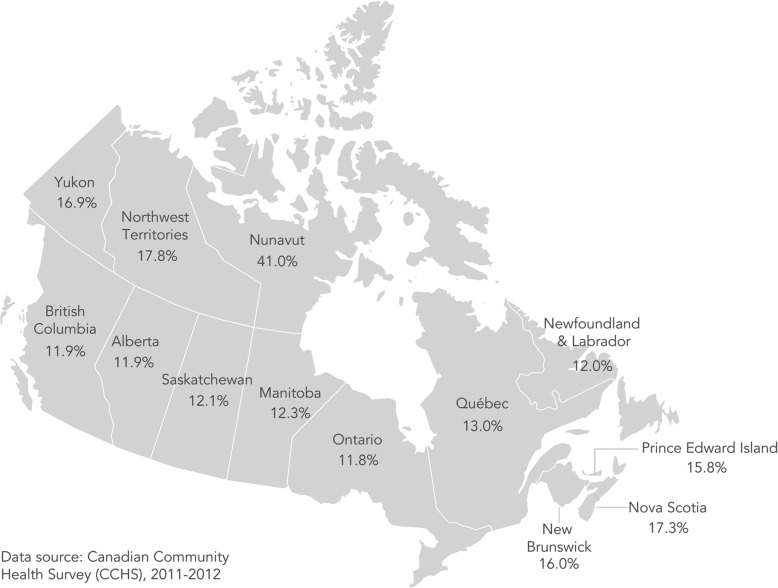
BACKGROUND: Household food insecurity is a potent social determinant of health and health care costs in Canada, but understanding of the social and economic conditions that underlie households' vulnerability to food insecurity is limited. METHODS: Data from the 2011-12 Canadian Community Health Survey were used to determine predictors of household food insecurity among a nationally-representative sample of 120,909 households. Household food insecurity over the past 12 months was assessed using the 18-item Household Food Security Survey Module. Households were classified as food secure or marginally, moderately, or severely food insecure based on the number of affirmative responses. Multivariable binary and multinomial logistic regression analyses were used to determine geographic and socio-demographic predictors of presence and severity of household food insecurity. RESULTS: The prevalence of household food insecurity ranged from 11.8% in Ontario to 41.0% in Nunavut. After adjusting for socio-demographic factors, households' odds of food insecurity were lower in Quebec and higher in the Maritimes, territories, and Alberta, compared to Ontario. The adjusted odds of food insecurity were also higher among households reliant on social assistance, Employment Insurance or workers' compensation, those without a university degree, those with children under 18, unattached individuals, renters, and those with an Aboriginal respondent. Higher income, immigration, and reliance on seniors' income sources were protective against food insecurity. Living in Nunavut and relying on social assistance were the strongest predictors of severe food insecurity, but severity was also associated with income, education, household composition, Aboriginal status, immigration status, and place of residence. The relation between income and food insecurity status was graded, with every $1000 increase in income associated with 2% lower odds of marginal food insecurity, 4% lower odds of moderate food insecurity, and 5% lower odds of severe food insecurity. CONCLUSIONS: The probability of household food insecurity in Canada and the severity of the experience depends on a household's province or territory of residence, income, main source of income, housing tenure, education, Aboriginal status, and household structure. Our findings highlight the intersection of household food insecurity with public policy decisions in Canada and the disproportionate burden of food insecurity among Indigenous peoples.
Overview
The claims and statistics of this paper haven’t been checked yet.
Free: it reads the open-access text and checks the first 5 claims that cite a source we can check. Create a free account to check every claim.
Integrity signals
Registry
Cites
Statistics
Figures
Verification
Claims the paper makes
The claims and statistics of this paper haven’t been checked yet.
Free: it reads the open-access text and checks the first 5 claims that cite a source we can check. Create a free account to check every claim.
Claims other papers make about this one
Each is checked against this paper’s own text: does it say what the citing paper says it does?
The source backs part of the claim, not all of it — or backs it for a different population, condition or comparison.
In the citing paper
“with risk greatest among lone-parent families, social assistance recipients, individuals who identify as Indigenous or Black, and people who live in Nunavut [2, 7].”
From Prevalence and sociodemographic correlates of food insecurity among post-secondary students and non-students of similar age in Canada (2023) · cites this paper as [2]
Experimental — accuracy not yet measuredThe cited source says what the claim attributes to it.
In the citing paper
“Food insecurity is most prevalent among households with inadequate and insecure incomes and few assets [2–6]”
From Prevalence and sociodemographic correlates of food insecurity among post-secondary students and non-students of similar age in Canada (2023) · cites this paper as [2]
Self-check
Percentages, sums and reported differences re-computed from the paper’s own numbers.
The self-check needs the paper’s full text.
Citations
Cites
Whitaker, R. C., Phillips, S. M., & Orzol, S. M. (2006) · Pediatrics · doi:10.1542/peds.2006-0239 · Cited by 817
Seligman, H. K., Bindman, A. B., Vittinghoff, E., Kanaya, A. M., & Kushel, M. B. (2007) · Journal of General Internal Medicine · doi:10.1007/s11606-007-0192-6 · Cited by 789
Household Food Insufficiency Is Associated with Poorer Health
Vozoris, N. T., & Tarasuk, V. S. (2003) · The Journal of Nutrition · doi:10.1093/jn/133.1.120 · Cited by 737
Self-citationThe Economics of Food Insecurity in the United States
Gundersen, C., Kreider, B., & Pepper, J. (2011) · Applied Economic Perspectives and Policy · doi:10.1093/aepp/ppr022 · Cited by 475
Household Food Security in the United States in 2018
Coleman‐Jensen, A., Rabbitt, M. P., Gregory, C., Singh, A. P., Coleman‐Jensen, A., Rabbitt, M. P., Gregory, C., & Singh, A. P. (2019) · AgEcon Search (University of Minnesota, USA) · doi:10.22004/ag.econ.301167 · Cited by 463
Food insufficiency and women's mental health: Findings from a 3-year panel of welfare recipients
Heflin, C. M., Siefert, K., & Williams, D. R. (2005) · Social Science & Medicine · doi:10.1016/j.socscimed.2005.04.014 · Cited by 396
Laraia, B. A., Siega-Riz, A. M., Gundersen, C., & Dole, N. (2006) · The Journal of Nutrition · doi:10.1093/jn/136.1.177 · Cited by 385
Cook, J. T., Black, M., Chilton, M., Cutts, D., Ettinger de Cuba, S., Heeren, T. C., Rose-Jacobs, R., Sandel, M., Casey, P. H., Coleman, S., et al. (2013) · Advances in Nutrition · doi:10.3945/an.112.003228 · Cited by 335 · cited 2×
“These results, taken in tandem with findings that marginal food insecurity is associated with poorer health [16, 22, 52, 53] and higher health care utilization [16, 25], argue for an end to the practice of treating marginally food insecure households as if they are food secure.”
BackgroundResultChild Hunger and Long-term Adverse Consequences for Health
Kirkpatrick, S. I., McIntyre, L., & Potestio, M. L. (2010) · Archives of Pediatrics & Adolescent Medicine · doi:10.1001/archpediatrics.2010.117 · Cited by 329
Food insecurity in Canadian households.
Che, J., & Chen, J. (2001) · PubMed · Cited by 311
Research works printed but not linked: 4
- 3. Riches G. Food banks and the welfare crisis. Ottawa: Canadian Council on Social Development; 1986.
- 12. Health Canada. Canadian community health survey, cycle 2.2, nutrition (2004) - income-related household food security in Canada. Ottawa: Office of Nutrition Policy and Promotion, Health Products and Food Branch, Health Canada; 2007.
- 55. Fréchet G, Lanctôt P, Morin A, Savard F. Equivalence scales: an empirical validation. 2010.
- 60. Gundersen C, Gruber J. The dynamic determinants of food insufficiency. In: Andrews M, Prell M, editors. Second Food Security Measurement and Research Conference, Volume II: Papers. Washington DC: U.S. Department of Agriculture, Economic Research Service; 2001. pp. 91–109.
Cited by
Items 201–255 of 255
Food Security in Nunatsiavut: From Historical Perspectives to Future Prospects
Bowers, R. (2022) · uO Research (University of Ottawa) · doi:10.20381/ruor-27626
Men, F., & Tarasuk, V. (2020) · Figshare · doi:10.6084/m9.figshare.13031485
Self-citationMen, F., & Tarasuk, V. (2020) · Figshare · doi:10.6084/m9.figshare.13031488
Self-citationWang, Y., St-Germain, A.-A. F., & Tarasuk, V. (2023) · Figshare · doi:10.6084/m9.figshare.23207809
Self-citationAdditional file 1 of Food worry and mental health outcomes during the COVID-19 pandemic
Han, B. B., Purkey, E., Davison, C., Watson, A., Nolan, D., Mitchell, D., Traviss, S., Kehoe, J., & Bayoumi, I. (2022) · Figshare · doi:10.6084/m9.figshare.19785763
Wang, Y., St-Germain, A.-A. F., & Tarasuk, V. (2023) · Figshare · doi:10.6084/m9.figshare.23207812
Self-citationThe role of aquatic foods in combating malnutrition and food insecurity: An integrative review
Kelvin E., V. (2024) · Journal of Biodiversity and Environmental Sciences (JBES) · doi:10.5281/zenodo.15354486 · Cited by 1
Pannu, A. (2022) · The Atrium (University of Guelph)
Herrera Carrera, W. J. P. (2021) · LA Referencia (Red Federada de Repositorios Institucionales de Publicaciones Científicas)
Bonin, S. (2021) · Papyrus : Institutional Repository (Université de Montréal) · doi:10.71781/1510
Ogie, E. (2023) · oURspace (University of Regina) · doi:10.82465/4426 · Cited by 1
Food Insecurity and the Experiences of Adults Aged 65 Years and Older
Mannings, Y. (2023) · ScholarWorks (Walden University)
Matthew, E. (2023) · HARVEST (University of Saskatchewan)
Darby, M. J. (2023) · Digital Commons - University of South Florida (University of South Florida)
Lafortune, A. (2022) · Papyrus : Institutional Repository (Université de Montréal) · doi:10.71781/31742
Delamere, M. (2024) · UWSpace (University of Waterloo)
ECONOMIC DETERMINANTS OF FOOD SECURITY IN NORTHWEST TERRITORIES (NWT), CANADA
Tetteh, O. B. (2024) · HARVEST (University of Saskatchewan)
Growing Sustainability: Hydroponic Cultivation of Food Sovereignty in Canada
Mitchell, M. (2024) · UWSpace (University of Waterloo)
Barry, M. (2025) · cIRcle (University of British Columbia) · doi:10.14288/1.0449980 · Cited by 1
Aslan, A. A., Sulaiman, N., Akhir, M. A. M., Amirullah, N. A., & Bakeri, N. A. (2025) · Malaysian Journal of Medicine and Health Sciences · doi:10.47836/mjmhs.v21.i6.1285
Isanovic, S., O’Connor, K., Richards, A. L., & Frongillo, E. A. (2026) · Current Developments in Nutrition · doi:10.1016/j.cdnut.2026.107654
Nutritional Epidemiology: Advances in the Analysis of Healthy and Sustainable Dietary Patterns
(2026) · Frontiers research topics · doi:10.3389/978-2-8325-7564-2
Insécurité Alimentaire des Ménages au Canada, 2021
Tarasuk, V. S., Li, T., & St-Germain, A.-A. F. (2022) · TSpace (University of Toronto) · Cited by 6
Self-citationKim, G. (2022) · TSpace (University of Toronto)
Daher, L. (n.d.) · Summit (Simon Fraser University)
Anstruther, S. M., Olstad, D. L., Levacher, V., Jean‐Baptiste, N., Turin, T. C., Livingstone, K. M., & Blanchet, R. (2026) · Sociology of Health & Illness · doi:10.1111/1467-9566.70176
Virtual transition education of rural adolescents with congenital heart disease: A pilot study
Chappell, A., Gingrich, J., Batara, J., Kovacs, A. H., & Mackie, A. S. (2026) · Health Care Transitions · doi:10.1016/j.hctj.2026.100134
Food Pathway to Placemaking: A Scoping Review on Immigrants’ Cultural Food Security
Dissanayakalage, B. P. S. (2026) · HARVEST (University of Saskatchewan)
Webb, N. (2026) · Mspace (University of Manitoba)
Vegan perceptions and experiences of food security and food insecurity
Jozkow, J. R., & Skinner, K. (2026) · Journal of Hunger & Environmental Nutrition · doi:10.1080/19320248.2026.2666148
Student perceptions of on‐campus foodscapes at a Canadian university
Clarke, S. (2026) · Canadian Geographies / Géographies canadiennes · doi:10.1111/cag.70079
Impact of The COVID-19 Pandemic on Household Food Security and Consumption Patterns in Indonesia
Amrullah, E. R. (2026) · Institutional Repositories DataBase (IRDB)
St-Germain, A.-A. F. (2026) · Canadian Public Policy · doi:10.3138/cpp.2025-009
“…the potential to advance our understanding of a common but still-unexplored proposition that differences in the two provinces’ social policy landscape contribute to their food insecurity differential (Kansanga et al. 2021, 2022; McIntyre et al. 2014; Olabiyi and McIntyre 2014; Tarasuk et al. 2019).”
InfluentialExploring the relationship between food literacy and food insecurity: a systematic review
Lee, E., Jeong, M., Kim, J., Han, D., Jang, J., Jang, E.-J., & Park, S. (2026) · Nutrition Research and Practice · doi:10.4162/nrp.2026.20.4.557
“In particular, given the strong association between economic factors and FI, the importance of direct food assistance and price subsidy policies should not be overlooked alongside FL enhancement [50,51].”
Lasserre, I. (2026) · Archipel (Université du Québec à Montréal)
Right to Food in Sub‐Saharan Africa: Challenges, Policies, and Sustainable Strategies
Onyeaka, H. N., Akinsemolu, A. A., Tamasiga, P., Nwaiwu, O., Oladipo, E. K., Aderibigbe, K. A., & Miri, T. (2026) · Sustainable Development · doi:10.1002/sd.71623
A Seat at the (Dinner) Table: Food and Eating Practices in the Ontario Basic Income Pilot
Halpenny, C., Power, E. M., Kirkpatrick, L., & Smith-Carrier, T. A. (2026) · Sociology of Health & Illness · doi:10.1111/1467-9566.70261
Producing neighbourhood estimates of food insecurity for England and Wales
Clark, S., Oldroyd, R. A., & Beecham, R. (2026) · Food Policy · doi:10.1016/j.foodpol.2026.103191
Jalali, S., Hu, X., Sobolev, B., & Jessri, M. (2026) · American Journal of Preventive Medicine · doi:10.1016/j.amepre.2026.108575
Brunori, G., Giudice, T. D., Rosa, M. D., & Mignani, C. (2026) · Springer eBooks · doi:10.1007/978-3-032-33157-1
Asaduzzaman, M., Mitul, S. S., Bai, X., & Liu, T. (2026) · Food and Energy Security · doi:10.1002/fes3.70324
Gillani, S., Shafiq, M. N., Ahmad, T. I., & Zaheer, S. (2021) · Pakistan Journal of Social Sciences · Cited by 18
More than Empty Plates: Assessing the Factors behind Food Insecurity in the Philippines
Velasco, F. I., & Magpantay, E. (2024) · UJoST- Universal Journal of Science and Technology
Low-income Families and the Rural Social Determinants of Health During COVID-19
Fisher, L., Sweatman, M., Mansfield, K., Oncescu, J., & Fortune, M. (2024) · Journal of rural and community development · doi:10.63315/a0224d04 · Cited by 1
Food Insecurity In Canada: Gaining A Better Understanding Of Where And Why It Exists
Spena, A. R. (2025) · The Atrium (University of Guelph) · Cited by 1
Thuyen, N. H. M., Piaseu, N., Leelacharus, S., & Tangcharoensathien, V. (2021) · Pacific Rim International Journal of Nursing Research · Cited by 6
Women’s Experiences of Food Insecurity in Quebec : A Feminist Intersectional Life Course Analysis
Cadavid, L. C. G. (2026) · Papyrus : Institutional Repository (Université de Montréal) · doi:10.71781/36444
Nwangwu, K. N., Chen, W., Wang, Y., Seyoum, G., & Zhang, S. (2026) · Food Security · doi:10.1007/s12571-026-01734-w
Santos, L. A., Pérez-Escamilla, R., Cherol, C. C. D. S., Ferreira, A. A., & Salles-Costa, R. (2023) · doi:10.1371/journal.pgph.0002324.r001
Metadata
- Authors
- Tarasuk, V., Fafard St-Germain, A.-A., & Mitchell, A.
- Affiliations
- University of Toronto (CA)
- Corresponding author
- Tarasuk, Valerie
- Venue
- BMC Public Health
- Published
- 2019-01-03
- Volume
- 19
- Issue
- 1
- Pages
- 12-12
- ISSN
- 1471-2458 (ISSN-L)
- PMC
- PMC6318847
- OpenAlex
- W2947923758
- Cited by
- 207
- References
- 69
- Citations by year
- 2026: 15 · 2025: 22 · 2024: 34 · 2023: 34 · 2022: 33 · 2021: 41 · 2020: 23 · 2019: 5
- FWCI
- 34.77
- Type
- journal article
- Language
- en
- Open access
- gold
- doi.org
- Licence
- cc-by
- creativecommons.org/licenses/by/4.0/ (tdm)
- Locations
- BMC Public Health (publishedVersion, cc-by)
- Europe PMC (PubMed Central) (publishedVersion, cc-by)
- PubMed Central (publishedVersion, cc-by)
- PubMed (publishedVersion)
- TSpace (University of Toronto) (submittedVersion, cc-by)
- DOAJ (DOAJ: Directory of Open Access Journals) (submittedVersion, cc-by-sa)
- Funders
- Canadian Institutes of Health Research (FRN 115208)
- Topics
- Health Sciences › Medicine › Public Health, Environmental and Occupational Health › Food Security and Health in Diverse Populations
- Life Sciences › Agricultural and Biological Sciences › General Agricultural and Biological Sciences › Food Security and Socioeconomic Dynamics
- Social Sciences › Sociology and Political Science › Income, Poverty, and Inequality
- Keywords
- household food insecurity, regional variation, sociodemographic predictors, food insecurity severity, social assistance, income, Aboriginal status, indigenous peoples, housing tenure, immigration status, household composition, Nunavut, Canada
- MeSH terms
- Adult, Canada, Child, Family Characteristics, Female, Food Supply, Geography, Humans, Male, Surveys and Questionnaires, Socioeconomic Factors
About these checks
Registry, retraction, Cites and statistics results are computed, not judged, with one exception: a printed reference that no index lists is read once by a model before it counts as a citation error. Claims are extracted by a model and kept only when their quote appears verbatim in the text; each cited source is then checked, with a model’s help, for whether it says what the claim relies on. Those verdicts can be wrong — read the claim’s quote and the cited source before relying on one.
Statistics and arithmetic are recomputed, not judged.
Confidence bands are shown only for fields calibrated on our annotated test set. None is calibrated yet, so no band is shown.
What counts as a claim ›How we measure confidence ›How we check this ›
Are you an author, or do you see a problem with this page? Request a review
Data sources
Bibliographic data: Semantic Scholar, OpenAlex, Crossref.
Contains information from the Semantic Scholar Academic Graph Datasets, made available under the ODC Attribution License (ODC-BY 1.0).
Semantic Scholar’s data is described in: Kinney, R., et al. (2023). The Semantic Scholar Open Data Platform. arXiv:2301.10140.
