

Geographic and socio-demographic predictors of household food insecurity in Canada, 2011–12
Open accessThe DOI matches its Crossref record; 71 of the 71 references it cites were found in a registry or an index.
Abstract
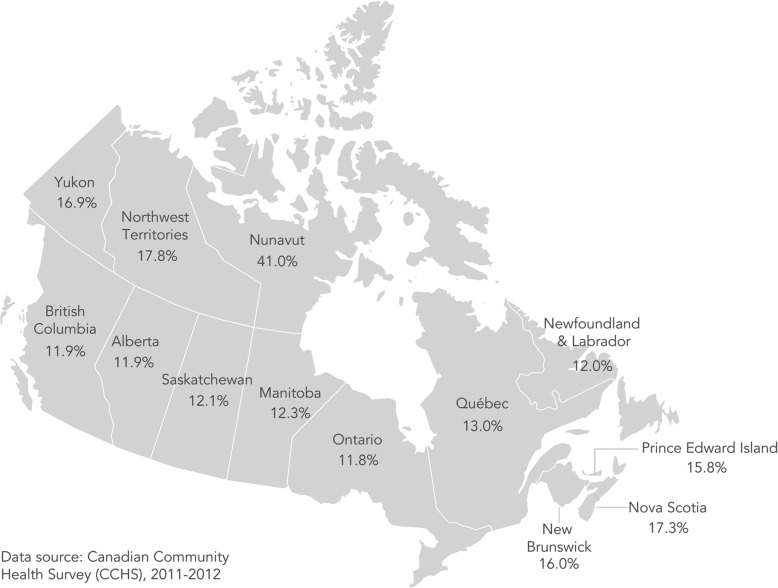
BACKGROUND: Household food insecurity is a potent social determinant of health and health care costs in Canada, but understanding of the social and economic conditions that underlie households' vulnerability to food insecurity is limited. METHODS: Data from the 2011-12 Canadian Community Health Survey were used to determine predictors of household food insecurity among a nationally-representative sample of 120,909 households. Household food insecurity over the past 12 months was assessed using the 18-item Household Food Security Survey Module. Households were classified as food secure or marginally, moderately, or severely food insecure based on the number of affirmative responses. Multivariable binary and multinomial logistic regression analyses were used to determine geographic and socio-demographic predictors of presence and severity of household food insecurity. RESULTS: The prevalence of household food insecurity ranged from 11.8% in Ontario to 41.0% in Nunavut. After adjusting for socio-demographic factors, households' odds of food insecurity were lower in Quebec and higher in the Maritimes, territories, and Alberta, compared to Ontario. The adjusted odds of food insecurity were also higher among households reliant on social assistance, Employment Insurance or workers' compensation, those without a university degree, those with children under 18, unattached individuals, renters, and those with an Aboriginal respondent. Higher income, immigration, and reliance on seniors' income sources were protective against food insecurity. Living in Nunavut and relying on social assistance were the strongest predictors of severe food insecurity, but severity was also associated with income, education, household composition, Aboriginal status, immigration status, and place of residence. The relation between income and food insecurity status was graded, with every $1000 increase in income associated with 2% lower odds of marginal food insecurity, 4% lower odds of moderate food insecurity, and 5% lower odds of severe food insecurity. CONCLUSIONS: The probability of household food insecurity in Canada and the severity of the experience depends on a household's province or territory of residence, income, main source of income, housing tenure, education, Aboriginal status, and household structure. Our findings highlight the intersection of household food insecurity with public policy decisions in Canada and the disproportionate burden of food insecurity among Indigenous peoples.
Overview
The claims and statistics of this paper haven’t been checked yet.
Free: it reads the open-access text and checks the first 5 claims that cite a source we can check. Create a free account to check every claim.
Integrity signals
Registry
Cites
Statistics
Figures
Verification
Claims the paper makes
The claims and statistics of this paper haven’t been checked yet.
Free: it reads the open-access text and checks the first 5 claims that cite a source we can check. Create a free account to check every claim.
Claims other papers make about this one
Each is checked against this paper’s own text: does it say what the citing paper says it does?
The source backs part of the claim, not all of it — or backs it for a different population, condition or comparison.
In the citing paper
“with risk greatest among lone-parent families, social assistance recipients, individuals who identify as Indigenous or Black, and people who live in Nunavut [2, 7].”
From Prevalence and sociodemographic correlates of food insecurity among post-secondary students and non-students of similar age in Canada (2023) · cites this paper as [2]
Experimental — accuracy not yet measuredThe cited source says what the claim attributes to it.
In the citing paper
“Food insecurity is most prevalent among households with inadequate and insecure incomes and few assets [2–6]”
From Prevalence and sociodemographic correlates of food insecurity among post-secondary students and non-students of similar age in Canada (2023) · cites this paper as [2]
Self-check
Percentages, sums and reported differences re-computed from the paper’s own numbers.
The self-check needs the paper’s full text.
Citations
Cites
Whitaker, R. C., Phillips, S. M., & Orzol, S. M. (2006) · Pediatrics · doi:10.1542/peds.2006-0239 · Cited by 817
Seligman, H. K., Bindman, A. B., Vittinghoff, E., Kanaya, A. M., & Kushel, M. B. (2007) · Journal of General Internal Medicine · doi:10.1007/s11606-007-0192-6 · Cited by 789
Household Food Insufficiency Is Associated with Poorer Health
Vozoris, N. T., & Tarasuk, V. S. (2003) · The Journal of Nutrition · doi:10.1093/jn/133.1.120 · Cited by 737
Self-citationThe Economics of Food Insecurity in the United States
Gundersen, C., Kreider, B., & Pepper, J. (2011) · Applied Economic Perspectives and Policy · doi:10.1093/aepp/ppr022 · Cited by 475
Household Food Security in the United States in 2018
Coleman‐Jensen, A., Rabbitt, M. P., Gregory, C., Singh, A. P., Coleman‐Jensen, A., Rabbitt, M. P., Gregory, C., & Singh, A. P. (2019) · AgEcon Search (University of Minnesota, USA) · doi:10.22004/ag.econ.301167 · Cited by 463
Food insufficiency and women's mental health: Findings from a 3-year panel of welfare recipients
Heflin, C. M., Siefert, K., & Williams, D. R. (2005) · Social Science & Medicine · doi:10.1016/j.socscimed.2005.04.014 · Cited by 396
Laraia, B. A., Siega-Riz, A. M., Gundersen, C., & Dole, N. (2006) · The Journal of Nutrition · doi:10.1093/jn/136.1.177 · Cited by 385
Cook, J. T., Black, M., Chilton, M., Cutts, D., Ettinger de Cuba, S., Heeren, T. C., Rose-Jacobs, R., Sandel, M., Casey, P. H., Coleman, S., et al. (2013) · Advances in Nutrition · doi:10.3945/an.112.003228 · Cited by 335 · cited 2×
“These results, taken in tandem with findings that marginal food insecurity is associated with poorer health [16, 22, 52, 53] and higher health care utilization [16, 25], argue for an end to the practice of treating marginally food insecure households as if they are food secure.”
BackgroundResultChild Hunger and Long-term Adverse Consequences for Health
Kirkpatrick, S. I., McIntyre, L., & Potestio, M. L. (2010) · Archives of Pediatrics & Adolescent Medicine · doi:10.1001/archpediatrics.2010.117 · Cited by 329
Food insecurity in Canadian households.
Che, J., & Chen, J. (2001) · PubMed · Cited by 311
Research works printed but not linked: 4
- 3. Riches G. Food banks and the welfare crisis. Ottawa: Canadian Council on Social Development; 1986.
- 12. Health Canada. Canadian community health survey, cycle 2.2, nutrition (2004) - income-related household food security in Canada. Ottawa: Office of Nutrition Policy and Promotion, Health Products and Food Branch, Health Canada; 2007.
- 55. Fréchet G, Lanctôt P, Morin A, Savard F. Equivalence scales: an empirical validation. 2010.
- 60. Gundersen C, Gruber J. The dynamic determinants of food insufficiency. In: Andrews M, Prell M, editors. Second Food Security Measurement and Research Conference, Volume II: Papers. Washington DC: U.S. Department of Agriculture, Economic Research Service; 2001. pp. 91–109.
Cited by
Items 101–200 of 255
Kansanga, M. M., Batung, E. S., Mohammed, K., Sano, Y., Taabazuing, M.-M., & Luginaah, I. (2023) · Journal of Aging & Social Policy · doi:10.1080/08959420.2023.2182082 · Cited by 12
“Although food insecurity is commonly thought to be a problem in the Global South, it is still a major concern in Global North countries, such as Canada and the United States especially among specific groups (Rabbitt et al., 2017; Tarasuk et al., 2019).”
BackgroundSharma, I., Campbell, M. K., Heisel, M. J., Choi, Y., Luginaah, I., Were, J. M., Vargas‐González, J., & Stranges, S. (2023) · PLoS ONE · doi:10.1371/journal.pone.0293515 · Cited by 8
Das, M. (2021) · Social Indicators Research · doi:10.1007/s11205-021-02625-7 · Cited by 9
Francis, J., Mildon, A., Tarasuk, V. S., & Frank, L. (2024) · Frontiers in Nutrition · doi:10.3389/fnut.2024.1287347 · Cited by 8
Self-citationDaley, A., Pandey, S., Phipps, S., & Watson, B. (2023) · Canadian Journal of Economics/Revue canadienne d économique · doi:10.1111/caje.12688 · Cited by 8
“19 First, consistent with other Canadian studies (e.g., Fafard St-Germain, Galloway, and Tarasuk 2019; Li, Dachner, and 18 As a robustness check, we provide estimates in which the control group consists of families in communities with a remoteness index of 0.45 or higher in the same…”
BackgroundMethodResultInfluentialWang, Y., St-Germain, A.-A. F., & Tarasuk, V. (2023) · BMC Public Health · doi:10.1186/s12889-023-15756-y · Cited by 6
Self-citationSohail, A., Du, J., Abbasi, B. N., & Ahmed, Z. (2024) · International Journal of Sustainable Development & World Ecology · doi:10.1080/13504509.2024.2367113 · Cited by 7
“Tarasuk et al. (2019) observed varying degrees of FINS severity among 120,909 Canadian households, with rates ranging from 11.8% in Ontario to 41.0% in Nunavut.”
InfluentialBeacom, E., McLaughlin, C. G., Furey, S., Hollywood, L. E., & Humphreys, P. K. (2021) · British Food Journal · doi:10.1108/bfj-05-2021-0514 · Cited by 6
Gajda, R., Jeżewska-Zychowicz, M., Styczyńska, M., & Jarossová, M. A. (2022) · Foods · doi:10.3390/foods11203222 · Cited by 6
St-Germain, A.-A. F., Hutchinson, J. M., & Tarasuk, V. S. (2024) · Applied Physiology, Nutrition, and Metabolism · doi:10.1139/apnm-2023-0302 · Cited by 6
Self-citationA spatial analyses of food insecurity and disability in the Southeast region of the United States
Sharma, A. (2022) · Journal of Maps · doi:10.1080/17445647.2022.2092909 · Cited by 6
“…with health and physical environment factors as community-level variables in explaining the association between disability and food insecurity in the Southeast region (Bronfenbrenner, 1992; Goldberg & Mawn, 2015; Schwartz et al., 2019b; Sharma, 2014; Shoff et al., 2014; Tarasuk et al., 2019).”
BackgroundBrunet, G., Fajardo, G., da Costa, M. I. F., Bonilla, L., González, F., Bentancor, S., Verdier, S., Curutchet, M. R., Girona, A., Pochellú, L., et al. (2025) · Appetite · doi:10.1016/j.appet.2025.108267 · Cited by 7
Factors associated with food insecurity in older adults in Ecuador
Illescas-Mogrovejo, L. M., Abril-Ulloa, V., Encalada-Torres, J., & Torres, L. E. E. (2022) · Revista chilena de nutrición · doi:10.4067/s0717-75182022000600609 · Cited by 11
Food insecurity and body dissatisfaction in a sample of Canadian adults
Lamont, A., & Speed, D. (2024) · Journal of Health Psychology · doi:10.1177/13591053241242342 · Cited by 5
“…from the literature also suggest that food inse-curity is associated with adverse effects independent of measures of SES (e.g. income, education; Tarasuk et al., 2019); therefore, even in cases where both food insecurity and poverty are present, the effects of food insecurity on body image…”
Sebai, I., Ing, A., Nardocci, M., Fediuk, K., Sadik, T., Chan, H. M., & Batal, M. (2024) · Applied Physiology, Nutrition, and Metabolism · doi:10.1139/apnm-2024-0220 · Cited by 6
Cisneros-Vásquez, E., López‐Moreno, M., Gutiérrez‐Espinoza, H., Arancibia, J. E. O., Sepulveda, R. A. Y., Martín‐Calvo, N., Smith, L., & López‐Gil, J. F. (2025) · Frontiers in Nutrition · doi:10.3389/fnut.2025.1527685 · Cited by 5
“Homoparental families, for their part, tackle discrimination and social stigma, factors that limit their economic opportunities and access to support networks, thus increasing their food vulnerability (50, 51).”
Beacom, E., Furey, S., Hollywood, L. E., & Humphreys, P. K. (2021) · British Food Journal · doi:10.1108/bfj-09-2020-0817 · Cited by 5
Muhajarine, N., Dixon, J., Dyck, E., Clifford, J., Chassé, P., Gupta, S. D., Christopherson-Cote, C., & Remember Rebuild Saskatchewan Team (2023) · JMIR Research Protocols · doi:10.2196/46643 · Cited by 5
Food Insecurity, Dietary Intakes, and Eating Behaviors in a Convenience Sample of Toronto Youth
Dubelt-Moroz, A., Warner, M., Heal, B., Khalesi, S., Wegener, J., de Zepetnek, J. O. T., Lee, J. J., Polecrone, T., El-Sarraj, J., Holmgren, E., et al. (2022) · Children · doi:10.3390/children9081119 · Cited by 6
“homeownership) [40] may contribute to the high prevalence of food insecurity observed in the study.”
BackgroundZhong, T., Crush, J., Song, Y., Si, Z., Scott, S., & Peng, Y. (2023) · Applied Geography · doi:10.1016/j.apgeog.2023.102924 · Cited by 9
Pollock, N. J., Wilson, M., Karaivanov, Y., Power, N., & Reccord, C. (2020) · Canadian Medical Association Journal · doi:10.1503/cmaj.77311 · Cited by 5
Improving food security for Labrador Inuit in Nunatsiavut, Labrador: A matter of health equityPreprint
Bowers, R., Turner, G., Graham, I. D., Furgal, C. M., & Dubois, L. (2021) · Research Square · doi:10.21203/rs.3.rs-1056651/v1 · Cited by 5
“A few more bites?”: Manifestation of pressure‐to‐eat in child care
Podanovitch, H., Campbell, J. E., Rossiter, M. D., Whitfield, K. C., & McIsaac, J. D. (2025) · Nutrition & Dietetics · doi:10.1111/1747-0080.70041 · Cited by 4
“…region (an important location to study food-related behaviours given its rurality, smaller population sizes, and high rates of chronic disease and food insecurity relative to the rest of the country), 18 – 20 involved purposive selection of centres following a public call for participation.”
Kuijper, L. E. N., Lacroix, E., Singh, G., Champagne, M., Beardy, B., Dubois, R., Wood, L., Harper, M. J., Muench, K., Kisselgoff, M., et al. (2024) · Appetite · doi:10.1016/j.appet.2024.107637 · Cited by 5
“Off-reserve Indigenous households also face a 27% higher prevalence of food insecurity (Tarasuk et al., 2019).”
Food insecurity and its association with socio-demographic characteristics in Cyprus
Kantilafti, M., Yannakoulia, M., Giannakou, K., Kyprianidou, M., & Chrysostomou, S. (2024) · Journal of Nutritional Science · doi:10.1017/jns.2024.47 · Cited by 5
“(15) In a context of continuously rising food costs, there is a general perception that healthy eating is more expensive compared to unhealthy eating.”
BackgroundResultNiankara, I. (2021) · African Journal of Science Technology Innovation and Development · doi:10.1080/20421338.2021.1982662 · Cited by 4
“A finding that corroborates with Tarasuk et al. (2019) in Canada; (Pindus and Hafford, 2019) in the United States; Jomaa et al. (2019) in Lebanon; Zhou et al. (2017) in Pakistan; Nkomoki et al. (2019) in Zambia; Roelen and Leon-Himmelstine (2019) in Burundi; Lentz et al. (2019) in Malawi; and Wanka…”
BackgroundResultFood Insecurity in Pakistan: A Study of Food Wastes in the Hoteling Industry of District Swat
Farooq, U., Ali, S., Khan, M. A., & Khan, M. I. (2023) · Pakistan Journal of Humanities and Social Sciences · doi:10.52131/pjhss.2023.1102.0480 · Cited by 4
Food insecurity and disability among working-age and older adults
Hadfield-Spoor, M., Avendaño, M., & Loopstra, R. (2024) · Public Health Nutrition · doi:10.1017/s1368980024000570 · Cited by 4
“These include people in receipt of income-replacement social security, people who are unemployed or underemployed, adults in younger age groups and people from disadvantaged groups (1,7 – 9) .”
BackgroundAdvancing assessment of responsive feeding environments and practices in child care
Campbell, J. E., McIsaac, J. D., Young, M., Dickson, E., Caldwell, S., Barich, R., & Rossiter, M. (2024) · Journal of Nutritional Science · doi:10.1017/jns.2024.10 · Cited by 4
The effects of a universal income transfer on food insecurity within households
Sarker, P. M., Daley, A., & Malacarne, J. (2024) · Agricultural and Resource Economics Review · doi:10.1017/age.2024.4 · Cited by 4
“Socioeconomic status is a strong predictor of food insecurity (Smith et al. 2017; Tarasuk et al. 2019; Bhawra et al. 2021), and there is evidence that income-based policy interventions have reduced the risk of food insecurity in Canada (Ionescu-Ittu et al. 2015; Loopstra et al. 2015; Li et al. 2016; McIntyre et al. 20…”
InfluentialPrevalence of food insecurity and associated factors among Cairo University students
Mohamed, H. S., & Ismail, K. A. (2022) · Journal of The Arab Society for Medical Research · doi:10.4103/jasmr.jasmr_5_21 · Cited by 5
Al-Bazz, S., Al-Kharabsheh, L., Béland, D., Lane, G. L., Engler‐Stringer, R., White, J., Koç, M., Batal, M., Chevrier, J., & Vatanparast, H. (2024) · Food Security · doi:10.1007/s12571-024-01477-6 · Cited by 5
“…shows that households, particularly low-income with children under 18 years of age, have a higher risk to FI than households without children (Tarasuk et al., 2019, 2022; Li et al., 2023; Marshall et al., 2022; Rabbitt et al., 2023; Nord, 2009) In Canada, the rates of food insecurity among…”
InfluentialDoes food insecurity compromise diet quality among Finnish private sector service workers?
Joutsi, R., Walsh, H. M., Lehto, E., Саари, Т., Rahkonen, O., Nevalainen, J., Erkkola, M., & Meinilä, J. M. (2024) · Public Health Nutrition · doi:10.1017/s1368980024002386 · Cited by 5
Social Support and Loneliness Among Black and Hispanic Senior Women Experiencing Food Insecurity
Kirkland, T. W., & Woo, J. (2022) · Nursing Clinics of North America · doi:10.1016/j.cnur.2022.04.012 · Cited by 4
Oduor, D. O., Mutavi, I. N., & Long’ora, A. E. (2022) · African Journal of History and Geography · doi:10.37284/ajhg.1.1.831 · Cited by 4
Sakeah, J. K., Apatinga, G. A., Adda, E. B., Apanga, P. A., Vlassoff, C., & Chen, Y. (2023) · BMC Nutrition · doi:10.1186/s40795-023-00750-9 · Cited by 4
Social path assessment and food security status of rural households in Iran
Haghighi, Z., & Namdar, R. (2024) · Frontiers in Sustainable Food Systems · doi:10.3389/fsufs.2024.1354421 · Cited by 4
“Pay the rent or feed the kids”: A scoping review of the ‘housing-food insecurity nexus’ in CanadaPreprint
Spring, C., & Rosol, M. (2022) · SocArXiv (OSF Preprints) · doi:10.31235/osf.io/wd87b · Cited by 5
Dondi, A., Candela, E., Morigi, F., Lenzi, J., & Lanari, M. (2021) · Medico e Bambino · doi:10.53126/meb40315 · Cited by 3
Hussain, Z., & Tarasuk, V. S. (2021) · Canadian Journal of Public Health · doi:10.17269/s41997-021-00577-6 · Cited by 8
“Both the probability and severity of household food insecurity are tightly linked to household socio-demographic characteristics, but risk also varies depending on the province or territory of residence (Tarasuk et al., 2019).”
BackgroundSelf-citationFood and nutrition education actions based on Pestalozzi's intuitive method
Fernandes, L. B., Inácio, M. L. C., Carvalho, G. D. S., Machado, M. L. B., Maciel, L. H. R., & de Angelis‐Pereira, M. C. (2021) · O Mundo da Saúde · doi:10.15343/0104-7809.202145424439 · Cited by 5
Pereira, F. V. P., Canuto, R., & Schuch, I. (2024) · BMC Public Health · doi:10.1186/s12889-024-20642-2 · Cited by 3
Hamdon, C. (2025) · Canadian Review of Sociology/Revue canadienne de sociologie · doi:10.1111/cars.70011 · Cited by 3
Kim, W., Lim, Y., & Lee, H. Y. (2025) · Journal of Hunger & Environmental Nutrition · doi:10.1080/19320248.2025.2597335 · Cited by 2
“38 We also found a significant association between perceived racial discrimination and food insecurity, aligning with previous studies showing African American residents report both food insecurity and racial discrimination in healthcare.”
St-Germain, A.-A. F., Mikola, D., Li, T., & Emery, J. H. (2026) · Canadian Public Policy · doi:10.3138/cpp.2024-042 · Cited by 2
“…socio-demographic and socio-economic characteristics shown to be associated with food insecurity (e.g., El-Hajj and Benhin 2021; Men and Tarasuk 2023; Tarasuk et al. 2019, 2022; Uppal 2023), income, and receipt of CERB/CRB (Morissette et al. 2021; Statistics Canada 2022a, 2022d, 2022e).”
Mah, C. L., & McIntyre, L. (2026) · Social Indicators Research · doi:10.1007/s11205-026-03814-y · Cited by 2
Onyango, E. O., Owuor, P. M., Otoadese, D., Odhiambo, S. A., Ajibade, T. B., Onyango, J. A., & Boateng, G. O. (2026) · Frontiers in Nutrition · doi:10.3389/fnut.2026.1841239 · Cited by 2
Assessing perceived food security among British Columbian rural and urban residents
DeBoer, Z., Sciences, E. H. B. S. O. H., & Chen, D. (2022) · BCIT Environmental Public Health Journal · doi:10.47339/ephj.2022.206 · Cited by 2
“…distribution of food security in Canada is determined through a variety of factors including access to food, availability of food, food prices, financial security, and ability to grow food (Tarasuk et al., 2019) Food security represents a larger challenge in Canada’s Indigenous communities.”
BackgroundRaised Food Prices Exacerbate Food Insecurity in Canada: A Call to Action
Dahal, R., Adhikari, K., & Tang, K. L. (2023) · Journal of Community Medicine & Public Health · doi:10.29011/2577-2228.100397 · Cited by 3
“It is a strong predictor of poor physical and mental health [4].”
BackgroundGeographic Comparison of Dietary Intake and Quality in Manitoba Adolescents
Slater, J. J., Katz, A., Pilli, B., Hinds, A. M., Urquia, M. L., Sanguins, J., Green, C., Cidro, J., Chateau, D. G., & Nickel, N. C. (2024) · Canadian Journal of Dietetic Practice and Research · doi:10.3148/cjdpr-2024-004 · Cited by 2
Food deserts, food mirages, and gentrification in Toronto, Canada
Menko, P., Olstad, D. L., Buttazzoni, A. N., & Minaker, L. M. (2025) · Health & Place · doi:10.1016/j.healthplace.2025.103490 · Cited by 2
Petresin, T., Any, M., Shujauddin, N., Annis, A., Haines, J., & Advisors, F. U. N. C. (2025) · BMC Public Health · doi:10.1186/s12889-025-23356-1 · Cited by 2
Mackie, A. S., Kovacs, A. H., Martin-Feeney, D. S., Ley, A. V.-D., McCrindle, B. W., Harris, K. C., Fournier, A., Chappell, A., Gingrich, J., Dimitropoulos, G., et al. (2025) · CJC Pediatric and Congenital Heart Disease · doi:10.1016/j.cjcpc.2025.06.001 · Cited by 2
A Macropsychology Perspective on Food Systems
McVeigh, J. (2021) · Springer eBooks · doi:10.1007/978-3-030-50176-1_13 · Cited by 2
Ferdinands, A. R., Lavriv, O., Beckie, M. A., & Mayan, M. J. (2023) · Canadian Food Studies / La Revue canadienne des études sur l alimentation · doi:10.15353/cfs-rcea.v10i3.627 · Cited by 2
Pare, S. M., Gunn, E., Morrison, K. M., Miller, A. L., Duncan, A. M., Buchholz, A. C., David, W. L., Tremblay, P. F., Vallis, L. A., Mercer, N. J., et al. (2024) · JMIR Research Protocols · doi:10.2196/48549 · Cited by 3
Morissette-Desjardins, A., Provencher, V., & Lebel, A. (2019) · Canadian Journal of Public Health · doi:10.17269/s41997-019-00239-8 · Cited by 1
“…qui sous-tendent l’insécurité alimentaire sont multiples et impliquent possiblement autant les caractéristiques individuelles, comme le statut socioéconomique du ménage, que des déterminants structuraux, comme l’offre alimentaire (Hamelin et al. 2009; Chénier 2017; Tarasuk et al. 2019).”
BackgroundManagement of Chronic sinusitis through Siddha Treatment - A Case Report
Raja, N. N. J., Veluchamy, H. N. D., & Sivanan, M. V. (2023) · International Journal of Ayurvedic Medicine · doi:10.47552/ijam.v14i2.3638 · Cited by 1
Treating Children and Adolescents With Obesity: Characteristics of Success
Christison, A. L., Tucker, J. M., King, E. C., Sweeney, B. R., Cuda, S. E., Frank, M., Kirk, S., & on behalf of the POWER Work Group (2023) · Childhood Obesity · doi:10.1089/chi.2023.0083 · Cited by 1
“26 Youth in low SES settings often encounter additional barriers to healthy eating, including food insecurity, less access to healthy foods, and fewer healthy family meal habits, 27–29 and it is likely that these factors also impede adherence to nutritional treatment approaches to pediatric obesity.”
Fikawati, S., Syafiq, A., Notarianti, R., & Gemily, S. C. (2024) · Indonesian Journal of Public Health Nutrition · doi:10.7454/ijphn.v5i1.1051 · Cited by 1
Kucab, M., Keown‐Stoneman, C. D. G., Birken, C. S., Perlman, M., Parsons, J. A., D’Annunzio, D., Thadani, S., Allen, C., & Maguire, J. L. (2025) · Journal of Nutrition · doi:10.1016/j.tjnut.2025.09.028 · Cited by 2
Caughey, A., Harper, S. L., Sanguya, I., Sargeant, J. M., Miners, A., Doucette, M., Koonoo, T., Weiler, H. A., Allen, J., MacRury, A., et al. (2025) · International Journal of Circumpolar Health · doi:10.1080/22423982.2025.2580100 · Cited by 2
“It is well-established that household food insecurity is associated with heightened nutritional vulnerability and a range of negative physical and mental health outcomes across the lifecycle, and these outcomes are independent of income, education and other social determinants of health [45,48].”
Sharma, I., Campbell, M. K., Choi, Y., Luginaah, I., Were, J. M., Vargas‐González, J., & Stranges, S. (2025) · BMC Public Health · doi:10.1186/s12889-025-25471-5 · Cited by 1
“It is often correlated with poor access to health services [22], food insecurity [23], poorer health promoting-behaviors, poorly built environments such as recreational parks, walking space, health care facilities, and environmental pollutants [24, 25].”
What Predicts Permanent Full-Time Job Holders Being Food Insecure?
Wei, M., St-Germain, A.-A. F., Li, T., & Tarasuk, V. S. (2025) · Canadian Public Policy · doi:10.3138/cpp.2024-059 · Cited by 1
“…incomes—which include income from wages, salaries, commissions, and self-employment, as in prior research (e.g., McIntyre, Bartoo, and Emery 2014; Tarasuk, Fafard St-Germain, and Mitchell 2019)—and with a main earner aged 18 years or above who was working at the time of the CIS inter-view ( n =…”
InfluentialSelf-citationEzeuko, L. C., & Odunvbun, M. E. (2026) · Egyptian Pediatric Association Gazette · doi:10.1186/s43054-026-00547-y · Cited by 1
Quayyum, F., Rao, A., Ford, K. L., John, J. C., Braga, J. R., Angl, E. N., Lofters, A., Gramlich, L. M., Kelly, A., Jain, R., et al. (2026) · BMJ Nutrition Prevention & Health · doi:10.1136/bmjnph-2025-001480 · Cited by 1
Exploring Food Security Dynamics in Canada: Urban and Rural Drivers Before and After the Pandemic
Spena, A. R., & Henson, S. (2026) · Springer eBooks · doi:10.1007/978-3-032-33157-1_15 · Cited by 1
Caracterização de crianças e adolescentes vulneráveis residentes de uma cidade Sulmineira
Inácio, M. L. C., Pereira, F. C., Alimeida, I. C., Fernandes, L. B., Garcia, D. S., Silva, T. A. F., Pereira, K. A. D. C., de Oliveira, I. R. C., Pereira, R. C., & de Angelis‐Pereira, M. C. (2021) · Saúde e Desenvolvimento Humano · doi:10.18316/sdh.v9i2.7074 · Cited by 1
Gajda, R., & Kołożyn‐Krajewska, D. (2020) · Zywnosc-nauka Technologia Jakosc · doi:10.15193/zntj/2020/122/326 · Cited by 2
COVID-19: Risco de Insegurança Alimentar e fatores associados na Madeira
Costa, L., Henriques, E., & Esmeraldo, T. (2020) · Acta Portuguesa de Nutrição · doi:10.21011/apn.2020.2302 · Cited by 4
Gajda, R. (2023) · Zywnosc-nauka Technologia Jakosc · doi:10.15193/zntj/2023/134/439 · Cited by 1
“The economic reasons are important because they also apply to developed countries [66].”
BackgroundMamahit, A. Y., Sera, A. C., Amaliah, L., Maretalinia, M., & Prayitno, T. (2023) · Jurnal Penelitian Pendidikan IPA · doi:10.29303/jppipa.v9ispecialissue.5988 · Cited by 1
“Additionally, income, education, household composition, Aboriginal status, immigration status, and place of residence were also associated with the severity of food insecurity (Tarasuk et al., 2019).”
BackgroundInfluentialRe-Considering Market Development Approaches to Support Nunavut Inuit Priorities in the Seal Market
Vanderkaden, S., Bailey, M., Giles, A., & Milley, C. (2024) · ARCTIC · doi:10.14430/arctic78777 · Cited by 1
Pereira, F. V. P., Canuto, R., & Schuch, I. (2024) · Cadernos de Saúde Pública · doi:10.1590/0102-311xpt034424 · Cited by 1
Matthew, E., Liebenehm, S., Natcher, D. C., Lloyd-Smith, P. R., & Mirzaei, O. (2025) · Canadian Journal of Agricultural Economics/Revue canadienne d agroeconomie · doi:10.1111/cjag.12389 · Cited by 1
Food Access and Insecurity in Adults with Mobility Disabilities
Schwartz, N. S. (2020) · TSpace (University of Toronto) · Cited by 2
MEKKHUM, W. (2021) · Chula Digiverse · doi:10.58837/chula.the.2021.353 · Cited by 1
Nandi, S., Barman, M., & Nandi, D. (2024) · Research Square · doi:10.21203/rs.3.rs-4208156/v1 · Cited by 1
The Nutritional Implications of Household Food Insecurity in Canada
Hutchinson, J. M. (2019) · TSpace (University of Toronto)
The Provision of Foods and Beverages to Children from Non-Parental Sources: An Exploratory Study
Klassen, E. B. (2020) · Scholarship@Western (Western University)
Schwere Kost: Zur sozialen Ungleichheit von Fleischkonsum und Fleischverzicht in Deutschland
Einhorn, L. (2020) · Social Science Open Access Repository (GESIS – Leibniz Institute for the Social Sciences) · Cited by 3
Pakravan-Charvadeh, M. R., Savari, M., Khan, H. A., Gholamrezai, S., & Flora, C. B. (2021) · Public Health Nutrition · doi:10.1017/s1368980021000872
Comparative study of variable importance measurements on identification of vulnerable households
Irfani, R., ERFIANI, E., & Sartono, B. (2022) · AIP conference proceedings · doi:10.1063/5.0117678
Procedures for claimant asylum within Canada, acceptance and rejection
Cameron, H. E., & Joundi, T. (2023) · doi:10.32920/22341202
Al-Kharabsheh, L., Al-Bazz, S., Koç, M., Garcia, J., Lane, G. L., Engler‐Stringer, R., White, J., & Vatanparast, H. (2023) · doi:10.32920/24084549
Perbedaan Karakteristik Demografi dan Klinis Ibu Hamil Overweight dan Obesitas Tipe I
Astutik, R. Y., Istighosah, N., & Siwi, R. P. Y. (2023) · JURNAL KEBIDANAN · doi:10.35890/jkdh.v12i02.287
Psychological Impact of COVID-19 on individuals: Through Active Choices and Passive Adaption
Fang, J., Lau, C. K. M., & Cheng, Y. (2024) · Frontiers research topics · doi:10.3389/978-2-8325-4481-5
A Review of Trends and Prevention Strategies for Mortgage Income Fraud in the Canadian Market
Lokanan, M. E., & Yeldandi, N. V. (2024) · Studies in systems, decision and control · doi:10.1007/978-3-031-54383-8_53
Exploring Consumers' Willingness To Adopt Climate-Friendly Diets
Miguel, M. I., & Majerova, J. (2024) · Frontiers research topics · doi:10.3389/978-2-8325-5371-8
Ng, E., France, C., & Thakidiyil, T. (2024) · Social Work in Public Health · doi:10.1080/19371918.2024.2425869
“Arguably, the most important proximate determinant of food insecurity is household income (Tarasuk et al., 2019).”
Gupta, S. D., Rizvi, S. J. R., Dixon, J., & Muhajarine, N. (2025) · Canadian Journal of Public Health · doi:10.17269/s41997-025-01014-8
“In 2017–2018, food insecurity, characterized by inadequate or insufficient access to food, affected 17.8%, or 1 in 6, of Canadian households, disproportionately impacting those who were most economically deprived (Tarasuk et al., 2019, 2022).”
InfluentialPoverty Reduction Politics and Food Insecurity: Better for High-Risk Groups?
Notten, G., Liu, L., & Tarasuk, V. S. (2025) · Canadian Public Policy · doi:10.3138/cpp.2024-028
“For example, households relying on social assistance and Employment Insurance face much higher risks compared with those depending on pensions (Tarasuk et al. 2019).”
InfluentialSelf-citationThe Community Garden Perspective on Reducing Food Insecurity and Health DisparitiesPreprint
Sonya, A., & Matthews, E. P. (2025) · Research Square · doi:10.21203/rs.3.rs-6609892/v1
Social prescriptions: Why some health-care practitioners are prescribing food to their patients
Little, M., Dodd, W., & Stringer, E. (2022) · The Conversation · doi:10.64628/aam.tgewdhhv4
Hermansyah, H. (2025) · Legalis Journal of Law Review · doi:10.61978/legalis.v3i3.1125
“Empirical evidence confirms that jurisdictions with mandatory representation and procedural checks see substantially lower eviction rates and improved housing stability (Tarasuk et al., 2019).”
Assessing the Influence of Agricultural Injuries on the Welfare of Cocoa Farming Households in Ghana
Tham-Agyekum, E. K., Sangber-Dery, G.-M., Ankuyi, F., Bakang, J.-E. A., Ayeh, S. J., & Nfaaful, E. (2025) · Journal of Agromedicine · doi:10.1080/1059924x.2025.2594115
“36 The association between poor household income, food insecurity, and the occurrence of injuries is supported by Fan et al., - 37 Tarasuk et al., 38 and Men et al. 39 However, it is not clear how these associations can be applied to developing countries like Ghana, because their socio-economic and…”
FED UP: A Mixed-Methods Investigation on the Influencing Factors of Food Insecurity in the Azores
Freiheit, R. (2022) · Portuguese National Funding Agency for Science, Research and Technology (RCAAP Project by FCT) · doi:10.34626/qrn2-1h79 · Cited by 2
Men, F., Urquia, M. L., & Tarasuk, V. (2021) · Figshare · doi:10.6084/m9.figshare.15179327
Self-citation
Metadata
- Authors
- Tarasuk, V., Fafard St-Germain, A.-A., & Mitchell, A.
- Affiliations
- University of Toronto (CA)
- Corresponding author
- Tarasuk, Valerie
- Venue
- BMC Public Health
- Published
- 2019-01-03
- Volume
- 19
- Issue
- 1
- Pages
- 12-12
- ISSN
- 1471-2458 (ISSN-L)
- PMC
- PMC6318847
- OpenAlex
- W2947923758
- Cited by
- 207
- References
- 69
- Citations by year
- 2026: 15 · 2025: 22 · 2024: 34 · 2023: 34 · 2022: 33 · 2021: 41 · 2020: 23 · 2019: 5
- FWCI
- 34.77
- Type
- journal article
- Language
- en
- Open access
- gold
- doi.org
- Licence
- cc-by
- creativecommons.org/licenses/by/4.0/ (tdm)
- Locations
- BMC Public Health (publishedVersion, cc-by)
- Europe PMC (PubMed Central) (publishedVersion, cc-by)
- PubMed Central (publishedVersion, cc-by)
- PubMed (publishedVersion)
- TSpace (University of Toronto) (submittedVersion, cc-by)
- DOAJ (DOAJ: Directory of Open Access Journals) (submittedVersion, cc-by-sa)
- Funders
- Canadian Institutes of Health Research (FRN 115208)
- Topics
- Health Sciences › Medicine › Public Health, Environmental and Occupational Health › Food Security and Health in Diverse Populations
- Life Sciences › Agricultural and Biological Sciences › General Agricultural and Biological Sciences › Food Security and Socioeconomic Dynamics
- Social Sciences › Sociology and Political Science › Income, Poverty, and Inequality
- Keywords
- household food insecurity, regional variation, sociodemographic predictors, food insecurity severity, social assistance, income, Aboriginal status, indigenous peoples, housing tenure, immigration status, household composition, Nunavut, Canada
- MeSH terms
- Adult, Canada, Child, Family Characteristics, Female, Food Supply, Geography, Humans, Male, Surveys and Questionnaires, Socioeconomic Factors
About these checks
Registry, retraction, Cites and statistics results are computed, not judged, with one exception: a printed reference that no index lists is read once by a model before it counts as a citation error. Claims are extracted by a model and kept only when their quote appears verbatim in the text; each cited source is then checked, with a model’s help, for whether it says what the claim relies on. Those verdicts can be wrong — read the claim’s quote and the cited source before relying on one.
Statistics and arithmetic are recomputed, not judged.
Confidence bands are shown only for fields calibrated on our annotated test set. None is calibrated yet, so no band is shown.
What counts as a claim ›How we measure confidence ›How we check this ›
Are you an author, or do you see a problem with this page? Request a review
Data sources
Bibliographic data: Semantic Scholar, OpenAlex, Crossref.
Contains information from the Semantic Scholar Academic Graph Datasets, made available under the ODC Attribution License (ODC-BY 1.0).
Semantic Scholar’s data is described in: Kinney, R., et al. (2023). The Semantic Scholar Open Data Platform. arXiv:2301.10140.
