

Effectiveness of an individual acceptance and commitment therapy for smoking cessation, delivered face-to-face and by telephone to adults recruited in primary health care settings: a randomized controlled trial
Open accessThe DOI matches its Crossref record; 47 of the 47 references it cites were found in a registry or an index.
Abstract
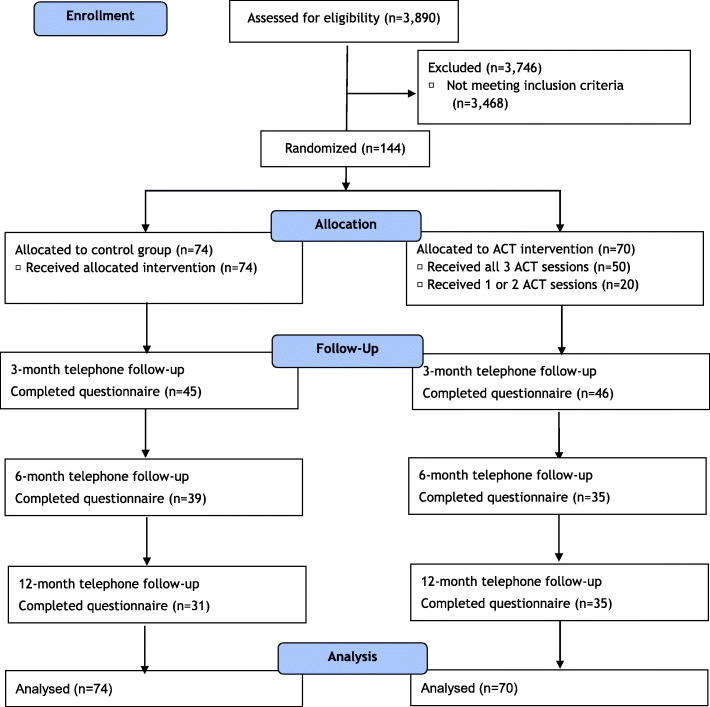
Background: The aim of this study was to examine the effectiveness of delivering an individual Acceptance and Commitment Therapy (ACT) for smoking cessation among a Chinese population. Methods: Participants were recruited from six primary health care centers. A total of 144 were eligible to take part in the study and agreed to be randomized to the intervention (ACT) group (n = 70) and control group (n = 74), respectively. Both groups received self-help materials on smoking cessation. The ACT group also underwent an initial face-to-face session and two telephone ACT sessions at 1 week and 1 month following the first session. They were re-contacted through telephone follow-ups at 3, 6, and 12 months by research assistants. The primary outcome was self-reported 7-day point-prevalence abstinence at the 12-month follow-up session. Other outcomes included biochemically validated quitting, quitting attempts, the intention to quit, the self-perception of quitting, and psychological flexibility. Results: There was no significant difference in the self-reported 7-day point prevalence quit rate at the 12-month follow-up between the intervention group (24.3%) and the control group (21.6%) (risk ratio = 1.12; 95%CI = (0.62, 2.05); p = 0.704). Greater improvements in secondary outcomes from baseline to the 12-month follow-up were observed in the ACT group than in the control group, including a forward progression in the participants’ readiness to quit smoking (p = 0.014) and increased psychological flexibility (p = 0.022). Conclusions: This study is the first evidence of a randomized-controlled trial on the adoption of an individual ACT for smoking cessation, delivered initially in primary health care settings and subsequently by telephone within a Chinese population. The present study found that the brief ACT intervention could not produce a significant quit rate but was promising in terms of bringing about cognitive changes, including greater psychological flexibility, and more confidence about quitting, when compared to the use of self-help materials only among the general population. Trial registration: This trial was registered prospectively with the U.S. National Library of Medicine: (NCT01652508) on 26th July 2012.
Overview
The claims and statistics of this paper haven’t been checked yet.
Free: it reads the open-access text and checks the first 5 claims that cite a source we can check. Create a free account to check every claim.
Integrity signals
Registry
Cites
Statistics
Figures
Verification
Claims the paper makes
The claims and statistics of this paper haven’t been checked yet.
Free: it reads the open-access text and checks the first 5 claims that cite a source we can check. Create a free account to check every claim.
Claims other papers make about this one
Each is checked against this paper’s own text: does it say what the citing paper says it does?
The source backs part of the claim, not all of it — or backs it for a different population, condition or comparison.
In the citing paper
“Previous studies have demonstrated that ACT-based digital interventions, including smartphone apps for the general population, promote smoking cessation.40–42”
From Efficacy of smartphone applications to help cancer patients quit smoking: Protocol of the Quit2Heal randomized controlled trial (2023) · cites this paper as [42]
Experimental — accuracy not yet measuredThe source backs part of the claim, not all of it — or backs it for a different population, condition or comparison.
In the citing paper
“This method has shown promise in smoking cessation interventions targeting the broader adult population [21, 22, 23].”
From Can an Acceptance and Commitment Therapy-Based Smartphone App Help Individuals with Mental Health Disorders Quit Smoking? (2024) · cites this paper as [22]
Experimental — accuracy not yet measuredThe source backs part of the claim, not all of it — or backs it for a different population, condition or comparison.
In the citing paper
“Using complete‐case analysis reduced the point estimate but did not substantially change the interpretation of the result (RR 1.06, 95% CI 0.54 to 2.11; 66 participants; Analysis 6.7).”
From Mindfulness for smoking cessation (2022) · cites this paper as Mak 2020
Experimental — accuracy not yet measuredThe source backs part of the claim, not all of it — or backs it for a different population, condition or comparison.
In the citing paper
“Mak 2020's point estimate favoured ACT over brief advice but there was substantial imprecision, meaning the result could indicate potential harm as well as considerable benefit (RR 1.27, 95% CI 0.59 to 2.75; 144 participants; very low‐certainty evidence; Analysis 2.3).”
From Mindfulness for smoking cessation (2022) · cites this paper as Mak 2020
Experimental — accuracy not yet measured
Self-check
Percentages, sums and reported differences re-computed from the paper’s own numbers.
The self-check needs the paper’s full text.
Citations
Cites
The Fagerstrom Test for Nicotine Dependence: a revision of the Fagerstrom Tolerance Questionnaire
HEATHERTON, T. F., KOZLOWSKI, L. T., FRECKER, R. C., & FAGERSTROM, K. (1991) · British Journal of Addiction · doi:10.1111/j.1360-0443.1991.tb01879.x · Cited by 10,738
Acceptance and commitment therapy: model, processes and outcomes
Hayes, S. C., Luoma, J. B., Bond, F. W., Masuda, A., & Lillis, J. (2006) · Behaviour Research and Therapy · doi:10.1016/j.brat.2005.06.006 · Cited by 6,587
The Health consequences of smoking—50 years of progress : a report of the Surgeon General
Lushniak, B. D., Samet, J. M., Pechacek, T. F., Norman, L., & Taylor, P. A. (2014) · Cited by 4,990
Bond, F. W., Hayes, S. C., Baer, R. A., Carpenter, K. M., Guenole, N., Orcutt, H. K., Waltz, T., & Zettle, R. D. (2011) · Behavior Therapy · doi:10.1016/j.beth.2011.03.007 · Cited by 3,950
General, U. S. S. (2014) · PsycEXTRA Dataset · doi:10.1037/e510072014-001 · Cited by 3,324
Addiction motivation reformulated: an affective processing model of negative reinforcement
Baker, T. B., Piper, M. E., McCarthy, D. E., Majeskie, M. R., & Fiore, M. C. (2004) · Psychological Review · doi:10.1037/0033-295x.111.1.33 · Cited by 2,162 · cited 1×
“[19], avoidance of distressing smoking-related thoughts, feelings, and bodily sensations is the principal motive for addictive behaviors such as smoking.”
BackgroundMeasuring experiential avoidance: A preliminary test of a working model
Hayes, S. C., Strosahl, K., Wilson, K. G., Bissett, R. T., Pistorello, J., Toarmino, D., Polusny, M. A., Dykstra, T. A., Batten, S. V., Bergan, J., et al. (2004) · The Psychological Record · doi:10.1007/bf03395492 · Cited by 2,140
Mackay, J. M., & Eriksen, M. P. (2002) · Medical Entomology and Zoology · Cited by 1,431
Outcome criteria in smoking cessation trials: proposal for a common standard
West, R., Hajek, P., Stead, L., & Stapleton, J. (2005) · Addiction · doi:10.1111/j.1360-0443.2004.00995.x · Cited by 1,285
Mobile phone-based interventions for smoking cessation
Whittaker, R., McRobbie, H., Bullen, C., Rodgers, A., & Gu, Y. (2016) · Cochrane Database of Systematic Reviews · doi:10.1002/14651858.cd006611.pub4 · Cited by 1,079
Individual behavioural counselling for smoking cessation
Lancaster, T., & Stead, L. F. (2005) · Cochrane Database of Systematic Reviews · doi:10.1002/14651858.cd001292.pub2 · Cited by 1,015
Telephone counselling for smoking cessation
Stead, L. F., Hartmann-Boyce, J., Perera, R., & Lancaster, T. (2013) · Cochrane Database of Systematic Reviews · doi:10.1002/14651858.cd002850.pub3 · Cited by 1,003 · cited 1×
“Telephone-based smoking cessation interventions have been adopted for many years in Hong Kong [16] and in other countries [15].”
BackgroundAssessing outcome in smoking cessation studies.
Velicer, W. F., Prochaska, J. O., Rossi, J. S., & Snow, M. G. (1992) · Psychological Bulletin · doi:10.1037//0033-2909.111.1.23 · Cited by 833
Group behaviour therapy programmes for smoking cessation
Stead, L. F., Carroll, A. J., & Lancaster, T. (2017) · Cochrane Database of Systematic Reviews · doi:10.1002/14651858.cd001007.pub3 · Cited by 781 · cited 2×
“6%) in the control group despite receiving self-help materials only, as compared to previous studies (2–10%) [7, 43].”
BackgroundResultTime for a change: putting the transtheoretical (stages of change) model to rest
WEST, R. (2005) · Addiction · doi:10.1111/j.1360-0443.2005.01139.x · Cited by 700 · cited 2×
“It is worth noting that, based on recent research results [44], it is recommended that the stage of change model is uninformative to predict the chance of successful smoking cessation.”
BackgroundAcceptance-based treatment for smoking cessation
Gifford, E. V., Kohlenberg, B. S., Hayes, S. C., Antonuccio, D. O., Piasecki, M. M., Rasmussen-Hall, M. L., & Palm, K. M. (2004) · Behavior Therapy · doi:10.1016/s0005-7894(04)80015-7 · Cited by 499
Prevalence of Smoking in China in 2010
Li, Q., Hsia, J., & Yang, G. (2011) · New England Journal of Medicine · doi:10.1056/nejmc1102459 · Cited by 453
Individual behavioural counselling for smoking cessation
Lancaster, T., & Stead, L. F. (2017) · Cochrane Database of Systematic Reviews · doi:10.1002/14651858.cd001292.pub3 · Cited by 436 · cited 1×
“A range of behavioral interventions has been shown to be effective for achieving smoking cessation [7, 8].”
BackgroundExpired air carbon monoxide: a simple breath test of tobacco smoke intake.
Jarvis, M. J., Russell, M. A., & Saloojee, Y. (1980) · BMJ · doi:10.1136/bmj.281.6238.484 · Cited by 372
Bricker, J. B., Mull, K. E., Kientz, J. A., Vilardaga, R., Mercer, L. D., Akioka, K. J., & Heffner, J. L. (2014) · Drug and Alcohol Dependence · doi:10.1016/j.drugalcdep.2014.07.006 · Cited by 340
Tyndall, I., Waldeck, D., Pancani, L., Whelan, R., Roche, B., & Dawson, D. L. (2019) · Journal of Contextual Behavioral Science · doi:10.1016/j.jcbs.2018.09.005 · Cited by 303
Telephone counseling for smoking cessation: rationales and meta-analytic review of evidence
Lichtenstein, E., Glasgow, R. E., Lando, H. A., Ossip-Klein, D. J., & Boles, S. M. (1996) · Health Education Research · doi:10.1093/her/11.2.243 · Cited by 282
Self change processes, self efficacy and decisional balance across five stages of smoking cessation.
Prochaska, J. O., & DiClemente, C. C. (1984) · PubMed · Cited by 280
Nissinen, A. M., Berrios, X., & Puska, P. (2001) · Europe PMC (PubMed Central) · Cited by 215
Gifford, E. V., Kohlenberg, B. S., Hayes, S. C., Pierson, H. M., Piasecki, M. P., Antonuccio, D. O., & Palm, K. M. (2011) · Behavior Therapy · doi:10.1016/j.beth.2011.03.002 · Cited by 200
Bricker, J., Wyszynski, C., Comstock, B., & Heffner, J. L. (2013) · Nicotine & Tobacco Research · doi:10.1093/ntr/ntt056 · Cited by 170 · cited 2×
“The increase in psychological flexibility following ACT is clinically meaningful, as previous studies found that increasing psychological flexibility serves as an essential element in smoking cessation treatments [21, 22, 25].”
BackgroundHernández-López, M., Luciano, M. C., Bricker, J. B., Roales-Nieto, J. G., & Montesinos, F. (2009) · Psychology of Addictive Behaviors · doi:10.1037/a0017632 · Cited by 137
Bricker, J. B., Bush, T., Zbikowski, S. M., Mercer, L. D., & Heffner, J. L. (2014) · Nicotine & Tobacco Research · doi:10.1093/ntr/ntu102 · Cited by 100 · cited 6×
“The finding of increased psychological flexibility following ACT is consistent with that of previous studies, where acceptance of physical cravings, emotions, and smoking-related thoughts as measured by the Avoidance and Inflexibility Scale (AIS) increased following telephone-delivered ACT for smoking cessation [24, 2…”
BackgroundResultInfluentialBricker, J. B., Mull, K. E., McClure, J. B., Watson, N. L., & Heffner, J. L. (2018) · Addiction · doi:10.1111/add.14127 · Cited by 91
Smoking cessation intervention in parents of young children: a randomised controlled trial
Abdullah, A. S. M., Mak, Y. W., Loke, A. Y., & Lam, T. (2005) · Addiction · doi:10.1111/j.1360-0443.2005.01231.x · Cited by 81
Self-citationBenefits of Telephone Care Over Primary Care for Smoking Cessation: A Randomized Trial
An, L. C., Zhu, S.-H., Nelson, D. B., Arikian, N. J., Nugent, S., Partin, M. R., & Joseph, A. M. (2006) · Archives of Internal Medicine · doi:10.1001/archinte.166.5.536 · Cited by 76
Bricker, J. B., Mann, S. L., Marek, P. M., Liu, J., & Peterson, A. V. (2010) · Nicotine & Tobacco Research · doi:10.1093/ntr/ntq002 · Cited by 76
Which smokers use the smoking cessation Quitline in Hong Kong, and how effective is the Quitline?
Abdullah, A. S. M., Lam, T.-H., Chan, S. S. C., & Hedley, A. J. (2004) · Tobacco Control · doi:10.1136/tc.2003.006460 · Cited by 65
McClure, J. B., Bricker, J., Mull, K., & Heffner, J. L. (2020) · Nicotine & Tobacco Research · doi:10.1093/ntr/nty268 · Cited by 52
Stanton, C. A., Lloyd-Richardson, E. E., Papandonatos, G. D., de Dios, M. A., & Niaura, R. (2009) · AIDS Education and Prevention · doi:10.1521/aeap.2009.21.3_supp.65 · Cited by 47
Validation of the Avoidance and Inflexibility Scale (AIS) among treatment-seeking smokers.
Farris, S. G., Zvolensky, M. J., DiBello, A. M., & Schmidt, N. B. (2015) · Psychological Assessment · doi:10.1037/pas0000059 · Cited by 43
Smoking Decisions from a Teen Perspective: A Narrative Study
Baillie, L., Lovato, C. Y., Johnson, J. L., & Kalaw, C. (2005) · American Journal of Health Behavior · doi:10.5993/ajhb.29.2.1 · Cited by 37
Kelly, M. M., Sido, H., Forsyth, J. P., Ziedonis, D. M., Kalman, D., & Cooney, J. L. (2015) · Journal of Dual Diagnosis · doi:10.1080/15504263.2014.992201 · Cited by 34
Addressing Weight Gain in Smoking Cessation Treatment: A Randomized Controlled Trial
Bush, T. M., Levine, M. D., Beebe, L. A., Cerutti, B., Deprey, M., McAfee, T. A., Boeckman, L. M., & Zbikowski, S. M. (2012) · American Journal of Health Promotion · doi:10.4278/ajhp.110603-quan-238 · Cited by 33
Smoking and mortality in a prospective cohort study of elderly C hinese in H ong K ong
Lam, T. H., Xu, L., Schooling, C. M., Chan, W. M., Lee, S. Y., & Leung, G. M. (2014) · Addiction · doi:10.1111/add.12776 · Cited by 30 · cited 1×
“However, similar to global figures [2], half of all deaths among smokers aged 65 years or older in Hong Kong were caused by smoking [6].”
BackgroundHeffner, J. L., McClure, J. B., Mull, K. E., Anthenelli, R. M., & Bricker, J. B. (2015) · Bipolar Disorders · doi:10.1111/bdi.12300 · Cited by 24
Mak, Y. W., & Loke, A. Y. (2015) · BMC Public Health · doi:10.1186/s12889-015-1485-z · Cited by 22 · cited 3×
“The overall design of the study was illustrated in a published study protocol [30].”
BackgroundMethodInfluentialSelf-citationSchauer, G. L., Bush, T., Cerutti, B., Mahoney, L., Thompson, J. R., & Zbikowski, S. M. (2013) · Preventing Chronic Disease · doi:10.5888/pcd10.120324 · Cited by 20
Vilardaga, R., Heffner, J. L., Mercer, L. D., & Bricker, J. B. (2014) · Behaviour Research and Therapy · doi:10.1016/j.brat.2014.07.008 · Cited by 17
Mak, Y. W., Loke, A. Y., Lam, T. H., & Abdullah, A. S. M. (2006) · Addictive Behaviors · doi:10.1016/j.addbeh.2005.12.018 · Cited by 14
Self-citationMak, Y. W., Lee, P. H., & Loke, A. Y. (2015) · BMC Public Health · doi:10.1186/s12889-015-2650-0 · Cited by 11 · cited 1×
“The reasons given for not taking part in the study and the predictors of participation in the trial were reported eleswhere [42].”
BackgroundSelf-citationMak, Y. W., & Loke, A. (2015) · PolyU Institutional Research Archive (Hong Kong Polytechnic University) · Cited by 1
Self-citation
Research works printed but not linked: 4
- 29. Hui, S. Health and physical activity in Hong Kong-a review. SDB Research Report 2001, no. 4. The Chinese University of Hong Kong. Available online: https://www.hksi.org.hk/f/page/611/r2.pdf (accessed on 5 Nov 2019).
- 39. Gifford EV. Acceptance based treatment for nicotine dependent smokers: Altering the regulatory functions of smoking related affect, physiological symptoms, and cognition. Doctoral dissertation. Reno: University of Nevada; 2002.
- 40. Gifford EV, Kohlenberg BK, Hayes SC, Antonuccio DO, Piasecki MP, Palm KM. Combining bupropion SR with acceptance based behavioral therapy for smoking cessation. Reno: Paper presented at the Association for Advancemnt of Behavior Therapy; 2002.
- 48. Stead LF, Hartmann-Boyce J, Perera R, Lancaster T. Telephone counselling for smoking cessation. Cochrane Database Syst Rev. 2013;8. · DOI · Paper page
Cited by
Mindfulness for smoking cessation
Jackson, S., Brown, J., Norris, E., Livingstone-Banks, J., Hayes, E., & Lindson, N. (2022) · Cochrane Database of Systematic Reviews · doi:10.1002/14651858.cd013696.pub2 · Cited by 45
Krotter, A., Diego, G. A., Menéndez, A. G., González‐Roz, A., Secades‐Villa, R., & Pérez, Á. G. (2024) · Journal of Contextual Behavioral Science · doi:10.1016/j.jcbs.2024.100773 · Cited by 39
Bricker, J., Miao, Z., Mull, K., Santiago-Torres, M., & Vock, D. M. (2023) · Journal of Medical Internet Research · doi:10.2196/43629 · Cited by 22
Santiago‐Torres, M., Mull, K. E., Sullivan, B. M., Rigotti, N. A., & Bricker, J. B. (2023) · Substance Use & Misuse · doi:10.1080/10826084.2022.2161317 · Cited by 20
“…adults who smoke to accept their cravings to smoke and let these cravings pass without smoking (Bricker et al., 2014; 2021; Karekla & Savvides, 2021; Mak et al., 2020; 2021; McCallion & Zvolensky, 2015; Santiago-Torres et al., 2021; Santiago‐Torres et al., 2022; Vilardaga et al., 2019).”
BackgroundLiu, J. Q., Mak, Y. W., Tang, A. L., Kwan, C., Zoubi, F. A., Wong, T. K. T., Tsang, G. S. H., Kwong, H. C., Lai, S. W. T., Sze, S. P. S., et al. (2025) · Journal of Pain · doi:10.1016/j.jpain.2025.105350 · Cited by 21
Self-citation
Metadata
- Authors
- Mak, Y. W., Leung, D. Y. P., & Loke, A. Y.
- Affiliations
- Hong Kong Polytechnic University (HK)
- Corresponding author
- Mak, Yim Wah
- Venue
- BMC Public Health
- Published
- 2020-11-16
- Volume
- 20
- Issue
- 1
- Pages
- 1719-1719
- ISSN
- 1471-2458 (ISSN-L)
- PMC
- PMC7667813
- OpenAlex
- W3103933465
- Cited by
- 24
- References
- 47
- Citations by year
- 2026: 3 · 2025: 4 · 2024: 4 · 2023: 9 · 2022: 3 · 2021: 1
- FWCI
- 1.95
- Type
- journal article
- Language
- en
- Open access
- gold
- doi.org
- Licence
- cc-by
- creativecommons.org/licenses/by/4.0/ (tdm)
- creativecommons.org/licenses/by/4.0/ (vor)
- Locations
- BMC Public Health (publishedVersion, cc-by)
- PubMed Central (publishedVersion, cc-by)
- PubMed (publishedVersion)
- PolyU Institutional Research Archive (Hong Kong Polytechnic University) (submittedVersion, cc-by)
- DOAJ (DOAJ: Directory of Open Access Journals) (submittedVersion, cc-by-sa)
- Funders
- Health and Medical Research Fund (10111861)
- Topics
- Health Sciences › Medicine › Public Health, Environmental and Occupational Health › Smoking Behavior and Cessation
- Social Sciences › Psychology › Clinical Psychology › Mindfulness and Compassion Interventions
- Health Sciences › Medicine › Epidemiology › Substance Abuse Treatment and Outcomes
- Keywords
- acceptance and commitment therapy, smoking cessation, telephone-delivered intervention, face-to-face intervention, primary care, psychological flexibility, Chinese adults, self-help materials, smoking abstinence, turnover intention
- MeSH terms
- Adult, Counseling, Female, Humans, Male, Middle Aged, Primary Health Care, Telephone, Smoking Cessation, Treatment Outcome, Acceptance and Commitment Therapy
About these checks
Registry, retraction, Cites and statistics results are computed, not judged, with one exception: a printed reference that no index lists is read once by a model before it counts as a citation error. Claims are extracted by a model and kept only when their quote appears verbatim in the text; each cited source is then checked, with a model’s help, for whether it says what the claim relies on. Those verdicts can be wrong — read the claim’s quote and the cited source before relying on one.
Statistics and arithmetic are recomputed, not judged.
Confidence bands are shown only for fields calibrated on our annotated test set. None is calibrated yet, so no band is shown.
What counts as a claim ›How we measure confidence ›How we check this ›
Are you an author, or do you see a problem with this page? Request a review
Data sources
Bibliographic data: Semantic Scholar, OpenAlex, Crossref.
Contains information from the Semantic Scholar Academic Graph Datasets, made available under the ODC Attribution License (ODC-BY 1.0).
Semantic Scholar’s data is described in: Kinney, R., et al. (2023). The Semantic Scholar Open Data Platform. arXiv:2301.10140.
