

Longitudinal impacts of an online safety and health intervention for women experiencing intimate partner violence: randomized controlled trial
Open accessPublished version of a preprint
The DOI matches its Crossref record; 77 of the 78 references it cites were found in a registry or an index; 29 of the 83 sources its claims cite were checked for support.
Abstract
BACKGROUND: Responding to intimate partner violence (IPV) and its consequences is made complex by women's diverse needs, priorities and contexts. Tailored online IPV interventions that account for differences among women have potential to reduce barriers to support and improve key outcomes. METHODS: Double blind randomized controlled trial of 462 Canadian adult women who experienced recent IPV randomly were assigned to receive either a tailored, interactive online safety and health intervention (iCAN Plan 4 Safety) or a static, non-tailored version of this tool. Primary (depressive symptoms, PTSD symptoms) and secondary (helpfulness of safety actions, confidence in safety planning, mastery, social support, experiences of coercive control, and decisional conflict) outcomes were measured at baseline and 3, 6, and 12 months later via online surveys. Generalized Estimating Equations were used to test for differences in outcomes by study arm. Differential effects of the tailored intervention for 4 strata of women were examined using effect sizes. Exit survey process evaluation data were analyzed using descriptive statistics, t-tests and conventional content analysis. RESULTS: Women in both tailored and non-tailored groups improved over time on primary outcomes of depression (p < .001) and PTSD (p < .001) and on all secondary outcomes. Changes over time did not differ by study arm. Women in both groups reported high levels of benefit, safety and accessibility of the online interventions, with low risk of harm, although those completing the tailored intervention were more positive about fit and helpfulness. Importantly, the tailored intervention had greater positive effects for 4 groups of women, those: with children under 18 living at home; reporting more severe violence; living in medium-sized and large urban centers; and not living with a partner. CONCLUSION: This trial extends evidence about the effectiveness of online safety and health interventions for women experiencing IPV to Canadian women and provides a contextualized understanding about intervention processes and effects useful for future refinement and scale up. The differential effects of the tailored intervention found for specific subgroups support the importance of attending to diverse contexts and needs. iCAN is a promising intervention that can complement resources available to Canadian women experiencing IPV. TRIAL REGISTRATION: Clinicaltrials.gov ID NCT02258841 (Prospectively Registered on Oct 2, 2014).
Overview
CoChat Summary
TL;DR
In a double-blind RCT of 462 Canadian women with recent intimate partner violence, both a tailored online safety/health intervention (iCAN Plan 4 Safety) and a static non-tailored version produced significant improvements over 12 months on depression, PTSD, and all secondary outcomes, with no overall between-arm differences. The tailored version showed differential benefits for women with children under 18 at home, more severe violence, living in medium/large urban centers, and not living with a partner.
Key findings
Both groups improved significantly over time on depression (p < .001) and PTSD (p < .001), but change over time did not differ by arm for depression (p = .598, ES = −0.18) or PTSD (p = .269, ES = −0.17).
- Secondary outcomes also improved in both groups, including coercive control, helpfulness of safety strategies, confidence in safety planning for self and children, and social support; mastery decreased in both groups (p < .001), with no group differences in change over time.
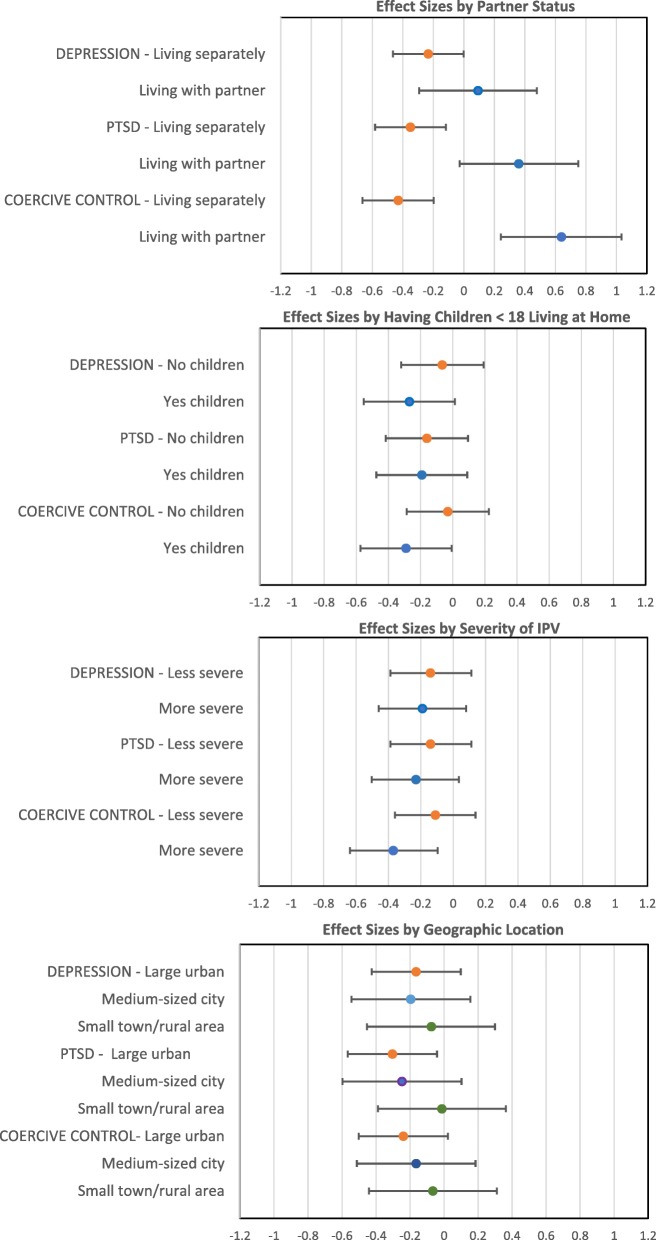
- The tailored intervention had greater effects than the non-tailored version for women with children under 18 at home on depression (ES = −0.27 vs −0.06) and coercive control (ES = −0.29 vs −0.03); for women reporting more severe violence on PTSD (ES = −0.23 vs −0.14) and coercive control (ES = −0.37 vs −0.11); for women in large/medium urban centers on depression, PTSD, and coercive control; and for women not living with a partner on depression (ES = −0.23 vs 0.09), PTSD (ES = −0.35 vs 0.36), and coercive control (ES = −0.43 vs 0.64).
- Exit survey ratings were high in both groups: gained something from the intervention (tailored 96.0%, non-tailored 93.8%), felt comfortable and safe (96.6% vs 95.3%), would recommend it (95.0% vs 90.0%); about one-quarter reported feeling anxious or upset (29.3% vs 24.9%), but most would still have taken part (92.5% vs 91.3%).
Methods
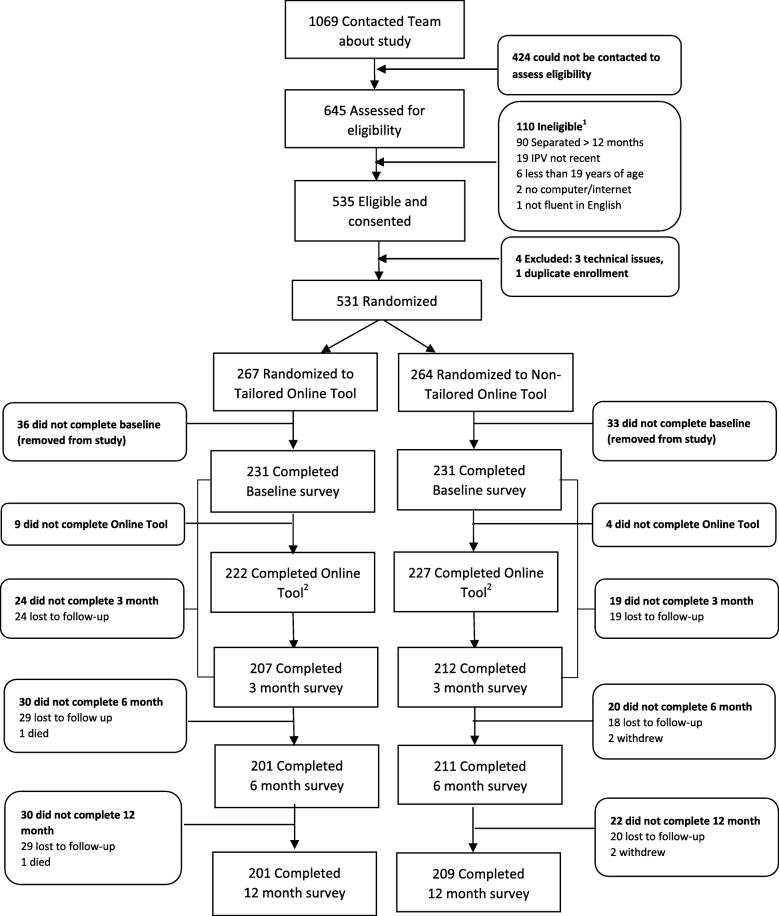
Double-blind, parallel RCT conducted October 2014–January 2017; 462 adult English-speaking women in British Columbia, Ontario, and New Brunswick who reported IPV in the previous 6 months (or separation within 12 months) were randomized 1:1 to a tailored interactive online intervention or a static non-tailored version.
- Primary outcomes were depressive symptoms (CESD-R) and PTSD symptoms (PCL-C); secondary outcomes included decisional conflict, helpfulness of safety actions, mastery, self-efficacy for safety planning, social support, and coercive control, measured at baseline and 3, 6, and 12 months via online surveys.
- Intent-to-treat analyses used Generalized Estimating Equations to test group-by-time interactions; subgroup differential effects were examined using Cohen’s d for four a priori strata, and exit survey process evaluation used descriptive statistics, t-tests, and conventional content analysis.
Limitations
The paper states participation was limited to adult women who could participate in English, had safe computer/email access, and had experienced recent IPV; the volunteer sample is not claimed to be representative, and recruitment of women with partners other than men was limited (5% of the sample).
- Women separated from an abusive partner for more than 12 months were ineligible; the authors note high interest from this group and call for further study.
- The authors state there was no true control group because providing “nothing” was unethical, and that baseline survey measures may themselves have functioned as an intervention; subgroup analyses were not fully powered, and the planned Indigenous subgroup analysis was not conducted because the number of Indigenous participants (n = 62, 13.4%) was too small.
Model-written summary. Check it against the paper before relying on it.
Integrity signals
Registry
Cites
Statistics
Figures
Verification
Claims the paper makes
18 Valid · 1 Not valid · 28 Not checked · 151 Own results and interpretations
Some cited sources support this claim and some don’t — read each source’s verdict below.
In the paper
“The lack of differences by study arm is consistent with the overall pattern of results found in 3 completed trials that also tested versions of a tailored intervention with the same core components, modified to fit different countries and contexts, against a non-tailored intervention [25, 37–39].”
§ Longitudinal impacts of an online safety and health intervention for women experiencing intimate partner violence: randomized controlled trial > Discussion
What the sources say
- Disputedcites [25] Eden KB Perrin NA Hanson GC Messing JT Bloom TL Campbell JC Use of Online Safety Decision Aid by Abused Women Am J Prev Med 2015 48 4 372 383 10.1016/j.amepre.2014.09.027 25547929 PMC4380709 sourceExperimental — accuracy not yet measured
Split into 2 atoms — 0 confirmed, 1 partially supported, 1 disputed, 0 misattributed, 0 unverifiable. Expand the claim to see per-atom verdicts.
Checked by a reasoning model — may be wrong.
- Supportedcites [37] Glass Nancy E. Perrin Nancy A. Hanson Ginger C. Bloom Tina L. Messing Jill T. Clough Amber S. Campbell Jacquelyn C. Gielen Andrea C. Case James Eden Karen B. The Longitudinal Impact of an Internet Safety Decision Aid for Abused Women American Journal of Preventive Medicine 2017 52 5 606 615 10.1016/j.amepre.2016.12.014 28108189 PMC9703467 source
Split into 2 atoms — 2 confirmed, 0 partially supported, 0 disputed, 0 misattributed, 0 unverifiable. Expand the claim to see per-atom verdicts.
- Supportedcites [38] Koziol-McLain J Vandal AC Wilson D Nada-Raja S Dobbs T McLean C Efficacy of a web-based safety decision aid for women experiencing intimate partner violence: randomized controlled trial J Med Internet Res 2018 19 12 e426 10.2196/jmir.8617 29321125 PMC6858022 source
Split into 2 atoms — 2 confirmed, 0 partially supported, 0 disputed, 0 misattributed, 0 unverifiable. Expand the claim to see per-atom verdicts.
- Supportedcites [39] Hegarty K Tarzia L Valpied J Murray E Humphreys C Taft A An online healthy relationship tool and safety decision aid for women experiencing intimate partner violence (I-DECIDE): a randomised controlled trial Lancet Public Health 2019 4 6 e301 e310 10.1016/S2468-2667(19)30079-9 31155223 source
Split into 2 atoms — 2 confirmed, 0 partially supported, 0 disputed, 0 misattributed, 0 unverifiable. Expand the claim to see per-atom verdicts.
plain- Asserted: passes — The authors put it forward as true.
- Checkable: passes — It can be checked against evidence.
- Load-bearing: unclear — It is unclear whether the paper’s conclusions depend on it.
- Based: passes — The paper gives a reason why it holds.
- Disputed
The cited sources support only part of this claim — read each source’s verdict below.
In the paper
“The power analysis was based on baseline means and standard deviations for depression and PTSD from the IRIS trial [37].”
§ Longitudinal impacts of an online safety and health intervention for women experiencing intimate partner violence: randomized controlled trial > Method > Participant enrollment and randomization
What the sources say
- Partly supportedcites [37] Glass Nancy E. Perrin Nancy A. Hanson Ginger C. Bloom Tina L. Messing Jill T. Clough Amber S. Campbell Jacquelyn C. Gielen Andrea C. Case James Eden Karen B. The Longitudinal Impact of an Internet Safety Decision Aid for Abused Women American Journal of Preventive Medicine 2017 52 5 606 615 10.1016/j.amepre.2016.12.014 28108189 PMC9703467 sourceExperimental — accuracy not yet measured
The Introduction identifies this study as the Internet Resource for Intervention and Safety (IRIS) trial, and Methods > Measures confirms that it assessed depression and PTSD. The available passages do not give baseline means and standard deviations for those outcomes, so they do not verify the stated inputs to the citing authors’ power analysis (page numbers unavailable). (LLM, conf=0.82)
plain- Asserted: passes — The authors put it forward as true.
- Checkable: passes — It can be checked against evidence.
- Load-bearing: unclear — It is unclear whether the paper’s conclusions depend on it.
- Based: passes — The paper gives a reason why it holds.
- Partly supported
The sources with a verdict support this claim; the rest weren’t checked yet, have no full text we could read, or their verdicts aren’t rated yet.
In the paper
“If, when and how women seek help or attempt to deal with the violence and its effects is often a long-term process shaped by relationship dynamics and diverse priorities, needs and conditions [10–13].”
§ Longitudinal impacts of an online safety and health intervention for women experiencing intimate partner violence: randomized controlled trial > Background
What the sources say
- Supportedcites [10] Anderson DK Saunders DG Leaving an abusive partner Trauma Violence Abus 2003 4 2 163 191 10.1177/1524838002250769 14697121 source
The Summary and Conclusions describes leaving as a process of managing violence, reassessing the relationship, and sometimes leaving and returning multiple times. The section on qualitative research describes gradual changes in women’s priorities and strategies, including seeking support and making safety plans; together, these support the claim’s account of how women respond to abuse over time. No page numbers were available in our copy. (LLM, conf=0.88)
- Not checked — no full text of the sourcecites [11] Macy RJ Rizo CF Ermentrout DM Characteristics, needs, and help seeking of partner violence victims mandated to community services by courts and child protective services Am J Orthop 2013 83 4 588 599 10.1111/ajop.12049 24164530 source
- Not checked — no full text of the sourcecites [12] Goodkind JR Sullivan CM Bybee DI A contextual analysis of battered women’s safety planning Violence Against Women. 2004 10 5 514 533 10.1177/1077801204264368 source
- Not checked — no full text of the sourcecites [13] Ford-Gilboe M Wuest J Merritt-Gray M Strengthening capacity to limit intrusion: Theorizing family health promotion in the aftermath of woman abuse Qual Heal Res 2005 15 4 477 501 10.1177/1049732305274590 15761094 source
plainstates an association- Asserted: passes — The authors put it forward as true.
- Checkable: unclear — It is unclear whether it could be checked against evidence.
- Load-bearing: passes — The paper’s conclusions depend on it.
- Based: passes — The paper gives a reason why it holds.
- Supported
The cited sources support only part of this claim — read each source’s verdict below.
In the paper
“Relatively few interventions have been shown to improve the safety, health or quality of life of women experiencing IPV”
§ Longitudinal impacts of an online safety and health intervention for women experiencing intimate partner violence: randomized controlled trial > Background
What the sources say
- Partly supportedcites [15] Rivas C, Vigurs C, Cameron J, Yeo L. A realist review of which advocacy interventions work for which abused women under what circumstances. Cochrane Database Syst Rev. 2019;6:1–310. PMC6598804 31254283 sourceExperimental — accuracy not yet measured
The Results (page not available) report mixed outcomes for advocacy interventions, including some improvements in safety and quality of life and other studies finding no benefit. This supports the claim's concern about limited demonstrated benefits for advocacy, but the review does not establish that relatively few interventions of all kinds improve safety, health or quality of life for women experiencing IPV. (LLM, conf=0.78)
- Not checked — no full text of the sourcecites [16] Ramsay J Carter Y Davidson L Dunne D Eldridge S Hegarty K Ramsay J Advocacy interventions to reduce or eliminate violence and promote the physical and psychosocial well-being of women who experience intimate partner abuse Cochrane database of systematic reviews 2009 Wiley Chichester 19588364 source
- Partly supportedcites [17] Tirado-Muñoz J Gilchrist G Farré M Hegarty K Torrens M The efficacy of cognitive behavioural therapy and advocacy interventions for women who have experienced intimate partner violence: a systematic review and meta-analysis Ann Med 2014 46 8 567 586 10.3109/07853890.2014.941918 25211469 sourceExperimental — accuracy not yet measured
The Summary of key evidence (page unavailable) reports some evidence that advocacy and CBT interventions reduce physical and psychological IPV, while cautioning that the small effects and heterogeneous trials preclude firm conclusions. This supports the claim's general point that demonstrated improvements in safety are limited. The review assessed IPV occurrence, however, not whether relatively few interventions improve women's health or quality of life, and it does not assess interventions generally beyond advocacy and CBT. (LLM, conf=0.84)
plain- Asserted: passes — The authors put it forward as true.
- Checkable: passes — It can be checked against evidence.
- Load-bearing: passes — The paper’s conclusions depend on it.
- Based: passes — The paper gives a reason why it holds.
- Partly supported
Every source the paper cites for this claim was checked and supports it.
In the paper
“Specifically, Maori women were more likely to benefit from the tailored intervention in terms of reductions in both depression and severity of violence (primary outcomes)”
§ Longitudinal impacts of an online safety and health intervention for women experiencing intimate partner violence: randomized controlled trial > Background
What the sources say
- Supportedcites [38] Koziol-McLain J Vandal AC Wilson D Nada-Raja S Dobbs T McLean C Efficacy of a web-based safety decision aid for women experiencing intimate partner violence: randomized controlled trial J Med Internet Res 2018 19 12 e426 10.2196/jmir.8617 29321125 PMC6858022 source
The Results > Outcomes subgroup analysis reports larger reductions for Māori women than for non-Māori women on both primary outcomes. The intervention effect was significant for depression at 3 months and for violence severity at 6 and 12 months; it was not significant at every follow-up point. (LLM, conf=0.90)
hedgedstates a cause- Asserted: passes — The authors put it forward as true.
- Checkable: passes — It can be checked against evidence.
- Load-bearing: passes — The paper’s conclusions depend on it.
- Based: passes — The paper gives a reason why it holds.
- Supported
93 more claims · 2 with their cited sources checked
Create a free account to see all 198 claims and to verify the 3 references still open.
- Probably not a substantial claim. 70
- It may state two separate claims as one. 43
Claims other papers make about this one
Each is checked against this paper’s own text: does it say what the citing paper says it does?
The source backs part of the claim, not all of it — or backs it for a different population, condition or comparison.
In the citing paper
“people who have negative health care experiences or who anticipate such experiences, including experiences arising from stigma and discrimination, are deterred from accessing care [4, 8–10].”
From Using a health equity lens to measure patient experiences of care in diverse health care settings (2024) · cites this paper as [9]
Experimental — accuracy not yet measured
Self-check
Percentages, sums and reported differences re-computed from the paper’s own numbers.
Each contradiction between two passages listed here was confirmed by an independent check.
Rated major: it would touch a result — a value a result rests on, reported and recomputed p-values on opposite sides of the significance level, two passages that conflict with no sign which is right, or a cited work retracted before this paper was published.
In the paper
§ Longitudinal impacts of an online safety and health intervention for women experiencing intimate partner violence: randomized controlled trial > Discussion
“For women with children under age of 18, the tailored version was more effective than the non-tailored version in reducing symptoms of depression and PTSD, and women’s experiences of coercive control, than it was for women who did not have children under the age of 18.”
§ Longitudinal impacts of an online safety and health intervention for women experiencing intimate partner violence: randomized controlled trial > Results > Subgroup differences
“The effect of the tailored versus non-tailored version was similar for women with and without children under 18 living at home on reduction in PTSD (ES = -0.19 vs ES = -0.16).”
Rated major: it would touch a result — a value a result rests on, reported and recomputed p-values on opposite sides of the significance level, two passages that conflict with no sign which is right, or a cited work retracted before this paper was published.
In the paper
§ Longitudinal impacts of an online safety and health intervention for women experiencing intimate partner violence: randomized controlled trial > Abstract > Results
“Women in both tailored and non-tailored groups improved over time on primary outcomes of depression (p < .001) and PTSD (p < .001) and on all secondary outcomes.”
§ Longitudinal impacts of an online safety and health intervention for women experiencing intimate partner violence: randomized controlled trial > Results > Primary and secondary outcomes
“Mastery decreased in both groups over time (p < .001), with no group differences in change over time observed.”
Rated minor: it would not touch a result — a value no result rests on, a p-value that stays on the same side of the significance level, or a conflict that is clerical, resolved elsewhere in the paper, or outside its own findings.
In the paper
“a 20-item self-report measure of symptoms reflective of the DSM-V criteria for depression. Women rated their symptom frequency in the past week on a 4-point scale (1 = rarely or none of the time to 4 = most of the time), with responses summed produce total scores (range 0–60).”
§ Longitudinal impacts of an online safety and health intervention for women experiencing intimate partner violence: randomized controlled trial > Method > Outcomes
Reported 60 · recomputed 80
Rated minor: it would not touch a result — a value no result rests on, a p-value that stays on the same side of the significance level, or a conflict that is clerical, resolved elsewhere in the paper, or outside its own findings.
In the paper
“Overall, 84.6% (N = 231) of participants in the tailored group”
§ Longitudinal impacts of an online safety and health intervention for women experiencing intimate partner violence: randomized controlled trial > Results
Reported 84.6 · recomputed 86.516854
Rated minor: it would not touch a result — a value no result rests on, a p-value that stays on the same side of the significance level, or a conflict that is clerical, resolved elsewhere in the paper, or outside its own findings.
In the paper
§ Longitudinal impacts of an online safety and health intervention for women experiencing intimate partner violence: randomized controlled trial > Method > Outcomes
“Items are rated on a 5-point Likert-type scale, ranging from 1 (none of the time) to 5 (all of the time). Total summed scores are computed, with higher scores suggestive of greater perceived support [53].”
§ Longitudinal impacts of an online safety and health intervention for women experiencing intimate partner violence: randomized controlled trial > Results > Primary and secondary outcomes
“| Social Support | 2.62 (0.96) | 2.69 (0.96) | 2.86 (1.05) | 2.89 (1.06) | 2.73 (1.06) | 2.78 (105) | 3.05 (1.11) | 3.13 (1.13) | .627 | 0.13 |”
Citations
Cites
Three Approaches to Qualitative Content Analysis
Hsieh, H.-F., & Shannon, S. E. (2005) · Qualitative Health Research · doi:10.1177/1049732305276687 · Cited by 44,601
CONSORT 2010 Statement: updated guidelines for reporting parallel group randomised trials
the CONSORT Group, Schulz, K. F., Altman, D. G., & Moher, D. (2010) · BMC Medicine · doi:10.1186/1741-7015-8-18 · Cited by 13,371
Process evaluation of complex interventions: Medical Research Council guidance
Moore, G. F., Audrey, S., Barker, M., Bond, L., Bonell, C., Hardeman, W., Moore, L., O'Cathain, A., Tinati, T., Wight, D., et al. (2015) · BMJ · doi:10.1136/bmj.h1258 · Cited by 6,204
Cochrane Database of Systematic Reviews
(2008) · Encyclopedia of Public Health · doi:10.1007/978-1-4020-5614-7_436 · Cited by 4,527
Health consequences of intimate partner violence
Campbell, J. C. (2002) · The Lancet · doi:10.1016/s0140-6736(02)08336-8 · Cited by 4,055
Psychometric properties of the PTSD checklist (PCL)
Blanchard, E. B., Jones-Alexander, J., Buckley, T. C., & Forneris, C. A. (1996) · Behaviour Research and Therapy · doi:10.1016/0005-7967(96)00033-2 · Cited by 3,997
Validation of a Decisional Conflict Scale
O'Connor, A. M. (1995) · Medical Decision Making · doi:10.1177/0272989x9501500105 · Cited by 2,452
Eysenbach, G., & CONSORT-EHEALTH Group (2011) · Journal of Medical Internet Research · doi:10.2196/jmir.1923 · Cited by 1,863
Explaining the gender difference in depressive symptoms.
Nolen-Hoeksema, S., Larson, J., & Grayson, C. (1999) · Journal of Personality and Social Psychology · doi:10.1037/0022-3514.77.5.1061 · Cited by 1,543
The Use of Psychological Testing for Treatment Planning and Outcomes Assessment
(2004) · doi:10.4324/9781410610614 · Cited by 1,503
Research works printed but not linked: 5
- Krause K Gürtler D Bischof G Rumpf H-J Lucht M John U Computergestützte Interventionen bei depressiven Symptomen Zeitschrift für Psychiatr Psychol und Psychother 2016 64 2 121 131
- Ponic P Varcoe C Smutylo T Trauma- (and violence-) informed approaches to supporting victims of violence: policy and practice considerations 2016 Ottawa Victims of Crime
- Varcoe C Ford-Gilboe M Scott-Storey K Wuest J Perrin N Women’s experiences with an online intervention: the complexity of women’s lives dealing with intimate partner violence and implications for engagement and design 2019
- O’Connor A User manual – decisional conflict scale 1993 Ottawa Ottawa Hospital Research Institute
- Statistics Canada Number of persons in the total population and the farm population, for rural areas and population centres classified by sex and age [Internet] 2016
Cited by
Danger in danger: Interpersonal violence during COVID-19 quarantine
Mazza, M., Marano, G., Lai, C., Janiri, L., & Sani, G. (2020) · Psychiatry Research · doi:10.1016/j.psychres.2020.113046 · Cited by 479
Trauma- and Violence-Informed Care: Orienting Intimate Partner Violence Interventions to Equity
Wathen, C. N., & Mantler, T. (2022) · Current Epidemiology Reports · doi:10.1007/s40471-022-00307-7 · Cited by 111
Self-citationEffectiveness of ICT-based intimate partner violence interventions: a systematic review
El Morr, C., & Layal, M. (2020) · BMC Public Health · doi:10.1186/s12889-020-09408-8 · Cited by 90
“%) were not re-ported and supposed any type of ICT [64, 68, 71].”
BackgroundMethodInfluentialLyall, V., Wolfson, L., Reid, N., Poole, N., Moritz, K. M., Egert, S., Browne, A. J., & Askew, D. A. (2021) · International Journal of Environmental Research and Public Health · doi:10.3390/ijerph18073445 · Cited by 72
Emezue, C., Chase, J. D., Udmuangpia, T., & Bloom, T. (2022) · Campbell Systematic Reviews · doi:10.1002/cl2.1271 · Cited by 93
Mental health solutions for domestic violence victims amid COVID-19: a review of the literature
Su, Z., McDonnell, D., Roth, S. C., Li, Q., Šegalo, S., Shi, F., & Wagers, S. M. (2021) · Globalization and Health · doi:10.1186/s12992-021-00710-7 · Cited by 60
Fiolet, R., Brown, C., Wellington, M., Bentley, K., & Hegarty, K. L. (2021) · Global Qualitative Nursing Research · doi:10.1177/23333936211028176 · Cited by 48
Micklitz, H. M., Glass, C. M., Bengel, J., & Sander, L. (2023) · Trauma Violence & Abuse · doi:10.1177/15248380231169481 · Cited by 63
Christo, E. M., & Layal, M. (2019) · Studies in health technology and informatics · doi:10.3233/978-1-61499-951-5-103 · Cited by 38
Ghidei, W., Montesanti, S. R., Tomkow, K., Silverstone, P. H., Wells, L., & Campbell, S. (2022) · Trauma Violence & Abuse · doi:10.1177/15248380211069059 · Cited by 38
“, 2019) and iCAN Plan 4 Safety—an online tool (Ford-Gilboe et al., 2020).”
BackgroundMethodBarriers and facilitators of using health information technologies by women: a scoping review
Moulaei, K., Moulaei, R., & Bahaadinbeigy, K. (2023) · BMC Medical Informatics and Decision Making · doi:10.1186/s12911-023-02280-7 · Cited by 29
“Overall, based on frequency, “privacy, confidentiality, and security concerns“(n = 24) [23, 25–28, 31–36, 38–43, 48–53, 55], “deficiencies and limitations of infrastructure, software, hardware, and network” (n = 19) [25, 26, 29, 31, 32, 34, 36, 39, 40, 42, 43, 49–56], “sociocultural chal-lenges” (n…”
BackgroundMethodInfluentialWirtz, A. L., Logie, C. H., & Mbuagbaw, L. C. E. (2022) · Epidemiologic Reviews · doi:10.1093/epirev/mxac008 · Cited by 27
Seff, I., Vahedi, L., McNelly, S., Kormawa, E., & Stark, L. (2021) · BMJ Global Health · doi:10.1136/bmjgh-2021-006780 · Cited by 29
Engaging Parents in Technology-Assisted Interventions for Childhood Adversity: Systematic Review
Aldridge, G., Tomaselli, A., Nowell, C., Reupert, A., Jorm, A. F., & Yap, M. B. H. (2024) · Journal of Medical Internet Research · doi:10.2196/43994 · Cited by 31
O'Campo, P. J., Velonis, A., Buhariwala, P., Kamalanathan, J., Hassan, M. A., & Metheny, N. (2021) · Journal of Medical Internet Research · doi:10.2196/24114 · Cited by 22
Cantor, A. G., Nelson, H. D., Pappas, M., Atchison, C., Hatch, B., Huguet, N., Flynn, B., & McDonagh, M. S. (2023) · Journal of General Internal Medicine · doi:10.1007/s11606-023-08033-6 · Cited by 21
Using a health equity lens to measure patient experiences of care in diverse health care settings
Browne, A. J., Varcoe, C., Ford-Gilboe, M., Wathen, C. N., Wilson, E., Bungay, V., & Perrin, N. (2024) · PLOS ONE · doi:10.1371/journal.pone.0297721 · Cited by 17
Self-citationDavid, K. B., Aborode, A. T., Olaoye, D. Q., Enang, N. V., Aboaba, K. O., & Yunusa, I. U. (2021) · Frontiers in Sociology · doi:10.3389/fsoc.2021.648395 · Cited by 16
“The effectiveness of online safety and health interventions for different needs of women who have experienced intimate partner violence have already been outlined previously (ElSerag and Thurston, 2020; Ford-Gilboe et al., 2020).”
BackgroundA systematic review on eHealth technology personalization approaches
ten Klooster, I., Kip, H., van Gemert‐Pijnen, J. E. W. C., Crutzen, R., & Kelders, S. M. (2024) · iScience · doi:10.1016/j.isci.2024.110771 · Cited by 25
van Gelder, N. E., Ligthart, S. A., ten Elzen, J., Prins, J. B., van Rosmalen-Nooijens, K. A. W. L., & Oertelt‐Prigione, S. (2021) · Journal of Interpersonal Violence · doi:10.1177/08862605211036108 · Cited by 19
“…online support cannot substitute offline support, they found it useful and they value the advantages that eHealth can provide, such as accessibility, privacy, autonomy, no judgment, and feeling supported (Ford-Gilboe et al., 2020; Hegarty et al., 2019; Lindsay et al., 2013; Tarzia et al., 2017).”
BackgroundLópez, R. F., de‐León‐de‐León, S., Martín‐de‐las‐Heras, S., Cantero, J. C. T., Megías, J. L., & Zapata‐Calvente, A. L. (2022) · BMC Women s Health · doi:10.1186/s12905-022-01669-2 · Cited by 14
“Online interventions that include counseling have been previously implemented in non-pregnant women who experience IPVAW, with mixed results regarding its efficacy [24, 26].”
BackgroundIntimate partner violence and women living with episodic disabilities: a scoping review protocol
Campbell, K., Ford‐Gilboe, M., Stanley, M., & MacKinnon, K. (2022) · Systematic Reviews · doi:10.1186/s13643-022-01972-x · Cited by 21
“To do this effectively, appropriate referrals and responses that extend beyond providing pamphlets or lists of available resources are needed [12, 20, 21].”
BackgroundSelf-citationAndreasen, K., Zapata‐Calvente, A. L., Martín‐de‐las‐Heras, S., Bueno‐Cavanillas, A., Schei, B., Dokkedahl, S. B., de‐León‐de‐León, S., López, R. F., Oviedo‐Gutiérrez, A., Ankerstjerne, L. B. S., et al. (2023) · JMIR Formative Research · doi:10.2196/38563 · Cited by 21
“The women’s ability to carry out safety behavior actions was measured through a revised version of the 22-item Safety Action Checklist, where the women specified whether they had used different safety actions and how helpful these actions had been [34].”
MethodSeewald, L., Walsh, T. B., Tolman, R. M., Lee, S. J., Reed, L. A., Ngo, Q., & Singh, V. A. (2022) · The Annals of Family Medicine · doi:10.1370/afm.2758 · Cited by 15
A Review of Intimate Partner Violence Interventions Relevant to Women During the COVID-19 Pandemic
Weeks, L. E., Stilwell, C. L., Rothfus, M. A., Weeks, A. J., Macdonald, M., Jackson, L. A., Dupuis‐Blanchard, S., Carson, A., Moody, E., Helpard, H., et al. (2023) · Violence Against Women · doi:10.1177/10778012221150275 · Cited by 16
“While we did not limit our search strategy to exclude older women, we found that these women were either overtly excluded from participating in studies or recruitment strategies did not result in their inclusion (e.g., Ford-Gilboe et al., 2020; Glass et al., 2017).”
Methodvan Gelder, N. E., Ligthart, S. A., van Rosmalen-Nooijens, K. A. W. L., Prins, J. B., & Oertelt‐Prigione, S. (2023) · Journal of Medical Internet Research · doi:10.2196/42641 · Cited by 17
“Also, part of the group who never logged in or who logged in only once may have experienced an effect from filling out the baseline survey and receiving feedback [25,26,42,65] or finding the desired information, which may have been enough to validate their experience and encourage them to seek help.”
InfluentialFord‐Gilboe, M., Varcoe, C., Scott-Storey, K. A., Browne, A. J., Jack, S. M., Jackson, K. T., Mantler, T., O’Donnell, S., Patten-Lu, N., Smye, V. L., et al. (2024) · BMC Public Health · doi:10.1186/s12889-023-17578-4 · Cited by 17
“…were invited to leave comments about their experiences and were provided with information about the signs of a stress response and strategies to manage distress as part of a safety protocol [40], as well as an honorarium of $30 CAD as an electronic giftcard sent to the woman’s safe email address.”
BackgroundSelf-citationDomestic Violence against Women and COVID-19
Zamba, C., Mousoulidou, M., & Christodoulou, A. (2022) · Encyclopedia · doi:10.3390/encyclopedia2010027 · Cited by 10
Barriers to Leaving an Abusive Relationship
Saunders, D. G. (2022) · Handbook of Interpersonal Violence and Abuse Across the Lifespan · doi:10.1007/978-3-319-89999-2_186 · Cited by 8
Foschiera, L. N., Dupont, M. F., & Habigzang, L. F. (2021) · Trends in Psychology · doi:10.1007/s43076-021-00119-6 · Cited by 10
“Many factors can facilitate or hinder their participation in assessments, which highlights the need for the adaptation of these assessments, especially considering the complexity and unique circumstances experienced by the women in the long term (Ford-Gilboe et al., 2020).”
BackgroundBarriers to Leaving an Abusive Relationship
Saunders, D. G. (2020) · Springer eBooks · doi:10.1007/978-3-319-62122-7_186-1 · Cited by 15
Virtual Support and Intimate Partner Violence Services: A Scoping Review
Baird, S. L., Tarshis, S., Messenger, C., & Falla, M. (2022) · Research on Social Work Practice · doi:10.1177/10497315221087232 · Cited by 15
“…of safety decision aids, illustrating this to be a wellresearched intervention, adapted in different formats for use in several different contexts, which can be incorporated into social work practice with survivors of IPV (e.g., Bagwell-Gray et al., Ford-Gilboe et al., 2020; Tarzia et al., 2018).”
BackgroundInfluentialDigital Interventions to Support and Treat Victims of Intimate Partner Violence: A Systematic Review
Oliveira, C., Araújo, E., Moreira, D. S., Pacheco, M., Calaboiça, C., & Santos, A. (2023) · European Psychologist · doi:10.1027/1016-9040/a000504 · Cited by 10
Ragucci, F., Dragan, M., Cuomo, A., Fagiolini, A. M., & Pozza, A. (2024) · Journal of Affective Disorders Reports · doi:10.1016/j.jadr.2024.100802 · Cited by 22
Uses of mHealth in Injury Prevention and Control: a Critical Review
Ranney, M. L., Stettenbauer, E. G., Delgado, M. K., Yao, K. A., & Orchowski, L. M. (2022) · Current Epidemiology Reports · doi:10.1007/s40471-022-00312-w · Cited by 11
Hovingh, J. W., van Duin, C. E. , Kuipers, D., van Rood, Y. R., Ludden, G., Hanssen, D. J. C., & Rosmalen, J. G. M. (2025) · JMIR Human Factors · doi:10.2196/76172 · Cited by 11
“Two interventions informed end users on specific medical procedures, such as medicine adherence (1) [21], breast reconstruction (1) [42], and one intervention focused on coping strategies for domestic violence [32] (Table S1 in Multimedia Appendix 2).”
Effectiveness of Telehealth for Women’s Preventive Services
Cantor, A. G., Nelson, H. D., Pappas, M., Atchison, C., Hatch, B., Huguet, N., Flynn, B., & McDonagh, M. S. (2022) · doi:10.23970/ahrqepccer256 · Cited by 8
Hui, V. C. C., Tian, L., Feng, X., Chen, Q., Wong, A. K. C., & Bloom, T. (2026) · PLoS ONE · doi:10.1371/journal.pone.0342453 · Cited by 8
Gamoran, J., Xu, Y., Palitz, S. A., Liu, J., Mowrey, W. B., Goldentyer, G., Gabbay, V., & Pimentel, S. S. (2024) · Psychiatry Research · doi:10.1016/j.psychres.2024.116221 · Cited by 8
Johnson, E. M., Jenssen, S., Wernette, G. T., Tweel, T., Johnson, D. M., & Zlotnick, C. (2022) · Psychiatry Research · doi:10.1016/j.psychres.2022.114895 · Cited by 5
Ndungu, J., Ngcobo-Sithole, M. B., & Gibbs, A. (2022) · Health Education Research · doi:10.1093/her/cyac008 · Cited by 6
Safety Planning Interventions for Adults Who Experience Interpersonal Violence: a Systematic Review
Sabuncu, B. C., Signorelli, M. C., Evans, D. P., Millender, E., Murgor, J. C., Lane, B., Okantey, B., & Hall, C. X. (2024) · Journal of Family Violence · doi:10.1007/s10896-024-00770-4 · Cited by 5
van Gelder, N. V., Ligthart, S., van Rosmalen-Nooijens, K., Prins, J., & Oertelt-Prigione, S. (2023) · Journal of Medical Internet Research · doi:10.2196/42647 · Cited by 7
He, Y., Guo, L., Liu, Y., Miao, W., Guo, Y., Xiaofang, D., Yang, C., Zhou, Q. J., Lei, X., Zhang, G., et al. (2021) · Neuropsychiatric Disease and Treatment · doi:10.2147/ndt.s334229 · Cited by 5
Signorelli, M. C., da Silva, V. L. C., Evans, D. P., Prado, S. M., & Glass, N. E. (2022) · Journal of Family Violence · doi:10.1007/s10896-022-00409-2 · Cited by 5
Self-citationIyawa, G. E., Akinmoyeje, B., Kays, R., Mutelo, S., & Ipinge, R. (2021) · IST-Africa Conference (IST-Africa) · Cited by 3
Tradução e adaptação transcultural da Composite Abuse Scale para o português brasileiro
da Rocha, R. W. G., de Oliveira, D. C., Liebel, V. A., Pallu, P. H. R., Hegarty, K. L., & Signorelli, M. C. (2022) · Revista de Saúde Pública · doi:10.11606/s1518-8787.2022056004196 · Cited by 3
Zapata‐Calvente, A. L., Martín‐de‐las‐Heras, S., Bueno‐Cavanillas, A., Andreasen, K., Rasch, V., & Khan, K. S. (2023) · PLoS ONE · doi:10.1371/journal.pone.0282997 · Cited by 3
“75) [35] and to complete a Measure of Victim Empowerment Related to Safety (MOVERS; α = .”
BackgroundGilbert, L., Parker, S. T., & Schechter, L. (2024) · Review of Economics of the Household · doi:10.1007/s11150-024-09696-8 · Cited by 4
“…violence interventions is limited (Ghidei et al. 2023; Seff et al. 2021), recent evidence suggests that access to digital safety planning tools (Ford-Gilboe et al. 2020; Hegarty et al. 2019; Bloom et al. 2014) and virtual therapies (Ragavan et al. 2020; Gray et al. 2015) may result in improved…”
Ramírez-Cruz, J. C., Santana-Cárdenas, S., Franco‐Paredes, K., & Javier-Juárez, S. P. (2023) · Revista Brasileira de Terapia Comportamental e Cognitiva · doi:10.31505/rbtcc.v25i1.1811 · Cited by 3
Andreasen, K., López, R. F., Wu, C. S., Linde, D. S., Oviedo‐Gutiérrez, A., Megías, J. L., Martín‐de‐las‐Heras, S., Zapata‐Calvente, A. L., Ankerstjerne, L. B. S., de‐León‐de‐León, S., et al. (2024) · European Journal of Obstetrics & Gynecology and Reproductive Biology · doi:10.1016/j.ejogrb.2024.07.025 · Cited by 5
Zan, Y., Newton, P. N., & Shah, T. I. (2025) · Social Sciences · doi:10.3390/socsci14090520 · Cited by 4
Ford‐Gilboe, M., Scott-Storey, K. A., Browne, A. J., Varcoe, C., Burd, C., Campbell, K., Garinger, C., Jack, S. M., Lynch, K., Malcolm, J., et al. (2025) · PLoS ONE · doi:10.1371/journal.pone.0330285 · Cited by 2
“Research staff will follow a safety protocol, developed and used with success in many previous studies, to guide all interactions with women [37].”
Self-citationYou Deserve to be Safe: Approaches to Safety Planning on Digital Interpersonal Violence Hotlines
Schrag, R. V., Jacobs, A. N., Mammah, R. O., Guerra, C., & Wood, L. (2026) · Journal of Interpersonal Violence · doi:10.1177/08862605251408134 · Cited by 1
Yu, P., Zhu, P., Kudiza, A., Kaburu, F. M., Intizar, M., Tong, C., Zhang, R., Jiang, J., Yu, X., Kuang, Q., et al. (2026) · Frontiers in Public Health · doi:10.3389/fpubh.2025.1687396 · Cited by 1
“Victims in rural areas often have even fewer resources, facing limited access to support services (26), while young victims may lack professional assistance entirely (19).”
InfluentialInvisible Wounds: A Systematic Review of Domestic Violence Against Women
Deacu, S., Cristian, M., Popa, S. I., Nitu, R. A., & Pricop, S. (2026) · Healthcare · doi:10.3390/healthcare14040465 · Cited by 5
“Similarly, Ford-Gilboe et al. [24] and Kishton et al. [19] reported 100% IPV exposure, as both studies specifically recruited women with ongoing or documented histories of abuse for intervention or healthcare utilization analyses.”
InfluentialNaidoo, K., Adeagbo, O., & Li, X. (2023) · Clinical sociology · doi:10.1007/978-3-031-20679-5_1 · Cited by 1
Mahapatro, M., Roy, S., Nayar, P., Panchkaran, S., & Jadhav, A. S. (2023) · Dialogues in Health · doi:10.1016/j.dialog.2023.100126 · Cited by 3
“Aqualitative study helps to identify outcomes most valued by participants and explore barriers and facilitators to adherence to the intervention [40].”
BackgroundWykorzystanie teleopieki w przeciwdziałaniu przemocy domowej i poseparacyjnej
Słowik, M., & Łuczak, M. J. (2024) · Family Forum · doi:10.25167/ff/5244 · Cited by 1
Masruroh, B. (2024) · Journal of Public Health · doi:10.1093/pubmed/fdae277 · Cited by 1
Strategies Used by Saudi Arabian Women to Respond to Intimate Partner Violence
Alhalal, E. (2025) · Journal of Family Violence · doi:10.1007/s10896-025-00808-1 · Cited by 1
“Thus, online tailored programs, such as safety intervention (Ford-Gilboe et al., 2020 ), can be developed to enhance women’s perception of some help-seeking strategies.”
Carnis, L. (2006) · Dialnet (Universidad de la Rioja)
Intervenciones de trabajadores y trabajadoras sociales en contextos de violencia de género
Hidalgo, C. D., Venegas, V. R., Rojas, A. A., et al. (2021) · Cátedra Paralela · doi:10.35305/cp.vi19.295
Global upsurge in violence against women during COVID-19: A rapid review of evidencePreprint
Zainuddin, M., Khan, S., Mahi, M., & Islam, E. (2022) · SocArXiv (OSF Preprints) · doi:10.31235/osf.io/ey9hz
The Relationship between Workplace violence and Missed Nursing Care among Staff Nurses
Elsayed, A. M. (2024) · Helwan International Journal of Nursing Research and Practice · doi:10.21608/hijnrp.2024.263139.1104
van Gelder, N. E., Sow, J., van Haalen, D. L., Schoorlemmer, I., Knol, M., Bouwer, E., & Oertelt‐Prigione, S. (2024) · Violence Against Women · doi:10.1177/10778012241270223
“They can reduce barriers to help-seeking due to easy accessibility, potentially available 24/7 and anonymity (Ford-Gilboe et al., 2020; Glass et al., 2021; Hegarty et al., 2019).”
Weeks, L. E., Allen, K., Holtmann, C., Leger, J., Dupuis‐Blanchard, S., MacQuarrie, C., Macdonald, M., Moody, E., Stilwell, C. L., Helpard, H., et al. (2024) · JMIR Research Protocols · doi:10.2196/57886
Aldkheel, A., & Zhou, L. (2025) · SSRN Electronic Journal · doi:10.2139/ssrn.5400010
O'Campo, P. J., Metheny, N., Buhariwala, P., Rasiah, S., & Yakubovich, A. R. (2025) · JMIR Research Protocols · doi:10.2196/67450
“…there is evidence from the United States to suggest that safety planning can help improve decisional conflict and mitigate future psychological and physical violence, there have been few evaluations of safety planning interventions outside the United States [9, 14-16] and only 1 in Canada [17].”
InfluentialSłowik, M., Łuczak, M. J., & Maraszkiewicz, M. (2025) · Family Forum · doi:10.25167/ff/5757 · Cited by 1
Cruz, M., & Pereira, H. (2026) · SAGE Open · doi:10.1177/21582440261429027 · Cited by 1
“…et al., 2020; Glass et al., 2022; Newlands & Benuto, 2021; Nikparvar et al., 2023; Sabina et al., 2023; Sa´ez et al., 2023), health education (Ford-Gilboe et al., 2020; Glass et al., 2022; Newlands & Benuto, 2021; Nikparvar et al., 2023; Sabina et al., 2023; Sa´ez et al., 2023; van Gelder…”
InfluentialFirst-Line Nursing Practices to Identify and Respond to Family Violence
Jack, S. M., Orr, E., & Richter, B. (2026) · Springer eBooks · doi:10.1007/978-3-032-06072-3_6
Perrin, N. (2026) · Springer eBooks · doi:10.1007/978-3-032-06072-3_4
Self-citationDrivers and Consequences of Family Violence
Campbell, J. C., & Pokharel, B. (2026) · Springer eBooks · doi:10.1007/978-3-032-06072-3_3
Durgu, N., & GEÇİM, G. Y. D. (2026) · Journal of Psychosocial Nursing and Mental Health Services · doi:10.3928/02793695-20260824-01
Metadata
- Authors
- Ford-Gilboe, M., Varcoe, C., Scott-Storey, K., Perrin, N., Wuest, J., Wathen, C. N., Case, J., & Glass, N.
- Affiliations
- University of British Columbia (CA)
- University of New Brunswick (CA)
- Johns Hopkins University (US)
- Western University (CA)
- ORCID
- Venue
- BMC Public Health
- Published
- 2020-02-26
- Volume
- 20
- Issue
- 1
- Pages
- 260-260
- ISSN
- 1471-2458 (ISSN-L)
- PMC
- PMC7043036
- OpenAlex
- W3009427464
- Semantic Scholar
- 7c3681aa47fd6064884e0a6d0f7bb0cdacb7a3f5
- Cited by
- 76
- References
- 78
- Citations by year
- 2026: 9 · 2025: 7 · 2024: 14 · 2023: 13 · 2022: 16 · 2021: 12 · 2020: 3
- FWCI
- 6.08
- Type
- journal article
- Language
- en
- Open access
- gold
- doi.org
- Licence
- cc-by
- creativecommons.org/licenses/by/4.0/ (tdm)
- creativecommons.org/licenses/by/4.0/ (vor)
- Locations
- BMC Public Health (publishedVersion, cc-by)
- Research Square (acceptedVersion, cc-by)
- PubMed Central (publishedVersion, cc-by)
- PubMed (publishedVersion)
- cIRcle (University of British Columbia) (submittedVersion, cc-by)
- DOAJ (DOAJ: Directory of Open Access Journals) (submittedVersion, cc-by-sa)
- Scholarship@Western (Western University) (submittedVersion)
- Open Collections
- Funders
- Canadian Institutes of Health Research (123323)
- Topics
- Social Sciences › Health › Intimate Partner and Family Violence
- Social Sciences › Sociology and Political Science › Stalking, Cyberstalking, and Harassment
- Social Sciences › Psychology › Applied Psychology › Digital Mental Health Interventions
- Keywords
- intimate partner violence, online intervention, safety planning, personalized interventions, depressive symptoms, post-traumatic stress disorder, coercive control, decisional conflict, social support, mastery, women's health, Canadian women
- MeSH terms
- Intimate Partner Violence, Adult, Canada, Double-Blind Method, Female, Health Promotion, Humans, Longitudinal Studies, Surveys and Questionnaires, Safety, Program Evaluation, Internet
About these checks
Registry, retraction, Cites and statistics results are computed, not judged, with one exception: a printed reference that no index lists is read once by a model before it counts as a citation error. Claims are extracted by a model and kept only when their quote appears verbatim in the text; each cited source is then checked, with a model’s help, for whether it says what the claim relies on. Those verdicts can be wrong — read the claim’s quote and the cited source before relying on one.
The claim verdicts this report counts are experimental: their accuracy is not yet measured.
A language model drew the claims from the paper on 2026-10-10, under version 3 of the claim definition (model deepseek-v4.1-flash, prompt extract-v3).
A second model labelled each claim on 2026-10-10 (model jev-1.13-20260917, definition revision gold-guideline-v0.2).
Cited sources are checked with a language model’s help (gpt-6-sol).
Statistics and arithmetic are recomputed, not judged.
Confidence bands are shown only for fields calibrated on our annotated test set. None is calibrated yet, so no band is shown.
What counts as a claim ›How we measure confidence ›How we check this ›
Are you an author, or do you see a problem with this page? Request a review
Data sources
Bibliographic data: Semantic Scholar, OpenAlex, Crossref.
Contains information from the Semantic Scholar Academic Graph Datasets, made available under the ODC Attribution License (ODC-BY 1.0).
Semantic Scholar’s data is described in: Kinney, R., et al. (2023). The Semantic Scholar Open Data Platform. arXiv:2301.10140.
