

The DOI matches its Crossref record; 73 of the 74 references it cites were found in a registry or an index.
Socio-economic inequalities in the multiple dimensions of access to healthcare: the case of South Africa
Open accessAbstract
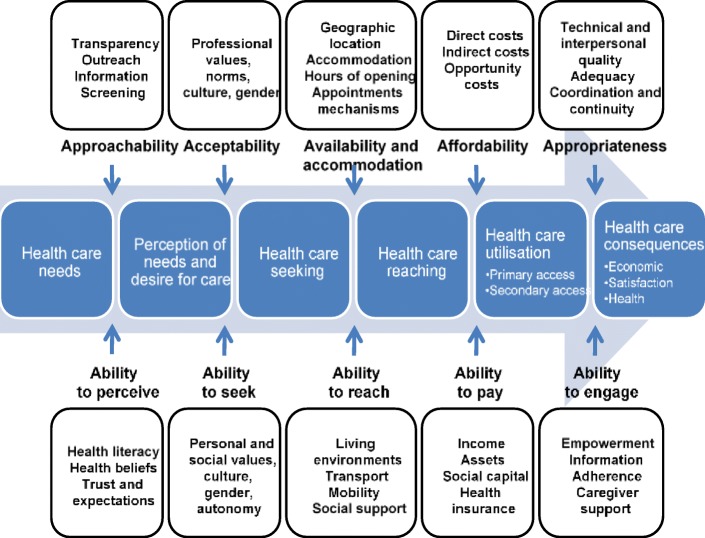
Background: The National Development Plan (NDP) strives that South Africa, by 2030, in pursuit of Universal Health Coverage (UHC) achieve a significant shift in the equity of health services provision. This paper provides a diagnosis of the extent of socio-economic inequalities in health and healthcare using an integrated conceptual framework. Method: The 2012 South African National Health and Nutrition Examination Survey (SANHANES-1), a nationally representative study, collected data on a variety of questions related to health and healthcare. A range of concentration indices were calculated for health and healthcare outcomes that fit the various dimensions on the pathway of access. A decomposition analysis was employed to determine how downstream need and access barriers contribute to upstream inequality in healthcare utilisation. Results: In terms of healthcare need, good and ill health are concentrated among the socio-economically advantaged and disadvantaged, respectively. The relatively wealthy perceived a greater desire for care than the relatively poor. However, postponement of care seeking and unmet need is concentrated among the socio-economically disadvantaged, as are difficulties with the affordability of healthcare. The socio-economic divide in the utilisation of public and private healthcare services remains stark. Those who are economically disadvantaged are less satisfied with healthcare services. Affordability and ability to pay are the main drivers of inequalities in healthcare utilisation. Conclusion: In the South African health system, the socio-economically disadvantaged are discriminated against across the continuum of access. NHI offers a means to enhance ability to pay and to address affordability, while disparities between actual and perceived need warrants investment in health literacy outreach programmes.
Overview
The claims and statistics of this paper haven’t been checked yet.
Run the check — free, no account needed. It reads the open-access text and checks the sources it cites.
Integrity signals
Registry
Cites
Statistics
Figures
Verification
Claims the paper makes
The claims and statistics of this paper haven’t been checked yet.
Run the check — free, no account needed. It reads the open-access text and checks the sources it cites.
Claims other papers make about this one
Each is checked against this paper’s own text: does it say what the citing paper says it does?
The source backs part of the claim, not all of it — or backs it for a different population, condition or comparison.
In the citing paper
“Additionally, the observed drop-off when analyzing the cascade of respondents who express symptoms, to those who seek facility-based care, to those who are treated by a trained healthcare provider, is also observed in similar research contexts [30–32].”
From Community and facility-level barriers to achieving UHC in Kono District, Sierra Leone and Maryland County, Liberia (2023) · cites this paper as [30]
Experimental — accuracy not yet measuredThe cited source says what the claim attributes to it.
In the citing paper
“External results from studies conducted in similar research contexts cite high visit costs as a primary deterrent from seeking medical care [30, 33, 34].”
From Community and facility-level barriers to achieving UHC in Kono District, Sierra Leone and Maryland County, Liberia (2023) · cites this paper as [30]
Self-check
Percentages, sums and reported differences re-computed from the paper’s own numbers.
The self-check needs the paper’s full text.
Citations
Cites
Transforming Our World: The 2030 Agenda for Sustainable Development
Desa, U. (2018) · Springer Publishing Company eBooks · doi:10.1891/9780826190123.ap02 · Cited by 19,478
Levesque, J.-F., Harris, M. F., & Russell, G. (2013) · International Journal for Equity in Health · doi:10.1186/1475-9276-12-18 · Cited by 3,484
The Concepts and Principles of Equity and Health
Whitehead, M. (1992) · International Journal of Health Services · doi:10.2190/986l-lhq6-2vte-yrrn · Cited by 2,284
On the measurement of inequalities in health
Wagstaff, A., Paci, P., & van Doorslaer, E. (1991) · Social Science & Medicine · doi:10.1016/0277-9536(91)90212-u · Cited by 1,810
Health disparities and health equity: Concepts and measurement
Braveman, P. (2006) · Annual Review of Public Health · doi:10.1146/annurev.publhealth.27.021405.102103 · Cited by 1,570
The health and health system of South Africa: Historical roots of current public health challenges
Coovadia, H., Jewkes, R., Barron, P., Sanders, D., & McIntyre, D. (2009) · The Lancet · doi:10.1016/s0140-6736(09)60951-x · Cited by 1,413
Socioeconomic inequalities in health: Measurement, computation, and statistical inference
Kakwani, N., Wagstaff, A. R., & van Doorslaer, E. K. A. (1997) · Journal of Econometrics · doi:10.1016/s0304-4076(96)01807-6 · Cited by 1,382
Health systems financing and the path to universal coverage
EVANS, D. B., & Etienne, C. F. (2010) · Bulletin of the World Health Organization · doi:10.2471/blt.10.078741 · Cited by 1,286
Analyzing Health Equity Using Household Survey Data: A Guide to Techniques and their Implementation
O'Donnell, O., van Doorslaer, E., Wagstaff, A., & Lindelow, M. (2007) · doi:10.1596/978-0-8213-6933-3 · Cited by 1,156
Wagstaff, A. R., van Doorslaer, E. K. A., & Watanabe, N. (2002) · Journal of Econometrics · doi:10.1016/s0304-4076(02)00161-6 · Cited by 1,099
Research works printed but not linked: 3
- Competition Commission. Health market inquiry. Provisional findings and recommendations report 2018.
- Shisana O, Labadarios D, Rehle T, Simbayi L, Zuma K, Dhansay A, et al. The South African National Health and Nutrition Examination Survey SANHANES-1. Ann Behav Med. 2009;37:45–60.
- Hunter JR, Asmall S, Ravhengani NM, Chandran TM, Tucker J, Mokgalagadi Y. The ideal Clinic in South Africa: progress and challenges in implementation. South African Heal Rev. 2015/16;2016:111–24.
Cited by
Sorted by citations
Items 201–209 of 209
Ndwamai, R. M. (2026) · International Journal of Development and Sustainability · doi:10.63212/ijds25111301
Nkosi, L., Nigussie, T., & Ayo-Yusuf, O. A. (2026) · Preventive Medicine Reports · doi:10.1016/j.pmedr.2026.103642
Boersema, G. C., Botma, Y., & Mulder, M. (2026) · Wound Healing Southern Africa · doi:10.36303/whsa.4859
Mawoyo, T. L., Laurenzi, C. A., Toit, S. D., Luitel, N. P., Trafford, Z., Jordans, M. J. D., Chideya, Y., Tomlinson, M., & Skeen, S. (2026) · Vulnerable Children and Youth Studies · doi:10.1080/17450128.2026.2737203
Liu, Y., Liu, Z., & Kotirum, C. (2026) · Frontiers in Public Health · doi:10.3389/fpubh.2026.1911356
Dietrich, J. J., Pakhomova, T. E., Basham, C. A., Closson, K., Zulu, B., Jesson, J., Zharima, C., Beksinska, M. E., Singh, R., Dong, E., et al. (2026) · Global Health Action · doi:10.1080/16549716.2026.2737555
Understanding parental trauma in caring for children with down syndrome within LSEN school settings
Adewuyi, H. O., & Dwarika, V. M. (2026) · Frontiers in Child and Adolescent Psychiatry · doi:10.3389/frcha.2026.1926429
Accessibility analysis of clinics in the Sekhukhune District Municipality, South Africa
Malepe, R. J., Schmitz, P., & Carow, S. (2026) · South African Geographical Journal · doi:10.1080/03736245.2026.2747281
Sithole, M. P., & Dhlomo-Sibiya, M. R. (2026) · Acta Psychologica Reports · doi:10.1016/j.aprep.2026.100005
Metadata
- Authors
- Gordon, T., Booysen, F., & Mbonigaba, J.
- Affiliations
- Human Sciences Research Council (ZA)
- University of the Witwatersrand (ZA)
- University of KwaZulu-Natal (ZA)
- Corresponding author
- Gordon, Tanja
- Venue
- BMC Public Health
- Published
- 2020-03-04
- Volume
- 20
- Issue
- 1
- Pages
- 289-289
- ISSN
- 1471-2458 (ISSN-L)
- PMC
- PMC7057636
- OpenAlex
- W3012082939
- Cited by
- 209
- References
- 74
- Citations by year
- 2026: 37 · 2025: 45 · 2024: 51 · 2023: 26 · 2022: 21 · 2021: 26 · 2020: 3
- FWCI
- 19.76
- Type
- journal article
- Language
- en
- Open access
- gold
- doi.org
- Locations
- BMC Public Health (publishedVersion, cc-by)
- PubMed Central (publishedVersion, cc-by)
- PubMed (publishedVersion)
- DOAJ (DOAJ: Directory of Open Access Journals) (submittedVersion, cc-by-sa)
- Funders
- Department for International Development
- Topics
- Health Sciences › Medicine › Public Health, Environmental and Occupational Health › Healthcare Systems and Reforms
- Social Sciences › Health › Public Health and Social Inequalities
- Social Sciences › Health › Health disparities and outcomes
- Keywords
- socioeconomic inequalities in health, health care access, universal health coverage, health care utilization, health care affordability, health care satisfaction, national health insurance, health literacy, decomposition analysis, concentration index, South Africa
- MeSH terms
- Adult, Female, Humans, Male, Nutrition Surveys, Socioeconomic Factors, South Africa, Healthcare Disparities
About these checks
Registry, retraction, Cites and statistics results are computed, not judged, with one exception: a printed reference that no index lists is read once by a model before it counts as a citation error. Claims are extracted by a model and kept only when their quote appears verbatim in the text; each cited source is then checked, with a model’s help, for whether it says what the claim relies on. Those verdicts can be wrong — read the claim’s quote and the cited source before relying on one.
Statistics and arithmetic are recomputed, not judged.
Confidence bands are shown only for fields calibrated on our annotated test set. None is calibrated yet, so no band is shown.
What counts as a claim ›How we measure confidence ›How we check this ›
Are you an author, or do you see a problem with this page? Request a review
