

Knowledge, health beliefs and attitudes towards dementia and dementia risk reduction among the Dutch general population: a cross-sectional study
Open accessThe DOI matches its Crossref record; 30 of the 30 references it cites were found in a registry or an index.
Abstract
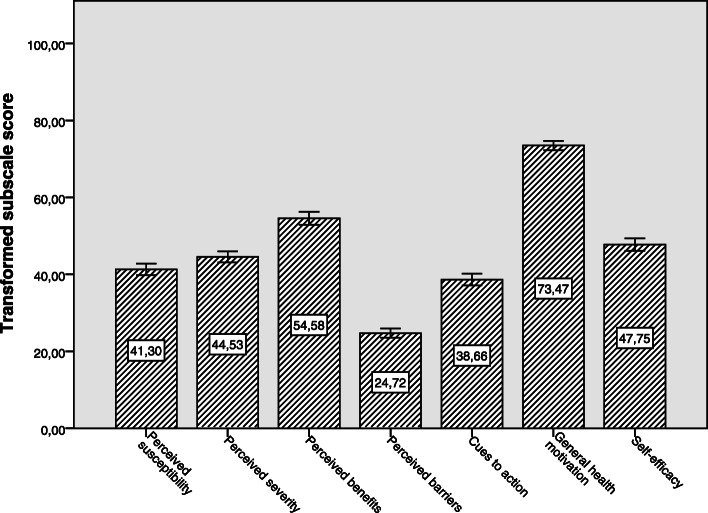
Background: Positive health beliefs and attitudes towards dementia and dementia risk reduction may encourage adopting a healthy behaviour. Therefore, we aimed to investigate the knowledge, health beliefs and attitudes towards dementia and dementia risk reduction among the Dutch general population and its association with the intention to change health behaviours. Methods: A random sample of Dutch residents (30 to 80 years) was invited to complete an online survey. We collected data on knowledge, health beliefs and attitudes towards dementia (risk reduction) and the intention to change health behaviours. Multivariable logistic regression analyses were used to obtain effect estimates. Results: Six hundred fifty-five participants completed the survey. In general, participants had insufficient knowledge about dementia and dementia risk reduction. Participants had relatively high scores on general health motivation and perceived benefits, but low scores on perceived susceptibility, perceived severity, perceived barriers, cues to action and self-efficacy. Individuals with higher scores on perceived benefits and cues to action had more often the intention to change their behaviour with regard to physical activity (OR = 1.33, 95%-CI:1.11–1.58; OR = 1.13, 95%-CI:1.03–1.24, respectively) and alcohol consumption (OR = 1.30, 95%-CI:1.00–1.69; OR = 1.17, 95%-CI:1.02–1.35, respectively). Younger excessive alcohol consumers with higher perceived severity scores had more often the intention to change their alcohol consumption behaviour (OR = 2.70, 95%-CI:1.04–6.97) compared to older excessive alcohol consumers. Opposite results were found for middle-aged excessive alcohol consumers (OR = 0.81, 95%-CI:0.67–0.99). Individuals who perceived more barriers had more often the intention to change their diet (OR = 1.10, 95%-CI:1.01–1.21), but less often the intention to change their smoking behaviour (OR = 0.78, 95%-CI:0.63–0.98). Moreover, less educated individuals with higher perceived benefits scores had less often the intention to change their diet (OR = 0.78, 95%-CI:0.60–0.99), while highly educated individuals with higher perceived benefits scores had more often the intention to change their diet (OR = 1.41, 95%-CI:1.12–1.78). Conclusions: The knowledge, beliefs and attitudes towards dementia and dementia risk reduction among the Dutch general population is insufficient to support dementia risk reduction. More education about dementia and dementia risk reduction is needed to improve health beliefs and attitudes towards dementia and dementia risk reduction in order to change health behaviour.
Overview
The claims and statistics of this paper haven’t been checked yet.
Free: it reads the open-access text and checks the first 5 claims that cite a source we can check. Create a free account to check every claim.
Integrity signals
Registry
Cites
Statistics
Figures
Verification
Claims the paper makes
The claims and statistics of this paper haven’t been checked yet.
Free: it reads the open-access text and checks the first 5 claims that cite a source we can check. Create a free account to check every claim.
Claims other papers make about this one
Each is checked against this paper’s own text: does it say what the citing paper says it does?
The source backs part of the claim, not all of it — or backs it for a different population, condition or comparison.
In the citing paper
“Another information that might play a role in dementia knowledge is indirect dementia experiences, as evidence shows its link with increased awareness [22–24]; nevertheless individuals with a parental family history of dementia have limited knowledge on dementia risk reduction [15].”
From Dementia is (not) a natural part of ageing: a cross-sectional study on dementia knowledge and misconceptions in Swiss and Italian young adults, adults, and older adults (2022) · cites this paper as [15]
Experimental — accuracy not yet measuredThe source backs part of the claim, not all of it — or backs it for a different population, condition or comparison.
In the citing paper
“indicating a higher level of openness to the idea that individuals influence their risk, as earlier international studies reported values between 36 % and 70 % [19– 22].”
From Sociodemographic differences in dementia prevention knowledge in Germany: Implications for targeted health communication (2026) · cites this paper as [21]
Experimental — accuracy not yet measuredThe cited source says what the claim attributes to it.
In the citing paper
“These findings align with extensive evidence from numerous international studies [18,20– 22,26].”
From Sociodemographic differences in dementia prevention knowledge in Germany: Implications for targeted health communication (2026) · cites this paper as [21]
Self-check
Percentages, sums and reported differences re-computed from the paper’s own numbers.
The self-check needs the paper’s full text.
Citations
Cites
1 retracted
Dementia prevention, intervention, and care: 2020 report of the Lancet Commission
Livingston, G., Huntley, J., Sommerlad, A., Ames, D., Ballard, C., Banerjee, S., Brayne, C., Burns, A., Cohen-Mansfield, J., Cooper, C., et al. (2020) · The Lancet · doi:10.1016/s0140-6736(20)30367-6 · Cited by 10,430
RetractedGuidelines for the process of cross-cultural adaptation of self-report measures
Beaton, D. E., Bombardier, C., Guillemin, F., & Ferraz, M. B. (2000) · Spine · doi:10.1097/00007632-200012150-00014 · Cited by 14,542
The Health Belief Model: a decade later.
Janz, N. K., & Becker, M. H. (1984) · Health Education Quarterly · doi:10.1177/109019818401100101 · Cited by 8,437 · cited 3×
“, health belief model (HBM), Trans Theoretical Model) [10, 11].”
BackgroundInfluentialThe Transtheoretical Model of Health Behavior Change.
Prochaska, J. O., & Velicer, W. F. (1997) · American Journal of Health Promotion · doi:10.4278/0890-1171-12.1.38 · Cited by 7,782
Dementia prevention, intervention, and care
Livingston, G., Sommerlad, A., Orgeta, V., Costafreda, S. G., Huntley, J., Ames, D., Ballard, C., Banerjee, S., Burns, A., Cohen-Mansfield, J., et al. (2017) · The Lancet · doi:10.1016/s0140-6736(17)31363-6 · Cited by 6,072
International Labour Organization
(2022) · Permanent Missions to the United Nations · doi:10.18356/9789210018289c229 · Cited by 4,331
MIND diet associated with reduced incidence of Alzheimer's disease
Morris, M. C., Tangney, C. C., Wang, Y., Sacks, F. M., Bennett, D. A., & Aggarwal, N. T. (2015) · Alzheimer's & Dementia · doi:10.1016/j.jalz.2014.11.009 · Cited by 1,162 · cited 1×
“legumes, vegetables, fruit, fish, meat, poultry, nuts, cheese and olive oil) [25, 26].”
MIND diet slows cognitive decline with aging
Morris, M. C., Tangney, C. C., Wang, Y., Sacks, F. M., Barnes, L. L., Bennett, D. A., & Aggarwal, N. T. (2015) · Alzheimer's & Dementia · doi:10.1016/j.jalz.2015.04.011 · Cited by 1,115 · cited 1×
“legumes, vegetables, fruit, fish, meat, poultry, nuts, cheese and olive oil) [25, 26].”
The 2015 Dutch food-based dietary guidelines
for the Committee Dutch Dietary Guidelines 2015, Kromhout, D., Spaaij, C. J. K., de Goede, J., & Weggemans, R. M. (2016) · European Journal of Clinical Nutrition · doi:10.1038/ejcn.2016.52 · Cited by 401
Kelly, S., Martin, S., Kuhn, I., Cowan, A., Brayne, C., & Lafortune, L. (2016) · PLOS ONE · doi:10.1371/journal.pone.0145074 · Cited by 331
Cited by
Machine Learning for Dementia Prediction: A Systematic Review and Future Research Directions
Javeed, A., Dallora, A. L., Berglund, J. S., Ali, A., Ali, L., & Anderberg, P. (2023) · Journal of Medical Systems · doi:10.1007/s10916-023-01906-7 · Cited by 187
“The number of dementia patients is rapidly increasing worldwide, and statistical projections suggest that 135 million people might be affected by dementia by 2050 [3].”
BackgroundNemcikova, M., Katreniakova, Z., & Nagyova, I. (2023) · Frontiers in Public Health · doi:10.3389/fpubh.2023.1104250 · Cited by 147
Pacifico, D., Fiordelli, M., Fadda, M., Serena, S., Piumatti, G., Carlevaro, F., Magno, F., Franscella, G., & Albanese, E. (2022) · BMC Public Health · doi:10.1186/s12889-022-14578-8 · Cited by 42
“Another information that might play a role in dementia knowledge is indirect dementia experiences, as evidence shows its link with increased awareness [22–24]; nevertheless individuals with a parental family history of dementia have limited knowledge on dementia risk reduction [15].”
BackgroundFarrow, M., Fair, H. L., Klekociuk, S. Z., & Vickers, J. C. (2022) · PLoS ONE · doi:10.1371/journal.pone.0267205 · Cited by 63
Javeed, A., Dallora, A. L., Berglund, J. S., Idrisoglu, A., Ali, L., Rauf, H. T., & Anderberg, P. (2023) · Biomedicines · doi:10.3390/biomedicines11020439 · Cited by 48
“The number of people with dementia is swiftly growing globally, and statistical forecasts indicate that 135 million individuals might have dementia by 2050 [2].”
BackgroundBransby, L., Rosenich, E., Maruff, P. T., & Lim, Y. Y. (2023) · The Journal of Prevention of Alzheimer s Disease · doi:10.14283/jpad.2023.119 · Cited by 41
“…surrounding MDRFs. Large-scale surveys suggest that many in the general population are unaware of MDRFs and have relatively low dementia literacy (109, 110) which may lead to non-evidence-based beliefs and attitudes (e.g., dementia is a normal part of ageing) (111) and limit opportunity for MDRF…”
BackgroundJaveed, A., Dallora, A. L., Berglund, J. S., & Anderberg, P. (2022) · Life · doi:10.3390/life12071097 · Cited by 39
“The number of dementia patients is rapidly increasing worldwide and statistical projections suggest that 135 million people might be affected with dementia by 2050 [3].”
BackgroundZülke, A. E., Luppa, M., Köhler, S., & Riedel-Heller, S. G. (2022) · PLOS ONE · doi:10.1371/journal.pone.0277037 · Cited by 34
“Although belief in preventability of dementia slightly increased over the last years, assumptions that the condition constitutes a normal part of ageing remained rather stable over time [7,8].”
BackgroundSiette, J., Dodds, L., Deckers, K., Köhler, S., & Armitage, C. J. (2023) · BMC Public Health · doi:10.1186/s12889-023-15843-0 · Cited by 28
“, [21]) limit generalizability to the general population.”
BackgroundResultInfluentialLiu, M., Sun, F., Lu, C., & Xie, J. (2022) · American Journal of Alzheimer s Disease & Other Dementias® · doi:10.1177/15333175221112143 · Cited by 16
Welberry, H., Chau, T., Heffernan, M., Jose, J. C. S., Jorm, L. R., Singh, M. F., Sachdev, P. S., Anstey, K. J., Lautenschlager, N. T., Valenzuela, M., et al. (2023) · Journal of Alzheimer s Disease · doi:10.3233/jad-220990 · Cited by 13
Padci pri starejših in vpliv pandemije covida-19
Simon, M. R., & Kralj, M. (2022) · ZRC SAZU, Založba ZRC eBooks · doi:10.3986/9789610506966_09 · Cited by 10
Güney, S., Doğan, Ö. Ç., Bakır, A., Öztürk, A., & Oldaç, T. (2024) · Journal of Applied Gerontology · doi:10.1177/07334648241251771 · Cited by 10
“…and healthy lifestyles in the public, leading to signi fi cant gaps in knowledge about prevention of dementia, as well as the connection between risk awareness, lifestyle choices and motivational factors to change the unhealthy behaviors for brain health (Heger et al., 2019; Vrijsen et al., 2021).”
InfluentialUnderstanding Health Beliefs and Health Behaviors in Older Adults at Risk for Alzheimer’s Disease
Zakrzewski, J. J., Davis, J. D., Gemelli, Z. T., & Korthauer, L. E. (2024) · Journal of Alzheimer s Disease · doi:10.3233/jad-230977 · Cited by 11
Dementia awareness in Egypt: what do people really know?
Ashour, A. A., Sabry, N. A., Ashour, A., Kassem, H. N., Alwerdani, M. M., Nofal, M., Mohamed, N. A., Abdalgeleel, S. A., & Khalaf, O. O. (2024) · The Egyptian Journal of Neurology Psychiatry and Neurosurgery · doi:10.1186/s41983-024-00864-2 · Cited by 9
“The first phase of questionnaire development included item generation, by a group of experts in the geriatric field, based on an extensive literature review [2, 13–18].”
BackgroundHealth Behavior Change to Mitigate Dementia Risk: An Updated Review
Sanborn, V. E., Davis, J. D., & Korthauer, L. E. (2024) · Current Geriatrics Reports · doi:10.1007/s13670-024-00421-y · Cited by 7
The Drivers of Conversations About Dementia Risk Reduction: A Qualitative Study
Fair, H. L., Doherty, K., Eccleston, C. E. A., Edmonds, M., Klekociuk, S. Z., & Farrow, M. (2023) · Journal of Health Communication · doi:10.1080/10810730.2023.2179136 · Cited by 6
“Dementia prevention is one health domain where public understanding is limited (Horst et al., 2021; Van Asbroeck et al., 2021; Vrijsen, Matulessij, Joxhorst, De Rooij, & Smidt, 2021), despite evidence that risk-reducing behavior change could reduce dementia incidence worldwide (World Health…”
BackgroundAl-Awad, F. A., AlAbdulKader, A. M., AlShammari, M. A., Rohaiem, S. N., Alharkan, K. S., Mohammedin, A. S., Alshurem, M., Albakr, D. M., Alkhunaizi, F., Almaslami, M., et al. (2024) · Electronic Journal of General Medicine · doi:10.29333/ejgm/14159 · Cited by 8
“This proportion is significantly higher than the 32.4% found in a recent Dutch general population study [6].”
BackgroundMethodResultInfluentialBruinsma, J., Loukas, V. S., Kassiotis, T., Heger, I., Rosenberg, A., Visser, L. N. C., Mangialasche, F., Fotiadis, D. I., Hanke, S., & Crutzen, R. (2024) · Journal of Alzheimer s Disease · doi:10.3233/jad-231369 · Cited by 9
Lin, R. S. Y., Su, J. J., Kim, S., Wong, A. K. C., Chan, T. W., & Lee, S. H. C. (2023) · Geriatric Nursing · doi:10.1016/j.gerinurse.2023.09.016 · Cited by 6
Tsai, F.-J., Shen, S.-W., Hu, Y.-J., & Tseng, C.-C. (2024) · Medicine · doi:10.1097/md.0000000000039744 · Cited by 9
“[41] Overall, older adults should be educated on dementia prevention associated with knowledge, cues to action, changing lifestyles, health motivation, and self-efficacy to achieve optimal behavioral intention.”
BackgroundExploration of COVID-19 Pandemic Prevention Behaviors among Healthcare Workers
Huang, H.-T., Tsai, C.-H., Wang, C.-F., Chien, T.-C., & Chang, S.-H. (2023) · Healthcare · doi:10.3390/healthcare11020153 · Cited by 8
“Past studies have pointed out that positive health beliefs can reduce the risk of disease [93], increase participation in preventive behaviors [94], and create a more positive view of epidemic preventive behaviors.”
BackgroundLay Knowledge About Dementia in Iceland: symptoms and Risk and Protective Factors
Jónsdóttir, M. K., Pálsdóttir, E. B., Hannesdóttir, S. Ý., & Karlsson, T. (2022) · Gerontology and Geriatric Medicine · doi:10.1177/23337214221142937 · Cited by 3
“Studies have shown that up to 75% of people (range 39%–75%) believe this to be the case (Cations et al., 2018; Vrijsen et al., 2021).”
BackgroundZülke, A. E., Blotenberg, I., Luppa, M., Löbner, M., Döhring, J., Williamson, M., Kosilek, R. P., Michel, I., Oey, A., Brettschneider, C., et al. (2024) · European Journal of Nutrition · doi:10.1007/s00394-024-03563-z · Cited by 4
“Motivation and (health-specific) self-efficacy have been pointed out as potential determinants of a healthy diet [18] and of health behavior change for brain health in (older) adults [19, 20].”
Tang, L., Zhuang, Z., meilin, L. U. O., Cai, Y., & Lyu, Q.-Y. (2025) · Preventive Medicine · doi:10.1016/j.ypmed.2024.108215 · Cited by 4
Makino, K., Lee, S., Katayama, O., Tomida, K., Yamaguchi, R., Yamagiwa, D., & Shimada, H. (2025) · Alzheimer s & Dementia Behavior & Socioeconomics of Aging · doi:10.1002/bsa3.70004 · Cited by 5
van Erpecum, C. L., Bornioli, A., García‐Gómez, P., Mölenberg, F. J. M., & den Braver, N. R. (2025) · Journal of Transport & Health · doi:10.1016/j.jth.2025.102042 · Cited by 4
Suggestions on the ideal method of conducting community screenings for older adults
Kouzuki, M., Tanaka, N., Miyamoto, M., & Urakami, K. (2023) · BMC Geriatrics · doi:10.1186/s12877-023-04119-2 · Cited by 4
The Importance of Knowledge on Dementia Risk Factors in the General Public: A Cross-Sectional Study
Meng, X., Dong, Y., Gao, T., Su, J., Zhao, Y., Zhu, X., He, M., Zhang, T. G., & Sun, J. (2024) · The Journal of Nervous and Mental Disease · doi:10.1097/nmd.0000000000001785 · Cited by 4
Dong, J., Yu, S., Qin, Y., Jin, X., Xing, Y., & Wang, H. (2025) · Qualitative Health Research · doi:10.1177/10497323251324127 · Cited by 3
“…in fl uence, racial and cultural variations have been a recurring theme in current research on health beliefs about dementia (Braun et al., 1996; Chapleski et al., 1997; Jang et al., 2010; Kjelvik et al., 2023; Matulesseij et al., 2020; Sagbakken et al., 2018; Vrijsen, Matulessij, et al., 2021).”
Otte, R. S., de Kruif, A. J. T. C. M., Naumann, E., & de van der Schueren, M. A. E. (2025) · Ageing International · doi:10.1007/s12126-025-09597-w · Cited by 3
“However, research among the Dutch general population indicated that there is insufficient knowledge, beliefs and attitudes towards dementia and its prevention to effectively support dementia risk reduction (Vrijsen et al., 2021).”
Simone, S. M., Kaplan, M., & Giovannetti, T. (2025) · Journal of Applied Gerontology · doi:10.1177/07334648251345191 · Cited by 4
“Speci fi cally, older age has been associated with higher perceived dementia severity, fewer perceived bene fi ts and barriers to engaging in health behaviors for dementia risk reduction, and lower self-ef fi cacy in one ’ s ability to engage in health behaviors (Vrijsen et al., 2021).”
Epidemiološke ocene prevalence demence v Sloveniji
Lovrečić, B., & Lovrečić, M. (2022) · ZRC SAZU, Založba ZRC eBooks · doi:10.3986/9789610506966_01 · Cited by 3
A Dynamic Composite Ensemble Learning Framework for Multi-Stage Dementia Prediction
Li, B., Mao, J., Wu, X., Sun, Y., & He, L. (2023) · IEEE International Conference on Bioinformatics and Biomedicine (BIBM) · doi:10.1109/bibm58861.2023.10385890 · Cited by 2
“According to the latest statistics from World Health Organization (WHO) 1 , currently more than 55 million people have dementia worldwide, and this data is rapidly increasing by almost 10 million new cases each year [2].”
MethodAlbus, P., Folkerts, A.-K., Kessler, J., Köhler, S., & Kalbe, E. (2026) · The journal of prevention of Alzheimer's disease · doi:10.1016/j.tjpad.2026.100517 · Cited by 1
“…variables appear to play an important role in shaping such knowledge, with higher educational attainment consistently associated with greater awareness of dementia prevention [18 – 21], suggesting a dual role of education as a determinant of both dementia risk and dementia prevention knowledge.”
Scholl, J., Winkens, L. H. H., & Veling, H. (2026) · JMIR Formative Research · doi:10.2196/79141 · Cited by 1
“…and Disability trial suggests that targeting adults aged 60 years and older is worthwhile, and it may even be strategic to do so; unlike younger adults, older adults perceive dementia as a serious risk and face fewer time constraints, making them more receptive to preventive measures [10,11].”
Huijzendveld, R. A., den Braver, N. R., Beenackers, M. A., van Lenthe, F. J., van Erpecum, C.-P. L., Bornioli, A., van Veldhuizen, R. J., Wagtendonk, A. J., García-Gómez, P., & Mölenberg, F. J. M. (2026) · Journal of Transport & Health · doi:10.1016/j.jth.2026.102288 · Cited by 1
Grkman, L., Mavrič, N., Lovrenčič, B., & Lovrenčič, M. (2022) · ZRC SAZU, Založba ZRC eBooks · doi:10.3986/9789610506768_14
Dolgotrajni covid-19/postcovidni sindrom in kognitivne motnje
Lovrečić, B., Lovrečić, M., & Grkman, L. (2022) · ZRC SAZU, Založba ZRC eBooks · doi:10.3986/9789610506966_06
(2022) · ZRC SAZU, Založba ZRC eBooks · doi:10.3986/9789610506966_00
Breme neformalnih oskrbovalcev oseb z demenco v času covida-19
Lovrečić, B., Lovrečić, M., & Mavrič, N. (2022) · ZRC SAZU, Založba ZRC eBooks · doi:10.3986/9789610506966_08
Dinamika nevropsihiatričnih simptomov pri osebah z demenco v povezavi s pandemijo in covidom-19
Lovrečić, B., Lovrečić, M., & Grkman, L. (2022) · ZRC SAZU, Založba ZRC eBooks · doi:10.3986/9789610506966_05
Duševno zdravje neformalnih družinskih oskrbovalcev oseb z demenco
Lovrečić, B., Lovrečić, M., & Cizl, M. (2022) · ZRC SAZU, Založba ZRC eBooks · doi:10.3986/9789610506966_07
Javnozdravstveni izzivi demence
Lovrečić, B., Lovrečić, M., Sambt, J., Grkman, L., Simon, M. R., Mavrič, N., Sedlak, S., Jelenc, M., Cizl, M., Kralj, M., et al. (2022) · ZRC SAZU, Založba ZRC eBooks · doi:10.3986/9789610506966 · Cited by 2
Poznavanje demence med splošno javnostjo
Lovrečić, B., Lovrečić, M., & Mavrič, N. (2022) · ZRC SAZU, Založba ZRC eBooks · doi:10.3986/9789610506966_02
Dolgotrajna oskrba ljudi z demenco
Mali, J. (2022) · ZRC SAZU, Založba ZRC eBooks · doi:10.3986/9789610506966_03
Ekonomsko breme demence v Sloveniji glede na rutinske podatkovne zbirke zdravstvenega varstva
Lovrečić, B., Sambt, J., Sedlak, S., & Jelenc, M. (2022) · ZRC SAZU, Založba ZRC eBooks · doi:10.3986/9789610506966_04
A Robust Technique for Prediction of Dementia Using Ensemble Voting Classifier
Murshid, M. M., Mamun, J. H., & Rafee, M. R. (2024) · International Conference on Computing, Communication and Networking Technologies (ICCCNT) · doi:10.1109/icccnt61001.2024.10724281
Huijzendveld, R. A., den Braver, N. R., Beenackers, M. A., van Lenthe, F. J., van Erpecum, C. L., Bornioli, A., van Veldhuizen, R. J., Wagtendonk, A. J., García‐Gómez, P., & Mölenberg, F. J. M. (2025) · SSRN Electronic Journal · doi:10.2139/ssrn.5270607
Kouzuki, M., Tanaka, N., Miyamoto, M., & Urakami, K. (2023) · Figshare · doi:10.6084/m9.figshare.23597470
Захаров, С. В., Schröter, A., & Teichmann, B. (2026) · Journal of Alzheimer s Disease Reports · doi:10.1177/25424823251409406
“36 Building on this evidence, the present study aims to validate these three instruments in Russian, thereby enabling their broader application in research and in the evaluation of psycho-educational initiatives for informal caregivers and public awareness programs.”
Timely diagnosis of dementia: the contribution of non-medical and informal contacts
Visser, F. C., Groen, L. J. T., Zwiers, L., Verwey, N. A., & Munster, B. C. V. (2026) · Aging & Mental Health · doi:10.1080/13607863.2026.2634132
“Such an approach would optimize the representation of different subgroups of the population (Vrijsen et al., 2021).”
A Squeeze and Excitation Network for Dementia Grades Prediction
Fethallah, H., Abdelhak, M., Rafika, B., & Smahi, S. (2026) · Communications in computer and information science · doi:10.1007/978-3-032-21582-6_7
Wu, F., Yang, C., Wu, F., & Sun, Z. (2026) · Dementia and Geriatric Cognitive Disorders · doi:10.1159/000552507 · Cited by 1
Agdere, S., Albers, E. A. C., Kreuk, E., Horstkötter, D., Paauw, D., Rirash, A. F., Smets, E. M. A., & Visser, L. N. C. (2026) · Research Square · doi:10.21203/rs.3.rs-9940093/v1
Chang, Y.-C., & Yang, C. (2026) · BMC Medical Education · doi:10.1186/s12909-026-10067-3
“Research suggests that the majority of the public erroneously perceives dementia as a normal part of aging, lacking an adequate understanding of its risk factors and care techniques [4, 5].”
Svolos, V., Strongylou, D. E., Zoupa, E., Triantafyllou, A., Katsama, M., Michas, K., Kosti, R., Bogiatzidou, O., Siokas, V., Liampas, I., et al. (2026) · Dietetics · doi:10.3390/dietetics5030050
“Others may perceive dementia as an inevitable consequence of their genetic profile and therefore not amenable to prevention [27–29].”
InfluentialBeyond barriers: a qualitative TDF and COM-B analysis of participation in active ageing programmes
Faizal, N. A., Pang, B. W. J., Ng, Y. S., Ding, Y. Y., Low, J. A. Y. H., & Lau, L. K. (2026) · Frontiers in Public Health · doi:10.3389/fpubh.2026.1952870
Metadata
- Authors
- Vrijsen, J., Matulessij, T. F., Joxhorst, T., de Rooij, S. E., & Smidt, N.
- Affiliations
- University Medical Center Groningen (NL)
- Corresponding author
- Vrijsen, J.
- ORCID
- Venue
- BMC Public Health
- Published
- 2021-05-03
- Volume
- 21
- Issue
- 1
- Pages
- 857-857
- ISSN
- 1471-2458 (ISSN-L)
- PMC
- PMC8094456
- OpenAlex
- W3157944786
- Semantic Scholar
- 8a038b8647eed0fdbfb4458fd75d774abaff2408
- Cited by
- 58
- References
- 29
- Citations by year
- 2026: 11 · 2025: 7 · 2024: 10 · 2023: 12 · 2022: 18
- FWCI
- 7.17
- Type
- journal article
- Language
- en
- Open access
- gold
- doi.org
- Licence
- cc-by
- creativecommons.org/licenses/by/4.0/ (tdm)
- creativecommons.org/licenses/by/4.0/ (vor)
- Locations
- BMC Public Health (publishedVersion, cc-by)
- PubMed Central (publishedVersion, cc-by)
- PubMed (publishedVersion)
- DOAJ (DOAJ: Directory of Open Access Journals) (submittedVersion, cc-by-sa)
- University of Groningen research database (University of Groningen / Centre for Information Technology) (submittedVersion, cc-by)
- Funders
- ZonMw
- Topics
- Health Sciences › Medicine › Psychiatry and Mental health › Dementia and Cognitive Impairment Research
- Social Sciences › Psychology › Applied Psychology › Behavioral Health and Interventions
- Social Sciences › Communication › Media Influence and Health
- Keywords
- dementia, dementia risk reduction, health beliefs, health attitudes, health knowledge, perceived susceptibility, perceived severity, perceived barriers, cues to action, self-efficacy, physical activity, alcohol consumption, diet, smoking, educational attainment, age differences, health motivation, perceived benefits
- MeSH terms
- Cross-Sectional Studies, Dementia, Humans, Health Knowledge, Attitudes, Practice, Middle Aged, Surveys and Questionnaires, Health Behavior, Intention, Risk Reduction Behavior
About these checks
Registry, retraction, Cites and statistics results are computed, not judged, with one exception: a printed reference that no index lists is read once by a model before it counts as a citation error. Claims are extracted by a model and kept only when their quote appears verbatim in the text; each cited source is then checked, with a model’s help, for whether it says what the claim relies on. Those verdicts can be wrong — read the claim’s quote and the cited source before relying on one.
Statistics and arithmetic are recomputed, not judged.
Confidence bands are shown only for fields calibrated on our annotated test set. None is calibrated yet, so no band is shown.
What counts as a claim ›How we measure confidence ›How we check this ›
Are you an author, or do you see a problem with this page? Request a review
Data sources
Bibliographic data: Semantic Scholar, OpenAlex, Crossref.
Contains information from the Semantic Scholar Academic Graph Datasets, made available under the ODC Attribution License (ODC-BY 1.0).
Semantic Scholar’s data is described in: Kinney, R., et al. (2023). The Semantic Scholar Open Data Platform. arXiv:2301.10140.
