

Risk and protective factors of drug abuse among adolescents: a systematic review
Open accessThe DOI matches its Crossref record; 71 of the 71 references it cites were found in a registry or an index; 24 of the 47 sources its claims cite were checked for support.
Abstract
Drug usage typically begins during adolescence. This systematic review identified risk and protective factors of drug abuse among adolescents worldwide across individual, family, and community domains.
Overview
CoChat Summary
## TL;DR
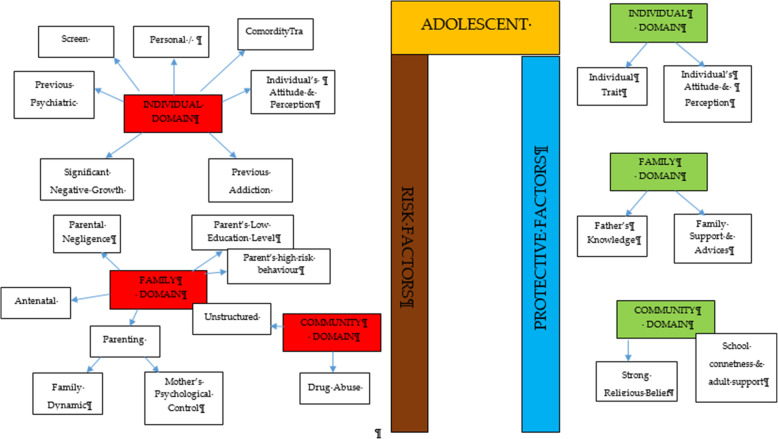
This systematic review identified risk and protective factors for adolescent drug abuse across individual, family, and community domains using 23 included studies (22 quantitative and 1 qualitative). The most frequently highlighted risks were individual factors, especially impulsivity, rebelliousness, emotional regulation problems, maltreatment, psychiatric disorders, prior substance exposure, and perceived accessibility; protective factors included optimism, mindfulness, school connectedness, and strong religious beliefs.
## Key findings
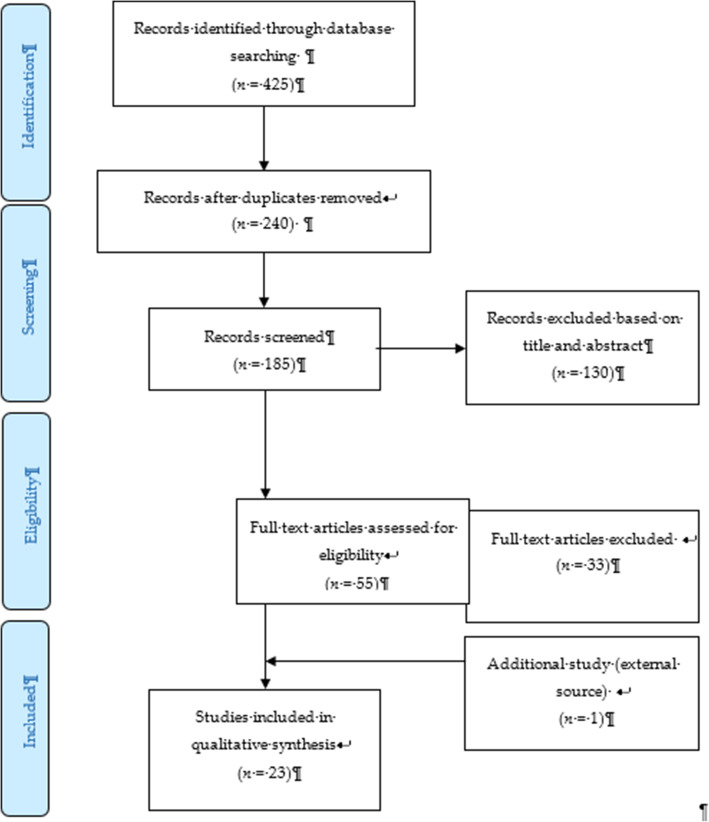
- The review screened 425 records and included 23 studies: 22 quantitative articles and 1 qualitative article; sample sizes ranged from 70 to 700,178, and the qualitative study included 100 interviewees.
- Individual risk factors reported included high impulsivity, rebelliousness, emotional regulation impairment, alexithymia, maltreatment/negative upbringing, conduct problems, major depressive disorder, prior e-cigarette exposure, behavioral addiction, low perceived risk, high perceived drug accessibility, and positive attitudes toward synthetic drugs.
- Family risk factors included prenatal maternal smoking, poor maternal psychological control, low parental education, negligence, poor supervision, uncontrolled pocket money, and substance-using family members; community risk factors included peers who abuse drugs.
- Protective factors reported included optimism (OR = 0.90, 95% CI 0.85–0.95), mindfulness (slower progression toward injectable drug abuse by 1.67 years, p = .041), social phobia (OR = 0.87, 95% CI 0.77–0.97), strong beliefs against substance abuse, desire to maintain health, high paternal awareness, school connectedness, structured activity, and strong religious beliefs.
## Methods
- Systematic review conducted following PRISMA, searching PubMed, EBSCOhost, and Web of Science for English-language full-text articles published from 2016 to December 2020.
- Inclusion focused on adolescents aged 10–18 years and drug-related substances excluding nicotine/tobacco and alcohol; citations were screened, duplicates removed, and full texts assessed against inclusion/exclusion criteria.
- Study quality was appraised with MMAT 2018 by two independent reviewers; because of heterogeneity, results were synthesized descriptively rather than meta-analyzed.
## Limitations
- The paper states it may have missed important factors because it included only English articles and searched only three databases.
- The paper also notes heterogeneity in study designs, substances, outcome measures, and analysis techniques, which led to descriptive synthesis rather than pooled analysis.
- Evident from the text: the review excluded tobacco and alcohol-related substance use, so its findings do not cover the full broader substance-abuse landscape.
Model-written summary. Check it against the paper before relying on it.
Integrity signals
Registry
Cites
Statistics
Figures
Verification
Claims the paper makes
23 Valid · 0 Not valid · 17 Not checked · 16 Own results and interpretations
The cited sources support only part of this claim — read each source’s verdict below.
In the paper
“This study also showed that the impulsivity trait alone was an independent risk factor that increased the odds between two to four times for using any drug compared to the non-impulsive group.”
§ Risk and protective factors of drug abuse among adolescents: a systematic review > Results > DOMAIN: individual factor
What the sources say
- Partly supportedcites [29] Chuang CWI Sussman S Stone MD Pang RD Chou CP Leventhal AM Kirkpatrick MG Impulsivity and history of behavioral addictions are associated with drug use in adolescents Addict Behav 2017 74 41 47 10.1016/j.addbeh.2017.05.021 28570913 PMC6604811 sourceExperimental — accuracy not yet measured
The Results section on past-six-month drug use (page not provided) says impulsivity alone was associated with greater likelihood of use across all five outcomes, including any drug use. It gives an odds ratio of 3.72 for tobacco use, but the available passage does not establish a two-to-fourfold odds ratio for any drug use. The Discussion also cautions that impulsivity may be a marker of other risk factors, so calling it an independent factor that increases use overstates the association. (LLM, conf=0.86)
plainstates a cause- Asserted: passes — The authors put it forward as true.
- Checkable: passes — It can be checked against evidence.
- Load-bearing: unclear — It is unclear whether the paper’s conclusions depend on it.
- Based: passes — The paper gives a reason why it holds.
- Partly supported
The cited sources support only part of this claim — read each source’s verdict below.
In the paper
“A study by Marin et al. found that youth with an optimistic trait were less likely to become drug dependent [33].”
§ Risk and protective factors of drug abuse among adolescents: a systematic review > Results > Protective factors
What the sources say
- Partly supportedcites [33] Marin S Heshmatian E Nadrian H Fakhari A Mohammadpoorasl A Associations between optimism, tobacco smoking and substance abuse among Iranian high school students Health Promot Perspect 2019 9 4 279 284 10.15171/hpp.2019.38 31777707 PMC6875553 sourceExperimental — accuracy not yet measured
The Results report that higher optimism scores were associated with lower odds of illicit drug use among students, and the Discussion describes the study as cross-sectional. The paper does not establish that optimistic youth were less likely to become drug dependent: it measured drug use, not dependence or later onset. (LLM, conf=0.88)
plainstates an association- Asserted: passes — The authors put it forward as true.
- Checkable: passes — It can be checked against evidence.
- Load-bearing: passes — The paper’s conclusions depend on it.
- Based: passes — The paper gives a reason why it holds.
- Partly supported
The cited sources support only part of this claim — read each source’s verdict below.
In the paper
“adolescents who had high-perceived availability of drugs in their neighborhoods were more likely to increase their usage of marijuana over time (OR = 11.00, 95% CI 9.11, 13.27) [35].”
§ Risk and protective factors of drug abuse among adolescents: a systematic review > Results > DOMAIN: individual factor
What the sources say
- Partly supportedcites [35] Schleimer JP Rivera-Aguirre AE Castillo-Carniglia A Laqueur HS Rudolph KE Suárez H Ramírez J Cadenas N Somoza M Brasesco MV Martins SS Cerdá M Investigating how perceived risk and availability of marijuana relate to marijuana use among adolescents in Argentina, Chile, and Uruguay over time Drug Alcohol Depend 2019 201 115 126 10.1016/j.drugalcdep.2019.03.029 31207452 PMC7075484 sourceExperimental — accuracy not yet measured
The Abstract Results report the quoted OR and 95% CI for the association between perceived marijuana availability and use in Argentina in 2014. The Abstract Methods describe cross-sectional surveys and past-month use, not an increase in an individual's use over time. The Materials and Methods > Measures section asks how easy marijuana would be to obtain; it does not measure the availability of drugs in respondents' neighborhoods. No page numbers are provided in our copy. (LLM, conf=0.91)
plainstates an association- Asserted: passes — The authors put it forward as true.
- Checkable: passes — It can be checked against evidence.
- Load-bearing: unclear — It is unclear whether the paper’s conclusions depend on it.
- Based: passes — The paper gives a reason why it holds.
- Partly supported
Every source the paper cites for this claim was checked and supports it.
In the paper
“exposure to e-cigarettes within the past 30 days is related to an increase in the prevalence of marijuana use and prescription drug use by at least four times in the 8th and 10th grades and by at least three times in the 12th grade [34].”
§ Risk and protective factors of drug abuse among adolescents: a systematic review > Results > DOMAIN: individual factor
What the sources say
- Supportedcites [34] Miech RA O’Malley PM Johnston LD Patrick ME E-cigarettes and the drug use patterns of adolescents Nicotine Tob Res 2015 18 5 654 659 10.1093/ntr/ntv217 26416823 PMC5654373 source
The Results section reports that past-30-day marijuana use and prescription drug abuse were at least four times as prevalent among past-30-day e-cigarette users in 8th and 10th grades, and at least three times as prevalent in 12th grade, compared with nonusers. The paper describes an association, not a causal increase. (LLM, conf=0.93)
plainstates an association- Asserted: passes — The authors put it forward as true.
- Checkable: passes — It can be checked against evidence.
- Load-bearing: unclear — It is unclear whether the paper’s conclusions depend on it.
- Based: passes — The paper gives a reason why it holds.
- Supported
The cited sources support only part of this claim — read each source’s verdict below.
In the paper
“Expecting mothers who smoke tobacco and alcohol have an indirect link with adolescent substance abuse in later life [24, 39].”
§ Risk and protective factors of drug abuse among adolescents: a systematic review > Results > DOMAIN: family factors
What the sources say
- Partly supportedcites [24] Cecil CAM Walton E Smith RG Viding E McCrory EJ Relton CL Suderman M Pingault JB McArdle W Gaunt TR Mill J Barker ED DNA methylation and substance-use risk: a prospective, genome-wide study spanning gestation to adolescence Transl Psychiatry 2016 6 12 e976 10.1038/tp.2016.247 27922636 PMC5315565 sourceExperimental — accuracy not yet measured
The Results (Follow-up analyses; page unavailable) report an indirect association between prenatal maternal tobacco smoking and adolescent substance use, including adolescent alcohol use. The Discussion identifies tobacco smoking—not maternal alcohol use—as the prenatal exposure with this indirect association. The claim is supported for smoking but not for alcohol use by expecting mothers. (LLM, conf=0.90)
- Not checked — no full text of the sourcecites [39] Osborne V Serdarevic M Striley CW Nixon SJ Winterstein AG Cottler LB Age of first use of prescription opioids and prescription opioid non-medical use among older adolescents Substance Use Misuse 2020 55 14 2420 2427 10.1080/10826084.2020.1823420 33059498 source
plainstates an association- Asserted: passes — The authors put it forward as true.
- Checkable: passes — It can be checked against evidence.
- Load-bearing: unclear — It is unclear whether the paper’s conclusions depend on it.
- Based: passes — The paper gives a reason why it holds.
- Partly supported
35 more claims · 13 with their cited sources checked
Create a free account to see all 56 claims and to verify the 3 references still open.
- It may state two separate claims as one. 12
- Probably not a substantial claim. 6
- The quote only partly states this claim. 1
Claims other papers make about this one
Each is checked against this paper’s own text: does it say what the citing paper says it does?
The source backs part of the claim, not all of it — or backs it for a different population, condition or comparison.
In the citing paper
“Additionally, individuals seeking enjoyment, those with personality traits like impulsivity, and those needing energy for extended work hours are more prone to substance use [75].”
From Prevalence and patterns of substance use in West Africa: A systematic review and meta-analysis (2024) · cites this paper as [75]
Experimental — accuracy not yet measuredIn the citing paper
“The data is clear-children who are unsupervised are more likely to engage in substance abuse, early sexuality, delinquency, and other related harms (Nawi et al., 2021;Reynoso & Rossi, 2019;Sun et al., 2025).”
From The Symbiotic Harm of a Criminal Record (2026) · cites this paper as Nawi et al., 2021
Citations
Cites
Interrater reliability: The kappa statistic
McHugh, M. L. (2012) · Biochemia Medica · doi:10.11613/bm.2012.031 · Cited by 19,877 · cited 1×
“77, indicating moderate agreement [23].”
Emotion-regulation strategies across psychopathology: A meta-analytic review
Aldao, A., Nolen-Hoeksema, S., & Schweizer, S. (2010) · Clinical Psychology Review · doi:10.1016/j.cpr.2009.11.004 · Cited by 6,686 · cited 1×
“way to avoid or suppress the negative feelings that they are experiencing [41, 47, 48].”
BackgroundThe Mixed Methods Appraisal Tool (MMAT) version 2018 for information professionals and researchers
Hong, Q. N., Fàbregues, S., Bartlett, G., Boardman, F., Cargo, M., Dagenais, P., Gagnon, M.-P., Griffiths, F., Nicolau, B., O’Cathain, A., et al. (2018) · Education for Information · doi:10.3233/efi-180221 · Cited by 4,737 · cited 1×
“This tool has been shown to be useful in systematic reviews encompassing different study designs [22].”
MethodSawyer, S. M., Azzopardi, P. S., Wickremarathne, D., & Patton, G. C. (2018) · The Lancet Child & Adolescent Health · doi:10.1016/s2352-4642(18)30022-1 · Cited by 3,666
Cannabis use and risk of psychotic or affective mental health outcomes: a systematic review.
Moore, T. H., Zammit, S., Lingford-Hughes, A., Barnes, T. R., Jones, P. B., Burke, M., & Lewis, G. (2007) · The Lancet · doi:10.1016/s0140-6736(07)61162-3 · Cited by 2,224
Adolescent cortical development: A critical period of vulnerability for addiction
Crews, F., He, J., & Hodge, C. (2007) · Pharmacology Biochemistry and Behavior · doi:10.1016/j.pbb.2006.12.001 · Cited by 1,091 · cited 1×
“Abusing drugs impairs the successful transition to adulthood by impairing the development of critical thinking and the learning of crucial cognitive skills [7].”
BackgroundMacleod, J., Oakes, R., Copello, A., Crome, I., Egger, M., Hickman, M., Oppenkowski, T., Stokes-Lampard, H., & Smith, G. D. (2004) · The Lancet · doi:10.1016/s0140-6736(04)16200-4 · Cited by 639
The increasing global health priority of substance use in young people
Degenhardt, L., Stockings, E., Patton, G., Hall, W. D., & Lynskey, M. (2016) · The Lancet Psychiatry · doi:10.1016/s2215-0366(15)00508-8 · Cited by 601 · cited 2×
“The increased burden due to drug abuse among adolescents and young adults was shown by the Global Burden of Disease (GBD) study in 2013 [2].”
BackgroundPrevalence of the Addictions: A Problem of the Majority or the Minority?
Sussman, S., Lisha, N., & Griffiths, M. (2011) · Evaluation & the Health Professions · doi:10.1177/0163278710380124 · Cited by 598 · cited 1×
“way to avoid or suppress the negative feelings that they are experiencing [41, 47, 48].”
BackgroundNeurobiologic processes in drug reward and addiction
Adinoff, B. (2004) · Harvard Review of Psychiatry · doi:10.1080/10673220490910844 · Cited by 546 · cited 1×
“On the opposite side of the coin, a greater perceived risk remains a protective factor for marijuana abuse [56].”
Background
Research works printed but not linked: 2
- Nation, U World Drug Report 2018 (United Nations publication, Sales No. E.18X.XI.9. United Nation publication) 2018
- National Institutes on Drug Abuse Drugs, brains, and behavior the science of addiction national institute on drug abuse (nida) 2014
Cited by
Substance Abuse Amongst Adolescents: An Issue of Public Health Significance
Nath, A., Choudhari, S. G., Dakhode, S. U., Rannaware, A., & Gaidhane, A. M. (2022) · Cureus · doi:10.7759/cureus.31193 · Cited by 132
“6% of people aged 15 to 26 reported using drugs at least once [1].”
BackgroundWoo, H. G., Park, S., Yon, H., Lee, S. W., Koyanagi, A., Jacob, L., Smith, L., Cho, W., Min, C., Lee, J., et al. (2023) · JAMA Network Open · doi:10.1001/jamanetworkopen.2023.14838 · Cited by 62
Kim, Y., Krause, T. M., & Lane, S. D. (2023) · JAMA Network Open · doi:10.1001/jamanetworkopen.2023.24183 · Cited by 63
Prevalence of Drug and Substance Use among Malaysian Youth: A Nationwide Survey
İsmail, R., Manaf, M. R. A., Hassan, M. R., Nawi, A. M., Ibrahim, N., Lyndon, N., Amit, N., Zakaria, E. B., Razak, M. A. A., Nor, N. I. Z., et al. (2022) · International Journal of Environmental Research and Public Health · doi:10.3390/ijerph19084684 · Cited by 56
“Drug and substance use (DSU) is a worldwide problem [1,2].”
BackgroundSelf-citationArnaud, N., Wartberg, L., Simon-Kutscher, K., & Thomasius, R. (2023) · European Child & Adolescent Psychiatry · doi:10.1007/s00787-023-02173-0 · Cited by 53
“A multitude of interrelated biological, psychological and social factors contribute to the development of SUDs [15, 16].”
Background
Metadata
- Authors
- Nawi, A. M., Ismail, R., Ibrahim, F., Hassan, M. R., Manaf, M. R. A., Amit, N., Ibrahim, N., & Shafurdin, N. S.
- Affiliations
- National University of Malaysia (MY)
- Venue
- BMC Public Health
- Published
- 2021-11-13
- Volume
- 21
- Issue
- 1
- Pages
- 2088-2088
- ISSN
- 1471-2458 (ISSN-L)
- PMC
- PMC8590764
- OpenAlex
- W3213688921
- Cited by
- 506
- References
- 71
- Citations by year
- 2026: 94 · 2025: 159 · 2024: 140 · 2023: 80 · 2022: 25
- FWCI
- 13.26
- Type
- journal article
- Language
- en
- Open access
- gold
- doi.org
- Licence
- cc-by
- creativecommons.org/licenses/by/4.0 (tdm)
- creativecommons.org/licenses/by/4.0 (vor)
- Locations
- BMC Public Health (publishedVersion, cc-by)
- PubMed Central (publishedVersion, cc-by)
- PubMed (publishedVersion)
- DOAJ (DOAJ: Directory of Open Access Journals) (submittedVersion, cc-by-sa)
- Topics
- Health Sciences › Medicine › Epidemiology › Substance Abuse Treatment and Outcomes
- Health Sciences › Medicine › Pediatrics, Perinatology and Child Health › Prenatal Substance Exposure Effects
- Social Sciences › Psychology › Clinical Psychology › Child and Adolescent Psychosocial and Emotional Development
- Keywords
- adolescent drug abuse, risk factors, protective factors, impulsivity, emotion regulation, parental supervision, family history of substance use, peer influence
- MeSH terms
- Adolescent, Major Depressive Disorder, Depressive Disorder, Major, Female, Humans, Pregnancy, Risk Factors, Schools, Substance-Related Disorders, Protective Factors
About these checks
Registry, retraction, Cites and statistics results are computed, not judged, with one exception: a printed reference that no index lists is read once by a model before it counts as a citation error. Claims are extracted by a model and kept only when their quote appears verbatim in the text; each cited source is then checked, with a model’s help, for whether it says what the claim relies on. Those verdicts can be wrong — read the claim’s quote and the cited source before relying on one.
The claim verdicts this report counts are experimental: their accuracy is not yet measured.
A language model drew the claims from the paper on 2026-10-10, under version 3 of the claim definition (model deepseek-v4.1-flash, prompt extract-v3).
A second model labelled each claim on 2026-10-10 (model jev-1.13-20260917, definition revision gold-guideline-v0.2).
Cited sources are checked with a language model’s help (gpt-6-sol).
Statistics and arithmetic are recomputed, not judged.
Confidence bands are shown only for fields calibrated on our annotated test set. None is calibrated yet, so no band is shown.
What counts as a claim ›How we measure confidence ›How we check this ›
Are you an author, or do you see a problem with this page? Request a review
Data sources
Bibliographic data: Semantic Scholar, OpenAlex, Crossref.
Contains information from the Semantic Scholar Academic Graph Datasets, made available under the ODC Attribution License (ODC-BY 1.0).
Semantic Scholar’s data is described in: Kinney, R., et al. (2023). The Semantic Scholar Open Data Platform. arXiv:2301.10140.
