

Health literacy and digital health information-seeking behavior-a cross-sectional study among highly educated Swedes
Open accessThe DOI matches its Crossref record; 44 of the 44 references it cites were found in a registry or an index.
Abstract
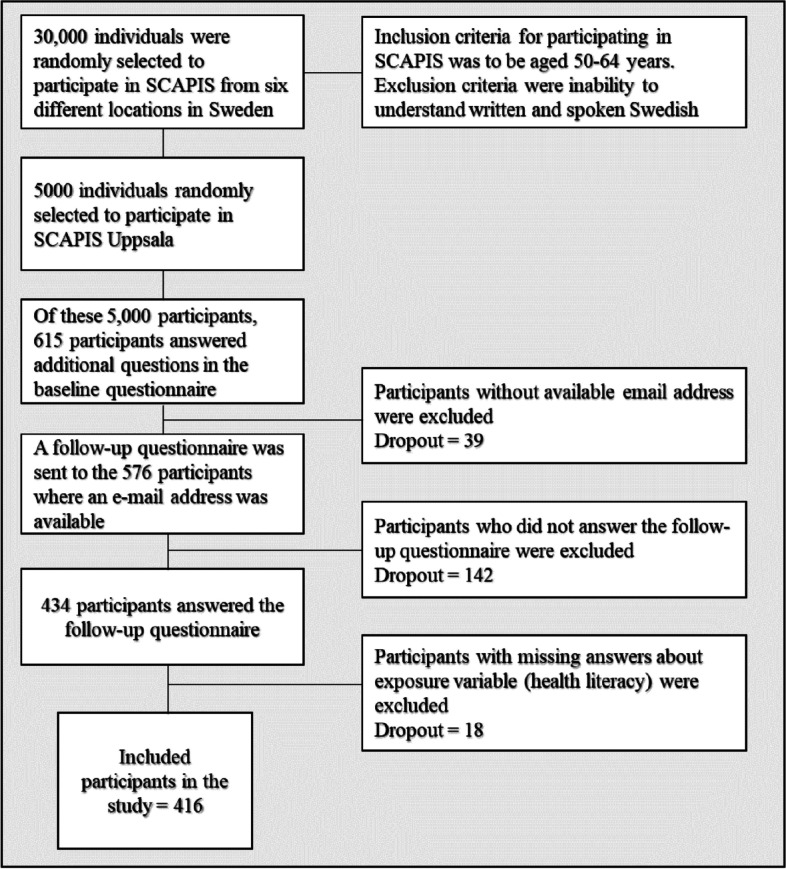
Background: The benefits of digital development in health care may be obscured by unequal opportunities to make use of digital resources. The aim of this study was to investigate the association of health literacy with I) accessing health check test results in the Patient Electronic Health Record (PAEHR), II) searching for information to better understand individual test results, and III) using the national health information online portal provided by the Swedish national health care system. Methods: This cross-sectional study included data from 434 individuals, 50–64 years old, randomly selected from the Swedish population during the year 2017 to a cohort study including health examination and a web-based survey. Health literacy was assessed at baseline using the Swedish Communicative and Critical Health Literacy scale. Digital information outcomes were assessed after three months. Adjusted odds ratios (ORs) and 95% confidence intervals (CI) for the separate outcomes were computed using logistic regression. Covariates included sex, age, education, country of birth, cardiovascular risk factors at baseline, general health, risk perception, referral, and new cardiovascular risk factors detected at health examination. Results: About a third of the participants (35%) had limited health literacy, while 65% had sufficient health literacy. Sufficient health literacy was associated with accessing the PAEHR (adjusted OR 1.81 95% CI 1.07–3.06) and use of the online national health information portal provided by the Swedish national health care system (adjusted OR 2.91 95% CI 1.13–7.52) but not with searching information to better understand individual test results (adjusted OR 1.29 0.75–2.20). Conclusions: Individuals with limited health literacy do not access their personal health information nor search for health information on the online national health information portal provided by the Swedish national health care system to the same extent as individuals with sufficient health literacy. More research is needed about how the level of health literacy relates to differences in online health information-seeking behavior and how digital health information sources and e-health services can be designed to ensure that the entire population has equal access to trustworthy and quality-ensured health information.
Overview
The claims and statistics of this paper haven’t been checked yet.
Free: it reads the open-access text and checks the first 5 claims that cite a source we can check. Create a free account to check every claim.
Integrity signals
Registry
Cites
Statistics
Figures
Verification
Claims the paper makes
The claims and statistics of this paper haven’t been checked yet.
Free: it reads the open-access text and checks the first 5 claims that cite a source we can check. Create a free account to check every claim.
Claims other papers make about this one
Each is checked against this paper’s own text: does it say what the citing paper says it does?
The source backs part of the claim, not all of it — or backs it for a different population, condition or comparison.
In the citing paper
“The finding that three quarters of students (75.43%) rely on social media as their primary health information source is noteworthy, yet consistent with the existing literature (7, 19, 47).”
From Health misinformation, digital health literacy, and attitudes toward science among university students: an exploratory cross-sectional survey (2026) · cites this paper as [47]
Experimental — accuracy not yet measured
Self-check
Percentages, sums and reported differences re-computed from the paper’s own numbers.
The self-check needs the paper’s full text.
Citations
Cites
Harrell, F. E. (2001) · Springer Series in Statistics · doi:10.1007/978-1-4757-3462-1 · Cited by 9,195
Health literacy and public health: A systematic review and integration of definitions and models
Sørensen, K., Van den Broucke, S., Fullam, J., Doyle, G., Pelikan, J., Slonska, Z., Brand, H., & (HLS-EU) Consortium Health Literacy Project European (2012) · BMC Public Health · doi:10.1186/1471-2458-12-80 · Cited by 6,213
Health literacy in Europe: Comparative results of the european health literacy survey (HLS-EU)
Sørensen, K., Pelikan, J. M., Röthlin, F., Ganahl, K., Slonska, Z., Doyle, G., Fullam, J., Kondilis, B., Agrafiotis, D., Uiters, E., et al. (2015) · The European Journal of Public Health · doi:10.1093/eurpub/ckv043 · Cited by 2,651
Understanding and Responding to Health Literacy as a Social Determinant of Health
Nutbeam, D., & Lloyd, J. E. (2021) · Annual Review of Public Health · doi:10.1146/annurev-publhealth-090419-102529 · Cited by 1,178 · cited 6×
“Nutbeam and Lloyd describe functional health literacy as the basic-level skills needed to obtain relevant health information and use that knowledge for specific health-related activities [7].”
BackgroundInfluentialStormacq, C., Van den Broucke, S., & Wosinski, J. (2019) · Health Promotion International · doi:10.1093/heapro/day062 · Cited by 928 · cited 1×
“Older adults and people with a different ethnicity than the majority population [8, 11] also have more limited health literacy compared to others.”
BackgroundKontos, E., Blake, K. D., Chou, W.-Y. S., & Prestin, A. (2014) · Journal of Medical Internet Research · doi:10.2196/jmir.3117 · Cited by 917
Health literacy interventions and outcomes: an updated systematic review.
Berkman, N. D., Sheridan, S., Donahue, K. E., Halpern, D. J., Viera, A. J., Crotty, K., Holland, A. L., Brasure, M., Lohr, K. N., Harden, E. A., et al. (2011) · PubMed Central · Cited by 909
Why Representativeness Should Be Avoided
Rothman, K. J., Gallacher, J. E., & Hatch, E. E. (2013) · International Journal of Epidemiology · doi:10.1093/ije/dys223 · Cited by 861
eHealth Literacy: Extending the Digital Divide to the Realm of Health Information
Neter, E., & Brainin, E. (2012) · Journal of Medical Internet Research · doi:10.2196/jmir.1619 · Cited by 843
Patient Portals and Patient Engagement: A State of the Science Review
Irizarry, T., DeVito Dabbs, A., & Curran, C. R. (2015) · Journal of Medical Internet Research · doi:10.2196/jmir.4255 · Cited by 732
Schulz, P. J., & Nakamoto, K. (2013) · Patient Education and Counseling · doi:10.1016/j.pec.2012.09.006 · Cited by 459
The Swedish CArdioPulmonary BioImage Study: objectives and design
Bergström, G., Berglund, G., Blomberg, A., Brandberg, J., Engström, G., Engvall, J., Eriksson, M., de Faire, U., Flinck, A., Hansson, M. G., et al. (2015) · Journal of Internal Medicine · doi:10.1111/joim.12384 · Cited by 455
New technologies, new disparities: The intersection of electronic health and digital health literacy
Smith, B., & Magnani, J. W. (2019) · International Journal of Cardiology · doi:10.1016/j.ijcard.2019.05.066 · Cited by 446 · cited 3×
“Using sound and images can help individuals with lower levels of health literacy to understand health information [2].”
BackgroundMethodInfluentialSarkar, U., Karter, A. J., Liu, J. Y., Adler, N. E., Nguyen, R., López, A., & Schillinger, D. (2010) · Journal of Health Communication · doi:10.1080/10810730.2010.499988 · Cited by 366
Media Health Literacy, eHealth Literacy, and the Role of the Social Environment in Context
Levin-Zamir, D., & Bertschi, I. (2018) · International Journal of Environmental Research and Public Health · doi:10.3390/ijerph15081643 · Cited by 360
Ishikawa, H., Nomura, K., Sato, M., & Yano, E. (2008) · Health Promotion International · doi:10.1093/heapro/dan017 · Cited by 333
Health literacy among refugees in Sweden – a cross-sectional study
Wångdahl, J., Lytsy, P., Mårtensson, L., & Westerling, R. (2014) · BMC Public Health · doi:10.1186/1471-2458-14-1030 · Cited by 231
Self-citationHealth Information-Seeking in the Digital Age
Percheski, C., & Hargittai, E. (2011) · Journal of American College Health · doi:10.1080/07448481.2010.513406 · Cited by 217
Bo, A., Friis, K., Osborne, R. H., & Maindal, H. T. (2014) · BMC Public Health · doi:10.1186/1471-2458-14-1095 · Cited by 213
Suka, M., Odajima, T., Okamoto, M., Sumitani, M., Igarashi, A., Ishikawa, H., Kusama, M., Yamamoto, M., Nakayama, T., & Sugimori, H. (2015) · Patient Education and Counseling · doi:10.1016/j.pec.2015.02.013 · Cited by 210
Health literacy and the use of healthcare services in Belgium
Vandenbosch, J., Van den Broucke, S., Vancorenland, S., Avalosse, H., Verniest, R., & Callens, M. (2016) · Journal of Epidemiology and Community Health · doi:10.1136/jech-2015-206910 · Cited by 184
Role of Health Literacy in Health-Related Information-Seeking Behavior Online: Cross-sectional Study
Lee, H. Y., Jin, S. W., Henning-Smith, C., Lee, J., & Lee, J. (2021) · Journal of Medical Internet Research · doi:10.2196/14088 · Cited by 180
The learning-by-doing principle.
Reese, H. W. (2011) · Behavioral Development Bulletin · doi:10.1037/h0100597 · Cited by 179
Moll, J., Rexhepi, H., Cajander, Å., Grünloh, C., Huvila, I., Hägglund, M., Myreteg, G., Scandurra, I., & Åhlfeldt, R.-M. (2018) · Journal of Medical Internet Research · doi:10.2196/jmir.9492 · Cited by 171
Trezona, A., Dodson, S., & Osborne, R. H. (2017) · BMC Health Services Research · doi:10.1186/s12913-017-2465-z · Cited by 163
“What does it mean?”: Uncertainties in understanding results of chromosomal microarray testing
Reiff, M., Bernhardt, B. A., Mulchandani, S., Soucier-Ernst, D., Cornell, D., Pyeritz, R. E., & Spinner, N. B. (2012) · Genetics in Medicine · doi:10.1038/gim.2011.52 · Cited by 122
Wångdahl, J. M., Lytsy, P., Mårtensson, L. I., & Westerling, R. (2018) · International Journal of Public Health · doi:10.1007/s00038-017-1074-2 · Cited by 119
Self-citationBlomstedt, Y., Norberg, M., Stenlund, H., Nyström, L., Lönnberg, G., Boman, K., Wall, S., & Weinehall, L. (2015) · BMJ Open · doi:10.1136/bmjopen-2015-009651 · Cited by 95
Suri, V. R., Majid, S., Chang, Y., & Foo, S. S.-B. (2015) · Patient Education and Counseling · doi:10.1016/j.pec.2015.12.017 · Cited by 87
Patient Challenges and Needs in Comprehending Laboratory Test Results: Mixed Methods Study
Zhang, Z., Citardi, D., Xing, A., Luo, X., Yu, L., & He, Z. (2020) · Journal of Medical Internet Research · doi:10.2196/18725 · Cited by 78
Maria, H., & Scandurra, I. (2017) · Studies in health technology and informatics · doi:10.3233/978-1-61499-830-3-723 · Cited by 70
Link, E., Baumann, E., & Klimmt, C. (2021) · Journal of Medical Internet Research · doi:10.2196/25963 · Cited by 66
Hemsley, B., Rollo, M. E., Georgiou, A., Balandin, S., & Hill, S. (2017) · Patient Education and Counseling · doi:10.1016/j.pec.2017.07.010 · Cited by 65
The Communicative and Critical Health Literacy Scale – Swedish Version
Wångdahl, J. M., & Mårtensson, L. I. (2014) · Scandinavian Journal of Public Health · doi:10.1177/1403494813500592 · Cited by 56
Self-citationFriis, K., Pedersen, M. H., Aaby, A., Lasgaard, M., & Maindal, H. T. (2020) · European Journal of Public Health · doi:10.1093/eurpub/ckaa064 · Cited by 49
Socio‐demographic characteristics affect health information seeking on the Internet in Turkey
Demirci, Ş., Uğurluoğlu, Ö., Konca, M., & Çakmak, C. (2021) · Health Information & Libraries Journal · doi:10.1111/hir.12358 · Cited by 49
Lee, H. Y., Kim, S., Neese, J. A., & Lee, M. H. (2021) · Archives of Public Health · doi:10.1186/s13690-021-00556-w · Cited by 38
Bonander, C., Nilsson, A., Björk, J., Blomberg, A., Engström, G., Jernberg, T., Sundström, J., Östgren, C. J., Bergström, G. M. L., & Strömberg, U. (2022) · PLoS ONE · doi:10.1371/journal.pone.0265088 · Cited by 33
Morimoto, A., Koh, C., Yasumoto, R., Furuki, H., Watanabe, K., 都筑, 千., & Sonoda, N. (2022) · Preventive Medicine · doi:10.1016/j.ypmed.2022.107112 · Cited by 26
Grauman, Å., Veldwijk, J., James, S. K., HANSSON, M. G., & Byberg, L. (2021) · European Journal of Cardiovascular Nursing · doi:10.1093/eurjcn/zvab019 · Cited by 25
Self-citationGrauman, Å., HANSSON, M. G., James, S. K., Veldwijk, J., & Höglund, A. T. (2019) · Patient Education and Counseling · doi:10.1016/j.pec.2019.03.010 · Cited by 16
Self-citationHow can communities and organisations improve their health literacy?
Lloyd, J. E., Thomas, L., Davies, G. P., Osten, R., & Harris, M. (2018) · Public Health Research & Practice · doi:10.17061/phrp2821809 · Cited by 13
Jaensson, M., Stenberg, E., Liang, Y., Nilsson, U. G., & Dahlberg, K. (2021) · BMJ Open · doi:10.1136/bmjopen-2021-056592 · Cited by 13
Short-term mental distress in research participants after receiving cardiovascular risk information
Grauman, Å., HANSSON, M. G., Puranen, A., James, S. K., & Veldwijk, J. (2019) · PLoS ONE · doi:10.1371/journal.pone.0217247 · Cited by 5
Self-citation
Research works printed but not linked: 2
- The HLS19 Consortium of the WHO Action Network M-POHL International Report on the Methodology, Results, and Recommendations of the European Health Literacy Population Survey 2019–2021 (HLS19) of M-POHL 2021 Vienna Austrian National Public Health Institute
- OECD Internet access (indicator) 2022
Cited by
Digital health literacy—a key factor in realizing the value of digital transformation in healthcare
Andersson, S. W., & González, M. M. P. (2025) · Frontiers in Digital Health · doi:10.3389/fdgth.2025.1461342 · Cited by 98
Digitalization in the Russian healthcare: barriers to digital maturity
GRIGORIEVA, N. S., Демкина, А. Е., & Николаевна, К. А. (2024) · Population and Economics · doi:10.3897/popecon.8.e111793 · Cited by 30
Dynamic fog computing for enhanced LLM execution in medical applications
Zagar, P., Ravi, V., Aalami, L. R., Krusche, S., Aalami, O., & Schmiedmayer, P. (2025) · Smart Health · doi:10.1016/j.smhl.2025.100577 · Cited by 29
Ren, Z., Xia, S., Sun, J., Wang, D., Du, Y., Li, N., & Liu, J. (2023) · Globalization and Health · doi:10.1186/s12992-023-00984-z · Cited by 28
Philpot, L. M., Ramar, P., Roellinger, D. L., Njeru, J. W., & Ebbert, J. O. (2024) · JMIR Formative Research · doi:10.2196/56493 · Cited by 25
Metadata
- Authors
- Sundell, E., Wångdahl, J., & Grauman, Å.
- Affiliations
- Uppsala University (SE)
- Corresponding author
- Grauman, Åsa
- Venue
- BMC Public Health
- Published
- 2022-12-05
- Volume
- 22
- Issue
- 1
- Pages
- 2278-2278
- ISSN
- 1471-2458 (ISSN-L)
- PMC
- PMC9724302
- OpenAlex
- W4311201186
- Cited by
- 56
- References
- 44
- Citations by year
- 2026: 18 · 2025: 15 · 2024: 19 · 2023: 4
- FWCI
- 10.89
- Type
- journal article
- Language
- en
- Open access
- gold
- doi.org
- Licence
- cc-by
- creativecommons.org/licenses/by/4.0 (tdm)
- creativecommons.org/licenses/by/4.0 (vor)
- Locations
- BMC Public Health (publishedVersion, cc-by)
- PubMed Central (publishedVersion, cc-by)
- PubMed (publishedVersion)
- Uppsala University Publications (Uppsala University) (submittedVersion, other-oa)
- DOAJ (DOAJ: Directory of Open Access Journals) (submittedVersion, cc-by-sa)
- Funders
- Hjärt-Lungfonden (20150049)
- Uppsala University
- Topics
- Health Sciences › Health Professions › General Health Professions › Health Literacy and Information Accessibility
- Health Sciences › Health Professions › Health Information Management › Electronic Health Records Systems
- Health Sciences › Health Professions › Health Information Management › Health, Technology, Consumer Behavior
- Keywords
- health literacy, cardiovascular risk factors, digital divide, e-health services
- MeSH terms
- Cross-Sectional Studies, Humans, Middle Aged, Surveys and Questionnaires, Sweden, Cohort Studies, Telemedicine, Internet, Health Literacy, Information Seeking Behavior
About these checks
Registry, retraction, Cites and statistics results are computed, not judged, with one exception: a printed reference that no index lists is read once by a model before it counts as a citation error. Claims are extracted by a model and kept only when their quote appears verbatim in the text; each cited source is then checked, with a model’s help, for whether it says what the claim relies on. Those verdicts can be wrong — read the claim’s quote and the cited source before relying on one.
Statistics and arithmetic are recomputed, not judged.
Confidence bands are shown only for fields calibrated on our annotated test set. None is calibrated yet, so no band is shown.
What counts as a claim ›How we measure confidence ›How we check this ›
Are you an author, or do you see a problem with this page? Request a review
Data sources
Bibliographic data: Semantic Scholar, OpenAlex, Crossref.
Contains information from the Semantic Scholar Academic Graph Datasets, made available under the ODC Attribution License (ODC-BY 1.0).
Semantic Scholar’s data is described in: Kinney, R., et al. (2023). The Semantic Scholar Open Data Platform. arXiv:2301.10140.
