

The DOI matches its Crossref record; 1 of the 1 references it cites were found in a registry or an index.
Fire-severity effects on plant–fungal interactions after a novel tundra wildfire disturbance: implications for arctic shrub and tree migration
Open accessAbstract
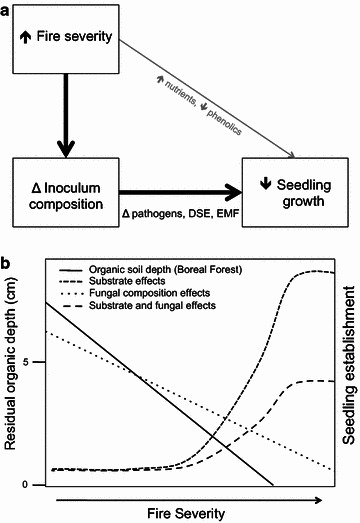
BACKGROUND: Vegetation change in high latitude tundra ecosystems is expected to accelerate due to increased wildfire activity. High-severity fires increase the availability of mineral soil seedbeds, which facilitates recruitment, yet fire also alters soil microbial composition, which could significantly impact seedling establishment. RESULTS: We investigated the effects of fire severity on soil biota and associated effects on plant performance for two plant species predicted to expand into Arctic tundra. We inoculated seedlings in a growth chamber experiment with soils collected from the largest tundra fire recorded in the Arctic and used molecular tools to characterize root-associated fungal communities. Seedling biomass was significantly related to the composition of fungal inoculum. Biomass decreased as fire severity increased and the proportion of pathogenic fungi increased. CONCLUSIONS: Our results suggest that effects of fire severity on soil biota reduces seedling performance and thus we hypothesize that in certain ecological contexts fire-severity effects on plant-fungal interactions may dampen the expected increases in tree and shrub establishment after tundra fire.
Overview
The claims and statistics of this paper haven’t been checked yet.
Run the check — free, no account needed. It reads the open-access text and checks the sources it cites.
Integrity signals
Registry
Cites
Statistics
Figures
Verification
Claims the paper makes
The claims and statistics of this paper haven’t been checked yet.
Run the check — free, no account needed. It reads the open-access text and checks the sources it cites.
Claims other papers make about this one
Each is checked against this paper’s own text: does it say what the citing paper says it does?
The source backs part of the claim, not all of it — or backs it for a different population, condition or comparison.
In the citing paper
“However, it is unclear how heterogeneity in fire behaviour determines heterogeneity in soil responses over time, in large part because of the limited studies that investigate fire severity gradients (Adkins et al., 2019;Garcia-Oliva et al., 2018;Hewitt, Hollingsworth, Chapin, & Taylor, 2016;Kolka et al., 2017;Whitman et al., 2019).”
From Fire as a fundamental ecological process: Research advances and frontiers (2020) · cites this paper as Hewitt et al., 2016
Experimental — accuracy not yet measuredThe source backs part of the claim, not all of it — or backs it for a different population, condition or comparison.
In the citing paper
“Dependent on the duration, magnitude and depth of heat transfer, fire can alter soil in ways that influence vegetation recovery (Brando, Oliveria-Santos, Rocha, Cury, & Coe, 2016;Johnstone, Hollingsworth, Chapin, & Mack, 2010), the structure of invertebrate and microbial communities (Hewitt et al., 2016) and availability of nutrients (Karam, Weisberg, Scheller, Johnson, & Miller, 2013).”
From Fire as a fundamental ecological process: Research advances and frontiers (2020) · cites this paper as Hewitt et al., 2016
Experimental — accuracy not yet measured
Self-check
Percentages, sums and reported differences re-computed from the paper’s own numbers.
The self-check needs the paper’s full text.
Citations
Cites
Increasing shrub abundance in the Arctic
Sturm, M., Racine, C., & Tape, K. (2001) · Nature · doi:10.1038/35079180 · Cited by 1,349
Research works printed but not linked: 59
- Harsch MA, Hulme PE, McGlone MS, Duncan RP. Are treelines advancing? A global meta-analysis of treeline response to climate warming. Ecol Lett. 2009;12(10):1040–9. · DOI · Paper page
- Rupp TS, Chapin FS, Starfield AM. Response of subarctic vegetation to transient climatic change on the Seward Peninsula in north–west Alaska. Glob Change Biol. 2000;6(5):541–55. · DOI
- Hinzman LD, Bettez ND, Bolton WR, Chapin FS, Dyurgerov MB, Fastie CL, Griffith B, Hollister RD, Hope A, Huntington HP, et al. Evidence and implications of recent climate change in northern Alaska and other arctic regions. Clim Change. 2005;72(3):251–98. · DOI
- Harsch MA, Bader MY. Treeline form—a potential key to understanding treeline dynamics. Global Ecol Biogeogr. 2011;20(4):582–96. · DOI
- Myers-Smith IH, Forbes BC, Wilmking M, Hallinger M, Lantz T, Blok D, Tape KD, Macias-Fauria M, Sass-Klaassen U, Levesque E, et al. Shrub expansion in tundra ecosystems: dynamics, impacts and research priorities. Environ Res Lett. 2011;6(4):045509. doi: 10.1088/1748-9326/6/4/045509 . · DOI · Paper page
- Klironomos JN. Feedback with soil biota contributes to plant rarity and invasiveness in communities. Nature. 2002;417(6884):67–70. · DOI
- Horton TR, Bruns TD, Parker VT. Ectomycorrhizal fungi associated with Arctostaphylos contribute to Pseudotsuga menziesii establishment. Can J Bot. 1999;77(1):93–102.
- Nunez MA, Horton TR, Simberloff D. Lack of belowground mutualisms hinders Pinaceae invasions. Ecology. 2009;90(9):2352–9. · DOI
- Booth MG. Mycorrhizal networks mediate overstorey-understorey competition in a temperate forest. Ecol Lett. 2004;7(7):538–46. · DOI
- Horton TR, van der Heijden MGA. The role of symbioses in seedling establishment and survival. In: Leck MA, Parker VT, Simpson RL, editors. Seedling ecology and evolution. Cambridge: Cambridge University Press; 2008. p. 189–213. · DOI
- Smith SE, Read DJ. Mycorrhizal Symbiosis. 3rd ed. New York: Academic Press; 2008.
- Newsham KK. A meta-analysis of plant responses to dark septate root endophytes. New Phytol. 2011;190(3):783–93. · DOI
- Mandyam K, Jumpponen A. Seeking the elusive function of the root-colonising dark septate endophytic fungi. Stud Mycol. 2005;53:173–89. · DOI
- Mandyam KG, Jumpponen A. Mutualism-parasitism paradigm synthesized from results of root-endophyte models. Front Microbiol. 2014;5:776. doi: 10.3389/fmicb.2014.00776 . · DOI
- Janzen DH. Herbivores and the number of tree species in tropical forests. Am Nat. 1970;104:501–28. · DOI
- Connell JH. On the role of natural enemies in preventing competitive exclusion in some marine animals and in rain forest trees. In: Den Boer PJ, Gradwell GR, editors. Dynamics of population: proceedings of the advanced study institute on dynamics of numbers of populations. Wageningen: Center for Agricultural Publishing and Documentation; 1971. p. 298–312.
- Mangan SA, Schnitzer SA, Herre EA, Mack KML, Valencia MC, Sanchez EI, Bever JD. Negative plant-soil feedback predicts tree-species relative abundance in a tropical forest. Nature. 2010;466(7307):752–5. · DOI
- Johnstone JF, Chapin FS, Hollingsworth TN, Mack MC, Romanovsky V, Turetsky M. Fire, climate change, and forest resilience in interior Alaska. Can J For Res-Rev Can Rech For. 2010;40(7):1302–12. · DOI
- Lantz TC, Gergel SE, Henry GHR. Response of green alder (Alnus viridis subsp fruticosa) patch dynamics and plant community composition to fire and regional temperature in north-western Canada. J Biogeogr. 2010;37(8):1597–610. · DOI
- Racine C, Jandt R, Meyers C, Dennis J. Tundra fire and vegetation change along a hillslope on the Seward Peninsula, Alaska, USA. Arct Antarct Alp Res. 2004;36(1):1–10. · DOI
- Higuera PE, Brubaker LB, Anderson PM, Brown TA, Kennedy AT, Hu FS. Frequent fires in ancient shrub tundra: implications of paleorecords for arctic environmental change. PLoS One. 2008;3(3):e0001744. · DOI
- Hu FS, Higuera PE, Walsh JE, Chapman WL, Duffy PA, Brubaker LB, Chipman ML. Tundra burning in Alaska: linkages to climatic change and sea ice retreat. J Geophys Res Biogeosci 2010;115(G04002, doi: 10.1029/2009JG001270 .):G04002. · DOI
- Landhausser SM, Wein RW. Postfire vegetation recovery and tree establishment at the arctic treeline: climate-change-vegetation-response hypotheses. J Ecol. 1993;81(4):665–72. · DOI
- Neary DG, Klopatek CC, DeBano LF, Ffolliott PF. Fire effects on belowground sustainability: a review and synthesis. For Ecol Manage. 1999;122(1–2):51–71. · DOI · Paper page
- Timling I, Walker DA, Nusbaum C, Lennon NJ, Taylor DL. Rich and cold: diversity, distribution and drivers of fungal communities in patterned-ground ecosystems of the North American Arctic. Mol Ecol. 2014;23(13):3258–72. · DOI
- Timling I, Dahlberg A, Walker DA, Gardes M, Charcosset JY, Welker JM, Taylor DL. Distribution and drivers of ectomycorrhizal fungal communities across the North American Arctic. Ecosphere 2012;3(11). (3:art111). http://dx.doi.org/110.1890/ES1812-00217.00211 . · DOI
- Timling I, Taylor DL. Peeking through a frosty window: molecular insights into the ecology of Arctic soil fungi. Fungal Ecol. 2012;5(4):419–29. · DOI
- Smith JE, McKay D, Brenner G, McIver J, Spatafora JW. Early impacts of forest restoration treatments on the ectomycorrhizal fungal community and fine root biomass in a mixed conifer forest. J Appl Ecol. 2005;42(3):526–35. · DOI
- Treseder K, Mack M, Cross A. Relationships among fires, fungi and soil dynamics in Alaskan boreal forests. Ecol Appl. 2004;14:1826–38. · DOI
- Taylor DL, Bruns TD. Community structure of ectomycorrhizal fungi in a Pinus muricata forest: minimal overlap between the mature forest and resistant propagule communities. Mol Ecol. 1999;8:1837–50. · DOI
- Parker TJ, Clancy KM, Mathiasen RL. Interactions among fire, insects and pathogens in coniferous forests of the interior western United States and Canada. Agric For Entomol. 2006;8(3):167–89. · DOI
- Johnstone JF, Hollingsworth TN, Chapin FS, Mack MC. Changes in fire regime break the legacy lock on successional trajectories in Alaskan boreal forest. Glob Chang Biol. 2010;16(4):1281–95. · DOI
- Hewitt RE, Bent E, Hollingsworth TN, Chapin FS, Taylor DL. Resilience of Arctic Mycorrhizal fungal communities after wildfire facilitated by resprouting shrubs. Ecoscience. 2013;20(3):296–310. · DOI
- Lloyd AH, Fastie CL, Eisen H. Fire and substrate interact to control the northern range limit of black spruce (Picea mariana) in Alaska. Can J For Res Rev Can Rech For. 2007;37(12):2480–93. · DOI
- Hollingsworth T, Walker M, Chapin F III, Parsons A. Scale-dependent environmental controls over species composition in Alaskan black spruce communities. Can J For Res. 2006;36:1781–96. · DOI
- Molina R, Massicotte H, Trappe JM. Specificity phenomena in mycorrhizal symbioses: community-ecological consequences and practical implications. In: Allen MF, editor. Mycorrhizal functioning: an integrative plant-fungal process. New York: Chapman and Hall; 1992. p. 357–423.
- Mack MC, Bret-Harte MS, Hollingsworth TN, Jandt RR, Schuur EAG, Shaver GR, Verbyla DL. Carbon loss from an unprecedented Arctic tundra wildfire. Nature. 2011;475(7357):489–92. · DOI
- Viereck LA, Dyrness CT, Batten AR, Wenzlick KJ. The Alaska vegetation classification. In: General technical report PNW-GTR-286. Portland: U.S. Department of Agriculture, Forest Service, Pacific Northwest Research Station; 1992. p. 278. · DOI
- Hewitt RE. Fire-severity effects on plant–fungal interactions: implications for Alaskan treeline dynamics in a warming climate. Ph.D. thesis. Fairbanks: University of Alaska Fairbanks; 2014.
- Hewitt RE, Chapin III FS, Hobbie SE, Hollingsworth TN, Taylor DL. Ectomycorrhizal shrub and seedling interactions facilitate tree establishment after wildfire at Alaska arctic treeline. (in review).
- Bent E, Taylor DL. Direct amplification of DNA from fresh and preserved ectomycorrhizal root tips. J Microbiol Methods. 2010;80(2):206–8. · DOI
- Bent E, Kiekel P, Brenton R, Taylor DL. Root-associated ectomycorrhizal fungi shared by various boreal forest seedlings naturally regenerating after a fire in interior Alaska and correlation of different fungi with host growth responses. Appl Environ Microbiol. 2011;77(10):3351–9. · DOI
- Hewitt R. Fire-severity effects on plant-fungal interactions after a novel tundra wildfire disturbance: implications for arctic shrub and tree migration. Bonanza Creek LTER. Long Term Ecological Research Network. 2016. doi: 10.6073/pasta/a131c0d6707b6aa746dfe0265141ad43 . · DOI
- Taylor DL, Houston S. A bioinformatics pipeline for sequence-based analyses of fungal biodiversity. In: Xu J-R, Bluhm BH, editors. Fungal genomics, vol. 722. New York: Humana Press; 2011. p. 141–55. · DOI
- Kruskal JB. Nonmetric multidimensional scaling: a numerical method. Psychometrika. 1964;29:115–29. · DOI
- McCune B, Grace JB. Analysis of ecological communities. 2nd ed. Gleneden Beach: MjM Software Design; 2001.
- Berry KJ, Kvamme KL, Mielke PW. Improvements in the permutation test for the spatial-analysis of the distribution of artifacts into classes. Am Antiq. 1983;48(3):547–53. · DOI
- Aylor DE. Spread of plant disease on a continental scale: role of aerial dispersal of pathogens. Ecology. 2003;84(8):1989–97. · DOI
- Peay KG, Schubert MG, Nguyen NH, Bruns TD. Measuring ectomycorrhizal fungal dispersal: macroecological patterns driven by microscopic propagules. Mol Ecol. 2012;21(16):4122–36. · DOI
- Blumenthal D, Mitchell CE, Pysek P, Jarosik V. Synergy between pathogen release and resource availability in plant invasion. Proc Natl Acad Sci USA. 2009;106(19):7899–904. · DOI
- Newsham KK, Upson R, Read DJ. Mycorrhizas and dark septate root endophytes in polar regions. Fungal Ecol. 2009;2(1):10–20. · DOI
- Tellenbach C, Sieber TN. Do colonization by dark septate endophytes and elevated temperature affect pathogenicity of oomycetes? FEMS Microbiol Ecol. 2012;82(1):157–68. · DOI
- Kasischke ES, French NH, Harrell P, Christensen NL, Ustin SL, Barry D. Monitoring of wildfires in boreal forests using large area AVHRR NDVI composite image data. Remote Sens Environ. 1993;45(1):61–71. · DOI
- Wein RW, Bliss LC. Changes in Arctic Eriophorum tussock communities following fire. Ecology. 1973;54:845–52. · DOI
- Castellano MA, Trappe JM, Molina R. Inoculation of container-grown Douglas-fir seedlings with basidiospores of Rhizopogon vinicolor and R. colossus: effects of fertility and spore application rate. Can J For Res. 1985;15(1):10–3. · DOI
- Ishida TA, Nara K, Tanaka M, Kinoshita A, Hogetsu T. Germination and infectivity of ectomycorrhizal fungal spores in relation to their ecological traits during primary succession. New Phytol. 2008;180(2):491–500. · DOI
- Zackrisson O, Nilsson MC, Wardle DA. Key ecological function of charcoal from wildfire in the boreal forest. Oikos. 1996;77(1):10–9. · DOI
- Johnstone JF, Chapin FS. Effects of soil burn severity on post-fire tree recruitment in boreal forest. Ecosystems. 2006;9:14–31. · DOI
- Chapin FS, Sturm M, Serreze MC, McFadden JP, Key JR, Lloyd AH, McGuire AD, Rupp TS, Lynch AH, Schimel JP, et al. Role of land-surface changes in Arctic summer warming. Science. 2005;310(5748):657–60. · DOI
Cited by
Sorted by citations
Fire as a fundamental ecological process: Research advances and frontiers
McLauchlan, K. K., Higuera, P. E., Miesel, J., Rogers, B. M., Schweitzer, J., Shuman, J. K., Tepley, A. J., Varner, J. M., Veblen, T. T., Adalsteinsson, S. A., et al. (2020) · Journal of Ecology · doi:10.1111/1365-2745.13403 · Cited by 729
“…that influence vegetation recovery (Brando, Oliveria-Santos, Rocha, Cury, & Coe, 2016; Johnstone, Hollingsworth, Chapin, & Mack, 2010), the structure of invertebrate and microbial communities (Hewitt et al., 2016) and availability of nutrients (Karam, Weisberg, Scheller, Johnson, & Miller, 2013).”
Self-citation
Metadata
- Authors
- Hewitt, R. E., Hollingsworth, T. N., Stuart Chapin III, F., & Lee Taylor, D.
- Affiliations
- University of Alaska Fairbanks (US)
- US Forest Service (US)
- Corresponding author
- Hewitt, Rebecca E.
- Venue
- BMC Ecology
- Published
- 2016-05-11
- Volume
- 16
- Issue
- 1
- Pages
- 25-25
- ISSN
- 1472-6785 (ISSN-L)
- PMC
- PMC4865011
- OpenAlex
- W2348186826
- Cited by
- 37
- References
- 1
- Citations by year
- 2026: 3 · 2025: 1 · 2024: 3 · 2023: 1 · 2022: 3 · 2021: 10 · 2020: 6 · 2019: 5 · 2018: 2 · 2017: 2 · 2016: 1
- FWCI
- 3.90
- Type
- journal article
- Language
- en
- Open access
- gold
- doi.org
- Licence
- cc-by
- Locations
- BMC Ecology (publishedVersion, cc-by)
- PubMed Central (publishedVersion, cc-by)
- PubMed (publishedVersion)
- Funders
- Alaska EPSCoR (EPS-0701898)
- NSF Graduate Research Fellowship (DGE-0639280 and 1242789)
- Center for Global Change
- Topics
- Life Sciences › Agricultural and Biological Sciences › Plant Science › Mycorrhizal Fungi and Plant Interactions
- Physical Sciences › Environmental Science › Global and Planetary Change › Fire effects on ecosystems
- Life Sciences › Agricultural and Biological Sciences › Soil Science › Soil Carbon and Nitrogen Dynamics
- Keywords
- fire severity, plant-fungal interactions, tree migration, soil microbial communities, root-associated fungi, fungal pathogens, seedling establishment, fungal inoculum
- MeSH terms
- Arctic Regions, Fungi, Plants, Trees, Plant Physiological Phenomena, Tundra
About these checks
Registry, retraction, Cites and statistics results are computed, not judged, with one exception: a printed reference that no index lists is read once by a model before it counts as a citation error. Claims are extracted by a model and kept only when their quote appears verbatim in the text; each cited source is then checked, with a model’s help, for whether it says what the claim relies on. Those verdicts can be wrong — read the claim’s quote and the cited source before relying on one.
Statistics and arithmetic are recomputed, not judged.
Confidence bands are shown only for fields calibrated on our annotated test set. None is calibrated yet, so no band is shown.
What counts as a claim ›How we measure confidence ›How we check this ›
Are you an author, or do you see a problem with this page? Request a review
