

Sex differences in the prevalence and adverse outcomes of sarcopenia and sarcopenic obesity in community dwelling elderly in East China using the AWGS criteria
Open accessThe DOI matches its Crossref record; 49 of the 49 references it cites were found in a registry or an index.
Abstract
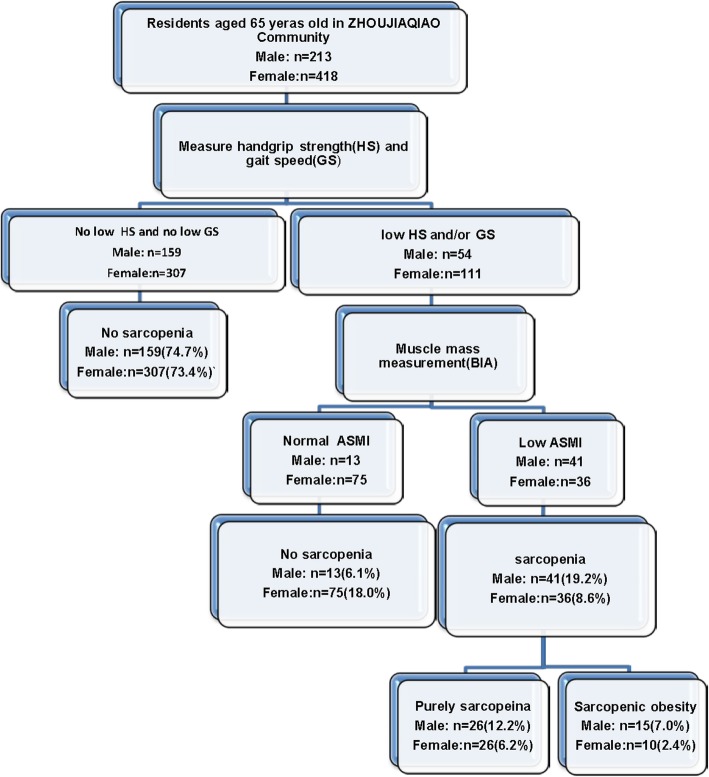
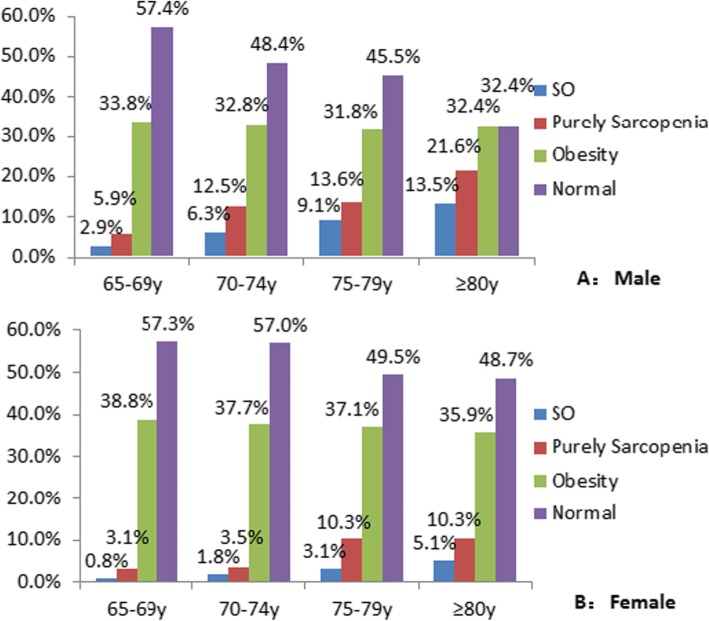
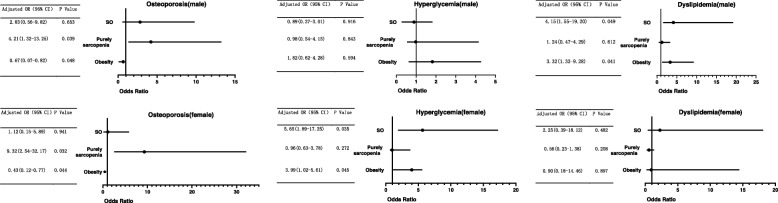
Background: Sarcopenia and sarcopenic obesity (SO) have a greater impact on the elderly. This study aimed to explore whether there were sex differences in the prevalence and adverse outcomes of sarcopenia and SO in community-dwelling elderly individuals in East China. Methods: This was a cross-sectional study that enrolled 213 males and 418 females aged > 65 years. Demographic characteristics, body composition, hand grip, gait speed, and indices of glucose and lipid metabolism were collected. Sarcopenia and SO were diagnosed using the Asian Working Group for Sarcopenia criteria. Results: (1) The prevalence of sarcopenia was 19.2% in males and 8.6% in females. The prevalence of SO was 7.0% in males and 2.4% in females. (2) In males, the odds ratios (ORs) of osteoporosis and dyslipidemia in the SO group were 4.21-fold and 4.15-fold higher than those in the normal group, respectively. In females, the ORs of osteoporosis and hyperglycemia in the SO group were 1.12-fold and 4.21-fold higher than those in the normal group. Conclusions: Males were more likely to be sarcopenic and to have SO than females using the AWGS criteria. Females with SO were more likely to have higher blood glucose, whereas males with SO were more likely to have osteoporosis and dyslipidemia.
Overview
The claims and statistics of this paper haven’t been checked yet.
Free: it reads the open-access text and checks the first 5 claims that cite a source we can check. Create a free account to check every claim.
Integrity signals
Registry
Cites
Statistics
Figures
Verification
Claims the paper makes
The claims and statistics of this paper haven’t been checked yet.
Free: it reads the open-access text and checks the first 5 claims that cite a source we can check. Create a free account to check every claim.
Claims other papers make about this one
Each is checked against this paper’s own text: does it say what the citing paper says it does?
The source backs part of the claim, not all of it — or backs it for a different population, condition or comparison.
In the citing paper
“Sarcopenic obesity has been so far identified through various definitions and diagnostic constructs, but it has been consistently demonstrated to be a strong and independent risk factor for frailty, comorbidities and mortality in various highly prevalent disease conditions, as well as for mortality in the general and especially in the older population [17-19].”
From Definition and Diagnostic Criteria for Sarcopenic Obesity: ESPEN and EASO Consensus Statement (2022) · cites this paper as [19]
Experimental — accuracy not yet measured
Self-check
Percentages, sums and reported differences re-computed from the paper’s own numbers.
The self-check needs the paper’s full text.
Citations
Cites
Sarcopenia: European consensus on definition and diagnosis
Cruz-Jentoft, A. J., Baeyens, J. P., Bauer, J. M., Boirie, Y., Cederholm, T., Landi, F., Martin, F. C., Michel, J.-P., Rolland, Y., Schneider, S. M., et al. (2010) · Age and Ageing · doi:10.1093/ageing/afq034 · Cited by 11,601
The metabolic phenotype in obesity: Fat mass, body fat distribution, and adipose tissue function
Goossens, G. H. (2017) · Obesity Facts · doi:10.1159/000471488 · Cited by 8,481
Sarcopenia in Asia: Consensus Report of the Asian Working Group for Sarcopenia
Chen, L.-K., Liu, L.-K., Woo, J., Assantachai, P., Auyeung, T.-W., Bahyah, K. S., Chou, M.-Y., Chen, L.-Y., Hsu, P.-S., Krairit, O., et al. (2014) · Journal of the American Medical Directors Association · doi:10.1016/j.jamda.2013.11.025 · Cited by 4,051
Fielding, R. A., Vellas, B., Evans, W. J., Bhasin, S., Morley, J. E., Newman, A. B., Abellan van Kan, G., Andrieu, S., Bauer, J., Breuille, D., et al. (2011) · Journal of the American Medical Directors Association · doi:10.1016/j.jamda.2011.01.003 · Cited by 3,256
Studenski, S. A., Peters, K. W., Alley, D. E., Cawthon, P. M., McLean, R. R., Harris, T. B., Ferrucci, L., Guralnik, J. M., Fragala, M. S., Kenny, A. M., et al. (2014) · The Journals of Gerontology: Series A · doi:10.1093/gerona/glu010 · Cited by 2,545
Mitchell, W. K., Williams, J., Atherton, P., Larvin, M., Lund, J., & Narici, M. (2012) · Frontiers in Physiology · doi:10.3389/fphys.2012.00260 · Cited by 1,377
Rosenberg, I. H. (1989) · The American Journal of Clinical Nutrition · doi:10.1093/ajcn/50.5.1231 · Cited by 1,102
Sarcopenic obesity: definition, cause and consequences
Stenholm, S., Harris, T. B., Rantanen, T., Visser, M., Kritchevsky, S. B., & Ferrucci, L. (2008) · Current Opinion in Clinical Nutrition and Metabolic Care · doi:10.1097/mco.0b013e328312c37d · Cited by 1,070
Srikanthan, P., Hevener, A. L., & Karlamangla, A. S. (2010) · PLoS ONE · doi:10.1371/journal.pone.0010805 · Cited by 600
Insulin resistance and sarcopenia: mechanistic links between common co-morbidities
Cleasby, M. E., Jamieson, P. M., & Atherton, P. J. (2016) · Journal of Endocrinology · doi:10.1530/joe-15-0533 · Cited by 596
Cited by
Items 101–176 of 176
Dental Functional Status as a Possible Risk Factor of Sarcopenia: A Computed Tomography‐Based Study
Gürhan, C., & Elibol, F. D. (2024) · Journal of Oral Rehabilitation · doi:10.1111/joor.13896 · Cited by 6
Gu, Q., He, M., He, Y.-Q., Dai, A., Liu, J., Chen, X., & Liu, P. (2023) · Discover Oncology · doi:10.1007/s12672-023-00624-3 · Cited by 6
Han, D. J., Na, K. J., Yun, T., Park, J. H., Na, B., Park, S., Lee, H., Park, I. K., Kang, C. H., & Kim, Y. T. (2025) · Journal of Cardiothoracic Surgery · doi:10.1186/s13019-024-03185-w · Cited by 9
Handajani, Y. S., Schröder‐Butterfill, E., Hengky, A., Sugiyono, S. P., Lamadong, V., & Turana, Y. (2022) · Tzu Chi Medical Journal · doi:10.4103/tcmj.tcmj_175_22 · Cited by 9
“found that males with sarcopenic obesity were more likely to have dyslipidemia [11,12].”
BackgroundVijewardane, S. C., Balasuriya, A., Myint, P. K., & Johnstone, A. M. (2022) · Geriatrics · doi:10.3390/geriatrics7020026 · Cited by 7
Factors Influencing Age-Related Loss of Skeletal Muscle Mass in Young Korean Men
Hwang, J., & Lee, J.-K. (2023) · Journal of the Korean Society of Physical Medicine · doi:10.13066/kspm.2023.18.4.67 · Cited by 5
Thet, D., Lappichetpaiboon, S., Trakultritrung, C., Sotangkur, N., Phonphithak, S., Lwin, H. M. S., Apornpong, T., Han, W. M., Avihingsanon, A., & Siritientong, T. (2024) · Nutrients · doi:10.3390/nu16152540 · Cited by 5
“In contrast, a study conducted in a community-dwelling elderly population showed that males were more likely to be sarcopenic than females [32].”
ResultPatterson, R. A., Cho, N. A., Fernandes, T. S., Tuplin, E. W. N., Lowry, D. E., da Silva, G. R. C. M., & Reimer, R. A. (2024) · Applied Physiology, Nutrition, and Metabolism · doi:10.1139/apnm-2024-0294 · Cited by 8
Shirotori, S., Hasegawa, Y., Nagai, K., Kusunoki, H., Yoshimura, S., Tokumoto, K., Hattori, H., Tamaki, K., Hori, K., Kishimoto, H., et al. (2025) · Diseases · doi:10.3390/diseases13040109 · Cited by 5
“This may be due to sex-based differences in body composition [35], hormonal changes [36], lifestyle factors [37], or oral health behaviors [37].”
Ayçiçek, G. Ş., Baş, A. O., Karabulut, E., & Halil, M. G. (2025) · Acta Clinica Belgica · doi:10.1080/17843286.2025.2583187 · Cited by 5
Vithran, D. T. A., Hassan, M. H. Y., Rahmati, M., Boyer, L., Wehliye, A. A., Xiao, W., & Li, Y. (2026) · Age and Ageing · doi:10.1093/ageing/afag020 · Cited by 5
Chen, J.-H., Chen, J., Chen, Y.-C., & Li, W. (2024) · Frontiers in Endocrinology · doi:10.3389/fendo.2024.1389295 · Cited by 6
Portinha, S. M. A. G., Sá‐Couto, P., & Matos, M. A. (2023) · Geriatric Care · doi:10.4081/gc.2023.10972 · Cited by 7
Detection of Sarcopenia in a Community-Dwelling Older Population in China
Zhang, H. Y., Chong, M. C., Tan, M. P., Chua, Y. P., & Zhang, J. H. (2024) · Journal of Geriatric Physical Therapy · doi:10.1519/jpt.0000000000000388 · Cited by 5
Prevalence of sarcopenia and associated dietary factors among older Chinese adults
Zhou, X., Wu, X., & Zhang, D. (2023) · Saudi Medical Journal · doi:10.15537/smj.2023.44.11.20230371 · Cited by 5
Self-citationHwang, J., & Kim, N.-H. (2023) · Journal of the Korean Society of Physical Medicine · doi:10.13066/kspm.2023.18.4.57 · Cited by 4
Hwang, J. (2023) · Journal of the Korean Society of Physical Medicine · doi:10.13066/kspm.2023.18.4.37 · Cited by 4
Ahn, S., Sung, Y., & Song, W. J. (2024) · Journal of Korean Medical Science · doi:10.3346/jkms.2024.39.e200 · Cited by 6
“3 Research highlights a higher prevalence of sarcopenia among males 4-6 compared to that among females, which is attributed to factors such as the greater initial muscle mass in male, which declines more sharply because of hormonal changes such as testosterone levels.”
BackgroundUsing CT imaging to identify sarcopenia as a risk factor for severe falls in older adults
Fries, N., Kotti, A., Woisetschläger, M., & Spångéus, A. (2025) · BMC Geriatrics · doi:10.1186/s12877-025-05707-0 · Cited by 5
Matsuyama, T., Yamamoto, S., Hashimoto, Y., Murai, M., Kitagawa, N., Hamaguchi, M., & Fukui, M. (2025) · Clinical Nutrition ESPEN · doi:10.1016/j.clnesp.2025.11.158 · Cited by 3
Determinants of dementia risk among older adults with probable sarcopenia and sarcopenia
Lipoeto, N. I., Vanoh, D., Desmawati, D., Ishak, W. R. W., & Mohamed, R. (2025) · BMC Public Health · doi:10.1186/s12889-025-22065-z · Cited by 5
“Meanwhile in women, decreasing muscle mass and function was significant during the early phase of menopause due to rapid decrease in estrogen level [43].”
Alcohol consumption may not be a risk factor for sarcopenia in the older adults
Mao, E.-H., Bu, Y., Liu, Q., Xu, J., Lü, X., Yang, X.-L., Gao, W. Q., & Shen, Z. (2025) · Experimental Biology and Medicine · doi:10.3389/ebm.2025.10520 · Cited by 6
Age, body composition analysis, and gender differences of morbidly obese Omani subjects
Al-Maskari, J., Al-Hadhrami, B., Waly, M. I., Al-Subhi, L., & Ali, A. (2024) · International journal of Nutrition Pharmacology Neurological Diseases · doi:10.4103/ijnpnd.ijnpnd_12_24 · Cited by 3
Son, W.-H., Ha, M., & Park, T. (2024) · Physical Activity and Nutrition · doi:10.20463/pan.2024.0009 · Cited by 5
“This disparity is largely attributed to diminished physical activity (PA) levels and a postmenopausal decline in estrogen levels, which contribute to decreased skeletal muscle mass and increased fat mass 4 .”
BackgroundAssociation between protoporphyrin IX and sarcopenia: a cross sectional study
Kao, C.-C., Yang, Z., & Chen, W. (2021) · BMC Geriatrics · doi:10.1186/s12877-021-02331-6 · Cited by 3
Zou, J., Zhou, N., Li, S., Wang, L., Ran, J., Yang, X. Y., Zhang, M., & Peng, W. (2025) · Scientific Reports · doi:10.1038/s41598-025-94823-3 · Cited by 2
“Studies have consistently shown a higher prevalence of sarcopenia in elderly men compared to women in Chinese communities 20–22 , while the evidence regarding gender differences in Western countries is controversial 23 .”
de Lima, A. B., Merchant, R. A., Faber, M. A., & Henriques‐Neto, D. (2026) · Maturitas · doi:10.1016/j.maturitas.2026.108869 · Cited by 2
A clinician's guide to the management of geriatric musculoskeletal disease: Part 2 – Sarcopenia
Tripodi, N., Wright, B., Lawton, A., Zanker, J., & Feehan, J. (2022) · International journal of osteopathic medicine · doi:10.1016/j.ijosm.2022.05.003 · Cited by 4
Park, J. H., Noh, K.-W., Kong, S., Kim, Y.-R., Oh, J., Seong, K. H., & Park, S. (2022) · Educational Gerontology · doi:10.1080/03601277.2022.2109894 · Cited by 3
Hwang, J. (2024) · Journal of the Korean Society of Physical Medicine · doi:10.13066/kspm.2024.19.1.31 · Cited by 3
Prevalence of Sarcopenic Obesity in Elderly Population: A Meta-Analysis
Rupolo, V. L., Camargo, T. L., Pureza, I. R. D. O. M., Beretta, M. V., & Garcêz, A. (2024) · Current Aging Science · doi:10.2174/0118746098331277241101025928 · Cited by 2
Santos, O. N. B., Silva, B. Y. D. C., Chaves, T. A. L., Oliveira, O. K. V., da Silva, J. K., & de Castro, S. N. R. (2021) · Braspen Journal · doi:10.37111/braspenj.2020354010 · Cited by 59
Povoroznyuk, V. V., Dedukh, N. V., Bystrytska, M. А., Dzerovych, N. I., & Shapovalov, V. S. (2021) · Medicni perspektivi · doi:10.26641/2307-0404.2021.2.234637 · Cited by 2
Obesity with Chinese Characteristics? Prevalence and Determinants of Overweight and Obesity in China
Gu, J., Yuan, Y., Land, K. C., & Fu, Q. (2022) · International handbooks of population · doi:10.1007/978-3-031-10936-2_5 · Cited by 1
Hipolitus, D., Handaya, A. Y., & Barmawi, A. (2022) · Bali Medical Journal · doi:10.15562/bmj.v12i1.3706 · Cited by 2
Prevención de la sarcopenia en el paciente adulto mayor con obesidad.
Taipe, D. B. C., & Teneda, A. C. C. (2023) · Ciencia Latina Revista Científica Multidisciplinar · doi:10.37811/cl_rcm.v7i1.4761 · Cited by 4
Evaluation of Sarcopenia in Patients with Monoclonal Gammopathy of Undetermined Significance
Kul, A. N., & Tuna, M. K. (2024) · Journal of Clinical Medicine · doi:10.3390/jcm13123458 · Cited by 1
“Sex differences have been reported rather frequently in both MGUS and sarcopenic patients, including adverse outcomes, with higher predisposition among males [23,24].”
BackgroundTolonen, A., Lehtomäki, K., Kerminen, H., Huhtala, H., Barlund, M. T., Osterlund, P. J., & Arponen, O. (2024) · Journal of Geriatric Oncology · doi:10.1016/j.jgo.2024.102171 · Cited by 1
Asano, K., Tachibana, K., Shinoda, S., & Nakamura, T. (2025) · Supportive Care in Cancer · doi:10.1007/s00520-025-09751-9 · Cited by 3
“In contrast, Du et al. [34] demonstrated that the prevalence rates of sarcopenia in older adults aged ≥ 65 years were 19.2% and 8.6% in men and women.”
InfluentialPrevalence of Sarcopenia in a Cosmopolitan City in Eastern India
Agarwal, S., Chakroborty, A., Chaudhuri, G. R., Basak, T., Sur, M., & Chattopadhyay, R. (2025) · Journal of Society of Indian Physiotherapists · doi:10.4103/jsip.jsip_6_25 · Cited by 1
Kandayah, T., Safian, N., & Shah, S. A. (2025) · PeerJ · doi:10.7717/peerj.20175 · Cited by 3
“This could be due to the rapid reduction in testosterone and insulin-like growth factor-1 levels in elderly men which leads to loss of muscle mass and strength ( Du et al., 2019 ).”
Xu, D., Wu, J., Zhu, Y., Guo, J., & Li, Y. (2026) · Journal of International Medical Research · doi:10.1177/03000605251413087 · Cited by 1
“20,21 This inherent difference may partially buffer the adverse effects associated with elevated RAR in women.”
Age, Not Sex, Drives Sarcopenia Severity in Mexican Older Adults with a Health Insurance Plan
Castillo-Vázquez, S. K., Rivero-Segura, N. A., Gómez-Verján, J. C., Camacho, J., & Hernández-Pando, D. (2026) · Geriatrics · doi:10.3390/geriatrics11040077 · Cited by 1
“Our results from the SPPB are contrary to those previously reported in the literature, which mention that women are prone to functional limitations and sarcopenic obesity [36].”
Awotidebe, A. W., Bala, A., & Abdulkarim, K. (2022) · Physiotherapy Quarterly · doi:10.5114/pq.2022.121148 · Cited by 1
Sarcopenia, obesity, and their association with selected behavioral factors in active older adults
Teraž, K., Kalc, M., Peskar, M., Pišot, S., Šimunič, B., Pišot, R., & Pori, P. (2022) · Frontiers in Physiology · doi:10.3389/fphys.2023.1129034 · Cited by 3
Hwang, J. (2024) · Journal of the Korean Society of Physical Medicine · doi:10.13066/kspm.2024.19.3.37 · Cited by 1
Li, M., Li, Y.-M., Huang, J.-J., Wang, Z., Wang, Q., Zhao, C., Lu, X., Xu, J., Shen, Z., & Gao, W. (2025) · Experimental Gerontology · doi:10.1016/j.exger.2025.112865 · Cited by 2
Puspitarini, E. D., & Prijambodo, P. (2022) · Biomolecular and Health Science Journal · doi:10.20473/bhsj.v5i1.35279 · Cited by 2
Lee, S.-Y., Gim, J., Kim, S. C., Baek, K., & Yoo, J. (2022) · Research Square · doi:10.21203/rs.3.rs-2103290/v1
Gene co-expression networks reveal sex-biased differences in musculoskeletal ageing
Olascoaga, S., Tovar, H., & Enríquez, J. E. (2024) · Frontiers in Aging · doi:10.3389/fragi.2024.1469479
Son, W. H., Park, H. T., Jeon, B. H., & Ha, M. (2024) · Physical Activity and Nutrition · doi:10.20463/pan.2024.0024
“Older women experience lower physical activity levels and significant hormonal changes before and after menopause, leading to a decreased lean body mass and increased body fat mass 3 , increasing the risk of obesity.”
BackgroundZhuravlyova, L., Кривоносова, О. М., & Zhuravlyova, A. K. (2025) · PROBLEMS OF ENDOCRINE PATHOLOGY · doi:10.21856/j-pep.2025.2.07
Kim, J., Byon, H. D., Platz, K., Toledo, G., & Howie‐Esquivel, J. (2025) · Heart & Lung · doi:10.1016/j.hrtlng.2025.09.003
Association Between Serum Magnesium and Muscle Mass in People With Type 2 Diabetes Mellitus
Pei, L.-L., Yang, Q., Liu, Y., & Hu, W. (2025) · International Journal of Endocrinology · doi:10.1155/ije/9939748 · Cited by 1
“Our result was consistent with the Chinese epidemiological survey that the prevalence of low muscle mass in males is higher than in females [18].”
Luo, Y., Wang, Y., Tang, S., Xu, L., Zhao, X., Han, M., Liu, Y., Xu, Y., & Han, B. (2024) · Figshare · doi:10.6084/m9.figshare.26709950
Damanti, S., Citterio, L., Zagato, L., Brioni, E., Magnaghi, C., Simonini, M., De Lorenzo, R., Ruggiero, M., Santoro, S., Senini, E., et al. (2024) · Figshare · doi:10.6084/m9.figshare.26756371
Ren, X., Zhang, X., He, Q., Du, L., Chen, K., Chen, S., & Pan, Y. (2022) · Figshare · doi:10.6084/m9.figshare.21069344
Self-citationAdditional file 1 of Association between protoporphyrin IX and sarcopenia: a cross sectional study
Kao, C.-C., Yang, Z.-Y., & Chen, W.-L. (2021) · Figshare · doi:10.6084/m9.figshare.14853591
Ren, X., Zhang, X., He, Q., Du, L., Chen, K., Chen, S., & Pan, Y. (2022) · Figshare · doi:10.6084/m9.figshare.21069353
Self-citationRen, X., Zhang, X., He, Q., Du, L., Chen, K., Chen, S., & Pan, Y. (2022) · Figshare · doi:10.6084/m9.figshare.21069347
Self-citationLuo, Y., Wang, Y., Tang, S., Xu, L., Zhao, X., Han, M., Liu, Y., Xu, Y., & Han, B. (2024) · Figshare · doi:10.6084/m9.figshare.25670337
Luo, Y., Wang, Y., Tang, S., Xu, L., Zhao, X., Han, M., Liu, Y., Xu, Y., & Han, B. (2024) · Figshare · doi:10.6084/m9.figshare.26709956
Luo, Y., Wang, Y., Tang, S., Xu, L., Zhao, X., Han, M., Liu, Y., Xu, Y., & Han, B. (2024) · Figshare · doi:10.6084/m9.figshare.25670181
Luo, Y., Wang, Y., Tang, S., Xu, L., Zhao, X., Han, M., Liu, Y., Xu, Y., & Han, B. (2024) · Figshare · doi:10.6084/m9.figshare.26709953
Ren, X., Zhang, X., He, Q., Du, L., Chen, K., Chen, S., & Pan, Y. (2022) · Figshare · doi:10.6084/m9.figshare.21069350
Self-citation12주간의 소도구 필라테스가 비만 노인 여성의 체력, 인지기능 및 신경영양인자에 미치는 영향*
신, 혜., 최, 고., 정, 원., & 이, 만. (2025) · 한국체육학회지 · doi:10.23949/kjpe.2025.9.64.5.1
Zhao, B., Li, H., Bao, L., Xu, S., Lai, H., Shi, X., & Yang, L. (2026) · Clinical Nutrition ESPEN · doi:10.1016/j.clnesp.2026.102990
Self-citationZhang, X., Fan, Y., Hua, L., Zhou, Y., & Sun, Q. (2026) · Nutrients · doi:10.3390/nu18081267 · Cited by 3
“The findings indicated that adverse outcomes associated with SO included falls [46], disability [21], osteoporosis [21,45], malnutrition [38], decreased pulmonary function [43,48], cognitive impairment [9,47,50], decline in physical function [8,49] and quality of life [8,9], negative emotional…”
InfluentialSelf-citationOoi, T. C., Rivan, N. F. M., Shahar, S., Ibrahim, A., & Singh, D. K. A. (2026) · Clinical Interventions in Aging · doi:10.2147/cia.s594695
Sleep-related Alzheimer’s disease vulnerability in aging: A muscle-metabolic perspective
Coccurello, R. (2026) · Neuroscience & Biobehavioral Reviews · doi:10.1016/j.neubiorev.2026.106869
Association between prediabetes and sarcopenia risk: a systematic review and meta-analysis
Nugroho, H., Alvianto, S., & Pratama, K. G. (2026) · Journal of clinical practice · doi:10.17816/clinpract696288
Frigerio, F., & Donini, L. M. (2026) · Endocrinology · doi:10.1007/978-3-030-71067-5_23-1
Gou, X., Zhu, J., Feng, X., Li, D., Gao, Q., & Ruan, B. (2026) · Frontiers in Medicine · doi:10.3389/fmed.2026.1938860
The role of bioelectrical impedance analysis in assessing sarcopenia in inflammatory bowel disease
Divakarla, S., Hinckfuss, C., Cruz, C., Luo, H., Dobes, M., & Subramaniam, K. (2026) · European Journal of Gastroenterology & Hepatology · doi:10.1097/meg.0000000000003265
Knapik, J., Fic, W., & Polak-Szczybyło, E. (2026) · Nutrients · doi:10.3390/nu18193247
“At later stages of ageing, men may become increasingly susceptible to muscle loss because of declining testosterone and IGF-1 concentrations [49,50].”
Metadata
- Authors
- Du, Y., Wang, X., Xie, H., Zheng, S., Wu, X., Zhu, X., Zhang, X., Xue, S., Li, H., Hong, W., Tang, W., Chen, M., Cheng, Q., & Sun, J.
- Affiliations
- Shanghai Medical College of Fudan University (CN)
- Fudan University (CN)
- Corresponding author
- Cheng, Qun
- Sun, Jianqin
- ORCID
- Venue
- BMC Endocrine Disorders
- Published
- 2019-10-25
- Volume
- 19
- Issue
- 1
- Pages
- 109-109
- ISSN
- 1472-6823 (ISSN-L)
- PMC
- PMC6814981
- OpenAlex
- W2981634288
- Cited by
- 175
- References
- 49
- Citations by year
- 2026: 13 · 2025: 23 · 2024: 38 · 2023: 38 · 2022: 34 · 2021: 21 · 2020: 8
- FWCI
- 10.80
- Type
- journal article
- Language
- en
- Open access
- gold
- doi.org
- Licence
- cc-by
- creativecommons.org/licenses/by/4.0/ (tdm)
- creativecommons.org/licenses/by/4.0/ (vor)
- Locations
- BMC Endocrine Disorders (publishedVersion, cc-by)
- Europe PMC (PubMed Central) (publishedVersion, cc-by)
- PubMed Central (publishedVersion, cc-by)
- PubMed (publishedVersion)
- DOAJ (DOAJ: Directory of Open Access Journals) (submittedVersion, cc-by-sa)
- Funders
- Foundation of Shanghai Municipal Commission of Health and Family Planning (201840176, 201740028)
- Shanghai Hospital Development Center (SHDC12016201)
- Natural Science Foundation of Shanghai (16411954600)
- Shanghai Key Laboratory of Clinical Geriatric Medicine (13dz2260700)
- Topics
- Health Sciences › Medicine › Physiology (medical) › Nutrition and Health in Aging
- Health Sciences › Medicine › Physiology (medical) › Body Composition Measurement Techniques
- Health Sciences › Medicine › Geriatrics and Gerontology › Frailty in Older Adults
- Keywords
- sarcopenia, sarcopenic obesity, sex differences, community-dwelling older adults, AWGS criteria, prevalence, osteoporosis, dyslipidemia, hyperglycemia, body composition, grip strength, walking speed, eastern China
- MeSH terms
- Aged, Aged, 80 and over, China, Cross-Sectional Studies, Female, Follow-Up Studies, Humans, Male, Obesity, Osteoporosis, Prognosis, Sex Factors, Body Mass Index, Prevalence, Hand Strength, Dyslipidemias, Sarcopenia, Independent Living
About these checks
Registry, retraction, Cites and statistics results are computed, not judged, with one exception: a printed reference that no index lists is read once by a model before it counts as a citation error. Claims are extracted by a model and kept only when their quote appears verbatim in the text; each cited source is then checked, with a model’s help, for whether it says what the claim relies on. Those verdicts can be wrong — read the claim’s quote and the cited source before relying on one.
Statistics and arithmetic are recomputed, not judged.
Confidence bands are shown only for fields calibrated on our annotated test set. None is calibrated yet, so no band is shown.
What counts as a claim ›How we measure confidence ›How we check this ›
Are you an author, or do you see a problem with this page? Request a review
Data sources
Bibliographic data: Semantic Scholar, OpenAlex, Crossref.
Contains information from the Semantic Scholar Academic Graph Datasets, made available under the ODC Attribution License (ODC-BY 1.0).
Semantic Scholar’s data is described in: Kinney, R., et al. (2023). The Semantic Scholar Open Data Platform. arXiv:2301.10140.
