

The effect of chlorhexidine on dental calculus formation: an in vitro study
Open accessThe DOI matches its Crossref record; 33 of the 33 references it cites were found in a registry or an index.
Abstract
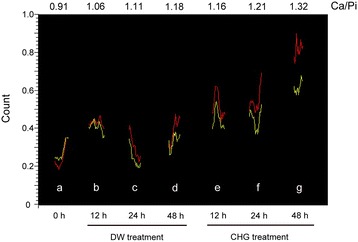
BACKGROUND: Chlorhexidine gluconate (CHG) has been proven to be effective in preventing and controlling biofilm formation. At the same time, an increase in calculus formation is known as one of considerable side effects. The purpose of this study was to investigate whether mineral deposition preceding a calculus formation would occur at an early stage after the use of CHG using an in vitro saliva-related biofilm model. METHODS: Biofilms were developed on the MBEC™ device in brain heart infusion (BHI) broth containing 0.5% sucrose at 37 °C for 3 days under anaerobic conditions. Biofilms were periodically exposed to 1 min applications of 0.12% CHG every 12 h and incubated for up to 2 days in BHI containing a calcifying solution. Calcium and phosphate in the biofilm were measured using atomic absorption spectrophotometry and a phosphate assay kit, respectively. Morphological structure was observed using a scanning electron microscope (SEM), and chemical composition was analyzed with an electron probe microanalyzer (EPMA). RESULTS: The concentrations of Ca and Pi following a single exposure to CHG increased significantly compared with the control. Repeatedly exposing biofilms to CHG dose-dependently increased Ca deposition, and the amount of Ca was five times as much as that of the control. Pi levels in CHG-treated biofilms were significantly higher than those from the control group (p < 0.05); however, the influence of the number of exposures was limited. Analyses using an SEM and EPMA showed many clusters containing calcium and phosphate complexes in CHG-treated biofilms. Upon composition analysis of the clusters, calcium was detected at a greater concentration than phosphate. CONCLUSIONS: Findings suggested that CHG may promote mineral uptake into the biofilm soon after its use. It is necessary to disrupt the biofilm prior to the start of a CHG mouthwash in order to reduce the side effects associated with this procedure. The management of patients is also important.
Overview
The claims and statistics of this paper haven’t been checked yet.
Free: it reads the open-access text and checks the first 5 claims that cite a source we can check. Create a free account to check every claim.
Integrity signals
Registry
Cites
Statistics
Figures
Verification
Claims the paper makes
The claims and statistics of this paper haven’t been checked yet.
Free: it reads the open-access text and checks the first 5 claims that cite a source we can check. Create a free account to check every claim.
Claims other papers make about this one
Each is checked against this paper’s own text: does it say what the citing paper says it does?
The cited source doesn’t support the claim as written.
In the citing paper
“The strength of this study model lies in its simplicity and standardization, achieved by excluding natural saliva and employing a well-controlled and reproducible system [10,11,21].”
From In vitro biomimetic development of artificial dental calculus: a proof of concept study (2025) · cites this paper as [21]
Checked by a reasoning model — may be wrong.
Experimental — accuracy not yet measuredThe source backs part of the claim, not all of it — or backs it for a different population, condition or comparison.
In the citing paper
“Other models, like those using hydroxyapatite-coated plastic pegs, complicate quantitative analysis due to challenges in defining consistent regions of interest [21].”
From In vitro biomimetic development of artificial dental calculus: a proof of concept study (2025) · cites this paper as [21]
Experimental — accuracy not yet measuredIn the citing paper
“Mucin contributed to biofilm matrix stabilization and enhanced bacterial adhesion, while urea, metabolized by urease-producing bacteria, released ammonia and elevated the local pH, promoting calcium phosphate precipitation [10,11,21,24].”
From In vitro biomimetic development of artificial dental calculus: a proof of concept study (2025) · cites this paper as [21]
In the citing paper
“Mucin contributed to biofilm matrix stabilization and enhanced bacterial adhesion, while urea, metabolized by urease-producing bacteria, released ammonia and elevated the local pH, promoting calcium phosphate precipitation [10,11,21,24].”
From In vitro biomimetic development of artificial dental calculus: a proof of concept study (2025) · cites this paper as [21]
Self-check
Percentages, sums and reported differences re-computed from the paper’s own numbers.
The self-check needs the paper’s full text.
Citations
Cites
Clinical Periodontology and Implant Dentistry
Lindhe, J., Lang, N. P., & Karring, T. (2008) · Cited by 903
Chlorhexidine: is it still the gold standard?
Jones, C. G. (1997) · Periodontology 2000 · doi:10.1111/j.1600-0757.1997.tb00105.x · Cited by 724 · cited 4×
“This has been proven to be safe, stable, and effective in preventing plaque formation and inhibiting the development of gingivitis [7, 8].”
InfluentialChlorhexidine mouthrinse as an adjunctive treatment for gingival health
James, P., Worthington, H. V., Parnell, C., Harding, M., Lamont, T., Cheung, A., Whelton, H., & Riley, P. (2017) · Cochrane Database of Systematic Reviews · doi:10.1002/14651858.cd008676.pub2 · Cited by 571 · cited 1×
“disturbance, and effects on the oral mucosa [11, 25].”
Clinical Periodontology and Implant Dentistry
Palmer, R. M. J., & Soory, M. (2003) · Cited by 449
Van Strydonck, D. A. C., Slot, D. E., Van der Velden, U., & Van der Weijden, F. (2012) · Journal of Clinical Periodontology · doi:10.1111/j.1600-051x.2012.01883.x · Cited by 353 · cited 1×
“This has been proven to be safe, stable, and effective in preventing plaque formation and inhibiting the development of gingivitis [7, 8].”
White, D. J. (1997) · European Journal of Oral Sciences · doi:10.1111/j.1600-0722.1997.tb00238.x · Cited by 325
Charles, C. H., Mostler, K. M., Bartels, L. L., & Mankodi, S. M. (2004) · Journal of Clinical Periodontology · doi:10.1111/j.1600-051x.2004.00578.x · Cited by 240 · cited 1×
“disturbance, and effects on the oral mucosa [11, 25].”
Efficacy of homecare regimens for mechanical plaque removal in managing gingivitis a meta review
Van der Weijden, F. A., & Slot, D. E. (2015) · Journal of Clinical Periodontology · doi:10.1111/jcpe.12359 · Cited by 235
Efficacy of inter‐dental mechanical plaque control in managing gingivitis – a meta‐review
Sälzer, S., Slot, D. E., Van der Weijden, F. A., & Dörfer, C. E. (2015) · Journal of Clinical Periodontology · doi:10.1111/jcpe.12363 · Cited by 230
Formation and Inhibition of Dental Calculus
Schroeder, H. E., & Shanley, D. (1969) · Journal of Periodontology-Periodontics · doi:10.1902/jop.1969.40.11.643 · Cited by 209
Figuero, E., Nóbrega, D. F., Gargallo, M. G., Tenuta, L. M. A., Herrera, D., & Carvalho, J. C. (2017) · Journal Of Clinical Periodontology · doi:10.1111/jcpe.12674 · Cited by 197 · cited 1×
“It has been demonstrated that adjunctive antimicrobials improve clinical parameters including plaque and gingival indexes by interfering with metabolic activities [2, 5, 6].”
Serrano, J., Escribano, M., Roldán, S., Martín, C., & Herrera, D. (2015) · Journal of Clinical Periodontology · doi:10.1111/jcpe.12331 · Cited by 182 · cited 1×
“It has been demonstrated that adjunctive antimicrobials improve clinical parameters including plaque and gingival indexes by interfering with metabolic activities [2, 5, 6].”
Figuero, E., Herrera, D., Tobías, A., Serrano, J., Roldán, S., Escribano, M., & Martín, C. (2019) · Journal of Clinical Periodontology · doi:10.1111/jcpe.13127 · Cited by 175
Overholser, C. D., Meiller, T. F., DePaola, L. G., Minah, G. E., & Niehaus, C. (1990) · Journal of Clinical Periodontology · doi:10.1111/j.1600-051x.1990.tb01108.x · Cited by 171
Evidence‐based control of plaque and gingivitis
Santos, A. (2003) · Journal of Clinical Periodontology · doi:10.1034/j.1600-051x.30.s5.5.x · Cited by 166 · cited 1×
“It has been demonstrated that adjunctive antimicrobials improve clinical parameters including plaque and gingival indexes by interfering with metabolic activities [2, 5, 6].”
Calculus removal and the prevention of its formation
Jepsen, S., Deschner, J., Braun, A., Schwarz, F., & Eberhard, J. (2011) · Periodontology 2000 · doi:10.1111/j.1600-0757.2010.00382.x · Cited by 157 · cited 2×
“A report of histological sections of a human tooth root showed that calculi were covered with viable bacterial plaque [13].”
Yates, R., Jenkins, S., Newcombe, R., Wade, W., Moran, J., & Addy, M. (1993) · Journal of Clinical Periodontology · doi:10.1111/j.1600-051x.1993.tb00327.x · Cited by 119
Escribano, M., Figuero, E., Martín, C., Tobías, A., Serrano, J., Roldán, S., & Herrera, D. (2016) · Journal of Clinical Periodontology · doi:10.1111/jcpe.12616 · Cited by 83
Najafi, M. H., Morteza, T., Mokhtari, M. R., Forouzanfar, A., Farazi, F., Mirzaee, M., Ebrahiminik, Z., & Mehrara, R. (2012) · PubMed Central · doi:10.4103/1735-3327.99824 · Cited by 83
Ohsumi, T., Takenaka, S., Wakamatsu, R., Sakaue, Y., Narisawa, N., Senpuku, H., Ohshima, H., Terao, Y., & Okiji, T. (2015) · PLoS ONE · doi:10.1371/journal.pone.0116647 · Cited by 66
Self-citationTissue Response in the Guinea Pig to Sterile and Non‐Sterile Calculus
Allen, D. L., & Kerr, D. A. (1965) · The Journal of Periodontology · doi:10.1902/jop.1965.36.2.121 · Cited by 58 · cited 1×
“ported that an autoclaved calculus does not cause pronounced inflammation or the formation of abscesses in connective tissues [30].”
P orphyromonas gingivalis biofilms persist after chlorhexidine treatment
Yamaguchi, M., Noiri, Y., Kuboniwa, M., Yamamoto, R., Asahi, Y., Maezono, H., Hayashi, M., & Ebisu, S. (2013) · European Journal Of Oral Sciences · doi:10.1111/eos.12050 · Cited by 56 · cited 2×
“for 5 min did not degrade their external structure or reduce the volume of protein and carbohydrate constituents [15].”
Self-citationKumar, S., Patel, S., Tadakamadla, J., Tibdewal, H., Duraiswamy, P., & Kulkarni, S. (2012) · International Journal of Dental Hygiene · doi:10.1111/j.1601-5037.2012.00560.x · Cited by 50
Porphyromonas gingivalis lipids and diseased dental tissues
Nichols, F. C., & Rojanasomsith, K. (2006) · Oral Microbiology and Immunology · doi:10.1111/j.1399-302x.2006.00264.x · Cited by 49 · cited 1×
“gingivalis were found in a subgingival calculus [31].”
Magnesium-Containing Crystals in Human Dental Calculus
Kodaka, T., Debari, K., & Higashi, S. (1988) · Journal of Electron Microscopy · doi:10.1093/oxfordjournals.jmicro.a050666 · Cited by 39 · cited 1×
“When plaque mineralization begins, brushite develops into octacalcium phosphate, hydroxyapatite, and whitlockite [27].”
Wong, L., Sissons, C. H., Pearce, E. I. F., & Cutress, T. W. (2002) · Archives of Oral Biology · doi:10.1016/s0003-9969(02)00114-0 · Cited by 34 · cited 1×
“It has been reported that an alkaline pH in biofilms is critical for the promotion of plaque mineralization [20, 29].”
Wong, L., & Sissons, C. H. (2006) · Archives of Oral Biology · doi:10.1016/j.archoralbio.2006.08.006 · Cited by 34 · cited 3×
“Wong L, Sissons CH, El P, Cutress TW. Calcium phosphate deposition in human dental plaque microcosm biofilms induced by a ureolytic pH-rise procedure.”
InfluentialRose, R. K., Hogg, S. D., & Shellis, R. P. (1994) · Journal of Dental Research · doi:10.1177/00220345940730111001 · Cited by 33 · cited 1×
“In addition, since calcium binds to lipoteichoic acid, the compromised surface may promote the deposition [28].”
Sidaway, D. A. (1978) · Journal of Periodontal Research · doi:10.1111/j.1600-0765.1978.tb00190.x · Cited by 21
Characterization of Pleurotus ostreatus Biofilms by Using the Calgary Biofilm Device
Pesciaroli, L., Petruccioli, M., Fedi, S., Firrincieli, A., Federici, F., & D’Annibale, A. (2013) · Applied and Environmental Microbiology · doi:10.1128/aem.02099-13 · Cited by 12
Matthews, D. (2011) · Evidence-Based Dentistry · doi:10.1038/sj.ebd.6400771 · Cited by 9 · cited 1×
“is the concentration involved in a conventional mouthwash product [18, 19].”
Relationship Between Plaque Mineralization In Vitro and Calculus Formation In Vivo
Eilberg, R. G., Judy, K. W. M., Iovino, E., Kornfeld, P., Phelan, J. A., & Ellison, R. (1973) · Journal of Dental Research · doi:10.1177/00220345730520013401 · Cited by 4 · cited 1×
“[22] tested the mineralizing activities of plaque using samples from humans.”
Quantitative Near-Surface Microanalysis and Depth Profiling by EPMA
Karduck, P. (1998) · Springer eBooks · doi:10.1007/978-3-7091-7506-4_16 · Cited by 3 · cited 1×
“The limit of detection of the elements was approximately 1 μm in depth [23].”
Cited by
Chen, X., Daliri, E. B.-M., Kim, N., Kim, J.-R., Yoo, D., & Oh, D.-H. (2020) · Pathogens · doi:10.3390/pathogens9070569 · Cited by 274
Moghadam, E. T., Yazdanıan, M., Tahmasebi, E., Tebyanian, H., Ranjbar, R., Yazdanian, A., Seifalian, A. M., & Tafazoli, A. (2020) · European Journal of Pharmacology · doi:10.1016/j.ejphar.2020.173665 · Cited by 166
Magacz, M., Kędziora, K., Sapa, J., & Krzyściak, W. (2019) · International Journal of Molecular Sciences · doi:10.3390/ijms20061443 · Cited by 90
Innate and adaptive immunity of periodontal disease. From etiology to alveolar bone loss
Becerra‐Ruiz, J. S., Velázquez, C. G., Martínez–Esquivias, F., Martínez‐Pérez, L. A., & Guzmán‐Flores, J. M. (2021) · Oral Diseases · doi:10.1111/odi.13884 · Cited by 89
Haralur, S. B., Alqahtani, N. R. S., & Mujayri, F. A. (2019) · Medicina · doi:10.3390/medicina55110749 · Cited by 68
“In the protracted use of chlorhexidine, an increase in the formation of supragingival calculi is also observed [17].”
Background
Metadata
- Authors
- Sakaue, Y., Takenaka, S., Ohsumi, T., Domon, H., Terao, Y., & Noiri, Y.
- Affiliations
- Niigata University (JP)
- Corresponding author
- Noiri, Yuichiro
- Venue
- BMC Oral Health
- Published
- 2018-03-27
- Volume
- 18
- Issue
- 1
- Pages
- 52-52
- ISSN
- 1472-6831 (ISSN-L)
- PMC
- PMC5872527
- OpenAlex
- W2803745720
- Cited by
- 60
- References
- 33
- Citations by year
- 2026: 5 · 2025: 7 · 2024: 8 · 2023: 5 · 2022: 10 · 2021: 13 · 2020: 7 · 2019: 5
- FWCI
- 7.17
- Type
- journal article
- Language
- en
- Open access
- gold
- doi.org
- Licence
- cc-by
- creativecommons.org/licenses/by/4.0/ (tdm)
- creativecommons.org/licenses/by/4.0/ (vor)
- Locations
- BMC Oral Health (publishedVersion, cc-by)
- PubMed Central (publishedVersion, cc-by)
- PubMed (publishedVersion)
- DOAJ (DOAJ: Directory of Open Access Journals) (submittedVersion)
- Funders
- Japan Society for the Promotion of Science (15H05021, 16K15785, 16K20451, 26305034, 26462876)
- Topics
- Health Sciences › Dentistry › Periodontics › Oral microbiology and periodontitis research
- Life Sciences › Biochemistry, Genetics and Molecular Biology › Molecular Biology › Bacterial biofilms and quorum sensing
- Health Sciences › Dentistry › General Dentistry › Dental Research and COVID-19
- Keywords
- chlorhexidine gluconate, dental calculus, dental plaque, mineral deposition, calcium and phosphate, biofilm eradication
- MeSH terms
- Calcium, Chlorhexidine, Dental Calculus, Electron Probe Microanalysis, Humans, Microscopy, Electron, Scanning, Phosphates, Saliva, Spectrophotometry, Atomic, Biofilms, In Vitro Techniques
About these checks
Registry, retraction, Cites and statistics results are computed, not judged, with one exception: a printed reference that no index lists is read once by a model before it counts as a citation error. Claims are extracted by a model and kept only when their quote appears verbatim in the text; each cited source is then checked, with a model’s help, for whether it says what the claim relies on. Those verdicts can be wrong — read the claim’s quote and the cited source before relying on one.
Statistics and arithmetic are recomputed, not judged.
Confidence bands are shown only for fields calibrated on our annotated test set. None is calibrated yet, so no band is shown.
What counts as a claim ›How we measure confidence ›How we check this ›
Are you an author, or do you see a problem with this page? Request a review
Data sources
Bibliographic data: Semantic Scholar, OpenAlex, Crossref.
Contains information from the Semantic Scholar Academic Graph Datasets, made available under the ODC Attribution License (ODC-BY 1.0).
Semantic Scholar’s data is described in: Kinney, R., et al. (2023). The Semantic Scholar Open Data Platform. arXiv:2301.10140.
