

Patient participation and associated factors in the discussions on do-not-attempt-resuscitation and end-of-life disclosure: a retrospective chart review study
Open accessPublished version of a preprint
The DOI matches its Crossref record; 41 of the 41 references it cites were found in a registry or an index.
Abstract
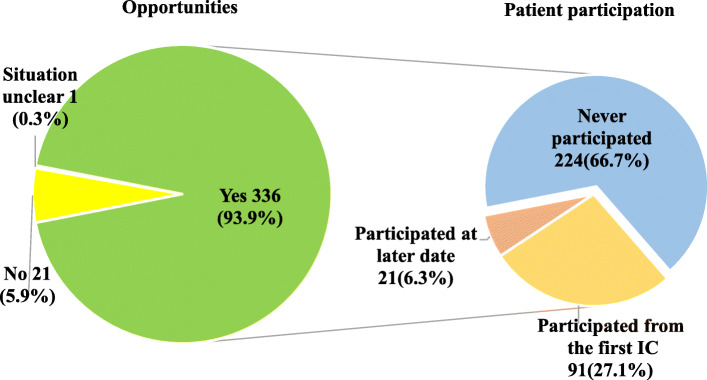
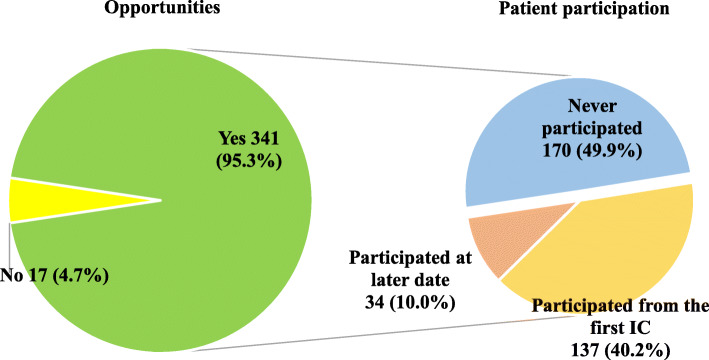
Background: Patient participation is a key foundation of advance care planning (ACP). However, a patient himself/herself may be left out from sensitive conversations such as end-of-life (EOL) care discussions. The objectives of this study were to investigate patients’ participation rate in the discussion of Cardiopulmonary Resuscitation (CPR) / Do-Not-Attempt-Resuscitation (DNAR) order, and in the discussion that the patient is at his/her EOL stage (EOL disclosure), and to explore their associated factors. Methods: This is a retrospective chart review study. The participants were all the patients who were hospitalized and died in a university-affiliated teaching hospital (tertiary medical facility) in central Tokyo, Japan during the period from April 2018 to March 2019. The following patients were excluded: (1) cardiopulmonary arrest on arrival; (2) stillbirth; (3) under 18 years old at the time of death; and (4) refusal by their bereaved family. Presence or absence of CPR/DNAR discussion and EOL disclosure, patients’ involvement in those discussions, and their associated factors were investigated. Results: CPR/DNAR discussions were observed in 336 out of the 358 patients (93.9%). However, 224 of these discussions were carried out without a patient (patient participation rate 33.3%). Male gender (odds ratio (OR) = 2.37 [95% confidence interval (CI) 1.32–4.25]), living alone (OR = 2.51 [1.34–4.71]), and 1 year or more from the date of diagnosis (OR = 1.78 [1.03–3.10]) were associated with higher patient’s participation in CPR/DNAR discussions. The EOL disclosure was observed in 341 out of the 358 patients (95.3%). However, 170 of the discussions were carried out without the patient (patient participation rate 50.1%). Patients who died of cancer (OR = 2.41[1.45–4.03]) and patients without mental illness (OR=2.41 [1.11–5.25]) were more likely to participate in EOL disclosure. Conclusions: In this clinical sample, only up to half of the patients participated in CPR/DNAR discussions and EOL disclosure. Female, living with family, a shorter period from the diagnosis, non-cancer, and mental illness presence are risk factors for lack of patients’ participation in CPR/DNAR or EOL discussions. Further attempts to facilitate patients’ participation, based on their preference, are warranted.
Overview
The claims and statistics of this paper haven’t been checked yet.
Free: it reads the open-access text and checks the first 5 claims that cite a source we can check. Create a free account to check every claim.
Integrity signals
Registry
Cites
Statistics
Figures
Verification
Claims the paper makes
The claims and statistics of this paper haven’t been checked yet.
Free: it reads the open-access text and checks the first 5 claims that cite a source we can check. Create a free account to check every claim.
Claims other papers make about this one
Each is checked against this paper’s own text: does it say what the citing paper says it does?
The source backs part of the claim, not all of it — or backs it for a different population, condition or comparison.
In the citing paper
“Evidence of decisions being documented varied from 19% to 93.9% in the studies that presented percentages (93.9%,28 92.3%,25 91.2%,45 70.9%,58 60%,42 57%–64%,59 21.2%44 and 19%22).”
From Do not attempt cardiopulmonary resuscitation decision-making process: scoping review (2025) · cites this paper as [28]
Experimental — accuracy not yet measuredThe cited source says what the claim attributes to it.
In the citing paper
“More broadly, Abe et al,28 Becker et al29 and Choi et al30 identify DNACPR decisions within the hospitalisation period”
From Do not attempt cardiopulmonary resuscitation decision-making process: scoping review (2025) · cites this paper as [28]
The cited source says what the claim attributes to it.
In the citing paper
“while Abe et al28 identified 9.2% of discussions as occurring during an outpatient visit.”
From Do not attempt cardiopulmonary resuscitation decision-making process: scoping review (2025) · cites this paper as [28]
The cited source says what the claim attributes to it.
In the citing paper
“Patient involvement in the decision-making process was reported between 33% and 55% of the time; 33%,28 48%,22 52.8%44 and 55.8%.45”
From Do not attempt cardiopulmonary resuscitation decision-making process: scoping review (2025) · cites this paper as [28]
The cited source says what the claim attributes to it.
In the citing paper
“When the patient was absent from the DNACPR discussion, decisions were made by those close to the patient based on discussion with the physician28 or by a senior doctor, with a consultant countersignature.25”
From Do not attempt cardiopulmonary resuscitation decision-making process: scoping review (2025) · cites this paper as [28]
Self-check
Percentages, sums and reported differences re-computed from the paper’s own numbers.
The self-check needs the paper’s full text.
Citations
Cites
Wright, A. A. (2008) · JAMA · doi:10.1001/jama.300.14.1665 · Cited by 2,788
Peberdy, M. A., Callaway, C. W., Neumar, R. W., Geocadin, R. G., Zimmerman, J. L., Donnino, M., Gabrielli, A., Silvers, S. M., Zaritsky, A. L., Merchant, R., et al. (2010) · Circulation · doi:10.1161/circulationaha.110.971002 · Cited by 2,522
Steinhauser, K. E. (2000) · JAMA · doi:10.1001/jama.284.19.2476 · Cited by 2,514
The effects of advance care planning on end-of-life care: A systematic review
Brinkman-Stoppelenburg, A., Rietjens, J. A., & van der Heide, A. (2014) · Palliative Medicine · doi:10.1177/0269216314526272 · Cited by 1,480
Rietjens, J. A. C., Sudore, R. L., Connolly, M., van Delden, J. J., Drickamer, M. A., Droger, M., van der Heide, A., Heyland, D. K., Houttekier, D., Janssen, D. J. A., et al. (2017) · The Lancet Oncology · doi:10.1016/s1470-2045(17)30582-x · Cited by 1,371
Advance Directives and Outcomes of Surrogate Decision Making before Death
Silveira, M. J., Kim, S. Y. H., & Langa, K. M. (2010) · New England Journal of Medicine · doi:10.1056/nejmsa0907901 · Cited by 1,292
Mack, J. W., Weeks, J. C., Wright, A. A., Block, S. D., & Prigerson, H. G. (2010) · Journal of Clinical Oncology · doi:10.1200/jco.2009.25.4672 · Cited by 806
Mack, J. W., Cronin, A., Keating, N. L., Taback, N., Huskamp, H. A., Malin, J. L., Earle, C. C., & Weeks, J. C. (2012) · Journal of Clinical Oncology · doi:10.1200/jco.2012.43.6055 · Cited by 560
Cancer Patient Preferences for Communication of Prognosis in the Metastatic Setting
Hagerty, R. G., Butow, P. N., Ellis, P. A., Lobb, E. A., Pendlebury, S., Leighl, N., Goldstein, D., Lo, S. K., & Tattersall, M. H. N. (2004) · Journal of Clinical Oncology · doi:10.1200/jco.2004.04.095 · Cited by 503
Curtis, J. R., Back, A. L., Ford, D. W., Downey, L., Shannon, S. E., Doorenbos, A. Z., Kross, E. K., Reinke, L. F., Feemster, L. C., Edlund, B., et al. (2013) · JAMA · doi:10.1001/jama.2013.282081 · Cited by 426
End-of-Life Care Discussions Among Patients With Advanced Cancer: A Cohort Study
Mack, J. W., Cronin, A., Taback, N., Huskamp, H. A., Keating, N. L., Malin, J. L., Earle, C. C., & Weeks, J. C. (2012) · Annals of Internal Medicine · doi:10.7326/0003-4819-156-3-201202070-00008 · Cited by 420
Downar, J., Goldman, R., Pinto, R., Englesakis, M., & Adhikari, N. K. J. (2017) · Canadian Medical Association Journal · doi:10.1503/cmaj.160775 · Cited by 403
Utility of the “Surprise” Question to Identify Dialysis Patients with High Mortality
Moss, A. H., Ganjoo, J., Sharma, S., Gansor, J., Senft, S., Weaner, B., Dalton, C., MacKay, K., Pellegrino, B., Anantharaman, P., et al. (2008) · Clinical Journal of the American Society of Nephrology · doi:10.2215/cjn.00940208 · Cited by 345
Paladino, J., Bernacki, R., Neville, B. A., Kavanagh, J., Miranda, S. P., Palmor, M., Lakin, J., Desai, M., Lamas, D., Sanders, J. J., et al. (2019) · JAMA Oncology · doi:10.1001/jamaoncol.2019.0292 · Cited by 333
Good death in cancer care: a nationwide quantitative study
Miyashita, M., Sanjo, M., Morita, T., Hirai, K., & Uchitomi, Y. (2007) · Annals of Oncology · doi:10.1093/annonc/mdm068 · Cited by 331
Morrison, L. J., Neumar, R. W., Zimmerman, J. L., Link, M. S., Newby, L. K., McMullan, P. W., Hoek, T. V., Halverson, C. C., Doering, L., Peberdy, M. A., et al. (2013) · Circulation · doi:10.1161/cir.0b013e31828b2770 · Cited by 300
Morrison, L. J., Kierzek, G., Diekema, D. S., Sayre, M. R., Silvers, S. M., Idris, A. H., & Mancini, M. E. (2010) · Circulation · doi:10.1161/circulationaha.110.970905 · Cited by 256
Advance care planning in dementia: recommendations for healthcare professionals.
Piers, R., Albers, G., Gilissen, J., De Lepeleire, J., Steyaert, J., Van Mechelen, W., Steeman, E., Dillen, L., Vanden Berghe, P., & Van den Block, L. (2018) · BMC Palliative Care · doi:10.1186/s12904-018-0332-2 · Cited by 254
Palliative care from diagnosis to death
Murray, S. A., Kendall, M., Mitchell, G., Moine, S., Amblàs-Novellas, J., & Boyd, K. (2017) · BMJ · doi:10.1136/bmj.j878 · Cited by 218
Kodish, E., & Post, S. G. (1995) · Journal of Clinical Oncology · doi:10.1200/jco.1995.13.7.1817 · Cited by 138
Strategic Targeting of Advance Care Planning Interventions: The Goldilocks Phenomenon
Billings, J. A., & Bernacki, R. (2014) · JAMA Internal Medicine · doi:10.1001/jamainternmed.2013.14384 · Cited by 134
Lopez-Acevedo, M., Havrilesky, L. J., Broadwater, G., Kamal, A. H., Abernethy, A. P., Berchuck, A., Secord, A. A., Tulsky, J. A., Valea, F. A., & Lee, P. S. (2013) · Gynecologic Oncology · doi:10.1016/j.ygyno.2013.04.010 · Cited by 113
ESMO Clinical Practice Guidelines on palliative care: advanced care planning
Schrijvers, D. M., & Cherny, N. I. (2014) · Annals of Oncology · doi:10.1093/annonc/mdu241 · Cited by 99
Levin, T. T., Li, Y., Weiner, J. S., Lewis, F., Bartell, A., Piercy, J., & Kissane, D. W. (2008) · Palliative and Supportive Care · doi:10.1017/s1478951508000540 · Cited by 96
Morita, T., Oyama, Y., Cheng, S., Suh, S., Koh, S. J., Kim, H. S., Chiu, T., Hwang, S., Shirado, A. N., & Tsuneto, S. (2015) · Journal of Pain and Symptom Management · doi:10.1016/j.jpainsymman.2015.02.020 · Cited by 83
Sato, K., Miyashita, M., Morita, T., Sanjo, M., Shima, Y., & Uchitomi, Y. (2007) · Supportive Care in Cancer · doi:10.1007/s00520-007-0332-x · Cited by 68
End of life decisions: attitudes of Finnish physicians
Hildén, H.-M., Louhiala, P., & Palo, J. (2004) · Journal of Medical Ethics · doi:10.1136/jme.2002.001081 · Cited by 65
Straw, S., Byrom, R. J., Gierula, J., Paton, M. F., Koshy, A. O., Cubbon, R. M., Drozd, M., Kearney, M. T., & Witte, K. K. (2018) · European Journal of Heart Failure · doi:10.1002/ejhf.1353 · Cited by 62
Reliability and Utility of the Surprise Question in CKD Stages 4 to 5
Javier, A., Figueroa, R., Siew, E. D., Salat, H., Morse, J. L., Stewart, T. G., Malhotra, R., Jhamb, M., Schell, J. O., Cardona, C. Y., et al. (2017) · American Journal of Kidney Diseases · doi:10.1053/j.ajkd.2016.11.025 · Cited by 60
Chu, D., Yen, Y., Hu, H.-Y., Lai, Y., Sun, W., Ko, M.-C., Huang, L.-Y., Chen, C.-C., Curtis, J. R., Lee, Y.-L., et al. (2018) · PLoS ONE · doi:10.1371/journal.pone.0197552 · Cited by 51
Sato, T., Soejima, K., Fujisawa, D., Takeuchi, M., Arai, D., Nakachi, I., Naoki, K., Kawada, I., Yasuda, H., Ishioka, K., et al. (2018) · The Oncologist · doi:10.1634/theoncologist.2017-0329 · Cited by 49
Self-citationWen, K.-Y., Lin, Y.-C., Cheng, J.-F., Chou, P.-C., Wei, C.-H., Chen, Y.-F., & Sun, J.-L. (2013) · Supportive Care in Cancer · doi:10.1007/s00520-013-1827-2 · Cited by 44
Torke, A. M., Sachs, G. A., Helft, P. R., Petronio, S., Purnell, C., Hui, S., & Callahan, C. M. (2011) · Journal of the American Geriatrics Society · doi:10.1111/j.1532-5415.2011.03480.x · Cited by 39
MacKenzie, A. (2014) · Journal of Emergency Medicine · doi:10.1016/j.jemermed.2014.01.010 · Cited by 38
Evaluation of do not resuscitate orders (DNR) in a Swiss community hospital
Junod Perron, N., Morabia, A., & de Torrenté, A. (2002) · Journal of Medical Ethics · doi:10.1136/jme.28.6.364 · Cited by 33
Nakano, K., Yoshida, T., Furutama, J., & Sunada, S. (2012) · Supportive Care in Cancer · doi:10.1007/s00520-011-1374-7 · Cited by 28
Perman, S. M., Beaty, B. L., Daugherty, S. L., Havranek, E. P., Haukoos, J. S., Juarez‐Colunga, E., Bradley, S. M., Fendler, T. J., Chan, P. S., Grossestreuer, A. V., et al. (2020) · Journal of the American Heart Association · doi:10.1161/jaha.119.014200 · Cited by 22
Nakamura, K., Kinugasa, Y., Sugihara, S., Hirai, M., Yanagihara, K., Haruki, N., Matsubara, K., Kato, M., & Yamamoto, K. (2018) · ESC Heart Failure · doi:10.1002/ehf2.12352 · Cited by 21
Fujimoto, K., Minami, S., Yamamoto, S., Ogata, Y., Koba, T., Futami, S., Yuh, N., Yaga, M., Masuhiro, K., & Komuta, K. (2014) · Supportive Care in Cancer · doi:10.1007/s00520-013-2105-z · Cited by 17
The Advance Care Planning Readiness Scale
Brown, A. J., Shen, M. J., Urbauer, D. L., Taylor, J. S., Parker, P. A., Carmack, C. L., Prescott, L. S., Rosemore, C., Kolawole, E. M., Sun, C. C., et al. (2017) · International Journal of Gynecological Cancer · doi:10.1097/igc.0000000000000953 · Cited by 17
Factors that Influence the Decision Maker regarding End-of-life Care
Iwabuchi, M., Sato, K., Miyashita, M., Morita, T., & Kinoshita, H. (2016) · Palliative Care Research · doi:10.2512/jspm.11.189 · Cited by 8
Cited by
Suen, M. H. P., Chow, A. Y. M., Woo, R. K. W., & Yuen, S. K. (2024) · Palliative & Supportive Care · doi:10.1017/s1478951524000464 · Cited by 27
Huang, L.-H., Lin, L.-S., Wang, C., Chang, Y., Lee, L.-C., Hu, C.-C., Hsu, P.-S., & Chu, W. (2021) · International Journal of Environmental Research and Public Health · doi:10.3390/ijerph18189882 · Cited by 15
Pennarola, B. W., Fry, A., Prichett, L. M., Beri, A., Shah, N. N., & Wiener, L. S. (2021) · Transplantation and Cellular Therapy · doi:10.1016/j.jtct.2021.12.007 · Cited by 15
Do not attempt cardiopulmonary resuscitation decision-making process: scoping review
Doody, O., Davidson, H., & Lombard, J. (2025) · BMJ Supportive & Palliative Care · doi:10.1136/spcare-2023-004573 · Cited by 10
“When the patient was absent from the DNACPR discussion, decisions were made by those close to the patient based on discussion with the physician 28 or by a senior doctor, with a consultant coun-tersignature.”
InfluentialAlbashayreh, A., Herr, K., Fan, W., Street, W. N., & Gilbertson‐White, S. (2024) · Clinical Nursing Research · doi:10.1177/10547738241292657 · Cited by 8
Metadata
- Authors
- Abe, A., Kobayashi, M., Kohno, T., Takeuchi, M., Hashiguchi, S., Mimura, M., & Fujisawa, D.
- Affiliations
- Keio University (JP)
- Kyorin University (JP)
- Corresponding author
- Abe, Akiko
- ORCID
- Venue
- BMC Palliative Care
- Published
- 2021-01-06
- Volume
- 20
- Issue
- 1
- Pages
- 6-6
- ISSN
- 1472-684X (ISSN-L)
- PMC
- PMC7789264
- OpenAlex
- W3120373895
- Cited by
- 18
- References
- 41
- Citations by year
- 2026: 2 · 2025: 2 · 2024: 8 · 2023: 3 · 2022: 1 · 2021: 2
- FWCI
- 3.03
- Type
- journal article
- Language
- en
- Open access
- gold
- doi.org
- Licence
- cc-by
- creativecommons.org/licenses/by/4.0/ (tdm)
- creativecommons.org/licenses/by/4.0/ (vor)
- Locations
- BMC Palliative Care (publishedVersion, cc-by)
- Research Square (acceptedVersion, cc-by)
- Europe PMC (PubMed Central) (publishedVersion, other-oa)
- PubMed Central (publishedVersion, cc-by)
- PubMed (publishedVersion)
- DOAJ (DOAJ: Directory of Open Access Journals) (submittedVersion, cc-by-sa)
- Funders
- Grant-in-Aid for Scientific Research (JP18K07476)
- Topics
- Health Sciences › Medicine › Public Health, Environmental and Occupational Health › Palliative Care and End-of-Life Issues
- Health Sciences › Medicine › Emergency Medicine › Cardiac Arrest and Resuscitation
- Health Sciences › Medicine › Public Health, Environmental and Occupational Health › Palliative and Oncologic Care
- Keywords
- patient participation, advance care planning, cardiopulmonary resuscitation, end-of-life care, associated factors, cancer mortality, mental illness, living alone, hospitalized patients, in-hospital mortality, physician-patient communication, teaching hospitals, gender differences, timing of diagnosis
- MeSH terms
- Aged, Aged, 80 and over, Mental Disorders, Cardiovascular Diseases, Cerebrovascular Disorders, Female, Humans, Liver Diseases, Male, Middle Aged, Neoplasms, Patient Participation, Residence Characteristics, Respiratory Tract Diseases, Sex Factors, Terminal Care, Time Factors, Odds Ratio, Resuscitation Orders, Disclosure, Advance Care Planning
About these checks
Registry, retraction, Cites and statistics results are computed, not judged, with one exception: a printed reference that no index lists is read once by a model before it counts as a citation error. Claims are extracted by a model and kept only when their quote appears verbatim in the text; each cited source is then checked, with a model’s help, for whether it says what the claim relies on. Those verdicts can be wrong — read the claim’s quote and the cited source before relying on one.
Statistics and arithmetic are recomputed, not judged.
Confidence bands are shown only for fields calibrated on our annotated test set. None is calibrated yet, so no band is shown.
What counts as a claim ›How we measure confidence ›How we check this ›
Are you an author, or do you see a problem with this page? Request a review
Data sources
Bibliographic data: Semantic Scholar, OpenAlex, Crossref.
Contains information from the Semantic Scholar Academic Graph Datasets, made available under the ODC Attribution License (ODC-BY 1.0).
Semantic Scholar’s data is described in: Kinney, R., et al. (2023). The Semantic Scholar Open Data Platform. arXiv:2301.10140.
