

Coping and wellbeing in bereavement: two core outcomes for evaluating bereavement support in palliative care
Open accessThe DOI matches its Crossref record; 35 of the 35 references it cites were found in a registry or an index.
Abstract
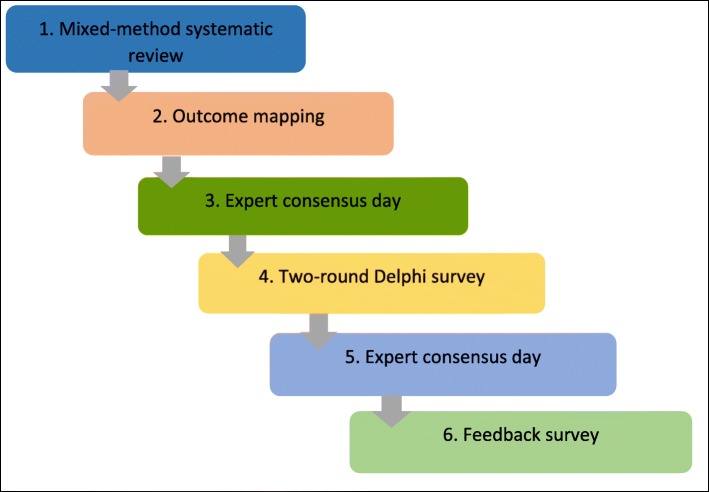
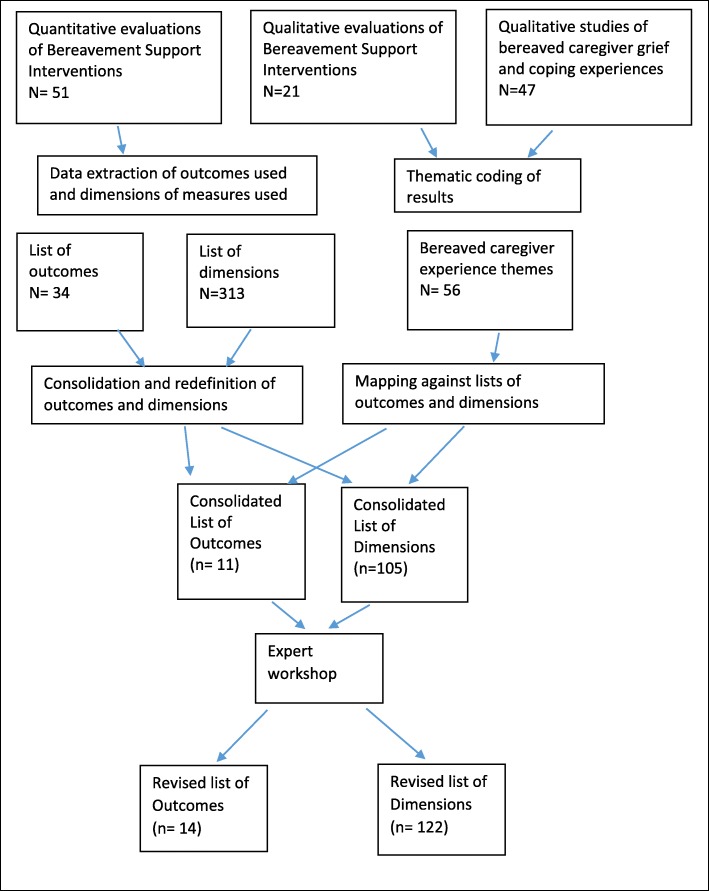
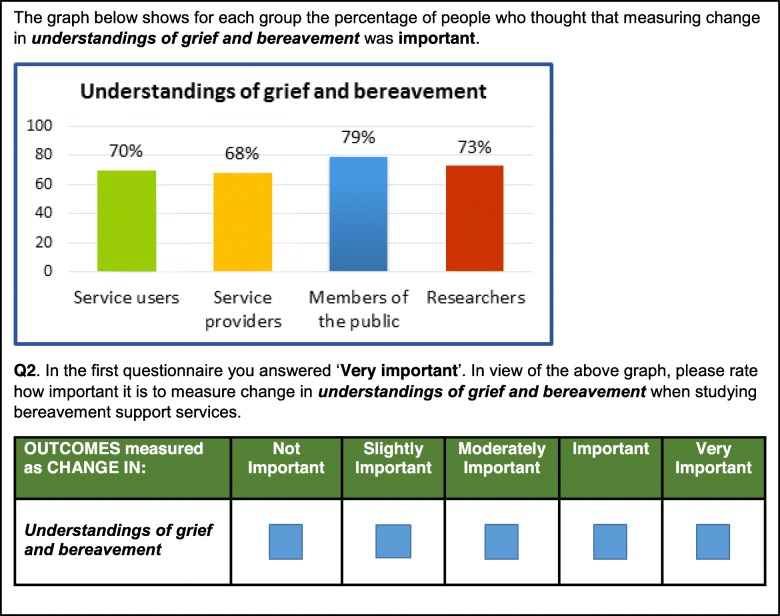
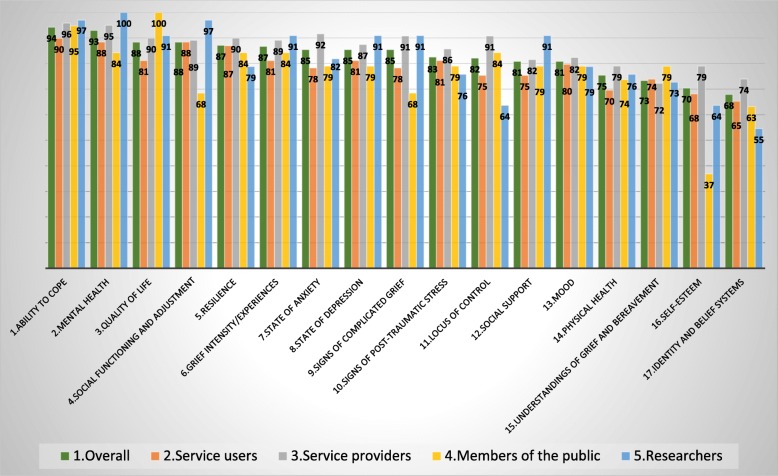
Background: Bereavement support is a core part of palliative care. However, the evidence base is limited by a lack of consistency in the outcomes used to evaluate services and models of support, which makes it difficult to compare approaches. Core Outcome Sets (COS) represent the minimum that should be measured in research into specific conditions or services. The aim of this study was to use a stakeholders’ perspective to develop a COS for evaluating bereavement support for adults in adult palliative care settings. Methods: A list of outcomes relevant to bereavement support was created following a systematic review of the quantitative and qualitative literature. At an expert workshop 21 stakeholders discussed their views on the most important outcomes and compared these to and critiqued the lists constructed from the review. These lists and discussions informed a two round international DELPHI survey (n = 240) designed to reach consensus on which outcomes/outcome dimensions should be included in the COS. To prioritise and validate the items emerging from the survey, participants at a subsequent consensus day ranked the relative importance of these items (n = 23). A final feedback exercise with these consensus day participants was conducted to confirm the selection of outcomes and dimensions. Results: ‘Ability to cope with grief’ and ‘Quality of life and mental wellbeing’ were selected as two core outcomes. Twenty-one different dimensions to explore when assessing these outcomes were also identified. The coping related dimensions have been categorised as: Negative and overwhelming grief; Communication and connectedness; Understanding, accepting and finding meaning in grief; Finding balance between grief and life going forwards; Accessing appropriate support. Those relating to quality of life and wellbeing have been categorised as; Participation in work and/or regular activities; Relationships and social functioning; Positive mental wellbeing and Negative mental and emotional state. Conclusion: This COS outlines a more consistent way forward for bereavement researchers and practitioners, whilst also orientating towards public health and resilience-based approaches to bereavement care. Further work is planned to identify and develop measures which are specific to this core outcome set, and which will facilitate the future comparability of bereavement services and interventions.
Overview
The claims and statistics of this paper haven’t been checked yet.
Free: it reads the open-access text and checks the first 5 claims that cite a source we can check. Create a free account to check every claim.
Integrity signals
Registry
Cites
Statistics
Figures
Verification
Claims the paper makes
The claims and statistics of this paper haven’t been checked yet.
Free: it reads the open-access text and checks the first 5 claims that cite a source we can check. Create a free account to check every claim.
Claims other papers make about this one
Each is checked against this paper’s own text: does it say what the citing paper says it does?
The source backs part of the claim, not all of it — or backs it for a different population, condition or comparison.
In the citing paper
“Grief is an expected and normal response to perinatal death (Harrop 2020), and parents often also report intense sadness, anxiety, and anger.”
From Support for parents and families after stillbirth and neonatal death (2024) · cites this paper as Harrop 2020
Experimental — accuracy not yet measuredThe source backs part of the claim, not all of it — or backs it for a different population, condition or comparison.
In the citing paper
“Many parents adapt over time with appropriate support from informal social networks, while others may benefit from low‐intensity interventions, such as peer‐support, or from more formal professional support (Aoun 2015; Harrop 2020).”
From Support for parents and families after stillbirth and neonatal death (2024) · cites this paper as Harrop 2020
Experimental — accuracy not yet measured
Self-check
Percentages, sums and reported differences re-computed from the paper’s own numbers.
The self-check needs the paper’s full text.
Citations
Cites
Developing and evaluating complex interventions: the new Medical Research Council guidance
Craig, P., Dieppe, P., Macintyre, S., Michie, S., Nazareth, I., & Petticrew, M. (2008) · BMJ · doi:10.1136/bmj.a1655 · Cited by 10,995
The Warwick-Edinburgh Mental Well-being Scale (WEMWBS): development and UK validation
Tennant, R., Hiller, L., Fishwick, R., Platt, S., Joseph, S., Weich, S., Parkinson, J., Secker, J., & Stewart-Brown, S. (2007) · Health and Quality of Life Outcomes · doi:10.1186/1477-7525-5-63 · Cited by 5,031
COSMIN Risk of Bias checklist for systematic reviews of Patient-Reported Outcome Measures
Mokkink, L. B., de Vet, H. C. W., Prinsen, C. A. C., Patrick, D. L., Alonso, J., Bouter, L. M., & Terwee, C. B. (2018) · Quality of Life Research · doi:10.1007/s11136-017-1765-4 · Cited by 2,479
The COMET Handbook: version 1.0
Williamson, P. R., Altman, D. G., Bagley, H., Barnes, K. L., Blazeby, J. M., Brookes, S. T., Clarke, M., Gargon, E., Gorst, S., Harman, N., et al. (2017) · Trials · doi:10.1186/s13063-017-1978-4 · Cited by 2,011
Health outcomes of bereavement.
Stroebe, M., Schut, H., & Stroebe, W. (2007) · The Lancet · doi:10.1016/s0140-6736(07)61816-9 · Cited by 1,746
Prinsen, C. A. C., Vohra, S., Rose, M. R., Boers, M., Tugwell, P., Clarke, M., Williamson, P. R., & Terwee, C. B. (2016) · Trials · doi:10.1186/s13063-016-1555-2 · Cited by 1,106
The Delphi technique in health sciences education research
de Villiers, M. R., de Villiers, P. J. T., & Kent, A. P. (2005) · Medical Teacher · doi:10.1080/13611260500069947 · Cited by 1,006
The National Institute for Clinical Excellence (NICE)
Rodgers, A.-T. (2002) · Annals of the Rheumatic Diseases · doi:10.1136/ard.61.suppl_2.ii92 · Cited by 966
The Delphi method and health research
de Meyrick, J. (2003) · Health Education · doi:10.1108/09654280310459112 · Cited by 397
The prevention and treatment of complicated grief: a meta-analysis
Wittouck, C., Van Autreve, S., De Jaegere, E., Portzky, G., & van Heeringen, K. (2011) · Clinical Psychology Review · doi:10.1016/j.cpr.2010.09.005 · Cited by 361
Research works printed but not linked: 3
- National Bereavement Alliance A Guide to Commissioning Services in England 2017
- Van den Berg, Gerard J. and Lundborg, Petter and Vikström, Johan, the economics of grief. IZA discussion paper no. 7010. Available at SSRN: https://ssrn.com/abstract=2183543. Accessed 25 Feb 2020.
- Bereavement Services Association and CRUSE Bereavement Care Service Standards 2013
Cited by
What is good grief support? Exploring the actors and actions in social support after traumatic grief
Cacciatore, J., Thieleman, K., Fretts, R., & Jackson, L. B. (2021) · PLOS ONE · doi:10.1371/journal.pone.0252324 · Cited by 141
“Strong social support for those dealing with intense grief may not accelerate recovery [36], but it may improve the capacity to cope [37].”
BackgroundAhmed, A. E., Ucbasaran, D., Cacciotti, G., & Williams, T. A. (2022) · Entrepreneurship Theory and Practice · doi:10.1177/10422587211046542 · Cited by 198
“…stress, entrepreneurship Individuals can experience work-related stress in response to triggers ranging in degree of severity from day-to-day work perturbations to significant adverse events such as economic crises and the COVID-19 pandemic (Harrop et al., 2020; Roux-Dufort, 2009; Turner, 1976).”
BackgroundHarrop, E., Goss, S., Farnell, D., Longo, M., Byrne, A., Barawi, K., Torrens-Burton, A., Nelson, A., Seddon, K., Machin, L., et al. (2021) · Palliative Medicine · doi:10.1177/02692163211043372 · Cited by 92
Self-citationHarrop, E., Morgan, F. M., Longo, M., Semedo, L., Fitzgibbon, J., Pickett, S., Scott, H., Seddon, K., Sivell, S., Nelson, A., et al. (2020) · Palliative Medicine · doi:10.1177/0269216320920533 · Cited by 90
“Although perceived lack of social support is recognised as a risk factor for problematic grief experiences [86,87] social support is often overlooked in quantitative evaluations of bereavement care [88].”
BackgroundSelf-citationSelman, L. E., FARNELL, D. J. J., Longo, M., Goss, S., Seddon, K., Torrens‐Burton, A., Mayland, C. R., Wakefield, D., Johnston, B. M., Byrne, A., et al. (2022) · Palliative Medicine · doi:10.1177/02692163221074876 · Cited by 74
Self-citationHarrop, E., Mann, M., Semedo, L., Chao, D., Selman, L. E., & Byrne, A. (2020) · Palliative Medicine · doi:10.1177/0269216320946273 · Cited by 55
“evidence for bereavement support relating to deaths from advanced disease [26, 27] and Dual Process Models of grief adaptation, which describe a process of oscillation between loss-orientated and restoration-orientated coping [28].”
BackgroundSelf-citationSanderson, E. A. M., Humphreys, S. K., Walker, F., Harris, D., Carduff, E., McPeake, J. M., Boyd, K. J., Pattison, N. A., & Lone, N. (2022) · PLoS ONE · doi:10.1371/journal.pone.0264971 · Cited by 45
Moss, S. J., Wollny, K., Poulin, T. G., Cook, D. J., Stelfox, H. T., Ordons, A. R. D., & Fiest, K. M. (2021) · BMC Palliative Care · doi:10.1186/s12904-021-00763-w · Cited by 44
“In our systematic review and narrative synthesis of RCTs evaluating bereavement interventions in adult ICUs targeting for informal caregivers, we found that the evidence is modest in scope.”
BackgroundMethodInfluentialKeegan, O., Murphy, I., Benkel, I., Limonero, J. T., Relf, M., & Guldin, M. (2021) · Palliative Medicine · doi:10.1177/02692163211043000 · Cited by 44
In-Hospital Bereavement Services as an Act of Care and a Challenge: An Integrative Review
Boven, C., Dillen, L., den Block, L. V., Piers, R. D., Noortgate, N. J. V. D., & Humbeeck, L. V. (2021) · Journal of Pain and Symptom Management · doi:10.1016/j.jpainsymman.2021.10.008 · Cited by 44
Hospital-Based Interventions to Address Provider Grief: A Narrative Review
Yazdan, R., Corey, K., Messer, S. J., Kim, E. H., Roberts, K. E., Selwyn, P. A., & Weinberger, A. H. (2023) · Journal of Pain and Symptom Management · doi:10.1016/j.jpainsymman.2023.03.001 · Cited by 36
A rapid review of the evidence for online interventions for bereavement support
Finucane, A., Canny, A., Mair, A. P. A., Harrop, E., Selman, L. E., Swash, B., Wakefield, D., & Gillanders, D. T. (2024) · Palliative Medicine · doi:10.1177/02692163241285101 · Cited by 36
Self-citationSelman, L. E., FARNELL, D. J. J., Longo, M., Goss, S., Torrens‐Burton, A., Seddon, K., Mayland, C. R., Machin, L., Byrne, A., & Harrop, E. (2022) · OMEGA - Journal of Death and Dying · doi:10.1177/00302228221144925 · Cited by 34
Self-citationCoronavirus pandemic: compassionate communities and information technology
Abel, J., & Taubert, M. (2020) · BMJ Supportive & Palliative Care · doi:10.1136/bmjspcare-2020-002330 · Cited by 33
Graven, L. J., Kitko, L. A., Saylor, M. A., Allen, L. A., Durante, Á., Evangelista, L. S., Fiedler, A. G., Kirkpatrick, J. N., Mixon, L. M., & Wells, R. D. (2025) · Circulation · doi:10.1161/cir.0000000000001323 · Cited by 31
“38 Studies show that care partner bereavement experiences are often complicated by emotional, familial, and financial challenges long after a person’s death 39 ; however, support is limited.”
Gillespie, K., McConnell, T., Roulston, A., Potvin, N., Ghiglieri, C. G., Gadde, I., Anderson, M. I., Kirkwood, J., Thomas, D., Roche, L., et al. (2024) · BMC Palliative Care · doi:10.1186/s12904-024-01364-z · Cited by 23
Lion, K., Jamieson, A., Billin, A., Jones, S., Pinkham, M. B., & Ownsworth, T. (2024) · Palliative Medicine · doi:10.1177/02692163241261211 · Cited by 23
“Bereavement support for families has been recognised as a core component of palliative care, 21,36 yet, this was non-existent or limited for caregivers in the current study, who needed to seek this from other sources (e.g. general practitioners or community-based psychologists).”
Vandersman, P., Chakraborty, A., Rowley, G., & Tieman, J. (2024) · Archives of Gerontology and Geriatrics · doi:10.1016/j.archger.2024.105473 · Cited by 16
Sharif, L., Almutairi, K., Alnasser, I. M., Attar, Z., Mahsoon, A. N., Alhofaian, A., Almutairi, B., Alqahtani, Y. J., Tunsi, A., Yaghmour, S. M., et al. (2025) · BMC Palliative Care · doi:10.1186/s12904-025-01790-7 · Cited by 15
Choi, S., Kitko, L. A., Hupcey, J. E., & Birriel, B. (2021) · Heart & Lung · doi:10.1016/j.hrtlng.2021.05.002 · Cited by 15
Fledderus, A. C., Pasmans, S. G. M. A., Wolkerstorfer, A., Oei, W., Etchevers, H., van Kessel, M. S., van der Horst, C. M. A. M., & Spuls, P. I. (2021) · British Journal of Dermatology · doi:10.1111/bjd.20437 · Cited by 13
Loughnan, S. A., Boyle, F. M., Ellwood, D. A., Crocker, S., Lancaster, A., Astell, C., Dean, J., Horey, D., Callander, E. J., Jackson, C. L., et al. (2022) · Trials · doi:10.1186/s13063-022-06363-0 · Cited by 13
“In the absence of a Core Outcome Set (COS) for stillbirth and neonatal death, program topics were mapped to the COS identified for coping and wellbeing in bereavement for adults in palliative care settings (see Table 1) [13].”
BackgroundDewhurst, F., Turner, R. L., Barrett, L. M., Westhead, E., Wakefield, D., & Hanratty, B. (2025) · OMEGA - Journal of Death and Dying · doi:10.1177/00302228251345033 · Cited by 10
Effectiveness of Brief Contact Interventions for Bereavement: A Systematic Review
McGill, K., Bhullar, N., Pearce, T., Batterham, P. J., Wayland, S., & Maple, M. J. (2022) · OMEGA - Journal of Death and Dying · doi:10.1177/00302228221108289 · Cited by 10
Health Care Professionals’ Views and Practices Regarding Bereavement Support
McAdam, J. L., Gularte-Rinaldo, J., Kim, S. B., & Erikson, A. E. (2025) · American Journal of Critical Care · doi:10.4037/ajcc2025717 · Cited by 10
Selman, L. E., Turner, N. L., Dawson, L., Chamberlain, C., Mustan, A., Rivett, A. C., & Fox, F. E. (2023) · Palliative Care and Social Practice · doi:10.1177/26323524231189523 · Cited by 10
Bereavement interventions for families in the ICU: a scoping review informed by a core outcome set
Foran, S. J., Rukh, M., Knapp, A., O’Brien, J., Brons, C., Glessman, J., Kawchuk, J., Goodridge, D. M., & Valiani, S. (2025) · Annals of Intensive Care · doi:10.1186/s13613-025-01557-6 · Cited by 7
“Outcomes were considered relevant if they aligned with at least one domain from the COS for bereavement research, or if they reflected emotional, psychological, or social impacts of the intervention on the bereaved [18].”
InfluentialPhan, H. P., Ngu, B. H., Hsu, C.-S., & Chen, S.-C. (2024) · Frontiers in Public Health · doi:10.3389/fpubh.2024.1440750 · Cited by 7
Schwalbach, T., Riguzzi, M., Köhler, M., & Naef, R. (2025) · Journal of Advanced Nursing · doi:10.1111/jan.70193 · Cited by 7
Agar, M. R., Siddiqi, N., Hosie, A., Boland, J. W., Johnson, M. J., Featherstone, I., Lawlor, P. G., Bush, S. H., Page, V. J., Amgarth‐Duff, I., et al. (2021) · Palliative Medicine · doi:10.1177/02692163211040186 · Cited by 7
“22 Yes Hydration status (9) Life impact Physical Functioning (25) Boettger et al.”
BackgroundInfluentialBereavement Experiences of Families in the Cardiac Intensive Care Unit
Erikson, A. E., Puntillo, K., & McAdam, J. L. (2022) · American Journal of Critical Care · doi:10.4037/ajcc2022859 · Cited by 7
Labram, A. H., Johnston, B. M., & McGuire, M. (2023) · Current Opinion in Supportive and Palliative Care · doi:10.1097/spc.0000000000000666 · Cited by 5
“[37] argued that researchers are using the wrong outcomes: their”
BackgroundMcConnell, T., Gillespie, K., Potvin, N., Roulston, A., Kirkwood, J., Thomas, D., McCullagh, A., Roche, L., O.’Sullivan, M., Binnie, K., et al. (2024) · BMC Palliative Care · doi:10.1186/s12904-024-01369-8 · Cited by 6
“The importance of qualitative data was emphasised throughout the workshops and is supported by the literature [23, 78, 80].”
BackgroundMethodInfluentialGallagher, K., Chant, K., Mancini, A., Bluebond‐Langner, M., & Marlow, N. (2023) · BMC Palliative Care · doi:10.1186/s12904-023-01326-x · Cited by 5
“In the absence of evidence from clinical trials the Delphi process has been adopted by clinicians and researchers in the field of palliative care to help develop guidelines, quality indicators, and measurable and comparable outcomes of care [14, 31–33].”
BackgroundScott, H. R., Sivell, S., Longo, M., Seddon, K., Fitzgibbon, J., Nelson, A., Byrne, A., & Harrop, E. (2022) · Bereavement · doi:10.54210/bj.2022.1078 · Cited by 5
Self-citationPrasetyo, Y. B., Faridi, F., Masruroh, N. L., Melizza, N., & Safitri, S. S. (2023) · Jurnal Keperawatan Padjadjaran · doi:10.24198/jkp.v11i1.2168 · Cited by 4
“According to some previous research (Harrop et al., 2020; O’Neill et al., 2021; Van Der Boor et al., 2020), the psychological pressure experienced due to economic demands during the pandemic increased mental and spiritual stress, so that an emotional and spiritual approach was needed.”
Staniland, L., Too, C., Butshiire, L., Skinner, S., & Breen, L. J. (2023) · OMEGA - Journal of Death and Dying · doi:10.1177/00302228231199876 · Cited by 4
“Recent research suggests that coping and wellbeing are the key outcomes that need to be captured in such measurements (Harrop et al., 2020).”
Petursdottir, A. B., & Thorsteinsson, H. S. (2024) · OMEGA - Journal of Death and Dying · doi:10.1177/00302228241253363 · Cited by 4
“Harrop et al., (2020) emphasized using results from qualitative studies to identify potential outcomes of interest.”
InfluentialJackson, B., Wayland, S., Ball, S.-A., Lamperd, A., Potter, A., & Maple, M. J. (2024) · Death Studies · doi:10.1080/07481187.2024.2419618 · Cited by 4
“Harrop et al. (2020) engaged with a range of stakeholders to define a set of valued outcomes to assess bereavement support in the palliative care context.”
Support for parents and families after stillbirth and neonatal death
Loughnan, S., Bakhbakhi, D., Ellwood, D. A., Boyle, F., Middleton, P., Burden, C., Ludski, K., Saunders, R., & Flenady, V. (2024) · Cochrane Database of Systematic Reviews · doi:10.1002/14651858.cd015798 · Cited by 3
Bereaved Family Quality of Life Varies With Comorbid Psychological Distress and ICU-Care Quality
Wen, F., Prigerson, H. G., Chuang, L., Chou, W., Hu, T., Huang, C.-C., & Tang, S. T. (2024) · Journal of Pain and Symptom Management · doi:10.1016/j.jpainsymman.2024.11.023 · Cited by 3
Delgado, M. X. L., González, Á. R. A., Buitrago, L., Campos, L. F. R., Ángel, L. F. V., Rodríguez, L. I. H., Granados, M. A. L., & González-Salazar, L. (2022) · Revista Colombiana de Psiquiatría · doi:10.1016/j.rcp.2022.10.005 · Cited by 3
Relatives' needs in terms of bereavement care throughout euthanasia processes: A qualitative study
Boven, C., Dillen, L., Humbeeck, L. V., den Block, L. V., Piers, R. D., & Noortgate, N. J. V. D. (2024) · Journal of Clinical Nursing · doi:10.1111/jocn.17185 · Cited by 2
Dönmez, Ç. F., & Johnston, B. M. (2025) · Current Opinion in Supportive and Palliative Care · doi:10.1097/spc.0000000000000773 · Cited by 2
Bereavement service deserts: A 2024 statewide assessment of bereavement services
Giang, C. W., Kcomt, L., Truchan, J., Dickinson, K., Evans‐Polce, R. J., & McCabe, S. E. (2025) · Death Studies · doi:10.1080/07481187.2025.2595997 · Cited by 2
Hopewell-Kelly, N., Goss, S., Mann, M. K., Machin, L., Pickles, T., Field, F., Perna, L., Selman, L. E., & Harrop, E. (2026) · Palliative Care and Social Practice · doi:10.1177/26323524251413281 · Cited by 2
Self-citationBereavement practices within older adult care homes in Scotland: a focus group study
Drummond, M., Burton, J., MacEachen, D., & Johnston, B. M. (2026) · BMJ Open · doi:10.1136/bmjopen-2025-115592 · Cited by 2
Flahault, C., Fasse, L., Veber, L., Sonrier, M., Leborgne, M. A., Michel, D., Marché, V., Vanbésien, A., Evin, A., Pujol, N., et al. (2024) · Palliative & Supportive Care · doi:10.1017/s1478951524001068 · Cited by 2
“These results were in line with researches showing that preparation improves adjustment to bereavement (Hebert et al. 2006; Wen et al. 2022), with the interesting question of how to operationalize what preparation would be (Harrop et al. 2020).”
Gillanders, D. T., Canny, A., Harrop, E. J., Hulbert-Williams, N., Neilson, A. R., Selman, L. E., Spiller, J. A., Swash, B., Buckle, P., Wakefield, D., et al. (2025) · Progress in Palliative Care · doi:10.1080/09699260.2025.2538935 · Cited by 2
“5,24 The intervention was also located within the Public Health Model for Bereavement Support and NICE three component model, as a component 1 and 2 intervention for those experiencing low to moderate levels of grief.”
Self-citationSelf-Care Strategies for Grief Counselors and Caregivers
Singha, R. (2024) · Advances in educational marketing, administration, and leadership book series · doi:10.4018/979-8-3693-1375-6.ch012 · Cited by 1
Ku, J., & Tabuchi, R. A. (2026) · Voices A World Forum for Music Therapy · doi:10.15845/voices.v26i1.4347 · Cited by 1
“In the context of bereavement, grief experiences can be viewed as a space for individuals to honor their loved ones and derive unique meaning from loss (Gillespie et al., 2024; Harrop et al., 2020; Neimeyer et al., 2011).”
Goss, S., Barawi, K., Sutton, E., Oates, R., Seddon, K., Sivell, S., Longo, M., Penny, A., Selman, L. E., & Harrop, E. (2026) · Frontiers in Public Health · doi:10.3389/fpubh.2026.1784477 · Cited by 1
Self-citationLohan, A., Dean, J., Yousef, N., Ludski, K., Ficinus, R., Loughnan, S. A., & Boyle, F. M. (2026) · Death Studies · doi:10.1080/07481187.2026.2723780 · Cited by 1
Grieving the Loss of a Child and the Use of Online Social Support: An Exploratory Survey Study
Clarkson, G., Sheikh, N. S., & Johnson, L. A. (2024) · Journal of Psychosocial Nursing and Mental Health Services · doi:10.3928/02793695-20240227-02 · Cited by 1
Diagnosis and Palliative Care Management of Lung Cancer: A Narrative Review
(2024) · Journal of Nursing & Healthcare · doi:10.33140/jnh.09.03.03 · Cited by 1
To Identify Relatives at Risk for Prolonged Grief Disorder Symptomatology: A Cross-Sectional Study
Boven, C., Noortgate, N. J. V. D., Dillen, L., Humbeeck, L. V., den Block, L. V., & Piers, R. D. (2025) · Journal of Pain and Symptom Management · doi:10.1016/j.jpainsymman.2025.02.001 · Cited by 1
Moss, S. J. (2021) · doi:10.11575/prism/39275 · Cited by 1
Priambodo, A. P., Hidayati, N. O., & Nuraeni, A. (2025) · International Medical Case Reports Journal · doi:10.2147/imcrj.s478751
孙琪梦, 周燚奎, 徐焕玢, 何雨亭, & 万琴 (2025) · 临床诊断与治疗杂志 · doi:10.62177/fcdt.v1i4.602
2021 (34th Annual) Sebastian K. Littmann Research Day Abstracts
University of Calgary (2021) · doi:10.11575/prism/38696
McConnell, T., Gillespie, K., Potvin, N., Roulston, A., Kirkwood, J., Thomas, D., McCullagh, A., Roche, L., O.’Sullivan, M., Binnie, K., et al. (2024) · Figshare · doi:10.6084/m9.figshare.25183308
Aplicaciones de la psicología en el tratamiento de pacientes con enfermedades crónicas. Tomo 2
González-Ramírez, L. P., Saldaña, A. C., & Martínez, R. S. R. (2024) · Repositorio del Tecnológico de Monterrey (Tecnológico de Monterrey) · doi:10.60514/b296-xf14
Moss, S. J., Wollny, K., Poulin, T. G., Cook, D. J., Stelfox, H. T., Ordons, A. R. D., & Fiest, K. M. (2021) · Figshare · doi:10.6084/m9.figshare.14583506
Loughnan, S. A., Boyle, F. M., Ellwood, D., Crocker, S., Lancaster, A., Astell, C., Dean, J., Horey, D., Callander, E., Jackson, C. L., et al. (2022) · Figshare · doi:10.6084/m9.figshare.20012349
Lapsen ja nuoren tukeminen perheenjäsenen kuollessa
Piilonen, S., & Schnabel, H. (2021) · Theseus (Ammattikorkeakoulujen)
Online bereavement self-help program - a feasibility study "Writing in Grief"
Carvalheira, E. G. (2023) · RepositóriUM (Universidade do Minho)
Outcomes for congenital melanocytic naevi
Fledderus, A. C. (2021) · Pure Amsterdam UMC
Mitchinson, L. (2023) · UCL Discovery (University College London)
Good Grief: What Video Games Teach Us About Loss
Dunlap, K., & Leech, C. (2025) · Bild und Bit · doi:10.14361/9783839468562-006
Kaya, M. E. (2024) · DSpace@FSM (FSM Vakif University)
Graciá, E. A., Rueda-Extremera, M., & Cantero-García, M. (2026) · Psicooncología · doi:10.5209/psic.108432
Rošker, L. (2026) · Repository of the University of Ljubljana (University of Ljubljana)
Metadata
- Authors
- Harrop, E., Scott, H., Sivell, S., Seddon, K., Fitzgibbon, J., Morgan, F., Pickett, S., Byrne, A., Nelson, A., & Longo, M.
- Affiliations
- Cardiff University (GB)
- University Hospital of Wales (GB)
- Swansea University (GB)
- Corresponding author
- Harrop, Emily
- ORCID
- Venue
- BMC Palliative Care
- Published
- 2020-03-12
- Volume
- 19
- Issue
- 1
- Pages
- 29-29
- ISSN
- 1472-684X (ISSN-L)
- PMC
- PMC7068975
- OpenAlex
- W3012554782
- Cited by
- 61
- References
- 35
- Citations by year
- 2026: 6 · 2025: 11 · 2024: 15 · 2023: 6 · 2022: 11 · 2021: 9 · 2020: 3
- FWCI
- 2.90
- Type
- journal article
- Language
- en
- Open access
- gold
- doi.org
- Licence
- cc-by
- creativecommons.org/licenses/by/4.0/ (tdm)
- creativecommons.org/licenses/by/4.0/ (vor)
- Locations
- BMC Palliative Care (publishedVersion, cc-by)
- PubMed Central (publishedVersion, cc-by)
- PubMed (publishedVersion)
- ORCA Online Research @Cardiff (Cardiff University) (acceptedVersion)
- DOAJ (DOAJ: Directory of Open Access Journals) (submittedVersion, cc-by-sa)
- Funders
- Marie Curie (C55837/A20999)
- Topics
- Social Sciences › Psychology › Clinical Psychology › Grief, Bereavement, and Mental Health
- Health Sciences › Medicine › Public Health, Environmental and Occupational Health › Palliative Care and End-of-Life Issues
- Health Sciences › Medicine › Public Health, Environmental and Occupational Health › Palliative and Oncologic Care
- Keywords
- bereavement support, palliative care, core outcome set, coping with grief, psychological well-being, quality of life, outcome measurement, stakeholder consensus, Delphi method, grief, resilience
- MeSH terms
- Adaptation, Psychological, Adolescent, Adult, Aged, Aged, 80 and over, Bereavement, Delphi Technique, Female, Humans, Male, Middle Aged, Palliative Care, Quality of Life, Surveys and Questionnaires, Hospice Care
About these checks
Registry, retraction, Cites and statistics results are computed, not judged, with one exception: a printed reference that no index lists is read once by a model before it counts as a citation error. Claims are extracted by a model and kept only when their quote appears verbatim in the text; each cited source is then checked, with a model’s help, for whether it says what the claim relies on. Those verdicts can be wrong — read the claim’s quote and the cited source before relying on one.
Statistics and arithmetic are recomputed, not judged.
Confidence bands are shown only for fields calibrated on our annotated test set. None is calibrated yet, so no band is shown.
What counts as a claim ›How we measure confidence ›How we check this ›
Are you an author, or do you see a problem with this page? Request a review
Data sources
Bibliographic data: Semantic Scholar, OpenAlex, Crossref.
Contains information from the Semantic Scholar Academic Graph Datasets, made available under the ODC Attribution License (ODC-BY 1.0).
Semantic Scholar’s data is described in: Kinney, R., et al. (2023). The Semantic Scholar Open Data Platform. arXiv:2301.10140.
