

Virtual reality reduces pain in palliative care–A feasibility trial
Open accessThe DOI matches its Crossref record; 44 of the 44 references it cites were found in a registry or an index.
Abstract
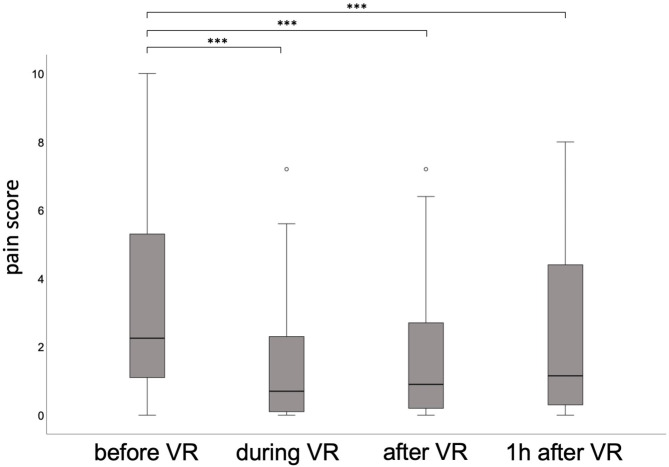
Background: Effective symptom control is a stated goal of palliative care (PC) to improve quality of life for terminally ill patients. Virtual reality (VR) provides temporary escapes from pharmacologically resistant pain and allows for experiences and journeys patients may not access in any other way. Enabling wishes through virtual worlds may also offer additional benefits such as controlling psychological and physical symptoms. Aims: We investigated the feasibility of a single VR experience as a viable, satisfying, and effective tool for end-of-life pain relief for inpatients presenting palliative needs. Design: This is an observational, single-arm and national single-center feasibility trial. Methods: A one-time VR experience with a selection of several videos and games was offered to 45 inpatients receiving PC at Muenster University Hospital. Patients with brain tumors, brain metastases, seizures, motion sickness, claustrophobia, vertigo, hearing or visual impairment, or unable to consent were excluded. Primary outcome measured patient reported pain on a visual analogue scale (VAS). We also measured Karnofsky performance status, health-related quality of life (HRQOL) using the EQ-5D-5 L questionnaire, and the Pain Out Questionnaire for postoperative pain. Results: We analyzed data from 21 women (52.5%) and 19 men (47.5%) at an average age of 51.9 (SD: 15.81) years. The mean Karnofsky score among the sample was 45.5 (SD: 14.97) and the HRQOL was 41.9 (SD: 23.08). While no serious side effects were reported during the intervention, three patients experienced nausea (7%), two headaches (5%), and three reported dry eyes (7%) afterwards. Significant pain reduction (baseline VAS 2.25 (SD: 0.4399)) was demonstrated during (VAS 0.7 (SD: 0.2983, p < 0.0001)), immediately after (VAS 0.9 (SD: 0.3354, p = 0.0001)) and one hour after the intervention (VAS 1.15 (SD: 0.4163, p = 0.0004)). More than 80% rated the VR experience as very good or good (85%, n = 34) and intended to make use of the device again (82.5%, n = 33). However, two participants (5%) also expressed sadness by becoming aware of old memories and previous opportunities that are gone. Discussion: The present pilot study suggests that VR seems to be a feasible and effective tool for pain relief in PC. Its use encompasses the approach of a total pain and symptom therapy and enhances patients’ dignity and autonomy. Future research ought to include if and to what extent VR could reduce the necessity of pharmacological pain relief.
Overview
The claims and statistics of this paper haven’t been checked yet.
Free: it reads the open-access text and checks the first 5 claims that cite a source we can check. Create a free account to check every claim.
Integrity signals
Registry
Cites
Statistics
Figures
Verification
Claims the paper makes
The claims and statistics of this paper haven’t been checked yet.
Free: it reads the open-access text and checks the first 5 claims that cite a source we can check. Create a free account to check every claim.
Claims other papers make about this one
Each is checked against this paper’s own text: does it say what the citing paper says it does?
The cited source doesn’t support the claim as written.
In the citing paper
“The more immersive the VR, the greater the analgesic effect.25,27,29,43,44”
From A Pilot Study of Virtual Reality in Hemodialysis for Mitigating Pain and Anxiety: User Experiences and Perceptions (2025) · cites this paper as [44]
Checked by a reasoning model — may be wrong.
Experimental — accuracy not yet measured
Self-check
Percentages, sums and reported differences re-computed from the paper’s own numbers.
The self-check needs the paper’s full text.
Citations
Cites
Development and preliminary testing of the new five-level version of EQ-5D (EQ-5D-5L)
Herdman, M., Gudex, C., Lloyd, A., Janssen, M., Kind, P., Parkin, D., Bonsel, G., & Badia, X. (2011) · Quality of Life Research · doi:10.1007/s11136-011-9903-x · Cited by 9,795 · cited 1×
“For the assessment of health-related quality of life (HRQOL), patients completed EQ-5D-5 L health questionnaire [31].”
MethodEarly Palliative Care for Patients with Metastatic Non–Small-Cell Lung Cancer
Temel, J. S., Greer, J. A., Muzikansky, A., Gallagher, E. R., Admane, S., Jackson, V. A., Dahlin, C. M., Blinderman, C. D., Jacobsen, J., Pirl, W. F., et al. (2010) · New England Journal of Medicine · doi:10.1056/nejmoa1000678 · Cited by 7,482
Symptom Prevalence in Patients with Incurable Cancer: A Systematic Review
Teunissen, S. C. C. M., Wesker, W., Kruitwagen, C., de Haes, H. C. J. M., Voest, E. E., & de Graeff, A. (2007) · Journal of Pain and Symptom Management · doi:10.1016/j.jpainsymman.2006.10.015 · Cited by 990 · cited 2×
“Observational research confirms that many patients suffering from cancer experience moderate or severe pain yet do not receive appropriate treatment [13, 16].”
BackgroundThe validity of pain intensity measures: what do the NRS, VAS, VRS, and FPS-R measure?
Thong, I. S. K., Jensen, M. P., Miró, J., & Tan, G. (2018) · Scandinavian Journal of Pain · doi:10.1515/sjpain-2018-0012 · Cited by 652 · cited 1×
“Also, the “VAS questionnaire” was self-constructed and is not standardized, although visual analog scales are proven and validated instruments for the measurement of individual pain over several years [44].”
BackgroundVirtual Reality and Pain Management: Current Trends and Future Directions
Li, A., Montaño, Z., Chen, V. J., & Gold, J. I. (2011) · Pain Management · doi:10.2217/pmt.10.15 · Cited by 536
Evidence on the cost and cost-effectiveness of palliative care: A literature review
Smith, S., Brick, A., O’Hara, S., & Normand, C. (2014) · Palliative Medicine · doi:10.1177/0269216313493466 · Cited by 502
Mallari, B., Spaeth, E. K., Goh, H., & Boyd, B. S. (2019) · Journal of Pain Research · doi:10.2147/jpr.s200498 · Cited by 374 · cited 1×
“It was concluded that VR is an effective treatment for acute pain, although lacking any long-term benefit addressing chronic pain [25].”
BackgroundGupta, A., Scott, K., & Dukewich, M. (2018) · Pain Medicine · doi:10.1093/pm/pnx109 · Cited by 340 · cited 2×
“It is considered that experiencing virtual worlds and environments necessitates sufficient mental capacity for distracting pain [19, 20].”
BackgroundVirtual reality for management of pain in hospitalized patients: results of a controlled trial
Tashjian, V. C., Mosadeghi, S., Howard, A. R., Lopez, M., Dupuy, T., Reid, M., Martinez, B., Ahmed, S., Dailey, F., Robbins, K., et al. (2017) · JMIR Mental Health · doi:10.2196/mental.7387 · Cited by 332
Virtual Reality as a Clinical Tool for Pain Management
Pourmand, A., Davis, S., Marchak, A., Whiteside, T., & Sikka, N. (2018) · Current Pain and Headache Reports · doi:10.1007/s11916-018-0708-2 · Cited by 326 · cited 2×
“It is considered that experiencing virtual worlds and environments necessitates sufficient mental capacity for distracting pain [19, 20].”
Background
Cited by
A scoping review of digital technology applications in palliative care
Tan, Y., Liang, X., Wei, M., Xing, H., Wang, Y., & Gao, Y. (2024) · BMC Palliative Care · doi:10.1186/s12904-024-01626-w · Cited by 42
“Guenther et al. [7] employed immersive 360° VR interventions for palliative care patients, including videos for travel, relaxation, and meditation, which resulted in significant pain reduction.”
InfluentialQin, W., Sun, R., Liang, Y., & Chen, D. (2024) · BMC Nursing · doi:10.1186/s12912-024-02184-5 · Cited by 24
“VR technology enables children to maintain a sense of pleasure, achieve a state of physical and mental relaxation, and eliminate anxiety through visual images and auditory stimulation [48–50].”
BackgroundVirtual reality use and patient outcomes in palliative care: A scoping review
Moloney, M., Doody, O., O’Reilly, M., Lucey, M. R., Callinan, J., Exton, C., Colreavy‐Donnelly, S., O’Mahony, F., Meskell, P., & Coffey, A. (2023) · Digital Health · doi:10.1177/20552076231207574 · Cited by 25
A Rapid Review of the Role of Virtual Reality in Care Delivery of Palliative Care and Hospice
Moutogiannis, P. P., Thrift, J. R., Pope, J. K., Browning, M. H. E. M., McAnirlin, O., & Fasolino, T. K. (2023) · Journal of Hospice and Palliative Nursing · doi:10.1097/njh.0000000000000983 · Cited by 16
A Systematic Review of Virtual Reality’s Impact on Anxiety During Palliative Care
Găină, A.-M., Ștefănescu, C., Szalontay, A.-S., Găină, M.-A., Poroch, V., Mosoiu, D. V., Ştefănescu, B., Axinte, M., Bostan, C. M., & Magurianu, L. A. (2024) · Healthcare · doi:10.3390/healthcare12242517 · Cited by 12
“…so they were very easily integrated into the routines of palliative care [62] VR was complementary to conventional palliative care protocols, being perceived as desirable by patients and providers alike as a treatment alternative that did not conflict with existing treatment or medication [62].”
InfluentialNoble, T., Boone, L., & Helou, A. E. (2023) · Frontiers in Pain Research · doi:10.3389/fpain.2023.1094125 · Cited by 8
Gerlach, C., Haas, L., Greinacher, A., Lantelme, J., Guenther, M., Thiesbonenkamp-Maag, J., Alt‐Epping, B., & Wrzus, C. (2024) · BMC Palliative Care · doi:10.1186/s12904-024-01577-2 · Cited by 10
“Still, other than previous studies that identified the potential of personalized and individually meaningful VR applications [5, 7–9, 23] , we did not find substantial quantitative advantages over standard VR.”
BackgroundSelf-citationVirtual reality reduces anxiety and pain in acute hospital palliative care: service evaluation
Burridge, N., Sillence, A., Teape, L., Clark, B., Bruce, E., Armoogum, J., Leloch, D., Spathis, A., & Etkind, S. N. (2023) · BMJ Supportive & Palliative Care · doi:10.1136/spcare-2023-004572 · Cited by 9
Virtual Reality Videos for Symptom Management in Hospice and Palliative Care
Deming, J. R., Dunbar, K. J., Lueck, J. F., & Oh, Y. (2024) · Mayo Clinic Proceedings Digital Health · doi:10.1016/j.mcpdig.2024.08.002 · Cited by 7
“24 Virtual reality can simulate being in nature, 25 with results similar to physically being outdoors.”
Enrichment through virtual reality for palliative care: A scoping review
Vasudevan, A. V., Cao, Y., Gough, P., & Ahmadpour, N. (2023) · Australian Conference on Computer-Human Interaction (OzCHI) · doi:10.1145/3638380.3638389 · Cited by 6
Salim, N. A., & Taylor, J. L. W. (2025) · Journal of Pain and Symptom Management · doi:10.1016/j.jpainsymman.2025.08.030 · Cited by 9
Mukai, T., Tsukiyama, Y., Yamada, S., Nishikawa, A., Hayami, S., Noguchi, R., Yoshida, J., Kashiwada, M., Ohta, S., Shimokawa, T., et al. (2023) · Palliative Medicine Reports · doi:10.1089/pmr.2023.0017 · Cited by 10
“’’ These results supported the findings of the previous studies.(3,4) According to Cluster 2 (using VR to regain daily life), the patients expressed the promising possibility of VR and their desire for their concerns about daily life lost due to hospitalization to be heard.”
ResultXia, W., Ding, J., Yan, Y., Chen, F., Yan, M., & Xu, X. (2024) · Journal of the American Medical Directors Association · doi:10.1016/j.jamda.2024.105086 · Cited by 8
Rodríguez de Galvis, S., Guerrero Rodríguez, E., Audije-Gil, J., Hernández, S., Argilés-Huguet, M., Botella, A., Burgos Villulas, M., Casaux-Huertas, A., González Sánchez, I., Marín López, M. T., et al. (2025) · Patient Preference and Adherence · doi:10.2147/ppa.s517622 · Cited by 3
“25,27,29,43,44 When the patient is fully immersed in the situation and feels as if they are part of the virtual world, it makes the experience more engaging.”
Assistive technologies for people with advanced disease and in palliative care: a scoping review
Clair‐Sullivan, N. S., Brighton, L. J., Jha, P., Bone, A. E., Sudirman, N. A., Maddocks, M. M., & Bayly, J. (2025) · Disability and Rehabilitation Assistive Technology · doi:10.1080/17483107.2025.2536175 · Cited by 4
“…experiences that can reduce the symptom burden associated with anxiety, depression, and chronic pain in patients with life-limiting illnesses [10]. whilst these advancements highlight the potential of assistive technology to enhance mental and physical well-being in people receiving…”
In sickness and in health—A scoping review on social virtual reality clinical applications
Belina, S. P., Czaja, S. J., Difede, J., Pain, K. J., Reid, C., & Won, A. S. (2024) · Digital Health · doi:10.1177/20552076241306460 · Cited by 4
“17 – 19 Increasingly, the use of VR applications has also been studied with older adult populations 20 – 23 to address exercise effort, anxiety, enjoyment, mood states, loneliness, and social engagement, which have been linked to health outcomes in older adults.”
Gains, A. M., Moghaddam, N. G., Baliousis, M., & Biswas, S. (2025) · BMJ Supportive & Palliative Care · doi:10.1136/spcare-2024-005342 · Cited by 3
“46 47 However, as mentioned earlier, three participants reported feeling sadness following the VR experience, 38 41 which may have also occurred within an additional study 47 as no improvements in mental health or well-being were found for participants who experienced VR viewing a non-memorable…”
InfluentialTargeted Digital Health Intervention in End‐of‐Life and Hospice Care: A Scoping Review
Jeon, M., Jeon, H., & Kim, S. (2025) · Journal of Advanced Nursing · doi:10.1111/jan.16734 · Cited by 6
Need for a ‘VR-cebo’ and more robust evaluations of virtual reality intervention
Flanagan, K., Taubert, M., & White, N. (2023) · BMJ Oncology · doi:10.1136/bmjonc-2023-000230 · Cited by 2
“Guenther et al 4 did include a follow-up and reported that the reduction in pain was sustained 1 hour after use of virtual technology.”
Technology to Support Care at the End-of-Life
Nwosu, A. C., Stanley, S., Norris, J., & Taubert, M. (2025) · Synthesis lectures on technology and health · doi:10.1007/978-3-032-04277-4_8 · Cited by 1
Maciejewski, H., Levy, K., Mann, C. M., Sullivan, S. S., Schuster, G., & Kerr, C. W. (2025) · American Journal of Hospice and Palliative Medicine® · doi:10.1177/10499091251363173 · Cited by 1
Balzer, M., Elsakka, A., Luijten, G., Schorrmann, K., Jovic, S., Gerigk, M., Mazilescu, L., Schmitz, S. M., Keyl, J., Liszio, S., et al. (2026) · Current Oncology Reports · doi:10.1007/s11912-026-01758-7 · Cited by 2
Exposure to Immersive Relaxing Virtual Environments for Hospitalized Patients
Pereira, M., Oliveira, P., Gomes, M. E., & de Sousa, S. (2023) · Advances in medical technologies and clinical practice book series · doi:10.4018/978-1-6684-9251-2.ch006
Research Trends and Highlights Toward Virtual Reality in Patients With Cancer: Bibliometric Analysis
Sezgin, M. G., & Bektaş, H. (2024) · CIN Computers Informatics Nursing · doi:10.1097/cin.0000000000001065 · Cited by 3
“39,41 For this reason, there is a need for the dissemination of home-based VR applications as they provide continuous care and monitoring When the keywords of the included studies were examined chronologically, it was seen that the words cancer and nursing had changed over the years, and the word…”
BackgroundTeknologi Virtual Reality (VR) dalam Manajemen Nyeri pada Pasien Kanker
Tulangow, I. W., Gayatri, D., Edison, C., & Waluyo, A. D. (2024) · Journal of Telenursing (JOTING) · doi:10.31539/joting.v6i1.10181
“…teruji kelayakkan dan keamanannya dalam intervensi manajemen nyeri pada anak-anak maupun dewasa (Kelleher et al., 2022) Serta menunjukkan akseptibilitas tinggi dari para pasien kanker serta dapat di jadikan pelarian sementara dari rasa sakit yang resisten secara farmakologis(Guenther et al., 2022).”
BackgroundFrith, A., Mall, A. E., Streisfeld, G., Swaringen, K., Escobar, E., Gorlatova, M. A., & Granger, B. B. (2025) · CIN Computers Informatics Nursing · doi:10.1097/cin.0000000000001309
Mental Health, Palliative Care and End-of-Life Issues—Application of Virtual Reality
Chiu, W.-K., Ip, T. W. Y., & Fong, B. Y. F. (2025) · Quality of life in Asia · doi:10.1007/978-981-96-0817-1_33
Estévez, D. R., Rodríguez, A. G., Morcuende, Á., Ferrándiz, M. C., & Naudin, E. M. (2025) · Europe PMC (PubMed Central) · doi:10.33620/fc.2173-9218.(2025).24 · Cited by 1
Mitchem, S., Salisbury, F., Gillis, B. D., Ostapenko, L. J., & Hill, K. A. (2025) · Springer eBooks · doi:10.1007/978-3-031-88954-7_14
Zhang, X. P., Wang, Z., Xu, Z., Wang, L., Liu, Q., & Qin, G. (2025) · Psycho-Oncologie · doi:10.18282/po4691
Another Life: Palliative Virtual Reality for Experiencing the World Until the End
Manzati, S. P., Manganotti, P., Manzoni, G. D., Festi, A., Tecchiolli, M., Costa, S., Ghizzo, A., Stanescu, R. M., Depetroni, F., Cosmo, M. D., et al. (2026) · Journal of Palliative Care · doi:10.1177/08258597261422062
Leveraging Publicly Available Data on VR Headsets for Gender-Responsive Standards Development
Baria, A. T., Callahan, G., & Schnerre, A. (2026) · International Journal of Standardization Research · doi:10.4018/ijsr.405060
Ruiz, P. D. J., Navia, M. A. C., Caballero, D. S. P., & Amán, J. E. M. (2026) · Reincisol · doi:10.59282/reincisol.v5(9)1591
Moreno, A., Côté, E., Rigoulat, C., Zubková, A., Pichon, C., Dubois, M., Belhouari, S., Pelletier, P., Caamano, C., & Fajnerová, I. (2026) · Psychology and Aging · doi:10.1037/pag0000981 · Cited by 1
Use of virtual reality as an adjunct tool for the acute reduction of pain in hospitalized patients
Nitz, D., Gianesini, C. F., Eidt, N. J. F., Reis, J. R., Ferreira, I., & da-Cunha, N. V. (2026) · Brazilian Journal Of Pain · doi:10.63231/2595-0118.e202686-en
Virtuelle Hochzeitsreise auf der Palliativstation
Streller, L., Russ, P., Grgic, I., Schmidt, A., Thewalt, M. W., & Volberg, C. (2026) · Zeitschrift für Palliativmedizin · doi:10.1055/a-2919-8257
Metadata
- Authors
- Guenther, M., Görlich, D., Bernhardt, F., Pogatzki-Zahn, E., Dasch, B., Krueger, J., & Lenz, P.
- Affiliations
- University Hospital Münster (DE)
- University of Münster (DE)
- Corresponding author
- Lenz, Philipp
- Venue
- BMC Palliative Care
- Published
- 2022-10-05
- Volume
- 21
- Issue
- 1
- Pages
- 169-169
- ISSN
- 1472-684X (ISSN-L)
- PMC
- PMC9533542
- OpenAlex
- W4301372145
- Cited by
- 34
- References
- 44
- Citations by year
- 2026: 5 · 2025: 12 · 2024: 9 · 2023: 8
- FWCI
- 6.40
- Type
- journal article
- Language
- en
- Open access
- gold
- doi.org
- Licence
- cc-by
- creativecommons.org/licenses/by/4.0 (tdm)
- creativecommons.org/licenses/by/4.0 (vor)
- Locations
- BMC Palliative Care (publishedVersion, cc-by)
- PubMed Central (publishedVersion, cc-by)
- PubMed (publishedVersion)
- DOAJ (DOAJ: Directory of Open Access Journals) (submittedVersion, cc-by-sa)
- Funders
- Westfälische Wilhelms-Universität Münster
- Topics
- Health Sciences › Medicine › Public Health, Environmental and Occupational Health › Palliative Care and End-of-Life Issues
- Physical Sciences › Computer Science › Human-Computer Interaction › Virtual Reality Applications and Impacts
- Health Sciences › Medicine › Anesthesiology and Pain Medicine › Pain Management and Opioid Use
- Keywords
- virtual reality, palliative care, analgesia, symptom management, health-related quality of life, Karnofsky performance status, virtual reality games, feasibility, hospitalized patients, adverse effects, patient satisfaction, dying patients, visual analogue scale, EQ-5D-5L, distraction therapy
- MeSH terms
- Virtual Reality, Feasibility Studies, Female, Humans, Male, Middle Aged, Pain, Palliative Care, Pilot Projects, Quality of Life
About these checks
Registry, retraction, Cites and statistics results are computed, not judged, with one exception: a printed reference that no index lists is read once by a model before it counts as a citation error. Claims are extracted by a model and kept only when their quote appears verbatim in the text; each cited source is then checked, with a model’s help, for whether it says what the claim relies on. Those verdicts can be wrong — read the claim’s quote and the cited source before relying on one.
Statistics and arithmetic are recomputed, not judged.
Confidence bands are shown only for fields calibrated on our annotated test set. None is calibrated yet, so no band is shown.
What counts as a claim ›How we measure confidence ›How we check this ›
Are you an author, or do you see a problem with this page? Request a review
Data sources
Bibliographic data: Semantic Scholar, OpenAlex, Crossref.
Contains information from the Semantic Scholar Academic Graph Datasets, made available under the ODC Attribution License (ODC-BY 1.0).
Semantic Scholar’s data is described in: Kinney, R., et al. (2023). The Semantic Scholar Open Data Platform. arXiv:2301.10140.
