

Virtual reality reduces pain in palliative care–A feasibility trial
Open accessThe DOI matches its Crossref record; 44 of the 44 references it cites were found in a registry or an index.
Abstract
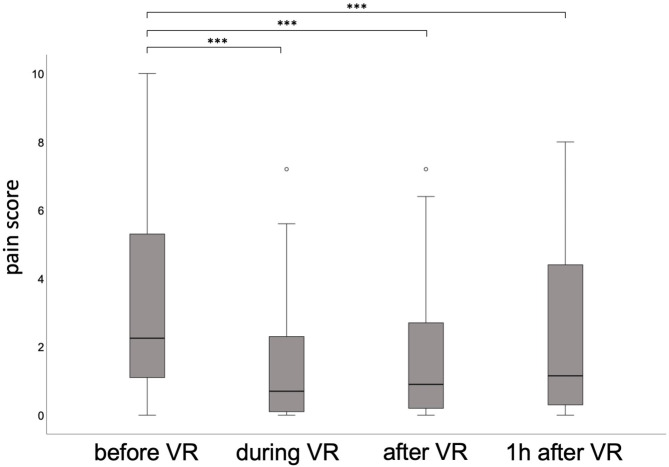
Background: Effective symptom control is a stated goal of palliative care (PC) to improve quality of life for terminally ill patients. Virtual reality (VR) provides temporary escapes from pharmacologically resistant pain and allows for experiences and journeys patients may not access in any other way. Enabling wishes through virtual worlds may also offer additional benefits such as controlling psychological and physical symptoms. Aims: We investigated the feasibility of a single VR experience as a viable, satisfying, and effective tool for end-of-life pain relief for inpatients presenting palliative needs. Design: This is an observational, single-arm and national single-center feasibility trial. Methods: A one-time VR experience with a selection of several videos and games was offered to 45 inpatients receiving PC at Muenster University Hospital. Patients with brain tumors, brain metastases, seizures, motion sickness, claustrophobia, vertigo, hearing or visual impairment, or unable to consent were excluded. Primary outcome measured patient reported pain on a visual analogue scale (VAS). We also measured Karnofsky performance status, health-related quality of life (HRQOL) using the EQ-5D-5 L questionnaire, and the Pain Out Questionnaire for postoperative pain. Results: We analyzed data from 21 women (52.5%) and 19 men (47.5%) at an average age of 51.9 (SD: 15.81) years. The mean Karnofsky score among the sample was 45.5 (SD: 14.97) and the HRQOL was 41.9 (SD: 23.08). While no serious side effects were reported during the intervention, three patients experienced nausea (7%), two headaches (5%), and three reported dry eyes (7%) afterwards. Significant pain reduction (baseline VAS 2.25 (SD: 0.4399)) was demonstrated during (VAS 0.7 (SD: 0.2983, p < 0.0001)), immediately after (VAS 0.9 (SD: 0.3354, p = 0.0001)) and one hour after the intervention (VAS 1.15 (SD: 0.4163, p = 0.0004)). More than 80% rated the VR experience as very good or good (85%, n = 34) and intended to make use of the device again (82.5%, n = 33). However, two participants (5%) also expressed sadness by becoming aware of old memories and previous opportunities that are gone. Discussion: The present pilot study suggests that VR seems to be a feasible and effective tool for pain relief in PC. Its use encompasses the approach of a total pain and symptom therapy and enhances patients’ dignity and autonomy. Future research ought to include if and to what extent VR could reduce the necessity of pharmacological pain relief.
Overview
The claims and statistics of this paper haven’t been checked yet.
Free: it reads the open-access text and checks the first 5 claims that cite a source we can check. Create a free account to check every claim.
Integrity signals
Registry
Cites
Statistics
Figures
Verification
Claims the paper makes
The claims and statistics of this paper haven’t been checked yet.
Free: it reads the open-access text and checks the first 5 claims that cite a source we can check. Create a free account to check every claim.
Claims other papers make about this one
Each is checked against this paper’s own text: does it say what the citing paper says it does?
The cited source doesn’t support the claim as written.
In the citing paper
“The more immersive the VR, the greater the analgesic effect.25,27,29,43,44”
From A Pilot Study of Virtual Reality in Hemodialysis for Mitigating Pain and Anxiety: User Experiences and Perceptions (2025) · cites this paper as [44]
Checked by a reasoning model — may be wrong.
Experimental — accuracy not yet measured
Self-check
Percentages, sums and reported differences re-computed from the paper’s own numbers.
The self-check needs the paper’s full text.
Citations
Cites
Development and preliminary testing of the new five-level version of EQ-5D (EQ-5D-5L)
Herdman, M., Gudex, C., Lloyd, A., Janssen, M., Kind, P., Parkin, D., Bonsel, G., & Badia, X. (2011) · Quality of Life Research · doi:10.1007/s11136-011-9903-x · Cited by 9,795 · cited 1×
“For the assessment of health-related quality of life (HRQOL), patients completed EQ-5D-5 L health questionnaire [31].”
MethodEarly Palliative Care for Patients with Metastatic Non–Small-Cell Lung Cancer
Temel, J. S., Greer, J. A., Muzikansky, A., Gallagher, E. R., Admane, S., Jackson, V. A., Dahlin, C. M., Blinderman, C. D., Jacobsen, J., Pirl, W. F., et al. (2010) · New England Journal of Medicine · doi:10.1056/nejmoa1000678 · Cited by 7,482
Symptom Prevalence in Patients with Incurable Cancer: A Systematic Review
Teunissen, S. C. C. M., Wesker, W., Kruitwagen, C., de Haes, H. C. J. M., Voest, E. E., & de Graeff, A. (2007) · Journal of Pain and Symptom Management · doi:10.1016/j.jpainsymman.2006.10.015 · Cited by 990 · cited 2×
“Observational research confirms that many patients suffering from cancer experience moderate or severe pain yet do not receive appropriate treatment [13, 16].”
BackgroundThe validity of pain intensity measures: what do the NRS, VAS, VRS, and FPS-R measure?
Thong, I. S. K., Jensen, M. P., Miró, J., & Tan, G. (2018) · Scandinavian Journal of Pain · doi:10.1515/sjpain-2018-0012 · Cited by 652 · cited 1×
“Also, the “VAS questionnaire” was self-constructed and is not standardized, although visual analog scales are proven and validated instruments for the measurement of individual pain over several years [44].”
BackgroundVirtual Reality and Pain Management: Current Trends and Future Directions
Li, A., Montaño, Z., Chen, V. J., & Gold, J. I. (2011) · Pain Management · doi:10.2217/pmt.10.15 · Cited by 536
Evidence on the cost and cost-effectiveness of palliative care: A literature review
Smith, S., Brick, A., O’Hara, S., & Normand, C. (2014) · Palliative Medicine · doi:10.1177/0269216313493466 · Cited by 502
Mallari, B., Spaeth, E. K., Goh, H., & Boyd, B. S. (2019) · Journal of Pain Research · doi:10.2147/jpr.s200498 · Cited by 374 · cited 1×
“It was concluded that VR is an effective treatment for acute pain, although lacking any long-term benefit addressing chronic pain [25].”
BackgroundGupta, A., Scott, K., & Dukewich, M. (2018) · Pain Medicine · doi:10.1093/pm/pnx109 · Cited by 340 · cited 2×
“It is considered that experiencing virtual worlds and environments necessitates sufficient mental capacity for distracting pain [19, 20].”
BackgroundVirtual reality for management of pain in hospitalized patients: results of a controlled trial
Tashjian, V. C., Mosadeghi, S., Howard, A. R., Lopez, M., Dupuy, T., Reid, M., Martinez, B., Ahmed, S., Dailey, F., Robbins, K., et al. (2017) · JMIR Mental Health · doi:10.2196/mental.7387 · Cited by 332
Virtual Reality as a Clinical Tool for Pain Management
Pourmand, A., Davis, S., Marchak, A., Whiteside, T., & Sikka, N. (2018) · Current Pain and Headache Reports · doi:10.1007/s11916-018-0708-2 · Cited by 326 · cited 2×
“It is considered that experiencing virtual worlds and environments necessitates sufficient mental capacity for distracting pain [19, 20].”
BackgroundVirtual Reality interventions for acute and chronic pain management
Ahmadpour, N., Randall, H., Choksi, H., Gao, A., Vaughan, C., & Poronnik, P. (2019) · The International Journal of Biochemistry & Cell Biology · doi:10.1016/j.biocel.2019.105568 · Cited by 287 · cited 1×
“mentioned shifting to virtual objects and skill building based on interaction as mechanisms of VR’s analgesic effects [43].”
BackgroundSymptoms in 400 patients referred to palliative care services: prevalence and patterns
Potter, J., Hami, F., Bryan, T., & Quigley, C. (2003) · Palliative Medicine · doi:10.1191/0269216303pm760oa · Cited by 285 · cited 1×
“The proportion of PC patients suffering from pain is quantified to be 64% according to another survey [14].”
BackgroundBani Mohammad, E., & Ahmad, M. (2019) · Palliative and Supportive Care · doi:10.1017/s1478951518000639 · Cited by 264 · cited 1×
“Another study showed the efficacy of a single VR intervention (HMD VR with Ocean Rift® or sitting on the beach with the “Happy Track”) when combined with morphine versus treatments with solely morphine for the reduction of pain and anxiety among patients with breast cancer using a randomized control design [40].”
BackgroundMosadeghi, S., Reid, M. W., Martinez, B., Rosen, B. T., & Spiegel, B. M. R. (2016) · JMIR Mental Health · doi:10.2196/mental.5801 · Cited by 233 · cited 1×
“In addition, some participants reported intermittent difficulties to maintain concentration [27].”
BackgroundSpiegel, B., Fuller, G., Lopez, M., Dupuy, T., Noah, B., Howard, A., Albert, M., Tashjian, V., Lam, R., Ahn, J., et al. (2019) · PLOS ONE · doi:10.1371/journal.pone.0219115 · Cited by 233
Bajwah, S., Oluyase, A. O., Yi, D., Gao, W., Evans, C. J., Grande, G., Todd, C., Costantini, M., Murtagh, F. E., & Higginson, I. J. (2020) · Cochrane Database of Systematic Reviews · doi:10.1002/14651858.cd012780.pub2 · Cited by 224
Martínez, M., Arantzamendi, M., Belar, A., Carrasco, J. M., Carvajal, A., Rullán, M., & Centeno, C. (2017) · Palliative Medicine · doi:10.1177/0269216316665562 · Cited by 215 · cited 2×
“Based on the benefits of dignity therapy in PC [9, 45], VR interventions may be interpreted as a modern version to support patients’ well-being and sense of dignity.”
BackgroundRodríguez-Prat, A., Monforte-Royo, C., Porta-Sales, J., Escribano, X., & Balaguer, A. (2016) · PLOS ONE · doi:10.1371/journal.pone.0151435 · Cited by 188 · cited 1×
“exemplified the way dignity and autonomy are intertwined [46].”
BackgroundTriberti, S., Repetto, C., & Riva, G. (2014) · Cyberpsychology, Behavior, and Social Networking · doi:10.1089/cyber.2014.0054 · Cited by 186 · cited 1×
“In fact, pain perception can be reduced by stimuli that attract attention [18].”
BackgroundRothaug, J., Zaslansky, R., Schwenkglenks, M., Komann, M., Allvin, R., Backström, R., Brill, S., Buchholz, I., Engel, C., Fletcher, D., et al. (2013) · The Journal of Pain · doi:10.1016/j.jpain.2013.05.016 · Cited by 178 · cited 1×
“Its core measure is the International Pain Outcomes Questionnaire [34], which primarily works with 11-item (0–10) numeric rating scales (NRS, higher numbers represent more severe symptoms) and binary items.”
BackgroundSelf-citationNiki, K., Okamoto, Y., Maeda, I., Mori, I., Ishii, R., Matsuda, Y., Takagi, T., & Uejima, E. (2019) · Journal of Palliative Medicine · doi:10.1089/jpm.2018.0527 · Cited by 145
Schwenkglenks, M. M., Gerbershagen, H. U., Taylor, R. S., Pogatzki-Zahn, E. M., Komann, M., Rothaug, J., Volk, T. J., Yahiaoui‐Doktor, M., Zaslansky, R., Brill, S., et al. (2014) · Pain · doi:10.1016/j.pain.2014.04.021 · Cited by 141
Self-citationPAIN OUT: The making of an international acute pain registry
Zaslansky, R., Rothaug, J., Chapman, C. R., Bäckström, R., Brill, S., Fletcher, D., Fodor, L., Gordon, D. B., Komann, M., Konrad, C., et al. (2015) · European Journal of Pain · doi:10.1002/ejp.571 · Cited by 114 · cited 1×
“Although this questionnaire is regularly used to measure patients’ satisfaction with postoperative pain management[32], we utilized it to collect data at different time points.”
MethodSymptom severity and distress in advanced cancer
Kirkova, J., Walsh, D., Rybicki, L., Davis, M. P., Aktas, A., Jin, T., & Homsi, J. (2010) · Palliative Medicine · doi:10.1177/0269216309356380 · Cited by 113 · cited 1×
“Most frequent symptoms of patients in PC with advanced cancer include fatigue, pain, dry mouth, anorexia, loss of weight and sleep problems [11].”
BackgroundSharar, S. R., Alamdari, A., Hoffer, C., Hoffman, H. G., Jensen, M. P., & Patterson, D. R. (2016) · Games for Health Journal · doi:10.1089/g4h.2015.0046 · Cited by 112 · cited 1×
“Moreover, unpleasant or painful procedures tended to be more tolerable while experiencing VR [29].”
BackgroundVogt, J., Beyer, F., Sistermanns, J., Kuon, J., Kahl, C., Alt‐Epping, B., stevens, S., Ahlborn, M., George, C., Heider, A., et al. (2021) · The Oncologist · doi:10.1002/onco.13751 · Cited by 112 · cited 1×
“A comprehensive concept is required whenever seriously ill and dying people are accompanied, treated and counselled, in order to cope with life-limiting diseases, usually associated with various ailments and high symptom burden during their progression [5, 6].”
BackgroundHess, S., Stiel, S., Hofmann, S., Klein, C., Lindena, G., & Ostgathe, C. (2014) · European Journal of Internal Medicine · doi:10.1016/j.ejim.2013.11.012 · Cited by 93 · cited 1×
“1% of their sample had non-cancer diagnoses [10].”
BackgroundAhmad, M., Bani Mohammad, E., & Anshasi, H. A. (2020) · Pain Management Nursing · doi:10.1016/j.pmn.2020.04.002 · Cited by 89 · cited 1×
“performed a review and strongly recommended the use of VR for female cancer patients as a supplementary intervention for the treatment of pain and anxiety [41].”
BackgroundLiving systematic review to assess the analgesic undertreatment in cancer patients
Roberto, A., Greco, M. T., Uggeri, S., Cavuto, S., Deandrea, S., Corli, O., & Apolone, G. (2022) · Pain Practice · doi:10.1111/papr.13098 · Cited by 80 · cited 1×
“outlined in their review that still about 40% of patients with pain due to cancer are undertreated [17].”
BackgroundHendricks, T. M., Gutierrez, C. N., Stulak, J. M., Dearani, J. A., & Miller, J. D. (2020) · Mayo Clinic Proceedings · doi:10.1016/j.mayocp.2020.02.032 · Cited by 69
Austin, P., Siddall, P. J., & Lovell, M. R. (2022) · Supportive Care in Cancer · doi:10.1007/s00520-022-06824-x · Cited by 68 · cited 1×
“Recently, an Australian study demonstrated the feasibility and high acceptance of VR (Oculus Rift® with the non-interactive video Nature Trek®) for patients with pain caused by cancer in PC [38].”
BackgroundReis-Pina, P., Lawlor, P. G., & Barbosa, A. (2017) · Journal of Pain Research · doi:10.2147/jpr.s139715 · Cited by 65 · cited 1×
“Observational research confirms that many patients suffering from cancer experience moderate or severe pain yet do not receive appropriate treatment [13, 16].”
BackgroundVirtual reality exercise intradialysis to improve physical function: A feasibility randomized trial
Segura‐Ortí, E., Dominguez, B. P., de Villar, L. O., Oliva, E. M., Martínez‐Gramage, J., Maset, R. G., & Gil‐Gómez, J. (2018) · Scandinavian Journal of Medicine and Science in Sports · doi:10.1111/sms.13304 · Cited by 63
Álvarez‐Pérez, Y., Rivero, F., Herrero, M., Viña, C. M., Fumero, A., Betancort, M., & Castro, W. P. (2021) · Journal of Clinical Medicine · doi:10.3390/jcm10163505 · Cited by 62 · cited 1×
“revealed decreased activity in brain areas associated with anxiety and pain after VR interventions [42].”
BackgroundThe Potential of Personalized Virtual Reality in Palliative Care: A Feasibility Trial
Perna-Forrest, L., Lund, S., White, N., & Minton, O. (2021) · American Journal of Hospice and Palliative Medicine® · doi:10.1177/1049909121994299 · Cited by 57
An Exploration of Virtual Reality Use and Application Among Older Adult Populations
Brown, J. A. (2019) · Gerontology and Geriatric Medicine · doi:10.1177/2333721419885287 · Cited by 55
Khalil, H. W., Al‐Sharman, A., El‐Salem, K., Alghwiri, A. A., Al‐Shorafat, D., Khazaaleh, S., & foul, L. A. (2018) · Neurorehabilitation · doi:10.3233/nre-182471 · Cited by 50
Li, Y., Li, X., Hou, L., Cao, L., Liu, G., & Yang, K. (2020) · Depression and Anxiety · doi:10.1002/da.22980 · Cited by 48 · cited 1×
“Based on the benefits of dignity therapy in PC [9, 45], VR interventions may be interpreted as a modern version to support patients’ well-being and sense of dignity.”
BackgroundThe Epidemiology of Depressive Symptoms in the Last Year of Life
Kozlov, E., Dong, X., Kelley, A. S., & Ankuda, C. K. (2019) · Journal of the American Geriatrics Society · doi:10.1111/jgs.16197 · Cited by 42 · cited 1×
“Besides physical deterioration, psychosocial symptoms such as depression and loneliness can exacerbate the situation [7, 8].”
BackgroundTrajectory of End-of-Life Pain and Other Physical Symptoms among Cancer Patients Receiving Home Care
Seow, H. Y., Guthrie, D. M., Stevens, T., Barbera, L. C., Burge, F., McGrail, K. M., Chan, K., Peacock, S. J., & Sutradhar, R. (2021) · Current Oncology · doi:10.3390/curroncol28030153 · Cited by 42 · cited 1×
“A comprehensive concept is required whenever seriously ill and dying people are accompanied, treated and counselled, in order to cope with life-limiting diseases, usually associated with various ailments and high symptom burden during their progression [5, 6].”
BackgroundTrajectory of psychosocial symptoms among home care patients with cancer at end‐of‐life
Seow, H. Y., Stevens, T., Barbera, L. C., Burge, F., McGrail, K. M., Chan, K., Peacock, S. J., Sutradhar, R., & Guthrie, D. M. (2020) · Psycho-Oncology · doi:10.1002/pon.5559 · Cited by 41 · cited 1×
“Besides physical deterioration, psychosocial symptoms such as depression and loneliness can exacerbate the situation [7, 8].”
BackgroundGerber, S. M., Müri, R. M., Mosimann, U. P., Nef, T., & Urwyler, P. (2018) · Annual International Conference of the IEEE Engineering in Medicine and Biology Society (EMBC) · doi:10.1109/embc.2018.8513003 · Cited by 31
Symptom burden in malignant and non-malignant disease on admission to a palliative care unit
See, D., Le, B. H. C., Gorelik, A., & Eastman, P. (2019) · BMJ Supportive & Palliative Care · doi:10.1136/bmjspcare-2018-001560 · Cited by 26 · cited 1×
“, the symptom burden between patients with malignant and non-malignant diseases is very similar after adjusting for confounders[12].”
BackgroundEstablishment of a Palliative Care Consultation Service (PCCS) in an Acute Hospital Setting
Engel, P. T., Thavayogarajah, T., Görlich, D., & Lenz, P. (2020) · International Journal of Environmental Research and Public Health · doi:10.3390/ijerph17144977 · Cited by 14 · cited 1×
“Patients were treated by the PCCS according to their actual needs and under the consideration of our treatment algorithm [15].”
MethodSelf-citation
Cited by
A scoping review of digital technology applications in palliative care
Tan, Y., Liang, X., Wei, M., Xing, H., Wang, Y., & Gao, Y. (2024) · BMC Palliative Care · doi:10.1186/s12904-024-01626-w · Cited by 42
“Guenther et al. [7] employed immersive 360° VR interventions for palliative care patients, including videos for travel, relaxation, and meditation, which resulted in significant pain reduction.”
InfluentialQin, W., Sun, R., Liang, Y., & Chen, D. (2024) · BMC Nursing · doi:10.1186/s12912-024-02184-5 · Cited by 24
“VR technology enables children to maintain a sense of pleasure, achieve a state of physical and mental relaxation, and eliminate anxiety through visual images and auditory stimulation [48–50].”
BackgroundVirtual reality use and patient outcomes in palliative care: A scoping review
Moloney, M., Doody, O., O’Reilly, M., Lucey, M. R., Callinan, J., Exton, C., Colreavy‐Donnelly, S., O’Mahony, F., Meskell, P., & Coffey, A. (2023) · Digital Health · doi:10.1177/20552076231207574 · Cited by 25
A Rapid Review of the Role of Virtual Reality in Care Delivery of Palliative Care and Hospice
Moutogiannis, P. P., Thrift, J. R., Pope, J. K., Browning, M. H. E. M., McAnirlin, O., & Fasolino, T. K. (2023) · Journal of Hospice and Palliative Nursing · doi:10.1097/njh.0000000000000983 · Cited by 16
A Systematic Review of Virtual Reality’s Impact on Anxiety During Palliative Care
Găină, A.-M., Ștefănescu, C., Szalontay, A.-S., Găină, M.-A., Poroch, V., Mosoiu, D. V., Ştefănescu, B., Axinte, M., Bostan, C. M., & Magurianu, L. A. (2024) · Healthcare · doi:10.3390/healthcare12242517 · Cited by 12
“…so they were very easily integrated into the routines of palliative care [62] VR was complementary to conventional palliative care protocols, being perceived as desirable by patients and providers alike as a treatment alternative that did not conflict with existing treatment or medication [62].”
Influential
Metadata
- Authors
- Guenther, M., Görlich, D., Bernhardt, F., Pogatzki-Zahn, E., Dasch, B., Krueger, J., & Lenz, P.
- Affiliations
- University Hospital Münster (DE)
- University of Münster (DE)
- Corresponding author
- Lenz, Philipp
- Venue
- BMC Palliative Care
- Published
- 2022-10-05
- Volume
- 21
- Issue
- 1
- Pages
- 169-169
- ISSN
- 1472-684X (ISSN-L)
- PMC
- PMC9533542
- OpenAlex
- W4301372145
- Cited by
- 34
- References
- 44
- Citations by year
- 2026: 5 · 2025: 12 · 2024: 9 · 2023: 8
- FWCI
- 6.40
- Type
- journal article
- Language
- en
- Open access
- gold
- doi.org
- Licence
- cc-by
- creativecommons.org/licenses/by/4.0 (tdm)
- creativecommons.org/licenses/by/4.0 (vor)
- Locations
- BMC Palliative Care (publishedVersion, cc-by)
- PubMed Central (publishedVersion, cc-by)
- PubMed (publishedVersion)
- DOAJ (DOAJ: Directory of Open Access Journals) (submittedVersion, cc-by-sa)
- Funders
- Westfälische Wilhelms-Universität Münster
- Topics
- Health Sciences › Medicine › Public Health, Environmental and Occupational Health › Palliative Care and End-of-Life Issues
- Physical Sciences › Computer Science › Human-Computer Interaction › Virtual Reality Applications and Impacts
- Health Sciences › Medicine › Anesthesiology and Pain Medicine › Pain Management and Opioid Use
- Keywords
- virtual reality, palliative care, analgesia, symptom management, health-related quality of life, Karnofsky performance status, virtual reality games, feasibility, hospitalized patients, adverse effects, patient satisfaction, dying patients, visual analogue scale, EQ-5D-5L, distraction therapy
- MeSH terms
- Virtual Reality, Feasibility Studies, Female, Humans, Male, Middle Aged, Pain, Palliative Care, Pilot Projects, Quality of Life
About these checks
Registry, retraction, Cites and statistics results are computed, not judged, with one exception: a printed reference that no index lists is read once by a model before it counts as a citation error. Claims are extracted by a model and kept only when their quote appears verbatim in the text; each cited source is then checked, with a model’s help, for whether it says what the claim relies on. Those verdicts can be wrong — read the claim’s quote and the cited source before relying on one.
Statistics and arithmetic are recomputed, not judged.
Confidence bands are shown only for fields calibrated on our annotated test set. None is calibrated yet, so no band is shown.
What counts as a claim ›How we measure confidence ›How we check this ›
Are you an author, or do you see a problem with this page? Request a review
Data sources
Bibliographic data: Semantic Scholar, OpenAlex, Crossref.
Contains information from the Semantic Scholar Academic Graph Datasets, made available under the ODC Attribution License (ODC-BY 1.0).
Semantic Scholar’s data is described in: Kinney, R., et al. (2023). The Semantic Scholar Open Data Platform. arXiv:2301.10140.
