

Spatial Distribution and Determinants of Early Marriage among Married Women in Ethiopia: A spatial and Multilevel Analysis
Open accessThe DOI matches its Crossref record; 44 of the 46 references it cites were found in a registry or an index, and 2 are not checked yet; 5 of the 12 sources its claims cite were checked for support.
Abstract
Early marriage varies spatially across Ethiopia; women’s education, women’s autonomy, and region were significant determinants.
Verified 2026-11-22 · 2 references not checked yet
Overview
CoChat Summary
## TL;DR
This national Ethiopian DHS study found that early marriage was spatially clustered, with hotspot regions in Amhara, Afar, and Tigray, and that women’s education, decision-making on first marriage, and region were key determinants. Using 11,646 ever-married women and multilevel/spatial analyses, the authors identified strong associations between lower education and higher odds of early marriage.
## Key findings
- Early marriage showed significant spatial clustering across Ethiopia (Global Moran’s I = 0.719, p < 0.001).
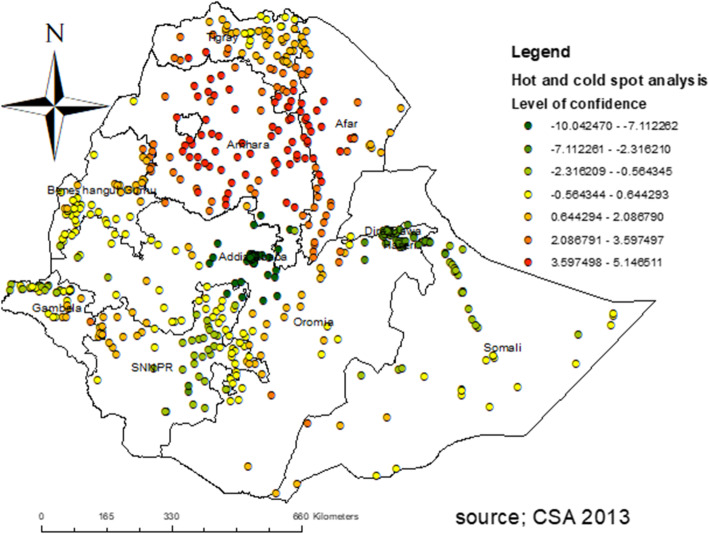
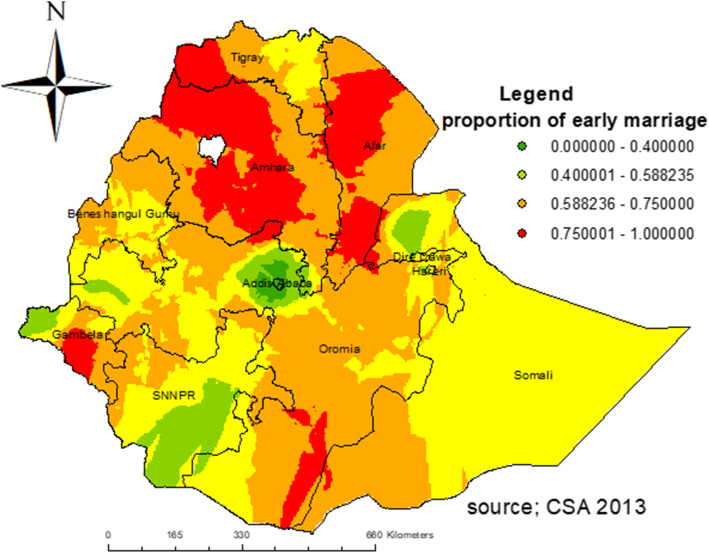
- Hotspot areas were identified in Amhara, Afar, southwestern Gambela, and southern Tigray; cold spots were in Addis Ababa, Dire Dawa, eastern SNNPR, and northwestern Gambela.
- In the multivariable multilevel model, compared with women with higher education, the odds of early marriage were higher for women with no education (AOR = 4.21, 95% CI 3.13–5.66), primary education (AOR = 3.37, 95% CI 2.80–4.92), and secondary education (AOR = 1.75, 95% CI 1.32–2.33).
- Early marriage was also more likely when the first marriage decision was made by parents (AOR = 1.88, 95% CI 1.68–2.09) or relatives (AOR = 2.16, 95% CI 1.60–2.91), and by region: Afar (AOR = 1.82, 95% CI 1.37–2.42), Amhara (AOR = 1.77, 95% CI 1.38–2.27), and Gambela (AOR = 1.44, 95% CI 1.09–1.90) were higher than Oromia, while Addis Ababa was lower (AOR = 0.50, 95% CI 0.36–0.68).
- The null model ICC was 13%, and about 56% of the variability in early marriage was explained in the full model.
## Methods
- Cross-sectional analysis of the 2016 Ethiopian Demographic and Health Survey, using a weighted sample of 11,646 ever-married reproductive-age women.
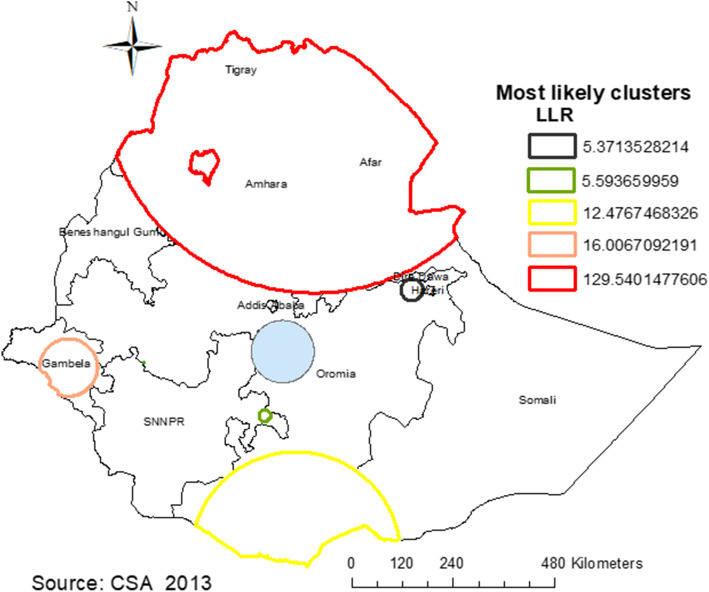
- Spatial analysis used ArcGIS 10.1, SaTScan 9.6, Global Moran’s I, hotspot analysis (Getis-Ord Gi*), spatial scan statistics with a Bernoulli model, and ordinary Kriging interpolation.
- Determinants were assessed with multilevel logistic regression in STATA 14; model fit was compared with deviance, and significance was declared using adjusted odds ratios with 95% CIs.
## Limitations
- The paper states that, because the data were secondary, some factors were not included, such as parents’ knowledge of the best marital age and knowing someone accused of early marriage.
- The cross-sectional design means the study cannot establish cause-and-effect relationships.
- The authors note possible recall bias and that SaTScan detects only circular clusters, so irregularly shaped clusters may have been missed.
- The paper states that the sample included ever-married women aged 15–49, so the findings may not be generalizable to the SDG indicator population of women aged 20–24 who married before 18; this is a limitation the text explicitly states.
Model-written summary. Check it against the paper before relying on it.
Integrity signals
Registry
Cites
Statistics
Figures
Verification
Claims the paper makes
4 Valid · 1 Not valid · 6 Not checked · 38 Own results and interpretations
The cited sources that could be checked couldn’t confirm or dispute this claim.
In the paper
“Besides, the higher educational attainment the women had, the more knowledge women get about the best age for marriage, and the harmful health outcomes of early marriage [40, 41].”
§ Spatial Distribution and Determinants of Early Marriage among Married Women in Ethiopia: A spatial and Multilevel Analysis > Discussion
What the sources say
- Could not verifycites [40] Yeneneh A Alemu K Dadi AF Alamirrew A Spatial distribution of antenatal care utilization and associated factors in Ethiopia: evidence from Ethiopian demographic health surveys BMC Pregnancy Childbirth 2018 18 1 12 10.1186/s12884-018-1874-2 29914403 PMC6007057 sourceExperimental — accuracy not yet measured
The Discussion (page unavailable) links education to antenatal-care use and to seeking knowledge about pregnancy complications. Neither that passage nor searches for marriage age and early marriage address whether education increases knowledge of the best age for marriage or the health harms of early marriage. (LLM, conf=0.76)
- Not checked — no full text of the sourcecites [41] Hardiani H Junaidi J Determinants of early marriage and model of maturing marriage age policy: a case Jambi Province Indones Innovative Issues Approaches SocSci 2018 11 73
plainstates an association- Asserted: passes — The authors put it forward as true.
- Checkable: passes — It can be checked against evidence.
- Load-bearing: unclear — It is unclear whether the paper’s conclusions depend on it.
- Based: passes — The paper gives a reason why it holds.
- Could not verify
Every source the paper cites for this claim was checked and supports it.
In the paper
“As a result of this rigid culture and tradition of marriage make young women forced to get married at early age [37].”
§ Spatial Distribution and Determinants of Early Marriage among Married Women in Ethiopia: A spatial and Multilevel Analysis > Discussion
What the sources say
- Supportedcites [37] Dessalegn M Ayele M Hailu Y Addisu G Gender Inequality and the Sexual and Reproductive Health Status of Young and Older Women in the Afar Region of Ethiopia Int J Environ Res Public Health 2020 17 1 14 10.3390/ijerph17124592 PMC7344930 32604777 source
Section 3.5 describes the Absuma marriage tradition and says a young woman may be forced by her community or relatives to marry her cousin. Sections 3.4 and 3.7 link Absuma to early marriage and describe early marriage as an ongoing problem in Afar. (LLM, conf=0.90)
plainstates a cause- Asserted: passes — The authors put it forward as true.
- Checkable: passes — It can be checked against evidence.
- Load-bearing: unclear — It is unclear whether the paper’s conclusions depend on it.
- Based: passes — The paper gives a reason why it holds.
- Supported
A result the paper reports from its own data — it cites no other source for it, so there is none to check. The quote shows it is in the paper.
In the paper
“a decision made by parents (AOR = 1.88, 95% CI 1.68–2.09)”
- Also stated in: § Determinants of early marriage among women of a reproductive age · plain
“The odds of early marriage among women whose first marriage decision was made by their parents and relatives were1.88 (AOR = 1.88, 95% CI 1.68–2.09), and 2.16 (AOR = 2.16, 95% CI 1.60–2.91) times higher as compared to those whose decision was made by themselves, respectively.”
§ Spatial Distribution and Determinants of Early Marriage among Married Women in Ethiopia: A spatial and Multilevel Analysis > Abstract > Results
plainstates an association- Asserted: passes — The authors put it forward as true.
- Checkable: passes — It can be checked against evidence.
- Load-bearing: passes — The paper’s conclusions depend on it.
- Based: passes — The paper gives a reason why it holds.
- Also stated in: § Determinants of early marriage among women of a reproductive age · plain
A result the paper reports from its own data — it cites no other source for it, so there is none to check. The quote shows it is in the paper.
In the paper
“In the hotspot analysis, the significant hotspot areas of early marriage were identified in the Amhara, Afar, southwestern Gambela, and southern Tigray regions whereas the significant cold spot areas were located in Addis Ababa, Dire Dawa, eastern SNNPR, and northwestern Gambela regions (Fig. 4).”
§ Spatial Distribution and Determinants of Early Marriage among Married Women in Ethiopia: A spatial and Multilevel Analysis > Results > Spatial distribution of early marriage
plain- Asserted: passes — The authors put it forward as true.
- Checkable: passes — It can be checked against evidence.
- Load-bearing: passes — The paper’s conclusions depend on it.
- Based: passes — The paper gives a reason why it holds.
A result the paper reports from its own data — it cites no other source for it, so there is none to check. The quote shows it is in the paper.
In the paper
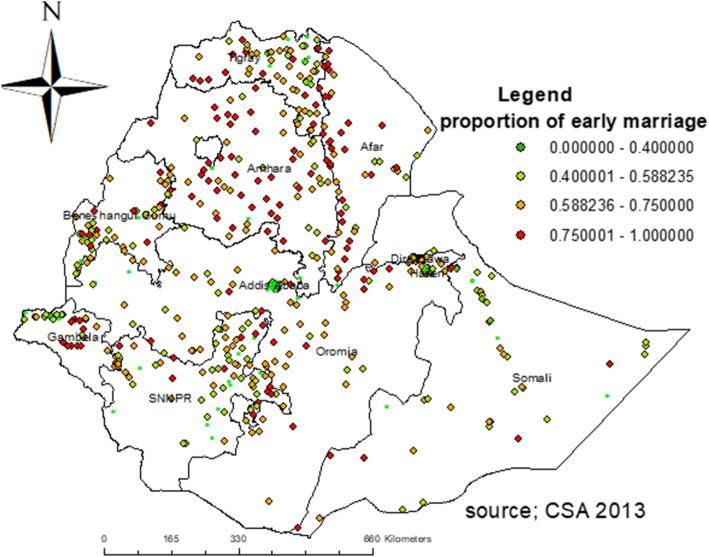
“On the other hand, Addis Ababa, eastern SNNPR, and northern Gambela had the lowest prevalence of early marriage (Fig. 3).”
§ Spatial Distribution and Determinants of Early Marriage among Married Women in Ethiopia: A spatial and Multilevel Analysis > Results > Spatial distribution of early marriage
plain- Asserted: passes — The authors put it forward as true.
- Checkable: passes — It can be checked against evidence.
- Load-bearing: unclear — It is unclear whether the paper’s conclusions depend on it.
- Based: passes — The paper gives a reason why it holds.
26 more claims
Create a free account to see all 49 claims and to verify the 2 references still open.
- Probably not a substantial claim. 10
- It may state two separate claims as one. 12
Self-check
Percentages, sums and reported differences re-computed from the paper’s own numbers.
Each contradiction between two passages listed here was confirmed by an independent check.
Rated minor: it would not touch a result — a value no result rests on, a p-value that stays on the same side of the significance level, or a conflict that is clerical, resolved elsewhere in the paper, or outside its own findings.
In the paper
§ Spatial Distribution and Determinants of Early Marriage among Married Women in Ethiopia: A spatial and Multilevel Analysis > Abstract > Results
“Thus, living in Afar (AOR = 1.82, 95%CI 1.37–2.42), Amhara (AOR = 1.77, 95% CI 1.38–2.77), and Gambela (AOR = 1.44, 95% CI 1.09–190) was associated with higher odds of early marriage.”
§ Spatial Distribution and Determinants of Early Marriage among Married Women in Ethiopia: A spatial and Multilevel Analysis > Results > Determinants of early marriage among women of a reproductive age
“Moreover, the odds of early marriage among women from Afar, Amhara, and, Gambela region was 1.82 (AOR = 1.82, 95% CI 1.37–2.42), 1.77 (AOR = 1.77, 95% CI 1.38–2.27), and 1.44 (AOR = 1.44, 95% CI 1.09–1.90) times higher as compared to women from the Oromia region respectively.”
Citations
Cites
Ethiopia demographic and health survey, 2000
Central Statistical Agency, & Ethiopia (2017) · Cited by 3,873
Demographic and Health Surveys
(2008) · Choice Reviews Online · doi:10.5860/choice.45-6819 · Cited by 1,439
Partitioning Variation in Multilevel Models
Goldstein, H., Browne, W., & Rasbash, J. (2002) · Understanding Statistics · doi:10.1207/s15328031us0104_02 · Cited by 874
Merlo, J., Chaix, B., Yang, M., Lynch, J., & Råstam, L. (2005) · Journal of Epidemiology and Community Health · doi:10.1136/jech.2004.023473 · Cited by 681
Demographic and Health Survey, 2015
Care, C., & Zimstat (2015) · University of Zimbabwe Institutional Repository (University of Zimbabwe) · Cited by 594
Raj, A., Saggurti, N., Balaiah, D., & Silverman, J. G. (2009) · The Lancet · doi:10.1016/s0140-6736(09)60246-4 · Cited by 445 · cited 1×
“Since early marriage is highly related to economic growth [30], child and maternal health [16], exploring the spatial distribution of early marriage provides evidence for the need to target intervention programs in high-risk areas where early marriage is most likely to occur.”
Spatial statistical analysis and geographic information systems
Anselin, L., & Getis, A. (1992) · The Annals of Regional Science · doi:10.1007/bf01581478 · Cited by 341
marrying-too-young-end-child-marriage
(2016) · Human Rights Documents online · doi:10.1163/2210-7975_hrd-9823-0072 · Cited by 312
Spatial Statistical Analysis and Geographic Information Systems
Anselin, L., & Getis, A. (2010) · Advances in Spatial Science · doi:10.1007/978-3-642-01976-0_3 · Cited by 299 · cited 1×
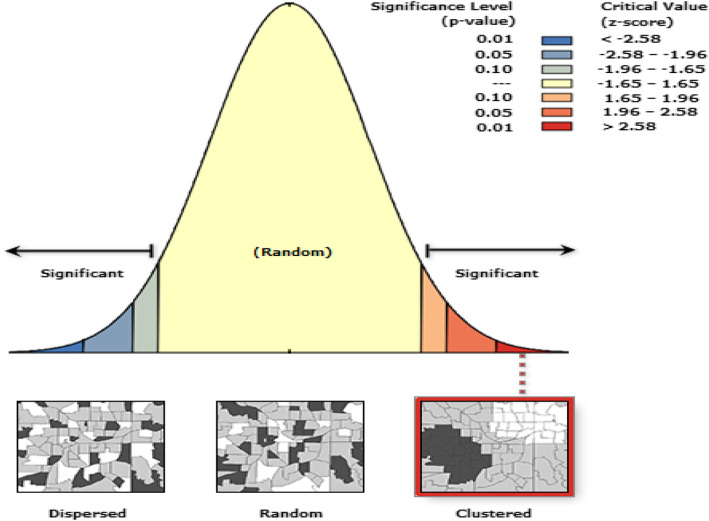
“A positive value for Moran’s Index indicates a clustered pattern of early marriage, while a negative value indicates a dispersed pattern and Moran’s I value close to zero indicates random distribution of early marriage [26, 27].”
BackgroundEconomic impacts of child marriage : global synthesis report
Wodon, Q. T., Malé, C., Nayihouba, K. A., Onagoruwa, A. O., Savadogo, A., Yedan, A., Edmeades, J., Kes, A., John, N. A., Murithi, L. K., et al. (2017) · MINISTERIO DE EDUCACIÓN · Cited by 224
Research works printed but not linked: 4
- UNICEF Progress for children fit: A World fit for children statistical review 2007 6.
- Curran J Spatial analysis for understanding contextual factors of variation in early marriage trends in Bangladesh Objectives 2010
- WHO Child marriages: 39 000 every day WHO Media Cent 2013 1 7
- Jones N Tefera B Stephenson J Gupta T Pereznieto P Early marriage in Ethiopia: the role of gendered social norms in shaping adolescent girls ’ futures 1 Introduction 2014
Cited by
Prevalence and Impact of Dysmenorrhea Among University Students in Ireland
Durand, H., Monahan, K., & McGuire, B. E. (2021) · Pain Medicine · doi:10.1093/pm/pnab122 · Cited by 136
Prevalence and factors associated with child marriage, a systematic review
Pourtaheri, A., Sany, S. B. T., Aghaee, M. A., Ahangari, H., & Peyman, N. (2023) · BMC Women s Health · doi:10.1186/s12905-023-02634-3 · Cited by 110
“Regional as well as religious differences can also account for the rate of early marriage [90].”
BackgroundDeterminants of desire for more children among women in Ethiopia
Muluneh, M. W., & Moyehodie, Y. A. (2021) · BMC Women s Health · doi:10.1186/s12905-021-01563-3 · Cited by 47
“In addition, the fertility transition in Ethiopia shows that although family planning programs have been effective in accelerating the decline in fertility rates, fertility behaviors should be considered in the analysis of fertility trends [11].”
BackgroundSocio-ecological factors of girl child marriage: a meta-synthesis of qualitative research
Pourtaheri, A., Mahdizadeh, M., Tehrani, H., Jamali, J., & Peyman, N. (2024) · BMC Public Health · doi:10.1186/s12889-023-17626-z · Cited by 64
“The geographical disparities in the prevalence of CM in Ethiopia are attributed to the expansion of girls’ education [78].”
BackgroundThe Manipulation of Religion and The Legalization of Underage Marriages in Indonesia
Barkah, Q., Cholidi, C., Rochmiyatun, S., Asmorowati, S., & Fernando, H. (2023) · SAMARAH Jurnal Hukum Keluarga dan Hukum Islam · doi:10.22373/sjhk.v7i1.13316 · Cited by 51
Singh, M., Shekhar, C., & Gupta, J. (2024) · BMC Public Health · doi:10.1186/s12889-024-20038-2 · Cited by 26
Lami, M., Negash, A., Eyeberu, A., Birhanu, A., Debella, A., Getachew, T., Berhanu, B., Balis, B., Bete, T., Abdeta, T., et al. (2023) · BMC Women's Health · doi:10.1186/s12905-023-02409-w · Cited by 15
“Early marriage is commonly reported in Tigray, Amhara, and Afar regions [15].”
BackgroundDeterminant factors of early marriage in developing countries: a literature review
Anggreni, D., Notobroto, H. B., & Soedirham, O. (2023) · Journal of Public Health in Africa · doi:10.4081/jphia.2023.2543 · Cited by 33
Seidu, A., Agbaglo, E., Dadzie, L. K., Ahinkorah, B. O., Ameyaw, E. K., Tetteh, J. K., & Yaya, S. (2020) · Contraception and Reproductive Medicine · doi:10.1186/s40834-020-00125-6 · Cited by 12
Gebeyehu, N. A., Gesese, M. M., Tegegne, K. D., Kebede, Y. S., Kassie, G. A., Mengstie, M. A., Zemene, M. A., Moges, N., Bantie, B., Feleke, S. F., et al. (2023) · PLOS ONE · doi:10.1371/journal.pone.0292625 · Cited by 11
RETRACTED: Exploring determinants of early marriage among women in Bangladesh: A multilevel analysis
Rashid, M. M., Siddiqi, M. N. A., Al-Amin, M., Rahman, M. M., Roy, T. K., Rahman, M., Islam, M. J., & Rahman, O. (2024) · PLoS ONE · doi:10.1371/journal.pone.0312755 · Cited by 24
RetractedAdola, S. G., & Wirtu, D. (2024) · Frontiers in Sociology · doi:10.3389/fsoc.2024.1412133 · Cited by 31
Getnet, M., Seretew, W. S., & Alem, A. Z. (2024) · PLoS ONE · doi:10.1371/journal.pone.0299519 · Cited by 10
Self-citationEarly Marriage Among Young Girls in Eastern Ethiopia: Trends From 2008 to 2018
Abdurahman, D., Assefa, N., & Berhane, Y. (2023) · Women's Reproductive Health · doi:10.1080/23293691.2022.2079828 · Cited by 7
Factors associated with girl child marriage in Iran: a qualitative socio-ecological approach
Pourtaheri, A., Mahdizadeh, M., Tehrani, H., Jamali, J., & Peyman, N. (2025) · Frontiers in Public Health · doi:10.3389/fpubh.2024.1477197 · Cited by 8
Alemu, M. B., Debie, A., Alemu, M. B., & Tessema, G. A. (2024) · PLoS ONE · doi:10.1371/journal.pone.0299443 · Cited by 6
Social and Economic Consequences of Early Marriage on Women's Education and Workforce Participation
Chandel, A., Yadav, M., & Hung, T. H. (2024) · Advances in psychology, mental health, and behavioral studies (APMHBS) book series · doi:10.4018/979-8-3693-3394-5.ch011 · Cited by 8
Wahyuningsih, S., Widati, S., Puspitasari, N., Salim, L. A., & Azkiya, M. W. (2025) · Narra J · doi:10.52225/narra.v5i1.1656 · Cited by 24
Karri, B., & Mathew, G. S. (2022) · Cogent Social Sciences · doi:10.1080/23311886.2022.2106649 · Cited by 8
“…are associated with early marriage and early conception practices which have a profound influence on the fertility and mortality levels of a woman (Alem et al., 2020; Bezie & Addisu, 2019; Bhattarai et al., 2022; Biswas & Kapoor, 2003; Gautam, 2019; Khongsdier, 2002; Maharatna, 2000; Mpilambo et…”
BackgroundGebeyehu, A. A., Damtie, D. G., & Yenew, C. (2022) · BMC Women s Health · doi:10.1186/s12905-022-02069-2 · Cited by 5
“Ethiopian official legal proclaimed that the age of marriage for women is more than 18 years [15], but most people have practiced early marriage, and 58% of the girls get married before 18 years, and also 35% of them become pregnant at the age of 15–19 [17, 18].”
BackgroundWondmeneh, T. G., & Giruma, A. (2025) · Maternal and Child Nutrition · doi:10.1111/mcn.13808 · Cited by 3
“…or war (FAO 2021) and recurrent drought (Wondmeneh 2022) contributing to food insecurity; the study area's inadequate water supply (Libey et al. 2022) and the presence of teenage mothers due to early marriage (Alem et al. 2020; Dessalegn et al. 2020) could all have an effect on recovery rates.”
A study on early marriages and pregnancy health in the South-Eastern region of Türkiye
Ak, E. Y., Şen, M. A., & Tandoğan, Ö. (2025) · BMC Women s Health · doi:10.1186/s12905-025-03788-y · Cited by 2
“Research has demonstrated that familial influences, particularly decisions made by parents or relatives, play a pivotal role in the decision-making process regarding early marriage [19].”
Kassaw, A. B., Mohammed, A., Muche, A., & Molla, A. (2026) · PLoS ONE · doi:10.1371/journal.pone.0342437 · Cited by 2
“Then categorized as having media exposure if a mother has been exposed to at least one of the four, and not if she had no exposure to any of the media sources [37].”
Fadheel, Q. J., & Mohammed, R. A. (2023) · Wiadomości Lekarskie · doi:10.36740/wlek202312110 · Cited by 2
Hidayah, N., Fawwaz, N. A., & Ekawati, N. (2023) · Health Research Journal Of Indonesia. · doi:10.63004/hrji.v2i2.278 · Cited by 4
Adola, S. G., Wirtu, D., & Dheresa, M. (2024) · F1000Research · doi:10.12688/f1000research.157735.1 · Cited by 2
Pourtaheri, A., Mahdizadeh, M., Tehrani, H., Jamali, J., & Peyman, N. (2024) · PLoS ONE · doi:10.1371/journal.pone.0313933 · Cited by 5
Exploring Determinants of Early Marriage among Women in Bangladesh: A Multilevel AnalysisPreprint
Rashid, M. M., Al-Amin, M., Rahman, M., et al. (2023) · Research Square · doi:10.21203/rs.3.rs-2920224/v1 · Cited by 1
Early Marriage Phenomena in Pandemic Era at Luwu Utara, Indonesia
Husain, W., Bahtiar, B., Kahfi, M. A., Indiyanto, A., & Fatmawati, F. (2024) · Al-Izzah Jurnal Hasil-Hasil Penelitian · doi:10.31332/ai.v0i0.6970 · Cited by 1
A systematic review of the multifaceted impact of child marriage on victims
Valan, M. L., Agboola, C., & Lord, V. B. (2024) · Vulnerable Children and Youth Studies · doi:10.1080/17450128.2024.2389395 · Cited by 3
“(Alem et al., 2020; Arthur et al., 2018; Biswajit, 2011; Mobolaji et al., 2020; Pourtaheri et al., 2023).”
Tedbabe, M. W., Birri, D. J., & Desta, T. T. (2025) · BioMed Research International · doi:10.1155/bmri/8649988 · Cited by 1
“However, this abhorrent practice is widespread in rural Ethiopia [19].”
Adola, S. G., Wirtu, D., & Dheresa, M. (2025) · Frontiers in Sociology · doi:10.3389/fsoc.2025.1544169 · Cited by 3
Mohammed, M. O. M. (2025) · Research Square · doi:10.21203/rs.3.rs-7391348/v1
Getnet, M., Yohannes, L., Worku, N., et al. (2026) · SAGE Open Medicine · doi:10.1177/20503121261449371
Factors associated with time to first marriage among women in Somalia: a Weibull survival analysis
Abdulle, A. A., Omar, M. A., Shidane, H. M., & Muse, A. H. (2026) · Reproductive Health · doi:10.1186/s12978-026-02373-2
“Women who attained secondary or higher education had a significantly lower hazard of marrying early, a finding that is remarkably consistent with a large body of literature from diverse contexts, such as Ethiopia, Bangladesh, and Nigeria [9, 14, 21].”
Mounchid, P. M., Shukla, S., & Steinert, J. (2026) · PLoS ONE · doi:10.1371/journal.pone.0346851 · Cited by 2
“Concerning the socio-economic conditions that increase the likelihood of child marriage, several studies have identified parents’ and the girls’ level of education as strong predictors [27–30].”
The Role of Primary Socialization Agent on Child marriage in Homabay County, Kenya
Ouko, C., & Otengah, W. A. P. (2026) · Sustainable Business and Society in Emerging Economies · doi:10.26710/sbsee.v8i1.3738
Metadata
- Authors
- Alem, A. Z., Yeshaw, Y., Kebede, S. A., Liyew, A. M., Tesema, G. A., Agegnehu, C. D., & Teshale, A. B.
- Affiliations
- University of Gondar (ET)
- Corresponding author
- Alem, Adugnaw Zeleke
- ORCID
- Venue
- BMC Women's Health
- Published
- 2020-09-15
- Volume
- 20
- Issue
- 1
- Pages
- 207-207
- ISSN
- 1472-6874 (ISSN-L)
- PMC
- PMC7493186
- OpenAlex
- W3084848305
- Cited by
- 39
- References
- 45
- Citations by year
- 2026: 5 · 2025: 7 · 2024: 13 · 2023: 8 · 2022: 3 · 2021: 2 · 2020: 1
- FWCI
- 4.68
- Type
- journal article
- Language
- en
- Open access
- gold
- doi.org
- Licence
- cc-by
- creativecommons.org/licenses/by/4.0 (tdm)
- creativecommons.org/licenses/by/4.0 (vor)
- Locations
- BMC Women s Health (publishedVersion, cc-by)
- PubMed Central (publishedVersion, cc-by)
- PubMed (publishedVersion)
- DOAJ (DOAJ: Directory of Open Access Journals) (submittedVersion, cc-by-sa)
- Greater South Information System
- Topics
- Social Sciences › Sociology and Political Science › Marriage and Family Dynamics
- Health Sciences › Medicine › Public Health, Environmental and Occupational Health › Adolescent Sexual and Reproductive Health
- Health Sciences › Medicine › Pediatrics, Perinatology and Child Health › Global Maternal and Child Health
- Keywords
- early marriage, early childbearing, spatial distribution, spatial clustering, determinants of early marriage, maternal education, parental decision-making, regional disparities, Ethiopia, married women, spatial epidemiology, multilevel analysis, Global Moran's I, Tigray, Amhara, Afar region
- MeSH terms
- Adolescent, Child, Culture, Educational Status, Ethiopia, Family Characteristics, Female, Humans, Marriage, Religion, Rural Population, Urban Population, Odds Ratio, Multilevel Analysis, Spatial Analysis
About these checks
Registry, retraction, Cites and statistics results are computed, not judged, with one exception: a printed reference that no index lists is read once by a model before it counts as a citation error. Claims are extracted by a model and kept only when their quote appears verbatim in the text; each cited source is then checked, with a model’s help, for whether it says what the claim relies on. Those verdicts can be wrong — read the claim’s quote and the cited source before relying on one.
The claim verdicts this report counts are experimental: their accuracy is not yet measured.
A language model drew the claims from the paper on 2026-10-10, under version 3 of the claim definition (model deepseek-v4.1-flash, prompt extract-v3).
A second model labelled each claim on 2026-10-10 (model jev-1.13-20260917, definition revision gold-guideline-v0.2).
Cited sources are checked with a language model’s help (gpt-6-sol).
Statistics and arithmetic are recomputed, not judged.
Confidence bands are shown only for fields calibrated on our annotated test set. None is calibrated yet, so no band is shown.
What counts as a claim ›How we measure confidence ›How we check this ›
Are you an author, or do you see a problem with this page? Request a review
Data sources
Bibliographic data: Semantic Scholar, OpenAlex, Crossref.
Contains information from the Semantic Scholar Academic Graph Datasets, made available under the ODC Attribution License (ODC-BY 1.0).
Semantic Scholar’s data is described in: Kinney, R., et al. (2023). The Semantic Scholar Open Data Platform. arXiv:2301.10140.
