

Effect of group-based acceptance and commitment therapy on older stroke survivors: study protocol for a randomized controlled trial.
Open accessThe DOI matches its Crossref record; 40 of the 41 references it cites were found in a registry or an index; 5 of the 16 sources its claims cite were checked for support.
Abstract
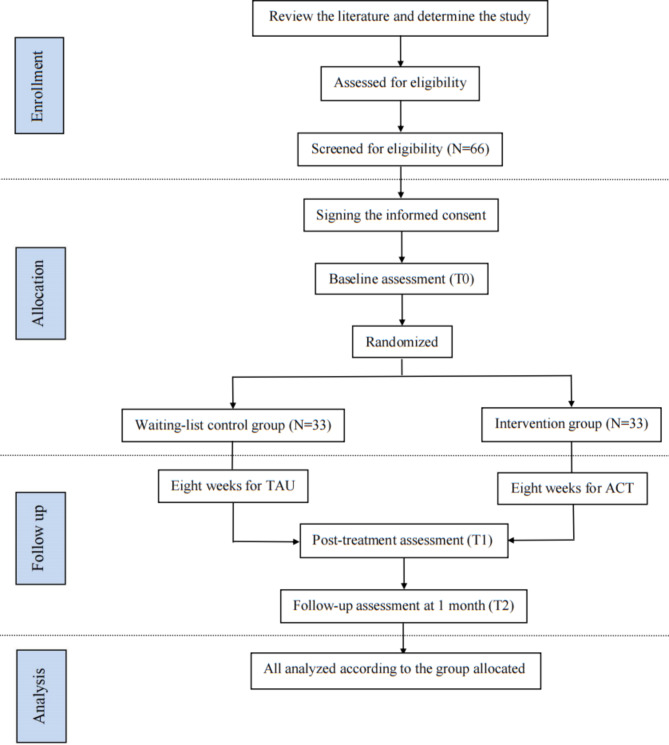
Introduction: Older stroke survivors usually experience various psychology disorders, such as post-stroke depression (PSD), which may be associated with high experiential avoidance (EA) and can seriously affect their quality of life. To date, the efficacy of group-based acceptance and commitment therapy (ACT) for older stroke survivors has not been established. The aim of this study is to investigate the effectiveness of group-based ACT on EA, PSD, psychological distress, and quality of life in older stroke survivors after group-based ACT. Methods and analysis: This study is a randomized, single-blind, wait-list controlled, parallel-arm trial. A total of 66 stroke survivors will be randomly assigned to wait-list control group or intervention group. Participants in wait-list control group will receive treatment as usual (TAU), while the intervention group will receive group-based ACT once a week for eight weeks. The primary outcome measure being EA, and the secondary outcome measures being PSD, psychological distress, and quality of life. Results of the two groups will be blindly assessed by professional evaluators at baseline (T0), post-treatment (T1), and one-month follow up (T2). Discussion: The results of this study will provide the first evidence for the effectiveness of a group-based ACT intervention in reducing EA, PSD, psychological stress, and improving quality of life for post-stroke survivors. Trial Registration: ChiCTR2200066361. Strengths and limitations of this study: No study has explored the EA in older stroke survivors and related factors at present. Group-based ACT has been shown to have a positive impact on anxiety and depressive symptoms in stroke survivors, but no studies have explored the effect of group-based ACT on the psychological status in older stroke survivors. Based on the previously published randomized controlled trials, this study used the group-based ACT to compare the effects of intervention on the psychological status of stroke survivors at different time points. This study met the gold standard for clinical trial delivery and provided additional evidence for group-based ACT, which also helped to lay the foundation for the feasibility and effectiveness of group-based ACT for older stroke survivors. The study had a short follow-up period. In addition, its clinical nature prevents blinding of the participants and therapists.
Overview
CoChat Summary
## TL;DR
This is a study protocol for a randomized, single-blind, wait-list controlled trial testing group-based acceptance and commitment therapy (ACT) plus treatment as usual in 66 older stroke survivors. The trial is designed to measure effects on experiential avoidance, post-stroke depression, psychological distress, and quality of life at baseline, post-treatment, and 1-month follow-up.
## Key findings
- Not stated in the paper.
- The planned sample is 66 stroke survivors, randomized 1:1 to wait-list control or intervention; each group is expected to have about 33 participants after allowing for 30% sample loss.
- The intervention is planned for 8 weeks, delivered once a week for 40 to 60 min per session in groups of 10 to 12 people.
- Outcomes will be assessed at T0 (baseline), T1 (post-treatment), and T2 (1-month follow-up), with EA as the primary outcome and PSD, psychological distress, and quality of life as secondary outcomes.
## Methods
- Randomized, single-blind, wait-list controlled, parallel-arm trial.
- Participants: older stroke survivors recruited by convenience sampling from a tertiary hospital in China; inclusion required age ≥ 60 years, stroke confirmed by MRI or CT, disease duration > half a year, clinically significant psychological distress (Hamilton Depression Scale ≥ 8), ability to communicate, informed consent, and ability to use WeChat.
- Main analysis planned with Chi-square tests and independent-sample t-tests for baseline comparability, plus GEE, GLMM, and MMRM for treatment effects; significance set at alpha = 0.05.
## Limitations
- The paper itself is a protocol, so it reports planned methods and outcomes rather than results; no efficacy findings are available yet.
- The study uses convenience sampling from a single tertiary hospital in China, which may limit generalizability (evident from the text).
- The paper does not state any completed trial outcomes, adverse event rates, or recruitment/retention results because those data are not yet reported.
Model-written summary. Check it against the paper before relying on it.
Integrity signals
Registry
Cites
Statistics
Figures
Verification
Claims the paper makes
5 Valid · 2 Not valid · 8 Not checked · 14 Own results and interpretations
Every source the paper cites for this claim was checked and supports it.
In the paper
“The most common neuropsychiatric outcome in stroke survivors is post-stroke depression (PSD) [11].”
§ Effect of group-based acceptance and commitment therapy on older stroke survivors: study protocol for a randomized controlled trial > Introduction
What the sources say
- Supportedcites [11] Khazaal W, Taliani M, Boutros C, et al. Psychological complications at 3 months following stroke: prevalence and correlates among stroke survivors in Lebanon. Front Psychol. 2021;12:663267. source
The Introduction explicitly states that post-stroke depression is the most common post-stroke neuropsychiatric disorder. The Discussion also describes it as the commonest mental disorder among stroke survivors. (LLM, conf=0.95)
plain- Asserted: passes — The authors put it forward as true.
- Checkable: passes — It can be checked against evidence.
- Load-bearing: unclear — It is unclear whether the paper’s conclusions depend on it.
- Based: passes — The paper gives a reason why it holds.
- Supported
The cited sources support only part of this claim — read each source’s verdict below.
In the paper
“One research supported the applicability of the ACT core processes in a variety of clinical populations, including older people [25].”
§ Effect of group-based acceptance and commitment therapy on older stroke survivors: study protocol for a randomized controlled trial > Introduction
What the sources say
- Partly supportedcites [25] Petkus AJ, Wetherell MA. Acceptance and Commitment Therapy with older adults: Rationale and Considerations. Cogn Behav Pract. 2013;20(1):47–56. sourceExperimental — accuracy not yet measured
The ACT model of psychopathology and treatment section says research suggests ACT-related core processes persist into older adulthood and reviews evidence involving several groups of older adults. It does not establish their applicability across a variety of clinical populations; the Future directions and conclusion section says the supporting research was largely conducted with people without depressive or anxiety disorders and calls for more research in clinical older-adult populations. Page numbers were not available in our copy. (LLM, conf=0.86)
plainstates an association- Asserted: passes — The authors put it forward as true.
- Checkable: passes — It can be checked against evidence.
- Load-bearing: unclear — It is unclear whether the paper’s conclusions depend on it.
- Based: passes — The paper gives a reason why it holds.
- Partly supported
In the paper
“A meta-analysis of stroke survivors showed that PSD was the most common predictor of quality of life in stroke survivors [12].”
§ Effect of group-based acceptance and commitment therapy on older stroke survivors: study protocol for a randomized controlled trial > Introduction
What the sources say
- Not checked — no full text of the sourcecites [12] Bello UM, Chutiyami M, Salihu D, et al. Quality of life of stroke survivors in Africa: a systematic review and meta-analysis. Qual Life Res. 2021;30(1):1–19. source
plainstates an association- Asserted: passes — The authors put it forward as true.
- Checkable: passes — It can be checked against evidence.
- Load-bearing: unclear — It is unclear whether the paper’s conclusions depend on it.
- Based: passes — The paper gives a reason why it holds.
A statement the paper makes itself — it cites no source for it, so there is none to check. The quote shows it is in the paper.
In the paper
“This is the first randomized controlled trial to test the efficacy of group-based ACT as a complementary therapy to TAU in improving EA, PSD, psychological distress, and quality of life in older stroke survivors, thereby facilitating rehabilitation and providing evidence-based support for psychological remodeling in older stroke survivors.”
§ Effect of group-based acceptance and commitment therapy on older stroke survivors: study protocol for a randomized controlled trial > Discussion
plainstates a cause- Asserted: passes — The authors put it forward as true.
- Checkable: passes — It can be checked against evidence.
- Load-bearing: passes — The paper’s conclusions depend on it.
- Based: unclear — It is unclear why the paper says it holds.
In the paper
“Second, as the mental flexibility of older stroke survivors improves, their psychological stress also tends to decrease [18].”
§ Effect of group-based acceptance and commitment therapy on older stroke survivors: study protocol for a randomized controlled trial > Discussion
What the sources say
- Not checked — no full text of the sourcecites [18] Fledderus M, Bohlmeijer ET, Fox JP, Schreurs KM, Spinhoven P. The role of psychological flexibility in a self-help acceptance and commitment therapy intervention for psychological distress in a randomized controlled trial. Behav Res Ther. 2013;51(3):142–51. source
hedgedstates an association- Asserted: passes — The authors put it forward as true.
- Checkable: passes — It can be checked against evidence.
- Load-bearing: passes — The paper’s conclusions depend on it.
- Based: passes — The paper gives a reason why it holds.
- Probably not a substantial claim. 15
- It may state two separate claims as one. 14
Self-check
Percentages, sums and reported differences re-computed from the paper’s own numbers.
Each contradiction between two passages listed here was confirmed by an independent check.
Rated minor: it would not touch a result — a value no result rests on, a p-value that stays on the same side of the significance level, or a conflict that is clerical, resolved elsewhere in the paper, or outside its own findings.
In the paper
§ Effect of group-based acceptance and commitment therapy on older stroke survivors: study protocol for a randomized controlled trial > Abstract > Methods and analysis
“This study is a randomized, single-blind, wait-list controlled, parallel-arm trial.”
§ Effect of group-based acceptance and commitment therapy on older stroke survivors: study protocol for a randomized controlled trial > Methods and analysis > Blinding
“as participants will also be blinded to randomization after the baseline assessment (T0).”
Citations
Cites
Hamilton, M. (1960) · Journal of Neurology, Neurosurgery & Psychiatry · doi:10.1136/jnnp.23.1.56 · Cited by 32,817 · cited 1×
“The HAM-D scale, developed by Hamilton [30] in 1960, is the most commonly used scale to assess post-stroke depression.”
MethodBond, F. W., Hayes, S. C., Baer, R. A., Carpenter, K. M., Guenole, N., Orcutt, H. K., Waltz, T., & Zettle, R. D. (2011) · Behavior Therapy · doi:10.1016/j.beth.2011.03.007 · Cited by 3,950
Hayes, S. C., Wilson, K. G., Gifford, E. V., Follette, V. M., & Strosahl, K. (1996) · Journal of Consulting and Clinical Psychology · doi:10.1037//0022-006x.64.6.1152 · Cited by 3,595
Relational frame theory: a post-Skinnerian account of human language and cognition
(2001) · Choice Reviews Online · doi:10.5860/choice.39-2482 · Cited by 1,984 · cited 1×
“The core component and the ultimate goal of ACT theory is to improve the individual’s psychological flexibility [21], that is, to fully feel, perceive and accept the things and emotions you experience at the moment, rather than focusing on avoiding painful memories or negative emotions in reality, and to make behavior…”
BackgroundStroke in China: advances and challenges in epidemiology, prevention, and management
Wu, S., Wu, B., Liu, M., Chen, Z., Wang, W., Anderson, C. S., Sandercock, P., Wang, Y., Huang, Y., Cui, L., et al. (2019) · The Lancet Neurology · doi:10.1016/s1474-4422(18)30500-3 · Cited by 1,589 · cited 1×
“Introduction The global prevalence and incidence of stroke have increased significantly [1].”
BackgroundHackett, M. L., & Pickles, K. (2014) · International Journal of Stroke · doi:10.1111/ijs.12357 · Cited by 1,140 · cited 2×
“Both the changes brought about by the disease and the psychological distress can significantly reduce the quality of life [5, 6, 14], thus increasing the risk of stroke recurrence and even death [15, 16].”
BackgroundPositive Psychology in Clinical Practice
Lee Duckworth, A., Steen, T. A., & Seligman, M. E. P. (2005) · Annual Review of Clinical Psychology · doi:10.1146/annurev.clinpsy.1.102803.144154 · Cited by 1,095 · cited 1×
“The total score of the scale ranged from 0 to 76, with > 35 being classified as severe depression, 21–35 as mild to moderate depression, 8–20 as possible depression, and < 8 as no depression [31].”
BackgroundDevelopment of a Stroke-Specific Quality of Life Scale
Williams, L. S., Weinberger, M., Harris, L. E., Clark, D. O., & Biller, J. (1999) · Stroke · doi:10.1161/01.str.30.7.1362 · Cited by 914 · cited 1×
“[34], is used to assess the quality of life.”
MethodHayes, S. C. (2016) · Behavior Therapy · doi:10.1016/j.beth.2016.11.006 · Cited by 785
Wang, Y.-J., Li, Z.-X., Gu, H.-Q., Zhai, Y., Jiang, Y., Zhao, X.-Q., Wang, Y.-L., Yang, X., Wang, C.-J., Meng, X., et al. (2020) · Stroke and Vascular Neurology · doi:10.1136/svn-2020-000457 · Cited by 511
Self-citation
Research works printed but not linked: 1
- Majumdar S, Morris R. Brief group-based acceptance and commitment therapy for stroke survivors. Br J Clin Psychol. 2019;58(1):70–90. https://doi.org/10.1111/bjc.12198. · DOI · Paper page
Cited by
Fallahtafti, P., Habibzadeh, A., Ghasemloo, N., Ghanbari, A., Taebi, M., Hosseini, K., & Soleimani, H. (2025) · BMC Neurology · doi:10.1186/s12883-025-04298-y · Cited by 13
“These factors collectively contribute to a significant decline in functional outcomes in the aging stroke population [28].”
Grimaldi, A., Veneziani, I., Culicetto, L., Quartarone, A., Calabrò, R. S., & Latella, D. (2025) · Healthcare · doi:10.3390/healthcare13151831 · Cited by 6
Yuan, Y., Hou, P., Wang, S., Kitayama, A., Yanagihara, K., & Liang, J. (2024) · Frontiers in Public Health · doi:10.3389/fpubh.2024.1239445 · Cited by 9
Park, E. K. C., Park, W. H., & Jeon, E. (2026) · Medicina · doi:10.3390/medicina62101841
Metadata
- Authors
- Chen, F., Zhou, Q., Wu, J., & Xu, X.
- Affiliations
- Central South University (CN)
- Third Hospital of Changsha (CN)
- Corresponding author
- Xu, Xianghua
- Venue
- BMC Complementary Medicine and Therapies
- Published
- 2023-10-06
- Volume
- 23
- Issue
- 1
- Pages
- 353-353
- ISSN
- 2662-7671 (ISSN-L)
- PMC
- PMC10557283
- OpenAlex
- W4387401797
- Semantic Scholar
- fc39b6c6ab9cabdd17d7baa8a2ae11a74068072a
- Cited by
- 5
- References
- 41
- Citations by year
- 2026: 2 · 2025: 2 · 2024: 1
- FWCI
- 1.45
- Type
- journal article
- Language
- en
- Open access
- gold
- doi.org
- Licence
- cc-by
- creativecommons.org/licenses/by/4.0 (tdm)
- creativecommons.org/licenses/by/4.0 (vor)
- Locations
- BMC Complementary Medicine and Therapies (publishedVersion, cc-by)
- PubMed Central (publishedVersion, cc-by)
- PubMed (publishedVersion)
- DOAJ (DOAJ: Directory of Open Access Journals) (submittedVersion, cc-by-sa)
- Funders
- Hunan Provincial Health Commission Scientific Research Program (B202314016750)
- Topics
- Social Sciences › Psychology › Clinical Psychology › Mindfulness and Compassion Interventions
- Health Sciences › Medicine › Rehabilitation › Stroke Rehabilitation and Recovery
- Health Sciences › Medicine › Oncology › Cancer survivorship and care
- Keywords
- acceptance and commitment therapy, group therapy, stroke survivors, older adults, post-stroke depression, experiential avoidance, psychological distress, quality of life, psychological intervention
- MeSH terms
- Aged, Humans, Quality of Life, Randomized Controlled Trials as Topic, Single-Blind Method, Survivors, Stroke, Acceptance and Commitment Therapy
About these checks
Registry, retraction, Cites and statistics results are computed, not judged, with one exception: a printed reference that no index lists is read once by a model before it counts as a citation error. Claims are extracted by a model and kept only when their quote appears verbatim in the text; each cited source is then checked, with a model’s help, for whether it says what the claim relies on. Those verdicts can be wrong — read the claim’s quote and the cited source before relying on one.
The claim verdicts this report counts are experimental: their accuracy is not yet measured.
A language model drew the claims from the paper on 2026-10-11, under version 3 of the claim definition (model deepseek-v4.1-flash, prompt extract-v3).
A second model labelled each claim on 2026-10-11 (model jev-1.13-20260917, definition revision gold-guideline-v0.2).
Cited sources are checked with a language model’s help (gpt-6-sol).
Statistics and arithmetic are recomputed, not judged.
Confidence bands are shown only for fields calibrated on our annotated test set. None is calibrated yet, so no band is shown.
What counts as a claim ›How we measure confidence ›How we check this ›
Are you an author, or do you see a problem with this page? Request a review
How to cite
Cite CoChat for the checks on this page, and the paper for its own findings.
- This page
- CoChat. (2026). Citation check: Effect of group-based acceptance and commitment therapy on older stroke survivors: study protocol for a randomized controlled trial. https://app.cochat.ai/papers/10.1186/s12906-023-04160-z
- The paper
- Chen, F., Zhou, Q., Wu, J., & Xu, X. (2023). Effect of group-based acceptance and commitment therapy on older stroke survivors: study protocol for a randomized controlled trial. BMC Complementary Medicine and Therapies. https://doi.org/10.1186/s12906-023-04160-z
Data sources
Bibliographic data: Semantic Scholar, OpenAlex, Crossref.
Contains information from the Semantic Scholar Academic Graph Datasets, made available under the ODC Attribution License (ODC-BY 1.0).
Semantic Scholar’s data is described in: Kinney, R., et al. (2023). The Semantic Scholar Open Data Platform. arXiv:2301.10140.
