

Effect of group-based acceptance and commitment therapy on older stroke survivors: study protocol for a randomized controlled trial.
Open accessThe DOI matches its Crossref record; 40 of the 41 references it cites were found in a registry or an index; 5 of the 16 sources its claims cite were checked for support.
Abstract
Introduction: Older stroke survivors usually experience various psychology disorders, such as post-stroke depression (PSD), which may be associated with high experiential avoidance (EA) and can seriously affect their quality of life. To date, the efficacy of group-based acceptance and commitment therapy (ACT) for older stroke survivors has not been established. The aim of this study is to investigate the effectiveness of group-based ACT on EA, PSD, psychological distress, and quality of life in older stroke survivors after group-based ACT. Methods and analysis: This study is a randomized, single-blind, wait-list controlled, parallel-arm trial. A total of 66 stroke survivors will be randomly assigned to wait-list control group or intervention group. Participants in wait-list control group will receive treatment as usual (TAU), while the intervention group will receive group-based ACT once a week for eight weeks. The primary outcome measure being EA, and the secondary outcome measures being PSD, psychological distress, and quality of life. Results of the two groups will be blindly assessed by professional evaluators at baseline (T0), post-treatment (T1), and one-month follow up (T2). Discussion: The results of this study will provide the first evidence for the effectiveness of a group-based ACT intervention in reducing EA, PSD, psychological stress, and improving quality of life for post-stroke survivors. Trial Registration: ChiCTR2200066361. Strengths and limitations of this study: No study has explored the EA in older stroke survivors and related factors at present. Group-based ACT has been shown to have a positive impact on anxiety and depressive symptoms in stroke survivors, but no studies have explored the effect of group-based ACT on the psychological status in older stroke survivors. Based on the previously published randomized controlled trials, this study used the group-based ACT to compare the effects of intervention on the psychological status of stroke survivors at different time points. This study met the gold standard for clinical trial delivery and provided additional evidence for group-based ACT, which also helped to lay the foundation for the feasibility and effectiveness of group-based ACT for older stroke survivors. The study had a short follow-up period. In addition, its clinical nature prevents blinding of the participants and therapists.
Overview
CoChat Summary
## TL;DR
This is a study protocol for a randomized, single-blind, wait-list controlled trial testing group-based acceptance and commitment therapy (ACT) plus treatment as usual in 66 older stroke survivors. The trial is designed to measure effects on experiential avoidance, post-stroke depression, psychological distress, and quality of life at baseline, post-treatment, and 1-month follow-up.
## Key findings
- Not stated in the paper.
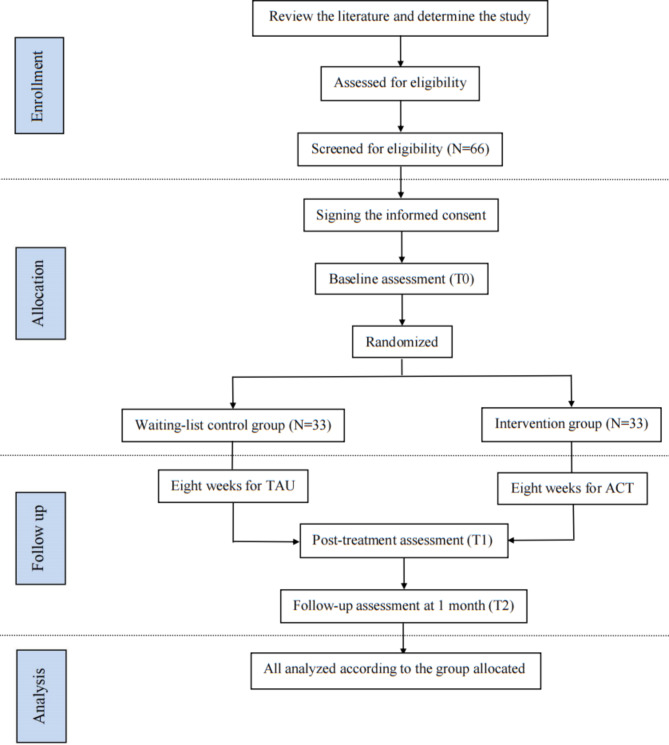
- The planned sample is 66 stroke survivors, randomized 1:1 to wait-list control or intervention; each group is expected to have about 33 participants after allowing for 30% sample loss.
- The intervention is planned for 8 weeks, delivered once a week for 40 to 60 min per session in groups of 10 to 12 people.
- Outcomes will be assessed at T0 (baseline), T1 (post-treatment), and T2 (1-month follow-up), with EA as the primary outcome and PSD, psychological distress, and quality of life as secondary outcomes.
## Methods
- Randomized, single-blind, wait-list controlled, parallel-arm trial.
- Participants: older stroke survivors recruited by convenience sampling from a tertiary hospital in China; inclusion required age ≥ 60 years, stroke confirmed by MRI or CT, disease duration > half a year, clinically significant psychological distress (Hamilton Depression Scale ≥ 8), ability to communicate, informed consent, and ability to use WeChat.
- Main analysis planned with Chi-square tests and independent-sample t-tests for baseline comparability, plus GEE, GLMM, and MMRM for treatment effects; significance set at alpha = 0.05.
## Limitations
- The paper itself is a protocol, so it reports planned methods and outcomes rather than results; no efficacy findings are available yet.
- The study uses convenience sampling from a single tertiary hospital in China, which may limit generalizability (evident from the text).
- The paper does not state any completed trial outcomes, adverse event rates, or recruitment/retention results because those data are not yet reported.
Model-written summary. Check it against the paper before relying on it.
Integrity signals
Registry
Cites
Statistics
Figures
Verification
Claims the paper makes
5 Valid · 2 Not valid · 8 Not checked · 14 Own results and interpretations
Every source the paper cites for this claim was checked and supports it.
In the paper
“The most common neuropsychiatric outcome in stroke survivors is post-stroke depression (PSD) [11].”
§ Effect of group-based acceptance and commitment therapy on older stroke survivors: study protocol for a randomized controlled trial > Introduction
What the sources say
- Supportedcites [11] Khazaal W Taliani M Boutros C Psychological complications at 3 months following stroke: prevalence and correlates among stroke survivors in Lebanon Front Psychol 2021 12 663267 10.3389/fpsyg.2021.663267 34177717 PMC8222528 source
The Introduction explicitly states that post-stroke depression is the most common post-stroke neuropsychiatric disorder. The Discussion also describes it as the commonest mental disorder among stroke survivors. (LLM, conf=0.95)
plain- Asserted: passes — The authors put it forward as true.
- Checkable: passes — It can be checked against evidence.
- Load-bearing: unclear — It is unclear whether the paper’s conclusions depend on it.
- Based: passes — The paper gives a reason why it holds.
- Supported
The cited sources support only part of this claim — read each source’s verdict below.
In the paper
“One research supported the applicability of the ACT core processes in a variety of clinical populations, including older people [25].”
§ Effect of group-based acceptance and commitment therapy on older stroke survivors: study protocol for a randomized controlled trial > Introduction
What the sources say
- Partly supportedcites [25] Petkus AJ Wetherell MA Acceptance and Commitment Therapy with older adults: Rationale and Considerations Cogn Behav Pract 2013 20 1 47 56 10.1016/j.cbpra.2011.07.004 26997859 PMC4795910 sourceExperimental — accuracy not yet measured
The ACT model of psychopathology and treatment section says research suggests ACT-related core processes persist into older adulthood and reviews evidence involving several groups of older adults. It does not establish their applicability across a variety of clinical populations; the Future directions and conclusion section says the supporting research was largely conducted with people without depressive or anxiety disorders and calls for more research in clinical older-adult populations. Page numbers were not available in our copy. (LLM, conf=0.86)
plainstates an association- Asserted: passes — The authors put it forward as true.
- Checkable: passes — It can be checked against evidence.
- Load-bearing: unclear — It is unclear whether the paper’s conclusions depend on it.
- Based: passes — The paper gives a reason why it holds.
- Partly supported
In the paper
“A meta-analysis of stroke survivors showed that PSD was the most common predictor of quality of life in stroke survivors [12].”
§ Effect of group-based acceptance and commitment therapy on older stroke survivors: study protocol for a randomized controlled trial > Introduction
What the sources say
- Not checked — no full text of the sourcecites [12] Bello UM Chutiyami M Salihu D Quality of life of stroke survivors in Africa: a systematic review and meta-analysis Qual Life Res 2021 30 1 1 19 10.1007/s11136-020-02591-6 32712933 source
plainstates an association- Asserted: passes — The authors put it forward as true.
- Checkable: passes — It can be checked against evidence.
- Load-bearing: unclear — It is unclear whether the paper’s conclusions depend on it.
- Based: passes — The paper gives a reason why it holds.
A statement the paper makes itself — it cites no source for it, so there is none to check. The quote shows it is in the paper.
In the paper
“This is the first randomized controlled trial to test the efficacy of group-based ACT as a complementary therapy to TAU in improving EA, PSD, psychological distress, and quality of life in older stroke survivors, thereby facilitating rehabilitation and providing evidence-based support for psychological remodeling in older stroke survivors.”
§ Effect of group-based acceptance and commitment therapy on older stroke survivors: study protocol for a randomized controlled trial > Discussion
plainstates a cause- Asserted: passes — The authors put it forward as true.
- Checkable: passes — It can be checked against evidence.
- Load-bearing: passes — The paper’s conclusions depend on it.
- Based: unclear — It is unclear why the paper says it holds.
In the paper
“Second, as the mental flexibility of older stroke survivors improves, their psychological stress also tends to decrease [18].”
§ Effect of group-based acceptance and commitment therapy on older stroke survivors: study protocol for a randomized controlled trial > Discussion
What the sources say
- Not checked — no full text of the sourcecites [18] Fledderus M Bohlmeijer ET Fox JP Schreurs KM Spinhoven P The role of psychological flexibility in a self-help acceptance and commitment therapy intervention for psychological distress in a randomized controlled trial Behav Res Ther 2013 51 3 142 51 10.1016/j.brat.2012.11.007 23337183 source
hedgedstates an association- Asserted: passes — The authors put it forward as true.
- Checkable: passes — It can be checked against evidence.
- Load-bearing: passes — The paper’s conclusions depend on it.
- Based: passes — The paper gives a reason why it holds.
- Probably not a substantial claim. 15
- It may state two separate claims as one. 14
Self-check
Percentages, sums and reported differences re-computed from the paper’s own numbers.
Each contradiction between two passages listed here was confirmed by an independent check.
Rated minor: it would not touch a result — a value no result rests on, a p-value that stays on the same side of the significance level, or a conflict that is clerical, resolved elsewhere in the paper, or outside its own findings.
In the paper
§ Effect of group-based acceptance and commitment therapy on older stroke survivors: study protocol for a randomized controlled trial > Abstract > Methods and analysis
“This study is a randomized, single-blind, wait-list controlled, parallel-arm trial.”
§ Effect of group-based acceptance and commitment therapy on older stroke survivors: study protocol for a randomized controlled trial > Methods and analysis > Blinding
“as participants will also be blinded to randomization after the baseline assessment (T0).”
Citations
Cites
Hamilton, M. (1960) · Journal of Neurology, Neurosurgery & Psychiatry · doi:10.1136/jnnp.23.1.56 · Cited by 32,817 · cited 1×
“The HAM-D scale, developed by Hamilton [30] in 1960, is the most commonly used scale to assess post-stroke depression.”
MethodBond, F. W., Hayes, S. C., Baer, R. A., Carpenter, K. M., Guenole, N., Orcutt, H. K., Waltz, T., & Zettle, R. D. (2011) · Behavior Therapy · doi:10.1016/j.beth.2011.03.007 · Cited by 3,950
Hayes, S. C., Wilson, K. G., Gifford, E. V., Follette, V. M., & Strosahl, K. (1996) · Journal of Consulting and Clinical Psychology · doi:10.1037//0022-006x.64.6.1152 · Cited by 3,595
Relational frame theory: a post-Skinnerian account of human language and cognition
(2001) · Choice Reviews Online · doi:10.5860/choice.39-2482 · Cited by 1,984 · cited 1×
“The core component and the ultimate goal of ACT theory is to improve the individual’s psychological flexibility [21], that is, to fully feel, perceive and accept the things and emotions you experience at the moment, rather than focusing on avoiding painful memories or negative emotions in reality, and to make behavior…”
BackgroundStroke in China: advances and challenges in epidemiology, prevention, and management
Wu, S., Wu, B., Liu, M., Chen, Z., Wang, W., Anderson, C. S., Sandercock, P., Wang, Y., Huang, Y., Cui, L., et al. (2019) · The Lancet Neurology · doi:10.1016/s1474-4422(18)30500-3 · Cited by 1,589 · cited 1×
“Introduction The global prevalence and incidence of stroke have increased significantly [1].”
BackgroundHackett, M. L., & Pickles, K. (2014) · International Journal of Stroke · doi:10.1111/ijs.12357 · Cited by 1,140 · cited 2×
“Both the changes brought about by the disease and the psychological distress can significantly reduce the quality of life [5, 6, 14], thus increasing the risk of stroke recurrence and even death [15, 16].”
BackgroundPositive Psychology in Clinical Practice
Lee Duckworth, A., Steen, T. A., & Seligman, M. E. P. (2005) · Annual Review of Clinical Psychology · doi:10.1146/annurev.clinpsy.1.102803.144154 · Cited by 1,095 · cited 1×
“The total score of the scale ranged from 0 to 76, with > 35 being classified as severe depression, 21–35 as mild to moderate depression, 8–20 as possible depression, and < 8 as no depression [31].”
BackgroundDevelopment of a Stroke-Specific Quality of Life Scale
Williams, L. S., Weinberger, M., Harris, L. E., Clark, D. O., & Biller, J. (1999) · Stroke · doi:10.1161/01.str.30.7.1362 · Cited by 914 · cited 1×
“[34], is used to assess the quality of life.”
MethodHayes, S. C. (2016) · Behavior Therapy · doi:10.1016/j.beth.2016.11.006 · Cited by 785
Wang, Y.-J., Li, Z.-X., Gu, H.-Q., Zhai, Y., Jiang, Y., Zhao, X.-Q., Wang, Y.-L., Yang, X., Wang, C.-J., Meng, X., et al. (2020) · Stroke and Vascular Neurology · doi:10.1136/svn-2020-000457 · Cited by 511
Self-citationRelational Frame Theory: A Post-Skinnerian Account of Human Language and Cognition
Barnes-Holmes, Y., Hayes, S. C., Barnes-Holmes, D., & Roche, B. (2002) · Advances in Child Development and Behavior · doi:10.1016/s0065-2407(02)80063-5 · Cited by 389
Wang, Y.-J., Li, Z.-X., Gu, H.-Q., Zhai, Y., Zhou, Q., Jiang, Y., Zhao, X.-Q., Wang, Y.-L., Yang, X., Wang, C.-J., et al. (2022) · Stroke and Vascular Neurology · doi:10.1136/svn-2021-001374 · Cited by 386
Self-citationComorbid Anxiety and Depression: Clinical and Conceptual Consideration and Transdiagnostic Treatment
Choi, K. W., Kim, Y.-K., & Jeon, H. J. (2020) · Advances in Experimental Medicine and Biology · doi:10.1007/978-981-32-9705-0_14 · Cited by 304 · cited 1×
“Some studies suggest that PSD is longer, more severe and more difficult to treat [13], which may be related to the psychological rigidity and inflexibility of stroke survivors.”
BackgroundWicksell, R. K., Olsson, G. L., & Hayes, S. C. (2010) · European Journal of Pain · doi:10.1016/j.ejpain.2010.05.001 · Cited by 259 · cited 1×
“How to improve the physical and mental status of older stroke survivors, alleviate negative emotions, and improve their quality of life, has become an imperative problem to be solved by more and more scholars [17–19].”
BackgroundLanctôt, K. L., Lindsay, M. P., Smith, E. E., Sahlas, D. J., Foley, N., Gubitz, G., Austin, M., Ball, K., Bhogal, S., Blake, T., et al. (2020) · International Journal of Stroke · doi:10.1177/1747493019847334 · Cited by 230 · cited 2×
“The Canadian Stroke Best Practice Recommendations, CSBPR) state that psychotherapy, including cognitive behavioral therapy, is one of the most commonly used strategies for post-stroke depression [16].”
BackgroundMethodFledderus, M., Bohlmeijer, E. T., Fox, J.-P., Schreurs, K. M. G., & Spinhoven, P. (2013) · Behaviour Research and Therapy · doi:10.1016/j.brat.2012.11.007 · Cited by 133 · cited 1×
“Second, as the mental flexibility of older stroke survivors improves, their psychological stress also tends to decrease [18].”
BackgroundThe trouble with language: Experiential avoidance, rules, and the nature of verbal events
Hayes, S. C., & Gifford, E. V. (1997) · Psychological Science · doi:10.1111/j.1467-9280.1997.tb00405.x · Cited by 131
Coping and Depression in Old Age: A Literature Review
Bjørkløf, G. H., Engedal, K., Selbæk, G., Kouwenhoven, S. E., & Helvik, A.-S. (2013) · Dementia and Geriatric Cognitive Disorders · doi:10.1159/000346633 · Cited by 130 · cited 2×
“Therefore, EA may be an important predictor of mental health problems among the older stroke survivors, and may function as both an etiological and maintaining factor of post-stroke depression [10].”
BackgroundAdvances in antidepressants for treating post-stroke depression
Paolucci, S. (2017) · Expert Opinion on Pharmacotherapy · doi:10.1080/14656566.2017.1334765 · Cited by 110 · cited 1×
“Both the changes brought about by the disease and the psychological distress can significantly reduce the quality of life [5, 6, 14], thus increasing the risk of stroke recurrence and even death [15, 16].”
BackgroundAcceptance and Commitment Therapy With Older Adults: Rationale and Considerations
Petkus, A. J., & Wetherell, J. L. (2013) · Cognitive and Behavioral Practice · doi:10.1016/j.cbpra.2011.07.004 · Cited by 108 · cited 1×
“One research supported the applicability of the ACT core processes in a variety of clinical populations, including older people [25].”
Brief group‐based acceptance and commitment therapy for stroke survivors.
Majumdar, S., & Morris, R. (2019) · British Journal of Clinical Psychology · doi:10.1111/bjc.12198 · Cited by 107 · cited 1×
“Majumdar et al. [41] conducted group-based ACT in stroke survivors and found that this approach significantly reduced depression and improved psychological health status in stroke survivors.”
BackgroundDeveloping a novel peer support intervention to promote resilience after stroke
Sadler, E., Sarre, S., Tinker, A., Bhalla, A., & McKevitt, C. (2017) · Health & Social Care in the Community · doi:10.1111/hsc.12336 · Cited by 80 · cited 1×
“In terms of psychological intervention for stroke survivors, Euan et al. [40] developed a novel peer support intervention to promote resilience after stroke.”
BackgroundAndrew, D. H., & Dulin, P. L. (2007) · Aging & Mental Health · doi:10.1080/13607860601086587 · Cited by 79 · cited 1×
“Studies have shown that the older persons are less likely to seek advice or to use strategies such as information seeking and emotional expression in the face of chronic illness, and tend to opt for fact-avoidance and behaviors that may stem from avoidance processes [9].”
BackgroundO'Brien, W. H., Singh, R. (., Horan, K., Moeller, M. T., Wasson, R., & Jex, S. M. (2019) · The Journal of Alternative and Complementary Medicine · doi:10.1089/acm.2019.0087 · Cited by 71 · cited 1×
“Among them, the subjects mainly included nurses [36], adolescents with multiple functional somatic syndromes [37], and mothers of children with autism spectrum [38], older veterans [39] and so on.”
BackgroundQuality of life of stroke survivors in Africa: a systematic review and meta-analysis
Bello, U. M., Chutiyami, M., Salihu, D., Abdu, S. I., Tafida, B. A., Jabbo, A. A., Gamawa, A., Umar, L., Lawan, A., Miller, T., et al. (2021) · Quality of Life Research · doi:10.1007/s11136-020-02591-6 · Cited by 64 · cited 1×
“A metaanalysis of stroke survivors showed that PSD was the most common predictor of quality of life in stroke survivors [12].”
BackgroundGandolfi, M., Donisi, V., Battista, S., Picelli, A., Valè, N., Del Piccolo, L., & Smania, N. (2021) · International Journal of Environmental Research and Public Health · doi:10.3390/ijerph18063089 · Cited by 48 · cited 2×
“Both the changes brought about by the disease and the psychological distress can significantly reduce the quality of life [5, 6, 14], thus increasing the risk of stroke recurrence and even death [15, 16].”
BackgroundMethodWong, H. J., Lua, P. L., Harith, S., & Ibrahim, K. A. (2021) · Health and Quality of Life Outcomes · doi:10.1186/s12955-021-01847-0 · Cited by 48 · cited 1×
“How to improve the physical and mental status of older stroke survivors, alleviate negative emotions, and improve their quality of life, has become an imperative problem to be solved by more and more scholars [17–19].”
BackgroundNiu, Y., Sheng, S., Chen, Y., Ding, J., Li, H., Shi, S., Wu, J., & Ye, D. (2022) · Journal of Stroke and Cerebrovascular Diseases · doi:10.1016/j.jstrokecerebrovasdis.2021.106225 · Cited by 40 · cited 2×
“A study by Niu et al. [23] showed that group-based ACT could effectively relieve depressive symptoms and improve neurological function in PSD, thereby improving the quality of life of patients.”
BackgroundMethodSelf-citationYao, Y., Yao, W., Wang, W., Li, H., & Lan, Y. (2013) · International Journal of Nursing Practice · doi:10.1111/ijn.12103 · Cited by 35 · cited 1×
“[29] measured the reliability of Chinese version of Acceptance and Action Questionnaire-II (AAQ-II), which consists of 10 items rated on a Likert scale of 1 ~ 7 points.”
MethodAgronin, M. (2009) · Current Psychiatry Reports · doi:10.1007/s11920-009-0005-1 · Cited by 32 · cited 1×
“In addition, group therapy results in a more cost-effective professional/client ratio [24].”
BackgroundKhazaal, W., Taliani, M., Boutros, C., Abou-Abbas, L., Hosseini, H., Salameh, P., & Sadier, N. S. (2021) · Frontiers in Psychology · doi:10.3389/fpsyg.2021.663267 · Cited by 31 · cited 10×
“Some studies suggest that PSD is longer, more severe and more difficult to treat [13], which may be related to the psychological rigidity and inflexibility of stroke survivors.”
BackgroundInfluentialLo, S. H. S., Chang, A. M., & Chau, J. P. C. (2017) · Disability and Rehabilitation · doi:10.1080/09638288.2016.1178348 · Cited by 30 · cited 2×
“Cronbach’s alpha for the total scale was 0.93, and Cronbach’s alpha for all 11 domains ranged from 0.63 to 0.90 [35].”
MethodInfluentialSalimi, M., Mahdavi, A., Yeghaneh, S. S., Abedin, M., & Hajhosseini, M. (2019) · MAEDICA – a Journal of Clinical Medicine · doi:10.26574/maedica.2019.14.3.240 · Cited by 30
Chan, S. H., Pan, Y., Xu, Y., & Yeung, K. C. (2020) · Clinical Rehabilitation · doi:10.1177/0269215520956908 · Cited by 27 · cited 1×
“Both the changes brought about by the disease and the psychological distress can significantly reduce the quality of life [5, 6, 14], thus increasing the risk of stroke recurrence and even death [15, 16].”
Backgrounddos Santos, E. B., Rodrigues, R. A. P., Fhon, J. R. S., & Haas, V. J. (2018) · Stress and Health · doi:10.1002/smi.2791 · Cited by 26
Kallesøe, K. H., Schröder, A., Wicksell, R. K., Preuss, T., Jensen, J. S., & Rask, C. U. (2020) · BMC Psychiatry · doi:10.1186/s12888-020-02862-z · Cited by 24 · cited 1×
“Among them, the subjects mainly included nurses [36], adolescents with multiple functional somatic syndromes [37], and mothers of children with autism spectrum [38], older veterans [39] and so on.”
BackgroundWang, X.-M., Ma, H.-Y., Zhong, J., Huang, X.-J., Yang, C.-J., Sheng, D.-F., & Xu, M.-Z. (2022) · Asian Journal of Psychiatry · doi:10.1016/j.ajp.2022.103104 · Cited by 23 · cited 1×
“The Cronbach’s α coefficient of the Chinese version of the HAMD-6 was 0.91, and the intra-group correlation coefficient (ICC) for retest reliability was 0.81 [32].”
MethodInfluentialJacobs, M. L., Luci, K., & Hagemann, L. (2018) · Clinical Gerontologist · doi:10.1080/07317115.2017.1391917 · Cited by 22 · cited 1×
“Among them, the subjects mainly included nurses [36], adolescents with multiple functional somatic syndromes [37], and mothers of children with autism spectrum [38], older veterans [39] and so on.”
BackgroundBecker, I., Maleka, M. D., Stewart, A., Jenkins, M., & Hale, L. A. (2020) · Disability and Rehabilitation · doi:10.1080/09638288.2020.1839792 · Cited by 21 · cited 1×
“…tomography (CT); (2) age ≥ 60 years old; (3) disease duration of more than half a year and having passed the acute stage and standard treatment [26]; (4) reporting a clinically significant level of psychological distress (Hamilton Depression Scale scored ≥ 8); (5) having the ability to…”
BackgroundQiu, X., Lan, Y., Miao, J., Pan, C., Sun, W., Li, G., Wang, Y., Zhao, X., Zhu, Z., & Zhu, S. (2023) · Journal of Psychosomatic Research · doi:10.1016/j.jpsychores.2023.111382 · Cited by 14 · cited 1×
“s’ study [27], The control group and intervention group”
Background
Research works printed but not linked: 1
- Majumdar S Morris R Brief group-based acceptance and commitment therapy for stroke survivors Br J Clin Psychol 2019 58 1 70 90 10.1111/bjc.12198 29999185 · DOI · Paper page
Cited by
Fallahtafti, P., Habibzadeh, A., Ghasemloo, N., Ghanbari, A., Taebi, M., Hosseini, K., & Soleimani, H. (2025) · BMC Neurology · doi:10.1186/s12883-025-04298-y · Cited by 13
“These factors collectively contribute to a significant decline in functional outcomes in the aging stroke population [28].”
Grimaldi, A., Veneziani, I., Culicetto, L., Quartarone, A., Calabrò, R. S., & Latella, D. (2025) · Healthcare · doi:10.3390/healthcare13151831 · Cited by 6
Yuan, Y., Hou, P., Wang, S., Kitayama, A., Yanagihara, K., & Liang, J. (2024) · Frontiers in Public Health · doi:10.3389/fpubh.2024.1239445 · Cited by 9
Park, E. K. C., Park, W. H., & Jeon, E. (2026) · Medicina · doi:10.3390/medicina62101841
Metadata
- Authors
- Chen, F., Zhou, Q., Wu, J., & Xu, X.
- Affiliations
- Central South University (CN)
- Third Hospital of Changsha (CN)
- Corresponding author
- Xu, Xianghua
- Venue
- BMC Complementary Medicine and Therapies
- Published
- 2023-10-06
- Volume
- 23
- Issue
- 1
- Pages
- 353-353
- ISSN
- 2662-7671 (ISSN-L)
- PMC
- PMC10557283
- OpenAlex
- W4387401797
- Semantic Scholar
- fc39b6c6ab9cabdd17d7baa8a2ae11a74068072a
- Cited by
- 5
- References
- 41
- Citations by year
- 2026: 2 · 2025: 2 · 2024: 1
- FWCI
- 1.45
- Type
- journal article
- Language
- en
- Open access
- gold
- doi.org
- Licence
- cc-by
- creativecommons.org/licenses/by/4.0 (tdm)
- creativecommons.org/licenses/by/4.0 (vor)
- Locations
- BMC Complementary Medicine and Therapies (publishedVersion, cc-by)
- PubMed Central (publishedVersion, cc-by)
- PubMed (publishedVersion)
- DOAJ (DOAJ: Directory of Open Access Journals) (submittedVersion, cc-by-sa)
- Funders
- Hunan Provincial Health Commission Scientific Research Program (B202314016750)
- Topics
- Social Sciences › Psychology › Clinical Psychology › Mindfulness and Compassion Interventions
- Health Sciences › Medicine › Rehabilitation › Stroke Rehabilitation and Recovery
- Health Sciences › Medicine › Oncology › Cancer survivorship and care
- Keywords
- acceptance and commitment therapy, group therapy, stroke survivors, older adults, post-stroke depression, experiential avoidance, psychological distress, quality of life, psychological intervention
- MeSH terms
- Aged, Humans, Quality of Life, Randomized Controlled Trials as Topic, Single-Blind Method, Survivors, Stroke, Acceptance and Commitment Therapy
About these checks
Registry, retraction, Cites and statistics results are computed, not judged, with one exception: a printed reference that no index lists is read once by a model before it counts as a citation error. Claims are extracted by a model and kept only when their quote appears verbatim in the text; each cited source is then checked, with a model’s help, for whether it says what the claim relies on. Those verdicts can be wrong — read the claim’s quote and the cited source before relying on one.
The claim verdicts this report counts are experimental: their accuracy is not yet measured.
A language model drew the claims from the paper on 2026-10-11, under version 3 of the claim definition (model deepseek-v4.1-flash, prompt extract-v3).
A second model labelled each claim on 2026-10-11 (model jev-1.13-20260917, definition revision gold-guideline-v0.2).
Cited sources are checked with a language model’s help (gpt-6-sol).
Statistics and arithmetic are recomputed, not judged.
Confidence bands are shown only for fields calibrated on our annotated test set. None is calibrated yet, so no band is shown.
What counts as a claim ›How we measure confidence ›How we check this ›
Are you an author, or do you see a problem with this page? Request a review
Data sources
Bibliographic data: Semantic Scholar, OpenAlex, Crossref.
Contains information from the Semantic Scholar Academic Graph Datasets, made available under the ODC Attribution License (ODC-BY 1.0).
Semantic Scholar’s data is described in: Kinney, R., et al. (2023). The Semantic Scholar Open Data Platform. arXiv:2301.10140.
