

Teaching history taking to medical students: a systematic review
Open accessThe DOI matches its Crossref record; 65 of the 69 references it cites were found in a registry or an index.
Abstract
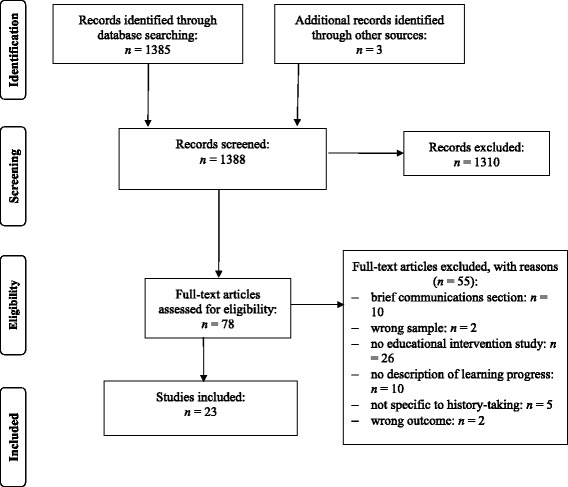
BACKGROUND: This paper is an up-to-date systematic review on educational interventions addressing history taking. The authors noted that despite the plethora of specialized training programs designed to enhance students' interviewing skills there had not been a review of the literature to assess the quality of each published method of teaching history taking in undergraduate medical education based on the evidence of the program's efficacy. METHODS: The databases PubMed, PsycINFO, Google Scholar, opengrey, opendoar and SSRN were searched using key words related to medical education and history taking. Articles that described an educational intervention to improve medical students' history-taking skills were selected and reviewed. Included studies had to evaluate learning progress. Study quality was assessed using the Medical Education Research Study Quality Instrument (MERSQI). RESULTS: Seventy-eight full-text articles were identified and reviewed; of these, 23 studies met the final inclusion criteria. Three studies applied an instructional approach using scripts, lectures, demonstrations and an online course. Seventeen studies applied a more experiential approach by implementing small group workshops including role-play, interviews with patients and feedback. Three studies applied a creative approach. Two of these studies made use of improvisational theatre and one introduced a simulation using Lego® building blocks. Twenty-two studies reported an improvement in students' history taking skills. Mean MERSQI score was 10.4 (range 6.5 to 14; SD = 2.65). CONCLUSIONS: These findings suggest that several different educational interventions are effective in teaching history taking skills to medical students. Small group workshops including role-play and interviews with real patients, followed by feedback and discussion, are widespread and best investigated. Feedback using videotape review was also reported as particularly instructive. Students in the early preclinical state might profit from approaches helping them to focus on interview skills and not being distracted by thinking about differential diagnoses or clinical management. The heterogeneity of outcome data and the varied ways of assessment strongly suggest the need for further research as many studies did not meet basic methodological criteria. Randomized controlled trials using external assessment methods, standardized measurement tools and reporting long-term data are recommended to evaluate the efficacy of courses on history taking.
Overview
The claims and statistics of this paper haven’t been checked yet.
Free: it reads the open-access text and checks the first 5 claims that cite a source we can check. Create a free account to check every claim.
Integrity signals
Registry
Cites
Statistics
Figures
Verification
Claims the paper makes
The claims and statistics of this paper haven’t been checked yet.
Free: it reads the open-access text and checks the first 5 claims that cite a source we can check. Create a free account to check every claim.
Claims other papers make about this one
Each is checked against this paper’s own text: does it say what the citing paper says it does?
The source backs part of the claim, not all of it — or backs it for a different population, condition or comparison.
In the citing paper
“Getting together the relevant information such as personal and psychosocial state, related personal and family medical background, the reason for consulting, plus the physical examination findings, should allow the physician to generate a diagnosis hypothesis.”
From The virtual patient as a learning tool: a mixed quantitative qualitative study (2018) · cites this paper as [7]
Experimental — accuracy not yet measuredThe source backs part of the claim, not all of it — or backs it for a different population, condition or comparison.
In the citing paper
“Both groups completed three sessions per week for four consecutive weeks—a duration previously shown to be sufficient for improving interview skills [10].”
From Feasibility study of using GPT for history-taking training in medical education: a randomized clinical trial (2025) · cites this paper as [10]
Experimental — accuracy not yet measuredIn the citing paper
“Moreover, it is possible to find systematic reviews that include studies where VP has been compared with some of those strategies and where it showed positive results against traditional lectures and even standardized patients, but evidence is not [7] conclusive and heterogeneity of the data suggest that more research is needed [7, 26, 29].”
From The virtual patient as a learning tool: a mixed quantitative qualitative study (2018) · cites this paper as [7]
Self-check
Percentages, sums and reported differences re-computed from the paper’s own numbers.
The self-check needs the paper’s full text.
Citations
Cites
Preferred Reporting Items for Systematic Reviews and Meta-Analyses: the PRISMA statement
Moher, D., Liberati, A., Tetzlaff, J., Altman, D. G., & for the PRISMA Group (2009) · BMJ · doi:10.1136/bmj.b2535 · Cited by 83,823
Preferred Reporting Items for Systematic Reviews and Meta-Analyses: The PRISMA Statement
Moher, D., Liberati, A., Tetzlaff, J., Altman, D. G., & The PRISMA Group (2009) · PLoS Medicine · doi:10.1371/journal.pmed.1000097 · Cited by 64,042 · cited 1×
“This review process was conducted according to the PRISMA statement [35, 36].”
MethodPreferred reporting items for systematic reviews and meta-analyses: the PRISMA Statement.
(2009) · PubMed Central · Cited by 44,859
Liberati, A., Altman, D. G., Tetzlaff, J., Mulrow, C., Gøtzsche, P. C., Ioannidis, J. P. A., Clarke, M., Devereaux, P. J., Kleijnen, J., & Moher, D. (2009) · PLoS Medicine · doi:10.1371/journal.pmed.1000100 · Cited by 28,164 · cited 1×
“This review process was conducted according to the PRISMA statement [35, 36].”
MethodPreferred Reporting Items for Systematic Reviews and Meta-Analyses: The PRISMA Statement
Moher, D., Liberati, A., Tetzlaff, J., & Altman, D. G. (2009) · Journal of Clinical Epidemiology · doi:10.1016/j.jclinepi.2009.06.005 · Cited by 19,575
Wang, G., Ma, R., Qiao, G., Wada, K., Aizawa, Y., & Satoh, T. (2015) · Integrative Medicine International · doi:10.1159/000368408 · Cited by 18,657
Hampton, J. R., Harrison, M. J., Mitchell, J. R., Prichard, J. S., & Seymour, C. (1975) · BMJ · doi:10.1136/bmj.2.5969.486 · Cited by 1,018
Association Between Funding and Quality of Published Medical Education Research
Reed, D. A., Cook, D. A., Beckman, T. J., Levine, R. B., Kern, D. E., & Wright, S. M. (2007) · JAMA · doi:10.1001/jama.298.9.1002 · Cited by 958 · cited 1×
“Study quality was considered using the Medical Education Research Study Quality Instrument (MERSQI), a tool developed especially to assess educational studies [39].”
MethodDoctor-patient communication: the Toronto consensus statement.
Simpson, M., Buckman, R., Stewart, M., Maguire, P., Lipkin, M., Novack, D., & Till, J. (1991) · BMJ · doi:10.1136/bmj.303.6814.1385 · Cited by 877
The Medical School Objectives Writing Group (1999) · Academic Medicine · doi:10.1097/00001888-199901001-00010 · Cited by 558
Aspegren, K. (1999) · Medical Teacher · doi:10.1080/01421599978979 · Cited by 519
Effect of Communications Training on Medical Student Performance
Yedidia, M. J. (2003) · JAMA · doi:10.1001/jama.290.9.1157 · Cited by 481 · cited 1×
“2003 [52] Randomized, two-group, pre-post comparison n = 293 clinical medical students Demonstration of interviewing skills, SP interviews, feedback and self-reflection OSCE station, communication skills rated by SPs Yes 13,5”
MethodThe Medical School Objectives Writing Group (1999) · Journal of the Association of American Medical Colleges · doi:10.1097/00001888-199901000-00010 · Cited by 449
PETERSON, M. C., HOLBROOK, J. M., HALES, D. V., SMITH, N. L., & STAKER, L. V. (1992) · Obstetrical & Gynecological Survey · doi:10.1097/00006254-199210000-00013 · Cited by 388 · cited 2×
“By the medical history, physicians garner 60–80 % of the information that is relevant for a diagnosis [13–17] and the history alone can lead to the final diagnosis in 76 % [13].”
BackgroundPeterson, M. C., Holbrook, J. H., Hales, D., Smith, N. L., & Staker, L. V. (1992) · PubMed Central · Cited by 262
The importance of the history in the medical clinic and the cost of unnecessary tests
Sandler, G. (1980) · American Heart Journal · doi:10.1016/0002-8703(80)90076-9 · Cited by 204 · cited 1×
“By the medical history, physicians garner 60–80 % of the information that is relevant for a diagnosis [13–17] and the history alone can lead to the final diagnosis in 76 % [13].”
BackgroundHargie, O., Dickson, D., Boohan, M., & Hughes, K. (1998) · Medical Education · doi:10.1046/j.1365-2923.1998.00154.x · Cited by 190 · cited 1×
“History taking and communication skills programmes have become cornerstones in medical education over the past 30 years and are implemented in most US [6],Canadian [8], German [29] and UK [30] medical schools.”
BackgroundLipkin, M., Putnam, S. M., Lazare, A., Carroll, J. G., & Frankel, R. M. (1997) · Cited by 179
Therapeutic aspects of the clinical encounter
Novack, D. H. (1987) · Journal of General Internal Medicine · doi:10.1007/bf02596174 · Cited by 152 · cited 1×
“Accuracy of diagnoses and the establishment of a good physician-patient relationship depend on effective communication within the medical interview [12, 13].”
BackgroundTeaching Clinical Medicine by Iterative Hypothesis Testing: Let's Preach What We Practice
Kassirer, J. P. (1983) · New England Journal of Medicine · doi:10.1056/nejm198310133091511 · Cited by 149
Perspective: Serious Play: Teaching Medical Skills With Improvisational Theater Techniques
Watson, K. (2011) · Academic Medicine · doi:10.1097/acm.0b013e31822cf858 · Cited by 144 · cited 5×
“Watson 2011 [55] Single-group post-test n = 116 preclinical medical students Five weekly 2-hour sessions in small groups, improvisational theatre Qualitative analysis of course evaluations, self-report questionnaire on acquired skills Yes 7”
BackgroundInfluentialThe rise and fall of students' skill in obtaining a medical history
Pfeiffer, C. A., Madray, H., Ardolino, A., & Willms, J. L. (1998) · Medical Education · doi:10.1046/j.1365-2923.1998.00222.x · Cited by 143 · cited 1×
“Students’ psychosocial interviewing skills especially seem to decline without targeted interventions [7, 19, 25].”
BackgroundTeaching medical students the important connection between communication and clinical reasoning
Windish, D. M., Price, E. G., Clever, S. L., Magaziner, J. L., & Thomas, P. A. (2005) · Journal of General Internal Medicine · doi:10.1111/j.1525-1497.2005.0244.x · Cited by 134 · cited 3×
“Four interventions [9, 10, 26, 54] provided real patients.”
BackgroundMethodSHOULD SKILLS IN COMMUNICATING WITH PATIENTS BE TAUGHT IN MEDICAL SCHOOLS?
Sanson‐Fisher, R., & Maguire, P. (1980) · The Lancet · doi:10.1016/s0140-6736(80)91844-9 · Cited by 127 · cited 1×
“Interview skills contribute significantly to problem detection, diagnostic accuracy, patient and physician satisfaction, patient adjustment to stress and illness, patient recall of information, patient adherence to therapy and patient health outcomes [7–11].”
BackgroundNestel, D., & Kidd, J. M. (2003) · Medical Teacher · doi:10.1080/0142159031000136752 · Cited by 119 · cited 4×
“Nestel and Kidd [50] used peer tutors and reported no differences regarding patient-”
BackgroundInfluentialHulsman, R. L., Harmsen, A. B., & Fabriek, M. (2008) · Patient Education and Counseling · doi:10.1016/j.pec.2008.10.009 · Cited by 119 · cited 2×
“2009 [49] Single-group post-test n = 331 preclinical medical students Seven small group sessions including SP interviews, videotape review, written self-evaluations, peer-feedback and discussion Rating of students’ reflections by trained observers; evaluation questionnaire Yes 9”
BackgroundMethodNovack, D. H. (1993) · JAMA · doi:10.1001/jama.1993.03500160071034 · Cited by 119 · cited 2×
“Often self-developed assessment scales were used although proven scales for external assessment do exist (for example the History-Taking Rating Scale (HTRS) [28], the Maastricht History-taking and Advice Checklist (MAAS) [24] or the Brown Interviewing Checklist (BIC) [6]).”
BackgroundMethodCan communication skills be taught?
Maguire, P. (1990) · PubMed · Cited by 117
Teaching medical interviewing. A basic course on interviewing and the physician-patient relationship
Novack, D. H. (1992) · Archives of Internal Medicine · doi:10.1001/archinte.152.9.1814 · Cited by 114
Three Functions of the Medical Interview
Lazare, A., Putnam, S. M., & Lipkin, M. (1995) · Frontiers of primary care · doi:10.1007/978-1-4612-2488-4_1 · Cited by 109 · cited 1×
“Other models emphasise patient-centeredness even more, describing an equal exchange of information and shared decision-making [21, 22].”
BackgroundThe Three-Function Model of the Medical Interview
Bird, J., & Cohen‐Cole, S. A. (2015) · Advances in psychosomatic medicine · doi:10.1159/000418260 · Cited by 101
Roshan, M., & Ap, R. (2000) · PubMed · Cited by 90
Patient-Centered Interviewing: An Evidence-Based Method
Smith, R. C. (2002) · Medical Entomology and Zoology · Cited by 90
(1988) · Annals of Internal Medicine · doi:10.7326/0003-4819-108-3-499_13 · Cited by 90
Lessons for clinicians from physician-patient communication literature
Rosenberg, E. E. (1997) · Archives of Family Medicine · doi:10.1001/archfami.6.3.279 · Cited by 90
Shochet, R., King, J., Levine, R. B., Clever, S. L., & Wright, S. M. (2013) · Education for Primary Care · doi:10.1080/14739879.2013.11493466 · Cited by 86 · cited 5×
“Shochet R, King J, Levine R, Clever S, Wright S. ‘Thinking on my feet’: an improvisation course to enhance students’ confidence and responsiveness in the medical interview.”
BackgroundMethodInfluentialThe three-function model of the medical interview. An educational device.
Bird, J., & Cohen‐Cole, S. A. (1990) · PubMed · Cited by 84
Interviewing and Patient Care.
(1973) · Annals of Internal Medicine · doi:10.7326/0003-4819-78-3-467_1 · Cited by 71
Enduring Attributes of Medicine Relevant for the Education of the Physician
Engel, G. L. (1973) · Annals of Internal Medicine · doi:10.7326/0003-4819-78-4-587 · Cited by 67 · cited 1×
“cine have changed the fact that a physician’s core clinical skills are interpersonal [4–6].”
BackgroundTeaching Inpatient Communication Skills to Medical Students: An Innovative Strategy
Losh, D. P., Mauksch, L. B., Arnold, R. W., Maresca, T. M., Storck, M. G., Maestas, R. R., & Goldstein, E. A. (2005) · Academic Medicine · doi:10.1097/00001888-200502000-00002 · Cited by 64 · cited 2×
“2005 [45] Single-group post-test n = 180 preclinical medical students One 2-hour teaching session including an introduction of communication benchmarks and a video demonstration of short scenarios contrasting “ok” with “better” communication skills Course evaluation questionnaire Yes 6,5”
BackgroundMethodWiecha, J., Gramling, R. E., Joachim, P., & Vanderschmidt, H. (2003) · Journal of Medical Internet Research · doi:10.2196/jmir.5.2.e13 · Cited by 63 · cited 2×
“Wiecha [46] reported on an online course developed to teach the cognitive basis for interviewing skills.”
BackgroundFortin, A. H., Haeseler, F., Angoff, N. R., Cariaga-Lo, L., Ellman, M. S., Vásquez, L., & Bridger, L. (2002) · Journal of General Internal Medicine · doi:10.1046/j.1525-1497.2002.00628.x · Cited by 62 · cited 3×
“tin [7] found that SP interviews were evaluated as one of the most effective teaching methods.”
BackgroundMethodÖzçakar, N., Mevsim, V., Güldal, D., Günvar, T., Yıldırım, E., Sisli, Z., & Şemin, İ. (2009) · BMC Public Health · doi:10.1186/1471-2458-9-474 · Cited by 60 · cited 2×
“Ozcakar [42] found that students having both verbal and visual (videotape review) feedback were more successful than those having verbal feedback alone.”
BackgroundMethodTeaching skills in communication to medical students— a critical review of the methodology
Sanson‐Fisher, R., Fairbairn, S., & Maguire, P. (1981) · Medical Education · doi:10.1111/j.1365-2923.1981.tb02312.x · Cited by 48 · cited 2×
“The MERSQI domains are very similar to the required methodical standards that Sanson-Fisher suggested for educational studies [40].”
BackgroundMethodVIRTUAL PATIENTS IN UNDERGRADUATE SURGERY EDUCATION: A RANDOMIZED CONTROLLED STUDY
Vash, J. H., Yunesian, M., Shariati, M., Keshvari, A., & Harirchi, I. (2007) · ANZ Journal of Surgery · doi:10.1111/j.1445-2197.2006.03978.x · Cited by 48 · cited 3×
“Vash JH, Yunesian M, Shariati M, Keshvari A, Harirchi I. Virtual patients in undergraduate surgery education: a randomized controlled study.”
BackgroundMethodInfluentialMukohara, K., Kitamura, K., Wakabayashi, H., Abe, K., Sato, J., & Ban, N. (2004) · BMC Medical Education · doi:10.1186/1472-6920-4-24 · Cited by 46 · cited 5×
“Small group workshops including role-play and feedback In two studies [28, 41], students participated in small group workshops practising history taking by role-play.”
BackgroundMethodInfluentialConsulting skills training and medical students' interviewing efficiency
Evans, B. J., Coman, G. J., & Goss, B. D. (1996) · Medical Education · doi:10.1111/j.1365-2923.1996.tb00729.x · Cited by 37 · cited 4×
“Four interventions [9, 10, 26, 54] provided real patients.”
BackgroundMethodInfluentialTo what extent are medical interviewing skills teachable?
Kraan, H. F., Crijnen, A. A. M., de Vries, M. W., Zuidweg, J., Imbos, T., & van der Vleuten, C. P. M. (1990) · Medical Teacher · doi:10.3109/01421599009006637 · Cited by 36 · cited 1×
“Of those studies reporting the duration of their educational interventions, the shortest intervention took two hours and the longest took seven 4-hour sessions (28 h).”
BackgroundBehavioural assessment of the effectiveness of a communication programme for medical students
Evans, B. J., Sweet, B., & Coman, G. J. (1993) · Medical Education · doi:10.1111/j.1365-2923.1993.tb00279.x · Cited by 33 · cited 4×
“Often self-developed assessment scales were used although proven scales for external assessment do exist (for example the History-Taking Rating Scale (HTRS) [28], the Maastricht History-taking and Advice Checklist (MAAS) [24] or the Brown Interviewing Checklist (BIC) [6]).”
BackgroundMethodInfluentialvon Lengerke, T., Kursch, A., Lange, K., & MHH*, A.-L. (2011) · PubMed Central · doi:10.3205/zma000766 · Cited by 30
Teaching the Medical Interview: Methods and Key Learning Issues in a Faculty Development Course
Hatem, D., Barrett, S., Hewson, M. G., Steele, D., Purwono, U., & Smith, R. C. (2007) · Journal of General Internal Medicine · doi:10.1007/s11606-007-0408-9 · Cited by 30 · cited 1×
“History taking and communication skills programmes have become cornerstones in medical education over the past 30 years and are implemented in most US [6],Canadian [8], German [29] and UK [30] medical schools.”
BackgroundPatient-Centered Interviewing: An Evidence-Based Method. 2nd ed.
Murcko, A. C. (2002) · Clinical Nurse Specialist · doi:10.1097/00002800-200211000-00019 · Cited by 25
Consultation skills of medical students before and after changes in curriculum
Utting, M. R., Campbell, F., Rayner, C., Whitehouse, C. R., & Dornan, T. L. (2000) · Journal of the Royal Society of Medicine · doi:10.1177/014107680009300509 · Cited by 24 · cited 2×
“Utting [43] compared two skills courses using an active “learning by doing” approach with one course and applying instructional methods in the other.”
BackgroundMethodEvaluating the effectiveness of communication skills training: a review of research.
Henwood, P. G., & ALTMAIER, E. M. (1996) · PubMed · Cited by 23
Harding, S. R., & D’Eon, M. F. (2001) · Teaching and Learning in Medicine · doi:10.1207/s15328015tlm1302_8 · Cited by 21 · cited 3×
“Harding SR, D’Eon MF.”
MethodInfluentialPhysician-patient communication: does it matter?
Nichols, L. O., & Mirvis, D. M. (1998) · PubMed · Cited by 12
Schildmann, J., Kampmann, M., & Schwantes, U. (2004) · PubMed · Cited by 11
Peltier, D. A., Regan-Smith, M. G., Wofford, J. L., Whelton, S., Kennebecks, G., & Carney, P. A. (2007) · Teaching and Learning in Medicine · doi:10.1080/10401330701366465 · Cited by 11
Gl, E. (1982) · PubMed · Cited by 11
Developing a support system for teaching and assessing clinical competence.
Battles, J. B., Sprankell, S. J., Carpenter, J. L., Bedford, J. A., & Kirk, L. M. (1992) · PubMed · Cited by 9
Evaluation of training medical students in patient-interviewing skills by three modes of learning.
Eoaskoon, W., Sumawong, V., & Silpakit, C. (1996) · PubMed · Cited by 7
Consulting-skills training to improve medical studentsʼ diagnostic efficiency
Evans, B. J., & Sweet, B. (1993) · Academic Medicine · doi:10.1097/00001888-199302000-00019 · Cited by 6 · cited 2×
“1993 [27] Non-randomized, twogroup post-test n = 106 preclinical medical students Programme of lectures and skills workshops Assessment of videotaped interviews with real patients by two independent, trained raters using the HTRS Yes 11,5”
BackgroundMethodPalmer, S. (1974) · AORN Journal · doi:10.1016/s0001-2092(07)63102-0 · Cited by 6
What is Missing from Patient Histories?
Rezler, A. G., Woolliscroft, J., & Kalishman, S. G. (1991) · Medical Teacher · doi:10.3109/01421599109098989 · Cited by 3 · cited 2×
“Students’ psychosocial interviewing skills especially seem to decline without targeted interventions [7, 19, 25].”
BackgroundProgress, Problems, and Promise
Gaertner, S. L., & Dovidio, J. F. (2014) · doi:10.4324/9781315804576-16 · Cited by 1
Research works printed but not linked: 3
- Davidoff F Deutsch S Egan KL Ende J Who Has Seen A Blood Sugar? - Reflections on Medical Education. Edited by the American College of Physicians 1996 Philadelphia American College of Physicians
- General Medical Council Tomorrow’s Doctors: Recommendations on Undergraduate Medical Education 1991 London General Medical Council
- Fischer T Chenot J-F Kleiber C Kochen MM Simmenroth-Nayda A Staats H Herrmann-Lingen C Kurs “ärztliche Basisfertigkeiten” - Evaluation eines primärärztlich orientierten Unterrichtskonzepts im Rahmen der neuen Approbationsordnung GMS Z Med Ausbild 2005 22 Doc59
Cited by
Psychosomatic medicine in Germany: more timely than ever
Zipfel, S., Herzog, W., Kruse, J., & Henningsen, P. (2016) · Psychotherapy and Psychosomatics · doi:10.1159/000447701 · Cited by 2,323
Self-citationTowards conversational diagnostic artificial intelligence
Tu, T., Schaekermann, M., Palepu, A., Saab, K., Freyberg, J., Tanno, R., Wang, A., Li, B., Amin, M., Cheng, Y., et al. (2025) · Nature · doi:10.1038/s41586-025-08866-7 · Cited by 366
“History-taking and the clinical interview are widely taught in both medical schools and postgraduate curricula 60–65 .”
Current Psychosomatic Practice
Fava, G. A., Cosci, F., & Sonino, N. (2017) · Psychotherapy and Psychosomatics · doi:10.1159/000448856 · Cited by 302
Interventions for improving medical students' interpersonal communication in medical consultations
Gilligan, C., Powell, M., Lynagh, M. C., Ward, B. M., Lonsdale, C., Harvey, P., James, E. L., Rich, D., Dewi, S. P., Nepal, S., et al. (2021) · Cochrane Database of Systematic Reviews · doi:10.1002/14651858.cd012418.pub2 · Cited by 139
Holderried, F., Stegemann–Philipps, C., Herschbach, L., Moldt, J.-A., Nevins, A., Griewatz, J., Holderried, M., Herrmann-Werner, A., Festl-Wietek, T., & Mahling, M. (2024) · JMIR Medical Education · doi:10.2196/53961 · Cited by 156
“To practice history taking, the learner is required to have an interactive encounter [14], and courses frequently rely on simulated or real patients [15].”
BackgroundSelf-citation
Metadata
- Authors
- Keifenheim, K. E., Teufel, M., Ip, J., Speiser, N., Leehr, E. J., Zipfel, S., & Herrmann-Werner, A.
- Affiliations
- Universitätsklinikum Tübingen (DE)
- Brown University (US)
- Corresponding author
- Keifenheim, Katharina E.
- Venue
- BMC Medical Education
- Published
- 2015-09-28
- Volume
- 15
- Issue
- 1
- Pages
- 159-159
- ISSN
- 1472-6920 (ISSN-L)
- PMC
- PMC4587833
- OpenAlex
- W2128813077
- Cited by
- 218
- References
- 69
- Citations by year
- 2026: 21 · 2025: 37 · 2024: 41 · 2023: 24 · 2022: 20 · 2021: 22 · 2020: 11 · 2019: 16 · 2018: 7 · 2017: 9 · 2016: 8 · 2015: 1
- FWCI
- 1.20
- Type
- journal article
- Language
- en
- Open access
- gold
- doi.org
- Licence
- Locations
- BMC Medical Education (publishedVersion, cc-by)
- PubMed Central (publishedVersion, cc-by)
- PubMed (publishedVersion)
- Funders
- Deutsche Forschungsgemeinschaft
- Eberhard Karls Universität Tübingen
- Topics
- Social Sciences › Education › Innovations in Medical Education
- Health Sciences › Health Professions › General Health Professions › Patient-Provider Communication in Healthcare
- Social Sciences › Education › Simulation-Based Education in Healthcare
- Keywords
- medical history, medical students, undergraduate medical education, educational intervention, role play, small group workshops, feedback, videotape review, improvisational theatre, simulation-based training, preclinical education
- MeSH terms
- Education, Medical, Humans, Medical History Taking, Students, Medical, Teaching
About these checks
Registry, retraction, Cites and statistics results are computed, not judged, with one exception: a printed reference that no index lists is read once by a model before it counts as a citation error. Claims are extracted by a model and kept only when their quote appears verbatim in the text; each cited source is then checked, with a model’s help, for whether it says what the claim relies on. Those verdicts can be wrong — read the claim’s quote and the cited source before relying on one.
Statistics and arithmetic are recomputed, not judged.
Confidence bands are shown only for fields calibrated on our annotated test set. None is calibrated yet, so no band is shown.
What counts as a claim ›How we measure confidence ›How we check this ›
Are you an author, or do you see a problem with this page? Request a review
Data sources
Bibliographic data: Semantic Scholar, OpenAlex, Crossref.
Contains information from the Semantic Scholar Academic Graph Datasets, made available under the ODC Attribution License (ODC-BY 1.0).
Semantic Scholar’s data is described in: Kinney, R., et al. (2023). The Semantic Scholar Open Data Platform. arXiv:2301.10140.
