

Teaching history taking to medical students: a systematic review
Open accessThe DOI matches its Crossref record; 65 of the 69 references it cites were found in a registry or an index.
Abstract
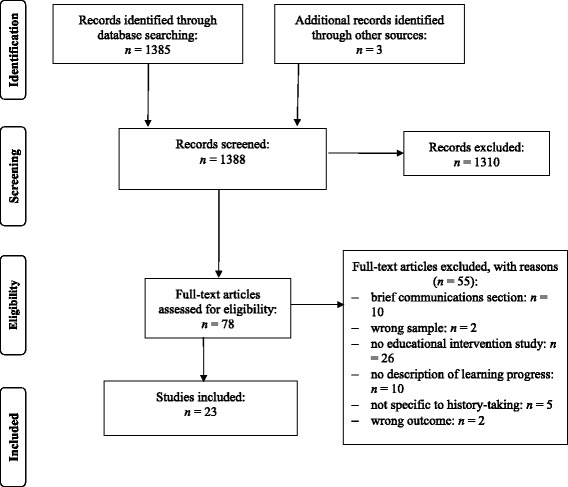
BACKGROUND: This paper is an up-to-date systematic review on educational interventions addressing history taking. The authors noted that despite the plethora of specialized training programs designed to enhance students' interviewing skills there had not been a review of the literature to assess the quality of each published method of teaching history taking in undergraduate medical education based on the evidence of the program's efficacy. METHODS: The databases PubMed, PsycINFO, Google Scholar, opengrey, opendoar and SSRN were searched using key words related to medical education and history taking. Articles that described an educational intervention to improve medical students' history-taking skills were selected and reviewed. Included studies had to evaluate learning progress. Study quality was assessed using the Medical Education Research Study Quality Instrument (MERSQI). RESULTS: Seventy-eight full-text articles were identified and reviewed; of these, 23 studies met the final inclusion criteria. Three studies applied an instructional approach using scripts, lectures, demonstrations and an online course. Seventeen studies applied a more experiential approach by implementing small group workshops including role-play, interviews with patients and feedback. Three studies applied a creative approach. Two of these studies made use of improvisational theatre and one introduced a simulation using Lego® building blocks. Twenty-two studies reported an improvement in students' history taking skills. Mean MERSQI score was 10.4 (range 6.5 to 14; SD = 2.65). CONCLUSIONS: These findings suggest that several different educational interventions are effective in teaching history taking skills to medical students. Small group workshops including role-play and interviews with real patients, followed by feedback and discussion, are widespread and best investigated. Feedback using videotape review was also reported as particularly instructive. Students in the early preclinical state might profit from approaches helping them to focus on interview skills and not being distracted by thinking about differential diagnoses or clinical management. The heterogeneity of outcome data and the varied ways of assessment strongly suggest the need for further research as many studies did not meet basic methodological criteria. Randomized controlled trials using external assessment methods, standardized measurement tools and reporting long-term data are recommended to evaluate the efficacy of courses on history taking.
Overview
The claims and statistics of this paper haven’t been checked yet.
Free: it reads the open-access text and checks the first 5 claims that cite a source we can check. Create a free account to check every claim.
Integrity signals
Registry
Cites
Statistics
Figures
Verification
Claims the paper makes
The claims and statistics of this paper haven’t been checked yet.
Free: it reads the open-access text and checks the first 5 claims that cite a source we can check. Create a free account to check every claim.
Claims other papers make about this one
Each is checked against this paper’s own text: does it say what the citing paper says it does?
The source backs part of the claim, not all of it — or backs it for a different population, condition or comparison.
In the citing paper
“Getting together the relevant information such as personal and psychosocial state, related personal and family medical background, the reason for consulting, plus the physical examination findings, should allow the physician to generate a diagnosis hypothesis.”
From The virtual patient as a learning tool: a mixed quantitative qualitative study (2018) · cites this paper as [7]
Experimental — accuracy not yet measuredThe source backs part of the claim, not all of it — or backs it for a different population, condition or comparison.
In the citing paper
“Both groups completed three sessions per week for four consecutive weeks—a duration previously shown to be sufficient for improving interview skills [10].”
From Feasibility study of using GPT for history-taking training in medical education: a randomized clinical trial (2025) · cites this paper as [10]
Experimental — accuracy not yet measuredIn the citing paper
“Moreover, it is possible to find systematic reviews that include studies where VP has been compared with some of those strategies and where it showed positive results against traditional lectures and even standardized patients, but evidence is not [7] conclusive and heterogeneity of the data suggest that more research is needed [7, 26, 29].”
From The virtual patient as a learning tool: a mixed quantitative qualitative study (2018) · cites this paper as [7]
Self-check
Percentages, sums and reported differences re-computed from the paper’s own numbers.
The self-check needs the paper’s full text.
Citations
Cites
Preferred Reporting Items for Systematic Reviews and Meta-Analyses: the PRISMA statement
Moher, D., Liberati, A., Tetzlaff, J., Altman, D. G., & for the PRISMA Group (2009) · BMJ · doi:10.1136/bmj.b2535 · Cited by 83,823
Preferred Reporting Items for Systematic Reviews and Meta-Analyses: The PRISMA Statement
Moher, D., Liberati, A., Tetzlaff, J., Altman, D. G., & The PRISMA Group (2009) · PLoS Medicine · doi:10.1371/journal.pmed.1000097 · Cited by 64,042 · cited 1×
“This review process was conducted according to the PRISMA statement [35, 36].”
MethodPreferred reporting items for systematic reviews and meta-analyses: the PRISMA Statement.
(2009) · PubMed Central · Cited by 44,859
Liberati, A., Altman, D. G., Tetzlaff, J., Mulrow, C., Gøtzsche, P. C., Ioannidis, J. P. A., Clarke, M., Devereaux, P. J., Kleijnen, J., & Moher, D. (2009) · PLoS Medicine · doi:10.1371/journal.pmed.1000100 · Cited by 28,164 · cited 1×
“This review process was conducted according to the PRISMA statement [35, 36].”
MethodPreferred Reporting Items for Systematic Reviews and Meta-Analyses: The PRISMA Statement
Moher, D., Liberati, A., Tetzlaff, J., & Altman, D. G. (2009) · Journal of Clinical Epidemiology · doi:10.1016/j.jclinepi.2009.06.005 · Cited by 19,575
Wang, G., Ma, R., Qiao, G., Wada, K., Aizawa, Y., & Satoh, T. (2015) · Integrative Medicine International · doi:10.1159/000368408 · Cited by 18,657
Hampton, J. R., Harrison, M. J., Mitchell, J. R., Prichard, J. S., & Seymour, C. (1975) · BMJ · doi:10.1136/bmj.2.5969.486 · Cited by 1,018
Association Between Funding and Quality of Published Medical Education Research
Reed, D. A., Cook, D. A., Beckman, T. J., Levine, R. B., Kern, D. E., & Wright, S. M. (2007) · JAMA · doi:10.1001/jama.298.9.1002 · Cited by 958 · cited 1×
“Study quality was considered using the Medical Education Research Study Quality Instrument (MERSQI), a tool developed especially to assess educational studies [39].”
MethodDoctor-patient communication: the Toronto consensus statement.
Simpson, M., Buckman, R., Stewart, M., Maguire, P., Lipkin, M., Novack, D., & Till, J. (1991) · BMJ · doi:10.1136/bmj.303.6814.1385 · Cited by 877
The Medical School Objectives Writing Group (1999) · Academic Medicine · doi:10.1097/00001888-199901001-00010 · Cited by 558
Research works printed but not linked: 3
- Davidoff F Deutsch S Egan KL Ende J Who Has Seen A Blood Sugar? - Reflections on Medical Education. Edited by the American College of Physicians 1996 Philadelphia American College of Physicians
- General Medical Council Tomorrow’s Doctors: Recommendations on Undergraduate Medical Education 1991 London General Medical Council
- Fischer T Chenot J-F Kleiber C Kochen MM Simmenroth-Nayda A Staats H Herrmann-Lingen C Kurs “ärztliche Basisfertigkeiten” - Evaluation eines primärärztlich orientierten Unterrichtskonzepts im Rahmen der neuen Approbationsordnung GMS Z Med Ausbild 2005 22 Doc59
Cited by
Psychosomatic medicine in Germany: more timely than ever
Zipfel, S., Herzog, W., Kruse, J., & Henningsen, P. (2016) · Psychotherapy and Psychosomatics · doi:10.1159/000447701 · Cited by 2,323
Self-citationTowards conversational diagnostic artificial intelligence
Tu, T., Schaekermann, M., Palepu, A., Saab, K., Freyberg, J., Tanno, R., Wang, A., Li, B., Amin, M., Cheng, Y., et al. (2025) · Nature · doi:10.1038/s41586-025-08866-7 · Cited by 366
“History-taking and the clinical interview are widely taught in both medical schools and postgraduate curricula 60–65 .”
Current Psychosomatic Practice
Fava, G. A., Cosci, F., & Sonino, N. (2017) · Psychotherapy and Psychosomatics · doi:10.1159/000448856 · Cited by 302
Interventions for improving medical students' interpersonal communication in medical consultations
Gilligan, C., Powell, M., Lynagh, M. C., Ward, B. M., Lonsdale, C., Harvey, P., James, E. L., Rich, D., Dewi, S. P., Nepal, S., et al. (2021) · Cochrane Database of Systematic Reviews · doi:10.1002/14651858.cd012418.pub2 · Cited by 139
Holderried, F., Stegemann–Philipps, C., Herschbach, L., Moldt, J.-A., Nevins, A., Griewatz, J., Holderried, M., Herrmann-Werner, A., Festl-Wietek, T., & Mahling, M. (2024) · JMIR Medical Education · doi:10.2196/53961 · Cited by 156
“To practice history taking, the learner is required to have an interactive encounter [14], and courses frequently rely on simulated or real patients [15].”
BackgroundSelf-citationThe virtual patient as a learning tool: a mixed quantitative qualitative study
Isaza-Restrepo, A., Gómez, M. T., Cifuentes, G., & Argüello, A. (2018) · BMC Medical Education · doi:10.1186/s12909-018-1395-8 · Cited by 129
Interventions for improving medical students' interpersonal communication in medical consultations
Gilligan, C., James, E. L., Snow, P., Outram, S., Ward, B. M., Powell, M., Lonsdale, C., Cushing, A. M., Silverman, J., Regan, T., et al. (2016) · Cochrane Database of Systematic Reviews · doi:10.1002/14651858.cd012418 · Cited by 124
Next-Generation Simulation—Integrating Extended Reality Technology Into Medical Education
Herur-Raman, A., Almeida, N. D., Greenleaf, W., Williams, D., Karshenas, A., & Sherman, J. H. (2021) · Frontiers in Virtual Reality · doi:10.3389/frvir.2021.693399 · Cited by 94
“Additionally, students often have limited class time to practice with SPs (Keifenheim et al., 2015; Maicher et al., 2017; Uchida et al., 2019).”
BackgroundInfluentialThe decline of clinical skills: a challenge for medical schools
Faustinella, F., & Jacobs, R. J. (2018) · International Journal of Medical Education · doi:10.5116/ijme.5b3f.9fb3 · Cited by 96
Beebe, S. L., Payne, N. G., Posid, T., Diab, D., Horning, P., Scimeca, A., & Jenkins, L. C. (2021) · The Journal of Sexual Medicine · doi:10.1016/j.jsxm.2021.09.011 · Cited by 72
Mazer, L. M., Storage, T. R., Merrell, S. B., Chi, J., & Skeff, K. M. (2016) · Journal of General Internal Medicine · doi:10.1007/s11606-016-3928-3 · Cited by 72
Rädel-Ablass, K., Schliz, K., Schlick, C., Meindl, B., Pahr-Hosbach, S., Schwendemann, H., Rupp, S., Roddewig, M., & Miersch, C. (2025) · BMC Medical Education · doi:10.1186/s12909-025-06756-0 · Cited by 37
“Therefore, it is essential for students in health professions to extensively practice anamnesis interviews to develop the skills necessary for thorough patient assessments and accurate clinical decision-making [4].”
Viljoen, C. A., Millar, R. S., Engel, M. E., Shelton, M., & Burch, V. C. (2019) · BMJ Open · doi:10.1136/bmjopen-2018-028800 · Cited by 55
Geoffroy, P. A., Delyon, J., Strullu, M., Tran‐Dinh, A., Duboc, H., Zafrani, L., Etienne, I., Lejoyeux, M., Ceccaldi, P., Plaisance, P. I., et al. (2020) · Psychiatry Investigation · doi:10.30773/pi.2019.0258 · Cited by 55
The medical consultation through the lenses of language and social interaction theory
Cox, A., & Li, S. (2019) · Advances in Health Sciences Education · doi:10.1007/s10459-018-09873-2 · Cited by 47
Chao, Y., Kang, C., Chuang, H., Hsieh, M., Chang, Y., Kuo, T. B. J., Yang, C. C. H., Huang, C., Fang, T., Li, H., et al. (2022) · Virtual Reality · doi:10.1007/s10055-022-00664-0 · Cited by 50
“…skills, UME students can also use modern learning methods such as standardized patients, videos, e-learning, small group workshops, simulations, and virtual reality (VR) to improve these core competencies (Danielson et al. 2019; Keifenheim et al. 2015; Lee et al. 2018a, b, 2018a; Letterie 2002).”
BackgroundDesigning and building OSCEBot ® for virtual OSCE – Performance evaluation
Pereira, D. S. M., Falcão, F., Nunes, A., Santos, N., Costa, P., & Pêgo, J. M. (2023) · Medical Education Online · doi:10.1080/10872981.2023.2228550 · Cited by 42
“During their career, clinicians will interview between 100,000 and 200,000 patients [18].”
BackgroundClinical Interviewing: An Essential but Neglected Method of Medicine
Fava, G. A., Sonino, N., Aron, D. C., Balon, R., Montiel, C. B., Cao, J., Concato, J., Eőry, A., Horwitz, R. I., Rafanelli, C., et al. (2024) · Psychotherapy and Psychosomatics · doi:10.1159/000536490 · Cited by 44
“Keeping the fl ow of interviewing while always staying focused on the person and his/her concerns is a complex and dif fi cult task that requires adequate training and substantial experience [34].”
BackgroundInfluentialSelf-citationAbi‐Rafeh, J., Henry, N., Xu, H. H., Bassiri-Tehrani, B., Arezki, A., Kazan, R., Gilardino, M. S., & Nahai, F. (2024) · Aesthetic Surgery Journal · doi:10.1093/asj/sjae025 · Cited by 37
Grey, C., Constantine, L., Baugh, G. M., & Lindenberger, E. C. (2017) · MedEdPORTAL · doi:10.15766/mep_2374-8265.10644 · Cited by 36
Reed, K., Reed, B., Bailey, J., BEATTIE, K. A., Lynch, E. A., Thompson, J. F., Vines, R. F., Wong, K. C., McCrossin, T., & Wilson, R. (2021) · Australian Journal of Rural Health · doi:10.1111/ajr.12733 · Cited by 35
What physicians reason about during admission case review
Juma, S., & Goldszmidt, M. A. (2016) · Advances in Health Sciences Education · doi:10.1007/s10459-016-9701-x · Cited by 35
“While multiple models exist to help teach and learn clinical tasks (e.g., taking a history, performing a physical exam) (Keifenheim et al. 2015; Kurtz et al. 2003; Lipkin et al. 1995; Makoul 2001; Silverman et al. 2005), very few models are integrated with the reasoning tasks that accompany them;…”
BackgroundWang, Z., Fan, T.-T., Li, M.-L., Zhu, N.-J., & Wang, X.-C. (2025) · BMC Medical Education · doi:10.1186/s12909-025-07614-9 · Cited by 32
Walter, S., Speidel, R., Hann, A., Leitner, J., Jerg‐Bretzke, L., Kropp, P. A., Garbe, J., & Ebner, F. K. (2021) · GMS journal for medical education · doi:10.3205/zma001496 · Cited by 46
“Das Üben am Patienten ist dafür aus organisatorischen, finanziellen und ethischen Gründen ungenügend [2].”
BackgroundInfluentialBarker, L. A., Moore, J. D., & Cook, H. A. (2024) · Nutrients · doi:10.3390/nu16070914 · Cited by 34
“Human simulated patients (HSPs) are considered the gold standard for authentic clinical encounters [12], however are often used sparingly due to cost and complexity of the organisation process [13].”
BackgroundThe feasibility of using generative artificial intelligence for history taking in virtual patients
Yi, Y., & Kim, K.-J. (2025) · BMC Research Notes · doi:10.1186/s13104-025-07157-8 · Cited by 28
“Despite the importance of interactive encounter for medical students to develop competencies in history taking [6], the doctor-patient interaction in conventional VPs, which were developed based on pre-LLM technology, significantly lacked in realism.”
Sezer, B., Sezer, T. A., Teker, G. T., & Elçin, M. (2023) · BMC Medical Education · doi:10.1186/s12909-023-04860-7 · Cited by 29
“The history-taking skill, which is the core of communication skills, enables making clinical decisions by receiving accurate information about the patient, usually directly from the patient, and in some cases from the patient’s relatives and other health personnel [3].”
BackgroundMethodInfluentialWulff, A., Mast, M., Hassler, M., Montag, S., Marschollek, M., & Jack, T. (2020) · Methods of Information in Medicine · doi:10.1055/s-0040-1716403 · Cited by 32
“20 Similar early fi ndings on medical history research were presented by Keifenheim et al. 21 Today, the signi fi cance of this rather time consuming approach for diagnostics is being discussed as new innovative diagnostic technologies such as imaging methods or laboratory analyses are fast and…”
Learning to Diagnose with Simulations: Examples from Teacher Education and Medical Education
Fischer, F., & Opitz, A. (2022) · Springer eBooks · doi:10.1007/978-3-030-89147-3 · Cited by 34
He, J., Wu, B., Zhong, H., Zhan, J., Zhu, L., Zhang, J., Zeng, Y., & Li, Z. (2024) · BMC Medical Education · doi:10.1186/s12909-024-05318-0 · Cited by 26
“…role-play with SPs, virtual patients and real patients [46–49], and improvisational theater [50], all of which have benefited students in the early preclinical stage more from programs by helping them focus on inter-view skills but not being distracted by thinking about differential diagnoses [51].”
BackgroundConnolly, M., Iohom, G., O’Brien, N., Volz, J., O’Muircheartaigh, A. C., Serchan, P., Biculescu, A., Gadre, K. G., Soare, C. G., Griseto, L., et al. (2024) · BMC Medical Education · doi:10.1186/s12909-024-05475-2 · Cited by 27
“Clinical tutorials which include encounters with real patients are recognised as integral elements in medical education [1–3].”
BackgroundKeifenheim, K. E., Petzold, E. R., Junne, F., Erschens, R. S., Speiser, N., Herrmann‐Werner, A., Zipfel, S., & Teufel, M. (2017) · GMS journal for medical education · doi:10.3205/zma001112 · Cited by 30
“Relativ wenige Ansätze befassen sich mit Aspekten der Beziehungsgestaltung, beziehen reale Patienten ein oder arbeiten mit Peer-Tutoren [1], [2], [3], [4], [5], [6], obwohl”
BackgroundSelf-citationPatientSim: A Persona-Driven Simulator for Realistic Doctor-Patient InteractionsPreprint
Kyung, D., Chung, H., Bae, S., Kim, J., Sohn, J. H., Kim, T., Kim, S., & Choi, E. (2025) · arXiv (Cornell University) · doi:10.48550/arxiv.2505.17818 · Cited by 30
“To address this, we focus our simulation on the history-taking process, a systematic approach to gather patient’s personal and medical information, prior to physical exam or lab tests [27].”
Liu, Y., Shi, C., Wu, L., Lin, X., Chen, X., Zhu, Y., Tan, H., & Zhang, W. (2025) · JMIR Medical Education · doi:10.2196/73419 · Cited by 28
“History-taking is fundamental to clinical practice and one of the clinicians’ most frequently performed tasks [1].”
Liu, C., Lim, R., Taylor, S., & Calvo, R. A. (2019) · Computers in Human Behavior · doi:10.1016/j.chb.2019.01.002 · Cited by 26
“For example, video recordings of the simulated clinical interactions (Roter et al., 2004), together with a checklist or assessment regarding students’ communication skills completed by the SP or instructor are effective forms of feedback that can be used for reflection (Keifenheim, 2015).”
MethodLack of knowledge regarding HPV and its relation to oropharyngeal cancer among medical students
Sallam, M., Dababseh, D., Yaseen, A. I. B., Al-Haidar, A., Ettarras, H., Jaafreh, D., Hasan, H., Al‐Salahat, K., Al-Fraihat, E., Hassona, Y. M., et al. (2021) · Cancer Reports · doi:10.1002/cnr2.1517 · Cited by 24
“strategies that would help to prepare medical students to be fully aware of HPV-related cancers and its prevention.(42,43)”
BackgroundDo the teaching, practice and assessment of clinical communication skills align?
Dewi, S. P., Wilson, A., Duvivier, R. J., Kelly, B. J., & Gilligan, C. (2024) · BMC Medical Education · doi:10.1186/s12909-024-05596-8 · Cited by 24
An Alternative to Traditional Bedside Teaching During COVID-19: High-Fidelity Simulation-Based Study
Ajab, S., Pearson, E., Dumont, S., Mitchell, A., Kastelik, J. A., Balaji, P., & Hepburn, D. A. (2022) · JMIR Medical Education · doi:10.2196/33565 · Cited by 25
“Bedside teaching has commonly been used to teach valuable core skills such as history taking and clinical examination, fostering effective communication skills and enabling professional relationships with patients and other health care professionals to be established [3].”
Sanson‐Fisher, R., Hobden, B., Carey, M. L., Mackenzie, L., Hyde, L., & Shepherd, J. (2019) · BMC Medical Education · doi:10.1186/s12909-019-1566-2 · Cited by 25
“More recently, similar positive effects of training have been reported in the areas of history taking [22], information retrieval [20] and empathy [23].”
BackgroundHerrmann‐Werner, A., Loda, T., Zipfel, S., Holderried, M., Holderried, F., & Erschens, R. S. (2021) · JMIR mhealth and uhealth · doi:10.2196/31559 · Cited by 24
“Communication with patients ranks among the most important tasks for physicians and is thus an integral aspect of medical training [1-3].”
BackgroundSelf-citationFunctional gastrointestinal disorders: History taking skills in practice
Daly, M., & Zárate-López, N. (2021) · Clinical Medicine · doi:10.7861/clinmed.2021-0189 · Cited by 26
Can patients improve the quality of care they receive? Experimental evidence from Senegal
Kovacs, R., Lagarde, M., & Cairns, J. (2021) · World Development · doi:10.1016/j.worlddev.2021.105740 · Cited by 24
Akatsu, H., Shiima, Y., Gomi, H., Hegab, A. E., Kobayashi, G., Naka, T., & Ogino, M. (2022) · BMC Medical Education · doi:10.1186/s12909-022-03130-2 · Cited by 20
“Role-plays and interviews with simulated patients, followed by feedback and discussion, are one of the widespread and effective teaching methods for teaching interview skills [3].”
BackgroundHirosawa, T., Yokose, M., Sakamoto, T., Harada, Y., Tokumasu, K., Mizuta, K., & Shimizu, T. (2025) · JMIR Medical Education · doi:10.2196/77332 · Cited by 19
Damaševičius, R., Maskeliūnas, R., & Blažauskas, T. (2025) · Annals of Pharmacy Education Safety and Public Health Advocacy · doi:10.51847/knshkqsf5t · Cited by 18
ChatGPT in Oncology Diagnosis and Treatment: Applications, Legal and Ethical Challenges
Zhou, Z., Qin, P., Cheng, X., Shao, M., Ren, Z., Zhao, Y., Li, Q., & Liu, L. (2025) · Current Oncology Reports · doi:10.1007/s11912-025-01649-3 · Cited by 18
“Over the past few decades, advancements in medical technology have fundamentally changed the way diseases are diagnosed, yet interacting with patients remains the most core clinical skill for physicians [24].”
Improving student documentation using a feedback tool
DeLeon, S. D., Mothner, B. A., & Middleman, A. B. (2017) · The Clinical Teacher · doi:10.1111/tct.12625 · Cited by 17
Virtual patients improve history-taking competence and confidence in medical students
Raafat, N., Harbourne, A. D., Radia, K., Woodman, M. J., Swales, C. E., & Saunders, K. (2023) · Medical Teacher · doi:10.1080/0142159x.2023.2273782 · Cited by 16
“The most effective learning strategy for history-taking is experiential, (Keifenheim et al. 2015) which is commonly described in the context of Kolb’s learning cycle (Kolb 2014).”
BackgroundEklics, K., Csongor, A., Hambuch, A., & Fekete, J. (2024) · Advances in Medical Education and Practice · doi:10.2147/amep.s438102 · Cited by 18
A multidisciplinary learning approach: training, preparation and role transition
Hulse, A. L. (2022) · British Journal of Nursing · doi:10.12968/bjon.2022.31.8.430 · Cited by 18
The role of diagnosis in delirium
Bhat, R. S., & Rockwood, K. J. (2016) · International Psychogeriatrics · doi:10.1017/s1041610216001095 · Cited by 16
Mohos, A., Mester, L., Barabás, K. N., Nagyvári, P., & Kelemen, O. (2020) · Orvosi Hetilap · doi:10.1556/650.2020.31930 · Cited by 15
Emekli, E., Çoşkun, Ö., & Budakoğlu, I. İ. (2024) · Health Information Management Journal · doi:10.1177/18333583241269031 · Cited by 14
“Reviews of the literature have also highlighted research examining training in the area of record-keeping, conducted via electronic record systems or focused on a specific clinical record type (Keifenheim et al., 2015; Rajaram et al., 2020; Samadbeik et al., 2020).”
Yu, M. X., Jiang, X. Y., Li, Y. J., Shen, Z. Y., Zhuang, S., & Gu, Y. F. (2017) · Medical Teacher · doi:10.1080/0142159x.2017.1395833 · Cited by 14
“A number of studies have evidence that the use of standardized patients (SPs) is effective for assessing student performance in history-taking (Luce 2001; Keifenheim et al. 2015).”
BackgroundGärtner, J., Prediger, S., & Harendza, S. (2021) · GMS journal for medical education · doi:10.3205/zma001464 · Cited by 13
Sharka, R. M. (2024) · Journal of Dental Education · doi:10.1002/jdd.13594 · Cited by 12
Abdelnabi, A. A. B., Soykan, B., Bhatti, D., & Rabadi, G. (2026) · ACM Transactions on Computing for Healthcare · doi:10.1145/3712298 · Cited by 17
“These abilities enable potential medical professionals to practice medicine with competence and compassion [16].”
Enhancing Dental Students' History‐Taking Skills With a Generative Artificial Intelligence Chatbot
Or, A. J., Sukumar, S., Ma, A., Ang, D., Liu, M., Ritchie, H. E., & Sarrafpour, B. (2025) · Journal of Dental Education · doi:10.1002/jdd.13952 · Cited by 14
“Talk to them”: Teaching communication skills to students of Traditional Chinese Medicine
Dean, S., Zaslawski, C., Roche, M. A., & Adams, J. (2016) · Journal of Nursing Education and Practice · doi:10.5430/jnep.v6n12p49 · Cited by 13
“Effective communication in a history taking interview has also been judged to be necessary to obtain quality and quantity of information to make a more accurate diagnosis.[42]”
BackgroundEftekhari, A., Tafti, A. A. D., Nasiriani, K., Hajimaghsoudi, M., Fallahzadeh, H., & Khorasani‐Zavareh, D. (2019) · Bulletin of Emergency and Trauma · doi:10.29252/beat-070407 · Cited by 12
“About taking medical history in the pre-hospital phase, the clinical technician should know what information should be collected, how to interpret and how to evaluate, and sometimes the role of the process due to lack of training of personnel [35].”
BackgroundHeneghan, N. R., Nazareth, M., Johnson, W. J., Tyros, I., Sadi, J., Gillis, H., & Rushton, A. (2021) · BMJ Open · doi:10.1136/bmjopen-2020-042602 · Cited by 12
Zhao, J., He, H., Du, J., Liu, Y., Li, Z., You, L., & Li, K. (2022) · Nurse Education in Practice · doi:10.1016/j.nepr.2022.103289 · Cited by 13
Wei, Y., Deng, N., Zheng, H., Guo, H., Zhang, H., Li, B., Wu, D., wei, L., & Si, X. (2025) · BMC Medical Education · doi:10.1186/s12909-025-07758-8 · Cited by 11
Sheth, U., Lo, M., McCarthy, J., Baath, N., Last, N., Guo, E., Monteiro, S., & Sibbald, M. (2025) · International Medical Education · doi:10.3390/ime4040039 · Cited by 11
“In fact, a thorough patient history alone can provide between 60 and 80 percent of the information required for diagnosis [1].”
Getting airtime: Exploring how patients shape the stories they tell health practitioners
Koopman, W. J., LaDonna, K. A., Kinsella, E. A., Venance, S. L., & Watling, C. (2021) · Medical Education · doi:10.1111/medu.14561 · Cited by 12
Theoretical background of the game design element “chatbot” in serious games for medical education
Aster, A., Lotz, A., & Raupach, T. (2025) · Advances in Simulation · doi:10.1186/s41077-025-00341-7 · Cited by 10
“The types of intervention ranged from instructional approaches (i.e., focus scripts, video tape, or online courses) to more sophisticated approaches (i.e., small-group workshops with role-play, simulated patients, real patients, or virtual patients) [7].”
Heneghan, N. R., Jagodzinska, J., Tyros, I., Johnson, W., Nazareth, M., Yeung, E., Sadi, J., Gillis, H., & Rushton, A. (2021) · Musculoskeletal Science and Practice · doi:10.1016/j.msksp.2021.102448 · Cited by 11
Muraya, T., Akagawa, Y., Andoh, H., Chiang, C., & Hirakawa, Y. (2021) · Journal of Rural Medicine · doi:10.2185/jrm.2021-022 · Cited by 17
Enhancing History-Taking Skills in Medical Students: A Practical Guide
Patel, R. (2023) · Cureus · doi:10.7759/cureus.41861 · Cited by 12
“There are studies to suggest that a good way to learn interview skills is from specific workshops like the teaching course we are proposing [10].”
BackgroundA színész mint szimulált páciens az oktatásban a Pécsi Tudományegyetemen
Koppán, Á., Lepenye, K. E., Halász, R., Sebők, J., Szemán, E., Németh, Z., & Rendeki, S. (2017) · Orvosi Hetilap · doi:10.1556/650.2017.30780 · Cited by 10
Advancing Diagnostic Excellence through Medical Education in Diagnostic Equity
Connor, D. M., Lypson, M. L., & González, C. M. (2025) · New England Journal of Medicine · doi:10.1056/nejmra2411882 · Cited by 9
Zhang, J., Cheng, M., Guo, N., Xing, A., & Xu, L. (2019) · BMC Medical Education · doi:10.1186/s12909-019-1541-y · Cited by 11
The Enduring Importance of Family Health History in the Era of Genomic Medicine and Risk Assessment
Haga, S. B., & Orlando, L. A. (2020) · Personalized Medicine · doi:10.2217/pme-2019-0091 · Cited by 9
Abi‐Rafeh, J., Mroueh, V., Bassiri-Tehrani, B., Marks, J., Kazan, R., & Nahai, F. (2024) · Aesthetic Plastic Surgery · doi:10.1007/s00266-023-03819-9 · Cited by 11
“In practice, the surgeon (or LLM) would lead interactions with patients, soliciting all necessary information, unprompted [19].”
Lippitsch, A., Steglich, J., Ludwig, C., Kellner, J., Hempel, L., Stoevesandt, D., & Thews, O. (2024) · Computer Methods and Programs in Biomedicine · doi:10.1016/j.cmpb.2023.107964 · Cited by 8
Abdelaziz, M., Hefnawy, A., Azzam, H., Reisha, O., & Hamdy, O. (2025) · Scientific Reports · doi:10.1038/s41598-025-86853-8 · Cited by 9
Nguyen, T. L., Pham, H., May, A. Y. C., & Chin, T. L. (2025) · International Journal of Computer Games Technology · doi:10.1155/ijcg/2315333 · Cited by 9
“There are also systematic reviews on research in various majors that include role-play factors, such as communication training [23], teaching history-taking [24], and learning through stimulation [25].”
Marks, C. J., Louw, A., & Couper, I. D. (2020) · African Journal of Emergency Medicine · doi:10.1016/j.afjem.2020.05.011 · Cited by 8
Stevanny, B., & Syakurah, R. A. (2022) · International Journal of Evaluation and Research in Education (IJERE) · doi:10.11591/ijere.v11i3.21901 · Cited by 10
“In order to make a successful, effective peer role-play, several things have to be prepared [25], including well-trained tutors, prior teaching of basic communication skills, sufficient time allocation for the students to prepare themselves for the roles, welldefined learning objective, realistic and well-designed sce…”
Natural Language Processing in Healthcare
Pradhan, D., Sahu, P. K., Tun, H. M., & Chatterjee, P. (2024) · Wiley eBooks · doi:10.1002/9781394297443.ch9 · Cited by 8
The mystery shopper student learning experience in undergraduate health education: A case study
Dean, S., Walsh, S., Williams, C., Zaslawski, C., Morgan, A., & Levett-Jones, T. L. (2018) · Nurse Education Today · doi:10.1016/j.nedt.2018.08.010 · Cited by 8
Herrmann‐Werner, A., Erschens, R. S., Fries, M., Wehner, H., Zipfel, S., & Wietek, T. F. (2022) · Stress and Health · doi:10.1002/smi.3206 · Cited by 6
Self-citationCan patient-physician interview skills be implemented with peer simulated patients?
Tengiz, F. İ., Sezer, H., Başer, A., & Şahin, H. (2022) · Medical Education Online · doi:10.1080/10872981.2022.2045670 · Cited by 7
“Using the literature, the researchers identified observational headings related to patient-physician interview skills [4, 7, 21], Katharina Eva [22], Katharina Eva [1, 23–26].”
Denizon Arranz, S., Blanco Canseco, J. M., Pouplana Malagarriga, M. M., Holgado Catalán, M. S., Gámez Cabero, M. I., Ruiz Sánchez, A., Monge Martín, D., Ruiz Moral, R., & Montero, S. Á. (2021) · PubMed Central · doi:10.3205/zma001436 · Cited by 7
“The evidence in favor of using SPs in communication skills training for taking CH is growing [40], [41], [42], [43], but still a bit scarce in specific areas [3].”
BackgroundResultInfluentialMeng, X., Zhang, M., Ma, W., Cheng, X., & Yang, X. (2023) · PeerJ · doi:10.7717/peerj.15052 · Cited by 6
Ko, H., Baugerud, G. A., Köpp, U. M. S., Johnson, M. S., & Hovden, E. (2024) · International Journal on Child Maltreatment Research Policy and Practice · doi:10.1007/s42448-024-00197-w · Cited by 6
“Medical histories are vital in patient care, as physicians can gather 60–80% of the necessary information for a diagnosis from this source alone (Keifenheim et al., 2015).”
Vickers, C. H. (2020) · Journal of Sociolinguistics · doi:10.1111/josl.12441 · Cited by 6
Iammeechai, W., Srikulmontri, T., Siritongtaworn, P., & Ratta‐apha, W. (2024) · Academic Psychiatry · doi:10.1007/s40596-024-01998-4 · Cited by 5
“Various studies have explored learning activities that enhance healthcare practitioners’ communication skills, including discussions, role-plays, simulated patients, and real patient interactions [1, 2].”
Barnsley, H., Robertson, S., Cruickshank, S., & McNair, H. A. (2024) · Radiography · doi:10.1016/j.radi.2024.03.009 · Cited by 5
Hossain, F., Bouh, M. M., Rahman, M. M., Shah, F., Mine, T., Islam, R., Nakashima, N., & Ahmed, A. (2024) · Applied System Innovation · doi:10.3390/asi7040069 · Cited by 5
Interdisciplinary Medical Communication Training at the University of Pécs
Eklics, K., Kárpáti, E., Cathey, R., Lee, A. J., & Koppán, Á. (2019) · International Conference on Higher Education Advances (HEAd) · doi:10.4995/head19.2019.9443 · Cited by 5
“, 1981;) over the course of their careers, clinicians take 100,000 - 200,000 medical histories (Keifenheim et al., 2015).”
BackgroundListening Education in the Medical Curriculum
Meldrum, H. M., & Apple, R. (2020) · Wiley eBooks · doi:10.1002/9781119554189.ch20 · Cited by 6
CyberPatientTM—An Innovative Approach to Medical Education
Farahmand, S., Meneghetti, A. T., Shi, K. X., Pachev, G., Ramezani, J., Zeinoddini, S., Mehrnoush, V., Hosseinzadeh, S., Kapur, H., & Qayumi, K. A. (2020) · Creative Education · doi:10.4236/ce.2020.116067 · Cited by 6
“Different methods have been used for practicing interview skills such as traditional approaches of lectures and reading materials, online courses, role playing and feedback, simulated and real patients (Keifenheim et al., 2015).”
MethodCharacterization of Clinical Skills Remediation: A National Survey of Medical Schools
Parsons, A. S., Warburton, K. M., Martindale, J. R., & Rosenberg, I. (2022) · Southern Medical Journal · doi:10.14423/smj.0000000000001361 · Cited by 5
Lange, S., Krüger, N., Warm, M., den Winkel, M. O., Buechel, J., Huber, J., Genzel‐Boroviczény, O., Fischer, M. R., & Dimitriadis, K. A. (2022) · GMS journal for medical education · doi:10.3205/zma001555 · Cited by 8
“[7] performed a systematic review to analyze different formats.”
BackgroundMethodInfluentialPreparing Medical Students for the Medical Interview
Kollhoff, M., Owings, C. S., & Cathcart-Rake, W. F. (2019) · Kansas Journal of Medicine · doi:10.17161/kjm.v10i1.8645 · Cited by 5
Erkan, G. N. (2025) · Journal of Dental Education · doi:10.1002/jdd.13866 · Cited by 5
Dang, H. N. N., Luong, T. V., Vo, H. T. H., Nguyen, L. T. K., Tran, T. N., Pham, H. T. A., Truong, H. T., Tran, H., Tran, T. T., Hoang, T. A., et al. (2026) · BMC Medical Education · doi:10.1186/s12909-026-09305-5 · Cited by 5
“…, Hong Thi Anh Pham 1,5 , Huong Thanh Truong 6 , Hoa Tran 7,8* , Toan Thanh Tran 9 , Tien Anh Hoang 10 , Thang Chi Doan 11 , Quan Huynh 2,12 and Thomas H. Marwick 2,12 Background History-taking skills (HTS) are among the fundamental competencies required for safe and effective medical practice [1].”
PatientSim: A Persona-Driven Simulator for Realistic Doctor-Patient Interactions
Kyung, D., Chung, H., Bae, S., Kim, J., Sohn, J. H., Kim, T., Kim, S., & Choi, E. (2025) · neural information processing systems · doi:10.52202/085713-0861 · Cited by 24
Aster, A., Lotz, A., Laupichler, M. C., & Raupach, T. (2025) · Medical Education Online · doi:10.1080/10872981.2025.2527175 · Cited by 4
“One training method for history taking is the use of simulated patients (SPs) [7].”
Metadata
- Authors
- Keifenheim, K. E., Teufel, M., Ip, J., Speiser, N., Leehr, E. J., Zipfel, S., & Herrmann-Werner, A.
- Affiliations
- Universitätsklinikum Tübingen (DE)
- Brown University (US)
- Corresponding author
- Keifenheim, Katharina E.
- Venue
- BMC Medical Education
- Published
- 2015-09-28
- Volume
- 15
- Issue
- 1
- Pages
- 159-159
- ISSN
- 1472-6920 (ISSN-L)
- PMC
- PMC4587833
- OpenAlex
- W2128813077
- Cited by
- 218
- References
- 69
- Citations by year
- 2026: 21 · 2025: 37 · 2024: 41 · 2023: 24 · 2022: 20 · 2021: 22 · 2020: 11 · 2019: 16 · 2018: 7 · 2017: 9 · 2016: 8 · 2015: 1
- FWCI
- 1.20
- Type
- journal article
- Language
- en
- Open access
- gold
- doi.org
- Licence
- Locations
- BMC Medical Education (publishedVersion, cc-by)
- PubMed Central (publishedVersion, cc-by)
- PubMed (publishedVersion)
- Funders
- Deutsche Forschungsgemeinschaft
- Eberhard Karls Universität Tübingen
- Topics
- Social Sciences › Education › Innovations in Medical Education
- Health Sciences › Health Professions › General Health Professions › Patient-Provider Communication in Healthcare
- Social Sciences › Education › Simulation-Based Education in Healthcare
- Keywords
- medical history, medical students, undergraduate medical education, educational intervention, role play, small group workshops, feedback, videotape review, improvisational theatre, simulation-based training, preclinical education
- MeSH terms
- Education, Medical, Humans, Medical History Taking, Students, Medical, Teaching
About these checks
Registry, retraction, Cites and statistics results are computed, not judged, with one exception: a printed reference that no index lists is read once by a model before it counts as a citation error. Claims are extracted by a model and kept only when their quote appears verbatim in the text; each cited source is then checked, with a model’s help, for whether it says what the claim relies on. Those verdicts can be wrong — read the claim’s quote and the cited source before relying on one.
Statistics and arithmetic are recomputed, not judged.
Confidence bands are shown only for fields calibrated on our annotated test set. None is calibrated yet, so no band is shown.
What counts as a claim ›How we measure confidence ›How we check this ›
Are you an author, or do you see a problem with this page? Request a review
Data sources
Bibliographic data: Semantic Scholar, OpenAlex, Crossref.
Contains information from the Semantic Scholar Academic Graph Datasets, made available under the ODC Attribution License (ODC-BY 1.0).
Semantic Scholar’s data is described in: Kinney, R., et al. (2023). The Semantic Scholar Open Data Platform. arXiv:2301.10140.
