

Impact of blended learning on learning outcomes in the public healthcare education course: a review of flipped classroom with team-based learning
Open accessThe DOI matches its Crossref record; 43 of the 43 references it cites were found in a registry or an index.
Abstract
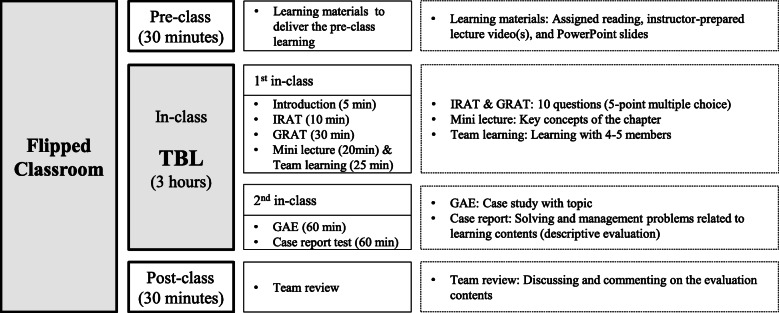
Background: A flipped classroom with team-based learning is a blended educational strategy that guides active learning inside and outside the classroom. This study aimed to verify the effects of this innovative blended educational strategy on knowledge, problem-solving ability, and learning satisfaction of undergraduate nursing students undergoing public healthcare education. Methods: The subjects were undergraduate nursing students enrolled in H University in South Korea. The experiment was conducted over a period of 8 weeks in the public healthcare course. Two groups, blended learning (A flipped classroom with team-based learning) which was the experimental group and traditional lecture-based classroom group, the control group, were assessed. In the blended learning group, the students had pre-class, in-class (including team-based learning elements), and post-class learning elements. The two groups were compared on the following learning outcomes: knowledge, problem-solving ability, and learning satisfaction. Results: Results showed that the blended learning instructional methods, in comparison with traditional lectures, enhanced the students’ knowledge, problem-solving ability, and learning satisfaction in the public healthcare course. Conclusions: This study supports the feasibility of the flipped classroom with team-based learning as a blended learning strategy, able to produce improvements in nursing students’ learning outcomes. Blended learning approaches may be an effective alternative to conventional approaches in nursing education.
Overview
The claims and statistics of this paper haven’t been checked yet.
Free: it reads the open-access text and checks the first 5 claims that cite a source we can check. Create a free account to check every claim.
Integrity signals
Registry
Cites
Statistics
Figures
Verification
Claims the paper makes
The claims and statistics of this paper haven’t been checked yet.
Free: it reads the open-access text and checks the first 5 claims that cite a source we can check. Create a free account to check every claim.
Claims other papers make about this one
Each is checked against this paper’s own text: does it say what the citing paper says it does?
The check wasn’t confident either way, so it gives no verdict — never disputed.
In the citing paper
“Prior research has often examined learning outcomes in aggregate terms or has assumed uniform effects of technology use across cognitive and motivational domains (Kang and Kim, 2021; Martin et al., 2022; Yu et al., 2022).”
From Cognitive offloading through digital tools and its relationship with critical thinking, task persistence, and learning depth (2026) · cites this paper as Kang and Kim, 2021
Experimental — accuracy not yet measured
Self-check
Percentages, sums and reported differences re-computed from the paper’s own numbers.
The self-check needs the paper’s full text.
Citations
Cites
The use of flipped classrooms in higher education: A scoping review
O'Flaherty, J., & Phillips, C. (2015) · The Internet and Higher Education · doi:10.1016/j.iheduc.2015.02.002 · Cited by 2,152 · cited 1×
“learner-centered education and active participation of learners in the classroom are necessary [8, 9].”
BackgroundEnhancing Student Engagement Using the Flipped Classroom
Gilboy, M. B., Heinerichs, S., & Pazzaglia, G. (2015) · Journal of Nutrition Education and Behavior · doi:10.1016/j.jneb.2014.08.008 · Cited by 1,064
Davies, R. S., Dean, D. L., & Ball, N. (2013) · Educational Technology Research and Development · doi:10.1007/s11423-013-9305-6 · Cited by 1,019
Hope and academic success in college.
Snyder, C. R., Shorey, H. S., Cheavens, J., Pulvers, K. M., Adams, V. H., & Wiklund, C. (2002) · Journal of Educational Psychology · doi:10.1037/0022-0663.94.4.820 · Cited by 790 · cited 1×
“To realize their learning goals, the learners actively participate in the learning process, which includes assessing the demands of assignments, planning relevant strategies, and monitoring the realization of goals [30].”
BackgroundA systematic review of the effectiveness of flipped classrooms in medical education
Chen, F., Lui, A. M., & Martinelli, S. M. (2017) · Medical Education · doi:10.1111/medu.13272 · Cited by 749
Upside down and inside out: Flip Your Classroom to Improve Student Learning.
Fulton, K. P. (2012) · Learning and leading with technology · Cited by 659
Ginns, P., & Ellis, R. (2007) · The Internet and Higher Education · doi:10.1016/j.iheduc.2006.10.003 · Cited by 461
Flipped Learning: Gateway to Student Engagement
Bergmann, J., & Sams, A. (2015) · Bibliothèque et Archives nationales du Québec (Québec government) · Cited by 459
Just Imagine: New Paradigms for Medical Education
Mehta, N. B., Hull, A. L., Young, J. B., & Stoller, J. K. (2013) · Academic Medicine · doi:10.1097/acm.0b013e3182a36a07 · Cited by 323
Choi, E., Lindquist, R., & Song, Y. (2014) · Nurse Education Today · doi:10.1016/j.nedt.2013.02.012 · Cited by 312
Cited by
Items 101–143 of 143
Learning Outcomes in Blended Learning Implementation
Hidayati, R. N., Wahyuningsih, B. D., Hariyono, R., & Musadek, A. (2023) · Journal of Scientific Research Education and Technology (JSRET) · doi:10.58526/jsret.v2i3.201 · Cited by 3
Blended Learning Practices in Current Educational ScenarioPreprint
Singh, V. (2024) · SSRN Electronic Journal · doi:10.2139/ssrn.4889255 · Cited by 1
Portal Perfusion Through the Splenic Vein During Liver Procurement
Bonatti, H., Pruett, T. L., & Sawyer, R. G. (2021) · Experimental and Clinical Transplantation · doi:10.6002/ect.2021.0212
The Perspective Of B.Ed. Students On The Drastic Surge Of Online Teaching Across Kerala
(2022) · i-manager’s Journal on Educational Psychology · doi:10.26634/jet.18.4.18471
Using Groups and Peer Tutors in Problem-Based Learning Classrooms in Higher Education
(2022) · Advances in educational technologies and instructional design book series · doi:10.4018/978-1-7998-8177-3.ch009
Impact of LMS-mediated readiness assurance testing on performance in pharmacy calculations
Bell, E. C. (2022) · Discover Education · doi:10.1007/s44217-022-00024-9
معوقات استخدام التعلم المقلوب في التدريس لدى معلمي محافظة القنفذة
السليماني, ع. م. م. ا. (2023) · Mağallaẗ Al-Qirā'aẗ wa Al-Maʿrifaẗ/Mağallaẗ Al-Qirā'aẗ wa Al-Maʿrifaẗ · doi:10.21608/mrk.2023.305783
T, S. K. P. S. (2023) · Journal of Propulsion Technology · doi:10.52783/tjjpt.v44.i4.938
Essential Pharmaceutics in the Flipped Classroom
Brunaugh, A. D., Moraga-Espinoza, D., Bahamondez‐Canas, T., Smyth, H. D. C., & Williams, R. O. (2024) · AAPS introductions in the pharmaceutical sciences · doi:10.1007/978-3-031-52520-9_1
Muslim, Ambiyar, A., Wakhinuddin, W., Usmeldi, & Arif, A. (2023) · Indonesian Journal Of Educational Research and Review · doi:10.23887/ijerr.v6i3.59293 · Cited by 8
The Perspective of Engineering Students About Blended Learning: Experience and Challenges
Gawanmeh, A., Alhammadi, R., Daradkeh, M. K., Atalla, S., & Mansoor, W. (2023) · Congress in Computer Science, Computer Engineering, and Applied Computing (CSCE) · doi:10.1109/csce60160.2023.00190
Ferreira, M., Meda, L., & Talvio, M. (2024) · Frontiers research topics · doi:10.3389/978-2-8325-4786-1 · Cited by 2
Wound Care Education from a Podiatry Perspective
Wijlens, A. M., Wasenius, E., & Stolt, M. (2024) · Springer eBooks · doi:10.1007/978-3-031-53230-6_13
The Effect of Blended Learning Method and Self-Efficacy on Students’ Self-Directed Learning
Hidayah, N., Putri, M., & Arafanianda, S. (2024) · Jurnal Pendidikan dan Pembelajaran Indonesia (JPPI) · doi:10.53299/jppi.v4i3.665 · Cited by 5
Development and psychometric testing of an instrument for team-based learning assessment
Mojtahedzadeh, R., Mohammadi, A., Kolahdooz, S., Parmelee, D. X., & Hassanzadeh, G. (2024) · Journal of Education and Health Promotion · doi:10.4103/jehp.jehp_1064_23
A Bibliometric Study of Blended Learning in Higher Education (2001- 2024)Preprint
Li, X., & Huang, M. Z. (2024) · Research Square · doi:10.21203/rs.3.rs-5302006/v1
Ma, G., & Shi, Y. (2024) · Social Education Research · doi:10.37256/ser.6120255882
Stimulating interest in learning: a bibliometric review from 2014 to 2024
Fu, X., & Dai, X. (2025) · Journal of Further and Higher Education · doi:10.1080/0309877x.2025.2479765 · Cited by 3
Dascălu, C. G., Topoliceanu, C., & Antohe, M. E. (2025) · European Journal of Investigation in Health Psychology and Education · doi:10.3390/ejihpe15040045 · Cited by 1
Awidi, I. T., Harper, T., & Savat, D. (2025) · Frontiers in Education · doi:10.3389/feduc.2025.1555923 · Cited by 2
Digitale kurs gir mange ny innsikt i helsepedagogikk
Vågan, A., Alvheim, A. R., Børve, H. B., & Lokøen, T. H. (2025) · Sykepleien Forskning · doi:10.4220/sykepleiens.2025.102343
Reyes, M. A. F. D., Funa, A. A., Jamisola, R., Perdigon, M. J. D., & Latonero, J. D. (2025) · Jurnal Keperawatan Indonesia · doi:10.7454/jki.v28i3.1556
Zhang, Y., Zhang, N., Liu, H., Kan, Y., & Zou, Y. (2024) · Figshare · doi:10.6084/m9.figshare.26561186
Oofuvong, M., Prathep, S., Plansangkate, P., Tanasansuttiporn, J., Sungworawongpana, C., & Jitpakdee, W. (2024) · Figshare · doi:10.6084/m9.figshare.25903904
Zhang, Y., Liu, J., Liang, J., Jie, L., Zhang, L., Tang, M., Chen, X., Xie, Y., Zhang, J., Su, L., et al. (2023) · Figshare · doi:10.6084/m9.figshare.24286574
Assessing gains from team-based learning in microeconomics
Espey, M., & Gorry, D. (2025) · The Journal of Economic Education · doi:10.1080/00220485.2025.2577352
MohammadPour, A., Behnaz, N., Babaei, S., Soltani, A., Heidarpoor, P., & Kalantarion, M. (2026) · Journal of Education and Health Promotion · doi:10.4103/jehp.jehp_1772_24
Khanapure, H., Shete, S., Keertan, Manjula, K., & Dodamani, R. B. (2026) · Journal of Ayurveda · doi:10.4103/joa.joa_40_24
Toofaninejad, E., Mohammadi-Aghdam, F.-Z., Babaei, S., & Kalantarion, M. (2026) · Research and Development in Medical Education · doi:10.34172/rdme.026.33385
Alsayed, S. (2026) · Journal of Umm Al-Qura University for Medical Sciences · doi:10.1007/s44361-025-00008-y
İskemik İnme Tanılı Olgunun Kavram Haritası Tekniği ile Hemşirelik Sürecinin Planlanması
Akan, D. Ç., & Karadakovan, A. (2026) · Hemşirelik Bilimi Dergisi · doi:10.54189/hbd.1682436
Teaching and Learning Strategies in Modern Marketing Education
Chakranarayan, V. (2026) · Studies in systems, decision and control · doi:10.1007/978-3-032-23645-6_73
Kotlarek, K. J., Bush, E. J., Loomis-Goltl, E. I., & Arzbecker, L. (2026) · Clinical Linguistics & Phonetics · doi:10.1080/02699206.2026.2680133
Rendrayani, F., Alfian, S. D., Nguyen, T. N., & Puspitasari, I. M. (2026) · BMC Medical Education · doi:10.1186/s12909-026-09722-6
Saniee, N., Seidi, M., & Amiri, F. (2026) · BMC Medical Education · doi:10.1186/s12909-026-09985-z
Chen, Y., Chiu, H., Chang, S.-P., Chung, L.-Y., Tseng, Y.-H., & Lee, C. (2026) · Australian Critical Care · doi:10.1016/j.aucc.2026.101651
Chen, J., Cui, J., Li, X., Yang, J., Yang, X., Zhong, H., Wang, F., Gu, Q., & Duan, C. (2026) · Medicine · doi:10.1097/md.0000000000049908
Xu, Q., Zain, N. M., Sulaiman, N. A. S., & Embong, H. (2026) · BMC Nursing · doi:10.1186/s12912-026-05022-y
Beigzadeh, A., Parvaresh‐Masoud, M., & Heydari, S. (2025) · Journal of Emergency Practice and Trauma · doi:10.34172/jept.2025.17 · Cited by 2
Daryanes, F., Zubaidah, S., Mahanal, S., & Sulisetijono, S. (2026) · Innovations in Education and Teaching International · doi:10.1080/14703297.2026.2719510
Christiansen, A., Feather, J., Oldfield, V., Ross, T., & Edge, E. (2026) · Journal of Further and Higher Education · doi:10.1080/0309877x.2026.2737429
Abdurahman, A., Ma, X., 张煜, & Tong, F. (2026) · Frontiers in Medicine · doi:10.3389/fmed.2026.1958220
Promoting flexibility, inclusivity and innovation within advanced practice education: part 2
Diamond-Fox, S. (2026) · International Journal for Advancing Practice · doi:10.12968/ijap.2025.0020
Metadata
- Authors
- Kang, H. Y., & Kim, H. R.
- Affiliations
- Chosun University (KR)
- Corresponding author
- Kim, Hae Ran
- ORCID
- Kim, Hae Ran
- Venue
- BMC Medical Education
- Published
- 2021-01-28
- Volume
- 21
- Issue
- 1
- Pages
- 78-78
- ISSN
- 1472-6920 (ISSN-L)
- PMC
- PMC7845047
- OpenAlex
- W3123745413
- Cited by
- 143
- References
- 43
- Citations by year
- 2026: 22 · 2025: 28 · 2024: 34 · 2023: 32 · 2022: 20 · 2021: 7
- FWCI
- 5.72
- Type
- journal article
- Language
- en
- Open access
- gold
- doi.org
- Licence
- cc-by
- creativecommons.org/licenses/by/4.0/ (tdm)
- creativecommons.org/licenses/by/4.0/ (vor)
- Locations
- BMC Medical Education (publishedVersion, cc-by)
- PubMed Central (publishedVersion, cc-by)
- PubMed (publishedVersion)
- DOAJ (DOAJ: Directory of Open Access Journals) (submittedVersion, cc-by-sa)
- Funders
- Chosun University (K207894001)
- Topics
- Social Sciences › Education › Innovative Teaching Methods
- Social Sciences › Education › Problem and Project Based Learning
- Social Sciences › Education › Innovations in Medical Education
- Keywords
- blended learning, flipped classroom, team-based learning, nursing education, learning outcomes, problem-solving skills, learning satisfaction, active learning, undergraduate nursing students
- MeSH terms
- Curriculum, Delivery of Health Care, Education, Nursing, Baccalaureate, Educational Measurement, Humans, Students, Nursing, Problem-Based Learning, Republic of Korea
About these checks
Registry, retraction, Cites and statistics results are computed, not judged, with one exception: a printed reference that no index lists is read once by a model before it counts as a citation error. Claims are extracted by a model and kept only when their quote appears verbatim in the text; each cited source is then checked, with a model’s help, for whether it says what the claim relies on. Those verdicts can be wrong — read the claim’s quote and the cited source before relying on one.
Statistics and arithmetic are recomputed, not judged.
Confidence bands are shown only for fields calibrated on our annotated test set. None is calibrated yet, so no band is shown.
What counts as a claim ›How we measure confidence ›How we check this ›
Are you an author, or do you see a problem with this page? Request a review
Data sources
Bibliographic data: Semantic Scholar, OpenAlex, Crossref.
Contains information from the Semantic Scholar Academic Graph Datasets, made available under the ODC Attribution License (ODC-BY 1.0).
Semantic Scholar’s data is described in: Kinney, R., et al. (2023). The Semantic Scholar Open Data Platform. arXiv:2301.10140.
