

Medical artificial intelligence readiness scale for medical students (MAIRS-MS)–development, validity and reliability study
Open accessThe DOI matches its Crossref record; 53 of the 55 references it cites were found in a registry or an index.
Abstract
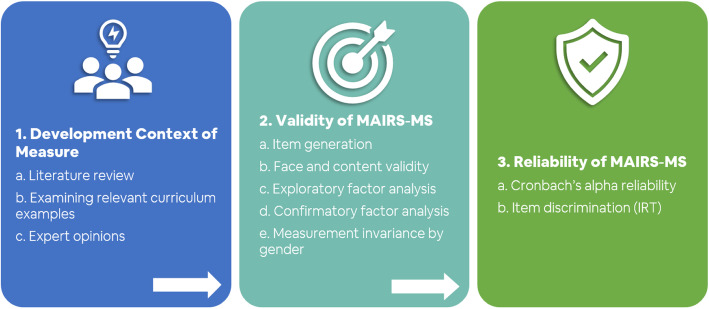
Background: It is unlikely that applications of artificial intelligence (AI) will completely replace physicians. However, it is very likely that AI applications will acquire many of their roles and generate new tasks in medical care. To be ready for new roles and tasks, medical students and physicians will need to understand the fundamentals of AI and data science, mathematical concepts, and related ethical and medico-legal issues in addition with the standard medical principles. Nevertheless, there is no valid and reliable instrument available in the literature to measure medical AI readiness. In this study, we have described the development of a valid and reliable psychometric measurement tool for the assessment of the perceived readiness of medical students on AI technologies and its applications in medicine. Methods: To define medical students’ required competencies on AI, a diverse set of experts’ opinions were obtained by a qualitative method and were used as a theoretical framework, while creating the item pool of the scale. Exploratory Factor Analysis (EFA) and Confirmatory Factor Analysis (CFA) were applied. Results: A total of 568 medical students during the EFA phase and 329 medical students during the CFA phase, enrolled in two different public universities in Turkey participated in this study. The initial 27-items finalized with a 22-items scale in a four-factor structure (cognition, ability, vision, and ethics), which explains 50.9% cumulative variance that resulted from the EFA. Cronbach’s alpha reliability coefficient was 0.87. CFA indicated appropriate fit of the four-factor model ( χ 2 /df = 3.81, RMSEA = 0.094, SRMR = 0.057, CFI = 0.938, and NNFI (TLI) = 0.928). These values showed that the four-factor model has construct validity. Conclusions: The newly developed Medical Artificial Intelligence Readiness Scale for Medical Students (MAIRS-MS) was found to be valid and reliable tool for evaluation and monitoring of perceived readiness levels of medical students on AI technologies and applications. Medical schools may follow ‘a physician training perspective that is compatible with AI in medicine’ to their curricula by using MAIRS-MS. This scale could be benefitted by medical and health science education institutions as a valuable curriculum development tool with its learner needs assessment and participants’ end-course perceived readiness opportunities.
Overview
The claims and statistics of this paper haven’t been checked yet.
Free: it reads the open-access text and checks the first 5 claims that cite a source we can check. Create a free account to check every claim.
Integrity signals
Registry
Cites
Statistics
Figures
Verification
Claims the paper makes
The claims and statistics of this paper haven’t been checked yet.
Free: it reads the open-access text and checks the first 5 claims that cite a source we can check. Create a free account to check every claim.
Claims other papers make about this one
Each is checked against this paper’s own text: does it say what the citing paper says it does?
The cited source doesn’t support the claim as written.
In the citing paper
“The validity of the self-report measurement instruments for AI literacy [11,12,14,15] has only been tested regarding their factorial structure.”
From Meta AI literacy scale: Further validation and development of a short version (2024) · cites this paper as [11]
Checked by a reasoning model — may be wrong.
Experimental — accuracy not yet measuredThe source backs part of the claim, not all of it — or backs it for a different population, condition or comparison.
In the citing paper
“Overall, this includes learning the AI terminology [13,37,45], strengths and limitations of AI [12,13,16,37,42], risks of AI [12,13,17,37,39,42], controlling for bias [42], critical appraisal AI literature and tools [12,13,34,37,39,45,46], and shared decision-making [12,13,37,41,45].”
From An evidence-based approach to artificial intelligence education for medical students: A systematic review (2023) · cites this paper as [17]
Experimental — accuracy not yet measuredThe source backs part of the claim, not all of it — or backs it for a different population, condition or comparison.
In the citing paper
“In particular, knowledge related to data stewardship [12,13,37,41], data preprocessing and acquisition [13], standardization [13], data analytics [13,17,39], health data infrastructure [45], programming [39,41], and big data [13,45], may help physicians appreciate the obstacles faced by data scientists and improve the multidisciplinary collaboration [13,39].”
From An evidence-based approach to artificial intelligence education for medical students: A systematic review (2023) · cites this paper as [17]
Experimental — accuracy not yet measuredThe source backs part of the claim, not all of it — or backs it for a different population, condition or comparison.
In the citing paper
“MAIRS-MC43 also showed at least some evidence for content validity while showing good evidence for structural validity and internal consistency.”
From A systematic review of AI literacy scales (2024) · cites this paper as [43]
Experimental — accuracy not yet measuredThe source backs part of the claim, not all of it — or backs it for a different population, condition or comparison.
In the citing paper
“GSE-6AI30, MAIRS-MC43, and SNAIL45 have been validated specifically for medical students, which makes them the instruments of choice if medical students are to be assessed.”
From A systematic review of AI literacy scales (2024) · cites this paper as [43]
Experimental — accuracy not yet measured
10 more claims about this paper
Create a free account to see every claim other papers make about this one.
Self-check
Percentages, sums and reported differences re-computed from the paper’s own numbers.
The self-check needs the paper’s full text.
Citations
Cites
Tabachnick, B. G., & Fidell, L. S. (1983) · Cited by 80,054
(1998) · Cited by 36,049
Research Design: Qualitative, Quantitative, and Mixed Methods Approaches
Creswell, J. W. (1994) · Cited by 35,508
(1991) · Cited by 15,554
Dermatologist-level classification of skin cancer with deep neural networks
Esteva, A., Kuprel, B., Novoa, R. A., Ko, J., Swetter, S. M., Blau, H. M., & Thrun, S. (2017) · Nature · doi:10.1038/nature21056 · Cited by 14,362
The Scree Test For The Number Of Factors
Cattell, R. B. (1966) · Multivariate Behavioral Research · doi:10.1207/s15327906mbr0102_10 · Cited by 13,554
Research Design: Qualitative, Quantitative, and Mixed Methods Approaches
ภู่พันธ์, ศ. (2018) · วารสารวิธีวิทยาการวิจัย (Journal of Research Methodology: JRM) · Cited by 13,060
High-performance medicine: the convergence of human and artificial intelligence
Topol, E. J. (2019) · Nature Medicine · doi:10.1038/s41591-018-0300-7 · Cited by 10,450
Structural Equation Modelling: Guidelines for Determining Model Fit
Hooper, D., Coughlan, J., & Mullen, M. R. (2008) · Dublin Institute of Technology · doi:10.21427/d7cf7r · Cited by 8,746
The Varimax Criterion for Analytic Rotation in Factor Analysis
Kaiser, H. F. (1958) · Psychometrika · doi:10.1007/bf02289233 · Cited by 7,580
Research works printed but not linked: 2
- Başar E Genel Öğretim Yöntemleri 2001 Samsun Kardeşler Ofset ve Matbaa
- Harman G Çelikler D Eğitimde hazir bulunuşluğun önemi üzerine bir derleme çalişmasi J Res Educ Teach 2012 3 2146 9199
Cited by
Items 101–200 of 378
Kaya, G., Büyükyılmaz, F., Çulha, Y., & Akyürek, P. (2025) · Nurse Education Today · doi:10.1016/j.nedt.2025.106721 · Cited by 21
Assessing medical students’ readiness for artificial intelligence after pre-clinical training
Alzaabi, A. A., & Masters, K. (2025) · BMC Medical Education · doi:10.1186/s12909-025-07008-x · Cited by 30
“While experts agree that understanding the uses, applications, disadvantages and limitations of AI is important, there is no consensus on how much AI should be introduced into the medical curriculum [13].”
InfluentialExploring Artificial Intelligence Readiness in Medical Students: Analysis of a Global Survey
Luong, J., Tzang, C.-C., McWatt, S. C., Brassett, C., Stearns, D. A., Sagoo, M. G., Kunzel, C., Sakurai, T., Chien, C.-L., Noël, G. P. J. C., et al. (2024) · Medical Science Educator · doi:10.1007/s40670-024-02190-x · Cited by 27
“All 676 students were invited to voluntarily complete a previously validated and reliable online questionnaire, the Medical Artificial Intelligence Readiness Scale for Medical Students (MAIRS-MS) [20].”
Rezazadeh, H., Mahani, A. M., & Salajegheh, M. (2025) · Health Science Reports · doi:10.1002/hsr2.70870 · Cited by 20
“The Medical AI Readiness Scale for Medical Students (MAIRS ‐ MS), designed by Karaca et al. (2021), is a valid instrument for such assessments [27].”
Burucu, R., & Polat, H. T. (2025) · Nurse Education in Practice · doi:10.1016/j.nepr.2025.104538 · Cited by 16
Wu, D., Sun, X., Liang, S., Qiu, C., & Wei, Z. (2025) · Frontiers of digital education. · doi:10.1007/s44366-025-0039-x · Cited by 24
“There are also AI literacy measurement tools specific to different sectors such as healthcare (Karaca et al., 2021) and higher education.”
Mucci, A., Green, W. M., & Hill, L. H. (2024) · New Directions for Adult and Continuing Education · doi:10.1002/ace.20521 · Cited by 28
Baseer, S., Jamil, B., Khan, S. A., Khan, M. O. F., Syed, A., & Ali, L. (2025) · BMC Medical Education · doi:10.1186/s12909-025-06911-7 · Cited by 23
“The Medical Artificial Intelligence Readiness Scale (MAIRS), is a tool for assessing medical professional’s readiness for AI [15].”
InfluentialArtificial Intelligence Readiness Status of Medical Faculty Students
EMİR, B., YURDEM, T., OZEL, T., SAYAR, T., UZUN, T. A., AKAR, U., & COLAK, U. A. (2024) · Konuralp Tıp Dergisi · doi:10.18521/ktd.1387826 · Cited by 13
AILIS 1.0: A new framework to measure AI literacy in library and information science (LIS)
Montesi, M., Álvarez-Bornstein, B., Bautista‐Puig, N., Ochando, M. B., & Díez, A. S. (2025) · The Journal of Academic Librarianship · doi:10.1016/j.acalib.2025.103118 · Cited by 24
Luo, J., Peng, Q., Cao, H., Li, W., & Tan, S. (2025) · BMC Medical Education · doi:10.1186/s12909-025-08388-w · Cited by 23
“It demonstrates good reliability, with a total Cronbach’s alpha coefficient of 0.8 and sub-dimension coefficients all exceeding 0.6 [6, 7].”
InfluentialHossain, Z., Alwreikat, A., Khan, G., Alotaibi, F. A., Biswas, M. S., & Sbeity, F. (2025) · Science & Technology Libraries · doi:10.1080/0194262x.2025.2484280 · Cited by 18
Yazdi, N. A., Ahari, U. Z., KhadiviMaleki, H., & Hasanabadi, P. (2025) · BMC Medical Education · doi:10.1186/s12909-025-07621-w · Cited by 16
Yapay Zekâ ile Reklam Tasarımı: Reklamcılara Yönelik Bir Araştırma
Gölgeli, K. (2025) · İnsan ve Toplum Bilimleri Araştırmaları Dergisi · doi:10.15869/itobiad.1527182 · Cited by 12
Hossain, Z., Biswas, M. S., Khan, N. A., & Khan, G. (2025) · IFLA Journal · doi:10.1177/03400352251331468 · Cited by 28
“Scholarly works (e.g. Hossain, 2024; Karaca et al., 2021; Markauskaite et al., 2022; Wood et al., 2021) emphasize the need to foster AI literacy – equipping students with the knowledge, skills and preparedness needed to effectively engage with AI technologies.”
Human-AI interaction: Augmenting decision-making for IT leader's project selection
Judkins, J. T., Hwang, Y., & Kim, S. (2024) · Information Development · doi:10.1177/02666669241249744 · Cited by 14
“The AI Knowledge variable was measured using a subset of scales including Cognition from the Medical Arti fi cial Intelligence Readiness Scale for medical students (MAIRS-MS) (Karaca et al., 2021).”
Assistive Tools or Insecurity: The Impact of Technological Readiness on Willingness to Use AI
Li, H., Ren, T., & Zhang, Z. (2024) · International Journal of Human-Computer Interaction · doi:10.1080/10447318.2024.2443802 · Cited by 20
“In the medical field, Karaca et al. (2021) developed an AI readiness scale for a specific population of medical students.”
InfluentialDhurandhar, D., Dhamande, M. M., Shivaleela, C., Bhadoria, P., Chandrakar, T., & Agrawal, J. (2025) · Cureus · doi:10.7759/cureus.76835 · Cited by 26
“The assessment focuses on their awareness, understanding, and attitudes toward AI, as well as the factors that influence their readiness to adopt AI in their clinical work [10].”
InfluentialLu, W., & Lin, C. (2025) · Education and Information Technologies · doi:10.1007/s10639-025-13323-z · Cited by 10
“The first one is the Medical Artificial Intelligence Readiness Scale for Medical Students (MAIRS-MS) developed by Karaca et al. (2021).”
Zhang, H. (2025) · Learning and Motivation · doi:10.1016/j.lmot.2025.102164 · Cited by 16
TIP FAKÜLTESİ ÖĞRENCİLERİNİN TIBBİ YAPAY ZEKA HAZIR BULUNUŞLULUĞUNUN İNCELENMESİ
Gencer, K., & Gencer, G. (2024) · Kocatepe tıp dergisi. · doi:10.18229/kocatepetip.1295779 · Cited by 16
Alsahafi, Z., & Baashar, A. (2025) · Cureus · doi:10.7759/cureus.83437 · Cited by 18
“Others have investigated specific disciplines like languages, mathematics, and medicine [23], individual educational activities such as assessment [24], and particular applications including assistive robots, adaptive learning, or proctoring systems [25].”
Blended Learning and AI: Enhancing Teaching and Learning in Higher Education
Wong, K. K. (2024) · Lecture notes in computer science · doi:10.1007/978-981-97-4442-8_4 · Cited by 17
Malešević, A., Kolesárová, M., & Čartolovni, A. (2024) · BMC Medical Ethics · doi:10.1186/s12910-024-01092-2 · Cited by 15
“The medical students’ readiness for AI, which they should develop during their studies, has received more attention in the form of the Medical Artificial Intelligence Readiness Scale for Medical Students (MAIRS-MS) [16].”
BackgroundMethodAdıgüzel, Z., Çakır, F. S., & Özbay, F. (2024) · Kybernetes · doi:10.1108/k-01-2024-0046 · Cited by 12
The wizard of artificial intelligence: Are physicians prepared?
Radhwi, O., & Khafaji, M. A. (2024) · Journal of Family and Community Medicine · doi:10.4103/jfcm.jfcm_144_24 · Cited by 10
Chen, X., Chen, Y., Xie, Y., & Cheng, L. (2025) · BMC Nursing · doi:10.1186/s12912-025-03852-w · Cited by 13
“It reflects their ability to integrate AI with professional expertise to deliver clinical services across prevention, diagnosis, treatment, and rehabilitation [13].”
InfluentialAssessing AI literacy in second language writing: a scale development and validation study
Huang, Z., Nazar, N., Abbas, G., & Jiang, Z. (2025) · Education and Information Technologies · doi:10.1007/s10639-025-13767-3 · Cited by 14
“…including algorithm literacy (Brodsky et al., 2020; Dogruel et al., 2022) and domain-specific AI literacy measures, such as health-related AI literacy tools designed to evaluate medi - cal students’ readiness to engage with AI technologies in clinical practice (Karaca et al., 2021; Topol, 2019).”
DİŞ HEKİMLİĞİ ÖĞRENCİLERİ YAPAY ZEKA UYGULAMALARINA NE KADAR HAZIR ?
Büyükkaya, B., Altındiş, S., & Cevahir, F. (2023) · JOURNAL OF BIOTECHNOLOGY AND STRATEGIC HEALTH RESEARCH · doi:10.34084/bshr.1407036 · Cited by 11
Artificial Intelligence Research During COVID-19 Pandemic: Contributed to Future Education
Prof., U. N. S., Nurhasan, N., Prahanı, B. K., Dr., U. N. S., Suprapto, N., Ph.D., U. N. S., Ardha, M. A. A., & M.Sc., U. N. S. (2022) · International Journal of Instruction · doi:10.29333/iji.2022.15313a · Cited by 18
“…you want to imitate and all of this is used to facilitate human work in various fields (Aphinives & Aphinives, 2021; Cox, 2021; Crea, 2021; Goh et al., 2021; Karaca et al., 2021; Pepic et al., 2021; Rahimunnisa et al., 2021 Scheetz et al., 2021; Secinaro et al., 2021; Tamilselvi et al., 2021).”
Brauner, P., Glawe, F., Liehner, G. L., Vervier, L., & Ziefle, M. (2025) · AI & Society · doi:10.1007/s00146-026-03023-8 · Cited by 95
“These included Technology Readiness (Neyer et al. 2016), an AI Readiness Scale (Karaca et al. 2021), and interpersonal trust (Niessen et al. 2021).”
Basem, J. I., Mani, R., Sun, S., Gilotra, K., Dianati‐Maleki, N., & Dashti, R. (2025) · Frontiers in Cardiovascular Medicine · doi:10.3389/fcvm.2025.1525966 · Cited by 9
Assessing AI literacy of university students in Pakistan: a cross-sectional survey
Butt, F. S., Malik, A., & Mahmood, K. (2025) · Digital Library Perspectives · doi:10.1108/dlp-06-2025-0094 · Cited by 12
Chotia, V., Sharma, P., Alshaghdali, N. O., Galgotia, D., & Sahore, N. (2025) · European Journal of Innovation Management · doi:10.1108/ejim-03-2025-0397 · Cited by 12
Nursing Students' Perception of and Readiness for Artificial Intelligence in Saudi Arabia
Bakarman, S. S., Alshammari, A., & Aboshaiqah, A. E. (2025) · Nursing Open · doi:10.1002/nop2.70386 · Cited by 11
“Overall readiness for AI was high, with a mean score of 3.79 (SD = 0.74) on the MAIRS-MS (Table 3, Figure 1).”
InfluentialKotzki, S., Turner, C. M., Gauthier, K., Minovès, M., & Vuillerme, N. (2026) · JMIR Medical Education · doi:10.2196/85243 · Cited by 10
“This approach follows previous work on AI readiness and familiarity in health professions, where multiple items are aggregated into a single readiness or familiarity score [24,25].”
InfluentialXin, Y., Yan, D., Shuren, L., Minyang, L., & Liuheng, L. (2026) · npj Digital Medicine · doi:10.1038/s41746-026-02521-9 · Cited by 21
Kang, K. Y., & Park, J.-H. (2026) · Journal of Librarianship and Information Science · doi:10.1177/09610006261425235 · Cited by 9
Analysis on Concept of AI Literacy According and Future Education to the Result of Systematic Review
Zhang, K., Li, L., & Yu, H.-C. (2024) · Journal of Lifestyle and SDGs Review · doi:10.47172/2965-730x.sdgsreview.v5.n01.pe03293 · Cited by 12
Yapay Zekâ Okuryazarlık Ölçeği Geliştirme ve Doğrulama Çalışması
Tekin, Ö. G. (2025) · Batı anadolu eğitim bilimleri dergisi · doi:10.51460/baebd.1609636 · Cited by 12
The Willingness of College Educators in Animation and Digital Media to Embrace Generative AI
Chen, X., Yang, F., & Yu, W. (2024) · International Conference on Educational and Information Technology · doi:10.1109/iceit61397.2024.10540881 · Cited by 10
“Furthermore, AI readiness has been proposed as a pivotal factor impacting AI tool acceptance[3, 4, 5].”
BackgroundArtificial intelligence skepticism in career domains
Adepoju, O. D., Tijani, B., & Karera, S. (2024) · International Journal for Digital Society · doi:10.20533/ijds.2040.2570.2024.0236 · Cited by 6
Regulatory and Implementation Considerations for Artificial Intelligence
Chen, S., & Lobo, B. C. (2024) · Otolaryngologic Clinics of North America · doi:10.1016/j.otc.2024.04.007 · Cited by 6
Bridging Gaps: AI-Driven Accessibility in Language Education
Asrifan, A., Shafa, S., Pratiwi, W. R., Bahri, A., Siregar, S. R., & Ingilan, S. S. (2025) · Advances in computational intelligence and robotics book series · doi:10.4018/979-8-3693-7260-9.ch006 · Cited by 7
Hanifa, H., Atia, M., Daboul, R., Alhamid, A. A. H., Alayyoubi, A., Naima, H. A., Alkassar, D., Nabhan, M. G., Alsaleh, B., & Abdula, F. (2025) · BMC Medical Education · doi:10.1186/s12909-025-07396-0 · Cited by 16
“The scale showed high reliability (Cronbach’s α = 0.87) in previous studies [8].”
InfluentialMunir, F. M., Ipema, H. J., Nohria, R., & Singh, D. (2025) · Currents in Pharmacy Teaching and Learning · doi:10.1016/j.cptl.2025.102439 · Cited by 8
YILMAZ, A. N., Altıparmak, S., & SÖKMEN, R. (2025) · CIN Computers Informatics Nursing · doi:10.1097/cin.0000000000001269 · Cited by 6
Khajeali, N., Kohan, N., Rezaei, S., & Saberi, A. (2025) · PLoS ONE · doi:10.1371/journal.pone.0323543 · Cited by 7
“The initial 27 items were narrowed down and finalized to 22 items in a four-factor structure (cognition, ability, vision, and ethics) [11].”
InfluentialÇankaya, A., & Filiz, E. (2025) · Bandırma Onyedi Eylül Üniversitesi Sağlık Bilimleri ve Araştırmaları Dergisi · doi:10.46413/boneyusbad.1618422 · Cited by 6
Medina-Gual, L., Medina-Velázquez, L., & Parejo, J.-L. (2025) · Australasian Journal of Educational Technology · doi:10.14742/ajet.10596 · Cited by 4
Enhancing AI literacy of educators in higher education
Schallert-Vallaster, S., Nüesch, C., Papageorgiou, K., Herrmann, L., Hofmann, M., & Buchner, J. (2025) · Zeitschrift für Hochschulentwicklung · doi:10.21240/zfhe/sh-ki-1/09 · Cited by 4
“Hence, we decided to include in our study the 18 items of an AI readiness scale (Karaca et al., 2021) to assess the preparedness, perceptions and attitude of the participants regarding incorporating AI into education, using a five-point Likert scale to capture their responses.”
Negative Perceptions, Attitudes, and Adoption Intentions: Unravelling Metaverse Adoption Challenges
Kirmani, M. D., Sadiq, M. A., Uddin, S. M. F., Adil, M., Ahmad, A., Haque, M. A., & Thaichon, P. (2025) · Journal of Consumer Behaviour · doi:10.1002/cb.70036 · Cited by 6
The more you think you know: AI experience, literacy, heuristics, and perceived AI authorship
Liu, S., Chu, H., Yuan, S., Sun, Y., & Men, L. R. (2025) · AI & Society · doi:10.1007/s00146-025-02643-w · Cited by 5
Alatawi, F., & Kerari, A. (2025) · Journal of Multidisciplinary Healthcare · doi:10.2147/jmdh.s567485 · Cited by 11
“2,15 Research indicates that higher readiness levels enhance students’ motivation, self-efficacy, and adapt-ability to technological innovations.”
ÇOBAN, N., & Beydağ, K. D. (2025) · BMC Nursing · doi:10.1186/s12912-025-04248-6 · Cited by 7
“The Medical Artificial Intelligence Readiness Scale (MAIRS) was created by Karaca et al. (2021) to determine individuals’ readiness levels for medical artificial intelligence applications [18].”
InfluentialHlede, V., Valanci, S., D’Antuono, G., Dow, H., Wiggins, R. H., Dorman, T., & O’Beirne, R. (2026) · JMIR Medical Education · doi:10.2196/69156 · Cited by 9
“AI readiness refers to the willingness and preparedness to adopt and implement AI technologies in learning and clinical practice [59].”
Artificial Intelligence: Readiness, Attitudes, and AI-Related Anxiety Among Oncology Nurses
Dönmez, E., Temiz, G., Mete, B., Marangoz, E., & Ortabağ, T. (2026) · Healthcare · doi:10.3390/healthcare14070848 · Cited by 7
“Artificial intelligence readiness was assessed using the Medical Artificial Intelligence Readiness Scale, a psychometrically validated instrument developed by Karaca, Çalı¸skan, and Demir in 2021 to measure healthcare learners’ preparedness for AI technologies [16].”
Dur, Ş., Coşğun, M., Göl, İ., & Erkin, Ö. (2026) · Nurse Education Today · doi:10.1016/j.nedt.2026.107117 · Cited by 8
Durak, G., Çankaya, S., & Öncü, S. (2026) · Education and Information Technologies · doi:10.1007/s10639-026-14023-y · Cited by 10
Chen, X., Ding, W., Wang, X., Wang, Y., Ma, S., & Tao, M. (2026) · Frontiers in Public Health · doi:10.3389/fpubh.2026.1885808 · Cited by 6
“Medical AI readiness was assessed using the scale developed by Karaca et al. (18).”
Elmaoğlu, E., & GÜLEÇ, H. Y. (2025) · Bingöl Üniversitesi Sağlık Dergisi · doi:10.58605/bingolsaglik.1600963 · Cited by 5
Pham, C., Nguyen, K.-H., & Le, D. T. (2025) · World Congress on Medical Physics and Biomedical Engineering, September 7 - 12, 2009, Munich, Germany · doi:10.1007/978-3-031-90194-2_35 · Cited by 5
Bilge, Y., Emiral, E., & Delal, İ. (2025) · Clinical Psychologist · doi:10.1080/13284207.2025.2515074 · Cited by 7
Lenke, M., Klowait, N. O., Biere, L., & Schulte, C. (2025) · Lecture notes in computer science · doi:10.1007/978-3-032-01222-7_8 · Cited by 5
Micallef Grimaud, L., & Gathu, C. (2024) · doi:10.2196/preprints.57746 · Cited by 3
Kong, E. W. S., Dilinika, J. M. S., Nie, X., Gautam, A., & Huang, K. (2025) · Proceedings of the Association for Information Science and Technology · doi:10.1002/pra2.1325 · Cited by 6
“We initially selected and adapted items from prior work relevant to social and ethical dimensions of AI literacy (Hwang et al., 2023; Karaca et al., 2021; Laupichler, Aster, et al., 2023; Laupichler, Aster, & Raupach, 2023; Lee & Park, 2024; Ng et al., 2023; Pinski & Benlian, 2023; Wang & Chuang,…”
Kazanç, Ş., KOÇYİĞİT, H., & Karagözoğlu, Ş. (2025) · BMC Medical Education · doi:10.1186/s12909-025-07774-8 · Cited by 6
“The Cronbach’s Alpha coefficient of the scale was determined as 0.87 [24].”
InfluentialFrom lecture hall to clinic: dental students’ AI readiness and anxiety across educational stages
Çakan, K. N., & İpek, İ. (2025) · BMC Medical Education · doi:10.1186/s12909-025-08181-9 · Cited by 5
An assessment of artificial intelligence literacy in Ecuadorian university students
Verduga-Alcívar, D. A., Román-Cao, E., & Cossío, N. S. (2026) · Social Sciences & Humanities Open · doi:10.1016/j.ssaho.2026.102465 · Cited by 6
Şengül, T., Sarıköse, S., Uncu, B., Taşkın, R., & Kaya, N. (2026) · Nurse Education Today · doi:10.1016/j.nedt.2026.107049 · Cited by 4
Artificial intelligence readiness in management education: Scale development and validation
Wang, I.-Y., Hung, C.-Y., Lin, H.-H., Lai, W.-H., & Wang, Y. (2026) · The International Journal of Management Education · doi:10.1016/j.ijme.2026.101429 · Cited by 12
Visci, P., Lupelli, F., Calò, F., Sirago, G., Solarino, B., Dell'Erba, A., & Ferorelli, D. (2026) · Medical Teacher · doi:10.1080/0142159x.2026.2663855 · Cited by 4
Syeda, A. F., Alriyami, F., Alshebli, A., Alketbi, M., Rahma, A., & Al-Houqani, M. (2026) · Frontiers in Medicine · doi:10.3389/fmed.2026.1799061 · Cited by 3
Grimaud, L. M., & Gathu, C. (2024) · JMIR Medical Education · doi:10.2196/57746 · Cited by 5
Lo, Y.-F., & Tai, Y. (2024) · Taiwanese Journal of Psychiatry · doi:10.4103/tpsy.tpsy_23_24 · Cited by 3
Oladimeji, O. O., Imran, A.-A.-Z., Wang, X., & Unnikrishnan, S. (2025) · Image and Vision Computing · doi:10.1016/j.imavis.2025.105601 · Cited by 8
Preparing Teachers for a ChatGPT-Influenced Workforce
Helvacı, İ. (2025) · Kastamonu Eğitim Dergisi · doi:10.24106/kefdergi.1683517 · Cited by 7
Şengül, T., Kirkland‐Kyhn, H., Akyaz, D. Y., & Cevizci, T. (2025) · Journal of Clinical Nursing · doi:10.1111/jocn.70038 · Cited by 4
Evaluation of the Medical Artificial Intelligence Readiness Status of Medical Faculty Students
Denizli, F. (2025) · Current Perspectives on Health Sciences · doi:10.58208/cphs.1533819 · Cited by 2
User-centric eXplainable AI criteria for implementing AI-based denoising in PET/CT
Champendal, M., Ribeiro, R. T., Müller, H., Prior, J. O., & dos Reis, C. S. (2025) · Radiography · doi:10.1016/j.radi.2025.103194 · Cited by 4
Ramezanzade, S., Dascalu, T., Bakhshandeh, A., Uribe, S. E., Ibragimov, B., & Bjørndal, L. (2025) · International Endodontic Journal · doi:10.1111/iej.70046 · Cited by 3
“Such training is intended to equip clinicians with the necessary skills for an AI-augmented health-care system (AlZaabi et al. 2023; Karaca et al. 2021).”
Hua, Y., & Sun, H. L. (2025) · Library & Information Science Research · doi:10.1016/j.lisr.2025.101381 · Cited by 4
Bozgeyik, B., & Öğümsöğütlü, E. (2025) · Healthcare · doi:10.3390/healthcare13222980 · Cited by 4
“However, with continuous updates and algorithmic enhancements, these errors have been substantially reduced, leading to significant improvements in the accuracy, consistency, and reliability of health information generation [20].”
Yaşar, O. M., Mancı, E., Yakut, H., Bahçecioğlu, H., & Yürekli, G. (2025) · Herkes için Spor ve Rekreasyon Dergisi · doi:10.56639/jsar.1805307 · Cited by 2
Çelik, O. T., Uçar, T., Baransel, E. S., & Barut, S. (2026) · CIN Computers Informatics Nursing · doi:10.1097/cin.0000000000001374 · Cited by 4
Doruker, N. Ç., & Kara, R. H. (2026) · BMC Medical Education · doi:10.1186/s12909-026-08583-3 · Cited by 2
“The scale also indicates that the ability factor evaluates competence in selecting an appropriate medical AI application, combining it with professional knowledge to use it appropriately, and explaining it to the patient [4].”
InfluentialYalçın, S. U., & Solhan, R. (2026) · Etkili Hemşirelik Dergisi · doi:10.46483/jnef.1532491 · Cited by 8
Aktura, S. Ç., & Dertli, S. (2026) · İzmir Katip Çelebi Üniversitesi Sağlık Bilimleri Fakültesi Dergisi · doi:10.61399/ikcusbfd.1640227 · Cited by 3
Aghajani, M. S., Hatami, J., & Toofaninejad, E. (2026) · Teaching and Learning in Medicine · doi:10.1080/10401334.2025.2608190 · Cited by 2
Luo, C., Xie, S., Yuan, R., Li, P., Yang, C., Cao, J., & He, Y. D. (2026) · Teaching and Learning in Medicine · doi:10.1080/10401334.2026.2627455 · Cited by 2
Medical Students’ Readiness for Medical Artificial Intelligence (AI)
Gayef, A., & Ilgaz, G. (2026) · INQUIRY The Journal of Health Care Organization Provision and Financing · doi:10.1177/00469580261418133 · Cited by 3
Artificial intelligence in higher education: faculty empowerment or future workplace stress
Soomro, S., Fan, M., Soomro, S., Sohu, J. M., Shaikh, S. N., & Kherazi, F. Z. (2026) · Learning Futures and Emerging Technologies · doi:10.1108/lfet-06-2025-0077 · Cited by 3
Özden, B. A., & Duru, P. (2026) · Journal of Evaluation in Clinical Practice · doi:10.1111/jep.70421 · Cited by 4
Li, J., Li, J., Qiu, Y., He, S., Zhang, Z., Wang, P., Zhang, H., & Lin, B. (2026) · Digital Health · doi:10.1177/20552076261431438 · Cited by 4
Alsalloum, G. A., Badr, Y., ALZAATREH, A., Shamayleh, A., Kumail, M., Ahmad, N. A., & Hadjiat, Y. (2026) · JMIR AI · doi:10.2196/80173 · Cited by 5
“Karaca et al [51] emphasize that students with a favorable attitude toward AI are more prepared to adopt AI systems cognitively and behaviorally.”
Lin, H., Lin, C.-S., Chai, C. S., Lin, C., Tsai, P.-J., & Liang, J. (2026) · Medical Education Online · doi:10.1080/10872981.2026.2675066 · Cited by 2
“In medical education, existing empirical work has often assessed AI readiness, attitudes toward AI, interest in AI literacy curriculum, or self-assessed AI literacy using pre-existing instruments [20–22].”
Emara, H. T., Khafagy, M. A., Niazy, N. A., & Abdel-Salam, S. A. (2026) · BMC Medical Education · doi:10.1186/s12909-026-09677-8 · Cited by 2
“…medical education has to catch attention as medical students represents the future doctors who need to have appropriate advanced clinical practices, which can be done with the help of AI applications, which need new competencies to utilize a huge health dataset, analyze, and report outcomes [6].”
AI Literacy Scale for Undergraduate Design Students: Development and Validation
Lin, S., & Tan, Z. (2026) · SAGE Open · doi:10.1177/21582440261463131 · Cited by 6
“However, most existing AI literacy models and assessment tools are designed for general education or STEM domains (Hou et al., 2025; Karaca et al., 2021; Ng et al., 2024; Ning et al., 2025), and often fail to capture competencies central to design education—such as visual reasoning, aesthetic…”
GÜLER, M. A., Demirdel, S., Demirdel, E., & Güler, M. B. (2026) · BMC Medical Education · doi:10.1186/s12909-026-09899-w · Cited by 2
Osorio, G. O. A. (2023) · Revista Investigaciones Andina · doi:10.33132/01248146.2255 · Cited by 5
Metadata
- Authors
- Karaca, O., Çalışkan, S. A., & Demir, K.
- Affiliations
- Ege University (TR)
- Dokuz Eylül University (TR)
- Corresponding author
- Çalışkan, S. Ayhan
- Venue
- BMC Medical Education
- Published
- 2021-02-18
- Volume
- 21
- Issue
- 1
- Pages
- 112-112
- ISSN
- 1472-6920 (ISSN-L)
- PMC
- PMC7890640
- OpenAlex
- W3131540942
- Cited by
- 377
- References
- 55
- Citations by year
- 2026: 148 · 2025: 120 · 2024: 65 · 2023: 27 · 2022: 14 · 2021: 3
- FWCI
- 7.88
- Type
- journal article
- Language
- en
- Open access
- gold
- doi.org
- Licence
- cc-by
- creativecommons.org/licenses/by/4.0/ (tdm)
- creativecommons.org/licenses/by/4.0/ (vor)
- Locations
- BMC Medical Education (publishedVersion, cc-by)
- PubMed Central (publishedVersion, cc-by)
- PubMed (publishedVersion)
- DOAJ (DOAJ: Directory of Open Access Journals) (submittedVersion, cc-by-sa)
- Funders
- Manisa Celal Bayar Üniversitesi
- Topics
- Health Sciences › Medicine › Health Informatics › Artificial Intelligence in Healthcare and Education
- Social Sciences › Education › Innovations in Medical Education
- Social Sciences › Education › Artificial Intelligence in Education
- Keywords
- artificial intelligence in healthcare, medical students, scale development, psychometric validation, AI competencies, AI ethics, AI literacy, medical curriculum, student needs assessment
- MeSH terms
- Artificial Intelligence, Humans, Psychometrics, Surveys and Questionnaires, Students, Medical, Turkey, Reproducibility of Results
About these checks
Registry, retraction, Cites and statistics results are computed, not judged, with one exception: a printed reference that no index lists is read once by a model before it counts as a citation error. Claims are extracted by a model and kept only when their quote appears verbatim in the text; each cited source is then checked, with a model’s help, for whether it says what the claim relies on. Those verdicts can be wrong — read the claim’s quote and the cited source before relying on one.
Statistics and arithmetic are recomputed, not judged.
Confidence bands are shown only for fields calibrated on our annotated test set. None is calibrated yet, so no band is shown.
What counts as a claim ›How we measure confidence ›How we check this ›
Are you an author, or do you see a problem with this page? Request a review
Data sources
Bibliographic data: Semantic Scholar, OpenAlex, Crossref.
Contains information from the Semantic Scholar Academic Graph Datasets, made available under the ODC Attribution License (ODC-BY 1.0).
Semantic Scholar’s data is described in: Kinney, R., et al. (2023). The Semantic Scholar Open Data Platform. arXiv:2301.10140.
