

Medical artificial intelligence readiness scale for medical students (MAIRS-MS)–development, validity and reliability study
Open accessThe DOI matches its Crossref record; 53 of the 55 references it cites were found in a registry or an index.
Abstract
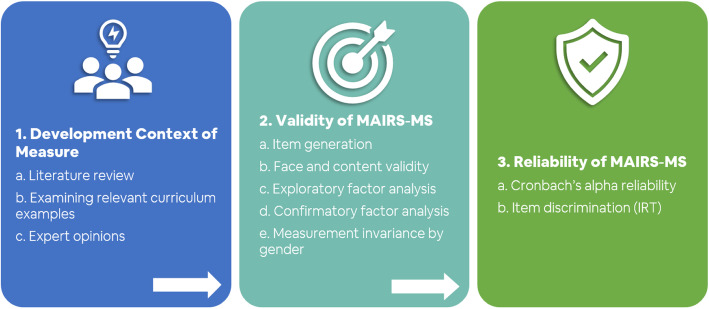
Background: It is unlikely that applications of artificial intelligence (AI) will completely replace physicians. However, it is very likely that AI applications will acquire many of their roles and generate new tasks in medical care. To be ready for new roles and tasks, medical students and physicians will need to understand the fundamentals of AI and data science, mathematical concepts, and related ethical and medico-legal issues in addition with the standard medical principles. Nevertheless, there is no valid and reliable instrument available in the literature to measure medical AI readiness. In this study, we have described the development of a valid and reliable psychometric measurement tool for the assessment of the perceived readiness of medical students on AI technologies and its applications in medicine. Methods: To define medical students’ required competencies on AI, a diverse set of experts’ opinions were obtained by a qualitative method and were used as a theoretical framework, while creating the item pool of the scale. Exploratory Factor Analysis (EFA) and Confirmatory Factor Analysis (CFA) were applied. Results: A total of 568 medical students during the EFA phase and 329 medical students during the CFA phase, enrolled in two different public universities in Turkey participated in this study. The initial 27-items finalized with a 22-items scale in a four-factor structure (cognition, ability, vision, and ethics), which explains 50.9% cumulative variance that resulted from the EFA. Cronbach’s alpha reliability coefficient was 0.87. CFA indicated appropriate fit of the four-factor model ( χ 2 /df = 3.81, RMSEA = 0.094, SRMR = 0.057, CFI = 0.938, and NNFI (TLI) = 0.928). These values showed that the four-factor model has construct validity. Conclusions: The newly developed Medical Artificial Intelligence Readiness Scale for Medical Students (MAIRS-MS) was found to be valid and reliable tool for evaluation and monitoring of perceived readiness levels of medical students on AI technologies and applications. Medical schools may follow ‘a physician training perspective that is compatible with AI in medicine’ to their curricula by using MAIRS-MS. This scale could be benefitted by medical and health science education institutions as a valuable curriculum development tool with its learner needs assessment and participants’ end-course perceived readiness opportunities.
Overview
The claims and statistics of this paper haven’t been checked yet.
Free: it reads the open-access text and checks the first 5 claims that cite a source we can check. Create a free account to check every claim.
Integrity signals
Registry
Cites
Statistics
Figures
Verification
Claims the paper makes
The claims and statistics of this paper haven’t been checked yet.
Free: it reads the open-access text and checks the first 5 claims that cite a source we can check. Create a free account to check every claim.
Claims other papers make about this one
Each is checked against this paper’s own text: does it say what the citing paper says it does?
The cited source doesn’t support the claim as written.
In the citing paper
“The validity of the self-report measurement instruments for AI literacy [11,12,14,15] has only been tested regarding their factorial structure.”
From Meta AI literacy scale: Further validation and development of a short version (2024) · cites this paper as [11]
Checked by a reasoning model — may be wrong.
Experimental — accuracy not yet measuredThe source backs part of the claim, not all of it — or backs it for a different population, condition or comparison.
In the citing paper
“Overall, this includes learning the AI terminology [13,37,45], strengths and limitations of AI [12,13,16,37,42], risks of AI [12,13,17,37,39,42], controlling for bias [42], critical appraisal AI literature and tools [12,13,34,37,39,45,46], and shared decision-making [12,13,37,41,45].”
From An evidence-based approach to artificial intelligence education for medical students: A systematic review (2023) · cites this paper as [17]
Experimental — accuracy not yet measuredThe source backs part of the claim, not all of it — or backs it for a different population, condition or comparison.
In the citing paper
“In particular, knowledge related to data stewardship [12,13,37,41], data preprocessing and acquisition [13], standardization [13], data analytics [13,17,39], health data infrastructure [45], programming [39,41], and big data [13,45], may help physicians appreciate the obstacles faced by data scientists and improve the multidisciplinary collaboration [13,39].”
From An evidence-based approach to artificial intelligence education for medical students: A systematic review (2023) · cites this paper as [17]
Experimental — accuracy not yet measuredThe source backs part of the claim, not all of it — or backs it for a different population, condition or comparison.
In the citing paper
“MAIRS-MC43 also showed at least some evidence for content validity while showing good evidence for structural validity and internal consistency.”
From A systematic review of AI literacy scales (2024) · cites this paper as [43]
Experimental — accuracy not yet measuredThe source backs part of the claim, not all of it — or backs it for a different population, condition or comparison.
In the citing paper
“GSE-6AI30, MAIRS-MC43, and SNAIL45 have been validated specifically for medical students, which makes them the instruments of choice if medical students are to be assessed.”
From A systematic review of AI literacy scales (2024) · cites this paper as [43]
Experimental — accuracy not yet measured
10 more claims about this paper
Create a free account to see every claim other papers make about this one.
Self-check
Percentages, sums and reported differences re-computed from the paper’s own numbers.
The self-check needs the paper’s full text.
Citations
Cites
Tabachnick, B. G., & Fidell, L. S. (1983) · Cited by 80,058
(1998) · Cited by 36,049
Research Design: Qualitative, Quantitative, and Mixed Methods Approaches
Creswell, J. W. (1994) · Cited by 35,500
(1991) · Cited by 15,554
Dermatologist-level classification of skin cancer with deep neural networks
Esteva, A., Kuprel, B., Novoa, R. A., Ko, J., Swetter, S. M., Blau, H. M., & Thrun, S. (2017) · Nature · doi:10.1038/nature21056 · Cited by 14,362
The Scree Test For The Number Of Factors
Cattell, R. B. (1966) · Multivariate Behavioral Research · doi:10.1207/s15327906mbr0102_10 · Cited by 13,554
Research Design: Qualitative, Quantitative, and Mixed Methods Approaches
ภู่พันธ์, ศ. (2018) · วารสารวิธีวิทยาการวิจัย (Journal of Research Methodology: JRM) · Cited by 13,070
High-performance medicine: the convergence of human and artificial intelligence
Topol, E. J. (2019) · Nature Medicine · doi:10.1038/s41591-018-0300-7 · Cited by 10,450
Structural Equation Modelling: Guidelines for Determining Model Fit
Hooper, D., Coughlan, J., & Mullen, M. R. (2008) · Dublin Institute of Technology · doi:10.21427/d7cf7r · Cited by 8,746
The Varimax Criterion for Analytic Rotation in Factor Analysis
Kaiser, H. F. (1958) · Psychometrika · doi:10.1007/bf02289233 · Cited by 7,580
What is AI Literacy? Competencies and Design Considerations
Long, D., & Magerko, B. (2020) · Proceedings of the 2020 CHI Conference on Human Factors in Computing Systems · doi:10.1145/3313831.3376727 · Cited by 3,241
SPSS survival manual: a step by step guide to data analysis using IBM SPSS
(2013) · Australian and New Zealand Journal of Public Health · doi:10.1111/1753-6405.12166 · Cited by 2,716
Ensuring Positiveness of the Scaled Difference Chi-square Test Statistic
Satorra, A., & Bentler, P. M. (2010) · Psychometrika · doi:10.1007/s11336-009-9135-y · Cited by 2,695
mirt: A Multidimensional Item Response Theory Package for the R Environment
Chalmers, R. P. (2012) · Journal of Statistical Software · doi:10.18637/jss.v048.i06 · Cited by 2,643
Ishtiaq, M. (2019) · English Language Teaching · doi:10.5539/elt.v12n5p40 · Cited by 1,732
Human Characteristics and School Learning
Bennett, N., & Bloom, B. S. (1979) · British Journal of Educational Studies · doi:10.2307/3119887 · Cited by 1,728
Chan, K. S., & Zary, N. (2019) · JMIR Medical Education · doi:10.2196/13930 · Cited by 877 · cited 2×
“In order to meet these requirements, physicians will need to have sufficient knowledge of mathematical concepts, the foundations of artificial intelligence, machine learning, data science, and related ethical and legal issues and be able to relate them in the context of medicine [46, 47].”
BackgroundAssessing Factorial Invariance in Ordered-Categorical Measures
Millsap, R. E., & Yun-Tein, J. (2004) · Multivariate Behavioral Research · doi:10.1207/s15327906mbr3903_4 · Cited by 862
Deep Learning for Identifying Metastatic Breast Cancer
Wang, D., Khosla, A., Gargeya, R., Irshad, H., & Beck, A. H. (2016) · arXiv (Cornell University) · doi:10.48550/arxiv.1606.05718 · Cited by 756
Medical students' attitude towards artificial intelligence: a multicentre survey
Pinto dos Santos, D., Giese, D., Brodehl, S., Chon, S. H., Staab, W., Kleinert, R., Maintz, D., & Baeßler, B. (2019) · European Radiology · doi:10.1007/s00330-018-5601-1 · Cited by 754
Evaluating Model Fit:a Synthesis of the Structural Equation Modelling Literature
Hooper, D., Coughlan, J. P., & Mullen, M. R. (2008) · Arrow@dit (Dublin Institute of Technology) · doi:10.21427/d79b73 · Cited by 680
Automated analysis of free speech predicts psychosis onset in high-risk youths
Bedi, G., Carrillo, F., Cecchi, G. A., Slezak, D. F., Sigman, M., Mota, N. B., Ribeiro, S., Javitt, D. C., Copelli, M., & Corcoran, C. M. (2015) · npj Schizophrenia · doi:10.1038/npjschz.2015.30 · Cited by 673 · cited 1×
“In addition, AI applications can detect coronary heart diseases by analyzing echocardiograms [8], psychotic events and neurological diseases such as Parkinson’s from speech patterns [9], facilitate the diagnosis of polyps and neoplasms in the gastrointestinal system [10] and perform certain procedural tasks such as kn…”
BackgroundMedical Education Must Move From the Information Age to the Age of Artificial Intelligence
Wartman, S. A., & Combs, C. D. (2018) · Academic Medicine · doi:10.1097/acm.0000000000002044 · Cited by 585
Sit, C., Srinivasan, R., Amlani, A., Muthuswamy, K., Azam, A., Monzon, L., & Poon, D. S. (2020) · Insights into Imaging · doi:10.1186/s13244-019-0830-7 · Cited by 507
Wu, A. D., Li, Z., & Zumbo, B. D. (2020) · Scholarworks (University of Massachusetts Amherst) · doi:10.7275/mhqa-cd89 · Cited by 491
Artificial intelligence in medical education
Masters, K. (2019) · Medical Teacher · doi:10.1080/0142159x.2019.1595557 · Cited by 469
A vision of the use of technology in medical education after the COVID-19 pandemic
Goh, P.-S., & Sandars, J. (2020) · MedEdPublish · doi:10.15694/mep.2020.000049.1 · Cited by 426
Sapci, A. H., & Sapci, H. A. (2020) · JMIR Medical Education · doi:10.2196/19285 · Cited by 377
Will artificial intelligence solve the human resource crisis in healthcare?
Meskó, B., Hetényi, G., & Győrffy, Z. (2018) · BMC Health Services Research · doi:10.1186/s12913-018-3359-4 · Cited by 360
Gong, B., Nugent, J. P., Guest, W., Parker, W., Chang, P. J., Khosa, F., & Nicolaou, S. (2019) · Academic Radiology · doi:10.1016/j.acra.2018.10.007 · Cited by 325
Machine learning and medical education
Kolachalama, V. B., & Garg, P. S. (2018) · npj Digital Medicine · doi:10.1038/s41746-018-0061-1 · Cited by 320
Kassahun, Y., Yu, B., Tibebu, A. T., Stoyanov, D., Giannarou, S., Metzen, J. H., & Vander Poorten, E. (2016) · International Journal of Computer Assisted Radiology and Surgery · doi:10.1007/s11548-015-1305-z · Cited by 238
Erratum: Corrigendum: Dermatologist-level classification of skin cancer with deep neural networks
Esteva, A., Kuprel, B., Novoa, R. A., Ko, J., Swetter, S. M., Blau, H. M., & Thrun, S. (2017) · Nature · doi:10.1038/nature22985 · Cited by 213
Where medical education meets artificial intelligence: ‘Does technology care?’
van der Niet, A. G., & Bleakley, A. (2021) · Medical Education · doi:10.1111/medu.14131 · Cited by 121
Useful Tools for Structural Equation Modeling [R package semTools version 0.5-3]
Jorgensen, T. D., Pornprasertmanit, S., Schoemann, A. M., & Rosseel, Y. (2020) · Cited by 109
AI-RADS: an artificial intelligence curriculum for residents
Lindqwister, A. L., Hassanpour, S., Lewis, P. J., & Sin, J. M. (2021) · Academic Radiology · doi:10.1016/j.acra.2020.09.017 · Cited by 103
Good relations with technology: Empirical ethics and aesthetics in care
Pols, J. (2017) · Nursing Philosophy · doi:10.1111/nup.12154 · Cited by 101
Siegersma, K. R., Leiner, T., Chew, D. P., Appelman, Y., Hofstra, L., & Verjans, J. W. (2019) · Netherlands Heart Journal · doi:10.1007/s12471-019-01311-1 · Cited by 96
Body pedagogics: embodied learning for the health professions
Kelly, M., Ellaway, R., Scherpbier, A., King, N., & Dornan, T. (2019) · Medical Education · doi:10.1111/medu.13916 · Cited by 81
AI added to the curriculum for doctors-to-be
Brouillette, M. (2019) · Nature Medicine · doi:10.1038/s41591-019-0648-3 · Cited by 56
On Artificial Intelligence and Deep Learning Within Medical Education
Carin, L. (2020) · Academic Medicine · doi:10.1097/acm.0000000000003630 · Cited by 56
The Bright, Artificial Intelligence-Augmented Future of Neuroimaging Reading
Hainc, N., Federau, C., Stieltjes, B., Blatow, M., Bink, A., & Stippich, C. (2017) · Frontiers in Neurology · doi:10.3389/fneur.2017.00489 · Cited by 52
Tuberculosis control, and the where and why of artificial intelligence
Doshi, R., Falzon, D., Thomas, B. V., Temesgen, Z., Sadasivan, L., Migliori, G. B., & Raviglione, M. C. (2017) · ERJ Open Research · doi:10.1183/23120541.00056-2017 · Cited by 42
Weske, U., Boselie, P., van Rensen, E. L. J., & Schneider, M. M. E. (2018) · BMC Health Services Research · doi:10.1186/s12913-018-2865-8 · Cited by 38
Medical College of the Future: from Informative to Transformative
Hamdy, H. (2018) · Medical Teacher · doi:10.1080/0142159x.2018.1498628 · Cited by 34
Pleura revisited: From histology and pathophysiology to pathology and molecular biology
Karpathiou, G., & Péoc’h, M. (2018) · The Clinical Respiratory Journal · doi:10.1111/crj.12982 · Cited by 27
Playing to our human strengths to prepare medical students for the future
Chen, J. (2017) · Korean Journal of Medical Education · doi:10.3946/kjme.2017.65 · Cited by 22
Awire, E., & Okumagba, M. T. (2020) · MedEdPublish · doi:10.15694/mep.2020.000001.1 · Cited by 16
Artificial Intelligence: Patient Care and Health Professional’s Education
Bhardwaj, D. (2019) · JOURNAL OF CLINICAL AND DIAGNOSTIC RESEARCH · doi:10.7860/jcdr/2019/38035.12453 · Cited by 12
Techniques to integrate artificial intelligence systems with medical information in gastroenterology
Jin, H., Zhang, M., & Hu, B. (2020) · Artificial Intelligence in Gastrointestinal Endoscopy · doi:10.37126/aige.v1.i1.19 · Cited by 11
Nursing knowledge: hints from the placebo effect
Zanotti, R., & Chiffi, D. (2016) · Nursing Philosophy · doi:10.1111/nup.12140 · Cited by 9
Kassahun, Y., Yu, B., Tibebu, A. T., Stoyanov, D. V., Giannarou, S., Metzen, J. H., & Poorten, E. V. (2016) · International Journal of Computer Assisted Radiology and Surgery · doi:10.1007/s11548-015-1340-9 · Cited by 7
Focus: Tracking Down an Epidemic’s Source
Jacobsmeyer, B. (2012) · Cited by 1
Research works printed but not linked: 2
- Başar E Genel Öğretim Yöntemleri 2001 Samsun Kardeşler Ofset ve Matbaa
- Harman G Çelikler D Eğitimde hazir bulunuşluğun önemi üzerine bir derleme çalişmasi J Res Educ Teach 2012 3 2146 9199
Cited by
Conceptualizing AI literacy: An exploratory review
Ng, D. T. K., Leung, J. K. L., Chu, S. K. W., & Qiao, M. S. (2021) · Computers and Education: Artificial Intelligence · doi:10.1016/j.caeai.2021.100041 · Cited by 2,205
Chiu, T. K. F., Xia, Q., Zhou, X., Chai, C. S., & Cheng, M. (2023) · Computers and Education: Artificial Intelligence · doi:10.1016/j.caeai.2022.100118 · Cited by 1,181
Artificial intelligence literacy in higher and adult education: A scoping literature review
Laupichler, M. C., Aster, A., Schirch, J., & Raupach, T. (2022) · Computers and Education Artificial Intelligence · doi:10.1016/j.caeai.2022.100101 · Cited by 658
A scoping review of artificial intelligence in medical education: BEME Guide No. 84
Gordon, M., Daniel, M., Ajiboye, A., Uraiby, H., Xu, N. Y., Bartlett, R., Hanson, J., Haas, M., Spadafore, M., Grafton-Clarke, C., et al. (2024) · Medical Teacher · doi:10.1080/0142159x.2024.2314198 · Cited by 679
Carolus, A., Koch, M. J., Straka, S., Latoschik, M. E., & Wienrich, C. (2023) · Computers in Human Behavior: Artificial Humans · doi:10.1016/j.chbah.2023.100014 · Cited by 488
Metadata
- Authors
- Karaca, O., Çalışkan, S. A., & Demir, K.
- Affiliations
- Ege University (TR)
- Dokuz Eylül University (TR)
- Corresponding author
- Çalışkan, S. Ayhan
- Venue
- BMC Medical Education
- Published
- 2021-02-18
- Volume
- 21
- Issue
- 1
- Pages
- 112-112
- ISSN
- 1472-6920 (ISSN-L)
- PMC
- PMC7890640
- OpenAlex
- W3131540942
- Cited by
- 377
- References
- 55
- Citations by year
- 2026: 148 · 2025: 120 · 2024: 65 · 2023: 27 · 2022: 14 · 2021: 3
- FWCI
- 7.88
- Type
- journal article
- Language
- en
- Open access
- gold
- doi.org
- Licence
- cc-by
- creativecommons.org/licenses/by/4.0/ (tdm)
- creativecommons.org/licenses/by/4.0/ (vor)
- Locations
- BMC Medical Education (publishedVersion, cc-by)
- PubMed Central (publishedVersion, cc-by)
- PubMed (publishedVersion)
- DOAJ (DOAJ: Directory of Open Access Journals) (submittedVersion, cc-by-sa)
- Funders
- Manisa Celal Bayar Üniversitesi
- Topics
- Health Sciences › Medicine › Health Informatics › Artificial Intelligence in Healthcare and Education
- Social Sciences › Education › Innovations in Medical Education
- Social Sciences › Education › Artificial Intelligence in Education
- Keywords
- artificial intelligence in healthcare, medical students, scale development, psychometric validation, AI competencies, AI ethics, AI literacy, medical curriculum, student needs assessment
- MeSH terms
- Artificial Intelligence, Humans, Psychometrics, Surveys and Questionnaires, Students, Medical, Turkey, Reproducibility of Results
About these checks
Registry, retraction, Cites and statistics results are computed, not judged, with one exception: a printed reference that no index lists is read once by a model before it counts as a citation error. Claims are extracted by a model and kept only when their quote appears verbatim in the text; each cited source is then checked, with a model’s help, for whether it says what the claim relies on. Those verdicts can be wrong — read the claim’s quote and the cited source before relying on one.
Statistics and arithmetic are recomputed, not judged.
Confidence bands are shown only for fields calibrated on our annotated test set. None is calibrated yet, so no band is shown.
What counts as a claim ›How we measure confidence ›How we check this ›
Are you an author, or do you see a problem with this page? Request a review
Data sources
Bibliographic data: Semantic Scholar, OpenAlex, Crossref.
Contains information from the Semantic Scholar Academic Graph Datasets, made available under the ODC Attribution License (ODC-BY 1.0).
Semantic Scholar’s data is described in: Kinney, R., et al. (2023). The Semantic Scholar Open Data Platform. arXiv:2301.10140.
