

Effect of a flipped classroom course to foster medical students’ AI literacy with a focus on medical imaging: a single group pre-and post-test study
Open accessThe DOI matches its Crossref record; 31 of the 31 references it cites were found in a registry or an index; 2 of the 9 sources its claims cite were checked for support.
Abstract
Background: The use of artificial intelligence applications in medicine is becoming increasingly common. At the same time, however, there are few initiatives to teach this important and timely topic to medical students. One reason for this is the predetermined medical curriculum, which leaves very little room for new topics that were not included before. We present a flipped classroom course designed to give undergraduate medical students an elaborated first impression of AI and to increase their “AI readiness”. Methods: The course was tested and evaluated at Bonn Medical School in Germany with medical students in semester three or higher and consisted of a mixture of online self-study units and online classroom lessons. While the online content provided the theoretical underpinnings and demonstrated different perspectives on AI in medical imaging, the classroom sessions offered deeper insight into how “human” diagnostic decision-making differs from AI diagnoses. This was achieved through interactive exercises in which students first diagnosed medical image data themselves and then compared their results with the AI diagnoses. We adapted the “Medical Artificial Intelligence Scale for Medical Students” to evaluate differences in “AI readiness” before and after taking part in the course. These differences were measured by calculating the so called “comparative self-assessment gain” (CSA gain) which enables a valid and reliable representation of changes in behaviour, attitudes, or knowledge. Results: We found a statistically significant increase in perceived AI readiness. While values of CSA gain were different across items and factors, the overall CSA gain regarding AI readiness was satisfactory. Conclusion: Attending a course developed to increase knowledge about AI in medical imaging can increase self-perceived AI readiness in medical students.
Overview
CoChat Summary
## TL;DR
This single-group pre/post study of a flipped classroom AI course for medical students found significant increases in self-rated AI readiness after the course, especially on the “vision” factor. Students also rated the course positively, with the self-study content and classroom sessions both preferred over the final assignment.
## Key findings
- The final analyzed sample was n = 24 medical students (from an initial 32 course participants); 83% response rate, 87.5% women, median semester 7, median age 23.
- Mean self-ratings after the course were significantly higher than before the course for all four MAIRS-MS factors: cognition, t(23) = 16.09, p < .001; ability, t(23) = 13.41, p < .001; vision, t(23) = 12.61, p < .001; ethics, t(23) = 6.85, p < .001.
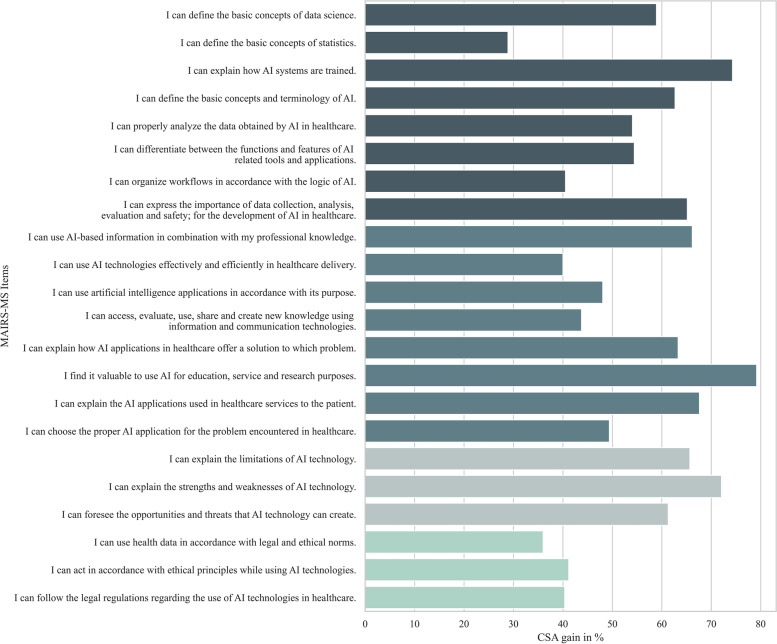
- The mean CSA gain across all 22 items was 55.6% (SD = 12.9); by factor, gains were vision 67.1% (SD = 13.0), ability 57.3% (SD = 12.0), cognition 55.1% (SD = 4.3), and ethics 40.8% (SD = 2.9).
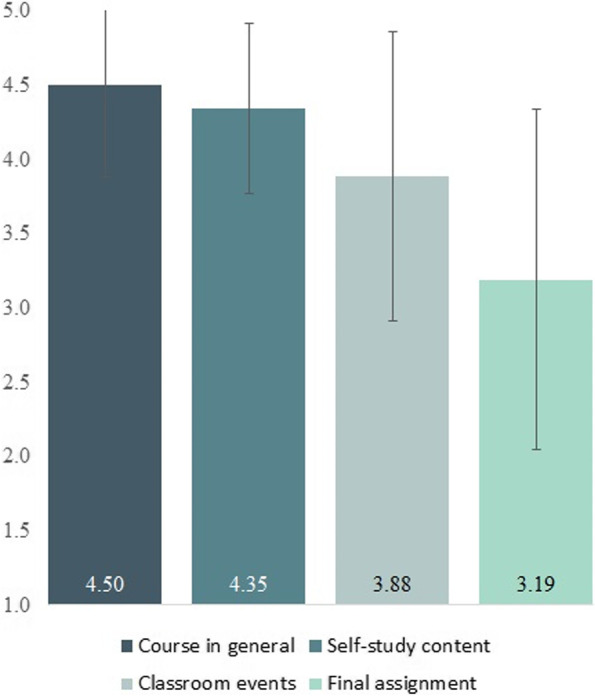
- Course evaluation was favorable: 50.0% rated it “very good,” 45.8% “good,” and 4.2% “satisfactory”; the overall course mean rating was 4.50/5 (SD = 0.57).
- Repeated-measures ANOVA showed ratings differed across course components: F(2,46) = 15.33, p < .001, partial η² = .40; both self-study content and classroom sessions were rated significantly better than the final assignment.
## Methods
- Design: Single-group pre/post-test study of an extracurricular flipped classroom course on AI in medical imaging at Bonn Medical School during the winter semester 2021/22.
- Sample/data: Medical students in semester 3 or higher were invited; questionnaires were completed before the last two lessons. The analysis included only participants who answered both questionnaires (n = 24).
- Main analysis: Student satisfaction was analyzed with repeated-measures ANOVA and post-hoc tests; change in AI readiness was assessed with paired t-tests on an adapted MAIRS-MS instrument and comparative self-assessment gain (CSA gain); internal consistency was assessed with Cronbach’s alpha.
## Limitations
- The paper states it could not run a confirmatory factor analysis because of the small sample size (24 students).
- The authors note that the adapted MAIRS-MS approach to measuring change over time still needs validation in future research.
- The sample was self-selected and highly intrinsically motivated: 95.8% said they participated because of interest in the topic, which could have influenced responses.
- Evident from the text: the study used a single-group design without a control group, so changes cannot be attributed causally to the course alone.
Model-written summary. Check it against the paper before relying on it.
Integrity signals
Registry
Cites
Statistics
Figures
Verification
Claims the paper makes
1 Valid · 0 Not valid · 2 Not checked · 26 Own results and interpretations
The cited sources support only part of this claim — read each source’s verdict below.
In the paper
“the current medical school curricula very rarely cover aspects of medical informatics, let alone AI, as part of their mandatory study programs [ 16 – 18 ].”
What the sources say
- Partly supportedcites [16] Sit C, Srinivasan R, Amlani A, Muthuswamy K, Azam A, Monzon L, et al. Attitudes and perceptions of UK medical students towards artificial intelligence and radiology: a multicentre survey. Insights Imaging. 2020;11(1):14. https://doi.org/10.1186/s13244-019-0830-7. sourceExperimental — accuracy not yet measured
The Results (p. n., Fig. 3) and Abstract support the AI half of the claim for one defined setting: of 484 students at 19 UK medical schools only 45 (9.2%) received any AI teaching and none received it as a mandatory/compulsory part of the curriculum, and the Discussion (p. n.) concludes there is 'a paucity of relevant teaching amongst UK medical schools'. However, the paper reports no data on coverage of medical informatics as such — 'informatics' appears only in the phrase 'AI and informatics teaching' — and its findings are confined to UK schools (Introduction: UK schools 'are not mandated to include this in the curriculum by the General Medical Council'), so the claim's broader, unspecific reach across 'current medical school curricula' and its informatics component are not supported by this source. (LLM, conf=0.75)
- Not checked yetcites [17] Mosch L, Back DA, Balzer F, Bernd M, Brandt J, Erkens S, et al. Lernangebote zu Künstlicher Intelligenz in der Medizin. Berlin: KI-Campus. https://doi.org/10.5281/zenodo.5497668. source
- Partly supportedcites [18] Grunhut J, Wyatt AT, Marques O. Educating future physicians in artificial intelligence (AI): an integrative review and proposed changes. J Med Educ Curric Dev. 2021;8:238212052110368. https://doi.org/10.1177/23821205211036836. sourceExperimental — accuracy not yet measured
Our copy supports the AI half of the sentence: Discussion > Lack of Implementation reports 'a void in actual planning and implementation' of AI education in the medical curriculum, with only 2 of 39 reviewed articles reporting implemented changes (Abstract > RESULTS) and the conclusion that 'there are few plans or implementations reported on how to incorporate AI in the medical curriculum.' However, nothing in our copy states that curricula rarely cover medical informatics; the only informatics passage (Discussion > Call for Research) relays a separate 2015 study that 30% of US medical students interested in clinical informatics could not identify training opportunities, which is about student access rather than curriculum coverage. Our copy also does not frame the gap in terms of mandatory versus optional coursework, so the 'mandatory study programs' qualifier is unattributed here. (LLM, conf=0.78)
plain- Asserted: passes — The authors put it forward as true.
- Checkable: passes — It can be checked against evidence.
- Load-bearing: passes — The paper’s conclusions depend on it.
- Based: passes — The paper gives a reason why it holds.
- Partly supported
A result the paper reports from its own data — it cites no other source for it, so there is none to check. The quote shows it is in the paper.
In the paper
“The mean student rating on the course in general was 4.50 on a 5-point Likert-scale ( SD = 0.57).”
plain- Asserted: passes — The authors put it forward as true.
- Checkable: passes — It can be checked against evidence.
- Load-bearing: unclear — It is unclear whether the paper’s conclusions depend on it.
- Based: passes — The paper gives a reason why it holds.
A result the paper reports from its own data — it cites no other source for it, so there is none to check. The quote shows it is in the paper.
In the paper
“The repeated measures ANOVA determined that mean student ratings showed a statistically significant difference between the three pedagogical formats (i.e., self-study content, classroom lessons, and final assignment), F (2, 46) = 15.33, p < .001, partial η 2 = .40.”
plain- Asserted: passes — The authors put it forward as true.
- Checkable: passes — It can be checked against evidence.
- Load-bearing: unclear — It is unclear whether the paper’s conclusions depend on it.
- Based: passes — The paper gives a reason why it holds.
A result the paper reports from its own data — it cites no other source for it, so there is none to check. The quote shows it is in the paper.
In the paper
“Bonferroni-adjusted post-hoc analysis revealed this difference to be statistically insignificant ( p = .06, M Diff = 0.46, 95%-CI [− 0.01, 0.92]).”
plain- Asserted: passes — The authors put it forward as true.
- Checkable: passes — It can be checked against evidence.
- Load-bearing: unclear — It is unclear whether the paper’s conclusions depend on it.
- Based: passes — The paper gives a reason why it holds.
A result the paper reports from its own data — it cites no other source for it, so there is none to check. The quote shows it is in the paper.
In the paper
“The internal consistency of both whole scales, measured by Cronbach’s alpha, was […].93 (“then”-condition) and .88 (“post”-condition), which can be interpreted as good [ 34 ]”
plain- Asserted: passes — The authors put it forward as true.
- Checkable: passes — It can be checked against evidence.
- Load-bearing: unclear — It is unclear whether the paper’s conclusions depend on it.
- Based: passes — The paper gives a reason why it holds.
2 more claims
Create a free account to see all 29 claims and to verify the 7 references still open.
- Probably not a substantial claim. 9
- It may state two separate claims as one. 16
Claims other papers make about this one
Each is checked against this paper’s own text: does it say what the citing paper says it does?
The source backs part of the claim, not all of it — or backs it for a different population, condition or comparison.
In the citing paper
“For instance, existing AI tools have been utilized to facilitate personalized, self-paced learning within courses, uncover new insights for targeted interventions, strengthen decision-making processes and clinical reasoning skills in nursing students, provide AI-assisted diagnostics, improve academic writing, and apply these advancements in patient care [26–31].”
From Exploring the integration of AI and national quality courses in China: a study on teaching practices in nursing smart education (2025) · cites this paper as [30]
Experimental — accuracy not yet measured
Statistics recomputed
Every reported test result, recomputed from its test statistic and degrees of freedom. A result shows as not adding up only once an independent check has confirmed it.
- ConsistentF(2, 46) = 15.33reported p < .001 · recomputed p < .001
“F (2, 46) = 15.33, p < .001”
- Consistentt(23) = 16.09reported p < .001 · recomputed p < .001
“t (23) = 16.09, p < .001”
- Consistentt(23) = 13.41reported p < .001 · recomputed p < .001
“t (23) = 13.41, p < .001”
- Consistentt(23) = 12.61reported p < .001 · recomputed p < .001
“t (23) = 12.61, p < .001”
- Consistentt(23) = 6.85reported p < .001 · recomputed p < .001
“t (23) = 6.85, p < .001”
Self-check
Percentages, sums and reported differences re-computed from the paper’s own numbers.
Each contradiction between two passages listed here was confirmed by an independent check.
Rated minor: it would not touch a result — a value no result rests on, a p-value that stays on the same side of the significance level, or a conflict that is clerical, resolved elsewhere in the paper, or outside its own findings.
In the paper
“Data collection was conducted prior to each of the last two lessons.”
“Mean self-ratings after course completion (post-items) were significantly higher than mean self-ratings before course participation (then-items)”
Rated minor: it would not touch a result — a value no result rests on, a p-value that stays on the same side of the significance level, or a conflict that is clerical, resolved elsewhere in the paper, or outside its own findings.
In the paper
“In theory, CSA gain can range from − 100 to + 100%.”
“Aggregated performance gain % = x ¯ pre - x ¯ post x ¯ pre - 1 * 100 , with x ¯ pre meaning initial self-assessment and x ¯ post meaning self-assessment after the course.”
Citations
Cites
High-performance medicine: the convergence of human and artificial intelligence
Topol, E. J. (2019) · Nature Medicine · doi:10.1038/s41591-018-0300-7 · Cited by 10,450 · cited 1×
“Already today, a number of medical fields rely on the help of AI-programs in their work [1, 2], including radiology [3], cardiology [4], or drug design [5], albeit mostly in laboratory or Open Access”
BackgroundArtificial intelligence in radiology
Hosny, A., Parmar, C., Quackenbush, J., Schwartz, L. H., & Aerts, H. J. W. L. (2018) · Nature Reviews Cancer · doi:10.1038/s41568-018-0016-5 · Cited by 3,803 · cited 1×
“Already today, a number of medical fields rely on the help of AI-programs in their work [1, 2], including radiology [3], cardiology [4], or drug design [5], albeit mostly in laboratory or Open Access”
BackgroundWhat is AI Literacy? Competencies and Design Considerations
Long, D., & Magerko, B. (2020) · Proceedings of the 2020 CHI Conference on Human Factors in Computing Systems · doi:10.1145/3313831.3376727 · Cited by 3,241 · cited 2×
“The MAIRS-MS instrument asks very generally about AI readiness and to some extent also contains techno-mathematical aspects (see item on statistics skills), which is not considered to be a central aspect of AI literacy by all research groups (e.g., [21]).”
BackgroundThe flipped classroom: A review of its advantages and challenges
Akçayır, G., & Akçayır, M. (2018) · Computers & Education · doi:10.1016/j.compedu.2018.07.021 · Cited by 1,343 · cited 1×
“Last but not least, this kind of teaching format seems to be particularly suitable in times of the Covid-19 pandemic [31], as it makes it possible to switch spontaneously between online and face-to-face teaching since the online content is already available in its entirety.”
BackgroundArtificial intelligence in cardiology
Johnson, K. W., Torres Soto, J., Glicksberg, B. S., Shameer, K., Miotto, R., Ali, M., Ashley, E., & Dudley, J. T. (2018) · Journal of the American College of Cardiology · doi:10.1016/j.jacc.2018.03.521 · Cited by 1,202 · cited 1×
“Already today, a number of medical fields rely on the help of AI-programs in their work [1, 2], including radiology [3], cardiology [4], or drug design [5], albeit mostly in laboratory or Open Access”
BackgroundThe role of artificial intelligence in healthcare: a structured literature review
Secinaro, S., Calandra, D., Secinaro, A., Muthurangu, V., & Biancone, P. (2021) · BMC Medical Informatics and Decision Making · doi:10.1186/s12911-021-01488-9 · Cited by 1,085 · cited 1×
“Already today, a number of medical fields rely on the help of AI-programs in their work [1, 2], including radiology [3], cardiology [4], or drug design [5], albeit mostly in laboratory or Open Access”
BackgroundThe impact of artificial intelligence in medicine on the future role of the physician
Ahuja, A. S. (2019) · PeerJ · doi:10.7717/peerj.7702 · Cited by 789 · cited 1×
“Furthermore, AI will permeate much of the daily clinical work as a supporting entity [24], which will have an enormous impact on skills necessary for future practice [25].”
BackgroundMedical students' attitude towards artificial intelligence: a multicentre survey
Pinto dos Santos, D., Giese, D., Brodehl, S., Chon, S. H., Staab, W., Kleinert, R., Maintz, D., & Baeßler, B. (2019) · European Radiology · doi:10.1007/s00330-018-5601-1 · Cited by 754 · cited 1×
“However, medical students today do not feel they understand the subject matter particularly well or receive sufficient teaching on the topic [26].”
BackgroundForschungsmethoden und Evaluation
Bortz, J., & Döring, N. (1995) · Springer-Lehrbuch · doi:10.1007/978-3-662-07301-8 · Cited by 731
Introducing artificial intelligence training in medical education
Paranjape, K., Schinkel, M., Nannan Panday, R., Car, J., & Nanayakkara, P. (2019) · JMIR Medical Education · doi:10.2196/16048 · Cited by 634 · cited 1×
“While there are some attempts to teach AI to (future) health care providers [19, 20] and to foster “AI literacy”, a term coined by Duri Long and Brian Magerko [21], the educational landscape is very heterogeneous.”
BackgroundMedical Education Must Move From the Information Age to the Age of Artificial Intelligence
Wartman, S. A., & Combs, C. D. (2018) · Academic Medicine · doi:10.1097/acm.0000000000002044 · Cited by 585 · cited 1×
“Furthermore, AI will permeate much of the daily clinical work as a supporting entity [24], which will have an enormous impact on skills necessary for future practice [25].”
BackgroundSit, C., Srinivasan, R., Amlani, A., Muthuswamy, K., Azam, A., Monzon, L., & Poon, D. S. (2020) · Insights into Imaging · doi:10.1186/s13244-019-0830-7 · Cited by 507 · cited 1×
“However, the current medical school curricula very rarely cover aspects of medical informatics, let alone AI, as part of their mandatory study programs [16–18].”
BackgroundKaraca, O., Çalışkan, S. A., & Demir, K. (2021) · BMC Medical Education · doi:10.1186/s12909-021-02546-6 · Cited by 377 · cited 2×
“Karaca et al. [32] recently created the so-called “Medical Artificial Intelligence Readiness Scale for Medical Students” (MAIRS-MS), which tries to assess the perceived preparedness to use AI-applications in health-care, i.e., “AI readiness”.”
BackgroundMethodArtificial Intelligence in Drug Design
Hessler, G., & Baringhaus, K.-H. (2018) · Molecules · doi:10.3390/molecules23102520 · Cited by 373
Wood, E. A., Ange, B. L., & Miller, D. D. (2021) · Journal of Medical Education and Curricular Development · doi:10.1177/23821205211024078 · Cited by 261 · cited 1×
“Thus, our research tries to answer the call expressed by many scholars that AI competencies of medical students should be promoted [35] and that their AI readiness should be improved, as there is a strong student interest in this topic [36].”
BackgroundNagel, S., Sinha, D., Day, D., Reith, W., Chapot, R., Papanagiotou, P., Warburton, E. A., Guyler, P., Tysoe, S., Fassbender, K., et al. (2017) · International Journal of Stroke · doi:10.1177/1747493016681020 · Cited by 217
Langerhuizen, D. W. G., Janssen, S. J., Mallee, W. H., van den Bekerom, M. P. J., Ring, D., Kerkhoffs, G. M. M. J., Jaarsma, R. L., & Doornberg, J. N. (2019) · Clinical Orthopaedics & Related Research · doi:10.1097/corr.0000000000000848 · Cited by 197
Perceptions of Digital Health Education Among European Medical Students: Mixed Methods Survey
Machleid, F., Kaczmarczyk, R., Johann, D., Balčiūnas, J., Atienza-Carbonell, B., von Maltzahn, F., & Mosch, L. (2020) · Journal of Medical Internet Research · doi:10.2196/19827 · Cited by 190 · cited 1×
“This means that only a small fraction of medical students gets the opportunity to further their education in this important topic, although past research has already demonstrated that medical students would like to see more elaborate courses on digital health and AI [22, 23].”
BackgroundGrunhut, J., Wyatt, A. T., & Marques, O. (2021) · Journal of Medical Education and Curricular Development · doi:10.1177/23821205211036836 · Cited by 161 · cited 1×
“However, the current medical school curricula very rarely cover aspects of medical informatics, let alone AI, as part of their mandatory study programs [16–18].”
BackgroundCo-designing AI literacy exhibits for informal learning spaces
Long, D., Blunt, T., & Magerko, B. (2021) · Proceedings of the ACM on Human-Computer Interaction · doi:10.1145/3476034 · Cited by 128 · cited 1×
“As Long et al. nicely put it, the goal is to acquire a “casual understanding of AI - i.e., understanding how a search engine works, not necessarily understanding how to program one” [27].”
BackgroundPoncette, A.-S., Glauert, D. L., Mosch, L., Braune, K., Balzer, F., & Back, D. A. (2020) · Journal of Medical Internet Research · doi:10.2196/22161 · Cited by 105 · cited 1×
“This means that only a small fraction of medical students gets the opportunity to further their education in this important topic, although past research has already demonstrated that medical students would like to see more elaborate courses on digital health and AI [22, 23].”
BackgroundBickelhaupt, S., Jaeger, P. F., Laun, F. B., Lederer, W., Daniel, H., Kuder, T. A., Wuesthof, L., Paech, D., Bonekamp, D., Radbruch, A., et al. (2018) · Radiology · doi:10.1148/radiol.2017170273 · Cited by 103
Self-citationSmartphone-Based Fundus Imaging–Where Are We Now?
Wintergerst, M. W. M., Jansen, L. G., Holz, F. G., & Finger, R. P. (2020) · Asia-Pacific Journal of Ophthalmology · doi:10.1097/apo.0000000000000303 · Cited by 86 · cited 1×
“While AI and its currently most important technology, machine learning, penetrates more and more medical subspecialties, it is most prevalent in medical imaging [6–10].”
BackgroundSelf-citationFully automated detection of breast cancer in screening MRI using convolutional neural networks
Dalmış, M. U., Vreemann, S., Kooi, T., Mann, R. M., Karssemeijer, N., & Gubern-Mérida, A. (2018) · Journal of Medical Imaging · doi:10.1117/1.jmi.5.1.014502 · Cited by 82 · cited 1×
“While AI and its currently most important technology, machine learning, penetrates more and more medical subspecialties, it is most prevalent in medical imaging [6–10].”
BackgroundEstimating Learning Outcomes From Pre- and Posttest Student Self-Assessments: A Longitudinal Study
Schiekirka, S., Reinhardt, D., Beibarth, T., Anders, S., Pukrop, T., & Raupach, T. (2013) · Academic Medicine · doi:10.1097/acm.0b013e318280a6f6 · Cited by 56 · cited 1×
“In order to address this problem, the “comparative self-assessment gain” (CSA gain) was also calculated [33].”
MethodSelf-citationOverview of digital health teaching courses in medical education in Germany in 2020
Aulenkamp, J., Mikuteit, M., Löffler, T., & Schmidt, J. (2021) · PubMed · doi:10.3205/zma001476 · Cited by 50 · cited 1×
“While there are some attempts to teach AI to (future) health care providers [19, 20] and to foster “AI literacy”, a term coined by Duri Long and Brian Magerko [21], the educational landscape is very heterogeneous.”
Background(2021) · doi:10.2196/30940 · Cited by 43 · cited 2×
“Thus, our research tries to answer the call expressed by many scholars that AI competencies of medical students should be promoted [35] and that their AI readiness should be improved, as there is a strong student interest in this topic [36].”
BackgroundInfluentialTomesko, J., Cohen, D., & Bridenbaugh, J. (2022) · Journal of Educational Evaluation for Health Professions · doi:10.3352/jeehp.2022.19.5 · Cited by 24 · cited 2×
“The authors define AI readiness as “the healthcare provider’s preparedness state in knowledge, skills, and attitude to utilize healthcare-AI applications during delivering prevention, diagnosis, treatment, and rehabilitation services in amalgam with own professional knowledge” [30].”
BackgroundChina’s data-driven dream to overhaul health care
O’Meara, S. (2021) · Nature · doi:10.1038/d41586-021-02694-1 · Cited by 9 · cited 1×
“…and implementation of AI in healthcare, such as the USA with the Department of Health & Human Services’ “Artificial Intelligence Strategy” [13], Germany as part of their “National Strategy for Artificial Intelligence” [14], and China through its National Natural Science Foundation of China [15].”
BackgroundLernangebote zu Künstlicher Intelligenz in der Medizin
Mosch, L. K., Back, A., Balzer, F., Bernd, M., Brandt, J., Erkens, S., Frey, N., Ghanaat, A., Glauert, D. L., Göllner, S., et al. (2021) · Multilingual Matters (Channel View Publications) · doi:10.5281/zenodo.5497667 · Cited by 9
Lernangebote zu Künstlicher Intelligenz in der Medizin
Mosch, L., Back, A., Balzer, F., Bernd, M., Brandt, J., Erkens, S., Frey, N., Ghanaat, A., Glauert, D. L., Göllner, S., et al. (2021) · Zenodo · doi:10.5281/zenodo.5497668
Research works printed but not linked: 3
- CB Insights Research, 2020a. State Of Healthcare Q2 2020 Report: Sector & Industry Investment Trends | CB Insights Research. [online] CB Insights Research. Available at: <https://www.cbinsights.com/research/report/healthcare-trends-q2-2020/> [Accessed 24 Aug 2022].
- Bishop J, Verleger M. The Flipped Classroom: A Survey of the Research. In: 2013 ASEE Annual Conference & Exposition Proceedings. ASEE Conferences; 23.1200.1–23.1200.18. doi:10.18260/1–2—22585 · doi:10.18260/1-2-22585
- Johnson GB. Student perceptions of the flipped classroom [master thesis]. Okangan: The University of British Columbia; 2013.
Cited by
Almatrafi, O., Johri, A., & Lee, H. (2024) · Computers and Education Open · doi:10.1016/j.caeo.2024.100173 · Cited by 341
Laupichler, M. C., Aster, A., Meyerheim, M., Raupach, T., & Mergen, M. (2024) · BMC Medical Education · doi:10.1186/s12909-024-05400-7 · Cited by 170
“At the same time, a “consensus on what and how to teach AI” [7, p1] in the medical curriculum appears to be lacking, and although there are individual elective courses attempting to foster AI competencies [8–9], the majority of medical students still receive very little AI education [10–11].”
BackgroundSelf-citationBiagini, G. (2025) · International Journal of Artificial Intelligence in Education · doi:10.1007/s40593-025-00466-w · Cited by 344
Chee, H., Ahn, S., & Lee, J. (2025) · British Journal of Educational Technology · doi:10.1111/bjet.13556 · Cited by 158
University Students’ Conceptualisation of AI Literacy: Theory and Empirical Evidence
Černý, M. (2024) · Social Sciences · doi:10.3390/socsci13030129 · Cited by 78
Metadata
- Authors
- Laupichler, M. C., Hadizadeh, D. R., Wintergerst, M. W. M., von der Emde, L., Paech, D., Dick, E. A., & Raupach, T.
- Affiliations
- University Hospital Bonn (DE)
- St Mary's Hospital (GB)
- Corresponding author
- Laupichler, Matthias C.
- ORCID
- Venue
- BMC Medical Education
- Published
- 2022-11-18
- Volume
- 22
- Issue
- 1
- Pages
- 803-803
- ISSN
- 1472-6920 (ISSN-L)
- PMC
- PMC9672614
- OpenAlex
- W4309265012
- Cited by
- 62
- References
- 30
- Citations by year
- 2026: 20 · 2025: 23 · 2024: 14 · 2023: 5
- FWCI
- 3.16
- Type
- journal article
- Language
- en
- Open access
- gold
- doi.org
- Licence
- cc-by
- creativecommons.org/licenses/by/4.0 (tdm)
- creativecommons.org/licenses/by/4.0 (vor)
- Locations
- BMC Medical Education (publishedVersion, cc-by)
- PubMed Central (publishedVersion, cc-by)
- PubMed (publishedVersion)
- DOAJ (DOAJ: Directory of Open Access Journals) (submittedVersion, cc-by-sa)
- Funders
- Universitätsklinikum Bonn
- Topics
- Health Sciences › Medicine › Health Informatics › Artificial Intelligence in Healthcare and Education
- Social Sciences › Education › Innovations in Medical Education
- Social Sciences › Education › Artificial Intelligence in Education
- Keywords
- flipped classroom, AI literacy, medical students, diagnostic imaging, AI readiness, diagnostic decision-making, online self-study
- MeSH terms
- Literacy, Artificial Intelligence, Curriculum, Humans, Schools, Medical, Students, Medical
About these checks
Registry, retraction, Cites and statistics results are computed, not judged, with one exception: a printed reference that no index lists is read once by a model before it counts as a citation error. Claims are extracted by a model and kept only when their quote appears verbatim in the text; each cited source is then checked, with a model’s help, for whether it says what the claim relies on. Those verdicts can be wrong — read the claim’s quote and the cited source before relying on one.
The claim verdicts this report counts are experimental: their accuracy is not yet measured.
A language model drew the claims from the paper on 2026-10-11, under version 3 of the claim definition (model deepseek-v4.1-flash, prompt extract-v3).
A second model labelled each claim on 2026-10-11 (model jev-1.13-20260917, definition revision gold-guideline-v0.2).
Cited sources are checked with a language model’s help (qwen3.8-omni-flash).
Statistics and arithmetic are recomputed, not judged.
Confidence bands are shown only for fields calibrated on our annotated test set. None is calibrated yet, so no band is shown.
What counts as a claim ›How we measure confidence ›How we check this ›
Are you an author, or do you see a problem with this page? Request a review
Data sources
Bibliographic data: Semantic Scholar, OpenAlex, Crossref.
Contains information from the Semantic Scholar Academic Graph Datasets, made available under the ODC Attribution License (ODC-BY 1.0).
Semantic Scholar’s data is described in: Kinney, R., et al. (2023). The Semantic Scholar Open Data Platform. arXiv:2301.10140.
