

Large language models improve clinical decision making of medical students through patient simulation and structured feedback: a randomized controlled trial
Open accessThe DOI matches its Crossref record; 37 of the 37 references it cites were found in a registry or an index; 5 of the 25 sources its claims cite were checked for support.
Abstract
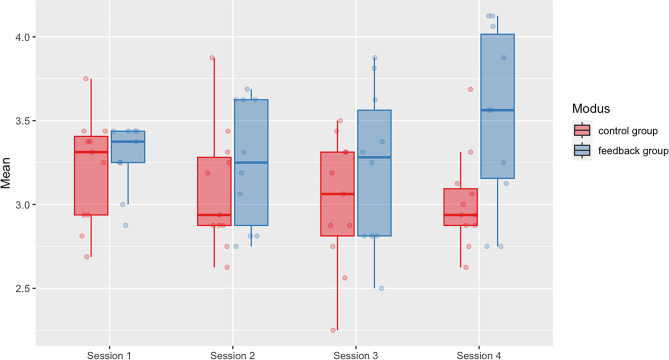
Background: Clinical decision-making (CDM) refers to physicians’ ability to gather, evaluate, and interpret relevant diagnostic information. An integral component of CDM is the medical history conversation, traditionally practiced on real or simulated patients. In this study, we explored the potential of using Large Language Models (LLM) to simulate patient-doctor interactions and provide structured feedback. Methods: We developed AI prompts to simulate patients with different symptoms, engaging in realistic medical history conversations. In our double-blind randomized design, the control group participated in simulated medical history conversations with AI patients (control group), while the intervention group, in addition to simulated conversations, also received AI-generated feedback on their performances (feedback group). We examined the influence of feedback based on their CDM performance, which was evaluated by two raters (ICC = 0.924) using the Clinical Reasoning Indicator – History Taking Inventory (CRI-HTI). The data was analyzed using an ANOVA for repeated measures. Results: Our final sample included 21 medical students (age mean = 22.10 years, semester mean = 4, 14 females). At baseline, the feedback group (mean = 3.28 ± 0.09 [standard deviation]) and the control group (3.21 ± 0.08) achieved similar CRI-HTI scores, indicating successful randomization. After only four training sessions, the feedback group (3.60 ± 0.13) outperformed the control group (3.02 ± 0.12), F (1,18) = 4.44, p = .049 with a strong effect size, partial η 2 = 0.198. Specifically, the feedback group showed improvements in the subdomains of CDM of creating context ( p = .046) and securing information ( p = .018), while their ability to focus questions did not improve significantly ( p = .265). Conclusion: The results suggest that AI-simulated medical history conversations can support CDM training, especially when combined with structured feedback. Such training format may serve as a cost-effective supplement to existing training methods, better preparing students for real medical history conversations.
Overview
CoChat Summary
TL;DR
This randomized controlled trial found that medical students who received ChatGPT-generated feedback after simulated patient conversations improved more in clinical decision making than students who only completed the AI simulation. The feedback group finished with higher CRI-HTI scores after four scenarios (3.604 vs 3.017), with a statistically significant and strong effect.
Key findings
- 29 students initially agreed to participate; 24 began after 5 dropped out before randomization, and 21 were included in the final analysis after 3 technical exclusions.
- After four scenarios, the feedback group outperformed the control group on clinical decision making: mean CRI-HTI 3.604 ± 0.130 vs 3.017 ± 0.118; F(1,20) = 4.436, p = .049; partial η² = 0.198.
- The feedback group improved significantly in the CRI-HTI subdomains “creating context” (p = .046) and “securing information” (p = .018), but not “focusing questions” (p = .265).
- Participants rated the simulations as highly accurate (8.67/10 ± 2.01), feasible (8.38/10 ± 1.88), and realistic (7.81/10 ± 1.40).
Methods
- Two-group randomized controlled study conducted at the University of Münster during winter term 2023/2024, using OpenAI ChatGPT 3.5 in the Playground interface.
- Sample: enrolled medical students from the University of Münster who attended in person and gave consent; final analyzed sample was 21 participants, aged 19–35, with 11 in control and 10 in feedback.
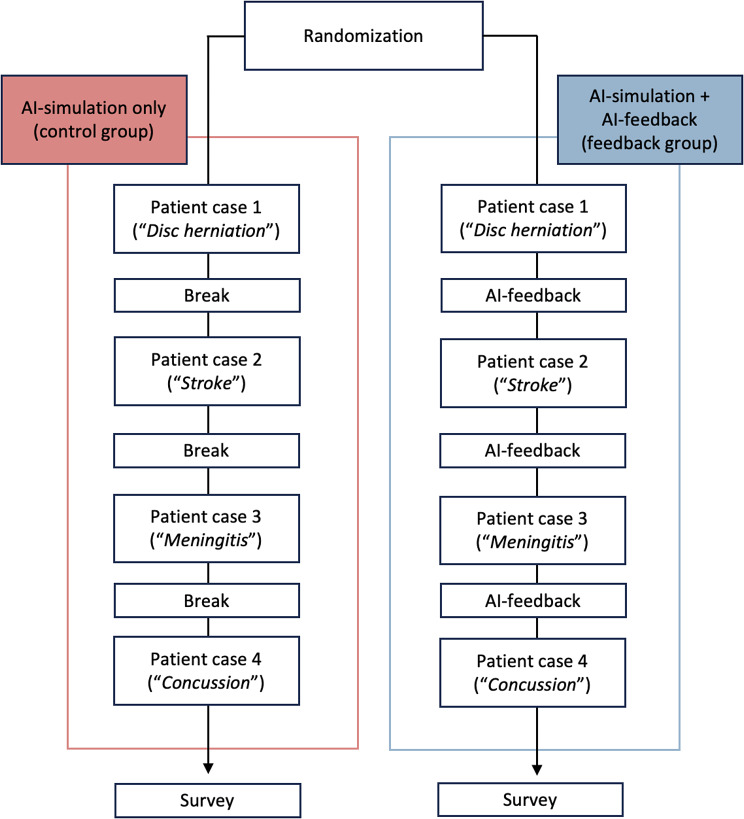
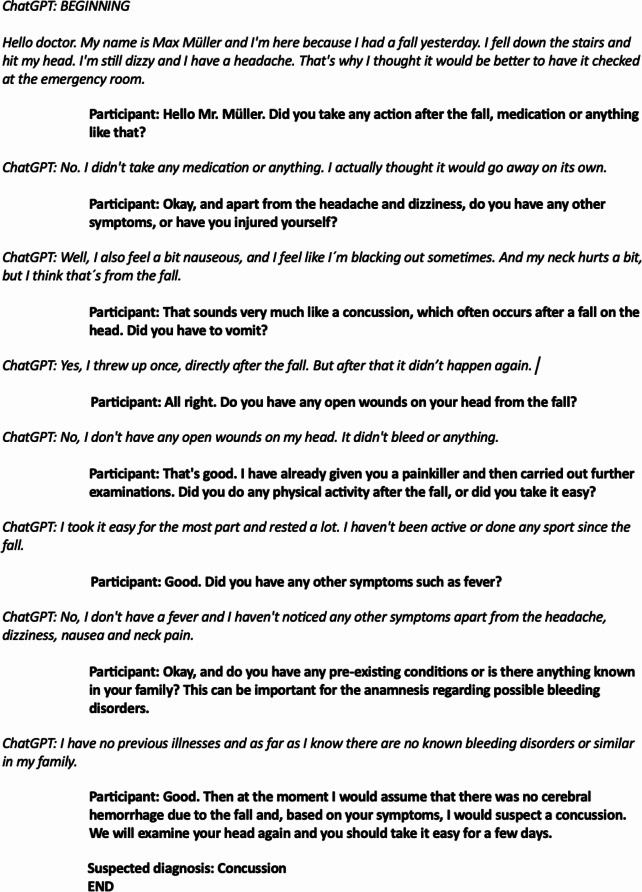
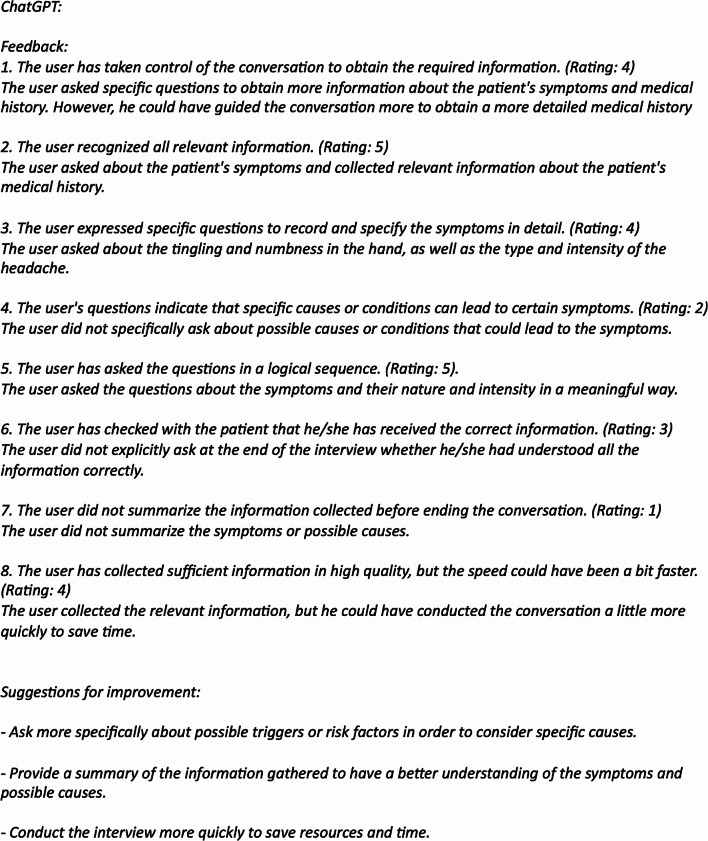
- Participants completed four 6-minute simulated medical-history scenarios (herniated lumbar disc, stroke, meningitis, concussion); the feedback group received ChatGPT-generated CRI-HTI-based feedback plus three improvement suggestions after each case.
- Outcomes were rated by two blinded human raters using the German CRI-HTI; main analysis was repeated-measures ANOVA with group as between-subject factor, CRI-HTI over 3 levels as within-subject factor, and gender, age, and semester as covariates.
Limitations
- The paper states that ChatGPT 3.5’s training data only extends to January 2022, the model continues to change over time, and replication with newer versions has not been tested.
- The conversations were conducted in German, and the authors note responses may have been more precise in English because ChatGPT was originally trained on English texts.
- The sample was relatively small, limiting statistical power; this is explicitly stated by the authors.
- The authors observed that some participants adapted to model latency by combining multiple questions into one prompt, which they note does not reflect a realistic medical-history conversation.
Model-written summary. Check it against the paper before relying on it.
Integrity signals
Registry
Cites
Statistics
Figures
Verification
Claims the paper makes
2 Valid · 2 Not valid · 9 Not checked · 49 Own results and interpretations
At least one cited source doesn’t support this claim or points to a different paper, and none confirmed it — see the verdicts below.
In the paper
“Among the few studies that exist on LLM-generated patient simulations [ 21 – 24 ], none have implemented feedback or debriefing at the time of reporting.”
What the sources say
- Could not verifycites [21] Holderried F, Stegemann-Philipps C, Herschbach L, et al. A generative pretrained transformer (GPT)-powered chatbot as a simulated patient to practice history taking: prospective, mixed methods study. JMIR Med Educ. 2024;10(1). https://doi.org/10.2196/53961. sourceExperimental — accuracy not yet measured
Our copy confirms only the framing that this is one of the first LLM/GPT-powered simulated-patient studies: the Limitations section states 'As this was the first study using GPT as a simulated patient...' and the Comparison With Prior Work section notes that most prior chatbot studies 'were performed before the broad accessibility of LLMs, such as GPT,' restricted in authenticity, adaptability and transferability. No passage in our copy — including Comparison With Prior Work, Principal Findings, Limitations or Conclusion — addresses whether those LLM-generated patient simulation studies implemented feedback or debriefing; searches for 'feedback', 'debriefing', 'reflection' and automated learner feedback after the conversation returned only CUQ usability items, interface comparisons and the absence of objective skill measurement in this study itself. The specific claim that none of the cited studies reported feedback or debriefing therefore cannot be checked against this source. (LLM, conf=0.72)
- Not checked yetcites [22] Benfatah M, Marfak A, Saad E, Hilali A, Nejjari C, Youlyouz-Marfak I. Assessing the efficacy of ChatGPT as a virtual patient in nursing simulation training: a study on nursing students’ experience. Teach Learn Nurs Published Online. 2024. https://doi.org/10.1016/j.teln.2024.02.005. source
- Disputedcites [23] Scherr R, Halaseh FF, Spina A, Andalib S, Rivera R. ChatGPT interactive medical simulations for early clinical education: case study. JMIR Med Educ. 2023;9(1). https://doi.org/10.2196/49877. sourceExperimental — accuracy not yet measured
Our copy of Scherr et al. (2023) explicitly builds and reports a feedback mechanism: the Methods state they 'specified that we wanted feedback about the answers only at the end of the simulation', and Principal Findings report that 'Feedback on the efficacy of treatments at each stage is given at the end of the simulation and can be either brief (Textbox 1) or detailed (Textbox 2 and 3)', with Textbox 4 generated specifically 'to exhibit simulation feedback mechanisms' including per-step feedback and alternatives to incorrect answers on request (Limitations, Preclinical-Clinical Appropriateness). The paper does not use the word 'debriefing', but the claim's assertion that none of the cited LLM-patient-simulation studies implemented feedback is contrary to what this source reports. Thus citing it among [21-24] as a study lacking feedback/debriefing is contradicted by its own text. (LLM, conf=0.85)
Checked by a reasoning model — may be wrong.
- Not checked yetcites [24] Vaughn J, Ford SH, Scott M, Jones C, Lewinski A. Enhancing healthcare education: leveraging ChatGPT for innovative simulation scenarios. Clin Simul Nurs. 2024;87. https://doi.org/10.1016/j.ecns.2023.101487. source
plain- Asserted: passes — The authors put it forward as true.
- Checkable: passes — It can be checked against evidence.
- Load-bearing: passes — The paper’s conclusions depend on it.
- Based: passes — The paper gives a reason why it holds.
- Could not verify
A result the paper reports from its own data — it cites no other source for it, so there is none to check. The quote shows it is in the paper.
In the paper
“Specifically, the feedback group showed improvements in the CDM-subdomains creating context ( p = .046) and securing information ( p = .018), while their ability to focus questions did not improve significantly ( p = .265).”
plain- Asserted: passes — The authors put it forward as true.
- Checkable: passes — It can be checked against evidence.
- Load-bearing: unclear — It is unclear whether the paper’s conclusions depend on it.
- Based: passes — The paper gives a reason why it holds.
A result the paper reports from its own data — it cites no other source for it, so there is none to check. The quote shows it is in the paper.
In the paper
“Specifically, the feedback group showed improvements in the CDM-subdomains creating context ( p = .046) and securing information ( p = .018), while their ability to focus questions did not improve significantly ( p = .265).”
plainstates a cause- Asserted: passes — The authors put it forward as true.
- Checkable: passes — It can be checked against evidence.
- Load-bearing: passes — The paper’s conclusions depend on it.
- Based: passes — The paper gives a reason why it holds.
A result the paper reports from its own data — it cites no other source for it, so there is none to check. The quote shows it is in the paper.
In the paper
“After four scenarios, participants in the feedback group ( M = 3.604 ± 0.130; 95% CI : 3.331, 3.878) outperformed the control group ( M = 3.017 ± 0.118; 95% CI : 2.770, 3.264), in CDM, F(1,20) = 4.436, p = .049, with a strong effect size, partial η 2 = 0.198.”
- Also stated in: § Discussion · boosted
“Using an experimental design, we found that the group receiving LLM-generated feedback demonstrated a significant improvement across four clinical scenarios compared to the control group.”
boostedstates a causen = 4 ·- Asserted: passes — The authors put it forward as true.
- Checkable: passes — It can be checked against evidence.
- Load-bearing: passes — The paper’s conclusions depend on it.
- Based: passes — The paper gives a reason why it holds.
- Also stated in: § Discussion · boosted
A result the paper reports from its own data — it cites no other source for it, so there is none to check. The quote shows it is in the paper.
In the paper
“Specifically, the feedback group showed improvements in the CDM-subdomains creating context ( p = .046) and securing information ( p = .018), while their ability to focus questions did not improve significantly ( p = .265).”
plainstates a cause- Asserted: passes — The authors put it forward as true.
- Checkable: passes — It can be checked against evidence.
- Load-bearing: passes — The paper’s conclusions depend on it.
- Based: passes — The paper gives a reason why it holds.
7 more claims
Create a free account to see all 62 claims and to verify the 20 references still open.
- Probably not a substantial claim. 42
- It may state two separate claims as one. 18
Claims other papers make about this one
Each is checked against this paper’s own text: does it say what the citing paper says it does?
The source backs part of the claim, not all of it — or backs it for a different population, condition or comparison.
In the citing paper
“However, most existing research remains conceptual or exploratory, with limited empirical evidence on the practical implementation of GPT-based systems in specific skill domains.”
From Feasibility study of using GPT for history-taking training in medical education: a randomized clinical trial (2025) · cites this paper as [7]
Experimental — accuracy not yet measuredThe cited source says what the claim attributes to it.
In the citing paper
“Brügge et al. [7] reported improved decision-making through AI-facilitated simulations.”
From Feasibility study of using GPT for history-taking training in medical education: a randomized clinical trial (2025) · cites this paper as [7]
Statistics that don’t add up
Each reported p-value recomputed from its test statistic and degrees of freedom, each partial η² from its F, and each ratio, mean difference or B printed with a p checked against its own confidence interval.
Rated minor: it would not touch a result — a value no result rests on, a p-value that stays on the same side of the significance level, or a conflict that is clerical, resolved elsewhere in the paper, or outside its own findings.
In the paper
“F(1,20) = 4.436, p = .049”
Reported p = .049 · recomputed p = .048
Statistics recomputed
Every reported test result, recomputed from its test statistic and degrees of freedom. A result shows as not adding up only once an independent check has confirmed it.
- Doesn’t add upF(1, 20) = 4.436reported p = .049 · recomputed p = .048
“F(1,20) = 4.436, p = .049”
- Consistentt(18) = 0.219reported p = .829 · recomputed p = .829
“t(18) = 0.219, p = .829”
Self-check
Percentages, sums and reported differences re-computed from the paper’s own numbers.
Each contradiction between two passages listed here was confirmed by an independent check.
Rated major: it would touch a result — a value a result rests on, reported and recomputed p-values on opposite sides of the significance level, two passages that conflict with no sign which is right, or a cited work retracted before this paper was published.
In the paper
“F(1,20) = 4.436”
“partial η 2 = 0.198”
Citations
Cites
Hattie, J., & Timperley, H. (2007) · Review of Educational Research · doi:10.3102/003465430298487 · Cited by 12,905
ChatGPT for Good? On Opportunities and Challenges of Large Language Models for Education
Kasneci, E., Seßler, K., Küchemann, S., Bannert, M., Dementieva, D., Fischer, F., Gasser, U., Groh, G., Günnemann, S., Hüllermeier, E., et al. (2023) · doi:10.35542/osf.io/5er8f · Cited by 7,552
ChatGPT for good? On opportunities and challenges of large language models for education
Kasneci, E., Sessler, K., Küchemann, S., Bannert, M., Dementieva, D., Fischer, F., Gasser, U., Groh, G., Günnemann, S., Hüllermeier, E., et al. (2023) · Learning and Individual Differences · doi:10.1016/j.lindif.2023.102274 · Cited by 7,326
Kung, T. H., Cheatham, M., Medenilla, A., Sillos, C., De Leon, L., Elepaño, C., Madriaga, M., Aggabao, R., Diaz-Candido, G., Maningo, J., et al. (2023) · PLOS Digital Health · doi:10.1371/journal.pdig.0000198 · Cited by 4,115
Kung, T. H., Cheatham, M., ChatGPT, Medenilla, A., Sillos, C., De Leon, L., Elepaño, C., Madriaga, M., Aggabao, R., Diaz-Candido, G., et al. (2022) · doi:10.1101/2022.12.19.22283643 · Cited by 4,115
How does communication heal? Pathways linking clinician–patient communication to health outcomes
Street, R. L., Makoul, G., Arora, N. K., & Epstein, R. M. (2009) · Patient Education and Counseling · doi:10.1016/j.pec.2008.11.015 · Cited by 2,465
An overview of the uses of standardized patients for teaching and evaluating clinical skills. AAMC
Barrows, H. S. (1993) · Academic Medicine · doi:10.1097/00001888-199306000-00002 · Cited by 928
Large Language Model Influence on Diagnostic Reasoning: A Randomized Clinical Trial
Goh, E., Gallo, R., Hom, J., Strong, E., Weng, Y., Kerman, H., Cool, J. A., Kanjee, Z., Parsons, A. S., Ahuja, N., et al. (2024) · JAMA Network Open · doi:10.1001/jamanetworkopen.2024.40969 · Cited by 724
Clinical Reasoning Strategies in Physical Therapy
Edwards, I., Jones, M., Carr, J., Braunack-Mayer, A., & Jensen, G. M. (2004) · Physical Therapy · doi:10.1093/ptj/84.4.312 · Cited by 472
Automatic feedback in online learning environments: A systematic literature review
Cavalcanti, A. P., Barbosa, A., Carvalho, R., Freitas, F., Tsai, Y.-S., Gašević, D., & Mello, R. F. (2021) · Computers and Education: Artificial Intelligence · doi:10.1016/j.caeai.2021.100027 · Cited by 440
Cited by
Generative artificial intelligence in medicine
Teo, Z. L., Thirunavukarasu, A. J., Elangovan, K., Cheng, H., Moova, P., Soetikno, B., Nielsen, C., Pollreisz, A., Ting, D. S. J., Morris, R. J. T., et al. (2025) · Nature Medicine · doi:10.1038/s41591-025-03983-2 · Cited by 119
“Differences emerged after just four sessions—highlighting the potential of foundation models to improve the provision of tailored clinical education 96 .”
Chow, J. C. L., & Li, K. (2025) · Information · doi:10.3390/info16070549 · Cited by 84
A systematic review of ethical considerations of large language models in healthcare and medicine
Fareed, M., Fatima, M., Uddin, J., Ahmed, A., & Sattar, M. A. (2025) · Frontiers in Digital Health · doi:10.3389/fdgth.2025.1653631 · Cited by 73
Generative AI for decision-making: A multidisciplinary perspective
Albashrawi, M. A. (2025) · Journal of Innovation & Knowledge · doi:10.1016/j.jik.2025.100751 · Cited by 104
Rädel-Ablass, K., Schliz, K., Schlick, C., Meindl, B., Pahr-Hosbach, S., Schwendemann, H., Rupp, S., Roddewig, M., & Miersch, C. (2025) · BMC Medical Education · doi:10.1186/s12909-025-06756-0 · Cited by 37
“Further research supports the integration of AI and virtual training in medical education, particularly for developing clinical reasoning skills, highlighting the effectiveness of AI tools in improving students’ ability to interact with patients and make informed clinical decisions [8–10].”
Zeng, J., Qi, W., Shen, S., Liu, X., Li, S., Wang, B., Dong, C., Zhu, X., Shi, Y., Lou, X., et al. (2025) · Journal of Medical Internet Research · doi:10.2196/79091 · Cited by 78
“For example, the Clinical Reasoning Indicator-History Taking Inventory was used to measure clinical reasoning skills [20].”
InfluentialWang, Z., Fan, T.-T., Li, M.-L., Zhu, N.-J., & Wang, X.-C. (2025) · BMC Medical Education · doi:10.1186/s12909-025-07614-9 · Cited by 32
“For instance, Holderried et al. [6] demonstrated that GPT-powered simulated patients could offer automated feedback in isolated history-taking tasks, and Brügge et al. [7] reported improved decision-making through AI-facilitated simulations.”
Roveta, A., Castello, L. M., Massarino, C., Francese, A., Ugo, F., & Maconi, A. (2025) · AI · doi:10.3390/ai6090227 · Cited by 62
“AI-based simulation platforms, including conversational agents and virtual reality environments, enhance clinical decision-making, self-efficacy, and improve technical skills in immersive learning scenarios [21,25].”
InfluentialJeon, S., & Kim, H. (2025) · Computers in Biology and Medicine · doi:10.1016/j.compbiomed.2025.110614 · Cited by 56
Li, D., & Lutfi, S. L. (2026) · JMIR Medical Informatics · doi:10.2196/79039 · Cited by 48
“Robustness and stability were evaluated via paraphrase robustness [10], leak resistance [18], and rater consistency metrics, including κ [8] and intraclass correlation coefficient (ICC) [39].”
InfluentialYan, Z., Fan, K.-Q., Zhang, Q., Wu, X., Chen, Y., Wu, X., Yu, T., Su, N., Zou, Y., Chi, H., et al. (2025) · World Journal of Urology · doi:10.1007/s00345-025-05757-4 · Cited by 24
Artificial Intelligence in Medical Education: A Practical Guide for Educators
Patil, N. G., Kou, N. L., Baptista‐Hon, D. T., & Monteiro, O. (2025) · MedComm – Future Medicine · doi:10.1002/mef2.70018 · Cited by 31
Twelve tips for developing and implementing AI curriculum for undergraduate medical education
Kim, D.-H., Kang, Y. J., & Lee, Y. (2025) · Medical Education Online · doi:10.1080/10872981.2025.2585637 · Cited by 32
“These simulations can also provide structured AI-generated feedback to guide improvement [62].”
Generative artificial intelligence in healthcare simulation-based education: A scoping review
Neo, N. W. S., Gunawan, J., Levett-Jones, T., Khoo, E. T., Chua, W. L., & Liaw, S. Y. (2025) · Clinical Simulation in Nursing · doi:10.1016/j.ecns.2025.101819 · Cited by 15
Large Language Model-Based Virtual Patient Simulations in Medical and Nursing Education: A Review
Jo, Y.-W., Lee, M., & Yang, H.-J. (2025) · Applied Sciences · doi:10.3390/app152211917 · Cited by 25
Hack, S., Attal, R., Yogev, D., Alsleibi, S., Gvili, B., Shahal, D., & Glikson, E. (2025) · Family Practice · doi:10.1093/fampra/cmaf087 · Cited by 16
Assessing the Accuracy of Diagnostic Capabilities of Large Language Models
Urdă-Cîmpean, A. E., Leucuta, D., Drugan, C., Duţu, A., Călinici, T., & Drugan, T. (2025) · Diagnostics · doi:10.3390/diagnostics15131657 · Cited by 19
“…also worth highlighting, in this same direction, the approach of Brügge et al., who have taken the next step in the use of LLMs for medical training by attempting to integrate ChatGPT into the education of future medical students [29]—an approach that our work will likely follow in the near future.”
Kıyak, Y. S., Emekli, E., Kara, T. İ., Çoşkun, Ö., & Budakoğlu, I. İ. (2025) · Journal of surgical education · doi:10.1016/j.jsurg.2025.103639 · Cited by 23
Chan, H. M., Ho, K. H. M., & Dias, J. M. (2025) · Clinical Simulation in Nursing · doi:10.1016/j.ecns.2025.101795 · Cited by 15
Altermatt, F. R., Neyem, A., Sumonte, N. I., Villagrán, I., Mendoza, M., Lacassie, H. J., & Delfino, A. E. (2025) · BMC Medical Education · doi:10.1186/s12909-025-08084-9 · Cited by 15
“By benchmarking these capabilities within a real-world exam context, we intend to advance the safe integration of LLMs in healthcare [6, 7].”
Education, Neuroscience, and Technology: A Review of Applied Models
de la Cruz, E. G., Gago-Valiente, F.-J., Gavín-Chocano, Ó., & Navío, E. P. (2025) · Information · doi:10.3390/info16080664 · Cited by 33
Basil, M., Ahmed, W., Hajeomar, R., Strawbridge, J., Lynch, M. R., & Mukhalalati, B. (2026) · BMC Medical Education · doi:10.1186/s12909-025-08527-3 · Cited by 23
GenAI-Supported Virtual Patients in Health Care Education: Systematic Review
Jiang, J., Ye, M. Z., Kwok, T. T.-O., & Wong, J. Y. H. (2026) · Journal of Medical Internet Research · doi:10.2196/82756 · Cited by 24
“First, in terms of input methods, 11 of 15 studies reported that participants interacted with the virtual patient by entering text [33-35, 37, 39-41 39-41, 43,47].”
InfluentialÖzer, N. E., Balci, Y., Bölükbaşı, G., İlhan, B., & Güneri, P. (2025) · European Journal Of Dental Education · doi:10.1111/eje.70034 · Cited by 12
“Additionally, adaptive learning platforms powered by LLMs personalise content delivery, addressing specific knowledge gaps and reinforcing areas where students need additional support [14].”
Cole, H. S., Lindley, M., & Senetza, A. (2025) · Clinical Simulation in Nursing · doi:10.1016/j.ecns.2025.101858 · Cited by 17
Ardila, C. M., Pineda‐Vélez, E., & Vivares‐Builes, A. M. (2025) · Dentistry Journal · doi:10.3390/dj13110489 · Cited by 13
“Emerging evidence shows that AI-generated individualized feed-back can positively influence learner performance in medical education [37], and LLM-supported simulations can structure clinical reasoning and provide actionable feedback for improvement [38].”
Susceptibility of Large Language Models to User-Driven Factors in Medical Queries
Lim, K. H., Kang, U., Li, X., Kim, J. S., Jung, Y., Park, S. J., & Kim, B.-H. (2025) · Journal of Healthcare Informatics Research · doi:10.1007/s41666-025-00218-4 · Cited by 17
Kıyak, Y. S., İş-Kara, T., & Emekli, E. (2026) · Medical Science Educator · doi:10.1007/s40670-025-02621-3 · Cited by 14
Lai, N. M., Lim, Y. S., Thein, W. M., Bhargava, P., Thomas, P., & Ong, Q. C. (2026) · JMIR Medical Education · doi:10.2196/88933 · Cited by 14
One shot at trust: building credible evidence for medical artificial intelligence
Kouzy, R., Hong, J. C., & Bitterman, D. S. (2025) · The Lancet Digital Health · doi:10.1016/j.landig.2025.100883 · Cited by 4
Controlled Yet Natural: A Hybrid BDI-LLM Conversational Agent for Child Helpline Training
Owayyed, M. A., Denga, A., & Brinkman, W. (2025) · ACM International Conference on Intelligent Virtual Agents (IVA) · doi:10.1145/3717511.3747075 · Cited by 8
Müller, Y., Lemberg, H., Gellert, P. R., & Zoellick, J. C. (2026) · JMIR Medical Education · doi:10.2196/88092 · Cited by 7
“Previous proof-of-concept and feasibility studies have demonstrated that GPT technologies can be used as sophisticated role-prompted simulations in medical education [25-34].”
Managing Clinical Uncertainty: Formalizing Management Reasoning in Emergency Care Delivery
Haimovich, A. D., Janke, A. T., Kocher, K. E., Mangus, C. W., Parsons, A. S., McCoy, L. G., Taylor, R. A., Rodman, A. M., & Pusic, M. V. (2025) · Annals of Emergency Medicine · doi:10.1016/j.annemergmed.2025.09.007 · Cited by 6
Cai, H., Wang, C., Zhang, Y., Ding, H., Hong, W., Zhao, Y., Cheng, S., & Wang, Y. (2026) · Diagnostics · doi:10.3390/diagnostics16040616 · Cited by 3
“Research also indicates that integrating LLMs into clinical decision-making (CDM) training for medical students offers a cost-effective supplement to existing teaching methods [13].”
The Evolving Role of AI in Simulation-Based Medical Education: A Narrative Review
Hasan, S. H., Ahmed, A., & Ismail, F. (2026) · Advances in Medical Education and Practice · doi:10.2147/amep.s581691 · Cited by 7
“20,21 However, this personalized learning often occurs in isolation and may reduce opportunities for collaborative learning, which is integral to healthcare students.”
Thind, B. S., Javidi, D., & Schwartz, L. M. (2026) · Frontiers in Digital Health · doi:10.3389/fdgth.2026.1830254 · Cited by 6
“…patients or generative clinical simulations, making this the most mature and widely implemented category to date, as reflected by publication volume, diversity of institutional contexts, and frequency of curricular deployment across the included literature (14, 17 – 19, 41 – 43, 46 – 49, 52).”
Déniz, C., Marcé, J., Macía, I., Rivas, F., Muñoz, A., Paradela, M., García, S., Moreno, C., Serratosa, I., García, M., et al. (2025) · Frontiers in Digital Health · doi:10.3389/fdgth.2025.1633278 · Cited by 7
Kermansaravi, M., Monami, M., & COHEN, R. V. (2025) · Diabetology & Metabolic Syndrome · doi:10.1186/s13098-025-02012-z · Cited by 5
“AI-simulated patients (ASP), powered by LLMs and generative AI, are rapidly transforming medical education and clinical training [13].”
Figueroa, R. A., Bernales, M., Hoeboer, C. M., & Olff, M. (2026) · European Journal of Psychotraumatology · doi:10.1080/20008066.2026.2616976 · Cited by 2
“Trainees can practice conversations repeatedly and flexibly, addressing traditional limitations of psychosocial intervention simulations, such as the limited availability of standardized patients and faculty (Brügge et al., 2024).”
Large Language Model-Based Virtual Patients for Simulated Clinical Learning: A Scoping Review
Gandhi, B., Morjaria, L., Illamperuma, I., Nadesan, P., Arora, A., & Sibbald, M. (2026) · AI in Medicine · doi:10.3390/aimed1010007 · Cited by 7
“In general, student/faculty perceptions were not notably different for this or other models with higher levels of integration, although limitations such as issues with server capacity were noted [7,17,18].”
Large language models for primary care ophthalmic education: a systematic review
Li, S., Wang, X., Chen, Y., Tian, M., Lin, P., Lai, M., & Jiang, L. (2026) · Frontiers in Medicine · doi:10.3389/fmed.2026.1810098 · Cited by 4
“A randomized controlled trial (RCT) by Brügge et al. (19) provides robust evidence for the application of LLMs in simulation-based education.”
Fruitman, H., Severin, S., Miah, A., Gao, C., Gim, H., Qian, C., Park, S.-O., Hou, K., Kong, E. L., Cook, B., et al. (2026) · Neurology Education · doi:10.1212/ne9.0000000000200320 · Cited by 3
“4,23 Br¨ugge and colleagues 17 showed that LLM-generated feedback for CBL improves clinical decision-making skills among medical students using a static, traditional format.”
Problem-based learning in the age of generative AI: A structured blueprint for medical curricula
Safarov, R., Wippermann, J., Meyer, F., & Wacker, M. (2026) · Zeitschrift für Evidenz Fortbildung und Qualität im Gesundheitswesen · doi:10.1016/j.zefq.2026.03.012 · Cited by 3
Who Does What? Archetypes of Roles Assigned to LLMs During Human-AI Decision-Making
Chappidi, S., Singh, J., & Krauze, A. V. (2026) · CHI Conference on Human Factors in Computing Systems · doi:10.1145/3772318.3791428 · Cited by 8
Shafiullah (2025) · World Journal of Urology · doi:10.1007/s00345-025-05832-w · Cited by 4
Zhang, W., Daniels, B., Mita, C., Nguyen, H. D. N., & Duong, D. (2026) · doi:10.2196/preprints.92826 · Cited by 2
Exploring the application of generative artificial intelligence in nursing: a cross-sectional study
Wu, J., Yang, M., Wei, X., Zheng, Y., & Deng, J. (2026) · Frontiers in Public Health · doi:10.3389/fpubh.2026.1689418 · Cited by 1
Liu, Y., Zhu, Y., Zhang, W., Lu, X., Wu, L., Yue, M., Xia, O., & Shi, C. (2026) · JMIR Medical Education · doi:10.2196/89367 · Cited by 3
“This is consistent with previous work showing that AI-driven virtual SPs can serve as a cost-efficient supplement to traditional SP training [42], reducing personnel and logistical costs while providing scalable and flexible practice opportunities that can be integrated seamlessly into the…”
Chen, N., Tang, L., Liu, Y., Lin, C., Li, Z., Shi, C., Shi, C., Xia, M., Gašević, D., Gašević, D., et al. (2026) · JMIR Medical Education · doi:10.2196/84347 · Cited by 5
“Recent GenAI-enabled training systems highlight the feasibility of scalable simulation and feedback (eg, Brügge et al [34]) but commonly rely on existing inventories rather than modeling fine-grained dialogue behaviors.”
AI on Trial: LLM-as-a-Judge for Private and Reliable Clinical Decision-Making
Khan, T. A., Rafiq, M., & Michalas, A. (2025) · Annual Computer Security Applications Conference Workshops (ACSAC Workshops) · doi:10.1109/acsacw69556.2025.00033 · Cited by 2
Large Language Models in der Rheumatologie
Knitza, J., & Hügle, T. (2026) · Zeitschrift für Rheumatologie · doi:10.1007/s00393-026-01803-7 · Cited by 1
An Interactive LLM-Based Simulator for Dementia-Related Activities of Daily Living
Gangaraju, K., Wung, S.-F., Berner, K., Wang, J., & Yuan, F. (2026) · IEEE/ACM Conference on Connected Health: Applications, Systems and Engineering Technologies · doi:10.1109/chase69719.2026.00024 · Cited by 1
“Users configure the dementia stage (e.g., early, moderate, or late), care setting, and ADL scenario; the simulator then generates verbal utterance paired with nonverbal/behavioral cues (in parentheses) to support stage-and context-conditioned interaction.”
Al-Azzam, A. A. M., Alkhateeb, Z., Shahin, A., et al. (2026) · Saudi Journal of Anaesthesia · doi:10.4103/sja.sja_903_25 · Cited by 1
“[23,24]”
Chuan, A., & Nanda, M. (2026) · Anesthesiology · doi:10.1097/aln.0000000000005933 · Cited by 1
Experiential Learning Models in Undergraduate Medical Education: A Systematic Review
Gupta, D. K., & Kumar, R. (2026) · Current Medical Issues · doi:10.4103/cmi.cmi_164_25 · Cited by 1
Ren, K., Weng, Q., Chen, Q., Li, H., Xie, D., Zeng, C., Wei, J., Lei, G., & Wang, Y. (2026) · Journal of Orthopaedic Surgery and Research · doi:10.1186/s13018-026-06844-x · Cited by 1
Clinical deskilling in the age of artificial intelligence: a framework for responsible integration
Ostrer, I. R., & Yang, D. (2026) · BMJ Digital Health & AI · doi:10.1136/bmjdh-2026-000045 · Cited by 1
“8 Emerging evidence also demonstrates that clinician use of AI can enhance critical thinking.”
AI-Assisted Formative Assessment in Clinical Education: From Algorithms to Agency
Nguyen, Q. T., Ha, T. M., & Mai, T. (2026) · JMIR Medical Education · doi:10.2196/93710 · Cited by 5
“In undergraduate medical education, an LLM-based patient simulation and structured feedback intervention was evaluated in a randomized controlled trial and repor-ted short-term support for clinical decision-making practice among medical students [27].”
Kochuiev, E., Kaliuzhka, V. I., Markevych, M. A., Кочуєва, З., & Piatykop, V. O. (2026) · Acta Neurochirurgica · doi:10.1007/s00701-026-06954-9 · Cited by 1
Abreu, D., & Perdomo, A. S. (2026) · RELIEVE - Revista Electrónica de Investigación y Evaluación Educativa · doi:10.30827/relieve.v32i1.36446 · Cited by 1
Jia, Z., Dai, D. W., Aryadoust, V., & Hua, Z. (2026) · Research Synthesis in Applied Linguistics · doi:10.1080/29984475.2026.2694603 · Cited by 1
Luo, Y., Ge, T., Luo, X., Lin, Z., Li, M., & Ke, B. (2026) · Frontiers in Medicine · doi:10.3389/fmed.2026.1868565 · Cited by 1
“This finding aligns with recent studies in AI-assisted medical training (31–33).”
Ye, Y., Tao, H., Huang, S., Zou, M., Chen, Y., Shen, P., Hao, M., & Liu, C. (2026) · Frontiers in Medicine · doi:10.3389/fmed.2026.1904001 · Cited by 1
Saloojee, H., Gramanie, M. C., Mwale, R., Bassett, B. A., Madhi, S. A., & Kalla, I. (2026) · Medical Teacher · doi:10.1080/0142159x.2026.2652061 · Cited by 9
Aljamaan, F., Mubarak, M., Altamimi, I., Alanteet, A. A., Alsalman, M., Dasuqi, S. A., Alballaa, R., Alarifi, M. I., Saadon, A. A., Alhaqbani, A. O., et al. (2025) · Research Square · doi:10.21203/rs.3.rs-6222830/v1
Large Language Models for the assessment of medical students’ clinical decision-makingPreprint
Benker, S. C., Vollprecht, J., Papan, C., Lu, M. H., & Darici, D. (2025) · Research Square · doi:10.21203/rs.3.rs-6660928/v1
Self-citationChen, N., Tang, L., Liu, Y., Lin, C., Li, Z., Shi, C., Shi, C., Xia, M., Gašević, D., Gašević, D., et al. (2025) · doi:10.2196/preprints.84347
KI im Medizinstudium – Wer nutzt es? Was bringt es?
Bäumken, M., Perau, T. P., & Berger, M. S. (2025) · Zeitschrift für Orthopädie und Unfallchirurgie · doi:10.1055/a-2652-5431
Lai, N. M., Lim, Y. S., Thein, W. M., Bhargava, P., Paraidathathu, T., & Ong, Q. C. (2025) · doi:10.2196/preprints.88933
Political Ideology Shifts in Large Language Models
Bernardelle, P., Civelli, S., Fröhling, L., Lunardi, R., Roitero, K., & Demartini, G. (2026) · Information Processing & Management · doi:10.1016/j.ipm.2026.105124 · Cited by 14
Trojacka, E., Przybek-Skrzypecka, J., Izdebska, J., Szaflik, J. P., Qazi, M. A., Azhar, A., & Skrzypecki, J. (2025) · Journal of Clinical Medicine · doi:10.3390/jcm15010283 · Cited by 1
Saloojee, H., Gramanie, M. C., Mwale, R., Bassett, B. A., Madhi, S. A., & Kalla, I. (2026) · doi:10.12688/verixiv.2318.1
Montano, I. H., Alonso, S. G., Martínez‐Licort, R., de Abajo, B. S., Díez, I. D. L. T., Miramontes‐González, J. P., Simon, M., Figuero, L. B., & Gudino, L. C. (2026) · Lecture notes in networks and systems · doi:10.1007/978-3-032-10731-2_13 · Cited by 1
Using ChatGPT to Reduce Academic Misconduct in a Systems Analysis Course: a Case Study
Mason, R., Seton, C., & Benson, J. (2026) · Communications in computer and information science · doi:10.1007/978-3-032-13056-3_1
Safdar, A., Iftikhar, H., Arshad, H. A., Anwar, M., Khan, A. Q., & Kanwal, S. (2025) · VAWKUM Transactions on Computer Sciences · doi:10.21015/vtcs.v13i2.2278
Hu, Y., Wang, Y., Watanabe, B., Gao, M., Qin, Z., Shi, K., Zhang, Z., Shambanna, S., Xue, Z., Zou, T., et al. (2026) · Research Square · doi:10.21203/rs.3.rs-8588902/v1 · Cited by 1
Feeding the Brain and Selling the Soul: The Ambivalences of Doing Work by Talking to Machines
Gray, E. S., Kochever, K. M., & Zarei, N. (2025) · Ethnographic Praxis in Industry Conference Proceedings · doi:10.1111/epic.70029
Large language models in trauma anesthesia education
Corpman, D. W., Lang, E., & Law, T. J. (2026) · Current Opinion in Anaesthesiology · doi:10.1097/aco.0000000000001617
Can AI Match Human Experts? Evaluating LLM-Generated Feedback on Resident Scholarly ProjectsPreprint
van Allen, Z., Forgues-Martel, S., Venables, M. J., Ghanney, Y., Villeneuve, A., Dongmo, J. B., Ahmed, M., Archibald, D., & Jolin‐Dahel, K. (2026) · medRxiv · doi:10.64898/2026.03.04.26346878 · Cited by 1
Johnston, S. J., McFadden, S. L., Glass, D. H., McFeeters, C., & Marley, J. (2026) · JMIR Research Protocols · doi:10.2196/preprints.95709
Olugbuyi, O., & Innis, K. (2026) · doi:10.2196/preprints.96105
Kim, S., Ji, M., Kim, C. Y., Yun, Y. I., Lee, G., Yoon, C. H., & Kim, M. K. (2026) · BMC Ophthalmology · doi:10.1186/s12886-026-04767-z
“In addition, AI-simulated medical history conversations using LLMs could have a potential use in medical student training [8].”
AI for Simulation Operations: A Framework for Administrative and Logistical Excellence
Herrington, A., & Rutherford-Hemming, T. (2026) · Simulation in Healthcare The Journal of the Society for Simulation in Healthcare · doi:10.1097/sih.0000000000000932
Sun, W., Yuan, Q., & Zhou, Q. (2026) · Frontiers in Psychology · doi:10.3389/fpsyg.2026.1798182
“The ability to filter valuable information, engage in critical thinking, and apply it effectively is a hallmark of critical consciousness transformation (Brügge et al., 2024).”
Nguyen, H., Zhang, H., Zhang, Y., Ding, J., & Chen, H. (2026) · IEEE International Conference on Artificial Intelligence Testing (AITest) · doi:10.1109/aitest70988.2026.00042 · Cited by 1
Wu, P., Han, Y., Zhang, J., Li, Y., Jiang, M., Lu, X., Zhang, H., Xu, D., Hao, M., Wang, L., et al. (2026) · medRxiv · doi:10.64898/2026.04.26.26351793
Evaluating large language models for pharmacotherapy simulations: a mixed-methods study
Farrag, A. N., El-Zeiny, A., & Ali, A. M. (2026) · npj Digital Medicine · doi:10.1038/s41746-026-02626-1 · Cited by 4
Hoang, L.-N., Joshi, P., Chahin, S. S., Ergun-Longmire, B., & Apple, R. W. (2026) · Springer eBooks · doi:10.1007/978-3-032-19116-8_1
Artificial Intelligence and Medical Distance Learning and Management
Madani, R., Richter, D. M., & Gomes, T. J. (2026) · Springer eBooks · doi:10.1007/978-3-032-19116-8_5
Castillo, E. V., Enríquez, C. R. D., Valenzuela-Domínguez, L. R., Ramírez, A. A. P., & López, S. T. (2026) · Educación Médica · doi:10.1016/j.edumed.2026.101197 · Cited by 3
“Evidence from the included randomized controlled trial by Brügge et al. 28 supports this scaffolding role, demonstrating that students who interacted with AI-simulated patients and subsequently received automated feedback achieved higher clinical decision-making scores compared to those who participated in simulation…”
InfluentialSamaraweera, S., Zaid, Z., Maheshi, B., Martínez‐Maldonado, R., & Dharmaratne, A. T. (2026) · doi:10.2196/preprints.101710
BaHammam, F. A. (2026) · JMIR Formative Research · doi:10.2196/91021 · Cited by 1
“These standardized virtual patients have been shown to generate reasonably authentic responses and provide appropriate feedback for learners [15,20,21].”
Muasher-Kerwin, C., Hughes, M. C., & Sanatizadeh, A. (2026) · JMIR Rehabilitation and Assistive Technologies · doi:10.2196/91019
“These findings extend previous work showing that LLMs can approach human-level factual performance while still lacking in cognitive depth and explainability [8].”
Sindhvananda, K., Ruengwattanachot, K., Leksuwankun, S., Pongpitakmetha, T., Hiransuthikul, A., Surawattanawong, T., Anukoolwittaya, P., & Panjasriprakarn, P. (2026) · BMC Medical Education · doi:10.1186/s12909-026-09511-1 · Cited by 3
“Our findings are broadly consistent with emerging evidence that LLM-based and other virtual patient systems can support history-taking, clinical decision-making, and learner confidence in medical education [22, 23, 26, 39].”
Rincón, E. H. H., Bastidas, J. C. K., Acevedo, S. B., & Florez, N. C. R. (2026) · Journal of Investigative Medicine · doi:10.1177/10815589261460883
Dhillon, I. K., Lee, G. K. Y., & Hu, S. (2026) · JMIR Medical Education · doi:10.2196/83376 · Cited by 1
“A strength of this study was the use of real-life clinical encounters, as opposed to previous studies’ use of simulated clinical encounters [6,7,9,17].”
Cusácovich, I., Martin, M. P., & Castro, R. G. (2026) · JMIR Formative Research · doi:10.2196/104579
Tan, F. Y. S., Ang, L. C., Ibrahim, R., Majeed, M. A., Aris, M. A. H. M., & George, S. D. (2026) · Sechenov Medical Journal · doi:10.47093/2218-7332.2026.17.1.30-40
Maimaris, S., Tedino, G., Memoli, G. A., Crisciotti, C., Albrizio, A., Sammartino, C., Bartolotta, E., Massetti, G., Mantica, G., Minerba, P., et al. (2026) · BMC Medical Education · doi:10.1186/s12909-026-09709-3
“Our findings align with and extend previous research on LLMs for clinical simulation [5, 9–11], demonstrating a comprehensive system that automates both case generation and dynamic patient simulation, evaluated through a structured multi-phase process.”
Metadata
- Authors
- Brügge, E., Ricchizzi, S., Arenbeck, M., Keller, M. N., Schur, L., Stummer, W., Holling, M., Lu, M. H., & Darici, D.
- Affiliations
- University Hospital Münster (DE)
- Harvard University (US)
- University of Münster (DE)
- Corresponding author
- Darici, Dogus
- Venue
- BMC Medical Education
- Published
- 2024-11-28
- Volume
- 24
- Issue
- 1
- Pages
- 1391-1391
- ISSN
- 1472-6920 (ISSN-L)
- PMC
- PMC11605890
- OpenAlex
- W4404795474
- Cited by
- 137
- References
- 34
- Citations by year
- 2026: 96 · 2025: 41
- FWCI
- 12.83
- Type
- journal article
- Language
- en
- Open access
- gold
- doi.org
- Licence
- cc-by
- creativecommons.org/licenses/by/4.0 (tdm)
- creativecommons.org/licenses/by/4.0 (vor)
- Locations
- BMC Medical Education (publishedVersion, cc-by)
- PubMed Central (publishedVersion, cc-by)
- PubMed (publishedVersion)
- DOAJ (DOAJ: Directory of Open Access Journals) (submittedVersion)
- Funders
- Universität Münster
- Topics
- Health Sciences › Medicine › Health Informatics › Artificial Intelligence in Healthcare and Education
- Health Sciences › Medicine › Family Practice › Clinical Reasoning and Diagnostic Skills
- Social Sciences › Education › Simulation-Based Education in Healthcare
- Keywords
- large language models, clinical decision-making, medical history, patient simulation, AI-generated feedback, medical students, clinical reasoning, AI prompts, structured feedback
- MeSH terms
- Clinical Decision-Making, Formative Feedback, Adult, Artificial Intelligence, Clinical Competence, Double-Blind Method, Education, Medical, Undergraduate, Feedback, Female, Humans, Male, Medical History Taking, Physician-Patient Relations, Students, Medical, Patient Simulation, Young Adult
About these checks
Registry, retraction, Cites and statistics results are computed, not judged, with one exception: a printed reference that no index lists is read once by a model before it counts as a citation error. Claims are extracted by a model and kept only when their quote appears verbatim in the text; each cited source is then checked, with a model’s help, for whether it says what the claim relies on. Those verdicts can be wrong — read the claim’s quote and the cited source before relying on one.
The claim verdicts this report counts are experimental: their accuracy is not yet measured.
A language model drew the claims from the paper on 2026-10-11, under version 3 of the claim definition (model deepseek-v4.1-flash, prompt extract-v3).
A second model labelled each claim on 2026-10-11 (model jev-1.13-20260917, definition revision gold-guideline-v0.2).
Cited sources are checked with a language model’s help (qwen3.8-omni-flash).
Statistics and arithmetic are recomputed, not judged.
Confidence bands are shown only for fields calibrated on our annotated test set. None is calibrated yet, so no band is shown.
What counts as a claim ›How we measure confidence ›How we check this ›
Are you an author, or do you see a problem with this page? Request a review
Data sources
Bibliographic data: Semantic Scholar, OpenAlex, Crossref.
Contains information from the Semantic Scholar Academic Graph Datasets, made available under the ODC Attribution License (ODC-BY 1.0).
Semantic Scholar’s data is described in: Kinney, R., et al. (2023). The Semantic Scholar Open Data Platform. arXiv:2301.10140.
