

Ethics education to support ethical competence learning in healthcare: an integrative systematic review
Open accessThe DOI matches its Crossref record; 84 of the 84 references it cites were found in a registry or an index; 42 of the 165 sources its claims cite were checked for support.
Abstract
Integrative systematic review exploring ethics education that promotes ethical competence learning for healthcare professionals and students.
Overview
CoChat Summary
TL;DR
This integrative systematic review synthesized 40 articles on ethics education for healthcare professionals and students, identifying support, awareness of one’s own thoughts and perceptions, and doing right by the patient’s best interests as key aspects of ethical competence learning. It concludes that varied designs and course content can support readiness to recognise and respond to ethically problematic work situations, though education does not necessarily change ethical behaviour or practice.
Key findings
- The review included 40 articles. Most studies were conducted in the United States (n = 5) and Taiwan (n = 5); by continent, 17 were from Asia, 14 from Europe, six from North America, and three from Australia.
- Three main themes were identified: making ethical competence learning possible (discussed in 32 articles), having awareness of one’s own thoughts and perceptions (22 articles), and doing right by the patient’s best interests (19 articles).
- Educational strategies included theoretical lectures and literature, workshops, case studies and problem-solving sessions, role-play or simulation, narratives and storytelling, and small-group discussions. Conditions emphasised included real work situations, clear learning objectives, time for reflection, an open atmosphere, and psychological safety.
- Ethical competence learning helped healthcare professionals and students notice ethical problems they were not previously aware of, but the review also notes that ethics education does not always lead to changed management of ethical problems in everyday clinical practice.
Methods
- Integrative systematic review following Whittemore and Knafl, with a PROSPERO protocol (CRD42019123055) and PRISMA standards. Searches used PubMed, CINAHL, and PsycInfo on 22–23 June 2020, plus a supplementary search on 10 January 2022, with terms including ‘health personnel’, ‘students’, ‘ethics’, ‘moral’, ‘simulation’, and ‘teaching’; limits were English, peer-reviewed, and published 2010–2021.
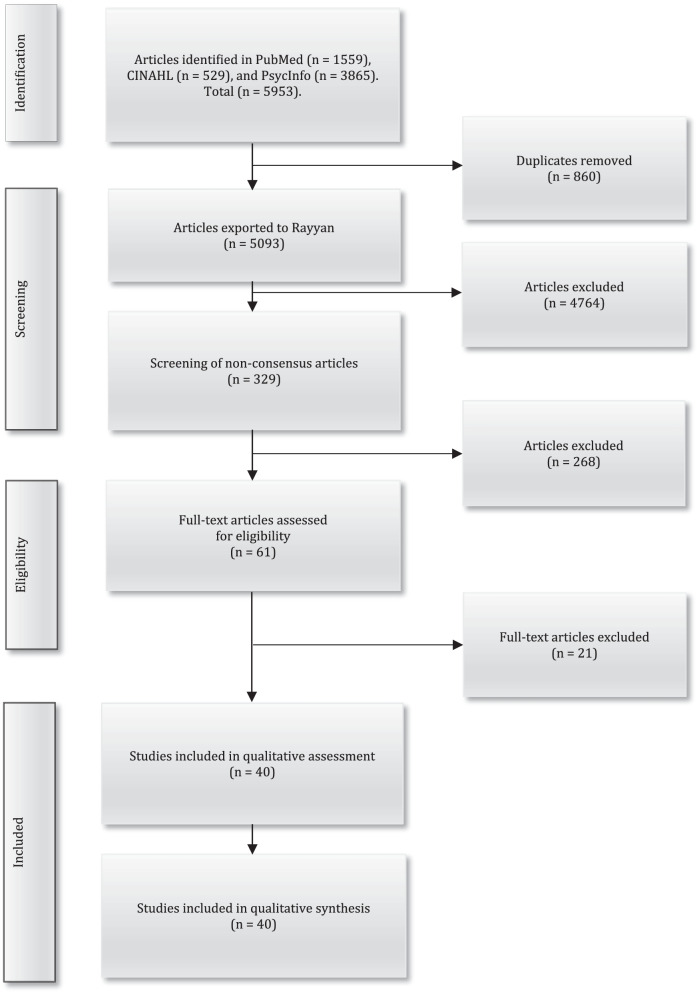
- The search resulted in 5,953 articles (PubMed 1,559; CINAHL 529; PsycInfo 3,865). After excluding duplicates (n = 860), 5,093 articles were imported into Rayyan QCRI; four authors screened titles and abstracts, 61 articles underwent full-text review, and 40 articles were included.
- Data were synthesised using thematic analysis in six phases, generating 228 initial codes; themes were discussed among authors until consensus was reached.
Limitations
- The paper states that the broad literature search may yield more irrelevant articles and is time-consuming, with a risk that relevant articles were accidentally deleted, weakening validity; this risk was partly managed by involving four authors in screening. It also states that excluding grey literature may have affected validity, that using three databases available at a university in western Sweden may have missed articles due to license limits, that the educators’ perspective was deliberately not included, and that transferability is limited to contexts with similar cultural, economic, and social conditions.
- Evident in the text: data analysis was conducted by the first author, although interpretation of themes was discussed with co-authors; quality assessment involved disagreements between two assessors that were resolved through discussion, and no articles were excluded due to a low-quality score.
Model-written summary. Check it against the paper before relying on it.
Integrity signals
Registry
Cites
Statistics
Figures
Verification
Claims the paper makes
33 Valid · 7 Not valid · 61 Not checked · 42 Own results and interpretations
Every source the paper cites for this claim was checked and supports it.
In the paper
“Thus, ethical competence risks being hampered by limited reflection and moral reasoning about the situation as a whole [29].”
§ Ethics education to support ethical competence learning in healthcare: an integrative systematic review > Background
What the sources say
- Supportedcites [29] Mpeli M Analysis of self-evaluated ethical competence of midwifery students at a selected nursing college in the Free State Curationis 2018 41 1 e1 e9 10.4102/curationis.v41i1.1925 PMC6131694 30198296 source
The Conclusion reports that students’ ethical competence was limited: their narratives lacked moral judgment and showed only intuitive, rather than critical, moral reasoning. The ‘Justification for beneficence and non-maleficence’ section also says ethical reasoning requires analysing the situation and reflecting on others’ perspectives, rather than merely following principles. (LLM, conf=0.91)
states a possible cause- Asserted: passes — The authors put it forward as true.
- Checkable: passes — It can be checked against evidence.
- Load-bearing: unclear — It is unclear whether the paper’s conclusions depend on it.
- Based: passes — The paper gives a reason why it holds.
- Supported
The cited sources support only part of this claim — read each source’s verdict below.
In the paper
“Healthcare professionals and students in clinical practice are confronted daily with difficult choices and must cope with questions of ‘rightness’ or ‘wrongness’ that influence their decision-making and the quality of the care provided [11, 12].”
§ Ethics education to support ethical competence learning in healthcare: an integrative systematic review > Background
What the sources say
- Partly supportedcites [11] Ulrich CM Taylor C Soeken K O’Donnell P Farrar A Danis M Everyday ethics: ethical issues and stress in nursing practice J Adv Nurs 2010 66 11 2510 2519 20735502 PMC3865804 sourceExperimental — accuracy not yet measured
The Introduction says moral questions of “rightness” or “wrongness” can underlie healthcare decisions and patient care, and the Results report frequent or daily encounters with several ethical issues among nurses. The paper does not establish that students, or healthcare professionals generally, confront such choices daily. (LLM, conf=0.85)
- Not checked — no full text of the sourcecites [12] Torabi M Borhani F Abbaszadeh A Atashzadeh-Shoorideh F Barriers to ethical decision-makingfor pre-hospital care professionals Nurs Ethics 2020 27 2 407 418 31185799 source
plainstates a cause- Asserted: passes — The authors put it forward as true.
- Checkable: passes — It can be checked against evidence.
- Load-bearing: passes — The paper’s conclusions depend on it.
- Based: passes — The paper gives a reason why it holds.
- Partly supported
Every source the paper cites for this claim was checked and supports it.
In the paper
“An open atmosphere and interaction between participants are important in ethics education when sensitive issues are discussed [69].”
§ Ethics education to support ethical competence learning in healthcare: an integrative systematic review > Results > Making ethical competence learning possible
What the sources say
- Supportedcites [69] Kuhn E Lunden L Moysich P Rogge K Roscher M Caning L Ethik First: extracurricular support for medical students and young physicians facing moral dilemmas in hospital routine GMS J Med Educ 2021 10.3205/zma001470 PMC8136346 34056063 source
The Results section reports that participants positively highlighted an open atmosphere, open interaction with one another and with difficult issues, and a culture of open discussion. The Project description (2.1, Concept) also describes a safe small-group space for ethical discourse. (LLM, conf=0.93)
plainstates an association- Asserted: passes — The authors put it forward as true.
- Checkable: passes — It can be checked against evidence.
- Load-bearing: unclear — It is unclear whether the paper’s conclusions depend on it.
- Based: passes — The paper gives a reason why it holds.
- Supported
The cited sources support only part of this claim — read each source’s verdict below.
In the paper
“Skills can be practiced through workshops [49], case studies and problem-solving sessions [37, 43, 47, 48, 50–53].”
§ Ethics education to support ethical competence learning in healthcare: an integrative systematic review > Results > Making ethical competence learning possible
What the sources say
- Partly supportedcites [49] Mohammadi M Sheikhasadi M Mahani S Taheri A Sheikhbardsiri H Abdi K The effect of bio ethical principles education on ethical attitude of prehospital paramedic personnel J Educ Health Promot 2021 31 10 289 10.4103/jehp.jehp_708_20 PMC8459844 34667789 sourceExperimental — accuracy not yet measured
The Materials and Methods (Intervention; page not provided) describe a workshop for teaching bioethical principles to paramedics, supporting the workshop part of the cited phrase. The reported outcome was improved ethical attitude, not practice or improvement of skills. Citation [49] is attached only to “workshops,” so the case-study and problem-solving parts are not assessed against this source. (LLM, conf=0.83)
- Not checked — no full text of the sourcecites [37] Schonfeld T Johnson K Seville E Suratt C Goedken J Differences between two methods of ethics education: focus group results Ethics Soc Welf 2015 9 3 240 254 source
- Supportedcites [43] Hem MH Molewijk B Gjerberg E Lillemoen L Pedersen R The significance of ethics reflection groups in mental health care: a focus group study among health care professionals BMC Med Ethics 2018 19 54 10.1186/s12910-018-0297-y 29871682 PMC5989396 source
The Results (Experiences from systematic reflection on ethical challenges; page unavailable) report that discussing ethical cases helped participants identify challenges, consider alternative actions, and develop professional competence. This supports the case-based problem-solving part of the sentence. The workshop claim has a separate citation and is not attributed to this source. (LLM, conf=0.86)
- Not checked — no full text of the sourcecites [47] Yeom H-A Ahn S-H Kim S-J Effects of ethics education on moral sensitivity of nursing students Nurs Ethics 2017 24 6 644 652 26811393 source
- Supportedcites [48] Harasym PH Tsai T-C Munshi FM Is problem-based learning an ideal format for developing ethical decision skills? Kaohsiung J Med Sci 2013 29 523 529 24099106 PMC11915924 source
The 'Teaching and learning in ethics' section states directly that, in the MER (Medical Ethical Reasoning) model, 'the identified skills can be learned through small group problem-solving sessions, assignments, observations, and case studies'. This matches the part of the citing sentence attached to this reference (skills practised through case studies and problem-solving sessions); 'workshops' is credited to a different reference [49] and is not attributed here. The paper's related discussion (same section) reinforces that PBL/case-based formats are used to refine ethical problem-solving behaviour. (LLM, conf=0.90)
- Not checked — no full text of the sourcecites [50] Monteverde S Undergraduate healthcare ethics education, moral resilience, and the role of ethical theories Nurs Ethics 2013 21 4 385 401 24311237 source
- Partly supportedcites [51] Lin Y-C Chan T-F Lai C-S Chin C-C Chou F-H Lin H-J The impact of an interprofessional problem-based learning curriculum of clinical ethics on medical and nursing students’ attitudes and ability of interprofessional collaboration: a pilot study Kaohsiung J Med Sci 2013 29 505 511 24018155 PMC11916136 sourceExperimental — accuracy not yet measured
Our copy supports the case-study / problem-solving part of the claim: the Introduction (p. 1) states that an interprofessional PBL curriculum 'would be a good and feasible approach for students to foster communication and collaboration skills', and the Abstract and The curriculum design (p. 1-2) describe a curriculum built around 'one PBL case study with two tutorial sessions' plus a multiperspective narrative used in sequential PBL tutorial sessions, with students' learning of interprofessional collaborative skills assessed by questionnaire. However, no passage in our copy mentions workshops as a means of practicing skills — the only other taught element is a 2-hour lecture and a feedback session — so the workshop component of the claim is not attributable to this source. (LLM, conf=0.72)
- Not checked — no full text of the sourcecites [52] Chou FC Kwan C-Y Hsin D Examining the effects of interprofessional problem-based clinical ethics: findings from a mixed methods study J Interprof Care 2016 30 3 362 369 27152541 source
- Not checked — no full text of the sourcecites [53] McCormick AJ Stowell-Weiss P Carson J Tebo G Hanson I Quesada B Continuing education in ethical decision making using case studies from medical social work Soc Work Health Care 2014 53 4 344 363 24717183 source
plainstates a cause- Asserted: passes — The authors put it forward as true.
- Checkable: passes — It can be checked against evidence.
- Load-bearing: unclear — It is unclear whether the paper’s conclusions depend on it.
- Based: passes — The paper gives a reason why it holds.
- Partly supported
Every source the paper cites for this claim was checked and supports it.
In the paper
“Nevertheless, support and learning activities do not necessarily promote ethical competence learning.”
§ Ethics education to support ethical competence learning in healthcare: an integrative systematic review > Results > Making ethical competence learning possible
What the sources say
- Supportedcites [67] Martins V Santoss C Duarte I Bioethics education and the development of nursing students' moral competence Nurse Educ Today 2020 95 104601 10.1016/j.nedt.2020.104601 33010668 source
The Discussion (Sec. 7) states that in this study 'the teachers promoted discussion in small groups about some ethical dilemmas, which we believe might have contributed to the nursing students' development of moral competence; however, this is not reflected in the results,' and that students 'revealed moral stagnation, which suggests that educational programs do not have enough impact on the moral competence of nursing students.' The Introduction (Sec. 1) likewise records that despite the range of pedagogical strategies used (theoretical-practical classes, tutorial orientation, film analysis, group work, debates, case studies, games), students still highlighted the need for further debate and analysis of practical cases. Together these support the hedged paraphrase that support and learning activities do not necessarily promote ethical/moral competence learning; the source's evidence base is a single Portuguese second-year nursing sample with no prior clinical experience, which the claim's 'not necessarily' phrasing accommodates. (LLM, conf=0.85)
- Supportedcites [68] Martins V Santos C Bataglia P Duarte I The teaching of ethics and the moral competence of medical and nursing students Health Care Anal 2021 29 2 113 126 10.1007/s10728-020-00401-1 32944887 PMC8106588 source
The Conclusion reports that most nursing and medical students showed stagnation or regression in moral competence after ethics education, supporting the cautious claim that learning activities do not necessarily improve it. The Limitations section notes that changes in scores cannot be attributed directly to the teaching, a qualification consistent with the claim’s wording. (LLM, conf=0.89)
plain- Asserted: passes — The authors put it forward as true.
- Checkable: passes — It can be checked against evidence.
- Load-bearing: passes — The paper’s conclusions depend on it.
- Based: passes — The paper gives a reason why it holds.
- Supported
68 more claims · 16 with their cited sources checked
Create a free account to see all 143 claims and to verify the 20 references still open.
- Probably not a substantial claim. 50
- It may state two separate claims as one. 31
Claims other papers make about this one
Each is checked against this paper’s own text: does it say what the citing paper says it does?
The source backs part of the claim, not all of it — or backs it for a different population, condition or comparison.
In the citing paper
“Internship nursing students experience many ethical issues in the clinical environment.”
From Experiences of internship nursing students in confronting ethical issues: a qualitative study (2025) · cites this paper as [7]
Experimental — accuracy not yet measured
Citations
Cites
Using thematic analysis in psychology
Braun, V., & Clarke, V. (2006) · Qualitative Research in Psychology · doi:10.1191/1478088706qp063oa · Cited by 194,414
Rayyan-a web and mobile app for systematic reviews.
Ouzzani, M., Hammady, H., Fedorowicz, Z., & Elmagarmid, A. (2016) · Systematic Reviews · doi:10.1186/s13643-016-0384-4 · Cited by 26,092 · cited 1×
“A total of 5093 articles were then imported into the Rayyan QCRI, a web-based sorting tool for systematic literature reviews [32].”
MethodLiberati, A., Altman, D. G., Tetzlaff, J., Mulrow, C., Gotzsche, P. C., Ioannidis, J. P. A., Clarke, M., Devereaux, P. J., Kleijnen, J., & Moher, D. (2009) · BMJ · doi:10.1136/bmj.b2700 · Cited by 17,648
The integrative review: updated methodology
Whittemore, R., & Knafl, K. (2005) · Journal of Advanced Nursing · doi:10.1111/j.1365-2648.2005.03621.x · Cited by 10,241 · cited 4×
“Methods Design This integrative review followed the method described by Whittemore and Knafl and was used to summarise and synthesise the current state of research on a particular area of interest [30], which in this study was the area of ethics education in healthcare.”
MethodInfluentialThe reflective practitioner: How professionals think in action
Bogumil, R. J. (1985) · Proceedings of the IEEE · doi:10.1109/proc.1985.13210 · Cited by 2,323 · cited 1×
“Such learning should be based on the patient’s perspective to transform healthcare professionals’ and students’ tacit knowledge into explicit knowledge with support from reflective practice [82].”
BackgroundAppraising the Evidence: Reviewing Disparate Data Systematically
Hawker, S., Payne, S., Kerr, C., Hardey, M., & Powell, J. (2002) · Qualitative Health Research · doi:10.1177/1049732302238251 · Cited by 1,216 · cited 1×
“, good, fair, poor, and very poor) [33].”
Moral Distress in Nursing Practice: Experience and Effect
Wilkinson, J. M. (1987) · Nursing Forum · doi:10.1111/j.1744-6198.1987.tb00794.x · Cited by 521
Everyday ethics: ethical issues and stress in nursing practice
Ulrich, C. M., Taylor, C., Soeken, K., O’Donnell, P., Farrar, A., Danis, M., & Grady, C. (2010) · Journal of Advanced Nursing · doi:10.1111/j.1365-2648.2010.05425.x · Cited by 305 · cited 3×
“This, in turn, might lead to compromised moral integrity and generate moral distress [11, 15, 16], as these reactions result from acting or not acting on the basis of one’s own sense of right and wrong [17].”
BackgroundMethodPrinciples of Biomedical Ethics
Athar, S. (2012) · Journal of the Islamic Medical Association of North America · doi:10.5915/43-3-8476 · Cited by 278
The many meanings of occupational competence and qualification
Ellström, P. (1997) · Journal of European Industrial Training · doi:10.1108/03090599710171567 · Cited by 264
Research works printed but not linked: 3
- The Swedish Society of Nursing Values for nursing 2016 Stockholm The Swedish Society of Nursing
- Dahlberg K Segesten K Health and caring in theory and praxis 2010 Stockholm Natur & Kultur
- Rogne L McCune S Advanced care planning. Communicating about mattes of life and death 2013 New York Springer
Cited by
European Resuscitation Council Guidelines 2025 Ethics in Resuscitation
Raffay, V. I., Wittig, J., Bossaert, L. L., Djakow, J., Djärv, T., Estella, Á., Lulić, I., Mentzelopoulos, S. D., Monsieurs, K. G., de Voorde, P. V., et al. (2025) · Resuscitation · doi:10.1016/j.resuscitation.2025.110734 · Cited by 80
Chance, E. A. (2025) · BMC Medical Education · doi:10.1186/s12909-025-07589-7 · Cited by 78
Ethical Considerations for Artificial Intelligence in Educational Assessments
Lim, T., Gottipati, S., & Cheong, M. L. F. (2023) · Advances in educational technologies and instructional design book series · doi:10.4018/979-8-3693-0205-7.ch003 · Cited by 77
Assessing the Current Limitations of Large Language Models in Advancing Health Care Education
Kim, J., & Vajravelu, B. N. (2025) · JMIR Formative Research · doi:10.2196/51319 · Cited by 46
Ethics in digital and AI coaching
Diller, S. J. (2024) · Human Resource Development International · doi:10.1080/13678868.2024.2315928 · Cited by 42
“This awareness can improve problem-solving abilities (Andersson et al. 2022; Jones 2009).”
(2023) · doi:10.33546/bnj.2446 · Cited by 28
“As such, they deserve support to enhance their learning and ethical competency development (Andersson et al., 2022).”
BackgroundFactors contributing to the promotion of moral competence in nursing
Wiisak, J., Stolt, M., Igoumenidis, M., Chiappinotto, S., Gastmans, C., Keogh, B., Mertens, E., Palese, A., Papastavrou, E., McCabe, C., et al. (2024) · Nursing Ethics · doi:10.1177/09697330241235305 · Cited by 39
Possible Health Benefits and Risks of DeepFake Videos: A Qualitative Study in Nursing Students
Martínez, O. N., Fernández, D., Monteagudo, N. C., & Rincón, O. F. (2024) · Nursing Reports · doi:10.3390/nursrep14040203 · Cited by 33
“It is important to adequately train health science students in the ethical and moral dilemmas they will encounter during their professional careers [60–62], including AI and DeepFake technology, in order to avoid risks and misuse [63].”
BackgroundDigitalization to achieve greener healthcare supply chain
Man, L. C., Lin, Y., Pang, G., Sanderson, J., & Duan, K. (2024) · Journal of Cleaner Production · doi:10.1016/j.jclepro.2024.142802 · Cited by 36
Din, Q. M. U., Tahir, A., Xiaojuan, Y., Alqahtani, S., & Gul, N. (2025) · Acta Psychologica · doi:10.1016/j.actpsy.2025.104986 · Cited by 53
Deroncele-Acosta, Á., Chumacero, R. V. J., Gamarra-Mendoza, S., Brito-Garcías, J. G., Flores-Valdivieso, H. G., Tejeda, M. E. V., & Goñi-Cruz, F. F. (2023) · Sustainability · doi:10.3390/su15065449 · Cited by 55
Ethical issues in palliative care: nursing and quality of life
Ibrahim, A. M., Zaghamir, D. E. F., Abdel‐Aziz, H. R., Elalem, O. M., Al-Yafeai, T. M., Sultan, H. M., Sliman, A. M. A., Elsaid, R. A. A., Aboelola, T. H., & Mersal, F. A. (2024) · BMC Nursing · doi:10.1186/s12912-024-02530-7 · Cited by 31
Enhancing student nurses’ ethical skills via simulation-based learning: barriers and opportunities
Rasesemola, R. M., & Molabe, M. (2025) · BMC Nursing · doi:10.1186/s12912-025-02742-5 · Cited by 30
“Therefore, “making ethical competence learning possible, having awareness of one’s own thoughts and perceptions, and doing right by the patient’s best interests are important aspects when seeking to increase the understanding and management of ethical problems in everyday healthcare work” [38].”
InfluentialShehata, A. M. K., Khalaf, M. A., Hijji, K. Z. A., & Osman, N. E. (2023) · Journal of Education and e-Learning Research · doi:10.20448/jeelr.v10i3.4989 · Cited by 34
“However, educators should be aware of ethical issues related to the use of the internet in education (Andersson et al., 2022).”
BackgroundNurturing ethical insight: exploring nursing students’ journey to ethical competence
Hansen, S., Hessevaagbakke, E., Lindeflaten, K., Elvan, K., & Lillekroken, D. (2024) · BMC Nursing · doi:10.1186/s12912-024-02243-x · Cited by 26
“The ways in which nursing and other healthcare professions educational institutions organise and implement learning activities to promote students’ ethical competence vary, and different approaches may yield diverse results [9–14].”
BackgroundLim, T., Gottipati, S., & Cheong, M. L. F. (2023) · Research Square · doi:10.21203/rs.3.rs-2696273/v1 · Cited by 18
Ethical competence in nursing: A theoretical definition
Halldórsdóttir, S., & Bryngeirsdottir, H. S. (2025) · Nursing Ethics · doi:10.1177/09697330251346437 · Cited by 26
Deskilling dilemma: brain over automation
Tarhouny, S. E., & Farghaly, A. (2026) · Frontiers in Medicine · doi:10.3389/fmed.2026.1765692 · Cited by 30
Khan, A. A., KHAN, A. R., Munshi, S., Dandapani, H. G., Jimale, M., Bogni, F. M., & Khawaja, H. R. (2025) · Journal of Medical Ethics · doi:10.1136/jme-2024-110240 · Cited by 14
Al-Wathinani, A. M., Barten, D. G., Alsahli, H., Alhamid, A., Alghamdi, W. M., Alqahtani, W. S. S., Alghamdi, R., Aljuaid, M. M., Albaqami, N. A., & Goniewicz, K. (2023) · Healthcare · doi:10.3390/healthcare11121756 · Cited by 28
“For instance, it has been found that ambulance personnel with more years of experience demonstrated significant differences in decision-making mechanisms [34].”
BackgroundHlaing, P. H., Hasswan, A., Salmanpour, V. A., Shorbagi, S., AlMahmoud, T., Jirjees, F., Kawas, S. A., Guraya, S. Y., & Sulaiman, N. D. (2023) · BMC Medical Education · doi:10.1186/s12909-023-04089-4 · Cited by 21
“Current research recognizes the role played by practice-based models of ethical decision making that are based more on experiences than theory [14, 15].”
BackgroundRoy, S., Shah, M. H., Ahluwalia, A., & Harky, A. (2023) · Cureus · doi:10.7759/cureus.41411 · Cited by 24
“By delving into the dimensions of sensitivity, knowledge, reflection, decision-making, action, and behavior, ethics education cultivates a holistic foundation of ethical competencies that are indispensable for effectively grappling with ethically problematic situations [1,2].”
BackgroundAsadi, S., Allison, J., Khurana, M., & Nilashi, M. (2024) · Education and Information Technologies · doi:10.1007/s10639-024-12476-7 · Cited by 16
“Additionally, simulations can allow students to improve their ability to deal with ethical dilemmas (Andersson et al., 2022).”
Goldbach, M., Riedel, A., & Lehmeyer, S. (2023) · Springer eBooks · doi:10.1007/978-3-662-67049-1_2 · Cited by 11
Norbäck, K., Höglund, A. T., Godskesen, T., et al. (2023) · BMC Medical Ethics · doi:10.1186/s12910-023-00901-4 · Cited by 11
“It is also important in order to promote ethical competence building among HCPs [32].”
BackgroundRiedel, A., Lehmeyer, S., & Monteverde, S. (2022) · Ethik in der Medizin · doi:10.1007/s00481-022-00709-7 · Cited by 16
“…bietet die unmittelbare persönliche Betroffenheit und Involviertheit große Chancen des erfahrungsbasierten situierten Lernens im Sinne kasuistisch angelegter ethischer Reflexion, Argumentation und Handlungsentscheidung (Andersson et al. 2022; Brandt et al. 2021; Rabe 2020; Salah et al. 2018).”
BackgroundInfluentialReputation Management: A Cog for Nurturing Trust and Building Entrepreneurial Success
Mtengwa, E., & Muchenje, C. (2023) · Advances in marketing, customer relationship management, and e-services book series · doi:10.4018/979-8-3693-0019-0.ch011 · Cited by 21
Reflective based learning for nursing ethical competency during clinical practices
Font‐Jiménez, I., Ortega, L., Pascual, J. L. G., Sanz, P. G., Aguarón-García, M. J., & Herrera, M. (2023) · Nursing Ethics · doi:10.1177/09697330221140513 · Cited by 13
“44 In situations that students consider unfair or wrong, they experience moral emotions, 45 and moral distress, 46 causing discomfort among them.”
BackgroundThompson-Bahm, H., Teixeira, J. E., & Lobo, R. C. G. (2025) · Corporate Governance and Sustainability Review · doi:10.22495/cgsrv9i3p7 · Cited by 14
“…search, e.g., Moran et al. (2014), support strategies for health care practitioners; Antwi et al. (2021), achievements in water and air pollution; Andersson et al. (2022), ethics education for healthcare professionals; Perez-Brescia (2022), Hispanics ’ access to health care during the COVID era;…”
Prevailing Moral Standards in Higher Education Institutions
Kong, K. G. (2024) · International Journal on Culture History and Religion · doi:10.63931/ijchr.v6i2.4 · Cited by 8
Milling, L., Nielsen, D. S., Kjær, J., Binderup, L. G., de Muckadell, C. S., Christensen, H. C., Christensen, E. F., Lassen, A. T., & Mikkelsen, S. S. (2023) · PLoS ONE · doi:10.1371/journal.pone.0284826 · Cited by 9
Gonella, S., Viottini, E., Gastmans, C., Tambone, S., Conti, A., Campagna, S., & Dimonte, V. (2024) · Nursing Ethics · doi:10.1177/09697330241262311 · Cited by 16
“9,38 This con fi rms the key role of a shared dialogical approach to promote readiness for practice and the potential effectiveness of several dialogical-oriented didactic strategies that our interviewees perceived as useful in providing a mental model to overcome complex situations.”
Physiotherapists’ Ethical Climate and Work Satisfaction: A STROBE-Compliant Cross-Sectional Study
Sillero, A. S., Margañón, R. A., Moreno‐Segura, N., Carrasco, J. J., Atef, H., Margañón, S. A., & Marqués‐Sulé, E. (2023) · Healthcare · doi:10.3390/healthcare11192631 · Cited by 11
“This finding suggests that other factors might play a role in developing ethical awareness and decision making among physical therapists beyond formal ethics education [30].”
BackgroundEthikkompetenzentwicklung zukünftiger Pflegefachpersonen
Lehmeyer, S., & Riedel, A. (2022) · Springer Reference Pflege, Therapie, Gesundheit · doi:10.1007/978-3-662-58680-8_2 · Cited by 19
Roze, E. F., Nilles, C., Louapre, C., Soumet-Leman, B., Renaud, M.-C., Dechartres, A., & Atkinson-Clément, C. (2024) · Medical Education Online · doi:10.1080/10872981.2024.2367823 · Cited by 13
“Other educational strategies could be relevant to teach medical humanities such as (but not limited to) problem-based learning, team-based learning, standardized patients exercise, special interest groups, and interactions with a patient-as -a teacher [2,47–49].”
BackgroundMoral reasoning skills: what they are and how they can be furthered in health professions education
Wienmeister, A. (2025) · Medicine Health Care and Philosophy · doi:10.1007/s11019-025-10289-0 · Cited by 12
“Engaging in deep discussions as well as the teaching and learning of reasoning skills are time-consuming activities (Chachad et al. 2024, p. 658; Rubinelli/Zanini 2012, p. 77; Andersson et al. 2022, p. 19).”
Gustavsson, M., von Schreeb, J., Arnberg, F. K., & Juth, N. (2023) · BMC Medical Ethics · doi:10.1186/s12910-023-00993-y · Cited by 6
“Differing views on ethical problems between professionals are mentioned in a systematic review as a source of frustration, as there can be differences in how various professionals perceive a situation [20].”
BackgroundExperiences of internship nursing students in confronting ethical issues: a qualitative study
Heidari, T., Jouybari, L., Borhani, F., & Sabzi, Z. (2025) · BMC Medical Ethics · doi:10.1186/s12910-025-01254-w · Cited by 6
“As the future workforce in the clinical environment, nursing students encounter challenging ethical issues that require ethical competency to identify and manage them to provide comprehensive care based on ethical principles [6, 7].”
Defining dignity in higher education as an alternative to requiring ‘Trigger Warnings’
MacLaren, G. (2024) · Nursing Philosophy · doi:10.1111/nup.12474 · Cited by 10
Sibarani, B. E. (2024) · International Journal of Ethics Education · doi:10.1007/s40889-024-00188-y · Cited by 20
“It denotes the educational facet comprising content and learning activities aimed at developing an understanding of and the ability to handle ethical dilemmas (Andersson et al. 2022 ).”
Xuto, P., Prasitwattanaseree, P., Chaiboonruang, T., Chaiwuth, S., Khwanngern, P., Nuntakwang, C., Nimarangkul, K., Suwansin, W., Khiaokham, L., & Bressington, D. T. (2025) · Nursing Reports · doi:10.3390/nursrep15030080 · Cited by 11
“Effective clinical and moral reasoning allows nursing students to navigate inpatient care’s ethical and clinical complexities [5].”
Cunha, L. S. D. O., Campagnoni, J. P., Finkler, M., & Vásquez, M. F. (2025) · Journal of Interprofessional Care · doi:10.1080/13561820.2025.2482682 · Cited by 13
“Furthermore, health professionals and students are confronted with a variety of ethical issues in their clinical practice (Andersson et al., 2022), leading to ethical conflicts.”
Does education increase ethical sensitivity a semi-experimental study
Yılmaz, Ş., & Güven, G. Ö. (2025) · Scientific Reports · doi:10.1038/s41598-024-83121-z · Cited by 12
“Altruism involves performing acts of kindness and acting in the best interest of the patient (items 5, 7, 19, 21, 22, 23, 25, and 26).”
Outcomes of team based learning in teaching medical ethics: a systematic review
Alizadeh, M., Bahrami, S., Saeedi, Z., & Khaninezhad, L. (2025) · BMC Medical Ethics · doi:10.1186/s12910-025-01329-8 · Cited by 13
“Effective medical ethics education can equip professionals with the necessary skills to analyze and resolve these issues [4, 10].”
van Schaik, M. V., Kröger, C., Zuidema, L., Stolper, M., Widdershoven, G. A. M., Pasman, H. R. W., & Metselaar, S. (2023) · BMC Palliative Care · doi:10.1186/s12904-023-01284-4 · Cited by 12
“Participants remarked that they felt safe to practice their facilitation techniques, which has been identified as a key aspect for learning ethical skills [27].”
BackgroundPerspectives on graduate teacher ‘readiness’ from principals of ‘hard-to-staff’ Australian schools
Ryan, J., Dadvand, B., & Murphy, S. (2025) · Teaching and Teacher Education · doi:10.1016/j.tate.2025.105037 · Cited by 5
Riedel, A., Goldbach, M., Lehmeyer, S., & Klotz, K. (2023) · Springer eBooks · doi:10.1007/978-3-662-67049-1_3 · Cited by 11
(2024) · doi:10.15561/20755279.2024.0202 · Cited by 5
“However, participation in sports alone does not lead to moral attitudes, judgments, and behaviors: it needs educational reinforcement [62].”
BackgroundPearson, M., Long, L., Baker, C., Doran, D., & Pringle, A. (2024) · International Journal of Mental Health Nursing · doi:10.1111/inm.13361 · Cited by 5
Simulation-Based Ethics Education: Building Confidence and Competence in Nursing Students
Dutta, R. R., Hunter, J., & Vega-Belluscio, E. (2025) · The Journal of Clinical Ethics · doi:10.1086/736150 · Cited by 6
Epistemic humility meets virtual reality: teaching an old ideal with novel tools
Starke, G., Sobieska, A., Knochel, K., & Buyx, A. (2025) · Journal of Medical Ethics · doi:10.1136/jme-2024-110591 · Cited by 8
“11 Yet, going beyond previous work, this paper advocates to embrace epistemic humility as a cornerstone of a competency-based medical education 12 and to teach it with novel technologies.”
Wiisak, J., Suhonen, R., Galazzi, A., Gastmans, C., Keogh, B., Papastavrou, E., Stefanopoulos, N., Palese, A., & Stolt, M. (2024) · International Nursing Review · doi:10.1111/inr.13080 · Cited by 7
Ha, K., & Oh, Y. (2025) · BMC Nursing · doi:10.1186/s12912-025-03269-5 · Cited by 9
“Questions assessing the participants’ general characteristics were derived from previous studies [13, 14].”
Efthymiou, I.-P. (2025) · IGI Global eBooks · doi:10.4018/979-8-3373-1992-6.ch009 · Cited by 10
Competencies of the public servant and their impacts: a study in Brazil
Mainardes, E. W., Nogueira, E. H. B., & Brugni, T. V. (2024) · International Journal of Public Leadership · doi:10.1108/ijpl-09-2023-0068 · Cited by 5
Or, J., & Golba, E. A. (2023) · Adult Learning · doi:10.1177/10451595231178279 · Cited by 5
“Health professions education is the stage when learners are confronted with different ethical problems in health care for the fi rst time (Andersson et al., 2022).”
Ethics in orthopaedic surgery practice: balancing patient care and technological advances
Vaishya, R., Scarlat, M. M., Bhadani, J. S., & Vaish, A. (2024) · International Orthopaedics · doi:10.1007/s00264-024-06335-w · Cited by 6
“Surgeons must manage these expectations by giving patients a realistic understanding of what can be achieved, including potential complications and post-operative recovery [ 21–24 ].”
Schou‐Juul, F., Ferm, L.-M. T., Kinch, S., Skov, S. S., Ritz, C., & Lauridsen, S. (2024) · BMC Medical Ethics · doi:10.1186/s12910-024-01106-z · Cited by 6
“Given the well-documented moral distress among healthcare professionals in dementia care [20], the ethics educational needs in healthcare [34] and the high prevalence of complex ethical issues they regularly encounter [15, 35], it is reasonable to expect that confidence levels would be tempered by…”
BackgroundZhang, N., Ren, X., Xu, Z., & Jin, C. (2024) · Journal of Advanced Nursing · doi:10.1111/jan.16677 · Cited by 6
Islam, F., Hasan, M. R., & Jahan, N. (2024) · Asian Journal of Ethics in Health and Medicine · doi:10.51847/5gtykd7zwf · Cited by 4
Levy, A. M., Grigorovich, A., McMurray, J., Quirt, H., Ranft, K., Engell, K., Stewart, S., Astell, A. J., Kokorelias, K. M., Schon, D., et al. (2024) · BMC Health Services Research · doi:10.1186/s12913-024-10912-5 · Cited by 6
“Developing competencies that build moral resilience through education and training programs also reduces healthcare providers’ levels of moral distress [1].”
BackgroundExperiential methods in ethical education of nursing and midwifery students
Kosicka, B., Ozdoba, P., Dziurka, M., Boczkowska, S., Machul, M., Chrzan‐Rodak, A., & Dobrowolska, B. B. (2023) · Pielegniarstwo XXI wieku / Nursing in the 21st Century · doi:10.2478/pielxxiw-2023-0024 · Cited by 6
Dang, H., Li, S., & Li, J. (2024) · Medicine · doi:10.1097/md.0000000000039865 · Cited by 4
Organ Donation and Transplantation Coordinators' Experience and needs for ethics education
You, J., Kim, M. S., Son, S., & Lee, I. (2024) · Nursing Ethics · doi:10.1177/09697330241265405 · Cited by 5
Art of Caring Model for Emergency Care Patients and Professionals
Elmqvist, C., Ivarsdotter, M., & Bratt, A. S. (2025) · Nursing Philosophy · doi:10.1111/nup.70024 · Cited by 5
Stimulating ambulance specialist nurse students’ ethical reflections by high-fidelity simulation
Wihlborg, J., Andersson, U., Sterner, A., Sandman, L., Kängström, A., & Boysen, G. N. (2024) · Nursing Ethics · doi:10.1177/09697330241291162 · Cited by 7
Nuevo concepto y herramienta para evaluar objetivamente el realismo en simulación clínica
Coro‐Montanet, G., Oliva‐Fernández, O., Ituarte, J. S., & Monedero, M. J. P. (2023) · Revista Latinoamericana de Simulación Clínica · doi:10.35366/110987 · Cited by 4
Sendekie, A. K., Czarniak, P., Chalmers, L., et al. (2025) · International Journal of Pharmacy Practice · doi:10.1093/ijpp/riaf035 · Cited by 3
Zhang, N., Ren, X., Xu, Z., & Zhang, K. (2025) · Acta Psychologica · doi:10.1016/j.actpsy.2025.104817 · Cited by 4
Tumor board simulation improves interdisciplinary decision-making in medical students
Fink, K., Forster, M., Oettle, M., Büttner, M., Eze, C., Käsmann, L., Tufman, A., Kauffmann-Guerrero, D. E., Bolt, T. A., Kovács, J., et al. (2024) · Journal of Cancer Research and Clinical Oncology · doi:10.1007/s00432-024-05908-x · Cited by 6
“As ethical considerations are essential in oncological clinical practice (Doukas et al. 2015 ), e.g., ethical considerations in decision-making (Andersson et al. 2022), shared decision-making (Lawson McLean and Lawson McLean 2024), and dealing with therapy goal change or therapy complications (de…”
BackgroundBASHIR, S., Ahmad, M. W., Khan, Z. A., Zaman, T. U., Javaid, M., & Haleem, A. (2025) · Cure & Care · doi:10.1016/j.ccwv.2025.100008 · Cited by 3
Blueprint of ethics content in undergraduate education: A workshop-research study
Chiappinotto, S., Galazzi, A., Papastavrou, E., Igoumenidis, M., McCabe, C., Gastmans, C., Wiisak, J., Stolt, M., Suhonen, R., & Palese, A. (2025) · Nursing Ethics · doi:10.1177/09697330251313784 · Cited by 4
“14 However, the available knowledge regarding the content to provide to all nurses worldwide remains fragmented 15 according to the nurses themselves, who have the same privilege as all professions of establishing a minimum standard of ethical education to ensure to all future members of the…”
Ética del gerente educativo y desempeño docente en educación media general
Villalobos, D. J. P., Gómez, R. J. M., & Borré, D. A. F. (2022) · doi:10.31876/rcs.v28i.38153 · Cited by 3
Andersson, U., Wihlborg, J., Kängström, A., Boysen, G. N., & Sterner, A. (2025) · Nurse Education Today · doi:10.1016/j.nedt.2025.106759 · Cited by 5
Ethikkompetenzentwicklung zukünftiger Pflegefachpersonen
Lehmeyer, S., & Riedel, A. (2022) · Springer Reference Pflege, Therapie, Gesundheit · doi:10.1007/978-3-662-58685-3_2-1 · Cited by 3
Professional Values and Ethics in Medical Education
Nafea, E. T. (2024) · Education and human development · doi:10.5772/intechopen.114233 · Cited by 8
Mdletshe, S., & Wang, A. (2024) · Journal of Medical Radiation Sciences · doi:10.1002/jmrs.837 · Cited by 6
Is nursing ethics education in disarray?
Snelling, P. C., & Gallagher, A. M. (2024) · Nursing Ethics · doi:10.1177/09697330241256992 · Cited by 4
Mapping Required Ethics Education in Computer Science: Insights from 100 U.S. Programs
Barkhuff, G., & Zegura, E. W. (2026) · ACM Technical Symposium on Computer Science Education (SIGCSE) · doi:10.1145/3770762.3772637 · Cited by 3
Social media use by nursing students: professional fitness and balancing opportunities against risks
Butler, S. (2025) · British Journal of Nursing · doi:10.12968/bjon.2024.0332 · Cited by 3
Barahona, C., Arriagada-Bruneau, G., & Rodríguez, M. F. (2025) · Journal of Academic Ethics · doi:10.1007/s10805-025-09633-z · Cited by 2
Factors Influencing Ethical Behavior Among Chinese Undergraduate Nursing Students
Jingwei, Z., Lin, S., Xuebei, W., Haoxin, K., Xinyue, Z., Jing, L., & Mingxia, L. (2024) · SAGE Open · doi:10.1177/21582440241241451 · Cited by 3
“Andersson et al. (2022) showed the group discussions were favored and recognized by nursing students in the ethical education.”
Kühler, M., Wint, N., Hillerbrand, R., & Giménez-Carbó, E. (2024) · Routledge eBooks · doi:10.4324/9781003464259-4 · Cited by 4
Nurse Educators’ Perspectives in Facilitating Ethics Education: A Descriptive Qualitative Study
Zolkefli, Y., Muharram, S. H., Nursalam, N., & Atan, A. (2024) · Teaching and learning in nursing · doi:10.1016/j.teln.2024.07.014 · Cited by 4
Addressing moral injury in nursing education
Johanson, L. S., Hughes, V., Fingerhood, M. L., & Mewborn, E. (2023) · Journal of Professional Nursing · doi:10.1016/j.profnurs.2023.07.010 · Cited by 3
Beyond Reporting: A Qualitative Approach to Managing Ethical Incidents in Healthcare
Järvisalo, P., von Bonsdorff, M. E., Haatainen, K. M., et al. (2026) · Journal of Nursing Management · doi:10.1155/jonm/8870121 · Cited by 2
“If ethical incidents are not adequately addressed, they can lead to sufering for those involved [7, 18], causing moral distress in nurses [5, 18] and threatening their professionalism and dignity [7].”
Shamsikhani, S., Hosseini, M. H. M., Safarabadi, M., & Jadidi, A. (2025) · International Journal of Africa Nursing Sciences · doi:10.1016/j.ijans.2025.100947 · Cited by 2
Research Ethics and Integrity During Pandemics: Developing the PREPARED Code
Chatfield, K., & Singh, M. (2025) · SpringerBriefs in research and innovation governance · doi:10.1007/978-3-031-91324-2 · Cited by 9
Kutsunugi, S., Ono, S., Ito, M., Suda, K., Chan, S. L., Fung, J. T. C., Claudia, L. K. Y., & Murakami, K. (2025) · International Journal of Nursing Studies Advances · doi:10.1016/j.ijnsa.2025.100465 · Cited by 2
Alanazi, A. S., Alanazi, A. S., Alshuayl, M. S., & Benlaria, H. (2025) · Journal of Disability Research · doi:10.57197/jdr-2025-0606 · Cited by 2
Leadership on Ethical Bases in the University Environment to Improve Standards in Higher Education
Gurgu, E. (2022) · Advances in higher education and professional development book series · doi:10.4018/978-1-6684-5195-3.ch003 · Cited by 5
“We are not heroes”: Examining nurses' experiences of moral distress during Covid-19
Ansari, N., Wilson, R. D., Warner, E. L., Taylor-Swanson, L. J., Epps, J. V., Iacob, E., & Supiano, K. P. (2024) · Teaching and learning in nursing · doi:10.1016/j.teln.2024.11.021 · Cited by 2
Abejas, A. G. (2026) · Palliative & Supportive Care · doi:10.1017/s1478951526102648 · Cited by 4
“Itreframes timenotasalogisticalconstraintbutasanethicalresourceandpro-videsatangiblemechanismforinstitutionalaccountability(Topol 2019;Anderssonetal.2022).”
Antwi, R. S., & Galanza, J. S. (2024) · Belitung Nursing Journal · doi:10.33546/bnj.3168 · Cited by 4
“Moral caring competency enables nurses to determine the optimal course of moral action for patients and is, therefore, a crucial component of high-quality care (Andersson et al., 2022; Koskenvuori et al., 2019).”
BackgroundLerma-García, D., Parra-Fernández, M. L., Romero, C., Martínez-Rodríguez, S., & Zafra, M. D. O. (2025) · PLoS ONE · doi:10.1371/journal.pone.0319015 · Cited by 2
Metadata
- Authors
- Andersson, H., Svensson, A., Frank, C., Rantala, A., Holmberg, M., & Bremer, A.
- Affiliations
- Linnaeus University (SE)
- Lund University (SE)
- Uppsala University (SE)
- Corresponding author
- Andersson, Henrik
- Venue
- BMC Medical Ethics
- Published
- 2022-03-19
- Volume
- 23
- Issue
- 1
- Pages
- 29-29
- ISSN
- 1472-6939 (ISSN-L)
- PMC
- PMC8933936
- OpenAlex
- W4220893584
- Cited by
- 338
- References
- 84
- Citations by year
- 2026: 97 · 2025: 113 · 2024: 75 · 2023: 45 · 2022: 8
- FWCI
- 9.79
- Type
- journal article
- Language
- en
- Open access
- gold
- doi.org
- Licence
- cc-by
- creativecommons.org/licenses/by/4.0 (tdm)
- creativecommons.org/licenses/by/4.0 (vor)
- Locations
- BMC Medical Ethics (publishedVersion, cc-by)
- PubMed Central (publishedVersion, cc-by)
- PubMed (publishedVersion)
- Diva portal (Dalarna University Library) (submittedVersion, other-oa)
- KTH Publication Database DiVA (KTH Royal Institute of Technology) (submittedVersion, other-oa)
- DOAJ (DOAJ: Directory of Open Access Journals) (submittedVersion, cc-by-sa)
- Lund University Publications (Lund University) (submittedVersion)
- Funders
- University of Boras
- Topics
- Health Sciences › Health Professions › General Health Professions › Ethics in medical practice
- Health Sciences › Medicine › Public Health, Environmental and Occupational Health › Ethics and bioethics in healthcare
- Social Sciences › Education › Innovations in Medical Education
- Keywords
- ethics education, ethical competence, healthcare workers, medical students, moral distress, moral injury, ethical decision-making, simulation-based training
- MeSH terms
- Delivery of Health Care, Ethics, Nursing, Health Personnel, Humans, Morals
About these checks
Registry, retraction, Cites and statistics results are computed, not judged, with one exception: a printed reference that no index lists is read once by a model before it counts as a citation error. Claims are extracted by a model and kept only when their quote appears verbatim in the text; each cited source is then checked, with a model’s help, for whether it says what the claim relies on. Those verdicts can be wrong — read the claim’s quote and the cited source before relying on one.
The claim verdicts this report counts are experimental: their accuracy is not yet measured.
A language model drew the claims from the paper on 2026-10-10, under version 3 of the claim definition (model deepseek-v4.1-flash, prompt extract-v3).
A second model labelled each claim on 2026-10-10 (model jev-1.13-20260917, definition revision gold-guideline-v0.2).
Cited sources are checked with a language model’s help (gpt-6-sol and qwen3.8-omni-flash).
Statistics and arithmetic are recomputed, not judged.
Confidence bands are shown only for fields calibrated on our annotated test set. None is calibrated yet, so no band is shown.
What counts as a claim ›How we measure confidence ›How we check this ›
Are you an author, or do you see a problem with this page? Request a review
Data sources
Bibliographic data: Semantic Scholar, OpenAlex, Crossref.
Contains information from the Semantic Scholar Academic Graph Datasets, made available under the ODC Attribution License (ODC-BY 1.0).
Semantic Scholar’s data is described in: Kinney, R., et al. (2023). The Semantic Scholar Open Data Platform. arXiv:2301.10140.
