

Ethics education to support ethical competence learning in healthcare: an integrative systematic review
Open accessThe DOI matches its Crossref record; 84 of the 84 references it cites were found in a registry or an index; 42 of the 165 sources its claims cite were checked for support.
Abstract
Integrative systematic review exploring ethics education that promotes ethical competence learning for healthcare professionals and students.
Overview
CoChat Summary
TL;DR
This integrative systematic review synthesized 40 articles on ethics education for healthcare professionals and students, identifying support, awareness of one’s own thoughts and perceptions, and doing right by the patient’s best interests as key aspects of ethical competence learning. It concludes that varied designs and course content can support readiness to recognise and respond to ethically problematic work situations, though education does not necessarily change ethical behaviour or practice.
Key findings
- The review included 40 articles. Most studies were conducted in the United States (n = 5) and Taiwan (n = 5); by continent, 17 were from Asia, 14 from Europe, six from North America, and three from Australia.
- Three main themes were identified: making ethical competence learning possible (discussed in 32 articles), having awareness of one’s own thoughts and perceptions (22 articles), and doing right by the patient’s best interests (19 articles).
- Educational strategies included theoretical lectures and literature, workshops, case studies and problem-solving sessions, role-play or simulation, narratives and storytelling, and small-group discussions. Conditions emphasised included real work situations, clear learning objectives, time for reflection, an open atmosphere, and psychological safety.
- Ethical competence learning helped healthcare professionals and students notice ethical problems they were not previously aware of, but the review also notes that ethics education does not always lead to changed management of ethical problems in everyday clinical practice.
Methods
- Integrative systematic review following Whittemore and Knafl, with a PROSPERO protocol (CRD42019123055) and PRISMA standards. Searches used PubMed, CINAHL, and PsycInfo on 22–23 June 2020, plus a supplementary search on 10 January 2022, with terms including ‘health personnel’, ‘students’, ‘ethics’, ‘moral’, ‘simulation’, and ‘teaching’; limits were English, peer-reviewed, and published 2010–2021.
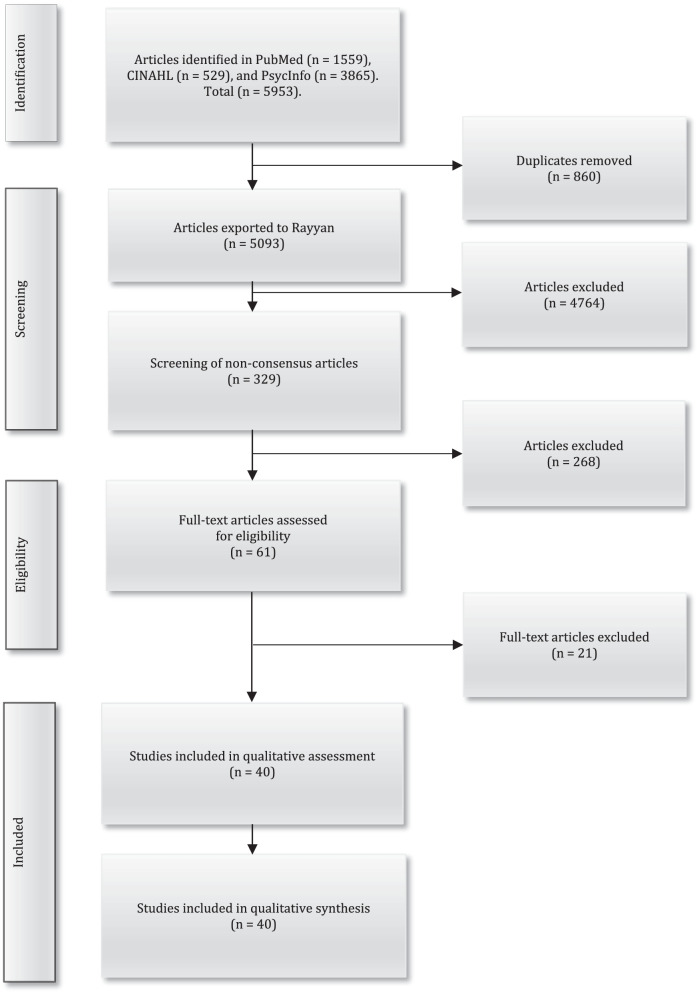
- The search resulted in 5,953 articles (PubMed 1,559; CINAHL 529; PsycInfo 3,865). After excluding duplicates (n = 860), 5,093 articles were imported into Rayyan QCRI; four authors screened titles and abstracts, 61 articles underwent full-text review, and 40 articles were included.
- Data were synthesised using thematic analysis in six phases, generating 228 initial codes; themes were discussed among authors until consensus was reached.
Limitations
- The paper states that the broad literature search may yield more irrelevant articles and is time-consuming, with a risk that relevant articles were accidentally deleted, weakening validity; this risk was partly managed by involving four authors in screening. It also states that excluding grey literature may have affected validity, that using three databases available at a university in western Sweden may have missed articles due to license limits, that the educators’ perspective was deliberately not included, and that transferability is limited to contexts with similar cultural, economic, and social conditions.
- Evident in the text: data analysis was conducted by the first author, although interpretation of themes was discussed with co-authors; quality assessment involved disagreements between two assessors that were resolved through discussion, and no articles were excluded due to a low-quality score.
Model-written summary. Check it against the paper before relying on it.
Integrity signals
Registry
Cites
Statistics
Figures
Verification
Claims the paper makes
33 Valid · 7 Not valid · 61 Not checked · 42 Own results and interpretations
Every source the paper cites for this claim was checked and supports it.
In the paper
“Thus, ethical competence risks being hampered by limited reflection and moral reasoning about the situation as a whole [29].”
§ Ethics education to support ethical competence learning in healthcare: an integrative systematic review > Background
What the sources say
- Supportedcites [29] Mpeli M Analysis of self-evaluated ethical competence of midwifery students at a selected nursing college in the Free State Curationis 2018 41 1 e1 e9 10.4102/curationis.v41i1.1925 PMC6131694 30198296 source
The Conclusion reports that students’ ethical competence was limited: their narratives lacked moral judgment and showed only intuitive, rather than critical, moral reasoning. The ‘Justification for beneficence and non-maleficence’ section also says ethical reasoning requires analysing the situation and reflecting on others’ perspectives, rather than merely following principles. (LLM, conf=0.91)
states a possible cause- Asserted: passes — The authors put it forward as true.
- Checkable: passes — It can be checked against evidence.
- Load-bearing: unclear — It is unclear whether the paper’s conclusions depend on it.
- Based: passes — The paper gives a reason why it holds.
- Supported
The cited sources support only part of this claim — read each source’s verdict below.
In the paper
“Healthcare professionals and students in clinical practice are confronted daily with difficult choices and must cope with questions of ‘rightness’ or ‘wrongness’ that influence their decision-making and the quality of the care provided [11, 12].”
§ Ethics education to support ethical competence learning in healthcare: an integrative systematic review > Background
What the sources say
- Partly supportedcites [11] Ulrich CM Taylor C Soeken K O’Donnell P Farrar A Danis M Everyday ethics: ethical issues and stress in nursing practice J Adv Nurs 2010 66 11 2510 2519 20735502 PMC3865804 sourceExperimental — accuracy not yet measured
The Introduction says moral questions of “rightness” or “wrongness” can underlie healthcare decisions and patient care, and the Results report frequent or daily encounters with several ethical issues among nurses. The paper does not establish that students, or healthcare professionals generally, confront such choices daily. (LLM, conf=0.85)
- Not checked — no full text of the sourcecites [12] Torabi M Borhani F Abbaszadeh A Atashzadeh-Shoorideh F Barriers to ethical decision-makingfor pre-hospital care professionals Nurs Ethics 2020 27 2 407 418 31185799 source
plainstates a cause- Asserted: passes — The authors put it forward as true.
- Checkable: passes — It can be checked against evidence.
- Load-bearing: passes — The paper’s conclusions depend on it.
- Based: passes — The paper gives a reason why it holds.
- Partly supported
Every source the paper cites for this claim was checked and supports it.
In the paper
“An open atmosphere and interaction between participants are important in ethics education when sensitive issues are discussed [69].”
§ Ethics education to support ethical competence learning in healthcare: an integrative systematic review > Results > Making ethical competence learning possible
What the sources say
- Supportedcites [69] Kuhn E Lunden L Moysich P Rogge K Roscher M Caning L Ethik First: extracurricular support for medical students and young physicians facing moral dilemmas in hospital routine GMS J Med Educ 2021 10.3205/zma001470 PMC8136346 34056063 source
The Results section reports that participants positively highlighted an open atmosphere, open interaction with one another and with difficult issues, and a culture of open discussion. The Project description (2.1, Concept) also describes a safe small-group space for ethical discourse. (LLM, conf=0.93)
plainstates an association- Asserted: passes — The authors put it forward as true.
- Checkable: passes — It can be checked against evidence.
- Load-bearing: unclear — It is unclear whether the paper’s conclusions depend on it.
- Based: passes — The paper gives a reason why it holds.
- Supported
The cited sources support only part of this claim — read each source’s verdict below.
In the paper
“Skills can be practiced through workshops [49], case studies and problem-solving sessions [37, 43, 47, 48, 50–53].”
§ Ethics education to support ethical competence learning in healthcare: an integrative systematic review > Results > Making ethical competence learning possible
What the sources say
- Partly supportedcites [49] Mohammadi M Sheikhasadi M Mahani S Taheri A Sheikhbardsiri H Abdi K The effect of bio ethical principles education on ethical attitude of prehospital paramedic personnel J Educ Health Promot 2021 31 10 289 10.4103/jehp.jehp_708_20 PMC8459844 34667789 sourceExperimental — accuracy not yet measured
The Materials and Methods (Intervention; page not provided) describe a workshop for teaching bioethical principles to paramedics, supporting the workshop part of the cited phrase. The reported outcome was improved ethical attitude, not practice or improvement of skills. Citation [49] is attached only to “workshops,” so the case-study and problem-solving parts are not assessed against this source. (LLM, conf=0.83)
- Not checked — no full text of the sourcecites [37] Schonfeld T Johnson K Seville E Suratt C Goedken J Differences between two methods of ethics education: focus group results Ethics Soc Welf 2015 9 3 240 254 source
- Supportedcites [43] Hem MH Molewijk B Gjerberg E Lillemoen L Pedersen R The significance of ethics reflection groups in mental health care: a focus group study among health care professionals BMC Med Ethics 2018 19 54 10.1186/s12910-018-0297-y 29871682 PMC5989396 source
The Results (Experiences from systematic reflection on ethical challenges; page unavailable) report that discussing ethical cases helped participants identify challenges, consider alternative actions, and develop professional competence. This supports the case-based problem-solving part of the sentence. The workshop claim has a separate citation and is not attributed to this source. (LLM, conf=0.86)
- Not checked — no full text of the sourcecites [47] Yeom H-A Ahn S-H Kim S-J Effects of ethics education on moral sensitivity of nursing students Nurs Ethics 2017 24 6 644 652 26811393 source
- Supportedcites [48] Harasym PH Tsai T-C Munshi FM Is problem-based learning an ideal format for developing ethical decision skills? Kaohsiung J Med Sci 2013 29 523 529 24099106 PMC11915924 source
The 'Teaching and learning in ethics' section states directly that, in the MER (Medical Ethical Reasoning) model, 'the identified skills can be learned through small group problem-solving sessions, assignments, observations, and case studies'. This matches the part of the citing sentence attached to this reference (skills practised through case studies and problem-solving sessions); 'workshops' is credited to a different reference [49] and is not attributed here. The paper's related discussion (same section) reinforces that PBL/case-based formats are used to refine ethical problem-solving behaviour. (LLM, conf=0.90)
- Not checked — no full text of the sourcecites [50] Monteverde S Undergraduate healthcare ethics education, moral resilience, and the role of ethical theories Nurs Ethics 2013 21 4 385 401 24311237 source
- Partly supportedcites [51] Lin Y-C Chan T-F Lai C-S Chin C-C Chou F-H Lin H-J The impact of an interprofessional problem-based learning curriculum of clinical ethics on medical and nursing students’ attitudes and ability of interprofessional collaboration: a pilot study Kaohsiung J Med Sci 2013 29 505 511 24018155 PMC11916136 sourceExperimental — accuracy not yet measured
Our copy supports the case-study / problem-solving part of the claim: the Introduction (p. 1) states that an interprofessional PBL curriculum 'would be a good and feasible approach for students to foster communication and collaboration skills', and the Abstract and The curriculum design (p. 1-2) describe a curriculum built around 'one PBL case study with two tutorial sessions' plus a multiperspective narrative used in sequential PBL tutorial sessions, with students' learning of interprofessional collaborative skills assessed by questionnaire. However, no passage in our copy mentions workshops as a means of practicing skills — the only other taught element is a 2-hour lecture and a feedback session — so the workshop component of the claim is not attributable to this source. (LLM, conf=0.72)
- Not checked — no full text of the sourcecites [52] Chou FC Kwan C-Y Hsin D Examining the effects of interprofessional problem-based clinical ethics: findings from a mixed methods study J Interprof Care 2016 30 3 362 369 27152541 source
- Not checked — no full text of the sourcecites [53] McCormick AJ Stowell-Weiss P Carson J Tebo G Hanson I Quesada B Continuing education in ethical decision making using case studies from medical social work Soc Work Health Care 2014 53 4 344 363 24717183 source
plainstates a cause- Asserted: passes — The authors put it forward as true.
- Checkable: passes — It can be checked against evidence.
- Load-bearing: unclear — It is unclear whether the paper’s conclusions depend on it.
- Based: passes — The paper gives a reason why it holds.
- Partly supported
Every source the paper cites for this claim was checked and supports it.
In the paper
“Nevertheless, support and learning activities do not necessarily promote ethical competence learning.”
§ Ethics education to support ethical competence learning in healthcare: an integrative systematic review > Results > Making ethical competence learning possible
What the sources say
- Supportedcites [67] Martins V Santoss C Duarte I Bioethics education and the development of nursing students' moral competence Nurse Educ Today 2020 95 104601 10.1016/j.nedt.2020.104601 33010668 source
The Discussion (Sec. 7) states that in this study 'the teachers promoted discussion in small groups about some ethical dilemmas, which we believe might have contributed to the nursing students' development of moral competence; however, this is not reflected in the results,' and that students 'revealed moral stagnation, which suggests that educational programs do not have enough impact on the moral competence of nursing students.' The Introduction (Sec. 1) likewise records that despite the range of pedagogical strategies used (theoretical-practical classes, tutorial orientation, film analysis, group work, debates, case studies, games), students still highlighted the need for further debate and analysis of practical cases. Together these support the hedged paraphrase that support and learning activities do not necessarily promote ethical/moral competence learning; the source's evidence base is a single Portuguese second-year nursing sample with no prior clinical experience, which the claim's 'not necessarily' phrasing accommodates. (LLM, conf=0.85)
- Supportedcites [68] Martins V Santos C Bataglia P Duarte I The teaching of ethics and the moral competence of medical and nursing students Health Care Anal 2021 29 2 113 126 10.1007/s10728-020-00401-1 32944887 PMC8106588 source
The Conclusion reports that most nursing and medical students showed stagnation or regression in moral competence after ethics education, supporting the cautious claim that learning activities do not necessarily improve it. The Limitations section notes that changes in scores cannot be attributed directly to the teaching, a qualification consistent with the claim’s wording. (LLM, conf=0.89)
plain- Asserted: passes — The authors put it forward as true.
- Checkable: passes — It can be checked against evidence.
- Load-bearing: passes — The paper’s conclusions depend on it.
- Based: passes — The paper gives a reason why it holds.
- Supported
68 more claims · 16 with their cited sources checked
Create a free account to see all 143 claims and to verify the 20 references still open.
- Probably not a substantial claim. 50
- It may state two separate claims as one. 31
Claims other papers make about this one
Each is checked against this paper’s own text: does it say what the citing paper says it does?
The source backs part of the claim, not all of it — or backs it for a different population, condition or comparison.
In the citing paper
“Internship nursing students experience many ethical issues in the clinical environment.”
From Experiences of internship nursing students in confronting ethical issues: a qualitative study (2025) · cites this paper as [7]
Experimental — accuracy not yet measured
Citations
Cites
Using thematic analysis in psychology
Braun, V., & Clarke, V. (2006) · Qualitative Research in Psychology · doi:10.1191/1478088706qp063oa · Cited by 194,414
Rayyan-a web and mobile app for systematic reviews.
Ouzzani, M., Hammady, H., Fedorowicz, Z., & Elmagarmid, A. (2016) · Systematic Reviews · doi:10.1186/s13643-016-0384-4 · Cited by 26,092 · cited 1×
“A total of 5093 articles were then imported into the Rayyan QCRI, a web-based sorting tool for systematic literature reviews [32].”
MethodLiberati, A., Altman, D. G., Tetzlaff, J., Mulrow, C., Gotzsche, P. C., Ioannidis, J. P. A., Clarke, M., Devereaux, P. J., Kleijnen, J., & Moher, D. (2009) · BMJ · doi:10.1136/bmj.b2700 · Cited by 17,648
The integrative review: updated methodology
Whittemore, R., & Knafl, K. (2005) · Journal of Advanced Nursing · doi:10.1111/j.1365-2648.2005.03621.x · Cited by 10,241 · cited 4×
“Methods Design This integrative review followed the method described by Whittemore and Knafl and was used to summarise and synthesise the current state of research on a particular area of interest [30], which in this study was the area of ethics education in healthcare.”
MethodInfluentialThe reflective practitioner: How professionals think in action
Bogumil, R. J. (1985) · Proceedings of the IEEE · doi:10.1109/proc.1985.13210 · Cited by 2,323 · cited 1×
“Such learning should be based on the patient’s perspective to transform healthcare professionals’ and students’ tacit knowledge into explicit knowledge with support from reflective practice [82].”
BackgroundAppraising the Evidence: Reviewing Disparate Data Systematically
Hawker, S., Payne, S., Kerr, C., Hardey, M., & Powell, J. (2002) · Qualitative Health Research · doi:10.1177/1049732302238251 · Cited by 1,216 · cited 1×
“, good, fair, poor, and very poor) [33].”
Moral Distress in Nursing Practice: Experience and Effect
Wilkinson, J. M. (1987) · Nursing Forum · doi:10.1111/j.1744-6198.1987.tb00794.x · Cited by 521
Everyday ethics: ethical issues and stress in nursing practice
Ulrich, C. M., Taylor, C., Soeken, K., O’Donnell, P., Farrar, A., Danis, M., & Grady, C. (2010) · Journal of Advanced Nursing · doi:10.1111/j.1365-2648.2010.05425.x · Cited by 305 · cited 3×
“This, in turn, might lead to compromised moral integrity and generate moral distress [11, 15, 16], as these reactions result from acting or not acting on the basis of one’s own sense of right and wrong [17].”
BackgroundMethodPrinciples of Biomedical Ethics
Athar, S. (2012) · Journal of the Islamic Medical Association of North America · doi:10.5915/43-3-8476 · Cited by 278
The many meanings of occupational competence and qualification
Ellström, P. (1997) · Journal of European Industrial Training · doi:10.1108/03090599710171567 · Cited by 264
Kirkevold, M. (1997) · Journal of Advanced Nursing · doi:10.1046/j.1365-2648.1997.1997025977.x · Cited by 243 · cited 2×
“Any discrepancies regarding authenticity, methodological quality, information value, and representativeness were considered, discussed, and resolved in the data evaluation process [34], leading to consensus between the authors regarding 2 articles pending between two adjacent grades good–fair.”
BackgroundEthical competence: An integrative review
Lechasseur, K., Caux, C., Dollé, S., & Legault, A. (2018) · Nursing Ethics · doi:10.1177/0969733016667773 · Cited by 177 · cited 3×
“Ethical competence contain components such as the capability to identify ethical problems, knowledge about the ethical and moral aspects of care, reflection on one’s own knowledge and actions, and the ability to make wise choices and carefully manage ethically challenging work situations [3].”
BackgroundInfluentialJohnson, C. E., Keating, J. L., & Molloy, E. K. (2020) · Medical Education · doi:10.1111/medu.14154 · Cited by 162 · cited 2×
“To promote effective learning conditions in which healthcare professionals and students feel safe, educators need to encourage an open dialogue aimed at enhancing the implementation of the intended learning activity [76, 77].”
BackgroundCannaerts, N., Gastmans, C., & Casterlé, B. D. D. (2014) · Nursing Ethics · doi:10.1177/0969733014523166 · Cited by 152
Effects of ethics education on moral sensitivity of nursing students
Yeom, H.-A., Ahn, S.-H., & Kim, S.-J. (2017) · Nursing Ethics · doi:10.1177/0969733015622060 · Cited by 151
Impact of moral case deliberation in healthcare settings: a literature review
Haan, M. M., van Gurp, J. L. P., Naber, S. M., & Groenewoud, S. (2018) · BMC Medical Ethics · doi:10.1186/s12910-018-0325-y · Cited by 144 · cited 1×
“Approaches such as moral case deliberation, ethics rounds, or discussion groups can be advantageously used to support ethical reflection [85].”
BackgroundDeveloping Ethical Competence in Health Care Organizations
Kälvemark Sporrong, S., Arnetz, B., Hansson, M. G., Westerholm, P., & Höglund, A. T. (2007) · Nursing Ethics · doi:10.1177/0969733007082142 · Cited by 141 · cited 1×
“Furthermore, ethical competence is important since it may prevent or reduce moral distress [22].”
BackgroundBaykara, Z. G., Demir, S. G., & Yaman, S. (2015) · Nursing Ethics · doi:10.1177/0969733014542673 · Cited by 136 · cited 2×
“This can strengthen the capability to identify certain situations and provide examples of instances where ethical values and norms have been violated [66].”
BackgroundEthics in Nursing Education: Learning To Reflect On Care Practices
Vanlaere, L., & Gastmans, C. (2007) · Nursing Ethics · doi:10.1177/0969733007082116 · Cited by 126
Blended learning in ethics education: A survey of nursing students
Hsu, L.-L. (2011) · Nursing Ethics · doi:10.1177/0969733011398097 · Cited by 112
Moral Distress in Emergency Nurses
Fernandez-Parsons, R., Rodriguez, L., & Goyal, D. (2013) · Journal of Emergency Nursing · doi:10.1016/j.jen.2012.12.009 · Cited by 111 · cited 1×
“This, in turn, might lead to compromised moral integrity and generate moral distress [11, 15, 16], as these reactions result from acting or not acting on the basis of one’s own sense of right and wrong [17].”
BackgroundAre medical students in prehospital care at risk of moral injury?
Murray, E., Krahé, C., & Goodsman, D. (2018) · Emergency Medicine Journal · doi:10.1136/emermed-2017-207216 · Cited by 108 · cited 1×
“At worst, moral distress can lead to moral injury, which occurs as a result of witnessing human suffering or failing to prevent outcomes that transgress deeply held beliefs [18].”
BackgroundA mixed‐method systematic review: support for ethical competence of nurses
Poikkeus, T., Numminen, O., Suhonen, R., & Leino‐Kilpi, H. (2014) · Journal of Advanced Nursing · doi:10.1111/jan.12213 · Cited by 96 · cited 2×
“Ethics education is one such way to develop ethical competencies [20].”
BackgroundAssessment of Resident Professionalism Using High‐fidelity Simulation of Ethical Dilemmas
Gisondi, M. A., Smith‐Coggins, R., Harter, P. M., Soltysik, R. C., & Yarnold, P. R. (2004) · Academic Emergency Medicine · doi:10.1197/j.aem.2004.04.005 · Cited by 90 · cited 1×
“While theoretical education via small-group discussions, lectures, and seminars in which ethical principles are applied is quite common [26], an alternative educational method is simulationbased learning [27].”
BackgroundUndergraduate healthcare ethics education, moral resilience, and the role of ethical theories
Monteverde, S. (2014) · Nursing Ethics · doi:10.1177/0969733013505308 · Cited by 85
Caring assessment in the Swedish ambulance services relieves suffering and enables safe decisions
Wireklint Sundström, B., & Dahlberg, K. (2011) · International Emergency Nursing · doi:10.1016/j.ienj.2010.07.005 · Cited by 83
Torabi, M., Borhani, F., Abbaszadeh, A., & Atashzadeh-Shoorideh, F. (2018) · BMC Medical Ethics · doi:10.1186/s12910-018-0334-x · Cited by 80 · cited 1×
“This, in turn, might lead to compromised moral integrity and generate moral distress [11, 15, 16], as these reactions result from acting or not acting on the basis of one’s own sense of right and wrong [17].”
BackgroundEthics reflection groups in community health services: an evaluation study
Lillemoen, L., & Pedersen, R. (2015) · BMC Medical Ethics · doi:10.1186/s12910-015-0017-9 · Cited by 75 · cited 4×
“By highlighting how healthcare professionals and students think about and analyse their attitudes and approaches when designing ethics education, previous habits can be made visible and critically examined [44].”
BackgroundInfluentialSimulation: A New Approach to Teaching Ethics
Buxton, M., Phillippi, J. C., & Collins, M. R. (2015) · Journal of Midwifery & Women's Health · doi:10.1111/jmwh.12185 · Cited by 75 · cited 2×
“Simulation is a way of highlighting ethical problems that exist in interactions with other individuals, such as patients or family members [54].”
BackgroundNursing students' ethical dilemmas regarding patient care: An integrative review
Albert, J. S., Younas, A., & Sana, S. (2020) · Nurse Education Today · doi:10.1016/j.nedt.2020.104389 · Cited by 74 · cited 1×
“BMC Medical Ethics (2022) 23:29 course content that supports healthcare professionals and students in developing ethical competence in terms of their ethical decision-making ability and the moral courage to confront ethical dilemmas [78].”
BackgroundThe Teaching of Ethics and the Moral Competence of Medical and Nursing Students
Martins, V. S. M., Santos, C. M. N. C., Bataglia, P. U. R., & Duarte, I. M. R. F. (2021) · Health Care Analysis · doi:10.1007/s10728-020-00401-1 · Cited by 70 · cited 1×
“Instead, these activities can also lead to stagnation in the development of ethical competence [67, 68].”
BackgroundChinese nurses’ perceived barriers and facilitators of ethical sensitivity
Huang, F. F., Yang, Q., Zhang, J., Khoshnood, K., & Zhang, J. P. (2016) · Nursing Ethics · doi:10.1177/0969733015574925 · Cited by 65 · cited 2×
“A hierarchical organizational climate influences sensitivity to ethical concerns, and a conformist work attitude could lead to an unwillingness to challenge routines in everyday clinical practice [86].”
BackgroundOrganisational and individual support for nurses’ ethical competence: A cross-sectional survey
Poikkeus, T., Suhonen, R., Katajisto, J., & Leino-Kilpi, H. (2018) · Nursing Ethics · doi:10.1177/0969733016642627 · Cited by 63 · cited 1×
“Ethical competence is essential for the ability to respect the patient’s rights and the quality of care [20, 21].”
BackgroundA learning model for nursing students during clinical studies
Ekebergh, M. (2011) · Nurse Education in Practice · doi:10.1016/j.nepr.2011.03.018 · Cited by 63
Holmberg, M., Forslund, K., Wahlberg, A. C., & Fagerberg, I. (2014) · Scandinavian Journal of Caring Sciences · doi:10.1111/scs.12079 · Cited by 61
Self-citationEthical conflicts in patient relationships: Experiences of ambulance nursing students
Bremer, A., & Holmberg, M. (2020) · Nursing Ethics · doi:10.1177/0969733020911077 · Cited by 56 · cited 1×
“As the future workforce, students need training to effectively deal with ethically problematic situations [4], and experienced professionals need to develop ways to manage ethical problems [5].”
BackgroundSelf-citationExploring person-centredness in emergency departments: A literature review
McConnell, D., McCance, T., & Melby, V. (2016) · International Emergency Nursing · doi:10.1016/j.ienj.2015.10.001 · Cited by 55
Ethics simulation in nursing education: Nursing students' experiences
Honkavuo, L. (2021) · Nursing Ethics · doi:10.1177/0969733021994188 · Cited by 55 · cited 3×
“Simultaneously, there is a need for healthcare professionals and students to formulate their thoughts, feelings, and intentions about the ethical problems that they have observed themselves or heard about through colleagues [37, 38, 41, 43, 45].”
BackgroundDeveloping nursing ethical competences online versus in the traditional classroom
Trobec, I., & Starcic, A. I. (2015) · Nursing Ethics · doi:10.1177/0969733014533241 · Cited by 52
Hem, M. H., Molewijk, B., Gjerberg, E., Lillemoen, L., & Pedersen, R. (2018) · BMC Medical Ethics · doi:10.1186/s12910-018-0297-y · Cited by 51 · cited 5×
“There is also a need for a welcoming climate in which the contradictions between different perceptions and attitudes can be balanced in a constructive way [43, 51].”
BackgroundInfluentialIs problem‐based learning an ideal format for developing ethical decision skills?
Harasym, P. H., Tsai, T., & Munshi, F. M. (2013) · The Kaohsiung Journal of Medical Sciences · doi:10.1016/j.kjms.2013.05.005 · Cited by 50 · cited 2×
“Ethics education needs to be built on strategies that optimise the ability to achieve the desired learning objectives [48].”
BackgroundBioethics education and the development of nursing students' moral competence
Martins, V., Santos, C., & Duarte, I. (2020) · Nurse Education Today · doi:10.1016/j.nedt.2020.104601 · Cited by 50 · cited 1×
“Instead, these activities can also lead to stagnation in the development of ethical competence [67, 68].”
BackgroundLin, Y., Chan, T., Lai, C., Chin, C., Chou, F., & Lin, H. (2013) · The Kaohsiung Journal of Medical Sciences · doi:10.1016/j.kjms.2013.05.006 · Cited by 50
A study of an ethics education topic for undergraduate nursing students
Kalaitzidis, E., & Schmitz, K. (2011) · Nurse Education Today · doi:10.1016/j.nedt.2011.02.006 · Cited by 47
A Case-Centered Approach to Nursing Ethics Education: A Qualitative Study
Lee, W., Choi, S., Kim, S., & Min, A. (2020) · International Journal of Environmental Research and Public Health · doi:10.3390/ijerph17217748 · Cited by 46 · cited 1×
“Small group discussions are appropriate when healthcare professionals or students are unwilling to stand out by asking questions or giving individual opinions in learning situations in which many people participate [63].”
BackgroundMohammadi, M. M. D., Sheikhasadi, H., Mahani, S. A., Taheri, A., Sheikhbardsiri, H., & Abdi, K. (2021) · Journal of Education and Health Promotion · doi:10.4103/jehp.jehp_708_20 · Cited by 46
Ethics education for health professionals: A values based approach
Godbold, R., & Lees, A. (2013) · Nurse Education in Practice · doi:10.1016/j.nepr.2013.02.012 · Cited by 45
Impacts of Socratic questioning on moral reasoning of nursing students
Torabizadeh, C., Homayuni, L., & Moattari, M. (2016) · Nursing Ethics · doi:10.1177/0969733016667775 · Cited by 44 · cited 1×
“Therefore, ethics education needs to be designed in such a way that the content includes both medical and ethical reasoning when the care situation is to be resolved [70, 74].”
BackgroundA medical ethical reasoning model and its contributions to medical education
Tsai, T., & Harasym, P. H. (2010) · Medical Education · doi:10.1111/j.1365-2923.2010.03722.x · Cited by 42
Effect of Ethics Seminar on Moral Sensitivity and Ethical Behavior of Clinical Nurses
Choe, K., Kim, S., Lee, C., & Kim, S. (2020) · International Journal of Environmental Research and Public Health · doi:10.3390/ijerph18010241 · Cited by 39 · cited 1×
“Group discussion, for example in ethics seminar, is a way to reduce unethical behaviour [73].”
BackgroundChou, F. C., Kwan, C.-Y., & Hsin, D. H.-C. (2016) · Journal of Interprofessional Care · doi:10.3109/13561820.2016.1146877 · Cited by 37 · cited 1×
“Learning together about issues that are perceived as ethically problematic can strengthen both the individual and their relationships with their colleagues [44, 52].”
BackgroundThe role of emotions in health professional ethics teaching
Gillam, L., Delany, C., Guillemin, M., & Warmington, S. (2014) · Journal of Medical Ethics · doi:10.1136/medethics-2012-101278 · Cited by 37 · cited 7×
“Ethics education should provide the opportunity to learn how to deal with emotions [40] and foster understanding of what is ethically ‘right’ or ‘wrong’ for the patient [45], which in turn influences the decisions made by healthcare professionals and students in clinical practice [51, 70].”
BackgroundInfluentialComparison of nurse educators’ and nursing students’ descriptions of teaching codes of ethics
Numminen, O., Leino-Kilpi, H., van der Arend, A., & Katajisto, J. (2011) · Nursing Ethics · doi:10.1177/0969733011408054 · Cited by 35 · cited 1×
“While theoretical education via small-group discussions, lectures, and seminars in which ethical principles are applied is quite common [26], an alternative educational method is simulationbased learning [27].”
BackgroundTeaching ethics using games: Impact on Iranian nursing students' moral sensitivity
Maddineshat, M., Yousufzadeh, M. R., Mohseni, M., & Maghsoudi, Z. (2019) · Indian Journal of Medical Ethics · doi:10.20529/ijme.2018.056 · Cited by 34 · cited 3×
“Through such training, an increased understanding of ethical problems can be gained [54, 72], for example, regarding the ways in which certain patients, events, and situations are to be viewed [37, 57, 65].”
BackgroundA training intervention to reduce paternalistic care and promote autonomy: a preliminary study
Sánchez-Izquierdo, M., Santacreu, M., Olmos, R., & Fernández-Ballesteros, R. (2019) · Clinical Interventions in Aging · doi:10.2147/cia.s213644 · Cited by 34 · cited 1×
“Ethical competence learning with a focus on ‘thinking ethics’ and problematising one’s own capabilities to judge and act can be an eye-opener for healthcare professionals and students [72, 75].”
BackgroundSmith, K. V., Klaassen, J., Zimmerman, C., & Cheng, A.-L. (2013) · Journal of Professional Nursing · doi:10.1016/j.profnurs.2012.04.020 · Cited by 31
Barriers to ethical decision-making for pre-hospital care professionals
Torabi, M., Borhani, F., Abbaszadeh, A., & Atashzadeh-Shoorideh, F. (2020) · Nursing Ethics · doi:10.1177/0969733019848044 · Cited by 28
The everyday work at a Swedish emergency department – The practitioners’ perspective
Andersson, H., Jakobsson, E., Furåker, C., & Nilsson, K. (2012) · International Emergency Nursing · doi:10.1016/j.ienj.2011.06.007 · Cited by 27
Self-citationSvensson, C., Bremer, A., & Holmberg, M. (2019) · Clinical Ethics · doi:10.1177/1477750919851050 · Cited by 27
Self-citationPaton, A., & Kotzee, B. (2021) · Health: An Interdisciplinary Journal for the Social Study of Health, Illness and Medicine · doi:10.1177/1363459319889102 · Cited by 26
Bridging the education–action gap: a near-peer case-based undergraduate ethics teaching programme
Kong, W. M., & Knight, S. (2017) · Journal of Medical Ethics · doi:10.1136/medethics-2016-103762 · Cited by 26 · cited 1×
“There is, however, a difference between learning how to manage ethical problems in everyday healthcare work and how these problems are actually managed, since one’s own inabilities or limitations may influence the outcome [62].”
BackgroundClinical ethics ward rounds: building on the core curriculum
Parker, L., Watts, L., & Scicluna, H. (2012) · Journal of Medical Ethics · doi:10.1136/medethics-2011-100468 · Cited by 25 · cited 5×
“One way to create such conditions is to construct appropriate learning objectives that clearly describe what should be achieved in terms of knowledge, skills, approaches, and values to effectively manage ethical problems [37, 38].”
BackgroundInfluentialMedical ethics education in China: Lessons from three schools
Sherer, R., Dong, H., Cong, Y., Wan, J., Chen, H., Wang, Y., Ma, Z., Cooper, B., Jiang, I., Roth, H., et al. (2017) · Education for Health · doi:10.4103/1357-6283.210501 · Cited by 23 · cited 5×
“Problem- or scenario-based learning stimulates healthcare professionals and students to learn and develop new understandings that allow them to manage ethical problems in their clinical practice [36].”
BackgroundInfluentialSvensson, A., Bremer, A., Rantala, A., Andersson, H., Devenish, S., Williams, J., & Holmberg, M. (2022) · International Journal of Older People Nursing · doi:10.1111/opn.12423 · Cited by 23 · cited 1×
“As the future workforce, students need training to effectively deal with ethically problematic situations [4], and experienced professionals need to develop ways to manage ethical problems [5].”
BackgroundSelf-citationEthics rounds do not improve the handling of ethical issues by psychiatric staff
Silén, M., Haglund, K., Hansson, M. G., & Ramklint, M. (2015) · Nordic Journal of Psychiatry · doi:10.3109/08039488.2014.994032 · Cited by 22 · cited 1×
“The design of such training could consist of lectures that are combined with watching movies, playing games, and performing case analyses and group discussions [37, 47, 60, 65].”
BackgroundNarrative writing as a strategy for nursing ethics education in Japan
Tsuruwaka, M., & Asahara, K. (2018) · International Journal of Medical Education · doi:10.5116/ijme.5b39.d5d2 · Cited by 22 · cited 7×
“Narrative groupwork is another way of highlighting and processing ethical problems [57].”
BackgroundInfluentialPre-licensure nursing students' experiences of psychological safety: A qualitative descriptive study
Lyman, B., & Mendon, C. R. (2021) · Nurse Education Today · doi:10.1016/j.nedt.2021.105026 · Cited by 22 · cited 2×
“To promote effective learning conditions in which healthcare professionals and students feel safe, educators need to encourage an open dialogue aimed at enhancing the implementation of the intended learning activity [76, 77].”
BackgroundLearning professional ethics: student experiences in a health mentor program
Langlois, S., & Lymer, E. (2016) · Education for Health · doi:10.4103/1357-6283.178927 · Cited by 20 · cited 1×
“Furthermore, such discussions can draw attention to situations where care and treatment have been experienced as unethical, such as when the patients’ concerns are not heard, or their needs are not met [61].”
BackgroundZafar, W. (2015) · Emergency Medicine Journal · doi:10.1136/emermed-2014-204081 · Cited by 20 · cited 1×
“These ethical problems appear as ethical challenges, conflicts, or dilemmas that influence the daily provision of care and treatment for patients [1, 2].”
BackgroundBowsher, G., Parry-Billings, L., Georgeson, A., & Baraitser, P. (2018) · BMC Medical Education · doi:10.1186/s12909-018-1181-7 · Cited by 19 · cited 1×
“Accordingly, ethics education to support ethical competence learning does not always lead to a change in how ethical problems are managed in everyday clinical practice [71].”
BackgroundEthical challenges in nursing emergency practice
Langeland, K., & Sørlie, V. (2011) · Journal of Clinical Nursing · doi:10.1111/j.1365-2702.2010.03606.x · Cited by 19 · cited 1×
“These ethical problems appear as ethical challenges, conflicts, or dilemmas that influence the daily provision of care and treatment for patients [1, 2].”
BackgroundGallagher, A., Peacock, M., Zasada, M., Coucke, T., Cox, A., & Janssens, N. (2017) · Nursing Inquiry · doi:10.1111/nin.12174 · Cited by 16
Shamim, M. S., Torda, A., Baig, L. A., Zubairi, N., & Balasooriya, C. (2021) · BMC Medical Education · doi:10.1186/s12909-020-02425-6 · Cited by 14 · cited 1×
“Simultaneously, it is valuable to design ethics education so that theoretical learning activities are integrated with practical ones and thereby provide an experience of real-life situations [46].”
BackgroundClinical group supervision for integrating ethical reasoning: Views from students and supervisors
Blomberg, K., & Bisholt, B. (2016) · Nursing Ethics · doi:10.1177/0969733015583184 · Cited by 10
D, S., Vaz, M., & Vaz, M. (2017) · Advances in Physiology Education · doi:10.1152/advan.00183.2016 · Cited by 9
Kuhn, E., Lunden, L., Moysich, P., Rogge, K., Roscher, M., Caning, L., & Rogge, A. (2021) · German Medical Science GMS Publishing House · doi:10.3205/zma001470 · Cited by 9 · cited 1×
“Interacting with others An open atmosphere and interaction between participants are important in ethics education when sensitive issues are discussed [69].”
BackgroundPersonal experience narratives by students: a teaching–learning tool in bioethics
Pandya, R. H., Shukla, R., Gor, A. P., & Ganguly, B. (2016) · Indian Journal of Medical Ethics · doi:10.20529/ijme.2016.041 · Cited by 9 · cited 4×
“Understanding one’s own values and attitudes can be facilitated through, for example, roleplay or simulation activities [54–56], narratives [40, 57, 58], storytelling [42] and discussions in small groups [38, 43–45, 47, 59–62].”
BackgroundInfluentialContinuing Education in Ethical Decision Making Using Case Studies From Medical Social Work
McCormick, A. J., Stowell-Weiss, P., Carson, J., Tebo, G., Hanson, I., & Quesada, B. (2014) · Social Work in Health Care · doi:10.1080/00981389.2014.884042 · Cited by 8
Qualitative Differences between Two Methods of Ethics Education: Focus Group Results
Schonfeld, T., Johnson, K., Seville, E., Suratt, C., & Goedken, J. (2015) · Ethics and Social Welfare · doi:10.1080/17496535.2015.1023737 · Cited by 8
Teaching ethics that honor the patient’s and the provider’s voice: The role of clinical integrity
Grace, A. J., & Kirkpatrick, H. A. (2018) · The International Journal of Psychiatry in Medicine · doi:10.1177/0091217418791445 · Cited by 8 · cited 2×
“Simultaneously, it might be difficult to predict how long, for example, group discussions may take to shed light on the various aspects of ethical problems [39].”
BackgroundLecturers’ lived experiences of guiding reflective seminars during nursing education
Lindberg, E. (2018) · Nurse Education in Practice · doi:10.1016/j.nepr.2018.06.005 · Cited by 7 · cited 1×
“According to this, reflection with some theoretical depth grounded in caring science can contribute to a deeper understanding beyond that which is common in the clinical practice [83].”
BackgroundNursing Ethics in Everyday Practice
(2013) · doi:10.1016/j.jradnu.2013.02.003 · Cited by 7
Mpeli, M. R. (2018) · Curationis · doi:10.4102/curationis.v41i1.1925 · Cited by 7 · cited 1×
“Thus, ethical competence risks being hampered by limited reflection and moral reasoning about the situation as a whole [29].”
BackgroundRural Ethics Ward Rounds: Enhancing medical students' ethical awareness in rural medicine
Watts, L., Parker, L., & Scicluna, H. (2013) · Australian Journal of Rural Health · doi:10.1111/ajr.12016 · Cited by 6 · cited 4×
“This technique is valuable when using external educators in a rural setting for example in ruralbased hospitals [59].”
BackgroundInfluential
Research works printed but not linked: 3
- The Swedish Society of Nursing Values for nursing 2016 Stockholm The Swedish Society of Nursing
- Dahlberg K Segesten K Health and caring in theory and praxis 2010 Stockholm Natur & Kultur
- Rogne L McCune S Advanced care planning. Communicating about mattes of life and death 2013 New York Springer
Cited by
European Resuscitation Council Guidelines 2025 Ethics in Resuscitation
Raffay, V. I., Wittig, J., Bossaert, L. L., Djakow, J., Djärv, T., Estella, Á., Lulić, I., Mentzelopoulos, S. D., Monsieurs, K. G., de Voorde, P. V., et al. (2025) · Resuscitation · doi:10.1016/j.resuscitation.2025.110734 · Cited by 80
Chance, E. A. (2025) · BMC Medical Education · doi:10.1186/s12909-025-07589-7 · Cited by 78
Ethical Considerations for Artificial Intelligence in Educational Assessments
Lim, T., Gottipati, S., & Cheong, M. L. F. (2023) · Advances in educational technologies and instructional design book series · doi:10.4018/979-8-3693-0205-7.ch003 · Cited by 77
Assessing the Current Limitations of Large Language Models in Advancing Health Care Education
Kim, J., & Vajravelu, B. N. (2025) · JMIR Formative Research · doi:10.2196/51319 · Cited by 46
Ethics in digital and AI coaching
Diller, S. J. (2024) · Human Resource Development International · doi:10.1080/13678868.2024.2315928 · Cited by 42
“This awareness can improve problem-solving abilities (Andersson et al. 2022; Jones 2009).”
Metadata
- Authors
- Andersson, H., Svensson, A., Frank, C., Rantala, A., Holmberg, M., & Bremer, A.
- Affiliations
- Linnaeus University (SE)
- Lund University (SE)
- Uppsala University (SE)
- Corresponding author
- Andersson, Henrik
- Venue
- BMC Medical Ethics
- Published
- 2022-03-19
- Volume
- 23
- Issue
- 1
- Pages
- 29-29
- ISSN
- 1472-6939 (ISSN-L)
- PMC
- PMC8933936
- OpenAlex
- W4220893584
- Semantic Scholar
- 9a9fe449b96b13c93175fe805a8622487ac729db
- Cited by
- 338
- References
- 84
- Citations by year
- 2026: 97 · 2025: 113 · 2024: 75 · 2023: 45 · 2022: 8
- FWCI
- 9.79
- Type
- journal article
- Language
- en
- Open access
- gold
- doi.org
- Licence
- cc-by
- creativecommons.org/licenses/by/4.0 (tdm)
- creativecommons.org/licenses/by/4.0 (vor)
- Locations
- BMC Medical Ethics (publishedVersion, cc-by)
- PubMed Central (publishedVersion, cc-by)
- PubMed (publishedVersion)
- Diva portal (Dalarna University Library) (submittedVersion, other-oa)
- KTH Publication Database DiVA (KTH Royal Institute of Technology) (submittedVersion, other-oa)
- DOAJ (DOAJ: Directory of Open Access Journals) (submittedVersion, cc-by-sa)
- Lund University Publications (Lund University) (submittedVersion)
- Funders
- University of Boras
- Topics
- Health Sciences › Health Professions › General Health Professions › Ethics in medical practice
- Health Sciences › Medicine › Public Health, Environmental and Occupational Health › Ethics and bioethics in healthcare
- Social Sciences › Education › Innovations in Medical Education
- Keywords
- ethics education, ethical competence, healthcare workers, medical students, moral distress, moral injury, ethical decision-making, simulation-based training
- MeSH terms
- Delivery of Health Care, Ethics, Nursing, Health Personnel, Humans, Morals
About these checks
Registry, retraction, Cites and statistics results are computed, not judged, with one exception: a printed reference that no index lists is read once by a model before it counts as a citation error. Claims are extracted by a model and kept only when their quote appears verbatim in the text; each cited source is then checked, with a model’s help, for whether it says what the claim relies on. Those verdicts can be wrong — read the claim’s quote and the cited source before relying on one.
The claim verdicts this report counts are experimental: their accuracy is not yet measured.
A language model drew the claims from the paper on 2026-10-10, under version 3 of the claim definition (model deepseek-v4.1-flash, prompt extract-v3).
A second model labelled each claim on 2026-10-10 (model jev-1.13-20260917, definition revision gold-guideline-v0.2).
Cited sources are checked with a language model’s help (gpt-6-sol and qwen3.8-omni-flash).
Statistics and arithmetic are recomputed, not judged.
Confidence bands are shown only for fields calibrated on our annotated test set. None is calibrated yet, so no band is shown.
What counts as a claim ›How we measure confidence ›How we check this ›
Are you an author, or do you see a problem with this page? Request a review
Data sources
Bibliographic data: Semantic Scholar, OpenAlex, Crossref.
Contains information from the Semantic Scholar Academic Graph Datasets, made available under the ODC Attribution License (ODC-BY 1.0).
Semantic Scholar’s data is described in: Kinney, R., et al. (2023). The Semantic Scholar Open Data Platform. arXiv:2301.10140.
