

Ethics education to support ethical competence learning in healthcare: an integrative systematic review
Open accessThe DOI matches its Crossref record; 84 of the 84 references it cites were found in a registry or an index; 42 of the 165 sources its claims cite were checked for support.
Abstract
Integrative systematic review exploring ethics education that promotes ethical competence learning for healthcare professionals and students.
Overview
CoChat Summary
TL;DR
This integrative systematic review synthesized 40 articles on ethics education for healthcare professionals and students, identifying support, awareness of one’s own thoughts and perceptions, and doing right by the patient’s best interests as key aspects of ethical competence learning. It concludes that varied designs and course content can support readiness to recognise and respond to ethically problematic work situations, though education does not necessarily change ethical behaviour or practice.
Key findings
- The review included 40 articles. Most studies were conducted in the United States (n = 5) and Taiwan (n = 5); by continent, 17 were from Asia, 14 from Europe, six from North America, and three from Australia.
- Three main themes were identified: making ethical competence learning possible (discussed in 32 articles), having awareness of one’s own thoughts and perceptions (22 articles), and doing right by the patient’s best interests (19 articles).
- Educational strategies included theoretical lectures and literature, workshops, case studies and problem-solving sessions, role-play or simulation, narratives and storytelling, and small-group discussions. Conditions emphasised included real work situations, clear learning objectives, time for reflection, an open atmosphere, and psychological safety.
- Ethical competence learning helped healthcare professionals and students notice ethical problems they were not previously aware of, but the review also notes that ethics education does not always lead to changed management of ethical problems in everyday clinical practice.
Methods
- Integrative systematic review following Whittemore and Knafl, with a PROSPERO protocol (CRD42019123055) and PRISMA standards. Searches used PubMed, CINAHL, and PsycInfo on 22–23 June 2020, plus a supplementary search on 10 January 2022, with terms including ‘health personnel’, ‘students’, ‘ethics’, ‘moral’, ‘simulation’, and ‘teaching’; limits were English, peer-reviewed, and published 2010–2021.
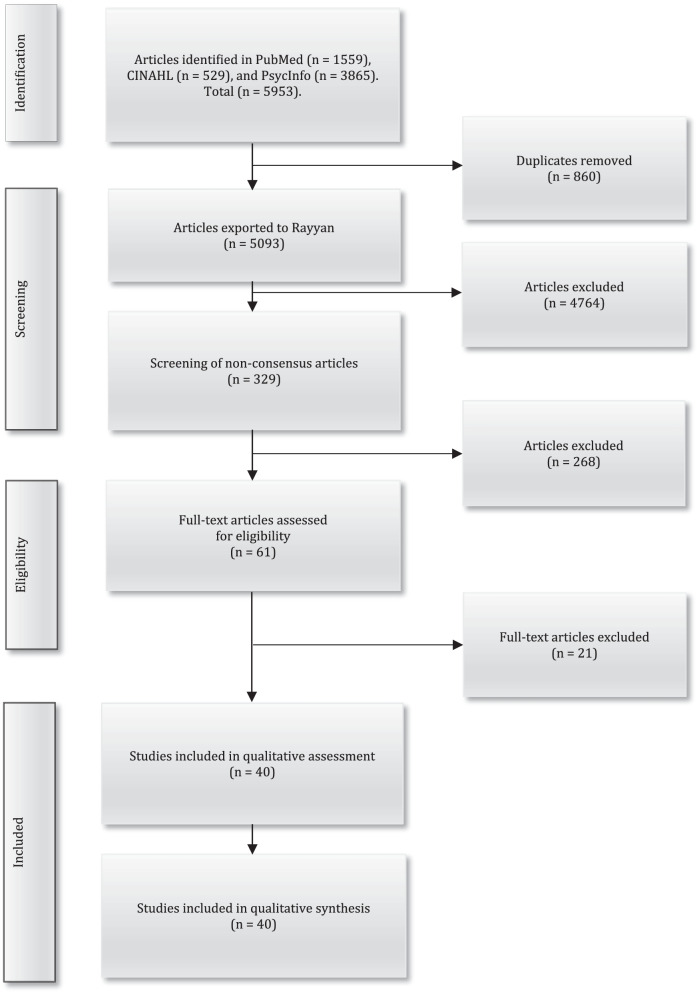
- The search resulted in 5,953 articles (PubMed 1,559; CINAHL 529; PsycInfo 3,865). After excluding duplicates (n = 860), 5,093 articles were imported into Rayyan QCRI; four authors screened titles and abstracts, 61 articles underwent full-text review, and 40 articles were included.
- Data were synthesised using thematic analysis in six phases, generating 228 initial codes; themes were discussed among authors until consensus was reached.
Limitations
- The paper states that the broad literature search may yield more irrelevant articles and is time-consuming, with a risk that relevant articles were accidentally deleted, weakening validity; this risk was partly managed by involving four authors in screening. It also states that excluding grey literature may have affected validity, that using three databases available at a university in western Sweden may have missed articles due to license limits, that the educators’ perspective was deliberately not included, and that transferability is limited to contexts with similar cultural, economic, and social conditions.
- Evident in the text: data analysis was conducted by the first author, although interpretation of themes was discussed with co-authors; quality assessment involved disagreements between two assessors that were resolved through discussion, and no articles were excluded due to a low-quality score.
Model-written summary. Check it against the paper before relying on it.
Integrity signals
Registry
Cites
Statistics
Figures
Verification
Claims the paper makes
33 Valid · 7 Not valid · 61 Not checked · 42 Own results and interpretations
Every source the paper cites for this claim was checked and supports it.
In the paper
“Thus, ethical competence risks being hampered by limited reflection and moral reasoning about the situation as a whole [29].”
§ Ethics education to support ethical competence learning in healthcare: an integrative systematic review > Background
What the sources say
- Supportedcites [29] Mpeli M Analysis of self-evaluated ethical competence of midwifery students at a selected nursing college in the Free State Curationis 2018 41 1 e1 e9 10.4102/curationis.v41i1.1925 PMC6131694 30198296 source
The Conclusion reports that students’ ethical competence was limited: their narratives lacked moral judgment and showed only intuitive, rather than critical, moral reasoning. The ‘Justification for beneficence and non-maleficence’ section also says ethical reasoning requires analysing the situation and reflecting on others’ perspectives, rather than merely following principles. (LLM, conf=0.91)
states a possible cause- Asserted: passes — The authors put it forward as true.
- Checkable: passes — It can be checked against evidence.
- Load-bearing: unclear — It is unclear whether the paper’s conclusions depend on it.
- Based: passes — The paper gives a reason why it holds.
- Supported
The cited sources support only part of this claim — read each source’s verdict below.
In the paper
“Healthcare professionals and students in clinical practice are confronted daily with difficult choices and must cope with questions of ‘rightness’ or ‘wrongness’ that influence their decision-making and the quality of the care provided [11, 12].”
§ Ethics education to support ethical competence learning in healthcare: an integrative systematic review > Background
What the sources say
- Partly supportedcites [11] Ulrich CM Taylor C Soeken K O’Donnell P Farrar A Danis M Everyday ethics: ethical issues and stress in nursing practice J Adv Nurs 2010 66 11 2510 2519 20735502 PMC3865804 sourceExperimental — accuracy not yet measured
The Introduction says moral questions of “rightness” or “wrongness” can underlie healthcare decisions and patient care, and the Results report frequent or daily encounters with several ethical issues among nurses. The paper does not establish that students, or healthcare professionals generally, confront such choices daily. (LLM, conf=0.85)
- Not checked — no full text of the sourcecites [12] Torabi M Borhani F Abbaszadeh A Atashzadeh-Shoorideh F Barriers to ethical decision-makingfor pre-hospital care professionals Nurs Ethics 2020 27 2 407 418 31185799 source
plainstates a cause- Asserted: passes — The authors put it forward as true.
- Checkable: passes — It can be checked against evidence.
- Load-bearing: passes — The paper’s conclusions depend on it.
- Based: passes — The paper gives a reason why it holds.
- Partly supported
Every source the paper cites for this claim was checked and supports it.
In the paper
“An open atmosphere and interaction between participants are important in ethics education when sensitive issues are discussed [69].”
§ Ethics education to support ethical competence learning in healthcare: an integrative systematic review > Results > Making ethical competence learning possible
What the sources say
- Supportedcites [69] Kuhn E Lunden L Moysich P Rogge K Roscher M Caning L Ethik First: extracurricular support for medical students and young physicians facing moral dilemmas in hospital routine GMS J Med Educ 2021 10.3205/zma001470 PMC8136346 34056063 source
The Results section reports that participants positively highlighted an open atmosphere, open interaction with one another and with difficult issues, and a culture of open discussion. The Project description (2.1, Concept) also describes a safe small-group space for ethical discourse. (LLM, conf=0.93)
plainstates an association- Asserted: passes — The authors put it forward as true.
- Checkable: passes — It can be checked against evidence.
- Load-bearing: unclear — It is unclear whether the paper’s conclusions depend on it.
- Based: passes — The paper gives a reason why it holds.
- Supported
The cited sources support only part of this claim — read each source’s verdict below.
In the paper
“Skills can be practiced through workshops [49], case studies and problem-solving sessions [37, 43, 47, 48, 50–53].”
§ Ethics education to support ethical competence learning in healthcare: an integrative systematic review > Results > Making ethical competence learning possible
What the sources say
- Partly supportedcites [49] Mohammadi M Sheikhasadi M Mahani S Taheri A Sheikhbardsiri H Abdi K The effect of bio ethical principles education on ethical attitude of prehospital paramedic personnel J Educ Health Promot 2021 31 10 289 10.4103/jehp.jehp_708_20 PMC8459844 34667789 sourceExperimental — accuracy not yet measured
The Materials and Methods (Intervention; page not provided) describe a workshop for teaching bioethical principles to paramedics, supporting the workshop part of the cited phrase. The reported outcome was improved ethical attitude, not practice or improvement of skills. Citation [49] is attached only to “workshops,” so the case-study and problem-solving parts are not assessed against this source. (LLM, conf=0.83)
- Not checked — no full text of the sourcecites [37] Schonfeld T Johnson K Seville E Suratt C Goedken J Differences between two methods of ethics education: focus group results Ethics Soc Welf 2015 9 3 240 254 source
- Supportedcites [43] Hem MH Molewijk B Gjerberg E Lillemoen L Pedersen R The significance of ethics reflection groups in mental health care: a focus group study among health care professionals BMC Med Ethics 2018 19 54 10.1186/s12910-018-0297-y 29871682 PMC5989396 source
The Results (Experiences from systematic reflection on ethical challenges; page unavailable) report that discussing ethical cases helped participants identify challenges, consider alternative actions, and develop professional competence. This supports the case-based problem-solving part of the sentence. The workshop claim has a separate citation and is not attributed to this source. (LLM, conf=0.86)
- Not checked — no full text of the sourcecites [47] Yeom H-A Ahn S-H Kim S-J Effects of ethics education on moral sensitivity of nursing students Nurs Ethics 2017 24 6 644 652 26811393 source
- Supportedcites [48] Harasym PH Tsai T-C Munshi FM Is problem-based learning an ideal format for developing ethical decision skills? Kaohsiung J Med Sci 2013 29 523 529 24099106 PMC11915924 source
The 'Teaching and learning in ethics' section states directly that, in the MER (Medical Ethical Reasoning) model, 'the identified skills can be learned through small group problem-solving sessions, assignments, observations, and case studies'. This matches the part of the citing sentence attached to this reference (skills practised through case studies and problem-solving sessions); 'workshops' is credited to a different reference [49] and is not attributed here. The paper's related discussion (same section) reinforces that PBL/case-based formats are used to refine ethical problem-solving behaviour. (LLM, conf=0.90)
- Not checked — no full text of the sourcecites [50] Monteverde S Undergraduate healthcare ethics education, moral resilience, and the role of ethical theories Nurs Ethics 2013 21 4 385 401 24311237 source
- Partly supportedcites [51] Lin Y-C Chan T-F Lai C-S Chin C-C Chou F-H Lin H-J The impact of an interprofessional problem-based learning curriculum of clinical ethics on medical and nursing students’ attitudes and ability of interprofessional collaboration: a pilot study Kaohsiung J Med Sci 2013 29 505 511 24018155 PMC11916136 sourceExperimental — accuracy not yet measured
Our copy supports the case-study / problem-solving part of the claim: the Introduction (p. 1) states that an interprofessional PBL curriculum 'would be a good and feasible approach for students to foster communication and collaboration skills', and the Abstract and The curriculum design (p. 1-2) describe a curriculum built around 'one PBL case study with two tutorial sessions' plus a multiperspective narrative used in sequential PBL tutorial sessions, with students' learning of interprofessional collaborative skills assessed by questionnaire. However, no passage in our copy mentions workshops as a means of practicing skills — the only other taught element is a 2-hour lecture and a feedback session — so the workshop component of the claim is not attributable to this source. (LLM, conf=0.72)
- Not checked — no full text of the sourcecites [52] Chou FC Kwan C-Y Hsin D Examining the effects of interprofessional problem-based clinical ethics: findings from a mixed methods study J Interprof Care 2016 30 3 362 369 27152541 source
- Not checked — no full text of the sourcecites [53] McCormick AJ Stowell-Weiss P Carson J Tebo G Hanson I Quesada B Continuing education in ethical decision making using case studies from medical social work Soc Work Health Care 2014 53 4 344 363 24717183 source
plainstates a cause- Asserted: passes — The authors put it forward as true.
- Checkable: passes — It can be checked against evidence.
- Load-bearing: unclear — It is unclear whether the paper’s conclusions depend on it.
- Based: passes — The paper gives a reason why it holds.
- Partly supported
Every source the paper cites for this claim was checked and supports it.
In the paper
“Nevertheless, support and learning activities do not necessarily promote ethical competence learning.”
§ Ethics education to support ethical competence learning in healthcare: an integrative systematic review > Results > Making ethical competence learning possible
What the sources say
- Supportedcites [67] Martins V Santoss C Duarte I Bioethics education and the development of nursing students' moral competence Nurse Educ Today 2020 95 104601 10.1016/j.nedt.2020.104601 33010668 source
The Discussion (Sec. 7) states that in this study 'the teachers promoted discussion in small groups about some ethical dilemmas, which we believe might have contributed to the nursing students' development of moral competence; however, this is not reflected in the results,' and that students 'revealed moral stagnation, which suggests that educational programs do not have enough impact on the moral competence of nursing students.' The Introduction (Sec. 1) likewise records that despite the range of pedagogical strategies used (theoretical-practical classes, tutorial orientation, film analysis, group work, debates, case studies, games), students still highlighted the need for further debate and analysis of practical cases. Together these support the hedged paraphrase that support and learning activities do not necessarily promote ethical/moral competence learning; the source's evidence base is a single Portuguese second-year nursing sample with no prior clinical experience, which the claim's 'not necessarily' phrasing accommodates. (LLM, conf=0.85)
- Supportedcites [68] Martins V Santos C Bataglia P Duarte I The teaching of ethics and the moral competence of medical and nursing students Health Care Anal 2021 29 2 113 126 10.1007/s10728-020-00401-1 32944887 PMC8106588 source
The Conclusion reports that most nursing and medical students showed stagnation or regression in moral competence after ethics education, supporting the cautious claim that learning activities do not necessarily improve it. The Limitations section notes that changes in scores cannot be attributed directly to the teaching, a qualification consistent with the claim’s wording. (LLM, conf=0.89)
plain- Asserted: passes — The authors put it forward as true.
- Checkable: passes — It can be checked against evidence.
- Load-bearing: passes — The paper’s conclusions depend on it.
- Based: passes — The paper gives a reason why it holds.
- Supported
68 more claims · 16 with their cited sources checked
Create a free account to see all 143 claims and to verify the 20 references still open.
- Probably not a substantial claim. 50
- It may state two separate claims as one. 31
Claims other papers make about this one
Each is checked against this paper’s own text: does it say what the citing paper says it does?
The source backs part of the claim, not all of it — or backs it for a different population, condition or comparison.
In the citing paper
“Internship nursing students experience many ethical issues in the clinical environment.”
From Experiences of internship nursing students in confronting ethical issues: a qualitative study (2025) · cites this paper as [7]
Experimental — accuracy not yet measured
Citations
Cites
Using thematic analysis in psychology
Braun, V., & Clarke, V. (2006) · Qualitative Research in Psychology · doi:10.1191/1478088706qp063oa · Cited by 194,414
Rayyan-a web and mobile app for systematic reviews.
Ouzzani, M., Hammady, H., Fedorowicz, Z., & Elmagarmid, A. (2016) · Systematic Reviews · doi:10.1186/s13643-016-0384-4 · Cited by 26,092 · cited 1×
“A total of 5093 articles were then imported into the Rayyan QCRI, a web-based sorting tool for systematic literature reviews [32].”
MethodLiberati, A., Altman, D. G., Tetzlaff, J., Mulrow, C., Gotzsche, P. C., Ioannidis, J. P. A., Clarke, M., Devereaux, P. J., Kleijnen, J., & Moher, D. (2009) · BMJ · doi:10.1136/bmj.b2700 · Cited by 17,648
The integrative review: updated methodology
Whittemore, R., & Knafl, K. (2005) · Journal of Advanced Nursing · doi:10.1111/j.1365-2648.2005.03621.x · Cited by 10,241 · cited 4×
“Methods Design This integrative review followed the method described by Whittemore and Knafl and was used to summarise and synthesise the current state of research on a particular area of interest [30], which in this study was the area of ethics education in healthcare.”
MethodInfluentialThe reflective practitioner: How professionals think in action
Bogumil, R. J. (1985) · Proceedings of the IEEE · doi:10.1109/proc.1985.13210 · Cited by 2,323 · cited 1×
“Such learning should be based on the patient’s perspective to transform healthcare professionals’ and students’ tacit knowledge into explicit knowledge with support from reflective practice [82].”
BackgroundAppraising the Evidence: Reviewing Disparate Data Systematically
Hawker, S., Payne, S., Kerr, C., Hardey, M., & Powell, J. (2002) · Qualitative Health Research · doi:10.1177/1049732302238251 · Cited by 1,216 · cited 1×
“, good, fair, poor, and very poor) [33].”
Moral Distress in Nursing Practice: Experience and Effect
Wilkinson, J. M. (1987) · Nursing Forum · doi:10.1111/j.1744-6198.1987.tb00794.x · Cited by 521
Everyday ethics: ethical issues and stress in nursing practice
Ulrich, C. M., Taylor, C., Soeken, K., O’Donnell, P., Farrar, A., Danis, M., & Grady, C. (2010) · Journal of Advanced Nursing · doi:10.1111/j.1365-2648.2010.05425.x · Cited by 305 · cited 3×
“This, in turn, might lead to compromised moral integrity and generate moral distress [11, 15, 16], as these reactions result from acting or not acting on the basis of one’s own sense of right and wrong [17].”
BackgroundMethodPrinciples of Biomedical Ethics
Athar, S. (2012) · Journal of the Islamic Medical Association of North America · doi:10.5915/43-3-8476 · Cited by 278
The many meanings of occupational competence and qualification
Ellström, P. (1997) · Journal of European Industrial Training · doi:10.1108/03090599710171567 · Cited by 264
Research works printed but not linked: 3
- The Swedish Society of Nursing Values for nursing 2016 Stockholm The Swedish Society of Nursing
- Dahlberg K Segesten K Health and caring in theory and praxis 2010 Stockholm Natur & Kultur
- Rogne L McCune S Advanced care planning. Communicating about mattes of life and death 2013 New York Springer
Cited by
Items 101–200 of 234
Informed Strategies Based on Education Research to Enhance the Learning Ecosystem
Qureshi, M. I., Shrivastava, T., Sharath, H. V., & Kaur, G. (2024) · Cureus · doi:10.7759/cureus.69431 · Cited by 10
“Encouraging students to reflect on their learning experiences, consider ethical dilemmas, and apply moral reasoning helps build integrity and accountability in their professional lives [34].”
BackgroundMaguire, A., & Miller, H. D. (2024) · Religion & Education · doi:10.1080/15507394.2024.2325910 · Cited by 3
“However, the efficacy of scenario-based learning as pertains to character depends on a supportive learning environment with space and time for reflection (after, or as part of the assessment) (Andersson et al., 2022).”
BackgroundNeenan, K., & Whelan, J. (2025) · Springer eBooks · doi:10.1007/978-3-031-78575-7_2 · Cited by 2
Çolak, A., Akaydın, C., BALLI, F. E., Sayan, İ., Aktaş, K., Işık, M. T., Sevim, O., Şaylıgil, Ö., Önen, Ö., Özdemir, R. C., et al. (2024) · doi:10.5152/4200 · Cited by 2
Ethical behavior profiles among nursing interns and their determinants: a latent profile analysis
Qu, J., Lin, P., Liu, L., Min, M., & Song, Y. P. (2026) · BMC Medical Education · doi:10.1186/s12909-026-08689-8 · Cited by 1
Ethical values held by nursing students. Comparative study in two country
Lesińska‐Sawicka, M., & Kızılırmak, A. (2024) · BMC Nursing · doi:10.1186/s12912-024-02198-z · Cited by 5
Sadikan, M. Z., Ariffin, I. A., & Hairi, H. A. (2024) · Journal of Education Technology in Health Sciences · doi:10.18231/j.jeths.2024.015 · Cited by 1
Hong, E., & Park, H. (2025) · Journal of Korean Public Health Nursing · doi:10.5932/jkphn.2025.39.3.368 · Cited by 1
Infectious diseases ethics: a worldwide survey
Righi, E., Mirandola, M., Grossi, A. A., Akova, M., Tacconelli, E., Fratucello, A., Nasim, A., Barac, A. M., & Yahav, D. (2024) · Clinical Microbiology and Infection · doi:10.1016/j.cmi.2024.10.021 · Cited by 1
Understanding ethical encounters in a hospital setting: a qualitative study
Durkin, J., Orton, S., Haydon, T. P., & Fleming, D. J. (2026) · BMC Medical Ethics · doi:10.1186/s12910-026-01446-y · Cited by 2
Rabasco, A., Neimeyer, G. J., Macura, Z., McKay, D., & Washburn, J. J. (2023) · Ethics & Behavior · doi:10.1080/10508422.2023.2266074 · Cited by 1
Ethics in optometry: an educational intervention
Hart, K. M., & Connor, H. R. M. (2024) · Clinical and Experimental Optometry · doi:10.1080/08164622.2024.2421439 · Cited by 3
Choose Your Own Adventure! A Novel Approach in Ethics Teaching
Krick, J., Jung, E., Abuhamdeh, S., & Zheng, B. (2026) · The Clinical Teacher · doi:10.1111/tct.70424 · Cited by 2
Barreras identificadas para el ejercicio de las buenas prácticas docentes en especialidades médicas
Muñoz, X., Saá, K. K., Reyes, P. S., Avendaño, M. T., & Altermatt, C. H. (2024) · Educación Médica · doi:10.1016/j.edumed.2024.100995 · Cited by 3
Ethical Decision-Making in Public Hospitals Management: Challenges and Models from Romania
Cumpăt, C. M., Zouri, M., Huţu, D., Cumpăt, M. A., Zouri, N., Grădinaru, A., Agheorghiesei, D. T., & Scripcariu, D. V. (2025) · Scientific Annals of Economics and Business · doi:10.47743/saeb-2025-0033 · Cited by 2
Self-perceived moral competence among healthcare students in Slovakia: a cross-sectional study
Dimunová, L., Štefková, G., Kaliský, J., Kalakay, R., Więch, P., Bazaliński, D., Miškárová, S., & Rimárová, K. (2026) · BMC Medical Education · doi:10.1186/s12909-026-08627-8 · Cited by 3
Akdoğan, H. D., Turgut, A. Ç., & Akdoğan, I. (2026) · International Journal of Research and Review · doi:10.52403/ijrr.20260230 · Cited by 1
AI Literacy and Scenario-based Ethical Judgment About Generative AI Among Undergraduate Students
Reed, J. M., Ferdig, R. E., Dodson, T. M., Gunstad, J., & Hughes, J. W. (2026) · Journal of Academic Ethics · doi:10.1007/s10805-026-09757-w · Cited by 8
Ethics in medical research and publications
Pleshchev, I. E., Shishkin, A., & Ivashkovskaya, A. (2025) · Медицинская этика · doi:10.24075/medet.2025.004 · Cited by 1
Ethical challenges in medical services
Agheorghiesei, D.-M., & Bercu, A. (2024) · International Conference "Economic Security in the Context of Systemic Transformations" · doi:10.53486/escst2023.26 · Cited by 2
Influence of Nurses' Moral Distress and Ethical Nursing Competence on Retention Intention
Choi, J.-H., Byun, M., & Do, T. N. (2025) · Journal of Korean Academy of Nursing Administration · doi:10.11111/jkana.2025.31.1.36 · Cited by 1
Ethical challenges and action alternatives: Case reflections in ambulance care
Bennesved, A., Bremer, A., Svensson, A., Rantala, A., Holmberg, M., & Björk, J. (2025) · Nursing Ethics · doi:10.1177/09697330251403138 · Cited by 1
Self-citationLuo, P. (2025) · International Conference on Intelligent Systems and Computational Networks (ICISCN) · doi:10.1109/iciscn64258.2025.10934565 · Cited by 1
Nurses’ perceived authentic leadership and moral courage: The mediating role of psychological safety
Lee, S., & Cho, H. (2026) · Nursing Ethics · doi:10.1177/09697330261437309 · Cited by 2
van Schaik, M. V. (2024) · doi:10.5463/thesis.532 · Cited by 1
Dadashzadeh, A., Ghasempour, M., Purabdollah, M., Dehghannezhad, J., Gilani, N., & Lilab, F. H. (2025) · BMC Emergency Medicine · doi:10.1186/s12873-025-01349-y · Cited by 1
DESENVOLVIMENTO E AVALIAÇÃO DA QUALIDADE TÉCNICA DA PLATAFORMA DE PROMOÇÃO DO CLIMA ÉTICO POSITIVO
Lanes, T. C., Dalmolin, G. D. L., Bertoldo, E. D. P., Pereira, L. A., & Ramos, F. R. S. (2026) · RECIMA21 - Revista Científica Multidisciplinar · doi:10.47820/recima21.v7i5.7841
Chitimbe, S., Chikazhe, L., & Jengeta, M. (2026) · Journal of Management Sciences Innovation and Technology · doi:10.63726/jmsit.v2i1.340
Contribución de la Bioética al desempeño académico en medicina legal en estudiantes de medicina
Roballino, Z. S. C., Alban, M. A. T., Pérez, E. S. M., Romero, A. G. M., & Bonifáz, M. A. T. (2026) · Revista Científica Multidisciplinar G-nerando · doi:10.66473/rcmg.v7i1.1172
Bassah, N., Tendongfor, N., Ebob-Anya, B.-A., Eta, V. A. E., Esembeson, M., Tita, B. V., Afanyini, S. R., Ndum, A. C., Ngah, N. E., Abdul-Rahim, S. A., et al. (2026) · Palliative Care and Social Practice · doi:10.1177/26323524261489148
Mental Health and Moral Education in the Digital Age
Li, D. (2025) · International Journal of Web-Based Learning and Teaching Technologies · doi:10.4018/ijwltt.367868 · Cited by 9
Artificial Intelligence and Design Ethics
Rosenzweig, E. (2025) · Elsevier eBooks · doi:10.1016/b978-0-443-29082-4.00030-8 · Cited by 1
Problem-Based Learning and Artificial Intelligence
Taranikanti, V., & Vuthaluru, S. (2025) · Springer eBooks · doi:10.1007/978-3-032-05405-0_9 · Cited by 2
Educating for STEM Wisdom by Adapting Ummânu Wisdom for Modern Times
Ferrari, M., & Kim, J. J. (2026) · Roeper Review · doi:10.1080/02783193.2026.2650094
Professionalism and Ethical Reasoning among Medical Students in Palestine: A Cross-Sectional Study
Zhour, M. F., Thafer, N. E., Makhlouf, T. Z., Hussein, N. H., Zeyadah, R. M., Ishnawer, I., Ikhzamia, T. I., & Maraqa, B. N. (2026) · Journal of Academic Ethics · doi:10.1007/s10805-026-09743-2
Ethical evolution in traumatology and orthopedics: from historical principles to modern challenges
Savgachev, V. V. (2025) · Медицинская этика · doi:10.24075/medet.2025.012
Lin, Y., Liu, H.-L., Chang, P., Lin, C., Chen, C.-W., & Yeh, Y.-S. (2026) · Medical Teacher · doi:10.1080/0142159x.2026.2708308 · Cited by 1
The Leuven Ethical Question Framework: A Guide for Evaluating Health Technology Innovations
Vandemeulebroucke, T., Denier, Y., Cavolo, A., & Gastmans, C. (2026) · Journal of Ethics and Emerging Technologies · doi:10.55613/jeet.v36i2.226
Importance of Ethical Code of Conduct for Psychological Practice in Pakistan
Amin, R., & Akram, B. (2024) · Journal of Professional & Applied Psychology · doi:10.52053/jpap.v5i1.275 · Cited by 1
Educational programmes improving nurses' ethical competence: A scoping review
Mohamadnezhad, F., Gheibizadeh, M., Sayadi, N., Irajpour, A., Gooshki, E. S., & Nasiri, M. (2026) · Nursing Ethics · doi:10.1177/09697330251403137
Teaching Medical Ethics and Law Using The Quiz-Based Team Learning (QTL) Approach
Razali, H. Y. H. (2024) · International Journal of Academic Research in Business and Social Sciences · doi:10.6007/ijarbss/v14-i4/21321
How Can Large Language Models Support the Acquisition of Ethical Competencies in Healthcare?
Smids, J., & Schermer, M. (2023) · The American Journal of Bioethics · doi:10.1080/15265161.2023.2249853
Ndayishimiye, P., Wangamati, C. K., Mukanyangezi, M. F., & Bernabe, R. D. L. C. (2026) · Open Research Europe · doi:10.12688/openreseurope.24125.1
Cornejo-Moreno, M. J., Órdenes, M. M., Rojas-Cáceres, C., & Barahona, C. (2026) · Journal of Academic Ethics · doi:10.1007/s10805-026-09727-2
Okoye, C., Gentili, S., Ceolin, C., Zucchelli, A., Soraci, L., Presta, R., Bertocchi, S., Pardini, N., Ornago, A. M., D'Angelo, D., et al. (2025) · Journal of the American Medical Directors Association · doi:10.1016/j.jamda.2025.105979
Arita, E., Masamura, Y., & Takehira, R. (2025) · Pharmacy · doi:10.3390/pharmacy13020045
Kartini, Y., Septianingrum, Y., & Faizah, I. (2026) · Pacific Rim International Journal of Nursing Research · doi:10.60099/prijnr.2026.278612
Yiğitoğlu, G. T., Yılmaz, H., & Keskin, G. (2026) · Archives of Psychiatric Nursing · doi:10.1016/j.apnu.2026.152216
A Narrative Ethics Education Website Develop: From Design Thinking to Action Research
Chiang, C.-H., Lin, Y.-C., Sun, J., & Sheu, S. (2024) · International Computer Symposium · doi:10.1109/ics64339.2024.00034
The Application of Project-Based Learning in Medical Ethics Education
Chen, R. (2025) · Journal of International Education and Development · doi:10.47297/wspiedwsp2516-250002.20250904
da Silva, S. S., & de Meireles, S. P. (2026) · doi:10.5753/educomp.2026.18851
Dünyada ve Türkiye Eğitim Kurumlarında Etik Uygulamalar
Aktaş, K. (2024) · doi:10.5152/4203
South African student nurses’ experiences of preparedness in delivering ethically competent care
Nomqonde, Z., & Downing, C. (2025) · International Journal of Africa Nursing Sciences · doi:10.1016/j.ijans.2025.100939 · Cited by 1
Rivière, É. (2026) · La Revue de Médecine Interne · doi:10.1016/j.revmed.2026.08.014
Nezamzadeh, M., Nouri, J. M., Moayed, M. S., Pishgooie, A. H., & Khaghanizadeh, M. (2025) · Iranian Journal of Nursing and Midwifery Research · doi:10.4103/ijnmr.ijnmr_210_24 · Cited by 1
Nanjala, K. R., Egessa, R. K. W., & Mumaraki, R. N. (2025) · Journal of Business and Social Review in Emerging Economies · doi:10.26710/jbsee.v11i2.3417
Tanaka, K., Kobayashi, Y., & Nakamura, T. (2026) · Asian Journal of Ethics in Health and Medicine · doi:10.51847/fkfmazwnfc
Üniversiteler ve Etik İklimin Önemi
Kaçal, Z., & Şaylıgil, Ö. (2024) · doi:10.5152/4204
Seo, M., Jaehan, R. Y. U., & Park, J. (2025) · BMC Palliative Care · doi:10.1186/s12904-025-01757-8 · Cited by 1
Ethics training as a crucial scope in the various specialties of the medical residency
Kanso, A., Farfour, I., Mansour, P., Ziade, G., Tarabay, L., Choucair, Y., & Abou‐Mrad, T. (2024) · International Journal of Ethics Education · doi:10.1007/s40889-024-00192-2 · Cited by 1
Soft skills during residency in Spain: an analysis of the specialized training programmes
Sánchez‐Peralta, L. F., Pagador, J. B., & Margallo, F. (2026) · BMC Medical Education · doi:10.1186/s12909-026-09210-x · Cited by 1
The Post-Pandemic Ethical Compass: Lost, Found, or Redefined?Preprint
Taiebine, M., & Nejjari, C. (2026) · Research Square · doi:10.21203/rs.3.rs-8918071/v1 · Cited by 1
Edwards, C. R., Murphy, A., Gunn, T. A., Singh, A., Arruzza, E. S., Makanjee, C. R., Geritz, E., & Chamunyonga, C. (2026) · Radiography · doi:10.1016/j.radi.2026.103438
Obstacles to Ethical Practice: Understanding Moral Stress among Health Care Workers in COVID-19
Gustavsson, M., von Schreeb, J., Juth, N., & Arnberg, F. K. (2025) · Asian Journal of Ethics in Health and Medicine · doi:10.51847/4yxrbu2gkn
Understanding death wishes in later life: a narrative review
Voshaar, R. C. O., & Marijnissen, R. M. (2026) · Frontiers in Psychiatry · doi:10.3389/fpsyt.2026.1791344
Evaluating the CARE Intervention for Improving Ethical Confidence in Dementia Care Professionals
Schou‐Juul, F., Ferm, L.-M. T., Kinch, S., Skov, S. S., Ritz, C., & Lauridsen, S. (2024) · Asian Journal of Ethics in Health and Medicine · doi:10.51847/19ycicyv5v
Lee, C.-Y., Lai, H.-Y., Chang, Y.-C., Hsieh, M., Yang, C., Lee, C., Hui, W. C., Chen, M.-M., & Yau, S.-Y. (2026) · BMC Medical Education · doi:10.1186/s12909-026-09286-5
Bhattarai, P. C. (2025) · Frontiers in Education · doi:10.3389/feduc.2025.1666931 · Cited by 2
Assessment of bioethics education, ethical awareness, and training needs among physicians in Jordan
Hasan, H. E., & Khabour, O. F. (2026) · Global Bioethics · doi:10.1080/11287462.2026.2728769
The Dependability Paradox: Leadership mismanagement of reliability in nursing education
Gutierrez, M. G. R. (2026) · Teaching and learning in nursing · doi:10.1016/j.teln.2026.04.017
Eriksen, K., Berg, S., & Dahl, M. (2026) · Asian Journal of Ethics in Health and Medicine · doi:10.51847/of4ndl6wl6
Biroudian, S., Ghorbani, H., Dadgaran, I., Kojidi, H. M., & Delpasand, K. (2026) · Journal of Health Reports and Technology · doi:10.5812/jhrt-162690
Sadat, J. (2025) · American Journal of Medical Education · doi:10.11648/j.mededu.20250101.11
Eğitim Kurumlarında Etik Karar Verme Modelleri ve Karar Verme Sürecini Etkileyen Faktörler
BALLI, F. E., & Önen, Ö. (2024) · doi:10.5152/4202
van Schaik, M. V., Kröger, C., Zuidema, L., Stolper, M., Widdershoven, G. A. M., Pasman, H. R. W., & Metselaar, S. (2022) · Research Square · doi:10.21203/rs.3.rs-2162784/v1
Ethics in dental education: A curriculum-based approach
Moin, V., Chugh, T., Ahluwalia, R., Gupta, N., Gupta, M., & Jain, M. (2025) · Santosh University Journal of Health Sciences · doi:10.4103/sujhs.sujhs_135_25
Dike, N. O., Kajjimu, J., & Amissah-Arthur, M.-B. (2026) · Advances in Medical Education and Practice · doi:10.2147/amep.s575929
Teaching Ethics and Shaping Futures: Building Ethical Competence in Tomorrow’s Healers
Rajasegaran, R. (2025) · International Journal of Advanced Medical and Health Research · doi:10.4103/ijamr.ijamr_144_25
Al-Mubarak, S. (2025) · Asian Bioethics Review · doi:10.1007/s41649-025-00375-z · Cited by 2
Digital Marketing Strategies in Medical Tourism
DALKILIÇ, S., & Dalgıç, P. N. (2025) · Advances in healthcare information systems and administration book series · doi:10.4018/979-8-3693-7888-5.ch003
Hemşirelikte Etik Eğitimine Yönelik İhtiyaç Analizi: Sistematik Bir İnceleme
Sezer, E., & Kaya, H. (2024) · Ege Üniversitesi Hemşirelik Fakültesi Dergisi · doi:10.53490/egehemsire.1242065 · Cited by 2
Shiekh, K., Qin, Z., Chiou, K. L., & Woodson, S. (2025) · IEEE Frontiers in Education Conference (FIE) · doi:10.1109/fie63693.2025.11328674
Xu, T., Yu, X., Zhe, T. A. O., Zhaoyu, L. I. U., Mengyan, Z. H. U., Bao, J., & Liu, C. (2026) · Research Square · doi:10.21203/rs.3.rs-10603902/v1
Metadata
- Authors
- Andersson, H., Svensson, A., Frank, C., Rantala, A., Holmberg, M., & Bremer, A.
- Affiliations
- Linnaeus University (SE)
- Lund University (SE)
- Uppsala University (SE)
- Corresponding author
- Andersson, Henrik
- Venue
- BMC Medical Ethics
- Published
- 2022-03-19
- Volume
- 23
- Issue
- 1
- Pages
- 29-29
- ISSN
- 1472-6939 (ISSN-L)
- PMC
- PMC8933936
- OpenAlex
- W4220893584
- Semantic Scholar
- 9a9fe449b96b13c93175fe805a8622487ac729db
- Cited by
- 338
- References
- 84
- Citations by year
- 2026: 97 · 2025: 113 · 2024: 75 · 2023: 45 · 2022: 8
- FWCI
- 9.79
- Type
- journal article
- Language
- en
- Open access
- gold
- doi.org
- Licence
- cc-by
- creativecommons.org/licenses/by/4.0 (tdm)
- creativecommons.org/licenses/by/4.0 (vor)
- Locations
- BMC Medical Ethics (publishedVersion, cc-by)
- PubMed Central (publishedVersion, cc-by)
- PubMed (publishedVersion)
- Diva portal (Dalarna University Library) (submittedVersion, other-oa)
- KTH Publication Database DiVA (KTH Royal Institute of Technology) (submittedVersion, other-oa)
- DOAJ (DOAJ: Directory of Open Access Journals) (submittedVersion, cc-by-sa)
- Lund University Publications (Lund University) (submittedVersion)
- Funders
- University of Boras
- Topics
- Health Sciences › Health Professions › General Health Professions › Ethics in medical practice
- Health Sciences › Medicine › Public Health, Environmental and Occupational Health › Ethics and bioethics in healthcare
- Social Sciences › Education › Innovations in Medical Education
- Keywords
- ethics education, ethical competence, healthcare workers, medical students, moral distress, moral injury, ethical decision-making, simulation-based training
- MeSH terms
- Delivery of Health Care, Ethics, Nursing, Health Personnel, Humans, Morals
About these checks
Registry, retraction, Cites and statistics results are computed, not judged, with one exception: a printed reference that no index lists is read once by a model before it counts as a citation error. Claims are extracted by a model and kept only when their quote appears verbatim in the text; each cited source is then checked, with a model’s help, for whether it says what the claim relies on. Those verdicts can be wrong — read the claim’s quote and the cited source before relying on one.
The claim verdicts this report counts are experimental: their accuracy is not yet measured.
A language model drew the claims from the paper on 2026-10-10, under version 3 of the claim definition (model deepseek-v4.1-flash, prompt extract-v3).
A second model labelled each claim on 2026-10-10 (model jev-1.13-20260917, definition revision gold-guideline-v0.2).
Cited sources are checked with a language model’s help (gpt-6-sol and qwen3.8-omni-flash).
Statistics and arithmetic are recomputed, not judged.
Confidence bands are shown only for fields calibrated on our annotated test set. None is calibrated yet, so no band is shown.
What counts as a claim ›How we measure confidence ›How we check this ›
Are you an author, or do you see a problem with this page? Request a review
Data sources
Bibliographic data: Semantic Scholar, OpenAlex, Crossref.
Contains information from the Semantic Scholar Academic Graph Datasets, made available under the ODC Attribution License (ODC-BY 1.0).
Semantic Scholar’s data is described in: Kinney, R., et al. (2023). The Semantic Scholar Open Data Platform. arXiv:2301.10140.
