

Integrating mental health into primary care in Nigeria: report of a demonstration project using the mental health gap action programme intervention guide
Open accessThe DOI matches its Crossref record; 22 of the 22 references it cites were found in a registry or an index; 4 of the 17 sources its claims cite were checked for support.
Abstract
BACKGROUND: The World Mental Health Surveys conducted by the World Health Organization (WHO) have shown that huge treatment gaps for severe mental disorders exist in both developed and developing countries. This gap is greatest in low and middle income countries (LMICs). Efforts to scale up mental health services in LMICs have to contend with the paucity of mental health professionals and health facilities providing specialist services for mental, neurological and substance use (MNS) disorders. A pragmatic solution is to improve access to care through the facilities that exist closest to the community, via a task-shifting strategy. This study describes a pilot implementation program to integrate mental health services into primary health care in Nigeria. METHODS: The program was implemented over 18 months in 8 selected local government areas (LGAs) in Osun state of Nigeria, using the WHO Mental Health Gap Action Programme Intervention Guide (mhGAP-IG), which had been contextualized for the local setting. A well supervised cascade training model was utilized, with Master Trainers providing training for the Facilitators, who in turn conducted several rounds of training for front-line primary health care workers. The first set of trainings by the Facilitators was supervised and mentored by the Master Trainers and refresher trainings were provided after 9 months. RESULTS: A total of 198 primary care workers, from 68 primary care clinics, drawn from 8 LGAs with a combined population of 966,714 were trained in the detection and management of four MNS conditions: moderate to severe major depression, psychosis, epilepsy, and alcohol use disorders, using the mhGAP-IG. Following training, there was a marked improvement in the knowledge and skills of the health workers and there was also a significant increase in the numbers of persons identified and treated for MNS disorders, and in the number of referrals. Even though substantial retention of gained knowledge was observed nine months after the initial training, some level of decay had occurred supporting the need for a refresher training. CONCLUSION: It is feasible to scale up mental health services in primary care settings in Nigeria, using the mhGAP-IG and a well-supervised cascade-training model. This format of training is pragmatic, cost-effective and holds promise, especially in settings where there are few specialists.
Overview
CoChat Summary
TL;DR
This pilot demonstration project in Osun State, Nigeria, tested whether the WHO mhGAP-IG plus a supervised cascade-training model could integrate mental health care into primary care. It found improved provider knowledge, increased identification and referral of MNS disorders, and feasibility of the model, though some skill decay occurred by 9 months.
Key findings
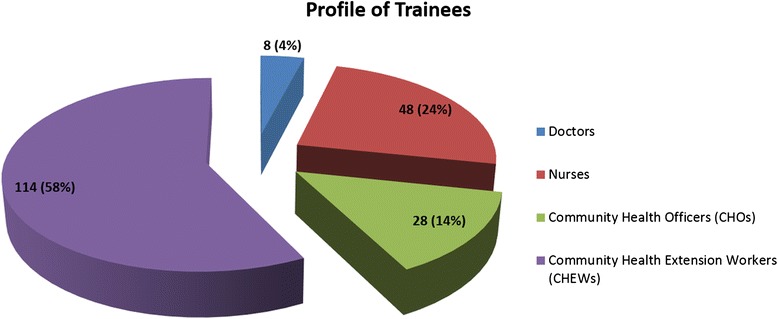
- A total of 198 primary care workers from 68 primary care clinics across 8 LGAs with a combined population of 966,714 were trained to detect and manage moderate to severe major depression, psychosis, epilepsy, and alcohol use disorders using the mhGAP-IG.
- Knowledge improved significantly from pre- to post-training (mean score difference −4.90, p < 0.001, CI −5.88 to −3.92), with retention at 9 months still above baseline (pre-training vs 9 months: −2.92, p < 0.001, CI −3.96 to −1.88) but lower than immediate post-training (post-training vs 9 months: 1.98, p < 0.001, CI 1.95 to 3.01).
- Compared with a baseline of zero MNS detection and treatment, trained staff identified and treated 96 clients and made 45 referrals to other levels of care, including 31 to PHC doctors and 14 to psychiatrists; 51 clients presented for follow-up clinics.
- About 65% of observed or assessed clinical encounters were rated in substantial compliance with the mhGAP-IG; policy attention increased, including employment of the state’s first psychiatrist and adoption of a national mhGAP-IG scale-up plan at the 56th National Council of Health meeting in August 2013.
Methods
- The program was implemented over 18 months in 8 selected LGAs in Osun State, Nigeria, as a pilot demonstration project with the Federal Ministry of Health and Osun State Ministry of Health, using a locally contextualized mhGAP-IG.
- A cascade training model was used: Master Trainers (psychiatrists) trained Facilitators (non-specialist physicians and senior nurses), who then trained frontline primary care workers; initial facilitator-led trainings were supervised by Master Trainers, and refresher training was provided after 9 months.
- Monitoring and evaluation included regular clinic visits, live clinical observations, review of clinical notes, debriefing sessions, and use of a contextualized WHO mhGAP monitoring and evaluation toolkit; pre- and post-training tests and a 9-month repeat test assessed knowledge and skills.
Limitations
- The paper states that relatively small numbers of clients were seen for MNS conditions despite training and public engagement, which the authors attribute to service utilization being a long and slow process.
- The paper states that stigma reduction among service providers was not measured, and that no personal information or individual patient-level data were collected.
- The paper states that knowledge and skills acquired during training may not necessarily translate into actual change in clinical practice; it also notes that cascade training runs the risk of quality decay, and some decay was observed at 9 months. Evident from the text: this was a pilot demonstration without a control or comparison group, and outcomes are facility-level counts rather than patient-level clinical outcomes.
Model-written summary. Check it against the paper before relying on it.
Integrity signals
Registry
Cites
Statistics
Figures
Verification
Claims the paper makes
4 Valid · 0 Not valid · 13 Not checked · 32 Own results and interpretations
Every source the paper cites for this claim was checked and supports it.
In the paper
“This step has already been successfully completed in Nigeria [21].”
§ Integrating mental health into primary care in Nigeria: report of a demonstration project using the mental health gap action programme intervention guide > Methods > The project overview
What the sources say
- Supportedcites [21] Abdulmalik J Kola L Fadahunsi W Adebayo K Yasamy MT Musa E Gureje O Country contextualization of the mental health gap action programme intervention guide: a case study from Nigeria PLOS Med 2013 10 8 e1001501 10.1371/journal.pmed.1001501 23976884 PMC3747990 source
The Summary Points explicitly state that contextualization of the mhGAP-IG was successfully carried out in Nigeria and produced a country-specific version. The Lessons Learnt section likewise describes the resulting context-specific manual. The claim concerns completion of contextualization, not the still-unevaluated impact of implementation. (LLM, conf=0.95)
plain- Asserted: passes — The authors put it forward as true.
- Checkable: passes — It can be checked against evidence.
- Load-bearing: passes — The paper’s conclusions depend on it.
- Based: passes — The paper gives a reason why it holds.
- Supported
The cited sources support only part of this claim — read each source’s verdict below.
In the paper
“This finding most likely reflects the observation previously made by others that even with continuous and sustained community engagement, ensuring acceptability and an increase in service utilization is often a long and slow process, whereby the numbers are initially modest and then slowly build up over time [23].”
§ Integrating mental health into primary care in Nigeria: report of a demonstration project using the mental health gap action programme intervention guide > Discussion
What the sources say
- Partly supportedcites [23] Ventevogel P van de Put W Faiz H van Mierlo B Siddiqi M Komproe IH Improving access to mental health care and psychosocial support within a fragile context: a case study from Afghanistan PLoS Med 2012 9 5 e1001225 10.1371/journal.pmed.1001225 22666183 PMC3362640 sourceExperimental — accuracy not yet measured
Split into 2 atoms — 0 confirmed, 2 partially supported, 0 disputed, 0 misattributed, 0 unverifiable. Expand the claim to see per-atom verdicts.
hedgedstates a possible cause- Asserted: passes — The authors put it forward as true.
- Checkable: passes — It can be checked against evidence.
- Load-bearing: unclear — It is unclear whether the paper’s conclusions depend on it.
- Based: passes — The paper gives a reason why it holds.
- Partly supported
A result the paper states — it cites no source for it, so there is none to check. The quote shows it is in the paper.
In the paper
“(a) the employment of the first psychiatrist in the state”
§ Integrating mental health into primary care in Nigeria: report of a demonstration project using the mental health gap action programme intervention guide > Results
plain- Asserted: passes — The authors put it forward as true.
- Checkable: passes — It can be checked against evidence.
- Load-bearing: unclear — It is unclear whether the paper’s conclusions depend on it.
- Based: passes — The paper gives a reason why it holds.
None of the sources cited for this claim have been checked yet.
In the paper
“We observed that relatively small numbers of clients were seen for MNS conditions despite the training of the providers to deliver improved service and the public engagement activities designed to inform the public about the availability of service. This was also in spite of the fact that the clinics were serving communities with relatively large population.”
§ Integrating mental health into primary care in Nigeria: report of a demonstration project using the mental health gap action programme intervention guide > Discussion
plain- Asserted: passes — The authors put it forward as true.
- Checkable: passes — It can be checked against evidence.
- Load-bearing: passes — The paper’s conclusions depend on it.
- Based: passes — The paper gives a reason why it holds.
A result the paper reports from its own data — it cites no other source for it, so there is none to check. The quote shows it is in the paper.
In the paper
“Following training, there was a marked improvement in the knowledge and skills of the health workers and there was also a significant increase in the numbers of persons identified and treated for MNS disorders, and in the number of referrals.”
§ Integrating mental health into primary care in Nigeria: report of a demonstration project using the mental health gap action programme intervention guide > Abstract > Results
plainstates a cause- Asserted: passes — The authors put it forward as true.
- Checkable: passes — It can be checked against evidence.
- Load-bearing: passes — The paper’s conclusions depend on it.
- Based: passes — The paper gives a reason why it holds.
27 more claims
Create a free account to see all 49 claims and to verify the 1 reference still open.
- Probably not a substantial claim. 11
- It may state two separate claims as one. 6
- The quote only partly states this claim. 1
Claims other papers make about this one
Each is checked against this paper’s own text: does it say what the citing paper says it does?
The source backs part of the claim, not all of it — or backs it for a different population, condition or comparison.
In the citing paper
“Gureje et al. (2015) earlier noted 40,8% knowledge gains but lacked longitudinal follow-up.”
From Scaling mental health care in Nigeria: Impact of WHO mhGAP training under the MeHPriC program on knowledge, attitudes, and practices of primary health care workers in Lagos State – A pre-post mixed-methods study (2025) · cites this paper as Gureje et al. (2015)
Experimental — accuracy not yet measuredThe source backs part of the claim, not all of it — or backs it for a different population, condition or comparison.
In the citing paper
“In other state-wide mhGAP projects in Nigeria, only clinical outcomes and trainee skill retention have been evaluated so far [27, 29, 30].”
From Integrating mental health into primary care: evaluation of the Health Action for Psychiatric Problems In Nigeria including Epilepsy and SubstanceS (HAPPINESS) pilot project (2022) · cites this paper as [30]
Experimental — accuracy not yet measuredThe source backs part of the claim, not all of it — or backs it for a different population, condition or comparison.
In the citing paper
“However, to date, only three Nigerian States (Lagos, Osun, and Ogun) have implemented state-wide mental health training for primary health care workers, which are the first contact for people with signs of mental illnesses [27–30].”
From Integrating mental health into primary care: evaluation of the Health Action for Psychiatric Problems In Nigeria including Epilepsy and SubstanceS (HAPPINESS) pilot project (2022) · cites this paper as [30]
Experimental — accuracy not yet measuredThe source backs part of the claim, not all of it — or backs it for a different population, condition or comparison.
In the citing paper
“Through building partnerships with other facilities, engaging users’ families, recruiting users via community outreach, and developing community awareness towards mental health issues, task-sharing providers can strengthen community acceptability and sustainability of the intervention [80].”
From Barriers and facilitators to implementation of evidence-based task-sharing mental health interventions in low- and middle-income countries: a systematic review using implementation science frameworks (2022) · cites this paper as [80]
Experimental — accuracy not yet measuredThe source backs part of the claim, not all of it — or backs it for a different population, condition or comparison.
In the citing paper
“In one instance, a general disorganization of the mental health system failed to provide service based on need, resulting in clients with serious mental health conditions receiving inadequate care at the primary care level while a disproportionate number of clients with common mental health conditions receiving specialized care [80].”
From Barriers and facilitators to implementation of evidence-based task-sharing mental health interventions in low- and middle-income countries: a systematic review using implementation science frameworks (2022) · cites this paper as [80]
Experimental — accuracy not yet measured
14 more claims about this paper
Create a free account to see every claim other papers make about this one.
Self-check
Percentages, sums and reported differences re-computed from the paper’s own numbers.
Rated minor: it would not touch a result — a value no result rests on, a p-value that stays on the same side of the significance level, or a conflict that is clerical, resolved elsewhere in the paper, or outside its own findings.
In the paper
“| Repeat assessment in November 2013 | TOTAL = 96 | TOTAL = 31 | TOTAL = 14 | 51 |”
§ Integrating mental health into primary care in Nigeria: report of a demonstration project using the mental health gap action programme intervention guide > Results
Reported 31 · recomputed 23
Rated minor: it would not touch a result — a value no result rests on, a p-value that stays on the same side of the significance level, or a conflict that is clerical, resolved elsewhere in the paper, or outside its own findings.
In the paper
“| Initial post-training scores versus scores 9 months later | 1.98 | <0.001 | 1.95 to 3.01 |”
§ Integrating mental health into primary care in Nigeria: report of a demonstration project using the mental health gap action programme intervention guide > Results
Reported 1.98 · recomputed 2.48
Citations
Cites
Vos, T., Flaxman, A. D., Naghavi, M., Lozano, R., Michaud, C., Ezzati, M., Shibuya, K., Salomon, J. A., Abdalla, S., Aboyans, V., et al. (2012) · The Lancet · doi:10.1016/s0140-6736(12)61729-2 · Cited by 8,291
Resources for mental health: scarcity, inequity, and inefficiency
Saxena, S., Thornicroft, G., Knapp, M., & Whiteford, H. (2007) · The Lancet · doi:10.1016/s0140-6736(07)61239-2 · Cited by 1,789 · cited 1×
“Thus, the system is characterized by inequity and inefficiency [18].”
BackgroundWang, P. S., Aguilar-Gaxiola, S., Alonso, J., Angermeyer, M. C., Borges, G., Bromet, E. J., Bruffaerts, R., de Girolamo, G., de Graaf, R., Gureje, O., et al. (2007) · The Lancet · doi:10.1016/s0140-6736(07)61414-7 · Cited by 1,655
Self-citationBarriers to improvement of mental health services in low-income and middle-income countries
Saraceno, B., van Ommeren, M., Batniji, R., Cohen, A., Gureje, O., Mahoney, J., Sridhar, D., & Underhill, C. (2007) · The Lancet · doi:10.1016/s0140-6736(07)61263-x · Cited by 1,088
Self-citationScale up services for mental disorders: a call for action
(2007) · The Lancet · doi:10.1016/s0140-6736(07)61242-2 · Cited by 835
Integrating Mental Health Into Primary Care. A Global Perspective
(2009) · Journal of Nervous & Mental Disease · doi:10.1097/01.nmd.0000362204.63479.6b · Cited by 807
Critical review of the literature
HORVÁTH, I. (1984) · Modelling in the Technology of Wastewater Treatment · doi:10.1016/b978-0-08-023978-1.50007-x · Cited by 531
Community study of knowledge of and attitude to mental illness in Nigeria
Gureje, O., Lasebikan, V. O., Ephraim-Oluwanuga, O., Olley, B. O., & Kola, L. (2005) · British Journal of Psychiatry · doi:10.1192/bjp.186.5.436 · Cited by 437 · cited 1×
“(MNS) disorders exposes the sufferers to abuse and economic impoverishment [4].”
BackgroundSelf-citationMbuba, C. K., Ngugi, A. K., Newton, C. R., & Carter, J. A. (2008) · Epilepsia · doi:10.1111/j.1528-1167.2008.01693.x · Cited by 407 · cited 1×
“treatment [2].”
Kroenke, K., Taylor-Vaisey, A., Dietrich, A. J., & Oxman, T. E. (2000) · Psychosomatics · doi:10.1016/s0033-3182(00)71172-8 · Cited by 164 · cited 1×
“It is an accepted norm that for the maintenance of clinical skills and competencies, primary care providers require opportunity for acquired knowledge to be reinforced through refresher training activities [22].”
Background
Research works printed but not linked: 2
- World Health Organization Mental Health Gap Action Programme (mhGAP) scaling up care for mental, neurological and substance abuse disorders 2008 Geneva World Health Organization 26290926
- WHO mhGAP Intervention Guide for mental, neurological and substance use disorders in non-specialized health settings: mental heatlh Gap Action Programme (mhGAP) 2010 Geneva World Health Organization 23741783
Cited by
Items 101–184 of 184
Profile and Determinants of Disability in Psychotic Disorders in Nigeria
Lasebikan, V. O., & Ayinde, O. O. (2016) · Community Mental Health Journal · doi:10.1007/s10597-016-0070-y · Cited by 4
Spagnolo, J., Champagne, F., Leduc, N., Melki, W., Bram, N., Guesmi, I., Rivard, M., Bannour, S., Bouabid, L., Ganzoui, S. B. H. H., et al. (2019) · Journal of Global Health Reports · doi:10.29392/joghr.3.e2019022 · Cited by 3
“Of note, mobilizing an already existing yet available resource to provide support to trainees was similarly highlighted as a major strength during one of the first mhGAP-IG training demonstrations on clinical utility in Nigeria (51).”
BackgroundAdetunji, A., Addo, B., Abegunde, D., Kalamar, A. M., Tulsiani, N. J., Sripad, P., Oyedokun-Adegbabo, F., & Ankomah, A. (2025) · BMJ Open · doi:10.1136/bmjopen-2024-089214 · Cited by 3
Psychiatric Practice in Nigeria
Lebimoyo, A. A. (2025) · Taiwanese Journal of Psychiatry · doi:10.4103/tpsy.tpsy_16_25 · Cited by 4
Sangwan, R. K., Kansara, D., Haider, A., Khetan, M., Huda, R. K., Dhikav, V., & Babu, B. V. (2025) · Frontiers in Public Health · doi:10.3389/fpubh.2025.1612961 · Cited by 2
The Challenges of Psychiatric Nursing Specialty: Education and Practice in Nigeria
Omi, J. I. I., Ebi, O. K., Amiegheme, F. E., & Afolayan, J. A. (2018) · Journal of Mental Disorders and Treatment · doi:10.4172/2471-271x.1000157 · Cited by 4
Practice Responses to Climigration
Palinkas, L. A. (2020) · Springer eBooks · doi:10.1007/978-3-030-41890-8_9 · Cited by 3
Bastoni, S., van Lotringen, C. M., Kip, H., Sanderman, R., van Gemert-Pijnen, L. J. E. W. C., & van Dongen, A. (2024) · Implementation Science Communications · doi:10.1186/s43058-024-00610-y · Cited by 5
Expérience d´intégration de la santé mentale en première ligne de soins en Guinée
Sow, A., Criel, B., Branger, B., Roland, M., & Spiegelaere, M. D. (2020) · Pan African Medical Journal · doi:10.11604/pamj.2020.37.107.20351 · Cited by 4
“Face à cette situation, le traitement des troubles mentaux au niveau des soins primaires, est la stratégie la plus souvent avancée et soutenue par L ́OMS [3, 4, 6].”
BackgroundInfluentialZani, B., Fairall, L. R., Petersen, I., Folb, N., Bhana, A., Thornicroft, G., Hanass‐Hancock, J., Lund, C., & Bachmann, M. O. (2020) · Tropical Medicine & International Health · doi:10.1111/tmi.13495 · Cited by 3
“keywords antiretroviral therapy, stigma, disability, depression diagnosis, depression treatment, multimorbidity Sustainable Development Goals (SDGs): SDG 1 (no poverty), SDG 3 (good health and well-being), SDG 17 (partnerships for the goals) Introduction Mental disorders contribute significantly to the burden of disea…”
BackgroundFolkerts, K. M., Merchant, I., & Yang, C. (2022) · Columbia Social Work Review · doi:10.52214/cswr.v20i1.9644 · Cited by 2
“…who are non-white, due to the high number of white providers Many non-white researchers and practitioners are actively working to incorporate culturally humble practices, but still the majority of mental health practices in the three focal countries undermine alternatives Gopalkrishnan, 2018).”
BackgroundEzeruigbo, C. (2022) · International Journal of Clinical Medicine · doi:10.4236/ijcm.2022.138026 · Cited by 4
Akhtar, S., Rabbani, F., Nafis, J., & Merali, Z. (2024) · Research Square · doi:10.21203/rs.3.rs-5571403/v1 · Cited by 2
Adewuya, A. O., Ola, B. A., Coker, O., Oladipo, O. E., Olibamoyo, O., & Atilola, O. (2025) · Implementation Science Communications · doi:10.1186/s43058-025-00798-7 · Cited by 1
“This reinforces their central role in the future of integrated mental health care delivery in Nigeria and elsewhere [14].”
Okewole, A., Awhangansi, S., & Akinfala, A. (2019) · Springer eBooks · doi:10.1007/978-3-030-17336-4_15 · Cited by 1
An App-Based WHO Mental Health Guide for Depression Detection: A Cluster Randomized Clinical Trial
Kohrt, B. A., Ojagbemi, A., Luitel, N. P., Bakolis, I., Bello, T., McCrone, P., Salisbury, T. T., Jordans, M. J. D., Votruba, N., Carswell, K., et al. (2025) · JAMA Network Open · doi:10.1001/jamanetworkopen.2025.12064 · Cited by 8
Self-citationAdegbite, O. A., & Palalas, A. (2025) · Open Praxis · doi:10.55982/openpraxis.17.3.905 · Cited by 4
The childlessness crisis: A mental health framework for infertility-linked suicides in India
Ghosh, D., Raj, S., ALmerab, M. M., & Mamun, M. A. (2025) · Mental Health & Prevention · doi:10.1016/j.mhp.2025.200442 · Cited by 3
Benedict, F. L., Mramba, C. V., Kaaya, S., Kimaro, J., Baumgartner, J. N., & Bachmann, M. O. (2025) · SSM - Mental Health · doi:10.1016/j.ssmmh.2025.100532 · Cited by 3
Mental health care services in Nigeria: A qualitative enquiry from family physicians’ perspective
Adeleke, O. T., Akinbode, A. O., Aibangbee, O., Orji, E. J., Oluwasanya, A. N., Adekunle, W. A., Oduniyi, O. A., Olabode, A. T., & Ariba, A. J. (2025) · PLOS mental health. · doi:10.1371/journal.pmen.0000285 · Cited by 8
“As of 2022, only three Nigerian states (Lagos, Ogun, and Osun) had implemented state-wide mental health training for primary health care workers, who serve as the first point of contact for people suspected of having mental illnesses [20–22].”
Dei‐Asamoa, R., Blocker, R., Ercis, M., Frye, M. A., Özerdem, A., Fiagbe, D., & Veldić, M. (2025) · Journal of Racial and Ethnic Health Disparities · doi:10.1007/s40615-025-02704-2 · Cited by 2
Adewuya, A. O., Oladipo, O. E., Emsley, R. A., & Asmal, L. (2026) · Child Abuse & Neglect · doi:10.1016/j.chiabu.2026.107962 · Cited by 2
Improving Community Mental Health Services in Nigeria
Adekeye, A. P. (2023) · Journal of Public Health and Primary Care · doi:10.4103/jphpc.jphpc_22_23 · Cited by 1
Sodeinde, K. J., Ogunsilu, E., Imishue, O. T., Adebisi, O., Omotosho, A., Adefala, N., & Gbadebo, A. (2024) · Tanzania journal of health research/Tanzania Journal of Health Research · doi:10.4314/thrb.v25i2.10
Ruderman, T., Kayira, W., Chalamanda, M., Kanzoole, K., Mpinga, K., Aron, M. B., Kelly, K., Singer, S., Ndarama, E. P. L., Smith, S. L., et al. (2023) · Intervention · doi:10.4103/intv.intv_24_23 · Cited by 1
Chukwu, A., Timmins, F., Üzar-Özçetin, Y. S., Stokes, D., Hernon, O., & Frawley, T. (2025) · Journal for the Study of Spirituality · doi:10.1080/20440243.2024.2447029 · Cited by 1
“In Nigeria, spirituality and religion play a critical role in shaping individuals’ decisions regarding mental health treatment (Gureje et al. 2015).”
Emerging models of psychotherapy
Spedding, M. F., & Chibanda, D. (2019) · Elsevier eBooks · doi:10.1016/b978-0-12-814932-4.00006-9 · Cited by 2
Atilola, O., Abiri, G., & Ola, B. A. (2018) · BJPsych International · doi:10.1192/bji.2017.14 · Cited by 2
“In addition, strategies for incorporating mental health services into broader community healthcare systems (Gureje et al, 2015), training of more youth mental health practitioners for the country (Omigbodun & Belfer, 2016) and task-shifting approaches for mental health services in youth…”
MethodRetractedBridging the gap by strengthening the MHGAP
Adekeye, A. P. (2022) · Archives of Mental Health · doi:10.4103/amh.amh_34_22 · Cited by 1
Maba, A. P. (2022) · Bulletin of Counseling and Psychotherapy · doi:10.51214/bocp.v5i1.340 · Cited by 1
Adoption of ICT4D frameworks to support screening for depression in Nigerian universities
Ojeme, B. (2018) · Open University of Cape Town (University of Cape Town) · Cited by 1
Gere, B. (2017) · Asian Journal of Social Sciences and Management Studies · doi:10.20448/journal.500/2017.4.1/500.1.65.69
“Gureje et al. (2015) reported that only a small numbers of clients were seen for mental, neurological and substance use disorders in primary health centers despite the availability of services and a limited number of trained personnel.”
BackgroundEducation About Mental Health and Illness: Innovative Approach for the Kenyan Context
Ndetei, D. M., Musyimi, C. W., Ruhara, R. W., Musau, A., & Mutiso, V. (2018) · Mental health and illness worldwide · doi:10.1007/978-981-10-0866-5_12-1
Spagnolo, J., Charfi, F., Bram, N., Doghri, L. L., & Melki, W. (2021) · Eastern Mediterranean Health Journal · doi:10.26719/emhj.21.021 · Cited by 1
WHO-mhGAP, MHPSS, IHME, and Other Internet Resources to Address the Global Burden of Mental Health
Kohn, R. (2021) · Springer eBooks · doi:10.1007/978-3-319-70134-9_116-1 · Cited by 1
WHO-mhGAP, MHPSS, IHME, and Other Internet Resources to Address the Global Burden of Mental Health
Kohn, R. (2021) · Springer eBooks · doi:10.1007/978-3-030-57296-9_116
Spagnolo, J., Champagne, F., Leduc, N., Melki, W., Bram, N., Guesmi, I., Rivard, M., Bannour, S., Bouabid, L., Ganzoui, S. B. H. H., et al. (2019) · Journal of Global Health Reports · doi:10.29392//001c.12026
Primary Mental Health Care in Low- and Middle-Income Countries
Isaac, M., Gureje, O., & Sumathipala, A. (2018) · Cambridge University Press eBooks · doi:10.1017/9781911623038.006 · Cited by 1
Self-citationEducation About Mental Health and Illness: Innovative Approach for the Kenyan Context
Ndetei, D. M., Musyimi, C. W., Ruhara, R. W., Musau, A., & Mutiso, V. (2019) · Mental health and illness worldwide · doi:10.1007/978-981-10-2350-7_12 · Cited by 1
de Freitas, A. P. A., & Borges, L. M. (2022) · Estudos e Pesquisas em Psicologia · doi:10.12957/epp.2022.68640
“…garantindo que os serviços e os profissionais estejam preparados para atender a esta demanda, uma vez que a proximidade com o território e a longitudinalidade do cuidado possibilitam o reconhecimento precoce e manejo adequado do risco de suicídio tão logo ele se apresente (Hirdes & Scarparo, 2015).”
BackgroundInfluentialExploring the experiences of mental health among internal migrants in Nigeria
Labinjo, T. (2022) · Sheffield Hallam University · doi:10.7190/shu-thesis-00450 · Cited by 1
dos Santos, D. V. C. (2023) · Digital Library of Theses and Dissertations (Universidade de São Paulo) · doi:10.11606/d.5.2023.tde-29052023-115114
Bamgbose, O. O., Pederson, A. B., & Okocha, A. A. G. (2023) · International Journal for the Advancement of Counselling · doi:10.1007/s10447-023-09525-0 · Cited by 3
“For instance, participants identified that given their role as first contact providers for individuals with mental health concerns (Gureje et al., 2015; Stefanovics et al., 2016; Tungchama et al., 2019) the education of religious leaders should address etiology and treatment of mental illness.”
BackgroundInfluentialIheanacho, T., Chu, C., Aguocha, C., Nwefoh, E., & Dike, C. C. (2023) · Research Square · doi:10.21203/rs.3.rs-3148682/v1
Adetunji, A., Addo, B., Abegunde, D., Kalamar, A. M., Tulsiani, N. J., Sri, P., Oyedokun-Adegbabo, F., & Ankomah, A. (2023) · Research Square · doi:10.21203/rs.3.rs-3210697/v1
Ansarifar, F., Rahimzadeh, M., Keshavarz, M., Babaheidari, T. B., & Saeieh, S. E. (2023) · Current Women s Health Reviews · doi:10.2174/0115734048259773230920104420
Services and systems of care for psychotic disorders: A global perspective
MALLA, A. K., & Iyer, S. N. (2023) · Oxford University Press eBooks · doi:10.1093/med/9780198735588.003.0008
Iheanacho, T. (2023) · Cambridge Prisms Global Mental Health · doi:10.1017/gmh.2024.4.pr4
Iheanacho, T., Chu, C., Aguocha, C. M., et al. (2023) · Cambridge Prisms Global Mental Health · doi:10.1017/gmh.2024.4.pr2
Iheanacho, T., Chu, C., Aguocha, C. M., et al. (2023) · Cambridge Prisms Global Mental Health · doi:10.1017/gmh.2024.4.pr5
Iheanacho, T., Chu, C., Aguocha, C. M., et al. (2023) · Cambridge Prisms Global Mental Health · doi:10.1017/gmh.2024.4.pr9
Iheanacho, T. (2023) · Cambridge Prisms Global Mental Health · doi:10.1017/gmh.2024.4.pr1
Iheanacho, T., Chu, C., Aguocha, C. M., et al. (2023) · Cambridge Prisms Global Mental Health · doi:10.1017/gmh.2024.4.pr3
Iheanacho, T., Chu, C., Aguocha, C. M., et al. (2023) · Cambridge Prisms Global Mental Health · doi:10.1017/gmh.2024.4.pr11
Iheanacho, T. (2023) · Cambridge Prisms Global Mental Health · doi:10.1017/gmh.2024.4.pr7
Iheanacho, T., Chu, C., Aguocha, C. M., et al. (2023) · Cambridge Prisms Global Mental Health · doi:10.1017/gmh.2024.4.pr6
Iheanacho, T., Chu, C., Aguocha, C. M., et al. (2023) · Cambridge Prisms Global Mental Health · doi:10.1017/gmh.2024.4.pr8
E o atributo orientação comunitária para a APS?
Oliveira, L. G. F., Fracolli, L. A., Pina-Oliveira, A. A., Gryschek, A. L. D. F. P. L., da Silva, M. R., Pereira, T. Z., Campos, D. S., Silva, G. L., da Silva, L. A., & Farias, L. G. (2024) · Contribuciones a las Ciencias Sociales · doi:10.55905/revconv.17n.3-133 · Cited by 2
Mushi, D., Hanlon, C., Moshiro, C. S., Francis, J. M., Feyasa, M. B., & Teferra, S. (2024) · BMC Health Services Research · doi:10.1186/s12913-024-10687-9
Mental health help-seeking by children and adolescents in Uganda's refugee settlements
Olumide, A. O. (2024) · The Lancet Child & Adolescent Health · doi:10.1016/s2352-4642(24)00166-4
Abah, T. (2020) · University of North Texas Digital Library (University of North Texas) · doi:10.12794/metadc1707305
When Life Does Not Matter Anymore: A Survey on Youths’ Perception of Suicide in Contemporary Nigeria
Lawal, S. A., & Olunlade, H. (2025) · Springer eBooks · doi:10.1007/978-3-030-68127-2_159-1
Adeleke, O. T., Adekunle, W. A., Oduniyi, O. A., Akinbode, A. O., Oluwasanya, A. N., Aibangbee, O., Orji, E. J., Olabode, A. T., & Ariba, A. J. (2025) · Research Square · doi:10.21203/rs.3.rs-6001960/v1
Taru, M. Y., Philip, T. F., Nwoga, C. N., Jidong, D. E., Ojeahere, M. I., Boyiga, B. B., Armiya’u, A. Y., & Akinnusi, P. (2025) · International Journal of Psychiatry · doi:10.33140/ijp.10.01.06 · Cited by 2
Mokaya, P. O., Ágoston, I., Galgalo, D. A., Maloba, G. O., Kazungu, J., & Gabriella, H.-F. (2025) · Acta Psychologica · doi:10.1016/j.actpsy.2025.105563 · Cited by 1
Abraham, D., Kumar, K., Hoogendoorn, A. W., de Wit, E. E., Veltman, D. J., & Bunders, J. (2025) · Advances in Mental Health · doi:10.1080/18387357.2025.2591084 · Cited by 1
Onofa, L. E. U., Ighoroje, M., Agboola, A. A., Ibrahim, N., Olaitan, F., Olujobi, A. O., Anozie, S., Samuel, O., Ogunsanya, T., Joseph, T. A., et al. (2026) · Journal of Neuro and Oncology Research · doi:10.46889/jnor.2026.6101
Humayun, A., Nisa, A., Haq, I. U., et al. (2026) · medRxiv · doi:10.64898/2026.01.22.26344671
Mental Health Care in Nigerian Prisons: A Practice-Based Critique of the Current Legal Framework
Ogunwale, A., MacManus, D., & Blackwood, N. (2026) · International Journal of Forensic Mental Health · doi:10.1177/14999013261426018
“…and within correctional services in particular, there is a need for the NCoSA and OPGMICJS to embrace a task-shifting and integrative approach to mental health service provision (Adebowale et al., 2014; Adebowale et al., 2018; Gureje et al., 2015; Jack et al., 2025; Ogunlesi & Ogunwale, 2018).”
Okoro, D. J., Inyang, U. E., & Esime, P. (2026) · International Journal of Public Health and Pharmacology · doi:10.52589/ijphp-dzpkigup
Teaching Psychology in Nigeria: Addressing Linguistic and Cultural Diversity for Student Wellbeing
Muhammed, S. A., & Omidire, M. F. (2026) · International and cultural psychology/International and cultural psychology series · doi:10.1007/978-3-032-09977-8_30
Nkansah, E. O., Boateng, D., Owusu‐Antwi, R., Baffour, P., & Dassah, E. T. (2026) · doi:10.2196/preprints.98706
Oladipo, O. E., Adewuya, A. O., Ola, B. A., Okewole, A., Ayankola, A. K., Esangbedo, A. E., & Lebimoyo, A. (2026) · Implementation Science Communications · doi:10.1186/s43058-026-00965-4
“Mental health services operate under high patient volumes, severely limited consultation time, and acute staffing shortages, with specialist care concentrated within few tertiary facilities [10].”
Akhtar, S., Rabbani, F., Nafis, J., Siddiqui, A., & Merali, Z. (2026) · BJPsych Open · doi:10.1192/bjo.2026.11051 · Cited by 3
Socioeconomic Challenges and Mental Health Outcomes Among Youths: The Mediating Role of GratitudePreprint
Sunday, J. R., Eze, C., Naibo, A. T., & Isaiah, U. S. (2026) · Research Square · doi:10.21203/rs.3.rs-10010418/v1
Sawhney, M. S., Schippert, A. C., Chiduo, M. G., Lutambi, A. M., Emidi, B., Hovland, O. J., Ødemark, I. L., Thorvik, C., Grov, E. K., & Kisa, S. (2026) · Frontiers in Public Health · doi:10.3389/fpubh.2026.1878653 · Cited by 2
Muhammad, N., Babandi, F., Also, U., & Ibrahim, U. M. (2026) · Discover Mental Health · doi:10.1007/s44192-026-00536-y · Cited by 1
Adesina, M., Taiwo, P., Olufadewa, I. I., MUSTAPHA, F., Abiose, D., Soneye, I., Oladele, R. I., & Jegede, A. (2026) · Global Health Cases · doi:10.1079/globalhealthcases.2026.0009
Treatment planning and intervention in multicultural counselling and psychotherapy
Otu, M. (2026) · Elsevier eBooks · doi:10.1016/b978-0-443-33939-4.00002-1
Orogbemi, O. M., & Ologunorisa, T. E. (2026) · International Journal of Scientific Research and Modern Technology. · doi:10.38124/ijsrmt.v5i7.1583 · Cited by 1
Buhari, T., Baguda, A., Aiyenuro, M., Ahmad, J. I., Galadanchi, J., Oluyori, A., Abdullahi, R. M., Iliyasu, Z., Akhigbe, O., Fawaz, A., et al. (2026) · medRxiv · doi:10.64898/2026.09.03.26362181
Badero, O. O., & Aisagbonhi, H. O. (2026) · Research Square · doi:10.21203/rs.3.rs-10562102/v1
Omoge, A. O., Omoge, M. O., AHMAD, A.-R. F., Onifade, P. B., & Arogundade, A. O. (2026) · Mental Wellness · doi:10.4081/mw.2026.67
Aja, L., Abonyi, O. S., Muhammad, T., Omebe, C. A., Onwudinjo, O. Q., Usulor, B. E., Sonia, I. U., & Nzarirwehi, J. (2026) · F1000Research · doi:10.12688/f1000research.186198.1
Metadata
- Authors
- Gureje, O., Abdulmalik, J., Kola, L., Musa, E., Yasamy, M. T., & Adebayo, K.
- Affiliations
- University of Ibadan (NG)
- World Health Organization - Nigeria (NG)
- World Health Organization (CH)
- Ladoke Akintola University of Technology (NG)
- Corresponding author
- Abdulmalik, Jibril
- Venue
- BMC Health Services Research
- Published
- 2015-06-21
- Volume
- 15
- Issue
- 1
- Pages
- 242-242
- ISSN
- 1472-6963 (ISSN-L)
- PMC
- PMC4475323
- OpenAlex
- W1598536764
- Semantic Scholar
- c845c3d7f8d78e2ed545e58b01980a164567aa3d
- Cited by
- 188
- References
- 22
- Citations by year
- 2026: 20 · 2025: 18 · 2024: 12 · 2023: 30 · 2022: 23 · 2021: 10 · 2020: 11 · 2019: 26 · 2018: 18 · 2017: 10 · 2016: 9 · 2015: 1
- FWCI
- 20.72
- Type
- journal article
- Language
- en
- Open access
- gold
- doi.org
- Locations
- BMC Health Services Research (publishedVersion, cc-by)
- Europe PMC (PubMed Central) (publishedVersion, cc-by)
- PubMed Central (publishedVersion, cc-by)
- PubMed (publishedVersion)
- Funders
- World Health Organization
- European Commission
- Bundesministerium für Gesundheit
- Topics
- Health Sciences › Medicine › Psychiatry and Mental health › Mental Health Treatment and Access
- Health Sciences › Health Professions › General Health Professions › Health Policy Implementation Science
- Social Sciences › Psychology › Clinical Psychology › Psychiatric care and mental health services
- Keywords
- mental health integration, primary care, Mental Health Gap Action Programme, task shifting, cascade training, mental health workforce shortage, major depressive disorder, psychosis, epilepsy, alcoholism, treatment gap, knowledge retention, refresher training, Osun State
- MeSH terms
- Adult, Cost-Benefit Analysis, Major Depressive Disorder, Developing Countries, Female, Health Personnel, Humans, Male, Mental Health Services, Nigeria, Pilot Projects, Poverty, Primary Health Care, Referral and Consultation, Delivery of Health Care, Integrated, Substance-Related Disorders
About these checks
Registry, retraction, Cites and statistics results are computed, not judged, with one exception: a printed reference that no index lists is read once by a model before it counts as a citation error. Claims are extracted by a model and kept only when their quote appears verbatim in the text; each cited source is then checked, with a model’s help, for whether it says what the claim relies on. Those verdicts can be wrong — read the claim’s quote and the cited source before relying on one.
The claim verdicts this report counts are experimental: their accuracy is not yet measured.
A language model drew the claims from the paper on 2026-10-10, under version 3 of the claim definition (model deepseek-v4.1-flash, prompt extract-v3).
A second model labelled each claim on 2026-10-10 (model jev-1.13-20260917, definition revision gold-guideline-v0.2).
Cited sources are checked with a language model’s help (gpt-6-sol).
Statistics and arithmetic are recomputed, not judged.
Confidence bands are shown only for fields calibrated on our annotated test set. None is calibrated yet, so no band is shown.
What counts as a claim ›How we measure confidence ›How we check this ›
Are you an author, or do you see a problem with this page? Request a review
Data sources
Bibliographic data: Semantic Scholar, OpenAlex, Crossref.
Contains information from the Semantic Scholar Academic Graph Datasets, made available under the ODC Attribution License (ODC-BY 1.0).
Semantic Scholar’s data is described in: Kinney, R., et al. (2023). The Semantic Scholar Open Data Platform. arXiv:2301.10140.
