

The use of e-health and m-health tools in health promotion and primary prevention among older adults: a systematic literature review.
Open accessThe DOI matches its Crossref record; 26 of the 26 references it cites were found in a registry or an index.
Abstract
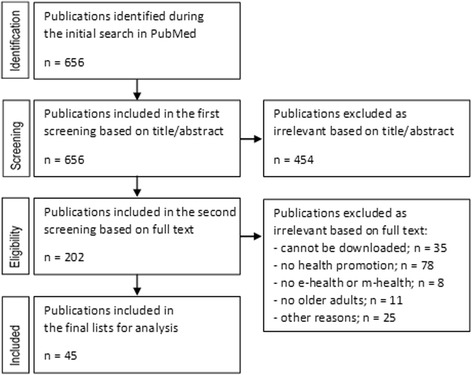
BACKGROUND: The use of e-health and m-health technologies in health promotion and primary prevention among older people is largely unexplored. This study provides a systematic review of the evidence on the scope of the use of e-health and m-health tools in health promotion and primary prevention among older adults (age 50+). METHODS: A systematic literature review was conducted in October 2015. The search for relevant publications was done in the search engine PubMed. The key inclusion criteria were: e-health and m-health tools used, participants' age 50+ years, focus on health promotion and primary prevention, published in the past 10 years, in English, and full-paper can be obtained. The text of the publications was analyzed based on two themes: the characteristics of e-health and m-health tools and the determinants of the use of these tools by older adults. The quality of the studies reviewed was also assessed. RESULTS: The initial search resulted in 656 publications. After we applied the inclusion and exclusion criteria, 45 publications were selected for the review. In the publications reviewed, various types of e-health/m-health tools were described, namely apps, websites, devices, video consults and webinars. Most of the publications (60 %) reported studies in the US. In 37 % of the publications, the study population was older adults in general, while the rest of the publications studied a specific group of older adults (e.g. women or those with overweight). The publications indicated various facilitators and barriers. The most commonly mentioned facilitator was the support for the use of the e-health/m-health tools that the older adults received. CONCLUSIONS: E-health and m-health tools are used by older adults in diverse health promotion programs, but also outside formal programs to monitor and improve their health. The latter is hardly studied. The successful use of e-health/m-health tools in health promotion programs for older adults greatly depends on the older adults' motivation and support that older adults receive when using e-health and m-health tools.
Overview
The claims and statistics of this paper haven’t been checked yet.
Free: it reads the open-access text and checks the first 5 claims that cite a source we can check. Create a free account to check every claim.
Integrity signals
Registry
Cites
Statistics
Figures
Verification
Claims the paper makes
The claims and statistics of this paper haven’t been checked yet.
Free: it reads the open-access text and checks the first 5 claims that cite a source we can check. Create a free account to check every claim.
Claims other papers make about this one
Each is checked against this paper’s own text: does it say what the citing paper says it does?
The source backs part of the claim, not all of it — or backs it for a different population, condition or comparison.
In the citing paper
“For older adults, the success of remote monitoring interventions to monitor and improve their health greatly depended on the support and training they received [99].”
From Telemedicine in the OECD: An umbrella review of clinical and cost-effectiveness, patient experience and implementation (2020) · cites this paper as [99]
Experimental — accuracy not yet measured
Self-check
Percentages, sums and reported differences re-computed from the paper’s own numbers.
The self-check needs the paper’s full text.
Citations
Cites
Three Approaches to Qualitative Content Analysis
Hsieh, H.-F., & Shannon, S. E. (2005) · Qualitative Health Research · doi:10.1177/1049732305276687 · Cited by 44,601
A typology of reviews: an analysis of 14 review types and associated methodologies
Grant, M. J., & Booth, A. (2009) · Health Information & Libraries Journal · doi:10.1111/j.1471-1842.2009.00848.x · Cited by 10,817
Building a practically useful theory of goal setting and task motivation: A 35-year odyssey.
Locke, E. A., & Latham, G. P. (2002) · American Psychologist · doi:10.1037/0003-066x.57.9.705 · Cited by 7,766 · cited 2×
“To help with the motivation, adequate goal setting is an important facilitating factor [18].”
(2007) · Circulation · doi:10.1161/circulationaha.107.185649 · Cited by 6,545 · cited 1×
“This is not surprising as many diseases can be prevented through physical activity or maintenance of a healthy weight [11–13].”
Physical Activity and Health: A Report of the Surgeon General: (525162010-001)
(1995) · PsycEXTRA Dataset · doi:10.1037/e525162010-001 · Cited by 5,479
Health promotion from the perspective of Social Cognitive Theory
Bandura, A. (1998) · Psychology & Health · doi:10.1080/08870449808407422 · Cited by 3,087 · cited 1×
“If the goals are too difficult to reach then, this has negative effects, and the goal setting becomes a barrier [18, 19].”
Moorhead, S. A., Hazlett, D. E., Harrison, L., Carroll, J. K., Irwin, A., & Hoving, C. (2013) · Journal of Medical Internet Research · doi:10.2196/jmir.1933 · Cited by 2,517
Eysenbach, G. (2001) · Journal of Medical Internet Research · doi:10.2196/jmir.3.2.e20 · Cited by 2,449 · cited 1×
“E-health typically refers to on-line and off-line computerbased applications while m-health refers to applications for mobile phones [1, 2].”
Thompson, P. D., Buchner, D., Piña, I. L., Balady, G. J., Williams, M. A., Marcus, B. H., Berra, K., Blair, S. N., Costa, F., Franklin, B., et al. (2003) · Circulation · doi:10.1161/01.cir.0000075572.40158.77 · Cited by 2,132
The effectiveness of interventions to increase physical activityA systematic review1 and 2
KAHN, E., RAMSEY, L., BROWNSON, R., HEATH, G., HOWZE, E., POWELL, K., STONE, E., RAJAB, M., & CORSO, P. (2002) · American Journal of Preventive Medicine · doi:10.1016/s0749-3797(02)00434-8 · Cited by 2,022 · cited 3×
“It is recognized hewer that these factors are important determinants of behavior change and not necessarily direct determinants of the use of e-health and m-health tools [13].”
Research works printed but not linked: 1
- 5. Physical Activity Guidelines Advisory Committee. Physical activity guidelines advisory committee report -2008. Washington, DC: U.S. Department of Health and Human Services; 2008.
Cited by
Items 101–200 of 325
Environmental and contextual factors influencing e-health use among older adults: A rapid review
Sharkiya, S. H., & Hag, A. M. (2024) · International Journal of Medical Informatics · doi:10.1016/j.ijmedinf.2024.105448 · Cited by 16
Mumtaz, A. (2022) · Journal of Healthcare Engineering · doi:10.1155/2022/7852806 · Cited by 20
Lowndes, A., & Connelly, D. M. (2023) · Digital Health · doi:10.1177/20552076231167004 · Cited by 19
“It has been recommended by Kampmeijer et al.(55) that older adults would use e-Health tools for health promotion more successfully if they received increased support.”
MethodSMART technologies in older adult care: a scoping review and guide for caregivers
Rybenská, K., Knapová, L., Janiš, K., Kühnová, J., Cimler, R., & Elavsky, S. (2024) · Journal of Enabling Technologies · doi:10.1108/jet-05-2023-0016 · Cited by 25
The evolution and mapping trends of mobile health (m-Health): a bibliometric analysis (1997–2023)
Alanzi, T. M., Rehman, S. U., Khan, M. A., & Istepanian, R. S. H. (2024) · mHealth · doi:10.21037/mhealth-23-20 · Cited by 22
Strategies and Tools for Supporting the Appropriateness of Drug Use in Older People
Lunghi, C., Trevisan, C., Fusaroli, M., Giunchi, V., Raschi, E., Sangiorgi, E., Domenicali, M., Volpato, S., Ponti, F. D., & Poluzzi, E. (2022) · Pharmaceuticals · doi:10.3390/ph15080977 · Cited by 22
“by healthcare providers, and accessibility (native language and printable material) [70], will plausibly result in higher adherence.”
BackgroundMethodGuo, Y., Wen, T., Yue, S., Zhao, X., & Huang, K. (2023) · Digital Health · doi:10.1177/20552076231167003 · Cited by 17
“As technology evolves, e-health and mobile health tools are increasingly being used in health promotion and primary prevention among older adults.(1) Mobile health devices can manage and motivate older adults’ health behaviors, assess health abnormalities and detect certain early diseases by monitoring relevant physic…”
Backgroundvan Elburg, F. R. T., van de Klundert, J. J., Nieboer, A. P., & Askari, M. (2023) · Frontiers in Public Health · doi:10.3389/fpubh.2023.1130570 · Cited by 17
“Older adults have been identified as the subpopulation that can benefit most from mHealth services (27, 32, 33).”
BackgroundPenno, E., & Gauld, R. D. C. (2017) · Health Systems & Reform · doi:10.1080/23288604.2017.1340927 · Cited by 19
“22,23,56,57 Implementation and Policy Challenges”
Mora‐Traverso, M., Molina‐García, P., Prieto‐Moreno, R., Borges‐Cosic, M., Guisado, V. C., Algarrada, R. D. P., Moreno‐Ramírez, P., Gomez‐Jurado, G., Tarrias, C. G., Isla, M. H., et al. (2022) · Research in Nursing & Health · doi:10.1002/nur.22218 · Cited by 18
“habilitation process, especially younger caregivers who tend to have adequate smartphone skills (Kampmeijer et al., 2016).”
BackgroundMethodInfluentialOn behalf of the U-Merge Scientific Office, Rodgers, A. L., Trinchieri, A., Ather, M. H., & Buchholz, N. (2018) · Urolithiasis · doi:10.1007/s00240-018-1086-2 · Cited by 18
Podda, J., Tacchino, A., Ponzio, M., Antonio, F. D., Susini, A., Pedullà, L., Battaglia, M. A., & Brichetto, G. (2024) · JMIR Formative Research · doi:10.2196/56074 · Cited by 18
“As expected, upper limb functionality correlated with the interface and satisfaction subscale, confirming that upper limb limitations can also prevent people, especially older adults, from using mHealth apps [53].”
BackgroundHege, I., Tolks, D., Kühn, S., & Shiozawa, T. (2020) · PubMed Central · doi:10.3205/zma001356 · Cited by 21
“Moderne Informations- undKommunikationstechnologien ermöglichen E-Health [2] und individualisierte Medizin.”
BackgroundZhu, D., Zhao, J., Wu, T., Zhu, B., Wang, M., & Han, T. (2025) · JMIR mhealth and uhealth · doi:10.2196/63022 · Cited by 17
“Nevertheless, this procedure imposes considerable financial burdens on the patients and requires a significant time commitment from the caregivers [6].”
Aranha, M., Shemie, J., James, K., Deasy, C., & Heavin, C. (2023) · Smart Health · doi:10.1016/j.smhl.2023.100435 · Cited by 15
Elavsky, S., Knapová, L., Janiš, K., Cimler, R., Kühnová, J., & Cernicky, T. (2024) · Journal of Medical Internet Research · doi:10.2196/45492 · Cited by 27
“…whereas the most commonly cited barriers to the adoption of new technologies are sociodemographic factors (age, education, and skills); personal factors (such as lack of time or other priorities); lack of support; lack of resources or unclear guidance on how to use the technology [16,17].”
Influence awareness: considering motivation in computer-assisted rehabilitation
López‐Jaquero, V., Montero, F., & Teruel, M. Á. (2017) · Journal of Ambient Intelligence and Humanized Computing · doi:10.1007/s12652-017-0652-8 · Cited by 13
“In this work, we are addressing our efforts towards including motivation in the development of e-Health systems, a cornerstone for the success or failure of an interactive system (Kampmeijer et al. 2016).”
BackgroundMethodInfluentialSeasonality of Back Pain in Italy: An Infodemiology Study
Ciaffi, J., Melicòni, R., Landini, M. P., Mancarella, L., Brusi, V., Faldini, C., & Ursini, F. (2021) · International Journal of Environmental Research and Public Health · doi:10.3390/ijerph18031325 · Cited by 19
A model of digital health communication media use during the Covid-19 pandemic
Sumaedi, S., Sumardjo, S., Saleh, A., & Syukri, A. F. (2021) · Health Education · doi:10.1108/he-03-2021-0040 · Cited by 18
Tudor, A. I. M., Nichifor, E., Litră, A. V., Chițu, I. B., Bratucu, T.-O., & Brătucu, G. (2022) · International Journal of Environmental Research and Public Health · doi:10.3390/ijerph19159172 · Cited by 15
“Five major themes of mHealth applications can be defined [25]: treatment compliance referring to the use of mobile applications to ensure that patients strictly adhere to their treatment schedule [26,27]; data and disease monitoring [28–30]; creation of health information and support systems at the care place—whereas…”
BackgroundDescriptive Norms and eHealth Use Among Older Adults: A Cross-Country Comparative Study
Wu, Q. J., Ngien, A., & Jiang, S. (2023) · Health Communication · doi:10.1080/10410236.2023.2297120 · Cited by 14
“Previous studies have primarily examined individual (e.g., demographics, computer knowledge and skills) and technological predictors (e.g., content and accessibility; Kampmeijer et al., 2016; Wilson et al., 2021).”
Ferraz, L. T., Santos, A. J. T., Lorenzi, L. J., Frohlich, D. M., Barley, E. A., & Castro, P. C. (2024) · BMJ Open · doi:10.1136/bmjopen-2023-078647 · Cited by 18
Herold, F., Theobald, P., Gronwald, T., Kaushal, N., Zou, L., de Bruin, E. D., Bherer, L., & Müller, N. G. (2024) · JMIR Aging · doi:10.2196/56433 · Cited by 17
Ahmed, A. S., Ho, C. W., Grant, Y., Archer, S., & Carrington, E. V. (2025) · BMJ Open · doi:10.1136/bmjopen-2024-086412 · Cited by 44
“What else can we do?”—Provider perspectives on treatment‐resistant depression in late life
Hamm, M., Karp, J. F., Lenard, E. M., Dawdani, A., Lavretsky, H., Lenze, E. J., Mulsant, B. H., Reynolds, C. F., Roose, S. P., & Brown, P. J. (2021) · Journal of the American Geriatrics Society · doi:10.1111/jgs.17592 · Cited by 15
“However, while telehealth care has been shown to be feasible in older adults with mental disorders, its implementation has been slow.(32,33) The coronavirus disease 2019 (COVID-19) pandemic is creating a systemic shift toward telehealth; a recent report estimated that U.”
BackgroundPanickar, R., Aziz, Z., Sani, N. M., & Kamarulzaman, A. (2023) · Patient Education and Counseling · doi:10.1016/j.pec.2023.107707 · Cited by 13
Mueller, J., Davies, A., Jay, C., Harper, S., Blackhall, F. H., Summers, Y., Harle, A. S. M., & Todd, C. J. (2018) · British Journal of Health Psychology · doi:10.1111/bjhp.12325 · Cited by 17
Sturge, J. L., Meijering, L., Jones, C. A., Garvelink, M. M., Caron, D., Nordin, S., Elf, M., & Légaré, F. (2021) · JMIR Research Protocols · doi:10.2196/19244 · Cited by 16
“These technologies could be enlisted to support mobility and autonomy in the home environment and hold great potential for older adults whose informed value-congruent decision is to stay home [23-26].”
BackgroundPalozzi, G., & Antonucci, G. (2022) · BMC Health Services Research · doi:10.1186/s12913-022-07637-8 · Cited by 15
“High inferences and connections were recognized between medical and technical disciplines [77].”
BackgroundInfluentialNon-Contact Measurement of Blood Oxygen Saturation Using Facial Video Without Reference Values
Sasaki, S., Sugita, N., Terai, T., & Yoshizawa, M. (2023) · IEEE Journal of Translational Engineering in Health and Medicine · doi:10.1109/jtehm.2023.3318643 · Cited by 16
“Furthermore, e-health and m-health [30] using general-purpose communication devices such as smartphones have been rapidly expanding in recent years.”
BackgroundZhu, D., Zhao, J., Wang, M., Cao, B., Zhang, W., Li, Y., Zhang, C., & Han, T. (2024) · JMIR mhealth and uhealth · doi:10.2196/53798 · Cited by 15
“Traditional nonpharmacological interventions, however, require professional guidance to achieve the desired results, which is associated with high costs and unequal health care resources [8].”
BackgroundHerold, M., Simbula, S., & Gallucci, M. (2024) · Current Psychology · doi:10.1007/s12144-024-06534-z · Cited by 15
“It can inter - est younger people as older ones (Kampmeijer et al., 2016).”
InfluentialWathne, H. B., Storm, M., Morken, I. M., & Husebø, A. M. L. (2025) · Journal of Advanced Nursing · doi:10.1111/jan.16736 · Cited by 23
Li, C., Wang, H., Yuan, J., Shi, L., Chen, Y., Gao, Z., Zhao, L., & Oliveira, A. (2025) · Digital Health · doi:10.1177/20552076251348578 · Cited by 14
“79,80 Geographically, developed countries in Europe and the United States have conducted the most in-depth research on the use of DHTs in older people with chronic diseases, particularly in the use of mobile devices to facilitate information exchange and feedback between doctors and patients and…”
Jørgensen, S. W., Lee, K., Klausen, S. H., Petersen, E. N., & Nørgaard, B. (2022) · The European Journal of Psychiatry · doi:10.1016/j.ejpsy.2022.08.003 · Cited by 16
Mobile health intervention for promotion of eye health literacy
Sharma, I. P., Chaudhry, M., Sharma, D., & Kaiti, R. (2021) · PLOS Global Public Health · doi:10.1371/journal.pgph.0000025 · Cited by 13
The effect of m-health applications on self-care improvement in older adults: A systematic review
Kalhori, S. R. N., Katigari, M. R., Azadboni, T. T., Pahlevanynejad, S., & Eshpala, R. H. (2023) · Informatics for Health and Social Care · doi:10.1080/17538157.2023.2171878 · Cited by 12
Trinidad, L. E. D. M., Andrade-Villanueva, J. F., Martínez-Ayala, P., Silva, R. I. C., Herrera-Godina, M. G., & González-Hernández, L. A. (2025) · JMIR mhealth and uhealth · doi:10.2196/57540 · Cited by 14
“…of digital health is using wireless technologies like phones, tablets, and smartphones for public health, which is known as mobile health (mHealth) [12]. eHealth and mHealth strategies have been proposed for many aspects of health services, including medication adherence, diagnosis, training,…”
Paolucci, T., Pezzi, L., Bressi, F., Russa, R. L., Zobel, B. B., Bertoni, G., Farì, G., & Bernetti, A. (2024) · Digital Health · doi:10.1177/20552076241297296 · Cited by 14
Dorell, Å., Konradsen, H., Kallström, A. P., & Kabir, Z. N. (2022) · PLoS ONE · doi:10.1371/journal.pone.0271972 · Cited by 12
“Other research also mentions that facilitating factors in communication with health care professionals are motivation, support, and feedback from the staff [25].”
BackgroundFeng, L., Lv, X., Wang, Y., Chu, S., Dai, Z., Jing, H., Tong, Z., Liao, X., & Liang, L. (2022) · Expert Review of Respiratory Medicine · doi:10.1080/17476348.2022.2108797 · Cited by 12
“lower educational levels or limited skills with electronic devices [97].”
BackgroundWeber, M., Schmitt, K., Frei, A. L., Puhan, M. A., & Raab, A. M. (2023) · Digital Health · doi:10.1177/20552076231203785 · Cited by 13
“35,47 According to a scoping review of barriers to eHealth use among older adults, consistent barriers were problems with the user interface, for instance, screen or text issues.”
BackgroundJohns, T. L., Huot, C., & Jenkins, J. C. (2022) · Primary Care Clinics in Office Practice · doi:10.1016/j.pop.2022.04.009 · Cited by 12
Liu, P. L. (2024) · Health Promotion International · doi:10.1093/heapro/daae132 · Cited by 9
Liu, T., Luo, Y. T., Pang, P. C., & Xia, Y. (2024) · Systems · doi:10.3390/systems12110504 · Cited by 12
Matemba, S. R. M., Alcéna-Stiner, D. C., Glazier, A., & Leblanc, N. M. (2024) · PLOS Global Public Health · doi:10.1371/journal.pgph.0003259 · Cited by 11
Nguyen, A., Somerville, E. K., Espín-Tello, S. M., Keglovits, M., & Stark, S. L. (2020) · JMIR Rehabilitation and Assistive Technologies · doi:10.2196/14465 · Cited by 9
“Mobile health (mHealth) apps are increasingly being used by health care providers to improve clinical workflow efficiency and as novel interventions to improve diverse health outcomes for patients [47-49].”
BackgroundKelechi, T. J., Prentice, M. A., Mueller, M., Madisetti, M., & Vertegel, A. A. (2020) · JMIR mhealth and uhealth · doi:10.2196/15015 · Cited by 11
“App features such as reminders have been found to be essential for app engagement and are influenced by social demographics; health characteristics; intentions to change; and actual health behaviors, motivation, and support [29].”
Beauchet, O., Matskiv, J., Launay, C. P., Gaudreau, P., Benatar, D., Ptito, A., Chou, P., Allali, G., Prate, F., Vaillant-Ciszewicz, A.-J., et al. (2022) · Maturitas · doi:10.1016/j.maturitas.2022.04.006 · Cited by 9
Vietzke, J., Schenk, L., & Baer, N.-R. (2023) · Digital Health · doi:10.1177/20552076231163788 · Cited by 16
“, ease of use) depict central facilitating factors.(23) On the other hand, a lack of motivation, high time expenditure, and difficulties in handling technical devices are among the most prominent barriers toward mHealth technology use.”
BackgroundKalaitzaki, A. E., Rovithis, M., Dimitropoulos, A., Koukouli, S., Linardakis, M. K., Katsiri, E., Rikos, N., Vasilopoulos, G., Tsolas, G., Papachristou, A., et al. (2023) · Medicina · doi:10.3390/medicina59081493 · Cited by 11
“This is a noteworthy and reassuring finding which suggests that old people in these three groups are receptive to the use of technology in the management of their disease, although contradictory evidence from the relevant literature demonstrates that the use of technology-based applications among users of any age in h…”
BackgroundAdriaans, D. J., Rosendaal, M., Nieuwenhuijzen, G. A. P., Heesakkers, F. F. B. M., Notenboom, L., Teijink, J. A. W., van Laarhoven, H. W. M., & Daele, A. T. M. D.-V. (2024) · European Journal of Oncology Nursing · doi:10.1016/j.ejon.2024.102638 · Cited by 12
Pop, A. I., & Lotrean, L. M. (2024) · BMC Medical Education · doi:10.1186/s12909-024-05939-5 · Cited by 11
“They should also maximize interprofessional learning possibilities and balance the risks and benefits of various treatment options to provide the best possible patient care [5–7].”
BackgroundDaniels, K., Vonck, S., Robijns, J., Quadflieg, K., Bergs, J., Spooren, A. I. F., Hansen, D., & Bonnechère, B. (2025) · JMIR Aging · doi:10.2196/63348 · Cited by 19
Li, Y., Cai, J., & Yu, H. (2025) · Frontiers in Public Health · doi:10.3389/fpubh.2025.1643510 · Cited by 14
Goff, D. L., Barais, M., Perraud, G., Derriennic, J., Aujoulat, P., Guillou-Landréat, M., & Reste, J. Y. L. (2021) · BMC Public Health · doi:10.1186/s12889-021-11443-y · Cited by 16
Quantifying Citizens’ Well-Being in Areas with Natural Based Solutions Using Mobile Computing
Gallos, P., Menychtas, A., Panagopoulos, C., Bimpas, M., & Maglogiannis, I. G. (2022) · Studies in health technology and informatics · doi:10.3233/shti210958 · Cited by 9
“being and public health using similar mHealth applications [6,11].”
BackgroundZhu, P., Wang, H., Zhang, L., & Jiang, X. (2022) · Computational and Mathematical Methods in Medicine · doi:10.1155/2022/8436741 · Cited by 8
“E-health generally refers to the various applications of information and communication technology in medical treatment, including not only the informatization of medical procedures in hospitals but also the sharing of regional medical information and health services [3, 4].”
BackgroundSedhed, J., Johansson, H., Andersson, N., Åkesson, E., Kalbe, E., Franzén, E., & Leavy, B. (2024) · BMC Neurology · doi:10.1186/s12883-024-03614-2 · Cited by 11
“Electronic health (eHealth) technology, enables health care to be provided outside standard clinical settings [20]. eHealth methods are feasible in PD [21, 22] and beneficial for older adults [23].”
BackgroundSavolainen, K., & Kujala, S. (2024) · JMIR Human Factors · doi:10.2196/45275 · Cited by 19
“Older adults are the largest group to face challenges in using digital health services [18,19].”
Backgroundvan Mierlo, R. F. R., Houben, V., Rikken, S. A. O. F., Gómez‐Doblas, J. J., Lozano-Torres, J., & Hof, A. W. J. V. ’. (2024) · Frontiers in Cardiovascular Medicine · doi:10.3389/fcvm.2024.1387148 · Cited by 8
LOU, V. W. Q., Cheng, C. Y. M., Ng, D. K.-S., Chan, F. H. W., Mo, S. S.-L., Kung, E. K.-M., & Luk, J. K.-H. (2022) · Journal of Gerontological Social Work · doi:10.1080/01634372.2022.2068722 · Cited by 9
“A systematic review showed that the most important facilitator for mHealth application mentioned by older patients was the support for the use of mHealth tools (Kampmeijer et al., 2016).”
BackgroundToyama, M., Cavero, V., Araya, R., Menezes, P. R., Mohr, D. C., Miranda, J. J., & Diez‐Canseco, F. (2022) · JMIR Human Factors · doi:10.2196/35486 · Cited by 8
“In addition, feedback and support have been reported as motivators for older adults using digital health interventions [29].”
Vélez, O. C., Solís‐Navarro, L., Sitjà‐Rabert, M., Pérez, L. M., Roca, J., Soto-Bagaria, L., Torres‐Castro, R., Díaz-Gallego, F., Vilaró, J., & Inzitari, M. (2023) · Frontiers in Public Health · doi:10.3389/fpubh.2023.1161883 · Cited by 7
“Furthermore, the successful use of digital tools in health promotion programmes for older adults highly depends on the motivation and support they receive when using these tools (18).”
Malkowski, O. S., Townsend, N. P., Kelson, M. J., Foster, C. E., & Western, M. J. (2024) · PLoS ONE · doi:10.1371/journal.pone.0303061 · Cited by 9
Gallos, P., Menychtas, A., Panagopoulos, C., Kaselimi, M., Τέμενος, Α., Rallis, I., Doulamis, A. D., Doulamis, N. D., Bimpas, M., Aggeli, A., et al. (2022) · Studies in health technology and informatics · doi:10.3233/shti220791 · Cited by 9
The Use of eHealth Practices by United States Patients with Self-Reported Glaucoma
Stagg, B. C., Gupta, D., Ehrlich, J. R., Newman-Casey, P. A., Stein, J. D., Kawamoto, K., & Hess, R. (2020) · Ophthalmology Glaucoma · doi:10.1016/j.ogla.2020.07.010 · Cited by 7
Dehghani, E., Karimi, K., Sokke, H. G., Khadembashiri, M. A., Ghavidel, F., & Memari, A. (2024) · Lifestyle Medicine · doi:10.1002/lim2.104 · Cited by 6
Liu, P. L., & Yeo, T. E. D. (2025) · Health Communication · doi:10.1080/10410236.2025.2476791 · Cited by 6
“…purchasing, and patient engagement in online health communities (S. Jiang & Liu, 2020). eHealth tools can be used to prompt positive health behavior change, help individuals lead and maintain a healthy lifestyle, and support disease diagnosis, treatment, and management (Kampmeijer et al., 2016).”
Lotrean, L. M., & Sabo, S. A. (2023) · Healthcare · doi:10.3390/healthcare11121731 · Cited by 8
“The use of digital solutions in the field of preventive, curative, and health recovery services, but also for educational management in the field of health, management, and communication in health services, the development of health policies has the potential to bring benefits to patients, health professionals, and me…”
BackgroundOlogeanu‐Taddei, R., Guthrie, C. H., & Wamba, S. F. (2022) · International Journal of Technology and Human Interaction · doi:10.4018/ijthi.299043 · Cited by 8
Kwan, R. Y. C., Liu, J. Y. W., Lee, P. H., Sin, O. S. K., Wong, J. S. W., Fu, M. R., & Suen, L. K. P. (2023) · Trials · doi:10.1186/s13063-023-07335-8 · Cited by 9
“E-health provides an alternative delivery method to conventional behavioural change methods delivered by human interventionists [24].”
MethodIrawan, A. S., Döbrössy, B., Srahbzu, M., Muharram, A. P., Kovács, S. D., & Girasek, E. (2025) · Frontiers in Digital Health · doi:10.3389/fdgth.2025.1533788 · Cited by 12
Crafoord, M.-T., Sundberg, K. K., Nilsson, M. I., Fjell, M., & Langius‐Eklöf, A. (2023) · CIN Computers Informatics Nursing · doi:10.1097/cin.0000000000001007 · Cited by 10
Yeo, Y., Lau, Y., Ang, W. W., Wong, Q. F., Tam, H. L., Loh, W. L., Wong, S. H., & Lau, S. T. (2023) · Geriatric Nursing · doi:10.1016/j.gerinurse.2023.10.012 · Cited by 5
Sassone, B., Fucă, G., Pedaci, M., Lugli, R., Bertagnin, E., Virzì, S., Bovina, M., Pasanisi, G., Mandini, S., MYERS, J. N., et al. (2024) · JMIR Cardio · doi:10.2196/57058 · Cited by 6
“Moreover, older age has consistently arisen as a factor for diminished internet XSL • FO RenderX accessibility, decreased use of digital health technology, and greater challenges in engaging with digital health care services across numerous studies [26,27].”
BackgroundZhu, Y., Xiao, Q. E., Ao, M. C., & Zhao, X. (2025) · Digital Health · doi:10.1177/20552076251317658 · Cited by 11
Sari, M., & Putri, N. I. P. (2021) · Insisiva Dental Journal Majalah Kedokteran Gigi Insisiva · doi:10.18196/di.v10i2.11311 · Cited by 12
Flickinger, T., Campbell, B. R., Timm, A. R., Baee, S., Datta, D., Shenoi, S., Rozanova, J., & Dillingham, R. (2022) · Telemedicine Reports · doi:10.1089/tmr.2022.0035 · Cited by 7
“35 Black non-Hispanic 28 (50) 15 (48) Hispanic 4 (7) 0 (0) White non-Hispanic 15 (27) 8 (26) Multiple races, other, or declined to answer 8 (14) 6 (19)”
Telemedicine in urologic oncology care: Will telemedicine exacerbate disparities?
Gul, Z., Sharbaugh, D. R., Ellimoottil, C. S., Rak, K. J., Yabes, J. G., Davies, B., & Jacobs, B. L. (2024) · Urologic Oncology Seminars and Original Investigations · doi:10.1016/j.urolonc.2023.10.002 · Cited by 8
Impact of Information Technology on Patient Confidentiality Rights: A Perspective
Elgujja, A. A. (2019) · Advances in medical technologies and clinical practice book series · doi:10.4018/978-1-7998-0047-7.ch018 · Cited by 5
Darley, A., Dix, R., Rocher, E., Stokes, D., & Carroll, Á. M. (2022) · HRB Open Research · doi:10.12688/hrbopenres.13549.1 · Cited by 5
“In a systematic review performed by Kampmeijer et al. 25 , the authors outlined the evidence on the facilitating factors and barriers to the use of digital health tools for health promotion and primary prevention among older adults.”
Xuan, Z., Niu, Y., Wang, Y., Wang, Z.-M., Zhao, J., Chang, H., & Xiao, Q. (2025) · Journal of Medical Internet Research · doi:10.2196/76222 · Cited by 9
“Digital remote self-management systems have shown to stimulate proactive health behaviors in older adults [24,25].”
Tailoring mHealth for Healthy Aging: Focus Group Study With Retirement-Age Adults
Collazo‐Castiñeira, P., Rodríguez‐Rey, R., Cruz-Jentoft, A. J., Allouch, S. B., Eglseer, D., Schoufour, J. D., Topinková, E., Weijs, P. J. M., Boirie, Y., & Sánchez‐Izquierdo, M. (2025) · JMIR mhealth and uhealth · doi:10.2196/70051 · Cited by 6
“Especially, external social support from family members, caregivers, or health care providers has been found to predict greater use and adherence to eHealth technologies [23,55,84,85].”
Maes, I., Carlier, S., Latomme, J., Backere, F. D., Cardon, G., & Dyck, D. V. (2024) · Health & Social Care in the Community · doi:10.1155/2024/5055630 · Cited by 5
Gordon, N. P., Yin, C., & Lo, J. C.-M. (2024) · JMIR Aging · doi:10.2196/63814 · Cited by 5
Factors influencing engagement with adherence-enhancing mobile health app in sickle cell disease
Abrams, C. M., Davila, N., Badawy, S. M., Marks, S., Kepper, M. M., Gibson, R. W., King, A. A., Gordeuk, V. R., Nwosu, C., Li, S., et al. (2024) · BMC Digital Health · doi:10.1186/s44247-024-00138-0 · Cited by 8
Manirambona, E., Khan, N. E., Ogungbe, O., Irakoze, S., Li, J., Uwiringiyimana, E., Fawole, I. O., Habarugira, C., Akingbade, O., Nzabonimana, A., et al. (2024) · Scientific Reports · doi:10.1038/s41598-024-80121-x · Cited by 4
Personalizing Care for Informal Heart Failure Caregivers: Challenges and Practical Implications
Säfström, E., & Liljeroos, M. (2025) · Current Heart Failure Reports · doi:10.1007/s11897-025-00703-2 · Cited by 5
“Using e-health services is becoming more common regardless of age as a way to exchange support and information [40, 41].”
Diaz, M. F. F., Sibley, K. M., Giberson, K., Sénéchal, M., & B̀ouchard, D. R. (2025) · Aging Clinical and Experimental Research · doi:10.1007/s40520-025-03172-8 · Cited by 3
“These factors include, but are not limited to personal preferences, poor digital literacy, technology-related challenges, age or income [37–39].”
Ebrahimi, Z., Barenfeld, E., Gyllensten, H., Olaya‐Contreras, P., Fors, A., Fredholm, E. M., Fuller, J. M., Goudarzi, M., Krantz, B., Swedberg, K. B., et al. (2023) · BMC Geriatrics · doi:10.1186/s12877-023-03866-6 · Cited by 8
“However, even if remote health-promoting services are recommended to improve reach [83], access, and efficiency in health care, they are underused in older populations [84].”
BackgroundSkeen, S. J., Tokarz, S., Gasik, R. E., Solano, C. M., Smith, E. A., Sagoe, M. B., Hudson, L. V., Steele, K., Theall, K. P., & Clum, G. A. (2023) · JMIR Research Protocols · doi:10.2196/47151 · Cited by 11
“Success among this user base relies on a baseline degree of digital readiness [140], which is itself often contingent on device familiarity—a strength of NOLA GEM, which leverages common SMS text message and native app functional affordances, distinct from, for example, a wearable actigraphy sensor.”
BackgroundPierucci, A., de Almeida, N. S., Lemes, Í. R., Milanez, V. F., Oliveira, C. B., Winkelströter, L. K., de Abreu, M. A. M. M., Nakagaki, W. R., & Toledo, A. C. C. G. (2024) · Computer Methods and Programs in Biomedicine · doi:10.1016/j.cmpb.2024.108551 · Cited by 6
Ezeigwe, O. J., Nwosu, K. O. S., Afolayan, O. K., Ojaruega, A. A., Echere, J., Desai, M., Onigbogi, M. O., Oladoyin, O. O., Okoye, N., & Fwelo, P. (2025) · Journal of Medical Internet Research · doi:10.2196/63403 · Cited by 6
“Mobile health apps are software programs running on smartphones and tablets to promote health and primary disease prevention [12,13].”
Professional Practices for Digital Healthcare
Edirippulige, S., & Senanayake, B. (2020) · Advances in medical technologies and clinical practice book series · doi:10.4018/978-1-7998-3274-4.ch006 · Cited by 5
Sturm, J., Dierick, A., Christianen, M., van Gelder, M., & Wouters, E. (2023) · Healthcare · doi:10.3390/healthcare11111612 · Cited by 5
“Additionally, in more recent literature, studies showed that older people, for the successful use of mHealth and eHealth, need support [5].”
BackgroundCan Mobile Digital Games Benefit Older Adults’ Health?
Duplàa, E., Kaufman, D. M., Sauvé, L., Rénaud, L., & Ireland, A. (2017) · Human-computer interaction series · doi:10.1007/978-3-319-60672-9_6 · Cited by 7
Ekstedt, M., Kirsebom, M., Lindqvist, G., Frykholm, O., Kneck, Å., Flink, M., & Wannheden, C. (2021) · doi:10.2196/preprints.34972 · Cited by 4
Barcelos, A., Moniz, A., Henriques, A. R., Mazeda, C., Mateus, E. F., Machado, A., Gonçalves, C. F., Moreto, M., de Almeida, M. F., Mendonça, N., et al. (2025) · JMIR Formative Research · doi:10.2196/72468 · Cited by 4
“These digital solutions have the potential to foster positive health behavior change, support healthier lifestyles, and assist in the diagnosis and treatment of diseases [19].”
Zhang, Y., Cao, X., Huang, L., Zhu, Y., & Chen, L. (2025) · BMJ Open · doi:10.1136/bmjopen-2025-108371 · Cited by 4
Metadata
- Authors
- Kampmeijer, R., Pavlova, M., Tambor, M., Golinowska, S., & Groot, W.
- Affiliations
- Maastricht University Medical Centre (NL)
- Jagiellonian University (PL)
- Corresponding author
- Pavlova, Milena
- Venue
- BMC Health Services Research
- Published
- 2016-08
- Volume
- 16
- Issue
- S5
- Pages
- 290-290
- ISSN
- 1472-6963 (ISSN-L)
- PMC
- PMC5016733
- OpenAlex
- W2520132032
- Cited by
- 328
- References
- 26
- Citations by year
- 2026: 21 · 2025: 30 · 2024: 57 · 2023: 50 · 2022: 57 · 2021: 39 · 2020: 35 · 2019: 16 · 2018: 13 · 2017: 7 · 2016: 1
- FWCI
- 3.31
- Type
- journal article
- Language
- en
- Open access
- gold
- doi.org
- Licence
- cc-by
- Locations
- BMC Health Services Research (publishedVersion, cc-by)
- Europe PMC (PubMed Central) (publishedVersion, cc-by)
- PubMed Central (publishedVersion, cc-by)
- PubMed (publishedVersion)
- Research Publications (Maastricht University) (publishedVersion, cc-by)
- Homo Politicus (Academy of Humanities and Economics in Lodz) (submittedVersion, cc-by-nc-nd)
- Jagiellonian University Repository (Jagiellonian University) (submittedVersion, cc-by-nc-nd)
- Research Publications (Maastricht University) (submittedVersion, other-oa)
- Topics
- Health Sciences › Medicine › Geriatrics and Gerontology › Technology Use by Older Adults
- Health Sciences › Health Professions › General Health Professions › Mobile Health and mHealth Applications
- Health Sciences › Health Professions › Health Information Management › Health, Technology, Consumer Behavior
- Keywords
- e-health, mobile health, health promotion, primary prevention, older adults, technology adoption, barriers and facilitators, mobile health apps, video consultation, self-monitoring
- MeSH terms
- Healthy Lifestyle, Aged, Health Promotion, Humans, Motivation, Primary Prevention, Global Health, Telemedicine, Internet, Mobile Applications
About these checks
Registry, retraction, Cites and statistics results are computed, not judged, with one exception: a printed reference that no index lists is read once by a model before it counts as a citation error. Claims are extracted by a model and kept only when their quote appears verbatim in the text; each cited source is then checked, with a model’s help, for whether it says what the claim relies on. Those verdicts can be wrong — read the claim’s quote and the cited source before relying on one.
Statistics and arithmetic are recomputed, not judged.
Confidence bands are shown only for fields calibrated on our annotated test set. None is calibrated yet, so no band is shown.
What counts as a claim ›How we measure confidence ›How we check this ›
Are you an author, or do you see a problem with this page? Request a review
Data sources
Bibliographic data: Semantic Scholar, OpenAlex, Crossref.
Contains information from the Semantic Scholar Academic Graph Datasets, made available under the ODC Attribution License (ODC-BY 1.0).
Semantic Scholar’s data is described in: Kinney, R., et al. (2023). The Semantic Scholar Open Data Platform. arXiv:2301.10140.
