

The use of e-health and m-health tools in health promotion and primary prevention among older adults: a systematic literature review.
Open accessThe DOI matches its Crossref record; 26 of the 26 references it cites were found in a registry or an index.
Abstract
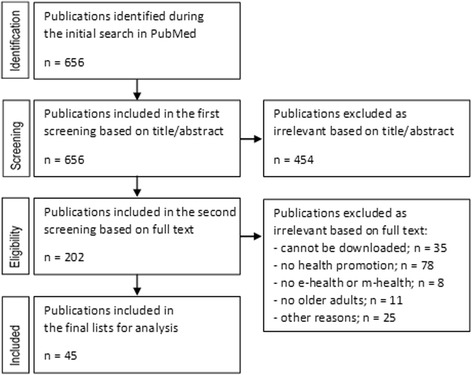
BACKGROUND: The use of e-health and m-health technologies in health promotion and primary prevention among older people is largely unexplored. This study provides a systematic review of the evidence on the scope of the use of e-health and m-health tools in health promotion and primary prevention among older adults (age 50+). METHODS: A systematic literature review was conducted in October 2015. The search for relevant publications was done in the search engine PubMed. The key inclusion criteria were: e-health and m-health tools used, participants' age 50+ years, focus on health promotion and primary prevention, published in the past 10 years, in English, and full-paper can be obtained. The text of the publications was analyzed based on two themes: the characteristics of e-health and m-health tools and the determinants of the use of these tools by older adults. The quality of the studies reviewed was also assessed. RESULTS: The initial search resulted in 656 publications. After we applied the inclusion and exclusion criteria, 45 publications were selected for the review. In the publications reviewed, various types of e-health/m-health tools were described, namely apps, websites, devices, video consults and webinars. Most of the publications (60 %) reported studies in the US. In 37 % of the publications, the study population was older adults in general, while the rest of the publications studied a specific group of older adults (e.g. women or those with overweight). The publications indicated various facilitators and barriers. The most commonly mentioned facilitator was the support for the use of the e-health/m-health tools that the older adults received. CONCLUSIONS: E-health and m-health tools are used by older adults in diverse health promotion programs, but also outside formal programs to monitor and improve their health. The latter is hardly studied. The successful use of e-health/m-health tools in health promotion programs for older adults greatly depends on the older adults' motivation and support that older adults receive when using e-health and m-health tools.
Overview
The claims and statistics of this paper haven’t been checked yet.
Free: it reads the open-access text and checks the first 5 claims that cite a source we can check. Create a free account to check every claim.
Integrity signals
Registry
Cites
Statistics
Figures
Verification
Claims the paper makes
The claims and statistics of this paper haven’t been checked yet.
Free: it reads the open-access text and checks the first 5 claims that cite a source we can check. Create a free account to check every claim.
Claims other papers make about this one
Each is checked against this paper’s own text: does it say what the citing paper says it does?
The source backs part of the claim, not all of it — or backs it for a different population, condition or comparison.
In the citing paper
“For older adults, the success of remote monitoring interventions to monitor and improve their health greatly depended on the support and training they received [99].”
From Telemedicine in the OECD: An umbrella review of clinical and cost-effectiveness, patient experience and implementation (2020) · cites this paper as [99]
Experimental — accuracy not yet measured
Self-check
Percentages, sums and reported differences re-computed from the paper’s own numbers.
The self-check needs the paper’s full text.
Citations
Cites
Three Approaches to Qualitative Content Analysis
Hsieh, H.-F., & Shannon, S. E. (2005) · Qualitative Health Research · doi:10.1177/1049732305276687 · Cited by 44,601
A typology of reviews: an analysis of 14 review types and associated methodologies
Grant, M. J., & Booth, A. (2009) · Health Information & Libraries Journal · doi:10.1111/j.1471-1842.2009.00848.x · Cited by 10,817
Building a practically useful theory of goal setting and task motivation: A 35-year odyssey.
Locke, E. A., & Latham, G. P. (2002) · American Psychologist · doi:10.1037/0003-066x.57.9.705 · Cited by 7,766 · cited 2×
“To help with the motivation, adequate goal setting is an important facilitating factor [18].”
(2007) · Circulation · doi:10.1161/circulationaha.107.185649 · Cited by 6,545 · cited 1×
“This is not surprising as many diseases can be prevented through physical activity or maintenance of a healthy weight [11–13].”
Physical Activity and Health: A Report of the Surgeon General: (525162010-001)
(1995) · PsycEXTRA Dataset · doi:10.1037/e525162010-001 · Cited by 5,479
Health promotion from the perspective of Social Cognitive Theory
Bandura, A. (1998) · Psychology & Health · doi:10.1080/08870449808407422 · Cited by 3,087 · cited 1×
“If the goals are too difficult to reach then, this has negative effects, and the goal setting becomes a barrier [18, 19].”
Moorhead, S. A., Hazlett, D. E., Harrison, L., Carroll, J. K., Irwin, A., & Hoving, C. (2013) · Journal of Medical Internet Research · doi:10.2196/jmir.1933 · Cited by 2,517
Eysenbach, G. (2001) · Journal of Medical Internet Research · doi:10.2196/jmir.3.2.e20 · Cited by 2,449 · cited 1×
“E-health typically refers to on-line and off-line computerbased applications while m-health refers to applications for mobile phones [1, 2].”
Thompson, P. D., Buchner, D., Piña, I. L., Balady, G. J., Williams, M. A., Marcus, B. H., Berra, K., Blair, S. N., Costa, F., Franklin, B., et al. (2003) · Circulation · doi:10.1161/01.cir.0000075572.40158.77 · Cited by 2,132
The effectiveness of interventions to increase physical activityA systematic review1 and 2
KAHN, E., RAMSEY, L., BROWNSON, R., HEATH, G., HOWZE, E., POWELL, K., STONE, E., RAJAB, M., & CORSO, P. (2002) · American Journal of Preventive Medicine · doi:10.1016/s0749-3797(02)00434-8 · Cited by 2,022 · cited 3×
“It is recognized hewer that these factors are important determinants of behavior change and not necessarily direct determinants of the use of e-health and m-health tools [13].”
Research works printed but not linked: 1
- 5. Physical Activity Guidelines Advisory Committee. Physical activity guidelines advisory committee report -2008. Washington, DC: U.S. Department of Health and Human Services; 2008.
Cited by
Items 201–300 of 325
Influencing factors of continuance intention of medical applications for the elderly
Huang, T., Cai, W., Lu, T., & Huang, C. (2026) · Scientific Reports · doi:10.1038/s41598-026-40494-7 · Cited by 3
Tseng, J. T., Hsiao, H., Yu, A. P., & Chen, Y. (2021) · Journal of the Society for Social Work and Research · doi:10.1086/715817 · Cited by 3
“Thus, usingmobile technology to connect with the other family members, including younger generations, may reduce older adults’ risk of social isolation as well as other mental and physical risks during quarantines (Dinov, 2008; Kampmeijer et al., 2016).”
BackgroundNoel, N. B., Noel, M. B., Yila, E., Nkala, C. A.-L., & Banwat, M. (2024) · Nigerian Medical Journal · doi:10.60787/nmj-64-6-373 · Cited by 6
“Since lack of education and training have been identified as major barriers to the implementation of telemedicine by health professionals, [14,15] medical school will provide an opportunity to address this gap from the early stages of their careers by equipping the future medical workforce with the…”
BackgroundAlves, G. C. G., Amador, F. L. D., dos Santos, V. R., & Moreira, R. S. L. (2024) · Revista Brasileira de Enfermagem · doi:10.1590/0034-7167-2023-0491 · Cited by 5
Sharper, S., Evans, C. S., Mufalali, S. M., Muduli, R., & Phiri, B. (2021) · Global Journal of Health Science · doi:10.5539/gjhs.v13n12p81 · Cited by 5
“Keywords: adherence, text messaging, mobile phone, HIV, ART, SMS reminders List of Abbreviations AIDS: Acquired Immune Deficiency Syndrome ART: Antiretroviral CD: Communicable Diseases CI: Confidence Interval DHI: Digital Health Intervention EPHPP: Effective Public Health Practice Project HIV: Human Immunodeficiency V…”
BackgroundInfluentialAntonucci, G., Palozzi, G., Ranalli, F., & Venditti, M. (2022) · Springer eBooks · doi:10.1007/978-3-030-87273-1_17 · Cited by 3
Health Monitoring System for Elderly Patients
Rochmawati, E., Setyonugroho, W., Utami, S. S., Permana, I., & Lestari, T. (2023) · Advances in health sciences research/Advances in Health Sciences Research · doi:10.2991/978-94-6463-190-6_17 · Cited by 3
Melhem, S. J., & Kayyali, R. (2023) · Frontiers in Public Health · doi:10.3389/fpubh.2023.1272344 · Cited by 5
Review and bibliometric analysis of AI-driven advancements in healthcare
Wang, Y. J., Choo, W. C., & Ng, K. Y. (2024) · Asia-Pacific Journal of Molecular Biology and Biotechnology · doi:10.35118/apjmbb.2024.032.2.10 · Cited by 6
Schadewaldt, V., O’Brien, T., Kalla, M., Krishnasamy, M., Burns, K., Bray, S. C. E., Gilbert, C. A., Lourenço, R. D. A., Thomas, J., Capurro, D., et al. (2025) · Digital Health · doi:10.1177/20552076251316713 · Cited by 5
“11,12 While several systematic reviews have highlighted the potential of DHS for cancer patients, they also identi fi ed a paucity of validated DHS, particularly for those with brain tumours 13 – 15 and for carers.”
Çakır, F., Ozturk, S., Gerçek, H., Eryıldız, E., Kartal, G., & Polat, M. G. (2025) · Health Education · doi:10.1108/he-07-2024-0089 · Cited by 2
Miguel, A. C., Fernández-Moreno, A., Pablo-Leis, A. I., Romero-Hernández, M., Munar, M., Moyà-Alcover, G., González-Hidalgo, M., & Segura‐Sampedro, J. J. (2025) · Journal of Clinical Medicine · doi:10.3390/jcm14072210 · Cited by 3
Neumann, A., König, H., & Hajek, A. (2025) · JMIR Aging · doi:10.2196/60311 · Cited by 3
“The reviews [38-40] mostly included studies from the United States or Europe.”
InfluentialEconomic impacts of changing technologies on New Zealand homecare delivery
Hennessy, J., & Rodrigues, A. (2019) · Journal of Enabling Technologies · doi:10.1108/jet-11-2018-0055 · Cited by 5
Larsson, E., Fahlström, G., Bertilsson, G., & Fristedt, S. (2020) · Gerontechnology · doi:10.4017/gt.2020.19.003.02 · Cited by 4
Abhari, S., Lankarani, K. B., Azadbakht, L., Kalhori, S. R. N., Safdari, R., Emamgholipour, S., Garavand, A., Barzegari, S., & Moradi, S. (2023) · Archives of Iranian Medicine · doi:10.34172/aim.2023.93 · Cited by 2
Ebrahimi, Z., Olaya‐Contreras, P., Goudarzi, M., & Ekman, I. (2025) · BMC Geriatrics · doi:10.1186/s12877-025-06509-0 · Cited by 3
“Older people participating in a remote PCC intervention reported that they experienced increased access and involvement in care [18], suggesting that welfare technology may play a role in implementing PCC, but its adoption among older people remains limited [19].”
Gregoor, A. M. S., Sangers, T. E., Heijnsdijk, E. A. M., Groot, C. A. U., Nijsten, T. E. C., & Wakkee, M. (2026) · EJC Skin Cancer · doi:10.1016/j.ejcskn.2026.100926 · Cited by 4
Sy, A. U., Marriott, J., Tannis, C., Demment, M. M., McIntosh, S. E., Hadley, J., Albert, P., Buenconsejo-Lum, L. E., & Dye, T. (2020) · PubMed · Cited by 2
Lifestyle Medicine Center for Brain Aging and Neurodegenerative Diseases
Mattson, M. P. (2020) · Springer eBooks · doi:10.1007/978-3-030-48088-2_26 · Cited by 2
DÖNMEZ, A. (2021) · Bilgi Yönetimi · doi:10.33721/by.886887 · Cited by 7
Li, Z., Ge, J., Zhang, C., Peng, X., Wu, Q.-F., & You, H. (2023) · American Journal of Health Promotion · doi:10.1177/08901171231186313 · Cited by 5
“As a study reported, the successful use of online healthcare tools for older adults greatly depends on the motivation and support they received.(31) Policies designed to improve attitudes toward e-health use has been proved effective.”
BackgroundTse, M. Y. M., Ng, S. S. M., LOU, V. W. Q., Lo, R. S. K., Cheung, D. S. K., Lee, P. H., Tang, S. K., Leung, S. H., & Tse, P. P.-S. (2023) · OBM Neurobiology · doi:10.21926/obm.neurobiol.2303183 · Cited by 3
Barbosa, M. C. F., Baldiotti, A. L. P., Braga, N. S., Lopes, C. T., Paiva, S. M., Granville‐Garcia, A. F., & Ferreira, F. M. (2023) · PubMed Central · doi:10.1590/0103-6440202305346 · Cited by 7
Brockes, C., Barresi, F., Schmidt, C., Schulz, E. G., & Schmidt-Weitmann, S. (2018) · DMW - Deutsche Medizinische Wochenschrift · doi:10.1055/a-0655-1083 · Cited by 4
“Telemedizinische Dienstleistungsangebote bieten mit einer zeit- und ortsunabhängigen Bereitstellung von Gesundheitsinformationen einen hohen Patientennutzen, insbesondere im präventiven Bereich [11].”
BackgroundInfluentialLópez‐Pelayo, H., Caballería, E., Díaz, E., Sánchez, A., Segura, L., Colom, J., Wallace, P., & Gual, A. (2019) · Health Informatics Journal · doi:10.1177/1460458219855177 · Cited by 5
Mateo, M. M., & Herrera, D. G. (2019) · REVISTA ESPAÑOLA DE COMUNICACIÓN EN SALUD · doi:10.20318/recs.2019.4429 · Cited by 3
Kuhlberg, H., Kujala, S., Hörhammer, I., & Koskela, T. (2021) · JMIR Research Protocols · doi:10.2196/27668 · Cited by 3
“In addition to risk perceptions, a systematic literature review reported that motivation, support, and feedback are the most influential factors in changing health-related behavior with eHealth tools [29].”
BackgroundPsychological Aspects in the Use of Telemedicine in Diabetes Mellitus
Taras, M. A. (2022) · Journal of Diabetes and Treatment · doi:10.29011/2574-7568.001098 · Cited by 2
Nuevas tecnologías en Medicina
Alonso, J. L. I., & Sánchez, C. A. (2022) · Revista de Investigación y Educación en Ciencias de la Salud (RIECS) · doi:10.37536/riecs.2022.7.1.308 · Cited by 5
Association of Lifestyle and Medication for Primary Cardiovascular Prevention in The Elderly
Martinez, T. L. D. R. (2022) · Online Journal of Cardiology Research & Reports · doi:10.33552/ojcrr.2022.06.000646 · Cited by 1
Teknologi M-Health Untuk Kesehatan Anak : A Scoping Review
Lulianthy, E., Adam, S., & Putri, D. K. (2021) · JHeS (Journal of Health Studies) · doi:10.31101/jhes.2009 · Cited by 6
“Alat-alat tersebut dapat digunakan untuk merangsang perubahan perilaku kesehatan yang positif atau membantu orang menjalani gaya hidup yang lebih sehat atau untuk mendukung diagnosis dan pengobatan penyakit (Kampmeijer et al., 2016; Samples et al., 2014).”
BackgroundToyama, M., Cavero, V., Araya, R., Menezes, P. R., Mohr, D. C., Miranda, J. J., & Diez‐Canseco, F. (2021) · doi:10.2196/preprints.35486 · Cited by 2
Wu, Y., Zheng, M., & Weng, C. (2023) · Visual Informatics · doi:10.1016/j.visinf.2023.10.004 · Cited by 4
Alves, G. C. G., Amador, F. L. D., dos Santos, V. R., & Moreira, R. S. L. (2024) · Revista Brasileira de Enfermagem · doi:10.1590/0034-7167-2023-0491pt · Cited by 1
Fall risk screening in older adults using the “CARE” frailty scale: The NuAge cohort results
Beauchet, O., Matskiv, J., Gaudreau, P., Allali, G., Vaillant-Ciszewicz, A.-J., Guérin, O., & Gros, A. (2024) · Maturitas · doi:10.1016/j.maturitas.2024.108134 · Cited by 1
A Metaverse Between Technical and Humanistic Domains to Reach Society 5.0
Osello, A., Manera, U., Rimella, N., Bin, C., Vasta, R., Masala, E., Shields, J. A. E., Tarantola, G., & Chiò, A. (2024) · IEEE Canada International Humanitarian Technology Conference · doi:10.1109/ihtc61819.2024.10855137 · Cited by 1
“These technologies allow healthcare providers to engage with older adults, motivate them, and promote healthy lifestyle behaviors [22].”
Tuncer, G. Z., & Tuncer, M. (2025) · Eating Disorders · doi:10.1080/10640266.2025.2498247 · Cited by 4
“Moreover, these interventions can allow individuals to access healthcare services without the fear of stigma-tization and support personalized care (Kampmeijer et al., 2016).”
The role of digital health interventions in chronic ulcer management: a systematic review
Stevenson, E. M., Coda, A., Chu, G., & Bourke, M. (2025) · Journal of Tissue Viability · doi:10.1016/j.jtv.2025.100928 · Cited by 2
Development of a motion capture and feedback system for Qigong
Baldinger, M., Lippmann, K., Lisca, G., & Senner, V. (2025) · Sports Engineering · doi:10.1007/s12283-025-00507-6 · Cited by 2
“In healthcare, it has the potential to be used for rehabilitation or health promotion and prevention programs [11].”
Health Information Systems’ Support for Management and Changing Work: Survey Study Among Physicians
Heponiemi, T., Virtanen, L., Kainiemi, E., Saukkonen, P., Reponen, J., & Lääveri, T. (2025) · JMIR Medical Informatics · doi:10.2196/65913 · Cited by 3
“Consequently, this may impact the extent of digital preventive work, as patients’ unawareness of the potential DHTs or their benefits has been mentioned amongst the barriers of digital prevention [33].”
Li, D., Zhu, Y., Yuan, C., Huang, Q., Yang, Y., Geng, Z., Yuan, X., & Wu, F. (2025) · JMIR Human Factors · doi:10.2196/71448 · Cited by 3
“Moreover, a lack of tailored mHealth designed specifically for their needs can decrease the older adults’ willingness to use mHealth, preventing them from adapting to technology and receiving the associated benefits [19,20].”
Tse, M. M. Y., Ng, S. S. M., LOU, V. W. Q., Lo, R. S., Cheung, D. S. K., Lee, P. H., Tang, A. S. K., & Tse, P. P.-S. (2026) · Healthcare · doi:10.3390/healthcare14040553 · Cited by 1
“Also, a systematic literature review highlighted the significance and effectiveness of digital tools in supporting older adults when they are given sufficient motivation and support [15].”
CONTE, F., Siano, D., & Oro, R. R. (2026) · International Journal of Health Policy and Management · doi:10.34172/ijhpm.9140 · Cited by 1
Silva, A. B., Cavalcante, M. T. L., Síndico, S. R. F., Serrano-Miguel, M., Loureiro, H., & Loureiro (2026) · Journal of Cross-Cultural Gerontology · doi:10.1007/s10823-026-09572-1 · Cited by 1
“A review on e-health/m-health for health promotion and primary prevention in people aged 50 + identified 45 studies over 10 years, highlighting that use “outside formal programs” is scarcely investigated (Kampmeijer et al., 2016).”
Liang, X., & Park, S. H. (2026) · JMIR Formative Research · doi:10.2196/94949 · Cited by 1
Rodríguez‐Martin, B., González-Arroyo, D., Priego-Jiménez, S., López-González, M. L., Medrano, M., Ruiz-Grao, M. C., & Álvarez‐Bueno, C. (2026) · JMIR mhealth and uhealth · doi:10.2196/67157 · Cited by 1
“For the users, mHealth facilitates social interaction, digital inclusion, and intergenerational relationships, ultimately reducing loneliness and enhancing overall quality of life [19,20].”
Requena, S. S., Sterling, M. M., Elphinston, R. A., Ritchie, C., Robins, S., & Armfield, N. R. (2021) · BMJ Open · doi:10.1136/bmjopen-2021-048964 · Cited by 1
Pinho, A. B., de Freitas, M. M., & Fontes, C. J. F. (2022) · Revista Brasileira de Ortopedia · doi:10.1055/s-0042-1742342 · Cited by 1
“31 The main fi nding of the present study includes this policy, since it proposes a simple and rapid application resource to be incorporated into primary care scenarios or in the outpatient health care network.”
Posenau, A., Leinweber, J., & Barthel, M. (2022) · Springer Reference Pflege, Therapie, Gesundheit · doi:10.1007/978-3-662-65219-0_80 · Cited by 1
Ferraz, L. T., Santos, A. J. T., Lorenzi, L. J., Castro, P. C., Frohlich, D. M., & Barley, E. A. (2023) · BMJ Open · doi:10.1136/bmjopen-2022-068762 · Cited by 1
Petersen, C. L., Li, X., Stevens, C. J., Goodinge, T. L., Carpenter-Song, E. A., & Batsis, J. A. (2023) · Gerontechnology · doi:10.4017/gt.2023.22.1.824.06 · Cited by 2
Jørgensen, S. W., Petersen, E. N., Klausen, S. H., Lee, K., & Nørgaard, B. (2023) · International Journal of Mental Health Nursing · doi:10.1111/inm.13221 · Cited by 1
An Analysis of eHealth Modes, Usage Levels, Enablers, and Obstacles
Konda, A. (2018) · IEEE International Conference on e-Health Networking, Applications and Services (Healthcom) · doi:10.1109/healthcom.2018.8531087 · Cited by 1
“To have better clarity of eHealth in different means/forms/context, based on personal experience and findings from the literature [1,8], the author of this paper will present categories of eHealth.”
BackgroundQualitative Assessment of a Medical Protocols Mobile Application at the Boston Marathon 2016
Tseng, D. S. D., d’Hemecourt, P. A., Baggish, A. L., Troyanos, C., Liu, J. H., Breaud, A. H., & Dyer, K. S. (2019) · Clinical Journal of Sport Medicine · doi:10.1097/jsm.0000000000000693 · Cited by 1
“The implementation ofmobile technology into certain health care settings is well-received.(6,7) Clinicians also adhere more to medical guidelines when provided clinical decision support through health technology.”
BackgroundEducation and Training for Digital Health
Edirippulige, S., & Senanayake, B. (2020) · Advances in logistics, operations, and management science book series · doi:10.4018/978-1-7998-2799-3.ch011 · Cited by 1
Engaging Older Clients With Exercise Physiology Software: Focussing on User-Prioritised Needs
Whetton, S., Visentin, D. C., Rowe, R. C., Rolf, D., Johns, S., Grayston, T. I., & Williams, A. D. (2021) · International Journal of Technology and Human Interaction · doi:10.4018/ijthi.2021100101 · Cited by 3
Impact of Information Technology on Patient Confidentiality Rights: A Perspective
Elgujja, A. A. (2022) · IGI Global eBooks · doi:10.4018/978-1-6684-6311-6.ch037 · Cited by 1
Bellinghausen, M., Waerdt, L. M., & Baumeister, H. (2022) · Springer eBooks · doi:10.1007/978-3-658-37903-2_11 · Cited by 1
Everyday technology use among people with Parkinson’s disease
Johnsson, C., Malinowsky, C. W., & Leavy, B. (2023) · Aging & Mental Health · doi:10.1080/13607863.2023.2202628 · Cited by 3
“The S-ETUQ + was used to collect data concerning relevance and perceived ability to use 41 ETs (Kottorp & Nygård, 2011).”
BackgroundMethodInfluentialZhu, X., & Yang, F. (2021) · Research Square · doi:10.21203/rs.3.rs-149038/v1 · Cited by 2
“Page 3/14 bene ts of eHealth for their health-related lifestyle [12-16].”
BackgroundFisa, B., Bachl, N., & Biach, A. (2021) · Springer eBooks · doi:10.1007/978-3-662-63396-0_4 · Cited by 1
Alaslawi, H., Berrou, I., Hamid, A. A., Alhuwail, D., & Aslanpour, Z. (2021) · doi:10.2196/preprints.28153 · Cited by 1
Sudré, M. R. S. (2023) · Digital Library of Theses and Dissertations (Universidade de São Paulo) · doi:10.11606/t.22.2023.tde-14112023-120908 · Cited by 1
Official Documents- Supplemental Letter ref. Performance, C5189-UZ (Closing Package)
D'Amelj, A. C. (2013)
Critical Success Factors for Adopting Telemedicine Applications
Maris, A., Yousfi, A., Ramshorst, S. V., & Ravesteyn, P. (2018) · Communications of the IIMA · doi:10.58729/1941-6687.1374
“However, studies that focus on critical success factors for the adoption of telemedicine applications are rare (Kampmeijer et al., 2016; Varabyova et al., 2017) and it is still a major challenge for organisations to successfully organise the adoption of ehealth applications (Yarbrough & Smith, 2007; Ross et al.”
BackgroundNutritional telemonitoring for community-dwelling older adults : Feasibility and effectiveness
Atten, M. N. V. D.-V. (2019) · doi:10.18174/471933
A Practical Overview on Comparison Discrete and Continuous Probability Distributions
Ashraf, J. (2019) · Annals of Biostatistics & Biometric Applications · doi:10.33552/abba.2019.02.000544
Maternal Healthcare Service Transformation: Exploring Opportunities for IT Use in Task Shifting
Nyende, H. (2020) · Hawaii International Conference on System Sciences (HICSS) · doi:10.24251/hicss.2020.446 · Cited by 1
“Kampmeijer et al [39] recommend IT an enabler for health promotion, thereby supporting the use of visuals on apps, websites, video consults and webinars.”
MethodResultInfluentialAgeing in a digital society : an occupational perspective on social participation
Fischl, C. (2020) · DiVA - Jönköping University · Cited by 4
Forming Impressions on Computer-Mediated Healthcare Peer-Support Systems for Informal Caregivers
Narasimha, S. (2020) · TigerPrints (Clemson University) · Cited by 1
de Almeida, R. S. (2020) · Advances in medical technologies and clinical practice book series · doi:10.4018/978-1-7998-7472-0.ch011
Using Machine Learning to Understand Text for Pharmacovigilance: A Systematic Review
Pilipiec, P. (2021) · DiVA (Luleå University of Technology)
Investigating e-health readiness of higher education institution students
Ntseme, O. J. (2019) · Boloka Institutional Repository (North-west University) · Cited by 2
New coping strategies and self-education for chronic pain management: E-health
Pardo, V. M., San‐Antolín, M., López‐López, D., Vallejo, R., Losa‐Iglesias, M. E., Morales, C. R., Rodríguez‐Sanz, D., Martínez‐Jiménez, E. M., & Calvo‐Lobo, C. (2021) · Elsevier eBooks · doi:10.1016/b978-0-12-820237-1.00052-1
Official Documents- Supplemental Letter ref. Performance, C5152-UZ (Closing Package)
D'Amelj, A. C. (2014)
SIMANTAP POLITA: Mobile Health Technology-Based Child Growth Monitoring & Stimulation Application
Lulianthy, E., Adam, S., & Aprina, T. (2022) · International Journal of Science and Healthcare Research · doi:10.52403/ijshr.20220113
Sly, J. R., Miller, S. J., Santiago‐Rivas, M., Jiang, Z., Hussain, A., & Jandorf, L. M. (2022) · doi:10.2196/preprints.37227
Maaß, L., Freye, M., Pan, C.-C., Dassow, H.-H., Niess, J., & Jahnel, T. (2022) · doi:10.2196/preprints.37980
Baer, N.-R., Vietzke, J., & Schenk, L. (2021) · doi:10.2196/preprints.27583
Virtual assistants and intelligent care environments for long-term patients: A Home set scenario.
Medina-García, R., Lozano-Hernández, C., Gómez, J. M., Ramos, J. J., KRIVEC, S. G., Steinböck, M., Chiaravalloti, A., Karkazis, P., Solachidis, V., Vretos, N., et al. (2022) · International Conference on PErvasive Technologies Related to Assistive Environments (PETRA) · doi:10.1145/3529190.3534771
“On the other hand, it facilitates the involvement of patients in their health care, which is an opportunity to promote self-care [9].”
BackgroundPosenau, A., Leinweber, J., & Barthel, M. (2022) · Springer Reference Pflege, Therapie, Gesundheit · doi:10.1007/978-3-662-54179-1_80-1
Percepción de las aplicaciones M-Salud en adultos mayores: revisión sistemática
Benavides-Guerrero, C., Hernández-Cortés, P. L., Valtier, M. C. G., & Rendón-Torres, L. A. (2022) · SANUS · doi:10.36789/revsanus.vi1.288 · Cited by 6
Göring, A., & Rudolph, S. (2022) · Springer eBooks · doi:10.1007/978-3-662-65344-9_17
Bodoor, N., & Al-Kasasbeh, M. M. (2022) · Asian Pacific Journal of Health Sciences · doi:10.21276/apjhs.2022.9.4s.13
Apport de l’intelligence artificielle dans la surveillance des personnes fragiles à domicile
Campo, É., Brulin, D., Esteve, D., & Chan, M. (2023) · Revue Ouverte d Intelligence Artificielle · doi:10.5802/roia.52
Irawan, A. S., Döbrössy, B. M., Srahbzu, M., Muharram, A. P., Kovács, D., & Girasek, E. (2023) · Research Square · doi:10.21203/rs.3.rs-3340953/v1
Trinidad, L. E. D. M., Andrade-Villanueva, J. F., Martínez-Ayala, P., Silva, R. I. C., Herrera-Godina, M. G., & González-Hernández, L. A. (2024) · doi:10.2196/preprints.57540
Enhancing caregiving for older adults: meeting basic needs and overcoming challenges in e-homecare
Rochmawati, E., Setyonugroho, W., Islami, M. Z., Lestari, T., & Khanif, A. (2024) · International Journal of Public Health Science (IJPHS) · doi:10.11591/ijphs.v13i2.23288
“E-health and m-health can refer to any electronic device or monitoring system used by healthcare professionals or individuals to monitor or improve their health status [10].”
BackgroundTse, M. Y. M., Ng, S. S. M., LOU, V. W. Q., Lo, R. S. K., Cheung, D. S. K., Lee, P. H., Tang, A. S. K., & Tse, P. P.-S. (2024) · doi:10.2196/preprints.59105
Albrecht, L., Ubels, N., Martinussen, B., Naglie, G., Rapoport, M. J., Hatch, S., Seitz, D. P., Checkland, C., & Conn, D. (2024) · doi:10.2196/preprints.62708
Evaluating the Quality and Utilization of Digital Features of Jordanian Private Hospitals Websites
(2024) · Journal of System and Management Sciences · doi:10.33168/jsms.2024.1103
Aplicação da multiplataforma do WhatsApp para a prevenção do câncer do colo do útero
Koshita, L. H., Pascotini, C. M. S., da Silva, T. M. G., & Bernuci, M. P. (2024) · Cuadernos de Educación y Desarrollo · doi:10.55905/cuadv16n6-102
Ezeigwe, O. J., Nwosu, K. O. S., Afolayan, O. K., Ojaruega, A. A., Echere, J., Desai, M., Onigbogi, M. O., Oladoyin, O. O., Okoye, N. C., & Fwelo, P. (2024) · doi:10.2196/preprints.63403
Yan, Y., Wang, Z., & Chen, L. (2024) · American Journal of Health Behavior · doi:10.5993/ajhb.48.4.15
Acceptance towards MM-PTM: A Self-Monitoring App for Non-Communicable Diseases
Purnami, C. T., Nuridzin, D. Z., Mawarni, A., & Sriatmi, A. (2024) · BIO Web of Conferences · doi:10.1051/bioconf/202413300010
Alkaff, Z. A., Murukesu, R. R., Villar, D. D., Woerle, J., & Spitschan, M. (2024) · F1000Research · doi:10.12688/f1000research.157814.1 · Cited by 3
Romanova, T. E. (2024) · Saratov Medical Journal · doi:10.15275/ssmj2003315
The effect of smartphones and mobile apps in Egyptian Emergency Departments: A cross-sectional study
Hassan, M. O., Aboelnasr, R. M., Elsebaey, A. F. A., Elabd, S. S., Ewida, A. H., & Taha, W. M. (2025) · African Journal of Emergency Medicine · doi:10.1016/j.afjem.2025.02.001
“In fact, some literature has suggested a deficiency in long-standing evidence for health apps, which highlights the possible risk to the health of mHealth users [9 – 11].”
Metadata
- Authors
- Kampmeijer, R., Pavlova, M., Tambor, M., Golinowska, S., & Groot, W.
- Affiliations
- Maastricht University Medical Centre (NL)
- Jagiellonian University (PL)
- Corresponding author
- Pavlova, Milena
- Venue
- BMC Health Services Research
- Published
- 2016-08
- Volume
- 16
- Issue
- S5
- Pages
- 290-290
- ISSN
- 1472-6963 (ISSN-L)
- PMC
- PMC5016733
- OpenAlex
- W2520132032
- Cited by
- 328
- References
- 26
- Citations by year
- 2026: 21 · 2025: 30 · 2024: 57 · 2023: 50 · 2022: 57 · 2021: 39 · 2020: 35 · 2019: 16 · 2018: 13 · 2017: 7 · 2016: 1
- FWCI
- 3.31
- Type
- journal article
- Language
- en
- Open access
- gold
- doi.org
- Licence
- cc-by
- Locations
- BMC Health Services Research (publishedVersion, cc-by)
- Europe PMC (PubMed Central) (publishedVersion, cc-by)
- PubMed Central (publishedVersion, cc-by)
- PubMed (publishedVersion)
- Research Publications (Maastricht University) (publishedVersion, cc-by)
- Homo Politicus (Academy of Humanities and Economics in Lodz) (submittedVersion, cc-by-nc-nd)
- Jagiellonian University Repository (Jagiellonian University) (submittedVersion, cc-by-nc-nd)
- Research Publications (Maastricht University) (submittedVersion, other-oa)
- Topics
- Health Sciences › Medicine › Geriatrics and Gerontology › Technology Use by Older Adults
- Health Sciences › Health Professions › General Health Professions › Mobile Health and mHealth Applications
- Health Sciences › Health Professions › Health Information Management › Health, Technology, Consumer Behavior
- Keywords
- e-health, mobile health, health promotion, primary prevention, older adults, technology adoption, barriers and facilitators, mobile health apps, video consultation, self-monitoring
- MeSH terms
- Healthy Lifestyle, Aged, Health Promotion, Humans, Motivation, Primary Prevention, Global Health, Telemedicine, Internet, Mobile Applications
About these checks
Registry, retraction, Cites and statistics results are computed, not judged, with one exception: a printed reference that no index lists is read once by a model before it counts as a citation error. Claims are extracted by a model and kept only when their quote appears verbatim in the text; each cited source is then checked, with a model’s help, for whether it says what the claim relies on. Those verdicts can be wrong — read the claim’s quote and the cited source before relying on one.
Statistics and arithmetic are recomputed, not judged.
Confidence bands are shown only for fields calibrated on our annotated test set. None is calibrated yet, so no band is shown.
What counts as a claim ›How we measure confidence ›How we check this ›
Are you an author, or do you see a problem with this page? Request a review
Data sources
Bibliographic data: Semantic Scholar, OpenAlex, Crossref.
Contains information from the Semantic Scholar Academic Graph Datasets, made available under the ODC Attribution License (ODC-BY 1.0).
Semantic Scholar’s data is described in: Kinney, R., et al. (2023). The Semantic Scholar Open Data Platform. arXiv:2301.10140.
