

The use of e-health and m-health tools in health promotion and primary prevention among older adults: a systematic literature review.
Open accessThe DOI matches its Crossref record; 26 of the 26 references it cites were found in a registry or an index.
Abstract
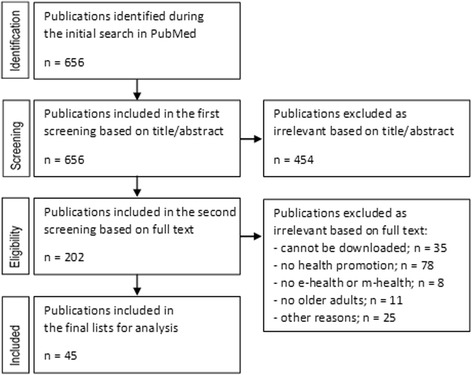
BACKGROUND: The use of e-health and m-health technologies in health promotion and primary prevention among older people is largely unexplored. This study provides a systematic review of the evidence on the scope of the use of e-health and m-health tools in health promotion and primary prevention among older adults (age 50+). METHODS: A systematic literature review was conducted in October 2015. The search for relevant publications was done in the search engine PubMed. The key inclusion criteria were: e-health and m-health tools used, participants' age 50+ years, focus on health promotion and primary prevention, published in the past 10 years, in English, and full-paper can be obtained. The text of the publications was analyzed based on two themes: the characteristics of e-health and m-health tools and the determinants of the use of these tools by older adults. The quality of the studies reviewed was also assessed. RESULTS: The initial search resulted in 656 publications. After we applied the inclusion and exclusion criteria, 45 publications were selected for the review. In the publications reviewed, various types of e-health/m-health tools were described, namely apps, websites, devices, video consults and webinars. Most of the publications (60 %) reported studies in the US. In 37 % of the publications, the study population was older adults in general, while the rest of the publications studied a specific group of older adults (e.g. women or those with overweight). The publications indicated various facilitators and barriers. The most commonly mentioned facilitator was the support for the use of the e-health/m-health tools that the older adults received. CONCLUSIONS: E-health and m-health tools are used by older adults in diverse health promotion programs, but also outside formal programs to monitor and improve their health. The latter is hardly studied. The successful use of e-health/m-health tools in health promotion programs for older adults greatly depends on the older adults' motivation and support that older adults receive when using e-health and m-health tools.
Overview
The claims and statistics of this paper haven’t been checked yet.
Free: it reads the open-access text and checks the first 5 claims that cite a source we can check. Create a free account to check every claim.
Integrity signals
Registry
Cites
Statistics
Figures
Verification
Claims the paper makes
The claims and statistics of this paper haven’t been checked yet.
Free: it reads the open-access text and checks the first 5 claims that cite a source we can check. Create a free account to check every claim.
Claims other papers make about this one
Each is checked against this paper’s own text: does it say what the citing paper says it does?
The source backs part of the claim, not all of it — or backs it for a different population, condition or comparison.
In the citing paper
“For older adults, the success of remote monitoring interventions to monitor and improve their health greatly depended on the support and training they received [99].”
From Telemedicine in the OECD: An umbrella review of clinical and cost-effectiveness, patient experience and implementation (2020) · cites this paper as [99]
Experimental — accuracy not yet measured
Self-check
Percentages, sums and reported differences re-computed from the paper’s own numbers.
The self-check needs the paper’s full text.
Citations
Cites
Three Approaches to Qualitative Content Analysis
Hsieh, H.-F., & Shannon, S. E. (2005) · Qualitative Health Research · doi:10.1177/1049732305276687 · Cited by 44,601
A typology of reviews: an analysis of 14 review types and associated methodologies
Grant, M. J., & Booth, A. (2009) · Health Information & Libraries Journal · doi:10.1111/j.1471-1842.2009.00848.x · Cited by 10,817
Building a practically useful theory of goal setting and task motivation: A 35-year odyssey.
Locke, E. A., & Latham, G. P. (2002) · American Psychologist · doi:10.1037/0003-066x.57.9.705 · Cited by 7,766 · cited 2×
“To help with the motivation, adequate goal setting is an important facilitating factor [18].”
(2007) · Circulation · doi:10.1161/circulationaha.107.185649 · Cited by 6,545 · cited 1×
“This is not surprising as many diseases can be prevented through physical activity or maintenance of a healthy weight [11–13].”
Physical Activity and Health: A Report of the Surgeon General: (525162010-001)
(1995) · PsycEXTRA Dataset · doi:10.1037/e525162010-001 · Cited by 5,479
Health promotion from the perspective of Social Cognitive Theory
Bandura, A. (1998) · Psychology & Health · doi:10.1080/08870449808407422 · Cited by 3,087 · cited 1×
“If the goals are too difficult to reach then, this has negative effects, and the goal setting becomes a barrier [18, 19].”
Moorhead, S. A., Hazlett, D. E., Harrison, L., Carroll, J. K., Irwin, A., & Hoving, C. (2013) · Journal of Medical Internet Research · doi:10.2196/jmir.1933 · Cited by 2,517
Eysenbach, G. (2001) · Journal of Medical Internet Research · doi:10.2196/jmir.3.2.e20 · Cited by 2,449 · cited 1×
“E-health typically refers to on-line and off-line computerbased applications while m-health refers to applications for mobile phones [1, 2].”
Thompson, P. D., Buchner, D., Piña, I. L., Balady, G. J., Williams, M. A., Marcus, B. H., Berra, K., Blair, S. N., Costa, F., Franklin, B., et al. (2003) · Circulation · doi:10.1161/01.cir.0000075572.40158.77 · Cited by 2,132
The effectiveness of interventions to increase physical activityA systematic review1 and 2
KAHN, E., RAMSEY, L., BROWNSON, R., HEATH, G., HOWZE, E., POWELL, K., STONE, E., RAJAB, M., & CORSO, P. (2002) · American Journal of Preventive Medicine · doi:10.1016/s0749-3797(02)00434-8 · Cited by 2,022 · cited 3×
“It is recognized hewer that these factors are important determinants of behavior change and not necessarily direct determinants of the use of e-health and m-health tools [13].”
Research works printed but not linked: 1
- 5. Physical Activity Guidelines Advisory Committee. Physical activity guidelines advisory committee report -2008. Washington, DC: U.S. Department of Health and Human Services; 2008.
Cited by
Digital transformation in healthcare: technology acceptance and its applications
Stoumpos, A. I., Kitsios, F., & Talias, M. A. (2023) · International Journal of Environmental Research and Public Health · doi:10.3390/ijerph20043407 · Cited by 939
“[14] (“aged”[MeSH Terms] OR “aged”[All Fields] OR “elderly”[All Fields] OR “old”[All Fields] OR “senior”[All Fields] OR “seniors”[All Fields]) AND (“health promotion”[MeSH Terms] OR “health promotion”[All Fields] OR “promotion”[All Fields] OR “primary prevention”[MeSH Terms] OR “primary prevention”[All Fields] OR “pre…”
Bringing health care to the patient: An overview of the use of telemedicine in OECD countries
(2020) · OECD Health Working Papers · doi:10.1787/8e56ede7-en · Cited by 539
New technologies, new disparities: The intersection of electronic health and digital health literacy
Smith, B., & Magnani, J. W. (2019) · International Journal of Cardiology · doi:10.1016/j.ijcard.2019.05.066 · Cited by 446
“[2] In the United States, 77% of the adult population owns a smart phone and 15% a wearable device, such that mHealth services are poised to significantly impact care.”
Eze, N. D., Mateus, C., & Cravo Oliveira Hashiguchi, T. (2020) · PLoS ONE · doi:10.1371/journal.pone.0237585 · Cited by 345
Kaihlanen, A.-M., Virtanen, L., Buchert, U., Safarov, N., Valkonen, P., Hietapakka, L., Hörhammer, I., Kujala, S., Kouvonen, A., & Heponiemi, T. (2022) · BMC Health Services Research · doi:10.1186/s12913-022-07584-4 · Cited by 298
Kruse, C., Fohn, J., Wilson, N., Nunez Patlan, E., Zipp, S., & Mileski, M. (2020) · JMIR Medical Informatics · doi:10.2196/20359 · Cited by 295
“The most recent review on a topic most like this work was published 5 years ago, spanned 10 years, analyzed 45 articles, and focused on older adults aged over 50 years [11].”
BackgroundResultCulture as a cure: Assessments of patient safety culture in OECD countries
(2020) · OECD Health Working Papers · doi:10.1787/6ee1aeae-en · Cited by 231
Effectiveness of Ambulatory Telemedicine Care in Older Adults: A Systematic Review
Batsis, J. A., DiMilia, P. R., Seo, L. M., Fortuna, K. L., Kennedy, M. A., Blunt, H. B., Bagley, P. J., Brooks, J., Brooks, E., Kim, S. Y., et al. (2019) · Journal of the American Geriatrics Society · doi:10.1111/jgs.15959 · Cited by 202
“Study Protocol We reviewed all English-language studies published from the year of the Centers for Medicare and Medicaid Service’s TMed coverage determination (January 2012) to July 2018.(36,39-44) Database searches were conducted in June 2017, and repeated in February and July 2018.”
MethodDigital Technologies for Health Promotion and Disease Prevention in Older People: Scoping Review
De Santis, K. K., Mergenthal, L., Christianson, L., Busskamp, A., Vonstein, C., & Zeeb, H. (2023) · Journal of Medical Internet Research · doi:10.2196/43542 · Cited by 162
“Although older people are willing to use digital technologies for health promotion, various facilitators are required to further encourage digital technology use [8,132,133].”
Dhingra, L. S., Aminorroaya, A., Oikonomou, E. K., Nargesi, A. A., Wilson, F. P., Krumholz, H. M., & Khera, R. (2023) · JAMA Network Open · doi:10.1001/jamanetworkopen.2023.16634 · Cited by 158
Desveaux, L., Shaw, J., Saragosa, M., Soobiah, C., Marani, H., Hensel, J., Agarwal, P., Onabajo, N., Bhatia, R. S., & Jeffs, L. (2018) · Journal of Medical Internet Research · doi:10.2196/jmir.8712 · Cited by 133
“Given the prevalence of mobile devices [22] and the increasing use of Web-based solutions for health prevention and promotion [23,24], mobile phone apps have emerged as a potential solution to improve self-management and adherence to guideline-based therapy due to their accessibility, low cost, and interactive potenti…”
BackgroundEdirippulige, S., Brooks, P., Carati, C., Wade, V. A., Smith, A. C., Wickramasinghe, S., & Armfield, N. R. (2018) · Journal of Telemedicine and Telecare · doi:10.1177/1357633x18793282 · Cited by 109
Guay, C., Auger, C., Demers, L., Mortenson, W. B., Miller, W. C., Gélinas-Bronsard, D., & Ahmed, S. (2017) · Journal of Medical Internet Research · doi:10.2196/jmir.7896 · Cited by 95
“Support from a group of peers was also found as a key factor of the efficacy of Internet-based interventions for older adults [71] and is reported as one of the three main reasons of using Internet among caregivers of people with cancer [73].”
BackgroundKlaver, N. S., van de Klundert, J. J., van den Broek, R. J. G. M., & Askari, M. (2021) · JMIR mhealth and uhealth · doi:10.2196/26845 · Cited by 126
“mHealth has shown to be able to improve care, self-management, and self-efficacy, as well as promote better behavior and medication adherence of older adults [14,19,22,23].”
BackgroundMaaß, L., Freye, M., Pan, C.-C., Dassow, H.-H., Niess, J., & Jahnel, T. (2022) · JMIR mHealth and uHealth · doi:10.2196/37980 · Cited by 101
“Although some studies have reported positive long-term effects on users’ health [7-11,15], a clear directive on whether apps are an effective tool for diagnosing and treating health issues is yet to be established.”
BackgroundTowards Usable E-Health: A Systematic Review of Usability Questionnaires
de Sousa, V. E. C., & Lopez, K. D. (2017) · Applied Clinical Informatics · doi:10.4338/aci-2016-10-r-0170 · Cited by 120
“In order to determine the ease of use (usability) for any new technology, rigorously developed and appropriate measures must be chosen [14, 15].”
BackgroundPilipiec, P., Groot, W. N. J., & Pavlova, M. (2020) · Journal of Population Ageing · doi:10.1007/s12062-020-09280-9 · Cited by 141
“The quality of the research design and the reported findings was assessed in line with Kampmeijer and colleagues (Kampmeijer et al. 2016).”
MethodResultInfluentialSelf-citationIntention to use Medical Apps Among Older Adults in the Netherlands: Cross-Sectional Study
Askari, M., Klaver, N. S., van Gestel, T. J., & van de Klundert, J. J. (2020) · Journal of Medical Internet Research · doi:10.2196/18080 · Cited by 105
“Medical apps have been shown to improve the care, self-management, and self-efficacy of older adults, as well as promote better behavior and medication adherence [16-19].”
Mobile Ecological Momentary Diet Assessment Methods for Behavioral Research: Systematic Review
Schembre, S. M., Liao, Y., O'Connor, S. G., Hingle, M. D., Shen, S.-E., Hamoy, K. G., Huh, J., Dunton, G. F., Weiss, R., Thomson, C. A., et al. (2018) · JMIR mHealth and uHealth · doi:10.2196/11170 · Cited by 87
“Finally, compared with traditional dietary assessment methods, event-contingent mEMDA may be limited by existing on a mobile platform, which might be less acceptable to some populations including people who are less comfortable with technology (eg, older adults) [78] or have low electronic health literacy [79].”
Design Considerations for Mobile Health Applications Targeting Older Adults
Li, C., Neugroschl, J., Zhu, C. W., Aloysi, A., Schimming, C. A., Cai, D., Grossman, H., Martin, J., Sewell, M., Loizos, M., et al. (2021) · Journal of Alzheimer's Disease · doi:10.3233/jad-200485 · Cited by 82
“According to three publications, rewards are important as a mechanism to enhance mHealth use by older adults [46, 63, 69].”
BackgroundElavsky, S., Knapova, L., Klocek, A., & Smahel, D. (2019) · Journal of Aging and Physical Activity · doi:10.1123/japa.2017-0410 · Cited by 76
Digital Health Interventions among People Living with Frailty: A Scoping Review
Linn, N., Goetzinger, C., Régnaux, J.-P., Schmitz, S., Dessenne, C., Fagherazzi, G., & Aguayo, G. (2021) · Journal of the American Medical Directors Association · doi:10.1016/j.jamda.2021.04.012 · Cited by 90
Nittas, V., Lun, P., Ehrler, F., Puhan, M. A., & Mütsch, M. (2019) · Journal of Medical Internet Research · doi:10.2196/13320 · Cited by 75
A systematic review on the use of mHealth to increase physical activity in older people
Aslam, A. S., van Luenen, S., Aslam, S., van Bodegom, D., & Chavannes, N. H. (2020) · Clinical eHealth · doi:10.1016/j.ceh.2020.04.002 · Cited by 75
Ethical issues related to eHealth: An integrative review
Jokinen, A., Stolt, M., & Suhonen, R. (2020) · Nursing Ethics · doi:10.1177/0969733020945765 · Cited by 92
“The successful use of eHealth in health promotion programmes depends on the motivation and support that people can receive.(27,28,44) The current health literature is limited regarding eHealth ethical issues, especially from the service users’ and citizens’ perspective.”
Backgroundvan Elburg, F. R. T., Klaver, N. S., Nieboer, A. P., & Askari, M. (2022) · BMC Geriatrics · doi:10.1186/s12877-022-03130-3 · Cited by 82
RESEARCHRacial and Socioeconomic Disparities in Access to Telehealth
Rivera, V., Aldridge, M. D., Ornstein, K. A., Moody, K. A., & Chun, A. K. (2020) · Journal of the American Geriatrics Society · doi:10.1111/jgs.16904 · Cited by 69
van Acker, J., Maenhout, L., & Compernolle, S. (2023) · Innovation in Aging · doi:10.1093/geroni/igad007 · Cited by 80
“Recent systematic reviews summarized existing mHealth interventions aimed at the primary, secondary, and tertiary prevention of chronic diseases in older adults (Kampmeijer et al., 2016; Matthew-Maich et al., 2016; Schorr et al., 2021).”
BackgroundOnyeaka, H., Romero, P. M., Healy, B. C., & Celano, C. M. (2020) · Journal of Aging and Health · doi:10.1177/0898264320966266 · Cited by 74
Budhwani, S., Fujioka, J. K., Thomas-Jacques, T., Vera, K. D., Challa, P., de Silva, R., Fuller, K., Shahid, S., Hogeveen, S. E., Chandra, S., et al. (2022) · Journal of the American Medical Informatics Association · doi:10.1093/jamia/ocac022 · Cited by 68
Pereira, A. A. C., Destro, J. R., Picinin Bernuci, M., Garcia, L. F., & Rodrigues Lucena, T. F. (2020) · JMIR mHealth and uHealth · doi:10.2196/17430 · Cited by 65
Liu, S., Ya, L., Wang, D., He, X., Ren, W., Kong, D., & Luo, Y. (2023) · Frontiers in Public Health · doi:10.3389/fpubh.2023.1200722 · Cited by 85
“The results of the systematic review also proved that the use of digital health tools can stimulate positive health behaviors in older adults and promote the development of health-promoting lifestyle (19), suggesting that health-promoting lifestyle may be a potential mediating factor.”
BackgroundAirola, E. (2021) · Journal of Medical Internet Research · doi:10.2196/23804 · Cited by 63
“The barriers and enablers are in line with previous similar systematic reviews [24,26].”
BackgroundResultMobile Support for Older Adults and Their Caregivers: Dyad Usability Study
Quinn, C. C., Staub, S., Barr, E., & Gruber-Baldini, A. (2019) · JMIR Aging · doi:10.2196/12276 · Cited by 61
Applications of Digital Health Technologies in Knee Osteoarthritis: Narrative Review
Shah, N., Costello, K. E., Mehta, A., & Kumar, D. (2022) · JMIR Rehabilitation and Assistive Technologies · doi:10.2196/33489 · Cited by 65
“With the increasing use of the internet and mobile computing devices in older adults [3-5], digital health holds promise for clinical and research applications in people with knee osteoarthritis (KOA) [6].”
BackgroundRobert, C., Erdt, M., Lee, J., Cao, Y., Naharudin, N. B., & Theng, Y.-L. (2021) · Journal of Medical Internet Research · doi:10.2196/15649 · Cited by 57
“A systematic review [19] did explore the use of eHealth among older adults aged 50 years and above, but with greater focus on the use of these technologies as a means for health promotion and primary prevention.”
BackgroundMethodGupta, S. K., Lakshmi, P. V. M., Kaur, M., & Rastogi, A. (2020) · Journal of Family Medicine and Primary Care · doi:10.4103/jfmpc.jfmpc_1684_20 · Cited by 66
“Measures like telemedicine help patients with non‐critical ailments to seek consultation and treatment through electronic platforms.[43,44]”
BackgroundDiabetes Self-management Apps: Systematic Review of Adoption Determinants and Future Research Agenda
Alaslawi, H., Berrou, I., Hamid, A. A., Alhuwail, D., & Aslanpour, Z. (2022) · JMIR Diabetes · doi:10.2196/28153 · Cited by 72
Hasnan, S., Aggarwal, S., Mohammadi, L., & Koczwara, B. (2022) · Journal of Geriatric Oncology · doi:10.1016/j.jgo.2022.06.004 · Cited by 55
Using Machine Learning for Pharmacovigilance: A Systematic Review
Pilipiec, P., Liwicki, M., & Bóta, A. (2022) · Pharmaceutics · doi:10.3390/pharmaceutics14020266 · Cited by 68
“A publication was evaluated as valid if the reported findings are logically the result of the described process, methods, data, and analyses that were used to find that result [64].”
MethodTelehealth Use for Enhancing the Health of Rural Older Adults: A Systematic Mixed Studies Review
Rush, K. L., Singh, S., Seaton, C. L., Burton, L., Li, E., Jones, C., Davis, J. C., Hasan, K., Kern, B., & Janke, R. (2021) · The Gerontologist · doi:10.1093/geront/gnab141 · Cited by 62
Social Media and eHealth Literacy Among Older Adults: Systematic Literature Review
Zhang, C., Mohamad, E. M. W., Azlan, A. A., Wu, A., Ma, Y., & Qi, Y. (2025) · Journal of Medical Internet Research · doi:10.2196/66058 · Cited by 69
Qan'ir, Y., & Song, L. (2019) · Psycho-Oncology · doi:10.1002/pon.5158 · Cited by 45
Kim, H., Tietsort, C. J., Posteher, K. A., Michaelides, A. P., & Toro‐Ramos, T. (2019) · Health Communication · doi:10.1080/10410236.2019.1663583 · Cited by 50
Fang, M. L., Siden, E. G., Korol, A., Demestihas, M.-A., Sixsmith, J., & Sixsmith, A. J. (2018) · Human Technology · doi:10.17011/ht/urn.201811224835 · Cited by 47
“While existing international and Canadian reviews focusing on older adults examine a variety of topics—including the breadth of eHealth options available (Kampmeijer, Pavlova, Tambor, Golinowska, & Groot, 2016; Robbins, Keung, & Arvanitis, 2018), the facilitators and barriers for eHealth types (Kampmeijer et al., 2016…”
BackgroundDesveaux, L., Agarwal, P., Shaw, J., Hensel, J. M., Mukerji, G., Onabajo, N., Marani, H., Jamieson, T., Bhattacharyya, O. K., Martin, D., et al. (2016) · BMC Medical Informatics and Decision Making · doi:10.1186/s12911-016-0381-5 · Cited by 51
“E-Health solutions are increasingly common in health-care, and involve the use of an electronic device or monitoring system by individuals or their healthcare providers to monitor or improve their health status [1].”
BackgroundTesting an app for reporting health concerns—Experiences from older people and home care nurses
Göransson, C., Eriksson, I., Ziegert, K., Wengström, Y., Langius‐Eklöf, A., Brovall, M., Kihlgren, A. L., & Blomberg, K. (2017) · International Journal of Older People Nursing · doi:10.1111/opn.12181 · Cited by 59
Saliasi, I., Martinon, P., Darlington, E., Smentek, C., Tardivo, D., Bourgeois, D. M., Dussart, C., Carrouel, F., & Fraticelli, L. (2021) · JMIR mhealth and uhealth · doi:10.2196/30480 · Cited by 51
“mHealth apps represent an alternative to or complement face-to-face communication between health care professionals and users of the health care system for primary prevention [6], as well as patients for secondary prevention [7].”
BackgroundFischer, F. (2020) · Bundesgesundheitsblatt - Gesundheitsforschung - Gesundheitsschutz · doi:10.1007/s00103-020-03143-6 · Cited by 46
The effect of undergraduate nursing students’ e-Health literacy on healthy lifestyle behaviour
Turan, N., Özdemir, N. G., Çulha, Y., Aydın, G. Ö., Kaya, H., & Aştı, T. A. (2020) · Global Health Promotion · doi:10.1177/1757975920960442 · Cited by 54
“The use of e-Health technologies could help healthcare providers improve or maintain their own health and that of their patients and families (2,9,31).”
BackgroundWang, X., Wu, Y., Meng, Z., Li, J., Li, X., Sun, X., & Zang, S. (2023) · Journal of Medical Internet Research · doi:10.2196/44225 · Cited by 41
Ahmed, B., Dannhauser, T. M., & Philip, N. Y. (2018) · Journal of Telemedicine and Telecare · doi:10.1177/1357633x18768601 · Cited by 46
“the government [33] indirectly affect the quality of service that healthcare providers can provide to their patients.”
BackgroundŻarnowski, A., Jankowski, M., & Gujski, M. (2022) · Medical Science Monitor · doi:10.12659/msm.937948 · Cited by 50
When Public Health Research Meets Social Media: Knowledge Mapping From 2000 to 2018
Yan, Z., Cao, B., Wang, Y., Peng, T., & Xiao-hua, W. (2020) · Journal of Medical Internet Research · doi:10.2196/17582 · Cited by 44
Adriaans, D. J., Daele, A. T. M. D.-V., van Bakel, M. J. H. M., Nieuwenhuijzen, G. A. P., Teijink, J. A. W., Heesakkers, F. F. B. M., & van Laarhoven, H. W. M. (2021) · Journal of Medical Internet Research · doi:10.2196/20861 · Cited by 44
“Other factors that could influence the use of new technology are the educational level or the skills needed for using electronic devices [7].”
BackgroundInfluentialBrar Prayaga, R., Jeong, E. W., Feger, E., Noble, H. K., Kmiec, M., & Prayaga, R. S. (2018) · JMIR mHealth and uHealth · doi:10.2196/mhealth.8930 · Cited by 33
“While there has been an interest in developing health technologies such as reminder applications [13-16] or automated phone reminders for older populations [17], a review of the literature reveals that very few programs have explored using text messaging with seniors to improve medication refill adherence [18,19].”
Feasibility of Perioperative eHealth Interventions for Older Surgical Patients: A Systematic Review
Jonker, L. T., Haveman, M. E., de Bock, G. H., van Leeuwen, B. L., & Lahr, M. M. H. (2020) · Journal of the American Medical Directors Association · doi:10.1016/j.jamda.2020.05.035 · Cited by 38
Smak Gregoor, A. M., Sangers, T. E., Eekhof, J. A., Howe, S., Revelman, J., Litjens, R. J., Sarac, M., Bindels, P. J., Bonten, T., Wehrens, R., et al. (2023) · eClinicalMedicine · doi:10.1016/j.eclinm.2023.102019 · Cited by 29
Stefanicka-Wojtas, D., & Kurpas, D. (2022) · Journal of Personalized Medicine · doi:10.3390/jpm12030467 · Cited by 40
“As Kampmeijer et al. (2016) noted, the successful use of eHealth/mHealth tools in health promotion programs for older people is highly dependent on the motivation and support they receive in using eHealth and mHealth tools [7].”
BackgroundSurveillance of communicable diseases using social media: A systematic review
Pilipiec, P., Samsten, I., & Bóta, A. (2023) · PLoS ONE · doi:10.1371/journal.pone.0282101 · Cited by 57
Recio-Rodriguez, J. I., González‐Sánchez, S., Tamayo‐Morales, O., Gómez-Marcos, M. Á., García‐Ortiz, L., Niño-Martín, V., Lugones‐Sánchez, C., & Rodríguez‐Sánchez, E. (2022) · BMC Geriatrics · doi:10.1186/s12877-022-03487-5 · Cited by 34
“The success of interventions using m-Health in older adults depends, to a large extent, on the motivational state and the support they receive for its use [8].”
BackgroundLi, W., Guo, J., Liu, W., Tu, J., & Tang, Q. (2024) · BMC Geriatrics · doi:10.1186/s12877-024-05361-y · Cited by 43
“Kampmeijer R’s study [51] demonstrates that older adults’ trust in healthcare and telemedicine is influenced by various factors, including Subjective Norms, Education, Health Level, Gender, Age, Self Efficacy, Service Environment, and more.”
BackgroundText-mining analysis of mHealth research
Ozaydin, B., Zengul, F. D., Öner, N., & Delen, D. (2017) · mHealth · doi:10.21037/mhealth.2017.12.02 · Cited by 32
“…health surveillance in Sub-Saharan Africa (6), healthy aging in developed countries (7), health promotion and primary prevention among older adults (8), maternal health in low income countries (9), management of tuberculosis, HIV/ AIDS, and chronic diseases (10,11), interventions for…”
BackgroundJaén-Extremera, J., Afanador-Restrepo, D. F., Rivas-Campo, Y., Rodas, A. G., Aibar‐Almazán, A., Hita‐Contreras, F., Carcelén‐Fraile, M. D. C., Castellote‐Caballero, Y., & Ortíz, R. (2023) · Journal of Clinical Medicine · doi:10.3390/jcm12030841 · Cited by 39
“Considering that one of the main aspects that influence the course of chronic diseases, including cardiovascular disease RFs, is the adherence to treatments [63], telemedicine may have its main effects in favoring the correct follow-up and the adoption of healthy lifestyle habits [64].”
BackgroundAuster‐Gussman, L. A., Lockwood, K. G., Graham, S. A., Pitter, V., & Branch, O. H. (2022) · Frontiers in Digital Health · doi:10.3389/fdgth.2022.886783 · Cited by 34
“Inclusion Criteria Inclusion criteria for the analytic sample were: (1) enrollment in either the Diabetes Prevention or Prevention program on or after January 1, 2019, (2) aged 65 years and older, (3) a starting BMI ≥25, (4) in the program for at least 3 months, (5) had a weight after 9 weeks, (6) had full demographic…”
BackgroundPromoting healthy lifestyles using information technology during the COVID-19 pandemic
Dixit, S., & Girish, N. (2021) · Reviews in Cardiovascular Medicine · doi:10.31083/j.rcm.2021.01.187 · Cited by 34
“Kampmeijer et al. (2016) and Muellmann et al. (2018) briefly highlighted the scope of eHealth and mHealth tools in health promotion and primary prevention among older adults.”
BackgroundWu, X. V., Dong, Y., Tan, P. C., Gan, P., Zhang, D., Chi, Y., Chao, F. F. T., Lu, J., Teo, B. H. D., & Tan, Y. (2022) · JMIR Aging · doi:10.2196/33118 · Cited by 42
Bellanca, C. M., Augello, E., Cantone, A. F., Mauro, R. D., Attaguile, G. A., Giovanni, V. D., Condorelli, G. A., Benedetto, G. D., Cantarella, G., & Bernardini, R. (2023) · Pharmaceuticals · doi:10.3390/ph16111542 · Cited by 38
Seifert, A., & Vandelanotte, C. (2021) · Aging and Health Research · doi:10.1016/j.ahr.2021.100032 · Cited by 28
Yang, R., Zeng, K., & Jiang, Y. (2022) · Journal of Medical Internet Research · doi:10.2196/27167 · Cited by 28
“Our finding suggests that there is still a gap in the actual use of e-communication between older adults and young adults [31,37,38].”
BackgroundCoves, A. F., Yeung, K. H. T., van der Putten, I. M., & Nelson, E. A. S. (2022) · Health Policy · doi:10.1016/j.healthpol.2022.07.012 · Cited by 34
“However, eHealth has the potential of increasing health among this population [101], especially for those with chronic conditions [102–105]; thus, this type of intervention should be kept simple and user-friendly, and older adults should be trained and supported during and after the adoption [99].”
BackgroundLiu, P. L., Ye, J. F., Ao, H. S., Sun, S., Zheng, Y., Li, Q., Feng, G. C., Wang, H., & Zhao, X. (2023) · Digital Health · doi:10.1177/20552076231185271 · Cited by 30
“dence consistently shows that the usage of ePHI technologies may contribute to health promotion goals.(9,10) According to Kreps and Neuhauser,(11) ePHI technologies can activate and”
BackgroundFischl, C., Blusi, M., Lindgren, H., & Nilsson, I. (2020) · Scandinavian Journal of Occupational Therapy · doi:10.1080/11038128.2020.1760347 · Cited by 32
“Through the integration of digital technologies into many services in society [1,2], digitalisation can provide possibilities for citizens to achieve good and equitable health and welfare, as well as, independence and participation in community living [3].”
Interventions across the Retirement Transition for Improving Well-Being: A Scoping Review
Rodríguez‐Monforte, M., Fernández-Jané, C., Martín-Arribas, A., Costa‐Tutusaus, L., Sitjà‐Rabert, M., Ramírez‐García, I., Vélez, O. C., Kopp, J., Vilaró, J., & Álvarez, E. C. (2020) · International Journal of Environmental Research and Public Health · doi:10.3390/ijerph17124341 · Cited by 33
“increase in e-health programs and initiatives [58,59].”
Scheerens, C., Gilissen, J., Volow, A. M., Powell, J., Ferguson, C. M., Farrell, D. W., Li, B., Berry, C. N., & Sudore, R. L. (2021) · Journal of the American Geriatrics Society · doi:10.1111/jgs.17284 · Cited by 26
Shahid, S., Hogeveen, S. E., Sky, P., Chandra, S., Budhwani, S., de Silva, R., Bhatia, R. S., Seto, E., & Shaw, J. (2023) · International Journal for Equity in Health · doi:10.1186/s12939-023-01849-y · Cited by 31
“This outcome is supported by existing literature detailing the lack of affordability and access to digital devices and/or the Internet among structurally marginalized communities, such as racial and cultural minorities [25, 46], older adults [23, 24, 47], Indigenous Peoples [9, 38, 43], individuals living in rural and…”
BackgroundScheckel, B., Schmidt, K., Stock, S., & Redaèlli, M. (2023) · Journal of Medical Internet Research · doi:10.2196/38447 · Cited by 28
“Talking about older users, support in using eHealth applications is often cited as a facilitator, whereas lack of time, monetary costs, and lack of motivation appear to be barriers in using those tools [16].”
Sinabell, I., & Ammenwerth, E. (2022) · Universal Access in the Information Society · doi:10.1007/s10209-022-00949-w · Cited by 30
“…(such as for diabetes) [10, 11]. eHealth systems designed for elderly users can be implemented for example as mobile Health (mHealth) systems [12, 13] or web-based eHealth systems [14, 15]. mHealth systems and web-based eHealth systems differ in terms such as realization (e.g., screen size)…”
Stjernswärd, S., & Hansson, L. I. (2018) · Internet Interventions · doi:10.1016/j.invent.2018.03.004 · Cited by 29
Brown, V., Tran, H. N. Q., Downing, K. L., Hesketh, K. D., & Moodie, M. (2021) · Obesity Reviews · doi:10.1111/obr.13227 · Cited by 27
Bartels, S. L., Johnsson, S. I., Boersma, K., Flink, I., McCracken, L. M., Petersson, S., Christie, H. L., Feldman, I., Simons, L. E., Onghena, P., et al. (2022) · BMJ Open · doi:10.1136/bmjopen-2021-059152 · Cited by 23
Adepoju, O., Dang, P., Nguyen, H., & Mertz, J. (2024) · INQUIRY The Journal of Health Care Organization Provision and Financing · doi:10.1177/00469580241271137 · Cited by 37
“45 Finally, considering the evidence of the impact of these technology tools on health outcomes, health insurers may offer these to patients with chronic conditions as a way of supporting patients’ chronic disease management efforts.”
BackgroundTurcotte, S., Bouchard, C., Rousseau, J., Leduc, R. D., Bier, N., Kairy, D., Dang‐Vu, T. T., Sarimanukoglu, K., Dubé, F., Racine, C. B., et al. (2023) · Australian Journal on Ageing · doi:10.1111/ajag.13244 · Cited by 28
Providing Medical Information to Older Adults in a Web-Based Environment: Systematic Review
McLean, B., Hossain, N., Donison, V., Gray, M., Durbano, S., Haase, K. R., Alibhai, S. M. H., & Puts, M. T. E. (2021) · JMIR Aging · doi:10.2196/24092 · Cited by 24
Frishammar, J., Essén, A., Simms, C., Edblad, R., & Hardebro, V. (2022) · IEEE Transactions on Engineering Management · doi:10.1109/tem.2022.3187792 · Cited by 27
“Here, research shows that people with abundant digital experience have a more positive attitude to embracing digital healthcare [17], [31].”
BackgroundMethodResultInfluentialGravesande, J., de Oliveira, L. A., Malik, N., Vrkljan, B. H., Zheng, R., Gardner, P. M., & Carlesso, L. C. (2023) · Journal of Integrative and Complementary Medicine · doi:10.1089/jicm.2022.0822 · Cited by 22
“22 (vi) Facilitators to online MBE participation: factors that enable implementation of an intervention (e.g., technical support, convenience, and affordability).”
Bonciani, M., Rosis, S. D., & Vainieri, M. (2021) · JMIR Research Protocols · doi:10.2196/19073 · Cited by 25
“Nevertheless, there is contradictory evidence about the impacts of mHealth interventions on health promotion practice and health outcomes [5-8].”
BackgroundZhu, X., & Yang, F. (2022) · International Journal of Older People Nursing · doi:10.1111/opn.12497 · Cited by 25
Hefler, M., Kerrigan, V., Grunseit, A. C., Freeman, B., Kite, J., & Thomas, D. (2020) · Journal of Medical Internet Research · doi:10.2196/16927 · Cited by 26
“Numerous reviews have concluded that social media have the potential to positively affect health but have found either mixed [5,6] or no definitive evidence [7-11] of their impact on health behavior, even as research in the field has significantly increased in recent years.”
BackgroundHeger, I., Deckers, K., de Vugt, M., Verhey, F., Oenema, A., van Boxtel, M., & Köhler, S. (2023) · Journal of Alzheimer’s Disease · doi:10.3233/jad-230225 · Cited by 20
“Several studies show that older participants also experience barriers to engage in web-based interventions [37, 38].”
BackgroundDubin, R. J., Angliss, G., Eng, C. L., Cisneros, T., & Griffon, D. J. (2021) · Journal of the American Veterinary Medical Association · doi:10.2460/javma.21.04.0203 · Cited by 23
“34,35 Our respondents experienced similar challenges when implementing client-facing telemedicine in their practices.”
BackgroundAcceptance of e‐health technology among older people: A qualitative study
Rochmawati, E., Kamilah, F., & Iskandar, A. C. (2022) · Nursing and Health Sciences · doi:10.1111/nhs.12939 · Cited by 21
Xie, Z., Chen, J., & Or, C. K. (2022) · Journal of Medical Internet Research · doi:10.2196/25959 · Cited by 29
“It has also been shown that eHealth enables consumers to easily obtain information about health issues for decision-making, which could lead to more effective care, patient empowerment, and time savings [8,18-22].”
BackgroundChumkasian, W., Fernandez, R. S., Win, K. T., Petsoglou, C., & Lord, H. (2021) · International Journal of Medical Informatics · doi:10.1016/j.ijmedinf.2021.104462 · Cited by 22
Jezewski, E., Miller, A., Eusebio, M., & POTTER, J. F. (2022) · International Journal of Environmental Research and Public Health · doi:10.3390/ijerph192013349 · Cited by 18
“These include electronic measuring tools, such as phone applications or online health tool monitoring, as well as direct nursing interventions [8,9].”
BackgroundLai, D. J., Liu, Z., Johnston, E., Dikomitis, L., D’Oliveira, T. C., & Shergill, S. S. (2024) · Critical Care · doi:10.1186/s13054-024-05089-6 · Cited by 20
“The themes of usability and perceived usefulness highlighted in this review were in line with older patients with chronic conditions [55], older patients with cancer [56], and the general older population [56, 57].”
BackgroundTejedor, S., Pérez-Escoda, A., Ventín, A., Tusa, F., & Gutiérrez, F. M. (2020) · International Journal of Environmental Research and Public Health · doi:10.3390/ijerph17239145 · Cited by 21
“[21] in which authors evidenced how e-health and m-health tools (understood as namely apps, websites, digital content, video consults and webinars) truly improve healthcare quality for adults in the way they receive more supportive assistance and are better informed.”
BackgroundImproving the eHealth literacy of older adults: A scoping review
Yang, Y., Yao, X., Lu, D., Wang, Y., Gan, Y., Bao, X., Zhang, J., & Zhang, Q. (2024) · Geriatric Nursing · doi:10.1016/j.gerinurse.2024.07.028 · Cited by 24
Monfort, G. M., Paluzié, G., Díaz-Gegúndez, M., & Chabrera, C. (2023) · Scientific Reports · doi:10.1038/s41598-023-29640-7 · Cited by 29
Boekhout, J. M., Peels, D. A., Berendsen, B., Bolman, C. A. W., & Lechner, L. (2019) · Journal of Medical Internet Research · doi:10.2196/13416 · Cited by 18
“This explanation is supported by the review of Kampmeijer et al [59] who found support to be essential to give older adults the confidence to experiment with new technologies.”
Metadata
- Authors
- Kampmeijer, R., Pavlova, M., Tambor, M., Golinowska, S., & Groot, W.
- Affiliations
- Maastricht University Medical Centre (NL)
- Jagiellonian University (PL)
- Corresponding author
- Pavlova, Milena
- Venue
- BMC Health Services Research
- Published
- 2016-08
- Volume
- 16
- Issue
- S5
- Pages
- 290-290
- ISSN
- 1472-6963 (ISSN-L)
- PMC
- PMC5016733
- OpenAlex
- W2520132032
- Cited by
- 328
- References
- 26
- Citations by year
- 2026: 21 · 2025: 30 · 2024: 57 · 2023: 50 · 2022: 57 · 2021: 39 · 2020: 35 · 2019: 16 · 2018: 13 · 2017: 7 · 2016: 1
- FWCI
- 3.31
- Type
- journal article
- Language
- en
- Open access
- gold
- doi.org
- Licence
- cc-by
- Locations
- BMC Health Services Research (publishedVersion, cc-by)
- Europe PMC (PubMed Central) (publishedVersion, cc-by)
- PubMed Central (publishedVersion, cc-by)
- PubMed (publishedVersion)
- Research Publications (Maastricht University) (publishedVersion, cc-by)
- Homo Politicus (Academy of Humanities and Economics in Lodz) (submittedVersion, cc-by-nc-nd)
- Jagiellonian University Repository (Jagiellonian University) (submittedVersion, cc-by-nc-nd)
- Research Publications (Maastricht University) (submittedVersion, other-oa)
- Topics
- Health Sciences › Medicine › Geriatrics and Gerontology › Technology Use by Older Adults
- Health Sciences › Health Professions › General Health Professions › Mobile Health and mHealth Applications
- Health Sciences › Health Professions › Health Information Management › Health, Technology, Consumer Behavior
- Keywords
- e-health, mobile health, health promotion, primary prevention, older adults, technology adoption, barriers and facilitators, mobile health apps, video consultation, self-monitoring
- MeSH terms
- Healthy Lifestyle, Aged, Health Promotion, Humans, Motivation, Primary Prevention, Global Health, Telemedicine, Internet, Mobile Applications
About these checks
Registry, retraction, Cites and statistics results are computed, not judged, with one exception: a printed reference that no index lists is read once by a model before it counts as a citation error. Claims are extracted by a model and kept only when their quote appears verbatim in the text; each cited source is then checked, with a model’s help, for whether it says what the claim relies on. Those verdicts can be wrong — read the claim’s quote and the cited source before relying on one.
Statistics and arithmetic are recomputed, not judged.
Confidence bands are shown only for fields calibrated on our annotated test set. None is calibrated yet, so no band is shown.
What counts as a claim ›How we measure confidence ›How we check this ›
Are you an author, or do you see a problem with this page? Request a review
Data sources
Bibliographic data: Semantic Scholar, OpenAlex, Crossref.
Contains information from the Semantic Scholar Academic Graph Datasets, made available under the ODC Attribution License (ODC-BY 1.0).
Semantic Scholar’s data is described in: Kinney, R., et al. (2023). The Semantic Scholar Open Data Platform. arXiv:2301.10140.
