

The use of e-health and m-health tools in health promotion and primary prevention among older adults: a systematic literature review.
Open accessThe DOI matches its Crossref record; 26 of the 26 references it cites were found in a registry or an index.
Abstract
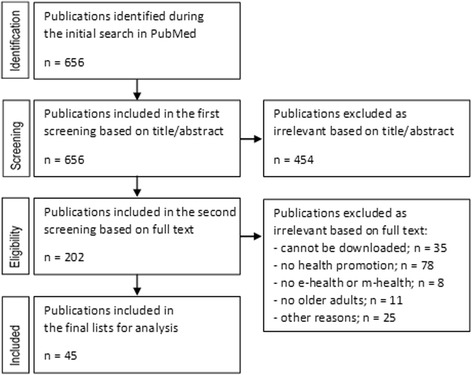
BACKGROUND: The use of e-health and m-health technologies in health promotion and primary prevention among older people is largely unexplored. This study provides a systematic review of the evidence on the scope of the use of e-health and m-health tools in health promotion and primary prevention among older adults (age 50+). METHODS: A systematic literature review was conducted in October 2015. The search for relevant publications was done in the search engine PubMed. The key inclusion criteria were: e-health and m-health tools used, participants' age 50+ years, focus on health promotion and primary prevention, published in the past 10 years, in English, and full-paper can be obtained. The text of the publications was analyzed based on two themes: the characteristics of e-health and m-health tools and the determinants of the use of these tools by older adults. The quality of the studies reviewed was also assessed. RESULTS: The initial search resulted in 656 publications. After we applied the inclusion and exclusion criteria, 45 publications were selected for the review. In the publications reviewed, various types of e-health/m-health tools were described, namely apps, websites, devices, video consults and webinars. Most of the publications (60 %) reported studies in the US. In 37 % of the publications, the study population was older adults in general, while the rest of the publications studied a specific group of older adults (e.g. women or those with overweight). The publications indicated various facilitators and barriers. The most commonly mentioned facilitator was the support for the use of the e-health/m-health tools that the older adults received. CONCLUSIONS: E-health and m-health tools are used by older adults in diverse health promotion programs, but also outside formal programs to monitor and improve their health. The latter is hardly studied. The successful use of e-health/m-health tools in health promotion programs for older adults greatly depends on the older adults' motivation and support that older adults receive when using e-health and m-health tools.
Overview
The claims and statistics of this paper haven’t been checked yet.
Free: it reads the open-access text and checks the first 5 claims that cite a source we can check. Create a free account to check every claim.
Integrity signals
Registry
Cites
Statistics
Figures
Verification
Claims the paper makes
The claims and statistics of this paper haven’t been checked yet.
Free: it reads the open-access text and checks the first 5 claims that cite a source we can check. Create a free account to check every claim.
Claims other papers make about this one
Each is checked against this paper’s own text: does it say what the citing paper says it does?
The source backs part of the claim, not all of it — or backs it for a different population, condition or comparison.
In the citing paper
“For older adults, the success of remote monitoring interventions to monitor and improve their health greatly depended on the support and training they received [99].”
From Telemedicine in the OECD: An umbrella review of clinical and cost-effectiveness, patient experience and implementation (2020) · cites this paper as [99]
Experimental — accuracy not yet measured
Self-check
Percentages, sums and reported differences re-computed from the paper’s own numbers.
The self-check needs the paper’s full text.
Citations
Cites
Three Approaches to Qualitative Content Analysis
Hsieh, H.-F., & Shannon, S. E. (2005) · Qualitative Health Research · doi:10.1177/1049732305276687 · Cited by 44,601
A typology of reviews: an analysis of 14 review types and associated methodologies
Grant, M. J., & Booth, A. (2009) · Health Information & Libraries Journal · doi:10.1111/j.1471-1842.2009.00848.x · Cited by 10,817
Building a practically useful theory of goal setting and task motivation: A 35-year odyssey.
Locke, E. A., & Latham, G. P. (2002) · American Psychologist · doi:10.1037/0003-066x.57.9.705 · Cited by 7,766 · cited 2×
“To help with the motivation, adequate goal setting is an important facilitating factor [18].”
(2007) · Circulation · doi:10.1161/circulationaha.107.185649 · Cited by 6,545 · cited 1×
“This is not surprising as many diseases can be prevented through physical activity or maintenance of a healthy weight [11–13].”
Physical Activity and Health: A Report of the Surgeon General: (525162010-001)
(1995) · PsycEXTRA Dataset · doi:10.1037/e525162010-001 · Cited by 5,479
Health promotion from the perspective of Social Cognitive Theory
Bandura, A. (1998) · Psychology & Health · doi:10.1080/08870449808407422 · Cited by 3,087 · cited 1×
“If the goals are too difficult to reach then, this has negative effects, and the goal setting becomes a barrier [18, 19].”
Moorhead, S. A., Hazlett, D. E., Harrison, L., Carroll, J. K., Irwin, A., & Hoving, C. (2013) · Journal of Medical Internet Research · doi:10.2196/jmir.1933 · Cited by 2,517
Eysenbach, G. (2001) · Journal of Medical Internet Research · doi:10.2196/jmir.3.2.e20 · Cited by 2,449 · cited 1×
“E-health typically refers to on-line and off-line computerbased applications while m-health refers to applications for mobile phones [1, 2].”
Thompson, P. D., Buchner, D., Piña, I. L., Balady, G. J., Williams, M. A., Marcus, B. H., Berra, K., Blair, S. N., Costa, F., Franklin, B., et al. (2003) · Circulation · doi:10.1161/01.cir.0000075572.40158.77 · Cited by 2,132
The effectiveness of interventions to increase physical activityA systematic review1 and 2
KAHN, E., RAMSEY, L., BROWNSON, R., HEATH, G., HOWZE, E., POWELL, K., STONE, E., RAJAB, M., & CORSO, P. (2002) · American Journal of Preventive Medicine · doi:10.1016/s0749-3797(02)00434-8 · Cited by 2,022 · cited 3×
“It is recognized hewer that these factors are important determinants of behavior change and not necessarily direct determinants of the use of e-health and m-health tools [13].”
Research works printed but not linked: 1
- 5. Physical Activity Guidelines Advisory Committee. Physical activity guidelines advisory committee report -2008. Washington, DC: U.S. Department of Health and Human Services; 2008.
Cited by
Items 301–325 of 325
Generational perspectives on E-Health acceptance: an extended UTAUT Framework
Gogiali, G., Nevi, G., & Dezi, L. (2024) · IEEE International Conference on Technology Management, Operations and Decisions (ICTMOD) · doi:10.1109/ictmod63116.2024.10959120
“But these technologies are mainly used by young people [22], despite the many benefits for the elderly as well.”
Albrecht, L., Ubels, N., Martinussen, B., Naglie, G., Rapoport, M. J., Hatch, S., Seitz, D. P., Checkland, C., & Conn, D. (2025) · Geriatrics · doi:10.3390/geriatrics10030079
“Previous research has demonstrated the critical importance of thoughtful design for digital interfaces to support ease of use, particularly for older adults, including consistent interface and terminology and clear processes [20,39], leading to a user-friendly experience [40,41].”
Stenzel, J., Kopkow, C., & Bahns, C. (2025) · physioscience · doi:10.1055/a-2653-1376
Wilson, E. L. (2025) · Online Journal of Public Health Informatics · doi:10.2196/72737 · Cited by 1
“Systematic reviews and meta-analyses across eHealth, mobile health, and broader DHIs consistently report moderate to small effect sizes, an outcome posited to implementation shortcomings and low user engagement efforts and user engagement [11-13].”
Sedhed, J., Johansson, H., Andersson, N., Åkesson, E., Kalbe, E., Franzén, E., & Leavy, B. (2024) · Figshare · doi:10.6084/m9.figshare.25556640
Lai, D. J., Liu, Z., Johnston, E., Dikomitis, L., D’Oliveira, T. C., & Shergill, S. S. (2024) · Figshare · doi:10.6084/m9.figshare.27123994
van Elburg, F. R. T., Klaver, N. S., Nieboer, A. P., & Askari, M. (2022) · Figshare · doi:10.6084/m9.figshare.19862573
van Elburg, F. R. T., Klaver, N. S., Nieboer, A. P., & Askari, M. (2022) · Figshare · doi:10.6084/m9.figshare.19862570
van Elburg, F. R. T., Klaver, N. S., Nieboer, A. P., & Askari, M. (2022) · Figshare · doi:10.6084/m9.figshare.19862576
Sedhed, J., Johansson, H., Andersson, N., Åkesson, E., Kalbe, E., Franzén, E., & Leavy, B. (2024) · Figshare · doi:10.6084/m9.figshare.25556567
Sedhed, J., Johansson, H., Andersson, N., Åkesson, E., Kalbe, E., Franzén, E., & Leavy, B. (2024) · Figshare · doi:10.6084/m9.figshare.26702506
Mobile health apps for Brazilian older adults: a scoping review of availability and quality
de Carvalho, D. H. T., Delinocente, M. L. B., Côrrea, M. F. C., Cassemiliano, G., Prando, B. C., & Carvalho, C. (2026) · Geriatrics Gerontology and Aging · doi:10.53886/gga.e0000378_en
Liljeroos, M., Åkerberg, A., & Arkkukangas, M. (2026) · Clinical Interventions in Aging · doi:10.2147/cia.s595091
Seo, Y., & Nakada, Y. (2026) · Computers in Human Behavior Artificial Humans · doi:10.1016/j.chbah.2026.100313 · Cited by 1
Spinello, G., Gobbi, E., Grotto, G., Moghadam, E., Buja, A., Paoli, A., & Moro, T. (2026) · doi:10.2196/preprints.102484
eHealth and orders of (dis)empowerment: perspectives from older adults aged 55 to 70 in Finland
Huvila, I., Ahmad, F., Enwald, H., Eriksson‐Backa, K., & Hirvonen, N. (2026) · Journal of Information Science · doi:10.1177/01655515261446920
Ha, J., & Hur, Y. (2026) · Journal of Community Health Nursing · doi:10.1080/07370016.2026.2696289
“A systematic review found that education-focused interventions may improve short-term awareness but have limited effects on sustained behavior change (Kampmeijer et al., 2016).”
Digital health equity among older adult(s): a conceptual analysis
Guo, X., Cao, J., Huang, M., Tongyu, T., Haishan, Q. U. A. N., Li, C., & Shen, X. (2026) · Frontiers in Public Health · doi:10.3389/fpubh.2026.1891578 · Cited by 1
Diaz, M. F. F., Sibley, K. M., Ugwuegbulem, C. O. T., Delbaere, K., & B̀ouchard, D. R. (2026) · JMIR Formative Research · doi:10.2196/95812
“Especially for older adults, it has been reported that adherence to mobile health greatly depends on their motivation and support received, including training and resources [40,41].”
Elsahoryi, N. A., & Milhem, F. (2026) · PeerJ · doi:10.7717/peerj.21643
“…are consistent with previous studies indicating that an SMS-based approach has potential for managing NCDs, particularly among older adults with mobility challenges and limited access to traditional health education ( Kampmeijer et al., 2016 ) but are not causal inferences about effectiveness.”
Ji, Y., & Moon, J. (2026) · Healthcare · doi:10.3390/healthcare14172790
“More broadly, digital health technologies have considerable potential to enhance functional independence, support healthy aging, and improve the quality of life of older adults [19,20].”
Hageman, M., & Miotto, A. (2026) · PEC Global · doi:10.1016/j.pecglo.2026.100017
Greaney, M. L., Cohen, S. A., Wallington, S. F., & Allen, J. D. (2026) · Journal of Racial and Ethnic Health Disparities · doi:10.1007/s40615-026-03170-0
Ajilogba, C. F., Briggs, R. P., Battalio, S. L., Nguyen, C., Wafford, Q. E., Marchese, S. H., Spring, B. J., & Pfammatter, A. F. (2026) · Annals of Behavioral Medicine · doi:10.1093/abm/kaag062
Metadata
- Authors
- Kampmeijer, R., Pavlova, M., Tambor, M., Golinowska, S., & Groot, W.
- Affiliations
- Maastricht University Medical Centre (NL)
- Jagiellonian University (PL)
- Corresponding author
- Pavlova, Milena
- Venue
- BMC Health Services Research
- Published
- 2016-08
- Volume
- 16
- Issue
- S5
- Pages
- 290-290
- ISSN
- 1472-6963 (ISSN-L)
- PMC
- PMC5016733
- OpenAlex
- W2520132032
- Cited by
- 328
- References
- 26
- Citations by year
- 2026: 21 · 2025: 30 · 2024: 57 · 2023: 50 · 2022: 57 · 2021: 39 · 2020: 35 · 2019: 16 · 2018: 13 · 2017: 7 · 2016: 1
- FWCI
- 3.31
- Type
- journal article
- Language
- en
- Open access
- gold
- doi.org
- Licence
- cc-by
- Locations
- BMC Health Services Research (publishedVersion, cc-by)
- Europe PMC (PubMed Central) (publishedVersion, cc-by)
- PubMed Central (publishedVersion, cc-by)
- PubMed (publishedVersion)
- Research Publications (Maastricht University) (publishedVersion, cc-by)
- Homo Politicus (Academy of Humanities and Economics in Lodz) (submittedVersion, cc-by-nc-nd)
- Jagiellonian University Repository (Jagiellonian University) (submittedVersion, cc-by-nc-nd)
- Research Publications (Maastricht University) (submittedVersion, other-oa)
- Topics
- Health Sciences › Medicine › Geriatrics and Gerontology › Technology Use by Older Adults
- Health Sciences › Health Professions › General Health Professions › Mobile Health and mHealth Applications
- Health Sciences › Health Professions › Health Information Management › Health, Technology, Consumer Behavior
- Keywords
- e-health, mobile health, health promotion, primary prevention, older adults, technology adoption, barriers and facilitators, mobile health apps, video consultation, self-monitoring
- MeSH terms
- Healthy Lifestyle, Aged, Health Promotion, Humans, Motivation, Primary Prevention, Global Health, Telemedicine, Internet, Mobile Applications
About these checks
Registry, retraction, Cites and statistics results are computed, not judged, with one exception: a printed reference that no index lists is read once by a model before it counts as a citation error. Claims are extracted by a model and kept only when their quote appears verbatim in the text; each cited source is then checked, with a model’s help, for whether it says what the claim relies on. Those verdicts can be wrong — read the claim’s quote and the cited source before relying on one.
Statistics and arithmetic are recomputed, not judged.
Confidence bands are shown only for fields calibrated on our annotated test set. None is calibrated yet, so no band is shown.
What counts as a claim ›How we measure confidence ›How we check this ›
Are you an author, or do you see a problem with this page? Request a review
Data sources
Bibliographic data: Semantic Scholar, OpenAlex, Crossref.
Contains information from the Semantic Scholar Academic Graph Datasets, made available under the ODC Attribution License (ODC-BY 1.0).
Semantic Scholar’s data is described in: Kinney, R., et al. (2023). The Semantic Scholar Open Data Platform. arXiv:2301.10140.
